Introduction
At the John Hunter Children's Hospital, the criteria for elective admission to the paediatric intensive care unit (PICU) following adenotonsillectomy for severe obstructive sleep apnoea (OSA) continue to evolve. In 2004, we reported a cohort of 42 children admitted electively to PICU post-operatively.Reference Walker, Whitehead and Rowley1 In 2007, we reported a further 46 children electively admitted to PICU post-operatively.Reference Walker, Whitehead and Rowley2 In this paper, we report on a further 34 children admitted to PICU between 2007 and 2011, and we review our criteria based upon the total series of 122 children admitted over the 15-year period from January 1997 to December 2011.
Materials and methods
A purpose-built, prospective database written in the Paradox Application Language (Borland International, Scots Valley, California, USA) was accessed to identify all children electively admitted to the paediatric intensive care unit (PICU) following adenotonsillectomy at John Hunter Children's Hospital, New Lambton, New South Wales, under the care of a single surgeon. These data were cross-linked to the PICU database of admissions under the relevant surgeon to ensure identification of all cases. Epidemiological data, mattress sleep studies (early in the series), polysomnogram (PSG) results, duration of admission to PICU and complications (including unplanned PICU admission) were recorded.
Tonsillectomy was accomplished using a diathermy technique for dissection and for haemostasis (supplemented by ties when necessary).Reference Walker and Gillies3 Adenoidectomy was always performed under direct vision, and was complete or partial dependent upon the clinical context. Adenoidectomy was performed via curettage early in the series but by suction-diathermy ablation for the remaining, majority of cases.Reference Walker4 The operations were performed by the surgeon or his registrar under supervision.
Results
During the 15 years from 1997 to 2011, 122 children were electively admitted to the paediatric intensive care unit (PICU) following tonsillectomy and partial or complete adenoidectomy. These children's ages ranged from 0.68 to 14.2 years (mean, 4.2 years; median, 3.2 years).
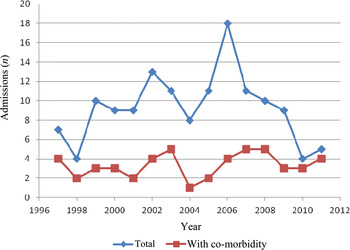
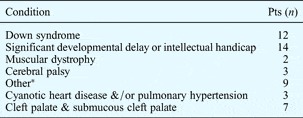
Forty-one per cent of the children (n = 50) had a recognised co-morbidity. The major co-morbidity for each child is listed in Table I. Figure 1 shows that the number of elective post-operative PICU admissions declined over the 15-year study period, but that the proportion of admitted cases with co-morbidity rose.
Elective post-operative paediatric intensive care unit admissions over the 15-year study period, showing total admissions and admissions with co-morbidity.

Major co-morbidities

*Two patients with Batten complex, two with velo-cardio-facial syndrome, and one each with hemifacial microsmia, Kabuki syndrome, Hurler syndrome, Prader–Willi syndrome and achondroplasia. Pts = patients
Pre-operative sleep studies comprised seven screening mattress or impedance studies, early in the series, and 113 PSGs. Two children did not have a sleep study pre-operatively. The respiratory disturbance index was assessed during rapid eye movement (REM) sleep in the 113 children undergoing PSG; results ranged from 6 to 159 events per hour (mean, 83 events per hour). The recorded oxygen saturation nadir ranged from 40 to 86 per cent.
We conducted an interim analysis of our results from 1997 to 2002. Based on this, we determined that, in order to identify all the children who had required more intervention than was appropriate on a paediatric surgical ward (e.g. re-positioning and supplementary oxygen), we would need to set the following criteria for elective admission to PICU following adeno-tonsillectomy for severe OSA: an isolated respiratory disturbance index in REM of 40 or more, or a respiratory disturbance index in REM of 20 or more plus an oxygen saturation nadir of 70 per cent or less.
After further analysis of our 2003–2006 data, we made two changes to our PICU admission criteria.
The first was to introduce a PICU short-stay admission as an option (the child always being operated upon early on a morning list), with review before discharge to the paediatric surgical ward. The decision to discharge a child to the ward was made after discussion between the surgeon and the intensivist, together with the paediatric anaesthetist when appropriate.
The second change was to alter the REM-based criteria for PICU admission to an isolated respiratory disturbance index in REM of 60 or more, or a respiratory disturbance index in REM of 40 or more together with a syndrome liable to be complicated by airway obstruction, small stature and/or young age. Subject to on-going audit, we planned to raise the first criterion threshold to an isolated respiratory disturbance index in REM of 80.
In the total series of 122 children electively admitted to PICU following adenotonsillectomy for severe OSA, 9 children required more intervention than just re-positioning and/or supplementary oxygen. However, five of these nine children were electively transferred to PICU with a nasopharyngeal tube in situ early in the series. After that early period, no child was assessed as requiring elective post-operative nasopharyngeal intubation. The remaining 4 children all required endotracheal intubation post-operatively, as follows: (1) an 11-month-old with multiple cerebral abnormalities associated with mixed sleep disordered breathing, with a respiratory disturbance index over 60, who required 4 days of intubation; (2) an 11-year-old graded ‘severe’ on mattress study, with an uncharacterised syndrome, tracheobronchomalacia and developmental delay, who required overnight intubation for supraglottic oedema of indeterminate cause;Reference Walker, Whitehead and Rowley1 (3) an 8-month-old with a respiratory disturbance index of 159 who required overnight intubation;Reference Walker, Whitehead and Rowley2 and (4) a morbidly obese 4-year-old with a respiratory disturbance index of 83.3 in REM, who required intubation for a respiratory syncytial virus positive respiratory tract infection and who spent 8 days in PICU.
One child aged 3 years, with a respiratory disturbance index of 58.8 in REM, was an unplanned readmission to PICU, following earlier discharge from PICU as a ‘short-stay and review’ case, because of oxygen desaturations and persistent upper airway obstruction several hours after return to the ward.
Over the same time period, five children were unexpectedly transferred to PICU following adenotonsillectomy for sleep-disordered breathing. Three were transferred from the recovery ward: (1) a 2-year-old, not studied pre-operatively, who was admitted to PICU overnight for observation because of excessive airway secretions; (2) a 3-year-old with a pre-operative respiratory disturbance index of 11 in REM who developed grossly excessive airway secretions requiring PICU admission for 3 days, treated with glycopyrrolate but not intubation; and (3) a child with a pre-operative respiratory disturbance index of 9.3 in REM, who spent 3 post-operative days in PICU, and whose post-operative PSG showing a respiratory disturbance index of 26 in REM. The remaining 2 children were transferred from the paediatric surgical ward: (1) a child with a respiratory disturbance index of 53 in REM and marked post-operative uvula swelling; and (2) a 5-year-old, Indigenous child, not studied pre-operatively, who desaturated with airway obstruction and was admitted to PICU for overnight observation.
Discussion
The development of OSA involves more than simple enlargement of the nasopharyngeal adenoids and the oropharyngeal tonsils. There is a complex inter-relationship among pharyngeal hypotonia, tongue size and position, mid-facial dimensions, faucial dimensions and shape, lower airway obstruction, obesity, and genetic predisposition. The long-term consequences of OSA, in terms of cognitive disorders and cardiovascular sequelae, have been increasingly recognised in children.Reference Walker, Whitehead and Gulliver5 A recent Australian position paper has advocated a significant increase in the use of adenotonsillectomy for sleep-disordered breathing in children.6 Our sleep unit measures the following parameters: sleep efficiency, sleep architecture, arousal index, total respiratory disturbance index, respiratory disturbance index in REM, oxygen saturation nadir and transcutaneous carbon dioxide zenith.Reference Walker, Whitehead and Gulliver5 Of these, we favour respiratory disturbance index in REM as the most reproducible and reliable guide to the severity of OSA, since it is during REM sleep that apnoea and desaturations are more common, more severe and more likely following sleep deprivation.Reference Walker, Whitehead and Rowley1
More severely affected children, especially those with co-morbidity, will require post-tonsillectomy care in the paediatric intensive care unit (PICU). This is despite the fact that specialist paediatric otolaryngologists favour precise surgical approaches which not only reduce operative time but also minimise intra-operative blood loss, palatal oedema and (perhaps) post-operative pooling of secretions, enabling a smoother post-operative recovery. The literature reports ‘severe’ or ‘significant’ post-operative respiratory compromise in 23 per centReference McColley, April, Carroll, Naclerio and Loughlin7 to 27 per centReference Rosen, Muckle, Mahowald, Goding and Ullevig8 of children admitted to PICU. It is suggested that factors including severity of obstructive events, young age, low weight, and syndromes liable to be associated with airway obstruction, may be cumulatively detrimental in the post-operative setting. More recently, in a series of 83 children, 4.8 per cent needed ‘major’ post-operative intervention (i.e. a PICU admission) while 19.3 per cent needed ‘minor’ intervention (i.e. admission to a paediatric surgical ward).Reference Hill, Litvak, Canapari, Cummings, Collins and Keamy9 This study identified the following risk factors: age less than 2 years; a respiratory disturbance index of more than 24; intra-operative laryngospasm requiring treatment; a post-operative oxygen saturation of less than 90 per cent in room air; and a paediatric acute care unit stay of more than 100 minutes.
Minimising elective PICU admissions has several advantages. The first is that there is less chance, given limited access to PICU beds, that a child will be admitted but then their surgery cancelled because no PICU bed is available. The second is the cost saving – a paediatric intensive care bed is considerably more expensive than a paediatric surgical bed. In addition, setting appropriate criteria for elective PICU admission for children undergoing adenotonsillectomy is imperative in order to minimise adverse post-operative events.
Paediatric surgical ward staff are well-experienced in recognising the signs of obstructive or central sleep apnoea persisting or developing post-operatively. Intermittent or continuous pulse oximetry monitoring is an essential part of post-operative care. Re-positioning and supplementary oxygen clearly do not require a PICU environment.
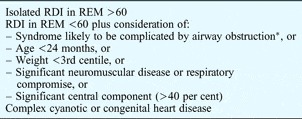
On review of the figures reported in this series, and excluding the five children who, early in the series, were managed post-operatively with a nasopharyngeal tube in situ, we identified the list of admission criteria shown in Table II. These criteria would have identified those children who needed PICU admission because they required intervention other than re-positioning and supplementary oxygen.
Criteria for elective PICU admission after adenotonsillectomy for severe OSA

*For example, cranio-facial anomalies, mucopolysaccharidoses, achondroplasia, Pierre–Robin sequence, Down syndrome. PICU = paediatric intensive care unit; OSA = obstructive sleep apnoea; RDI = respiratory disturbance index; REM = rapid eye movement sleep
More problematic, however, is the recognition of children who require unplanned admission to PICU. In our series, these children were mostly recognised in the recovery suite immediately post-operatively, and were not as much of a potential safety issue as those children recognised on the ward, remote from the operating theatre. However, such cases raise the issue of obtaining a PICU bed as an emergency, rather than as a planned elective admission. In our series, we identified 5 unplanned transfers into PICU, against a background of 122 elective PICU admissions; this incidence may be reassuring, equating as it does to 1.5 per cent of the 329 adenotonsillectomies undertaken by the surgeon at John Hunter Children's Hospital for sleep-disordered breathing over the study period. Clinical experience and vigilance are required to identify those children who have an unexpected need for PICU admission post-operatively, and in this setting PICU bed planning is more difficult.
• This study re-audited elective paediatric intensive care unit (PICU) admissions after adenotonsillectomy for severe obstructive sleep apnoea (OSA)
• Admission criteria were reappraised based on 122 elective admissions over 15 years
• New criteria are presented, based on respiratory disturbance index in rapid eye movement sleep, co-morbidity, age and weight
• Fewer elective PICU admissions enables significant clinical, clerical and financial benefits
Based upon this study, our current criteria for elective admission to PICU following adenotonsillectomy at John Hunter Children's Hospital are as shown in Table II.
Conclusion
Previously, our unit has published criteria for elective admission to the paediatric intensive care unit (PICU) following adenotonsillectomy for severe OSA. In the current study, we reappraised our criteria based upon on-going critical audit of our results (especially for unplanned readmission) from 122 elective admissions over a 15-year period (1997–2011).
There are significant incentives (both in terms of finance and admission planning) to avoid elective PICU admission following adenotonsillectomy for severe OSA when not required. Conversely, unplanned admission to PICU has significant implications for the safe post-operative management of children with severe OSA, and also makes PICU bed-planning very difficult.
In this clinical setting, the existence of criteria for elective admission to PICU is important for paediatric surgeons, anaesthetists and intensivists. Based on the current study, our criteria are: an isolated respiratory disturbance index in REM of greater than 60; a respiratory disturbance index in REM of less than 60 in the presence of a coexisting syndrome likely to be complicated by airway obstruction, age less than 24 months, weight less than the third centile, significant neuromuscular disease or respiratory compromise, or a significant central component (more than 40 per cent); or complex cyanotic or congenital heart disease.
Acknowledgements
We gratefully acknowledge the contributions of our colleagues in the paediatric sleep unit and the paediatric intensive care unit at the John Hunter Children's Hospital.