The criminal justice system of eighteenth- and nineteenth-century England has been likened to a corridor of connected rooms or stage sets.Footnote 1 At each stage in the judicial process—from detection and apprehension through to trial, sentencing, and punishment—decisions were made that might remove the accused from the system entirely, or propel that person further along the process into a number of possible outcomes. That decision making (including the identity of the decision makers and the criteria upon which their decisions were based) has been the subject of much historical study.Footnote 2 Less attention has been given to the individual experiences—the singular journeys—of the accused through this labyrinthine process. This is in large part because of the inherent evidential and methodological difficulties of reconstructing judicial pathways and the wider criminal lives of offenders. As Tim Hitchcock and Robert Shoemaker note, the archives of criminal justice were created to manage the bureaucracy of prosecution and punishment, not to reveal the criminal's navigation of that system.Footnote 3 Tracing an individual offender's journey through the judicial process (and that person's life beyond) therefore entails piecing together fragments spread almost randomly across hundreds of thousands of pages.
To do this manually is a time-consuming task, but one that can reveal much about the criminal lives of offenders, as a number of recent studies have shown.Footnote 4 This heroic work has necessarily been limited to relatively small sample sizes. The challenge, then, is to reconstruct the criminal histories of tens (even hundreds) of thousands of offenders. Because of the digital era, this is now possible. Digital technologies allow us as researchers to apply our long-standing questions about the experience of justice at the individual level, to “big data”; that is, collections of records and information so large and complex that traditional forms of processing and analysis are inadequate. Digital technologies allow the preservation of a considerable level of qualitative detail from sources on a scale that allows for comprehensive quantitative analysis. And a range of tools, from electronic databases and optical character recognition, to automated name-linking algorithms, network analysis, and data visualisation techniques enable researchers to dismember the archives and reconstruct them with convict lives in mind. One of the greatest opportunities offered by the digital is this ability to reconstitute the archive and thus track convicts as they moved through the judicial system and beyond. Prior to this it was extremely difficult to trace offenders past the point of sentencing. It is possible now, to trace the criminal and wider life histories of the approximately 90,000 offenders sentenced at the Old Bailey to transportation to Australia or imprisonment within Britain between 1780 and 1925. This is precisely the aim of the Digital Panopticon, a collaborative research project funded by the United Kingdom Arts and Humanities Research Council as part of its “Digital Transformations” program.Footnote 5 To this end, an essential element of the project will be the creation of a freely accessible, searchable web site (www.digitalpanopticon.org, to be made publically available in 2017) that automatically identifies all of the documents relating to single individuals across more than forty different sets of judicial and civil records, and combines these together to form a “life archive” for that person.Footnote 6
This article presents some of the initial findings from our early forays into reconstructing convict journeys using the Digital Panopticon’s searchable website, particularly in terms of quantitatively and qualitatively mapping out the penal outcomes experienced by Old Bailey convicts following sentencing. These findings are based on the digital record linkage that has so far been conducted between the Old Bailey Proceedings, the published accounts of trials held at London's principal criminal court—the project's core dataset—and five other datasets of digitized criminal justice records currently on the website, which span the judicial process, from pretrial to post-sentencing.Footnote 7 First, the early Home Office “criminal registers” (covering the years 1790–1799), lists kept of those committed to Newgate for trial, which frequently provide a note of post-sentencing decisions as well as personal details of the accused.Footnote 8 Second, the British Convict Transportation Registers, a dataset that contains details for approximately 123,000 convicts transported to Australia between 1787 and 1868.Footnote 9 Third, a dataset of “convict indents,” documents first compiled as convicts were loaded onto the ships for transportation, and repeatedly augmented up to the point of disembarkation.Footnote 10 Fourth, the late-eighteenth-century London coroners' inquests, which can be used to identify Old Bailey convicts who subsequently died in Newgate.Footnote 11 And, finally, a dataset of Home Office pardoning records which provide details of post-sentencing decisions.Footnote 12 Because of this digitized record linkage it is possible to trace convict journeys at a level of detail and on a scale previously unimaginable. The website has produced, at present, more than 35,000 fragments of “life archives,” meaning two or more records relating to a single individual linked together in a chain, which by the completion of the project will form the basis of much longer chains of records pertaining to individual lives, from birth to death. In many instances, it is possible to trace the accused from their committal to Newgate and then on to their trial at the Old Bailey, that person's sentence, and a number of immediate post-sentencing outcomes.
Such penal journeys will now be addressed. Our focus is limited to the years 1790–99, for which the Digital Panopticon currently has the fullest data, and to the penal outcomes experienced by two groups of Old Bailey convicts in particular: 1) those sentenced to death and 2) those sentenced to transportation. The paths from sentence to final penal outcome in such cases were rarely straightforward. In mapping out the judicial outcomes for the Old Bailey condemned and those sentenced to transportation in the 1790s, we here intend to shed light on those pathways that have been less well explored in the historiography, and to deepen understanding of the key factors that shaped post-sentencing decision making. By using digital technologies to reconstruct the nineteenth-century paper panopticon that tracked the movements of offenders through the criminal justice system and beyond, it is possible, for the first time, to trace the penal outcomes and wider lives of Old Bailey convicts, both at the individual and collective level. It is possible to recover experiences and stories that would otherwise be lost, all with qualitative depth allied to quantitative breadth. In this sense, the digital makes it possible to conduct a new form of research (or, at the very least, a form unachievable on the same scale manually). Digital scholarship can thus be a “macroscope,” making it possible to recover and analyze—at one and the same time—the rich details of a single convict's life and the quantitative bulk of tens of thousands of lives taken together; a theme we will return to in the Conclusion.
Quantifying the Condemned
It has long been recognized that hanging was by no means an inevitable outcome for those sentenced to death by the courts in the eighteenth and nineteenth centuries. Through the pardoning process, many offenders escaped the noose, and there were a number of different routes that capital convicts followed after sentencing. The particular pathways followed by convicts were shaped in large part (and in the first instance) by the decisions of the judges and the ruling authorities within the pardoning process. Much has been written about those who were left for execution and about the rate at which capital convicts were actually put to death.Footnote 13 The criteria for deciding whether or not to leave an offender to hang have also been well studied. Although elite support and claims to respectability could in some instances be crucial, several historians have instead suggested that in the majority of cases, the issues of greatest importance to the king's ministers who controlled the pardoning system were, as John Beattie concludes, “the nature of the offence—particularly the level of violence that had been involved—the age, gender, and criminal record of the defendant, and the evidence given at the trial by the witnesses, both for the prosecution and defence.”Footnote 14 Far less has been said, however, about those who escaped the noose. There has been little study, in particular, of the range of penal outcomes that those pardoned from death experienced, the rate at which convicts suffered such outcomes, and the extent to which the conditions attached to pardons might also have been influenced by the kinds of factors identified by Beattie (and others) as crucial in the initial decision between life and death. The first half of this article, therefore, has two aims. First, through a quantitative study of the immediate penal outcomes experienced by the approximately 700 offenders sentenced to death at the Old Bailey in the 1790s, supplemented by a number of qualitative examples, it seeks to provide an initial map of the largely unexplored terrain of the penal journeys of capital convicts. And second, by correlating those various outcomes against the crime, gender, age, and previous criminal conduct of offenders, it will explore the wider role of such factors in determining the specific condition(s) upon which pardons were granted.
The Hanging Cabinet
It is first necessary to briefly describe how the mechanism of pardoning worked in the metropolis, as this was the key process by which the penal outcomes of the condemned were determined. The system of pardoning in London was, in several important respects, very different from that in the rest of England and Wales.Footnote 15 In London, pardoning rested in the hands of what came to be known as the “hanging cabinet,” whereby the recorder of London, the chief sentencing officer of the Old Bailey, was charged with reporting to a meeting of the King in Council all those who had been sentenced to death at one or more previous sessions of the court.Footnote 16 Three aspects of the hanging cabinet's work in the 1790s are especially relevant for our purposes. In the first instance, the delays that had plagued the meetings of the hanging cabinet in the 1780s had largely abated by 1790.Footnote 17 As George III returned to health and as the numbers of capital convictions declined in the early 1790s, so the hanging cabinet fell back into its regular, timely schedule. Second, the sources of information on which the hanging cabinet could make its decisions were also increasing in the 1790s. For reports of the trials, recorders drew first and foremost on the accounts printed as the Old Bailey Proceedings, copies of which were also made available to the Lord Chancellor and the Home Secretary in advance of meetings of the hanging cabinet.Footnote 18 Petitions and testimony from the keeper and chaplain of Newgate were evidently also available,Footnote 19 but with the creation of the “criminal registers” by the City of London in September 1791 (later taken over by the Home Office in 1793), the recorder had access to a further source of information on the personal details and character of capital convicts.Footnote 20 Third and finally, it should be noted that whereas overarching decisions about whether to leave an offender for execution appear to have been reached with some haste by the hanging cabinet, the finer details of what condition(s) the reprieved were required to serve—decided by the recorder and the Home Secretary—often took weeks or months to finalize, and it was not unusual in the 1790s for such conditions to be altered two or three times for individual convicts. Such decisions set in motion the penal outcomes that capital convicts would ultimately suffer. It is those outcomes, and the criteria that possibly shaped such decision making, that we will now discuss.
Penal Outcomes for the Condemned
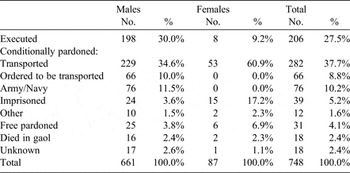
A total of 748 offenders were capitally convicted and sentenced to death at the Old Bailey in the years 1790–99. The Proceedings only go this far, giving little indication of what happened to such convicts after sentencing. By digitally linking the trial records for these 748 offenders to the five other datasets described in the introductory section, we are now able to trace the immediate post-sentencing outcomes of the condemned (Table 1). Approximately one quarter were left for execution. The majority were pardoned on the condition of transportation (most of whom were subsequently transported, but others not). Others were pardoned on the condition of service in the army or navy, or on a multitude of other possible conditions, such as imprisonment or sureties for good behavior. Some were granted a free pardon, conferring absolution from the offense without any form of condition. However, others died in jail while awaiting their execution or fulfilment of their conditional pardon. Four were pardoned and sent to the Marine Society, two were pardoned and sent to the Philanthropic Society, one was pardoned on condition of a fine, and one, also conditionally pardoned, was at large following an escape from the hulks. In short, the outcomes for the most part fall within one of two categories, but with a “long tail” of several other journeys followed by the condemned.
Post-sentencing Outcomes of Old Bailey Convicts Sentenced to Death, 1790–99.

Until a similar map is compiled for other periods, it is difficult to say how typical the 1790s were. What can be said is that execution was much less common in the 1790s than it had been earlier. The 206 capital convicts denied mercy by the hanging cabinet and put to death in the 1790s represent a far more select group than in any other decade of the eighteenth century.Footnote 21 As Simon Devereaux has recently shown, the 1790s represent a dramatic retreat both in the percentage of capital convicts left for death and the absolute numbers of offenders executed as a result, from the appallingly high levels witnessed in the early to mid-1780s.Footnote 22 Execution levels in London declined markedly with the beginnings of convict transportation to Australia in 1787. And although the percentage and number of capital convicts hanged did undergo a slight resurgence following the outbreak of the French Revolution, the 41% of condemned offenders actually hanged in 1791 pales in comparison with the 60% executed in 1787, and even this peak in the 1790s was below the lowest figures typically registered each year since at least 1760.Footnote 23 When only 15% of the convicts sentenced to death at the Old Bailey in 1793 were subsequently executed (in absolute terms, nine offenders who lost their lives on the gallows) this was perhaps the smallest annual proportion ever witnessed in the eighteenth century.
Upon what basis, then, were this unfortunate small minority of capital convicts selected for execution in the 1790s, a period when the government was clearly wary about putting large numbers of offenders to death? The nature of the offense and the age and gender of the offender appear to have been crucial. In the first instance, correlating offenses against the likelihood of execution suggests that there were, broadly speaking, three categories of crimes when it came to pardoning decisions in the 1790s. First, there were a handful of offenses that were largely deemed “unpardonable,” and for which the perpetrators (whatever their character) rarely escaped the noose. The overwhelming majority (more than 80% at the least) of those sentenced to death for riot, murder, mail theft, rape, and fraud in the 1790s were, for example, subsequently denied the king's mercy and lost their lives on the gallows.Footnote 24 Second, a small selection of capital crimes were not deemed serious enough to warrant execution under any circumstances. Therefore, none of the thirteen offenders sentenced to death for pickpocketing or grand larceny were executed. And third, a large number of offenses (ranging from highway robbery and burglary to animal theft and returning from transportation) fell somewhere in between these two extremes and resulted in a wide range of penal outcomes depending upon the particular circumstances of the crime and the identity of the offender.
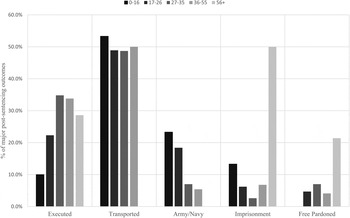
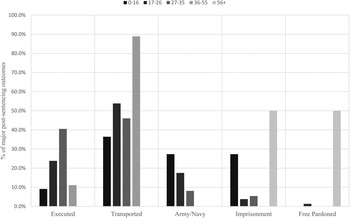
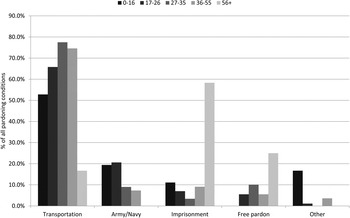
There appears to have been an extreme reluctance to put women to death for this “middling” range of offenses, aside from a very few select examples. Taking those sentenced to death at the Old Bailey in the 1790s as a whole, males were three times as likely to be executed (Table 1). Nor does this pattern purely reflect the fact that women were typically put on trial for less serious offenses.Footnote 25 If we look at the individual offenses of burglary, robbery, housebreaking, and theft from a dwelling house, in every instance the males convicted of such crimes were up to four times more likely to be executed than their female counterparts.Footnote 26 Youth, too, seems to have been influential.Footnote 27 Young offenders under the age of 17 and sentenced to death at the Old Bailey were less likely to be hanged than those 17–26 years of age, who were in turn slightly less likely to be executed than those 27 years of age or older (Figure 1). Of course, the relationship between age and pardoning policy was complicated by the nature of the offenses typically committed by each age group and by the gender of the accused.Footnote 28 We will try to isolate the influence of age from these other factors by limiting the focus to males sentenced to death for burglary or housebreaking only (Figure 2). A similar pattern is evident: male housebreakers and burglars under the age of 17 were much less likely to be executed than the young adults convicted of such crimes, although none of those older than 55 years of age were executed.
Major post-sentencing outcomes of Old Bailey convicts sentenced to death, by age group, 1790–99.

As Peter King notes, the more favorable treatment given to the young may have been linked to the fact that they had not yet had time to gather a reputation as hardened offenders, and the issue of previous offending is one that other historians have pointed to as a crucial factor in eighteenth-century pardoning policy.Footnote 29 From the marginal notes on surviving recorders' reports, John Beattie concludes that “a condemned man's or woman's best chance of being saved from the gallows was to persuade the Recorder and the [hanging cabinet] that they were not dealing with a dangerous old offender.”Footnote 30 By looking at the pardoning decisions that were made about the Old Bailey condemned in the 1790s, and linking this to the evidence of previous criminal behavior that can be gleaned about the offenders from comments made in the criminal registers and from computer-generated name-matching of the digitized accounts of trials, we can begin to explore this issue from a different angle to that offered by the surviving recorders' reports. This is certainly not without its problems: the compiler of the criminal register might not always have recorded what was known about the accused's previous offending, there are difficulties with automated name-matching of the trial accounts (including the fact that offenders might, and sometimes were, previously tried at the Old Bailey under a different name), and information might have been presented during the recorder's report that is now lost. In short, the data presented here do not equate to a comprehensive picture of the criminal records of those who were condemned to death at the Old Bailey in the 1790s. However, in drawing upon the available evidence and utilizing the methodologies opened up by digital technologies, it does provide some at least suggestive findings.
Of the 748 offenders sentenced to death at the Old Bailey in the 1790s, at least forty-seven had previously been put on trial at the court for a different crime, and eight of those forty-seven individuals had previously stood trial on more than one occasion.Footnote 31 Some had been acquitted by the jury, but many had been found guilty: ten trials had resulted in sentences of death (only for the offenders to be subsequently pardoned on condition of transportation or service in the army or navy), whereas others produced sentences spanning the penal range, from transportation and imprisonment, to whipping and service in the armed forces. Clearly in this instance the sample size is too small to undertake any kind of quantitative analysis. However, a qualitative examination of the pardoning decisions made in relation to these forty-seven offenders suggests that whereas in some cases previous criminal behavior contributed to the offenders losing their lives, nevertheless the mere fact of having previously stood trial at the Old Bailey was not an automatic barrier to receiving the royal mercy.
Some of those executed in the 1790s certainly had long criminal histories, including multiple previous appearances at the Old Bailey. When Daniel Mackaway's case came before the hanging cabinet following his death sentence at the Old Bailey in September 1799 for burglary, his criminal record left a lot to be desired, and this was likely foremost among the reasons for his subsequent execution.Footnote 32 The hanging cabinet were certainly already aware of Mackaway, having previously granted him a pardon for a highway robbery committed two years earlier, on the condition of serving in the army.Footnote 33 As far back as 1794, when Mackaway was only 22 years of age, the compiler of the criminal register had described him as “a very notorious offender,” followed three years later by the similarly dismaying note, “an old offender.”Footnote 34 By contrast, John Purdy's lengthy criminal record did not ultimately lead to execution. When capitally convicted at the Old Bailey in July 1797 for a burglary, this was, as a note in the criminal register stated, the fourth time Purdy had appeared before the court within a year.Footnote 35 He was, nonetheless, granted the king's mercy on condition of being transported for life. Having been transferred onto the hulks at Langstone Harbour, Purdy however found means to escape, and from thence travelled up to Nottingham, where he committed at least four burglaries.Footnote 36 He was soon apprehended, brought back to London and tried, convicted and sentenced to death for “returning from transportation.” Despite Purdy's now expansive criminal record, the hanging cabinet again saw scope for mercy, perhaps in light of his defense that conditions on board the ship were such that “there was not victuals enough for any man to live upon by any possibility.”Footnote 37 He was pardoned on condition of transportation for life, setting sail for New South Wales in 1800.Footnote 38
Previous appearances at the Old Bailey did not mean, therefore, that an offender later sentenced to death for a different crime would necessarily suffer the law's ultimate penalty. A further indication that being a known “old offender” was not an automatic ticket to the gallows is suggested by the pardoning decisions that were made in relation to individuals who were described in just such a way in the Home Office criminal registers, an issue that can be studied because of the computerized linking of those documents and the pardoning records. At least 15 of the 748 offenders sentenced to death at the Old Bailey in the 1790s were described in the registers as “an old offender,” “a person of very bad character,” or some analogous term. Nonetheless, this knowledge did not prevent the decision makers within the pardoning system from sparing the lives of the vast majority of the offenders so described, mostly on the condition of transportation. In the case of Thomas Atwell, sentenced to death in 1796 for returning from transportation, the compiler of the criminal register complained that “to enumerate the offences committed by Attwell [sic] would fill this page of paper, he has been a thief from his infancy and notwithstanding the king's mercy which has been extended to him in three instances within my knowledge he now stands charged for a burglary in Surrey.” Perhaps in light of Atwell's fitness for service (a laborer and just 23 years of age) at a time when recruits were desperately needed, the decision was nevertheless made to pardon him on condition of serving in the 77th Regiment of Foot.Footnote 39
Such were the factors that meant that a (relatively) small minority of the Old Bailey condemned were actually hanged in the 1790s. What of the penal journeys of the majority (approximately three quarters of the condemned) who escaped the noose? What condition(s), if any, were they required to serve for the king's mercy, and to what extent was this also shaped by the character of the offender and/or the nature of the crime? A comment made in 1795 by the Recorder of London, Sir John William Rose, gives some sense of this, at least in relation to the three conditions of transportation, service in the army, or entering into the navy. Reporting on the cases of twenty-eight offenders convicted at the Old Bailey, Rose noted: “I think the justice of the country will not suffer if some few of the prisoners named in the list referred [to as] guilty of light offences and not the old offenders are permitted to go to sea [in the naval service].” “I have recommended some of the old offenders to the indulgence of being sent to the West Indies [in the armed forces],” Rose continued, whereas “the crimes of others are so infamous to society that as to them I cannot recommend… any further extension of mercy [beyond transportation to Australia for life].”Footnote 40 From what can be learned about the crimes, identities, and penal outcomes of the condemned through computerized record linkage, this strategy appears to have been put into practice, in addition to other factors not discussed by Rose.
Although transportation to Australia was the penal outcome suffered by the majority of the Old Bailey condemned in the 1790s, particularly females, it was by no means a blanket alternative to death in capital cases (Table 1). It certainly seems to have been the automatic condition for healthy offenders under the age of 55 whose crimes were relatively serious and who did not have good characters on their side. Among those whose crimes were considered by Rose in 1795 to be “so infamous” as to require their transportation to Australia were Austin and John Flowers, two brothers convicted of a highway robbery, but one in which they apparently treated their victims, “as civilly as many could do,” a fact that almost certainly saved them from the gallows.Footnote 41 For others, it was not just the seriousness of the crime for which they had been convicted, but also their age; specifically, whether they were so old as to preclude them from transportation. No offenders over the age of 55 were sent to Australia for any capital offense in the 1790s, and instead they were required to serve a term of imprisonment or, in many cases, granted a free pardon (Figure 1).Footnote 42 And even in cases where the offense was relatively minor, a perceived bad character in some instances led to the offender being transported. The evidence presented against William Marson, an 18-year-old weaver from Coventry, at his trial for shoplifting in April 1798 was clear, but on account of his “youth” and no doubt too the testimony of a favorable character witness, the jury found him guilty with a recommendation to mercy.Footnote 43 The Recorder of London, Sir John William Rose, similarly saw grounds for clemency in Marson's youth, and although Rose apparently considered that a pardon on condition of imprisonment or a return to the offender's parish might be enough, he ultimately decided against this, being persuaded that, “having made bad connections in town,” Marson would therefore “unlikely remain with his friends in the country.” Instead the recorder recommended that Marson be pardoned from death on condition of transportation to Australia for seven years.Footnote 44 Marson was accordingly delivered onto the hulks in January 1799, and set sail for Australia shortly thereafter.Footnote 45
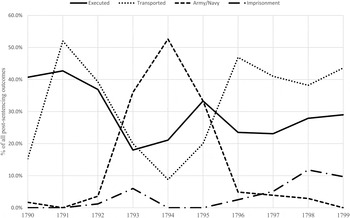
Transportation was certainly not a blanket alternative to death in the mid-1790s when the outbreak of the Haitian Revolution and war with France triggered a mobilization drive by the government. Many of the men (and it was always men) sentenced to death at mid-decade who might otherwise have been transported (or even executed) were instead pardoned on the condition of serving in the army or navy.Footnote 46 Indeed, whereas only a handful of capital convicts were pardoned on condition of entering into the army or navy at the opening and close of the decade, in the years 1793–95 approximately 54% of male capital convicts were pardoned on this condition (Figure 3). In 1794, at the height of the government's mobilization drive, approximately thirty convicts, or two thirds of the males pardoned from death, were entered into the army or the navy. By contrast, only six male capital convicts were pardoned on condition of transportation in the same year. In the mid-1790s, then, recruitment of the armed forces appears to have been the major driving force in pardoning decisions.Footnote 47
In this context, it was teenage and young adult males who were most commonly pardoned on condition of serving in the army or navy. Nearly one quarter of condemned males under the age of 27 were pardoned on condition of serving in the army or navy in the 1790s, whereas mercy on such terms was granted to fewer than one in ten over that age. This policy helps to explain why execution rates in the 1790s were so much lower for teenage and young adult offenders than for convicts in their 30s and 40s (Figures 1 and 2). It also helps to explain why, once pardoned, proportionally more offenders between the ages of 27 and 55 were granted mercy on the condition of transportation than younger convicts (Figure 4). If there was a demand for young males in the Australian penal colonies, then, this did not have a substantial impact on pardoning policies in the 1790s at least, when the imperatives of war appear to have played a much greater role.Footnote 48
Major post-sentencing outcomes of male Old Bailey convicts sentenced to death for burglary or housebreaking, by age group, 1790–99.

Major post-sentencing outcomes of male Old Bailey convicts sentenced to death, by year, 1790–99.

Conditions of pardons for all Old Bailey convicts sentenced to death, by age group, 1790–99.

A 28-year-old Londoner named William Pope was one of those recommended by Rose to be pardoned on condition of serving as a soldier in the West Indies after he was convicted of burglary and sentenced to death at the Old Bailey in April 1795.Footnote 49 An entry in the criminal register noted that a magistrate in Lambeth considered Pope to be “a very old offender” and “a very dangerous man to society,” under suspicion of “having committed diverse footpad robberies in the county of Surrey.” Faced with prosecution for one such robbery, Pope had entered service on a ship, but was subsequently “discharged as he said from a pretended hurt he had in his head which disabled him from doing duty as a seaman.” The keeper of the criminal register, Edward Raven, went on to complain that when under confinement, thieves such as Pope “will represent anything and propose anything for liberty,” particularly their being stout, able seamen, “and when the King has indulged them with what they solicit [i.e. a pardon on condition of serving in the army], they then have an excuse if they desert that they are either ruptured or diseased and unable to serve.”Footnote 50 That an offender of such bad character as Pope was, for a second time, granted mercy on condition of service in the army, rather than transportation to Australia, illustrates the government's primary concern with mobilization in the mid-1790s. Pope's reappearance at the Old Bailey in May 1797 on a charge of unlawfully breaking the condition of his pardon would at first glance seem to confirm Raven's worst suspicions. However, notwithstanding his previous duplicity, in this instance an officer testified at the trial to Pope's good conduct abroad, such that he had been “the means of saving one of his Majesty's ships, and the whole convoy,” and confirmed Pope's defense that he had been brought back to England by force, not of his own volition. Pope was acquitted as a result.Footnote 51
Because pardon on condition of serving in the army or navy was not an option for reprieved females, decision makers within the pardoning system instead turned to imprisonment as a suitable alternative when transportation to Australia was not deemed appropriate.Footnote 52 In a fifth of such instances the explanation can likely be found in the age of the offender: three of the fiteen women granted a pardon from death on condition of imprisonment in the 1790s were over the age of 45 and therefore (as discussed in the following section) not deemed suitable for transportation.Footnote 53 This included Ann Sanmert, a 57-year-old widow born in Hanover, capitally convicted at the Old Bailey in 1797 of stealing from a dwelling house, an offense for which several women under the age of 45, by contrast, had been transported as a condition of their pardon in the 1790s.Footnote 54 In other instances it was less an issue of age than of misgivings about the justice of the conviction or a sense that transportation was too severe a punishment for the crime. Margaret Kennedy, a 24-year-old single woman from London capitally convicted for pickpocketing, was pardoned from death on condition of 12 months' hard labor in the house of correction and a 1 s fine, as “the judges considered she should have been acquitted of the capital part of the charge at the time of the trial.”Footnote 55 Indeed, females condemned for the relatively less serious crimes of pickpocketing and shoplifting were in general far more likely to be pardoned on condition of imprisonment (as opposed to transportation) than were members of the same sex condemned for burglary or robbery.Footnote 56
Imprisonment was likewise imposed as a condition for the reprieved elderly, sick, or infirm males who were deemed unsuitable for either service in the armed forces or transportation to Australia. Whereas those over 55 years of age who had been convicted on clear evidence for “unpardonable” crimes such as forgery did not receive mercy, those convicted of lesser offenses and subsequently pardoned from death were treated with relative leniency compared with middle-aged offenders (Figures 1 and 4). Of the twenty-three male felons pardoned from death on condition of imprisonment, seven were over the transportation age “limit” of 55. This was the fate of Valentine Harrison, a tallow chandler from Yorkshire aged 60 at the time of his sentence to death for robbery in 1793.Footnote 57 After serving out twelve months in the house of correction as a condition of his pardon, in September 1800 Harrison was back before the courts, this time the Middlesex sessions of the peace, for an alleged fraud.Footnote 58 In the case of John Milton, his initial dodge of New South Wales was to be only temporary; two years after being pardoned from death on condition of six months in the house of correction (rather than transportation), Milton was back at the Old Bailey on a charge of grand larceny, for which he was this time sentenced to seven years' transportation, subsequently setting sail for Botany Bay in January 1802.Footnote 59
For some this was not their first stint in prison, nor was it necessarily to be their last. For George Clayton, a 56-year-old shoemaker born in Manchester and sentenced to death in 1793 for grand larceny but subsequently pardoned on condition of six months' imprisonment in Newgate, this was to be followed by at least eight other appearances at the Old Bailey and several periods of imprisonment in between.Footnote 60 Just eighteen months after receiving the king's mercy and serving out his time in Newgate, Clayton was back at the Old Bailey charged with stealing calico, for which he was sentenced to two years in the house of correction and a 1 s fine. Now described by the keeper of the criminal registers as “an old offender” who “has been in custody several times,” Clayton was, by his own defense, desperately poor and unwell, driven to commit one offense as he “had nothing to put into [his] mouth.” Over the next five years, Clayton was convicted of seven separate grand larcenies, resulting in seven more periods of imprisonment, to each of which was added a public whipping.Footnote 61
For a significant number, eighteen, of the offenders sentenced to death at the Old Bailey in the 1790s, their lives came to an end within the walls of Newgate, rather than on the gallows just outside. The largest annual total of such deaths occurred in 1790, when nine of those sentenced to death died in Newgate. This was the tail end of appallingly high levels of convict deaths in London's prisons during the later 1780s, as delays in meetings of the hanging cabinet led to scores of condemned offenders being held in Newgate to await their fate, along with countless more offenders sentenced to transportation and sitting in prison before being sent to Botany Bay.Footnote 62 At least thirty-nine individuals convicted at the Old Bailey in 1788 later died in prison, a figure that jumped to fifty-eight in 1789, before falling to thirty-seven in 1790 and eleven in 1791, as the pressure of numbers on London's prisons abated.Footnote 63 During the remaining part of the 1790s, relatively few of those condemned to death subsequently died in prison, at an average of about one or two felons each year.Footnote 64
The majority, although not all, of the capital felons who died in prison died after having been conditionally pardoned. John Gilbert was 58 years' old in July 1798 when he was convicted of coining and sentenced to death at the Old Bailey, a sentence from which he was pardoned the following month on condition of being transported to New South Wales for life.Footnote 65 Two years prior to this Gilbert had spent a year in Newgate for a separate coining offense, but in this instance he was not to leave the prison alive: on April 5, 1799, after nine months awaiting transportation, Gilbert died in Newgate following a lengthy “decline and arithmatic [sic] complaint”, being “an elderly man” with an apparent “inward decay.”Footnote 66 Lawrence Jones was, by contrast, awaiting his forthcoming execution when he took his own life in Newgate on December 9, 1793. The 40-year-old Londoner found no mercy from the hanging cabinet following his conviction for highway robbery, and he was therefore left for execution. Clearly overcome by distress that “the world would frown” upon his wife in the wake of his ignominious public execution, Jones consequently found means to hang himself in his cell, despite the best efforts of the underkeepers to prevent this by chaining him to the floor. The investigating coroner, Thomas Shelton, and the inquest jury, showed little sympathy for Jones' plight. On a verdict of “felo de se,” Jones's corpse was subsequently buried in a hole dug in a nearby street, with his clothes and irons still on.Footnote 67
Qualifying Those Left Behind
Capital sentences were only a small proportion of all those passed at the Old Bailey for serious crimes. This article's focus now shifts from those convicts originally condemned to death, to the much larger proportion of felons sentenced to transportation. In these situations also, the Digital Panopticon makes it possible to determine whether the punishment was actually implemented, to assess how the process for the selection of convicts operated, and, most importantly, to examine the alternate penal journeys that awaited a large proportion of those initially bound for Australia.
To date, considerably less attention has been given to the pathways and legal practices which saw some men and women sentenced to transportation shipped to Australia whereas others were left behind. Whereas an increasing amount is known about the convicts who built and shaped modern Australia, surprisingly little is known about their peers who were initially consigned to the same punishment, but who were ultimately left in England.
Much like capital sentences, a sentence of transportation was not a de facto one-way ticket to Australia. Although some convicts sentenced to transportation would arrive in the colonies within months, others might receive pardons that freed them or altered their sentence, die waiting to sail, or serve out their entire time in prison or one of the notorious hulks (floating prison ships). However, transportation was unusual in that, unlike with capital convicts, the paper trail that makes it possible to quantify and qualify the process of how and why some were transported, and others were not, is minimal. The mechanisms and decision-making process that took some convicts to Australia and saw other stay behind in England have left scant record. The conclusions historians have provided on this matter are largely drawn from analyzing the characteristics of those who arrived in Australia. As such, our understanding of how convicts were selected for sail is incomplete.
By exploring the range of journeys taken by those who were sentenced to transportation but who never arrived in Australia, we can shed a little more light on the complex criteria that governed penal transportation. First, however, it may be useful to provide an overview of what historians have already gleaned about the process of post-sentencing selection of transported convicts. Although most of the literature on this subject relates to transportation during the nineteenth century, it still provides a useful framework for our discussion.
Post-sentencing Selection
As with a capital sentence, the factors of age, gender, offense type, previous character, and timing could all impact the likelihood of a sentence of transportation being passed in court.Footnote 68
Traditionally, historians of colonial Australia suggested that it was the very worst of convicts, the unskilled dregs of England's gaols, drawn from the criminal class, who were sent out of sight, and out of mind, to Australia.Footnote 69 However, as research has evolved, a much more complex view of how convicts were selected for transportation has become apparent. After sentencing, many have suggested that there was a second set of considerations, little recorded, that determined who was bound for Botany Bay. As early as the 1960s, Alan Shaw noted that the proportion of convicts that actually arrived in Australia after sentencing could range from as little as 30% to as much as 75%.Footnote 70 David Meredith's contribution to Convict Workers in 1988 suggested that the disparity between sentencing and implementation was actually caused by a rigorous process of secondary selection based on a convict's usefulness to the colony on the grounds of factors such as age (under 50 years of age), good health, and, perhaps, even record of behavior.Footnote 71 More recent studies have supported early findings on post-sentencing implementation. Deborah Oxley, in her seminal work on women and transportation, Convict Maids, disputed that all available convict women were sent to Australia, instead suggesting that “overt policies regarding sentences, health and age were clear: exile was ostensibly reserved for those awarded the severest punishments, women who were badly behaved while detained, along with others serving shorter sentences but whose health was strong and under forty-five years.”Footnote 72 It was these convicts, she suggested, selected from all those sentenced to transportation, who arrived in Australia. Ongoing studies from Hamish Maxwell-Stewart, Matthew Cracknell, and Kris Inwood are beginning to explore the possibilities of biometric criteria for selection; however, as of yet, these studies are unable to show whether height or weight really could determine whether a convict was selected to sail to Australia.Footnote 73
Much has been made of the testimony of John Capper—the superintendent of the Hulks—to the 1812 select committee on transportation. When it came to the issue of selection, Capper stated “many are not fit to send there and many not fit from old age which would render them a matter of great burden to the colony… We seldom exceed the age of fifty; where a man is fifty years of age he is not sent” (for women the age limit was set at 45 years).Footnote 74 Capper added “generally speaking they are very young that go out, from London in particular.”Footnote 75 Capper's testimony, and the consideration that has been given by historians to age and health as selection criteria, does suggest that, in theory at least, some formal post-sentencing process of selection existed. However, it remains unlikely that such criteria were definitive, static, or even consistently adhered to.
A range of other criteria have been suggested as important for the post-sentencing selection of convicts, all of which must be understood as dependent on their own contextual factors such as era, colony, and specific colonial administrators.Footnote 76 Both Oxley and Meredith noted that although the rate of convicts shipped to Australia “usually reflected penal imperatives in Britain,” the level of transportation at any given time could also respond to the labor needs of particular colonies.Footnote 77 However, as Godfrey and Cox discussed in their article on the final convicts sent on the last fleet to Western Australia in 1867, the needs of the prospective colony were not always the only consideration. In the later phases of transportation, a colony might ask for a certain kind or number of convicts, or a particular demographic of prisoner, which they did not always receive.Footnote 78 Britain might send those most needed by the colony, or those they most wished to be rid of. Babbette Smith suggested, particularly in the case of transportation to Western Australia, that the wishes of the convicts themselves may have had a role to play in who boarded a vessel and who was left behind.Footnote 79 Robert Hughes suggested that bribing corruptible officials could allow names to be taken “in or out of the ‘Bay drafts’—the lists of who was to be shipped to Australia.”Footnote 80 Writing more than 40 years later, Smith too suggested that with “fierce competition” for passage on transport vessels, lists of convicts to sail tended to favor those with the money to influence officials.Footnote 81
Ultimately, although there is evidence to suggest that a number of factors, from health and age, to colonial need, or penal imperative, could contribute to convict selection after sentencing, the phenomenon remains almost as mysterious to historians as it was to those waiting to sail. The criteria for selection may have also changed throughout the 80 year period of transportation to Australia. For example, Smith details the frustration felt by those serving on the hulks in the 1850s at the “constant changes in policy” regarding selection for transportation. Smith notes that in any given period selection might favor the well behaved, or the most hardened criminals.Footnote 82
The information on convicts who arrived in Australia is so detailed that, as Maxwell-Stewart noted, it even includes “the colour of the eyes of some 160,000 convicts.”Footnote 83 This wealth of knowledge on Australian arrivals means that research on selection remains focused on those who sailed. However, this leaves a prohibitively large gap in knowledge of how the system of transportation truly worked, a fact not lost on those who have spent decades researching this issue. Oxley surmised, “it is imperative that we discover who out of that pool of potential transportees was actually sent to Australia, who was not, and why. Such questions regarding selection procedures will not be answered until further rigorous investigation is made of the British court records. Only then can hidden agendas in the colonisation of Australia be discerned.”Footnote 84 It cannot be fully appreciated how post-sentencing selection for transportation worked, although so much is known about those who arrived in Australia and so little is known about those that were left behind.
It is this British perspective on selection for transportation, long recognized but little researched, that the Digital Panopticon provides the chance to begin piecing together. By tracing all of those sentenced at the Old Bailey to transportation, rather than only a subset of convicts actually transported to Australia, and bringing together the largest collection of British records for the study of convicts to date, the Panopticon makes it possible to connect records detailing alternate penal journeys to a large population of those left behind. Although a comprehensive quantitative analysis of the numbers and characteristics of those not selected for voyage presently remains elusive, the following discussion seeks to qualify the nature of the penal journeys taken by those sentenced to transportation, but never sent to Australia.
A total of 1,759 offenders were convicted at the Old Bailey and sentenced to be transported “beyond the seas” in the years 1790–99. The penal outcomes for these convicts can be separated into four broad categories: transported, pardoned, left to servitude in England, and deceased. Each will be explored in turn subsequently. However, because of the immense complexities of both the digital record linkage process, and the multiple materials involved in tracing the journeys of those sentenced to transportation, it must be noted that all numbers offered are provisional.
Penal Outcomes for Convicts Sentenced to Transportation
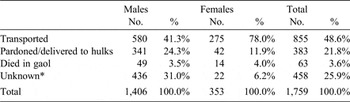
Of the 1,759 Old Bailey convicts sentenced to transportation in this period, only 855 (48.6% of those sentenced) can be traced to a convict voyage headed for Botany Bay.Footnote 85 However, it is worth noting that this figure is substantially larger than the one suggested by Shaw when he wrote that in the early period of transportation “less than a third [of those sentenced] were actually sent away.”Footnote 86 However, this figure is also less than the two thirds that has been suggested for later periods of transportation (Table 2).Footnote 87
Post-sentencing Outcomes of Old Bailey Convicts Sentenced to Transportation, 1790–99.

*A 3-year sample of missing convicts (1790–92) suggests that up to 43.8% of these individuals may be traceable in alternate records of transportation, and 11.6% may be traceable in HO 47 petitions for pardon.
Linking the pardoning records with the rest of our data allows us to see how judicial intervention could transform an initial sentence of transportation into a range of different penal outcomes. The process by which pardons were granted to those awaiting transportation differs little from that which saved many from the gallows. However, although extensive work has been conducted on the pardon process for capital convicts, the rates and conditions of pardons for those sentenced to penal transportation are less well known. Pardons for transportees can be separated into two groups: free pardons that set a convict at liberty, and conditional pardons. The latter granted convicts liberty on the understanding that they found work, served in the armed forces, left the country, provided sureties for good behavior, or served a term of imprisonment.
Full pardons were the rarest form of mercy offered to convicts in this period. A few (predominantly women) might be discharged if their situations, such as pregnancy, a large number of children to provide for, great age, or illness, were felt to warrant such unrestricted freedom. John MacDonald was sentenced to seven years' transportation in 1797 for the theft of a watch.Footnote 88 His plea for clemency cited the following factors: “first offence, good previous character, has served 10 years in the army… and is now very ill in Newgate and in a very short period he ‘most probably, will terminate his existence.’”Footnote 89 MacDonald was granted a free pardon so that he could live out the remainder of his life outside of the prison walls and outside of the state's responsibility.
Far more common were pardons that reduced punishment or asked for insurance of a convict's good behavior. Nineteen-year-old apprentice Henry Stephens was granted a pardon on the condition that he return to his master's service for the remainder of his apprenticeship, and then provide security to ensure his good behavior for the remainder of time left on his sentence.Footnote 90 Pickpocket Mary Smith escaped passage to Australia in return for serving seven months in a house of correction, and paying a 1 s fine, as did thief Thomas Watkins, who was sentenced to serve three months in Newgate and to pay the same.Footnote 91 Often by the time a petition for clemency was addressed, the small term of imprisonment that was substituted for transportation had already passed; therefore, prisoners were set free much in the same way that they would have been if a free pardon had been granted. Conditional pardons were predominantly granted to young, first-time offenders (especially with good characters or good family backgrounds) or those with heavy family responsibilities or who were in particularly tragic circumstances.
During the 1790s, there were a small group of convicts who escaped formal transportation after receiving a pardon to undertake “self-transportation” to the colonies. This unusual pardon type seems to have been in operation only during the very early phases of transportation. Information on the process is almost entirely missing from current historiography. Those pardoned on condition of self-transportation, such as William Pearce and Thomas Carr, have no records of transportation, but would have presumably still arrived in Australia.Footnote 92 It is unclear whether these convicts would have been integrated into the convict system once in Australia, or if they lived as free migrants; therefore it is unclear how their journeys should be interpreted. Further study of the self-transported would make a fascinating contribution to the history of early transportation to Australia.
As has already been demonstrated in the case of capital convicts, transportation was not the automatic fate awaiting all who were of peak age, fit, and useful. A significant proportion of men awaiting transportation were pardoned to serve in the army or navy. Of the 162 male Old Bailey convicts recorded in the HO 47 records of applications for clemency 1790–99, forty of them (24.6%)—again approximately one quarter—were recommended to mercy on condition of enlisting in the forces or serving in the West Indies. Interestingly, unlike in the case of capital convicts, this type of pardon was recommended fairly consistently throughout the decade, rather than peaking during the wars of the mid-decade years.
The proportion of those released to “serve” was in all likelihood much larger than formal pardon records suggest. Matthias Knuckey, a 19-year-old blacksmith, found guilty of grand larceny and sentenced to seven years' transportation, was pardoned the following year on the condition that he spend his sentence serving in the West Indies.Footnote 93 Knuckey does not, however, appear in the HO 47 records. Likewise, no entry exists for Joseph Burford either, a 22-year-old tailor due to be transported for seven years for the theft of a watch and coat in 1792.Footnote 94 However, the “criminal registers” of prisoners recorded that he had been “pardoned 12 November 1794 to serve in the West Indies” and discharged.Footnote 95 The larger proportion of men who were pardoned on these conditions may well have clustered mid-decade when, Hughes notes, men otherwise eligible for transportation found themselves “press-ganged into the navy, or even dragged into the uniformed rabble of the British army.”Footnote 96 Of course, war often meant not only an increased need for men to serve in the military, but also a shortage of available ships to send to Australia.
Some individuals had either the requisite experience, or willingness, for military service. Twenty-one-year-old rope maker William Reynolds was noted to be both of “previous good character” and “willing to serve in HM navy.” He was pardoned to serve as a soldier in the West Indies less than a year after his original sentence was passed.Footnote 97 Similarly, William Hunt had a record of good conduct from more than six years in the “2nd Life Guards.”Footnote 98 He was pardoned six months after the sentence to serve in the West Indies.Footnote 99 However, willingness, experience, and even opportunity were no guarantee of pardon on the condition of service. John Clack appealed for clemency on the grounds that he had already served eighteen months of his seven year sentence on a hulk at Woolwich and that he had been “offered a post by Captain Charles Craven of HMS Trimmer.”Footnote 100 However, whereas there is no record of transportation for Clack, there is no register entry to suggest that a pardon was granted to him either.
There is qualitative, if not quantitative, evidence to suggest that family circumstances may have helped men with selection for pardon to serve in the forces. William Terry had no previous military experience or previous good character; however, his application for clemency noted that he “has a wife and young children to support.”Footnote 101 Less than three months after his sentence he was pardoned to serve in the West Indies.Footnote 102
Sending young and healthy men to serve in the British forces provided a useful and cost-effective option for relieving the oversupply of convicts waiting to sail to Australia and the crowds amassing on the prison hulks. In the future, closer attention to a comparison of the credentials and characteristics of the often young, healthy, and useful convicts offered a range of pardons, and those selected for voyage to Australia, would help to broaden understanding of selection criteria under the convict system.
Arguably, the largest proportion of those who were sentenced to transportation but left behind in England, and the majority of the 383 criminal register entries we have examined, were not the pardoned, but those men delivered to the hulks but never transported. We know least about why some men were left behind, whereas others from the same hulk were taken to Australia. Although never explicit, the historiographical focus on the young, healthy, and useful sent to Australia has often implied that those left behind somehow did not meet these desired criteria. However, it is not difficult to find cases in which those who served on the hulks were virtually indistinguishable from their transported peers.
Alexander Patten was 17 when found guilty of burglary and theft under the value of 40 s in February 1796.Footnote 103 Ten months later, Alexander, a 157cm tall painter from London was transferred to one of the hulks in Portsmouth.Footnote 104 There are no records of Alexander applying for a pardon, or any records suggesting ill health. He was young, somewhat skilled, and presumably healthy. However, almost five years later, in 1801, Alexander was still confined in the Perseus hulk, where he served out the remainder of his sentence.Footnote 105
When looking at the men left to stagnate in the hulks, the idea that age, health, and skill were consistently used to select convicts after sentencing for voyage seems unfathomable. However, there may have been practical concerns which, on top of the characteristics historians have identified, played a role in deciding who was sent and who stayed behind. At the sessions held at the Old Bailey on October 31, 1792, thirty-eight men were sentenced to transportation. Only three of them, including Thomas Poore, a burglar and 162cm tall former mariner from Exeter, would eventually make the voyage to Australia.Footnote 106 Poore was delivered onto the Stanislaw hulk at Woolwich shortly after trial. Likewise, John Harrison (39 years old, no listed occupation, 165cm tall), a thief, was delivered to the Prudentia hulk at Woolwich before both he and Poore sailed to Australia on the Ganges in 1796.Footnote 107 However, Richard Powell, a 22-year-old, 165cm tall labourer and pickpocket from London, and William Croaker, who was somewhere between 23 and 39 years old and relatively statuesque at 172cm tall, a thief and plasterer, were convicted at the same session and never transported.Footnote 108 All four men were sentenced to seven years' transportation on the same day. All were relatively young property offenders. There was no discernible difference in the quality or utility of their trades or their physical stature, nor were there records of illness. The only difference seems to be that whereas Poore and Harrison were held in Woolwich, Croaker and Powell were held on the Lion hulk at Portsmouth.Footnote 109
Although there is every chance that post-sentencing selection of convicts for sail did consider youth, utility, and health, it seems that a large proportion of those convicted and sentenced to transportation already met these criteria, leaving a surfeit of male convicts to select from. In these cases, perhaps hulks were picked depending upon where a convict vessel docked, or on a rotational basis, drawing men from particular hulks at particular times.
Finally, linking the coroners' inquests database allowed us to discover that sixty-three (14.1% of traced alternate outcomes, 3.6% of those sentenced) of those left behind in England died before it was possible for their sentence to be implemented. In the cramped and insanitary conditions of eighteenth-century prisons, fever was rife and infection could spread quickly. Coroners would regularly record a death with little details, listing simply “fever,” “decline,” “despondency,” or “natural causes.”
Thomas Kennedy was found guilty of the theft of a silver watch in 1797 and detained in Newgate waiting to be transported.Footnote 110 Thomas spent the next eighteen months in the gaol, too unwell to be transferred. William Clark, a fellow prisoner described Kennedy as “an elderly man of near sixty years of age and very much emaciated and decayed.”Footnote 111 It can perhaps be inferred from the report of Kennedy's “bad leg” that he had open ulcers or other wounds that had become infected. At the beginning of April 1799, Thomas began to suffer from fever and fits, which continued for a two weeks. Despite his wife administering the remedy of a pint of porter with an ounce of tobacco soaked into it, a particularly bad fit and episode of vomiting seized Thomas and he died.Footnote 112 Most of those who died were, like Thomas, the elderly (at least in transportation terms).
The generic fevers, fits, and “decline” listed as causes of death for those in Newgate could be a of infections such as typhus, typhoid, dysentery, pneumonia, or tuberculosis, which spread quickly and fatally throughout London. Those without strong immunity—the elderly or very young—were especially at risk. Convicts also died as a result of pre-existing conditions such as venereal disease, heart problems, and jaundice. The rate of death among prisoners awaiting transportation will have been considerably higher than suggested by the small number of coroners' records available. Elizabeth (or Edith) Lany, for example, was a 38-year-old widow from Durham, sentenced to seven years' transportation at the Old Bailey in 1793.Footnote 113 She died three months after sentencing. There is no coroner's record for Lany, and although a note of her death was made by the common sergeant of the prison, no details of what happened to her, or where she was when she died, are apparent.Footnote 114 Those who died in other prisons or on the hulks left very little trace. It remains unlikely that a comprehensive study of all those who died while awaiting transportation will ever be possible. Beatrice and Sydney Webb commented in 1922, “of all the places of confinement that British history records the Hulks were apparently the most brutalizing, the most demoralizing, and the most horrible. The death rate was appalling, even for the prisons of the period.”Footnote 115 Thomas Forbes suggested “reports have made it clear that convict hulks could be dreadful and deadly places of confinement.”Footnote 116 Forbes estimated that on board the first hulk of the Australian convict period, almost 20% of inmates died before transportation.Footnote 117
Long-term, serious, and chronic illness also prevented inmates from travelling to Australia. If removed to a hospital (or elsewhere but not formally pardoned) inmates were effectively removed from the process of selection, but left very few records. At present, it is not possible to explore those not selected for transportation because of ill health, who must number significantly among the more than one in three convicts between 1790 and 1799 who did not have their sentences implemented.
Although post-sentencing selection for sail may have relied on the criteria of youth, health, and utility, it can only have done so after death, illness, and discharge removed a sizeable proportion of the aged and frail population, and conditional pardons removed men who were considered of better use elsewhere. To date, not enough attention has been paid to the possibility that the numbers of young and healthy men and women arriving in Australia were not the result of a positive selection, but rather of a level of negative “natural” selection in which the elderly, the very young, and the frail died or became incapacitated before secondary selection could take place. Such occurrences may have left a disproportionately young and healthy population of convicts for those responsible for voyage selection to pick from.
A fuller picture of the true proportion of those who stayed behind, where they were placed, and their characteristics to compare with their transported peers, is needed. Until such a time as this exists, the idea that a range of factors, from the sociopolitical to the practical availability of inmates at any given time, and their personal circumstances, contributed to sentence implementation is just one more piece of a poorly developed puzzle. There may be a number of undocumented factors that were used in post-sentencing selection. An offender's character, physique, and temperament may all have carried weight in the decision making of officials when it came to the ultimate disposal of convicts. With a greater understanding of the impact that documented factors played in penal outcomes, it will, at least, be possible to assess how much decision making was left for undocumented factors to control.
Our efforts at record linkage are still developing, and although the Digital Panopticon data and search capabilities are of high quality, they are not yet complete. Errors in transcription and tagging, and in the original records, mean that offenders can appear where they should not, and that their details can sometimes be wrong. Edward Burne's entry in our database suggests that he was sentenced to be transported for stealing hay. On closer inspection, Edward's sentence summary in the Proceedings subsequently reveals that it was an unrelated Charles Burne from the same session who was sentenced to seven years' transportation, and that two separate Edward Burnes were also tried on the same occasion. One was sentenced to be imprisoned for one week and to be publicly whipped, the other was sentenced to serve one month's imprisonment.Footnote 118 The relevant Edward Burne's criminal register again amalgamates these cases, suggesting that Edward was punished with one month's imprisonment and a whipping,Footnote 119 although it must be noted that these kind of entries are a very small minority in a database with hundreds of thousands of records and links.
However, even where records have been connected with ease and accuracy, the contemporary recording of the fate of those awaiting transportation can still be fallible. Mary Yarrow, sentenced to seven years' transportation for breaking and entering the house of Sophia Linney in 1793, was transferred to the convict ship Indispensable in April 1796.Footnote 120 If we search for Mary, her convict indent, created as the ship was loaded, will allow us to count her among the transported. We know, however, that Mary was subsequently unloaded from the ship and given a full pardon in September 1797, passing to the care of her parish.Footnote 121 Mary was both selected for transportation and pardoned before she could sail to Australia. Likewise, Mary Davis was sentenced to transportation in September 1793.Footnote 122 She was loaded onto the convict vessel Surprize in 1794, but then removed in April of that year, because of a case of “lockjaw” rendering her unfit for voyage. She was transferred back to Newgate where she served the remainder of her sentence.Footnote 123
We must acknowledge that our records are incomplete, both for those sent to Australia and those left behind. Although the British Convict Transportation Registers offer an invaluable view of those sent to Australia, not every record has been preserved. Sarah Gower was convicted of stealing in 1792. She was sentenced to seven years' transportation.Footnote 124 The criminal registers state that she was “removed on board the Surprize … 10 February 1794.”Footnote 125 However, no record of her voyage or arrival in Australia can be found. We must accept that individual transportation records, and even whole ship's worth of records have been lost, accounting for at least some of the 458 (25.9%) individuals whose penal outcomes we could not trace in the abovementioned records.
With each new record collection added to the Panopticon’s database—more pardons and death data, alternate registers of transportation, more detailed hulk documents—the clarity of our analysis will be improved. Each additional link created between datasets and in life archives further refines, by process of elimination, the conclusions we draw.
Conclusions
In the case of both capital sentences and those of transportation, it was not inevitable that the punishment pronounced in court would determine what happened to a convict. By reconstructing the penal journeys of the Old Bailey condemned it becomes evident that, in the 1790s at least, hanging was by no means an inevitable outcome for those sentenced to death. Less than a quarter of those sentenced to death during this period would hang. Nor was transportation used as a blanket alternative for those granted mercy. Even with the resumption of mass transportation after 1787, the Old Bailey reprieved continued to follow a number of other penal routes. Slightly over one quarter more would find themselves shipped to Australia and the rest might be pardoned to undertake military service, be imprisoned, or die from natural causes while awaiting sentence. The shape of a capital convict's eventual penal outcome could be influenced by the identity of the offender and the nature of the crime and by such external pressures as wartime recruitment.
In the case of penal transportation too, there was more to a pronouncement of a sentence than simple implementation. Although the historiography has often suggested that the young, healthy, and skilled would be taken to Australia while others were left behind, the picture for the early years of transportation is considerably more complex. It was rare for the aged and sickly to arrive in the colonies. However, whether this was the result of “positive” selection of the healthy, or the death, incapacitation, and pardoning of the less desirable is unclear. Nor were all the young, healthy, and skilled automatically bound for Botany Bay. Convicts characteristically indistinguishable from those who sailed beyond the seas might be pardoned and set to military service, or left to stagnate on the hulks. A full understanding of post-sentencing selection for transportation will only be achieved when as much is known, in aggregate, about the characteristics of those left behind in England and their penal journeys, as is known about those who arrived in Australia.
The picture for the 1790s shows, with reference both to capital convicts and transportees, that outcomes could be diverse. The criteria that determined such journeys were not static, but ever-developing, changeable, and responsive to a range of personal, social, and political matters. More work, both qualitative and quantitative, remains to be done. For example, pardoning petitions and reports that have been used extensively to study the outcomes in capital cases are still to be consulted in a systematic way for those originally sentenced to penal transportation. The picture we draw here serves mainly to bring a range of penal journeys into view so that in future they might be more fully explored and understood.
The digital record linkage from the Digital Panopticon has enabled us to begin systematically connecting huge numbers of offenders from the courtroom to the next judicial stage. Our “life archives” allow us, at the click of a button, to see the disparity between sentencing and sentence implementation. Our tools enable us to analyze the diverse range of outcomes a group of same-sentence convicts might experience, and, as demonstrated here, to look more closely at the details and diversity of under-researched penal processes. We continue to develop and refine our digital technologies and methodologies. Before the website's launch, a large collection of additional datasets will be added and linked to the life archives of Old Bailey convicts. The complete collection will offer social, criminal, and personal data on not only the condemned and transported, but also on the imprisoned, for almost 150 years of British history. Criminal registers, prison records, and huge civil datasets such as the census will connect together, making it possible to answer questions about the rates of recidivism and effectiveness of penal regimes. It will be possible to measure “criminal characteristics” from age and occupation, to biometric data, to form conclusions about who was drawn into the criminal justice system and why, and how penal outcomes affected offenders and their descendants. When complete, the Digital Panopticon life archives, and the tools to search, analyze, and visualize these will allow researchers to interrogate questions and data relating to the lives, crimes, and pathways of offenders on an unprecedented scale. This article has already shown, with thousands of Old Bailey offenders already linked to further records of death, transportation, pardons, and confinement, that researchers can begin to consider questions of sentencing, implementation, and outcome at both the broad collective and the detailed individual levels. Whether we want to count or clarify the nature of crime and punishment, our online archives make possible the kind of research that has previously been too time consuming, laborious, or simply impossible. As such, there is now an opportunity to start exploring new perspectives and approaches to well-known areas in the history of law and crime.
Although our study has considered only a small sample of all the capital and transported convicts to pass through the Old Bailey between 1787 and 1925, in time it will be possible to produce a comprehensive picture of the patterns and processes of sentencing and implementation from the eighteenth to the twentieth century. The range and scale of documents drawn into the Digital Panopticon and effective automated record linkage among them will allow researchers to quantify and qualify not only the number of convicts who were sentenced to one punishment only to experience another outcome, but also the nature and details of those alternate experiences. More importantly, it will be possible to consider more holistically the characteristics of those drawn into the criminal justice system, and the impact that factors such as sex, age, occupation, and crime played in judicial and penal decision making.