Introduction
The dolichopodid subfamily Sympycninae (Diptera: Dolichopodidae) is a complex assemblage of cosmopolitan distribution. The species tend to be rather small and dull coloured, and, although often ignored by general collectors, they can be quite abundant in Malaise and water (pan) traps. The type genus Sympycnus Loew is largely amphitropical in distribution but particularly diverse in the temperate regions of South America (Van Duzee Reference Van Duzee1930; Parent Reference Parent1932b), New Zealand (Parent Reference Parent1933), and Australia (Parent Reference Parent1932a). Sympycnus is a rather generalized taxon and close to what might be regarded as a “bauplan” for the subfamily. Not surprisingly, many sympycnine genera now include species that were originally described in Sympycnus. Although undoubtedly a paraphyletic genus, it remains a necessary taxonomic repository for hundreds of species, which have been described or are awaiting description.
This paper is centred on the striking similarity of male secondary sexual characters (MSSCs) found in two derived and distinctive genera of Sympycninae: Pinacocerus Van Duzee from the Patagonian region of Chile and Argentina and Yumbera Bickel from eastern Australia and Tasmania. The two genera are reviewed and new species are described.
I dedicate this study to the dipterists of the Canadian National Collection (CNC), Ottawa, and am pleased to contribute to a volume honouring the dipterists who worked there during its heyday, 1937–1989. Appropriately, of the two new species described here, one is known only from the CNC holdings and the other is known only from material collected by a CNC dipterist.
I first visited the CNC Diptera Collection in June 1979, having driven to Ottawa from Ithaca, New York, with my fellow graduate student at Cornell University, the lepidopterist John Rawlins. We slept out in Gatineau Park and made forays to the collections at the Central Experimental Farm. There I met Dick Vockeroth, who seemed delighted to meet me. He talked (and chain-smoked) virtually non-stop during my time there, and he unloaded such a wealth of detailed knowledge about Dolichopodidae that one may have thought it was his family of specialty, not Syrphidae. However, I subsequently found out he could talk like that about many fly families, all of which were remembered from specific collecting episodes. I met the other staff there, Monty Wood, Guy Shewell, Herb Teskey, Frank McAlpine, J. Antony Downes, Bob Peterson, and the remarkable illustrator Ralph Idema, many of whom I got to know better in subsequent visits. At that time, the buzz of preparation was in the air for the first volume of the Manual of Nearctic Diptera, and Dick gave me a typescript copy of the MND dolichopodid chapter, which proved to be most useful. I came away with a great haul: exemplars of troublesome genera, a couple of boxes of reprints, and a big chunk of the CNC's huge Nearctic Medetera Fischer von Waldheim holdings for my thesis research.
I subsequently visited the CNC on six different occasions, at times assisted by generous CanaColl grants, and it is a most welcoming place. I have always been impressed by the huge collections, drawer after drawer of unsorted Dolichopodidae, all nicely presented with the CNC trademark of specimens glued to pins and compact labels (of course meaning that more specimens were packed into each drawer). Apart from a superb North American collection, as one might expect, there were substantial amounts of material from around the world: Chile, Mexico, Uganda, Europe (one of the few North American institutes with significant European holdings), Brazil, Ecuador, Peru, Nepal, etc. Although the CNC lacks large historical type collections characteristic of older museums, it more than compensates by its enormous holdings of new material, and that is the real treasure, the thousands of undescribed species. The problem was that I felt an obligation to try to sort as much as possible into genus/subfamily, and often I would work late into the night. However, such work is never a real burden; the foundation of deep taxonomic knowledge is the innumerable hours spent at the microscope. Only then can you leave printed keys behind and start to become the key. But this is not the place for Zen reflections, so it is best to say I learnt a lot during the time I spent at the CNC, and for that I am grateful.
Material and methods
This study is based on material housed in the Australian Museum, Sydney (AMS), Natural History Museum, London (BMNH), Canadian National Collection of Insects, Agriculture and Agri-Food Canada, Ottawa (CNC), and the National Museum of Natural History, Smithsonian Institution, Washington, DC (USNM). In descriptions of the hypopygium, “dorsal” and “ventral” refer to morphological positions before genitalic rotation and flexion. Thus, in figures showing a lateral view of the hypopygium, the top of the page is morphologically ventral, whereas the bottom is dorsal. Morphological terminology follows McAlpine (Reference McAlpine1981). The CuAx ratio is the length of the dm–cu crossvein/distal section CuA. The position of features on elongate structures such as leg segments is given as a fraction of the total length, starting from the base. The relative lengths of the podomeres should be regarded as representative ratios and not measurements. The ratios for each leg are given in the following formula and punctuation: trochanter + femur; tibia; tarsomere 1/2/3/4/5. The following abbreviations and terms are used: MSSC – male secondary sexual character(s) (non-genitalic characters found only on the male body); I, II, III: pro-, meso-, metathoracic legs; C, coxa; T, tibia; F, femur; ac, acrostichal setae; ad, anterodorsal; av, anteroventral; dc, dorsocentral setae; dv, dorsoventral; hm, postpronotal setae; npl, notopleural setae; pa, postalar setae; pd, posterodorsal; pm, presutural supra-alar setae; pv, posteroventral; sa, postsutural supra-alar setae; sr, presutural intra-alar setae; t, tarsus; t1–5, tarsomeres 1 to 5.
Taxonomy
The subfamily Sympycninae is recognized by the following suite of characters: vertex not excavated; posterior mesonotum not flattened; vein M unbranched; femora II and III usually with strong anterior preapical seta; postvertical seta near vertex usually small; tibia I often with distal ad row of short setae (“serration”); veins R4+5 and M usually subparallel distad of the dm–cu crossvein; anal angle often reduced or lost; hypopygium partially encased by the postabdomen.
Species of Pinacocerus and Yumbera, the two genera treated here, are keyed separately because they are geographically distinct. However, they are readily separated by characters given in their generic diagnoses.
Pinacocerus Van Duzee
Pinacocerus Van Duzee, Reference Van Duzee1930: 11. Type species: Pinacocerus nodicornis Van Duzee, Reference Van Duzee1930: 11, by monotypy.
Diagnosis
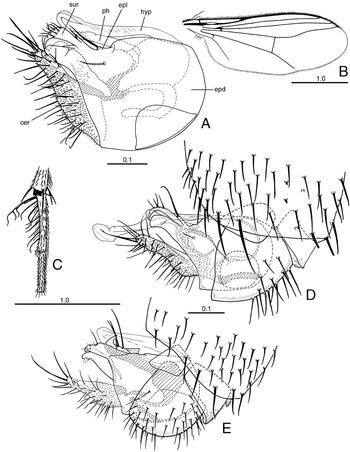
Small (∼2.0–3.0 mm in length) dark brown–metallic green Sympycninae. Head: male ventral postocular setae not distinctly developed, and ventral two-thirds of postcranium with abundant flattened and thickened dark brown setae radiating outwards, appearing like “nest” of ventral postcranial setae (setae not as flattened in females); males with distinctly modified 1st flagellomere and arista (MSSC). Thorax: ac irregular biseriate; lateral scutellar seta about one-quarter length of median scutellar seta; proepisternum with 7–8 short black setae dorsad of CI. Legs: TI without distal ad serration of short setae; tarsus I shorter than TI; It1 longer than remaining distal tarsomeres combined; FII and FIII each with strong anterior preapical seta. Wing: veins R4+5 and M converging in distal third of wing, with M joining the margin well in front of wing apex (Fig. 1B). Abdomen: tergite 1 with field of short whitish setae on the surface, with longer white marginal setae laterally (MSSC), and with dorsal marginal setae becoming black; hypopygium of generalized sympycnine type.
Remarks
Pinacocerus comprises two species and is endemic to southern South America, an area of distinctive temperate biota sometimes termed the Patagonian or Magellanic Region. Although label data on habitat and elevation are lacking, the Chilean distribution range of the common P. nodicornis (also see under species) suggests a wide habitat range, from semi-arid woodland in the north to temperate rainforest in the south.
Pinacocerus is defined by a number of diagnostic and probably derived characters (see Key and Diagnosis). Many of these are autapomorphic male secondary sexual characters. However, the distinctive wing venation, with veins R4 + 5 and M converging and M joining the margin well in front of the wing apex, and the absence of a setal “serration” on TI, are both probably derived characters and occur in both sexes. On the basis of descriptions of Sympycninae from South America and other regions, Pinacocerus appears to be somewhat isolated within the subfamily.

Pinacocerus nodicornis Van Duzee
Pinacocerus nodicornis Van Duzee: A, hypopygium, left lateral; B, male wing, dorsal; C, male basitarsus III, ventral. Pinacocerus candiptorum sp. nov.: D, hypopygium, left lateral. Yumbera trisignata sp. nov.: E, hypopygium, left lateral. Legend: cer, cercus; epd, epandrium; epl, epandrial lobe; hyp, hypandrium; ph, phallus; sur, surstylus.

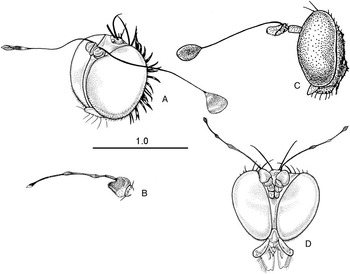
Pinacocerus nodicornis Van Duzee: A, male head, left anterolateral. Pinacocerus candiptorum sp. nov.: B, male left antenna, lateral. Yumbera callida (Parent): C, male head, left lateral. Yumbera trisignata sp. nov.: D, male head, anterior.

Pinacocerus nodicornis Van Duzee, Reference Van Duzee1930: 13.
Type material
Van Duzee described P. nodicornis on the basis of the ♂ holotype and 3 ♂ and ♀ paratypes collected in ARGENTINA: Lago Nahuel Huapi, 28–31.X.1926, and ♂ and ♀ paratypes, collected at Bariloche, Rio Negro, 1.XI.1926 (BMNH, holotype examined; additional specimens from this series, not designated as paratypes, in USNM).
Additional records
CHILE: 25 ♂, 49 ♀, Hda. Illapel, Coquimbo, 20.XI.1954; 2 ♂, Elmanzano, Santiago, 9.II.1951; 2 ♂, 2 ♀, Maimenuco, Malleco, 10–13.XII.1959; 4 ♂, 2 ♀, Lincura, Malleco, 800 m, 6–10.I.1959; 3 ♂, 3 ♀, Lincura, Nuble, 4.I.1959; ♂, Pino Hachado, 7.I.1959; 2 ♂, 3 ♀, Chile Chico, Lago Buenos Aires, Aysén, 24–31.XII.1960; 2 ♀, Puerto Ibanez, Lago Buenos Aires, Aysén, 12–15.I.1961 (all L. Peña, CNC).
Redescription
Male: length: 3.0–3.1 mm; wing: 2.8 × 1.0 mm.
Head: (Fig. 2A); vertex and frons dull metallic blue-black with grey pruinosity; vertex slightly flattened behind ocellar tubercle and sloping towards the occipital foramen; dorsal postocular setae somewhat thicker (MSSC), ventral postocular setae not distinctly developed, and ventral two-thirds of the postcranium with abundant flattened and thickened dark brown setae radiating outwards, appearing like “nest” of ventral postcranial setae (MSSC); pair of strong converging vertical setae present; ocellar setae strong, diverging, and with pair of short posterior setulae on ocellar tubercle; face with grey pruinosity, sharply narrowed beneath the antennae, but eyes distinctly separated beneath by narrow face; eye facets uniform; palp short, dark brown with yellowish setae; proboscis dark brown; antenna yellow-orange, short, and appearing “fleshy”; scape short and cup-like and appressed into head; pedicel bare of usual ring of short setae; 1st flagellomere short and rounded; arista black, thickened at base, and narrowed, bearing large black subtriangular apical flag (MSSC).
Thorax: dark metallic blue-green and with light dusting of grey pruinosity over pleura; postscutellum with median longitudinal mound; posterior mesoscutum not flattened; ac present as 6–7 setae in irregular biseriate or almost uniseriate row; 6 strong dc present, with posteriormost slightly offset laterally; 1 pa, 2 sa, 1 sr, 2 npl, 1 hm, 1 pm present; median scutellar seta strong, lateral scutellar seta about one-third length of median; scutellum sometimes with short hair near dorso-posterior margin; proepisternum with 7–8 short black setae dorsad of CI.
Legs: coxae and remainder of legs almost entirely dark brown with some metallic green reflection, although apices of FI and FII were yellowish; setae black, except where noted; CI with short anterior setae, basal three-quarters with anterio-median row of thickened and flattened yellow setae (MSSC), and with some normal black apicolateral setae; CII with dense field of brown anterior setae and with strong black lateral seta at 1/2; CIII with strong lateral seta at 1/3, some short whitish hair basally, and short lateral seta near 2/3; I: 5.2; 4.1; 1.6/0.4/0.4/0.3/0.4; FI with short posterior and pv setae; TI with strong dorsal setae at 1/5 (short), 1/3, and 3/5 and with strong pv setae at 2/5 and 3/5, with anteroapical comb of hair; It1 longer than the remaining distal tarsomeres combined; It2–4 ventrally pad-like with dense, whitish pile (MSSC); II: 5.0; 5.3; 2.7/1.3/1.3/1.0/0.7; FII with anterior preapical seta at 4/5 and weaker av and pv setae distally; TII with slightly offset strong ad–pd setal pairs at 1/8, 1/4, and 1/2, with ventral seta at 1/4 and 3/5, and with strong apical av, ad, pd, and pv setae; IIt1 with short ventral seta at 3/4; III: 6.9; 6.6; 2.3/1.6/1.4/0.8/0.7; FIII in the basal quarter with 5–6 long ventral setae (MSSC), with strong anterior preapical seta at 4/5 and av and pv setae at 7/8; TIII with strong anterior setae at 1/5 and 1/2, with 5 strong dorsal setae spaced along length, and with strong apical av, pv, ad, and dorsal setae; IIIt1 (Fig. 1C) slightly excavated along posterior surface, with 2 long curved posterior setae positioned near base, followed distally by row of 9–10 shorter curved setae, with all setae curved towards the apex (MSSC).
Wing: (Fig. 1B); hyaline; R2 + 3 straight to margin, not curved distally; R4 + 5 closely parallel to R2 + 3 along anterior margin; M basally diverged from R4 + 5, but bent anteriorly halfway between dm–cu and wing apex to become subparallel with R4 + 5, joining the margin well anterior of wing apex; CuAx ratio: 0.5; lower calypter brown with fan of dark brown setae; halter yellow.
Abdomen: segments 1–8 entirely dark brown with metallic blue-green reflections; tergite 1 with a field of short, whitish setae on the surface, with longer, white marginal setae laterally (MSSC), with the dorsal marginal setae becoming black; segments 2–6 covered with field of short, black setae and with posterior row of marginal setae; sternite 8 formed cap over the left dorsobasal hypopygial foramen; hypopygium (Fig. 1A) entirely dark brown; the epandrium subtriangular with strong setae arising from the internal wall and strong setae present on the ventral epandrial margin; epandrial lobe present as peduncle bearing short apical setae; the surstylus comprising 2 overlapping lobes, with ventral lobe bearing a field of setae; hypandrium forming narrow cover; phallus with some ventral irregularities on surface; cercus elongate, subtriangular, and setose.
Female: similar to male, except as noted: wing 3.2 × 1.3; dorsal postocular setae unmodified, but lower postoculars also not developed; lower two-thirds of the postcranium also with black-brownish setae radiating outwards, but setae not flattened or thickened; face and clypeus quite wide and covered with grey pruinosity; frontal clypeal suture distinct and face tectiform, that is, projecting beyond the curvature of the eyes at suture; palp large and ovate, black with yellowish margins; antenna mostly dark brown, unmodified; scape short; pedicel with ring of short setae; 1st flagellomere short, subtriangular, with dorsal unmodified arista; proepisternum also with distal group of short black setae; CI with dense short anterior setae, and without modified yellow setae; It2–4 unmodified, without ventral pile; FIII without ventral setae; IIIt1 unmodified, without posterior row of setae; segments 1–5 with all vestitures black.
Remarks
Pinacocerus nodicornis is known over a wide range of latitudes in quite different habitats in Chile and Argentina. Chilean specimens have been found from Cochimbo, near 30°S (coastal, presumably semi-arid heath or open woodland), to Lago Buenos Aires, near 46°S (cold, wet Valdivian forest), as well as in a number of intervening localities that are within Mediterranean and temperate vegetation zones.
Pinacocerus candiptorum Bickel, sp. nov.
Type material
CHILE: Holotype ♂, Lincura, Malleco, 800 m, 6–10.I.1959, L. Peña; paratype ♂, Lincura, Ñuble, 4.I.1959, L. Peña (CNC).
Description
Male: length: 2.3 mm; wing: 2.2 × 0.8 mm; similar to P. nodicornis, except as noted:
Head: ventral postocular setae also not developed; dorsal postocular setae not thickened; lower two-thirds of postcranium also with abundant black-brownish setae radiating outwards, appearing like “nest” of ventral postcranial setae (MSSC); antenna (Fig. 2B) yellow-orange with first flagellomere infuscated near aristal base; 1st flagellomere short and subtriangular, appearing somewhat “fleshy”; arista dorsal with flattened nodes at 1/3, slightly larger node at 2/3, and with lanceolate apical flag that is black basally and tapering to a narrow, white point (MSSC).
Thorax: scutellum with short hair near dorso-posterior margin; proepisternum with 7–8 short black setae dorsad of CI.
Legs: colouration similar; CI covered with short, somewhat thickened black setae across anterior surface, without yellow setae, and with normal black apicolateral setae; CII with some anterior setae and with strong black lateral seta at 1/2; CIII with strong black lateral seta at 1/3; I: 3.7; 3.6; 1.2/0.3/0.2/0.2/0.2; FI with row of short posterior setae along length, 3 slightly stronger posterior setae in distal quarter, and 3 pv setae in distal fifth; TI with row of 8–10 short dorsal setae along the length, mirrored by row of 8–10 slightly stronger pd setae along length, strong pv setae at 1/3 and 2/3, and with anteroapical comb of hair; It2–4 unmodified; II: 4.2; 4.2; 2.1/1.2/0.6/0.5/0.4; FII with anterior preapical seta at 4/5 and with somewhat weaker av and pv setae at 7/8 distally; TII with slightly offset strong ad–pd setal pairs at 1/8, 1/4, and 1/2, without any ventral setae, and with strong apical av, ad, pd, and pv setae; IIt1 with short ventral seta at 3/4; III: 4.8; 4.9; 1.4/0.8/0.6./0.4/0.4; FIII with long ventral seta at 1/8, among row of shorter ventral setae in basal half (MSSC?), with strong anterior preapical seta at 4/5 and av and pv setae at 7/8; TIII with strong anterior setae at 1/4 and 2/3, with 5 strong dorsal setae spaced along the length, and with strong apical av, pv, ad, and dorsal setae; IIIt1 unmodified.
Wing: CuAx ratio: 0.4; halter yellow with brownish stalk.
Abdomen: tergite 1 also with field of short, whitish setae on the surface, with longer white marginal setae laterally (MSSC); hypopygium entirely dark brown (Fig. 1D); epandrium subtriangular, with strong seta arising from the internal wall and the epandrial lobe bearing long apical seta; surstylus comprising 2 overlapping lobes, with ventral lobe bearing some setae; hypandrium forming narrow cover; phallus with expanded apex; cercus elongate, subtriangular, and setose.
Female: not reliably associated and possibly indistinguishable from female P. nodicornis (q.v.).
Remarks
Pinacocerus candiptorum is known from two males collected from Lincura in Malleco province (holotype) and from Lincura in Ñuble province. Because both specimens were collected within a few days of each other, the two sites possibly represent the same locale. I found one “Lincura” in Chilean gazetteers, Lincura Ñuble: 36°52′0″S, 72°23′0″W. The widespread P. nodicornis shares these two collection events and is therefore sympatric with P. candiptorum, at least in the Biobío region of central Chile.
Etymology
This species is named in honour of all the staff who have worked in the Diptera Section of the Canadian National Collection, Ottawa, “candipt” being a contraction of “Canadian Dipterists” and “-orum” being the Latin possessive plural suffix.
Yumbera Bickel
Yumbera Bickel, Reference Bickel1992: 1007. Type species: Sympycnus callidus Parent, 1932: 137, orig. des.
Diagnosis
Small (2.5–3.2 mm in length); body often yellow. Head: males often with distinctly modified 1st flagellomere and/or with apical aristal flag present; males often with enlarged white palp (MSSC). Thorax: ac absent; lateral scutellar seta reduced to tiny hair or absent. Legs: TI without distal ad serration of short setae; tarsus I distinctly longer than tibia I; FII and FIII each lacking distinct anterior preapical seta. Wing: veins R4+5 and M subparallel in the distal half.
Remarks
Yumbera is unique among the Sympycninae in having lost the anterior preapical seta on femora II and III. Most other genera in the subfamily, including Sympycnus (s.l.), have a strong preapical on these two posterior femora. The genus is also notable for the development of male antennal modifications in all species except Yumbera nudicornis (see Bickel Reference Bickel1992 for discussion).
Yumbera is known only in eastern Australia, with five species confined to the Australian mainland, from the Cairns district to Victoria, and a new species from Tasmania, Yumbera trisignata, described below. This new species is distinct from the mainland species in several ways. It is found in cold subalpine woodlands and heath above 1000 m, in marked contrast to the rainforest/wet sclerophyll forest habitat characteristic of the five mainland species. In addition, Y. trisignata has a dark green-black thorax and abdomen, as opposed to the predominately yellow colouration of the other species. Similar to most Yumbera species, males of Y. trisignata have modified antennae, but with a nodate arista in contrast to the rounded apical aristal flag of three other species.
All species of Yumbera, except Y. nudicornis, the species with the most plesiomorphic characteristics (see Bickel Reference Bickel1992), have the palp enlarged and ivory coloured. Often the male proboscis is also ivory coloured, and possibly they function as a display unit in mate recognition (the female palp and proboscis are yellowish or brownish).

Yumbera trisignata Bickel, sp. nov.
Type material
Holotype ♂, paratypes, 2 ♂, 4 ♀, AUSTRALIA: Tasmania: Mt. Field Nat. Park, Lake Belcher Trail, 17–19.ii.1994, 1100 m, yellow pans, ex moor, B.J. Sinclair (AMS; paratype ♂, CNC).
Description
Male: length: 3.2 mm; wing: 3.3 × 1.2 mm.
Head: (Fig. 2D); vertex and frons dull metallic blue-black with grey pruinosity; vertex slightly flattened behind ocellar tubercle and sloping towards occipital foramen; postocular setae white ventrally and black on dorsal half, with the dorsalmost seta positioned slightly posteriad of vertex; pair of strong converging vertical setae present; ocellar setae strong, diverging, and with pair of short posterior setulae on ocellar tubercle; face brown with yellowish pruinosity, narrowed beneath the antennae, but eyes distinctly separated; eye facets uniform; palp enlarged, ovate, and ivory coloured, without usual short surface vestiture but with tiny apical setae (all MSSC); proboscis also ivory coloured (MSSC); antenna mostly yellow; arista black; scape short and cup-like; pedicel with ring of short setae and with strong dorsal and ventral setae; 1st flagellomere enlarged, swollen, and rounded, with excavated base near joint with pedicel (MSSC); arista arising dorsobasally on first flagellomere, and with flattened nodes at 3/5 and 3/4 and with obovate apical flag (MSSC).
Thorax: dark brown with metallic green reflections and covered by light dusting of grey pruinosity; postscutellum with median longitudinal mound; posterior mesoscutum not flattened; ac absent; 6 strong dc present, posteriormost slightly offset laterally; 1 pa, 2 sa, 1 sr, 2 npl, 1 hm, 1 pm present; median scutellar seta strong, lateral scutellar seta reduced to weak hair; proepisternum with short seta dorsad of CI.
Legs: coxae mostly reddish brown, although CII dark brown on anterior surface, and with dusting of grey pruinosity; trochanters and femora light brown; tibiae and basal tarsomeres yellow; distal tarsomeres infuscated; setae black; CI with short anterior setulae and 3 weak apicolateral setae; CII with short anterior setulae and strong anterolateral seta; CIII with strong lateral seta at 1/3 and very short seta at 1/2; I: 3.7; 3.5; 2.0/0.8/0.6/0.3/0.4; FI with short subapical pv seta, otherwise leg bare of major setae; It1 about 2/3 length of TI; II: 4.2; 5.0; 2.1/0.8/0.6/0.4/0.4; FII without anterior preapical seta but with strong posterior seta at 4/5 and with preapical pv seta; TII with strong ad setae at 1/5 and 1/2, with weak pd at 1/6, strong pd at 1/4, weak pv at 2/3, and strong apical av, ad, pd, and pv setae; III: 5.0; 5.8; 1.1/1.3/0.8/0.5/0.5; FIII without anterior preapical seta but with short preapical av and pv setae; TIII with strong anterior setae at 1/6, 1/3, and 2/3, with 6 strong, spaced dorsal setae along the length, and with strong apical av and pv setae; IIIt1 shorter than IIIt2.
Wing: hyaline; R2 + 3 straight to the margin, not curved distally; R4 + 5 and M subparallel to apex beyond the dm–cu crossvein and slightly arched anteriorly; CuAx ratio: 0.8; lower calypter brown with a fan of black setae; halter yellow.
Abdomen: segments 1–8 entirely dark brown with black vestiture; tergite 1 with long setae along posterior margin; terga 2–6 with posterior row of short marginal setae; sternite 8 forming cap over the hypopygial foramen; hypopygium (Fig. 1E) dark brown with yellow cercus; epandrium subtriangular; epandrial lobe bearing 3 long setae; surstylus comprising 2 overlapping lobes, each bearing short distal setae; hypandrium forming broad cover; phallus with distinct apical hook-like curve and ventral triangular mound basad; cercus subtriangular with long apical setae.
Female: similar to male, except as noted: wing 3.4 × 1.3; face wider; palp smaller, brownish, and surface with short, black vestiture; proboscis dark brown; antenna unmodified: 1st flagellomere rounded and subtriangular with dorsal plain arista.
Remarks
Yumbera trisignata is known from mixed subalpine woodland and heath above 1000 m in Mt. Field National Park, Tasmania. This rather cold and exposed habitat contrasts markedly with the mainland rainforest/wet sclerophyll forest characteristic of the other six Yumbera species.
Yumbera trisignata has the male palp enlarged, and the palp and proboscis are bright ivory coloured in males. The palp and proboscis may function together in mate recognition (in females, both are the usual brown colour).
Discussion
Dolichopodids are well known for their elaborate MSSC, assumed to aid species recognition during courtship. These MSSC include flag-like flattening of the arista and tarsomeres, modified setae, prolongation and deformation of podomeres, orientated silvery pruinosity, modified venation, etc. Females, in contrast, usually have a conservative facies and often cannot be identified in isolation. Because MSSC are undoubtedly significant in mate recognition, they provide a valid basis for defining species. However, such characteristics can be misleading when used out of context in keys because they are frequently subject to homoplasy.
The Patagonian Pinacocerus and Australian Yumbera are each monophyletic groups that are separated morphologically and geographically. However, they display striking similarity in the development of antennal MSSC: (a) male arista with rounded apical flag – P. nodicornis (Fig. 2A) and Y. callida (Fig. 2C), Y. signata and Y. athertonia; (b) male arista with two flattened nodes and a short triangular apical flag – P. candiptorum (Fig. 2B) and Y. trisignata (Fig. 2D). Below are three hypotheses on the origin of such homoplasy in these two genera:
1. The MSSC were present and variously expressed in a common ancestor, such as Sympycnus (s.l.), possibly before Gondwana was split by continental drift. However, Y. nudicornis, the species with the most plesiomorphic characters and sister to all other species in the Yumbera, shows no male antennal modification (Bickel Reference Bickel1992).
2. The similar MSSC arose independently de novo in the geographically isolated Pinacocerus and Yumbera lineages, a reflection of parallel evolution within a major taxon and possibly reflecting similar mate recognition systems in the two genera.
3. The tendency of a given MSSC to develop “independently” in different taxa may be an inherent feature or potentiality of a character, what Saether (Reference Saether1986) called “underlying synapomorphy,” or, in terms of modern ideas of evolutionary development (e.g. Hall Reference Hall2003; Wake et al. Reference Wake, Wake and Specht2011), based on shared developmental pathways arising early in a taxon's history that are capable of being “turned-on” at different levels within its phylogeny. In other words, it is a highly probable physical change from an unmodified state. In the case discussed above, the potentiality to develop antennal modifications may lie much deeper within Dolichopodidae other than just Sympycninae. For example, apical aristal flags have developed “independently” at least eight times in Sciapodinae (Bickel Reference Bickel1994) and seven times in Dolichopodinae (S. Brooks, personal communication). Such “potential” might be a basal characteristic of the family, associated with novel mating behaviours. However, the independent or de novo origin of a character may be difficult to distinguish from the renewed phenotypic expression of an ancestral character state encoded in the genotype. More work is needed to define monophyletic groups within Sympycninae before these hypotheses can be critically assessed.
Acknowledgements
This work was supported in part by Grants 85/0921 and 87/5905 from the Australian Biological Resources Study (ABRS). Hannah Finlay drew the figures, except for Figure 2C, which was drawn by Lisa Parkinson. I thank the following curators for information and the loan of specimens: J. Chainey (BMNH), S. Brooks (CNC), and F.C. Thompson and N. Woodley (USNM).