INTRODUCTION
Acquired brain injury (ABI) is defined as any injury to the brain after birth due to traumatic or non-traumatic causes, including infection and inflammation, vascular events, cerebral anoxia, toxic and metabolic insults, and brain tumors. Traumatic brain injury (TBI) is a leading cause of death and disability in young people (defined as children and adolescents) worldwide (World Health Organization, 2006), affecting 280–1373 per 100,000 young people a year (McKinlay & Hawley, Reference McKinlay and Hawley2013). Non-traumatic causes of ABIs affect a further 82.3 per 100,000 young people a year (Chan et al., Reference Chan, Pole, Keightley, Mann and Colantonio2016).
Childhood ABIs would result in physical (de Kloet et al., Reference de Kloet, Gijzen, Braga, Meesters, Schoones and Vliet Vlieland2015), cognitive (Anderson et al., Reference Anderson, Godfrey, Rosenfeld and Catroppa2012a), psychiatric (Max et al., Reference Max, Wilde, Bigler, MacLeod, Vasquez, Schmidt, Chapman, Hotz, Yang and Levin2012), and social (Ryan et al., Reference Ryan, van Bijnen, Catroppa, Beauchamp, Crossley, Hearps and Anderson2016) consequences. In 35%–50% of young people with ABIs, these deficits persist (Brehaut et al., Reference Brehaut, Miller, Raina and McGrail2003; Lewis et al., Reference Lewis, Morris, Morris, Krawiecki and Foster2000). Rehabilitation of the “cognitive, emotional, psychosocial, and behavioral deficits caused by an insult to the brain” (p. 141) is termed neuropsychological rehabilitation (Wilson, Reference Wilson2008).
With increasing awareness of the long-term psychological sequelae (Anderson et al., Reference Anderson, Godfrey, Rosenfeld and Catroppa2012b) and the prevalence of criminal justice involvement (McKinlay et al., Reference McKinlay, Corrigan, Horwood and Fergusson2014) for young people with ABIs, there has been a call for supporting wellness, resilience, and participation to maximize the trajectory of young people affected by ABIs. The Foresight Report (2008) defines wellbeing as:
a dynamic state, in which the individual is able to develop their potential, work productively and creatively, build strong and positive relationships with others, and contribute to their community. It is enhanced when an individual is able to fulfil their personal and social goals and achieve a sense of purpose in society. (p. 10)
Consequently, promoting wellness through neuropsychological rehabilitation may require a shift in emphasis away from traditional views of rehabilitation as a means to restore function and reduce the impact of disability (British Society of Rehabilitation Medicine, 2015; World Health Organization, 2011) and towards models that focus on participation, environment, relationships (Gracey et al., Reference Gracey, Olsen, Austin, Watson, Malley, Reed, Byard and Fine2015), and the subjective experience of self within such social contexts (Gracey et al., Reference Gracey, Palmer, Rous, Psaila, Shaw, O’Dell, Cope and Mohamed2008).
Neuropsychological rehabilitation for young people with ABIs commonly involves goal setting (Tucker, Reference Tucker, Reed, Byard and Fine2015). Setting goals supports success in rehabilitation by focusing attention, energizing, clarifying strategies and knowledge, and encouraging persistence (Locke & Latham, Reference Locke and Latham2002). Goal setting can support wellness by placing young people at the center of decision making (Department for Education, 2014). Therefore, analyzing the goals of young people within a neuropsychological rehabilitation service facilitates the consideration of key components of wellness as well as identifying service and support needs.
However, young people with ABIs are a heterogeneous group (McCarron, Reference McCarron2017) and may have different neuropsychological rehabilitation goals depending on sex, age, type of ABI, and time post-injury. Although ABI affects the same gross areas in males and females, some sex-specific differences have been identified. For example, males may have more goals around learning and memory (Donders & Hoffman, Reference Donders and Hoffman2002), and females may have more goals relating to the management of physical and emotional symptoms (Ewing-Cobbs et al., Reference Ewing-Cobbs, Cox, Clark, Holubkov and Keenan2018). Increasing age may be associated with a greater focus on goals around support and environmental factors, as increasing educational (Gamino et al., Reference Gamino, Chapman and Cook2009) and psychosocial expectations (Steinberg, Reference Steinberg2008) through adolescence may magnify the support needs of young people with ABIs compared to their peers. Due to enhanced service provision through the UK Major Trauma Networks (National Institute for Health and Care Excellence, 2016) and the greater prevalence of traumatic causes of ABIs, which may result in increased societal awareness, young people with TBIs may have fewer goals around environmental support than young people with non-traumatic causes of ABIs. With increasing time post-injury there may be a reduction in goals related to physical and cognitive impairments as functional impairments show improvement over time (Anderson et al., Reference Anderson, Godfrey, Rosenfeld and Catroppa2012b). However, goals around participation may increase as discrepancies between the young persons’ representations of their current and pre-injury self are re-evaluated (Gracey et al., Reference Gracey, Evans and Malley2009).
The International Classification of Functioning, Disability and Health: Children and Youth Version (ICF-CY) (World Health Organisation, 2007) provides a framework for mapping the neuropsychological rehabilitation goals of young people with ABIs and developing a further understanding of what “wellness” means for young people with ABIs. The ICF-CY is derived from the International Classification of Functioning, Disability and Health (World Health Organisation, 2001). It was designed to facilitate consideration of the interrelationship between contextual factors [environmental factors (EF)] and components of functioning and disability [body structures (BS), body functions (BF), and activities and participation (AP) components], while accommodating the developmental processes occurring during childhood and adolescence.
Previous studies have used the ICF to classify outcomes important to carers and professionals working with people with ABIs (Mbale et al., Reference Mbale, Taylor, Brabin, Mallewa and Gladstone2017; McCulloch et al., Reference McCulloch, De Joya, Hays, Donnelly, Johnson, Nirider, Roth, Saliga and Ward2016). A wide range of outcomes spanning across the ICF domains were identified. The ICF-CY has been used as a foundation to consider the role of contextual factors in the rehabilitation of young people with TBIs (Cicca & Threats, Reference Ciccia and Threats2015), but to our knowledge, no other study has used the ICF-CY to analyze the post-acute goals or outcomes in young people with ABIs. Community and residential pediatric neurorehabilitation services in the UK have begun to analyze the rehabilitation goals of young people with ABIs in order to shape the interventions provided (Dunford et al., Reference Dunford, Bannigan and Wales2013), but further research is needed in order to develop a systematic and evidence-based approach for this. This study aimed to:
1. Increase understanding of the community neuropsychological rehabilitation goals of young people with ABIs, and how these goals map onto the ICF-CY two-level classification;
2. Identify if there is an association between demographic and injury-related factors and the types of community neuropsychological rehabilitation goals young people with ABIs have.
The hypotheses were:
1. The community neuropsychological rehabilitation goals of young people with ABIs will span across the ICY-CY domains of BS, BF, AP, and EF.
2. There will be no association between sex and the distribution of goal codes across the ICF-CY domains, but the most common two-level classification goal codes will be different for males and females, with males having goals around cognitive symptoms and females having goals related to physical and emotional symptoms.
3. The proportion of EF goal codes will increase with increasing age at assessment.
4. Young people with non-traumatic brain injuries will show a greater proportion of EF goal codes than those with TBIs.
5. With increasing time post-injury the proportion of BF goal codes will decrease, and the proportion of AP goal codes will increase.
METHOD
Ethical Approval
This study was approved by the local National Health Service Trust’s quality improvement department as a service evaluation. All data were obtained and analyzed in compliance with data protection legislation and the Trust’s regulations.
Setting
This study was conducted within a specialist community neuropsychological rehabilitation service for young people with ABIs based within the UK NHS. The service consists of an interdisciplinary team including specialists from clinical psychology, neuropsychology, educational psychology, speech and language therapy, occupational therapy, pediatric neurology, and child and adolescent psychiatry. The service takes a multisystemic and evidence-based approach to assessment and context-sensitive rehabilitation, working closely with young people, their families, educational settings, and other services involved (Gracey et al., Reference Gracey, Olsen, Austin, Watson, Malley, Reed, Byard and Fine2015).
Participants
Inclusion and exclusion criteria for participants were based on service acceptance criteria and an ability to participate in the goal-setting process. The service accepts young people with any type and severity of ABI up to the age of 19 years. The young people referred to the service have complex psychosocial needs that cannot be met through non-specialist community mental health, physical health, or education support services alone. The participants were retrospectively identified from all new consecutive accepted referrals of young people with ABIs who had previously attended the specialist community neuropsychological rehabilitation service between 2010 and 2015. Young people who were seen multiple times within the service were only included once. This yielded 100 young people. Two children (one male child aged 2 with an ABI due to encephalitis, and one female child aged 4 with a severe TBI) were excluded as they were not able to participate in the goal-setting process due to their level of functioning, giving 98 participants.
Goal Setting
Goal setting was conducted as part of the initial assessment of young people. Two healthcare professionals from the interdisciplinary team met with the young person and their primary caregivers. Young people were asked what they would like to be different in their first appointment to shape the assessment and goal-setting process for rehabilitation. This was part of an ongoing dialogue with them and their family during the assessment process, at the end of which identified goals were summarized and agreed with the young person and their family. Goals were articulated using the “SMART” (specific, measurable, achievable, realistic, and time-limited) approach (Bovend’Eerdt et al., Reference Bovend’Eerdt, Botell and Wade2009).
Data Extraction
Neuropsychological rehabilitation goals, sex, age at assessment, ABI type, and time post-injury information were extracted from service users’ initial assessment clinical records. Participants were grouped into categories to facilitate the translation of research findings into the settings in which they participated and into the services they accessed. Participants were divided into age categories: preschool or primary school (<11 years), secondary school (11 to <16 years), and post-compulsory education (≥16 years). Time post-injury was classified according to categories commonly used in research (LeBlanc et al., Reference LeBlanc, Feyz, Meyer, Duplantie, Thomas, Abouassaly, Champoux, Couturier, Lin, Lu and Robinson2008; Ponsford et al., Reference Ponsford, Downing, Olver, Ponsford, Acher, Carty and Spitz2014); <2 years, 2–5 years, and ≥5 years. ABI type was classified as TBI or non-TBI.
Measures
The concise version of the ICF-CY (World Health Organisation, 2007) was used in this study to improve the sensitivity at which similarities in the goals of young people with ABIs could be detected.
The ICF-CY has a “nested” structure so that broader categories are increasingly defined to include more detailed subcategories. It is structured into four domains of BF, BS, AP, and EF. Each domain is structured into chapters (first level). Each chapter consists of further descriptions of components of functioning and disability, called branching levels. The concise form of the ICF-CY consists of one branching level (second level) within the chapters, to give a two-level classification of chapter headings and first branching level.
The ICF-CY utilizes an alphanumeric coding system. The letters b, s, d, and e denote the domains BF, BS, AP, and EF, respectively. This is followed by a numeric code denoting the chapter number (one digit) and second level (two digits).
Coding
The goals were independently coded by two researchers (R.H.M. and S.W.). There was 90% concordance between coders at the ICF-CY two-level classification code level. Following discussion, consensus was reached on all disagreements. Where possible the single best ICF-CY code to define the goal was sought. Goals comprising several distinct aspects were allocated multiple codes. If an EF was related to a component of functioning and disability on which it exerted its affect, both the EF and additional component codes were applied. This is in accordance with the ICF-CY guidelines.
Statistical Analysis
Data were analyzed using Microsoft Excel. The analysis was conducted in terms of goal codes to reflect the multiple goals per participant. The reliability of this approach was assessed using the chi-squared goodness of fit test to determine if the distribution of participants and goal codes across the demographic and injury-related groups was significantly different. Descriptive statistical analysis was performed to identify the proportion of goals according to ICF-CY domains and chapters. Proportions were calculated out of the total number of ICF-CY codes assigned. Two-level classification goal codes with a frequency of ≥10 were reported at a code level. The chi-squared test of Independence was used to test the null hypothesis that there was no difference in the distribution of goal codes across the AP, EF, and BF ICF-CY domains according to sex, age at assessment, ABI type, and time post-injury. BS was excluded from the chi-squared analysis due to there being only one goal in this domain. One chi-squared analysis was performed for each independent variable initially, with significant results being explored through further chi-squared analysis for each domain of the ICF-CY. Effect size was calculated using Cramer’s V. The top three two-level classification goal codes for each subgroup were reported. Results were considered significant if p < .05, and the Holm–Bonferroni correction was applied to correct for multiple comparisons.
RESULTS
Sample
Of the 98 participants, 58 were male (59%) and 40 were female (41%). The mean age at assessment was 12.92 years (SD = 3.87; range = 2–19 years). The mean time post-injury was 3.65 years (SD = 4.23; range = 0–18 years). The type of ABI was 64% (n = 63) TBI, 16% (n = 16) infection, 7% (n = 7) tumor, 7% (n = 7) vascular, and 5% (n = 5) other ABIs. Of the participants with TBIs, the injury severity was classified as mild in 24% (n = 15), moderate in 17% (n = 11), severe in 32% (n = 20), and unknown in 27% (n = 17).
Three hundred and twenty-six neuropsychological rehabilitation goals were identified (a median of three goals per participant with a range of 1–9). These goals were given 447 ICF-CY two-level classification codes. There was no significant difference in the distribution of participants and goal codes (Table 1) across the demographic and injury-related groups (sex: χ2(1) = .00025, p = .99; age at assessment: χ2(2) = 2.59, p = .27; ABI type: χ2(1) = 2.12, p = .14; time post-injury: χ2(2) = .46, p = .79).
Distribution of participants and goal codes across demographic and injury-related groups

ABI = acquired brain injury.
Distribution of Goal Codes Across ICF-CY Domains and Chapters
Goal codes spanned across the ICF-CY domains. AP goal codes were the most common type (n = 232, 52% of total goal codes). Twenty-eight percent (n = 124) of total goal codes were BF codes, 20% (n = 90) were EF codes, and <1% (n = 1) were BS codes. Ninety-four percent (n = 92) of participants had AP goal codes, 64% (n = 63) had BF goal codes, 49% (n = 48) had EF goal codes, and 1% (n = 1) had a BS goal code.
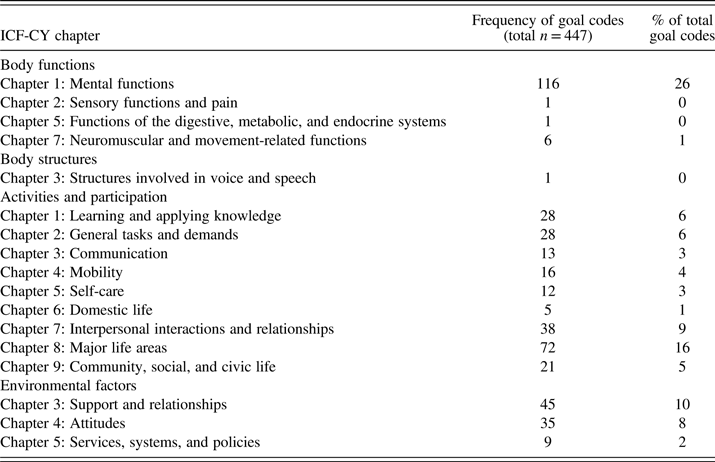
Eighty-seven different two-level classification goal codes were identified, spanning 17 different chapters (Table 2). The three most common chapters came from three different domains (BF, AP, and EF) and were mental functions (n = 116, 26% of total goal codes), major life areas (n = 72, 16% of total goal codes), and support and relationships (n = 45, 10% of total goal codes).
Distribution of goal codes across ICF-CY chapters

Common Two-Level Classification Goal Codes
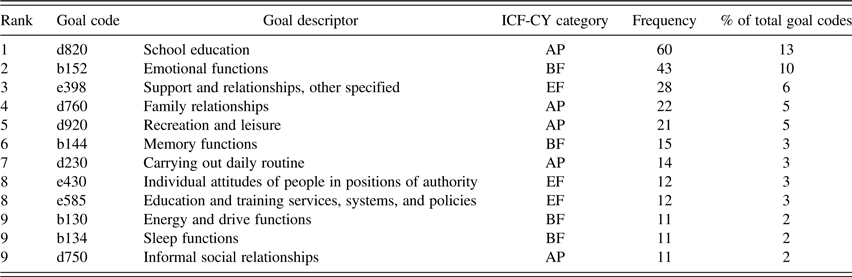
Twelve two-level classification goal codes were endorsed ≥10 times (Table 3). School education (d820, an AP code) was the most common two-level classification goal code (n = 60, 13% of total goal codes). This was followed by emotional functions (b152, a BF goal code; n = 43, 10% of total goal codes), support and relationships, other specified (e398, an EF goal code; n = 28, 6% of total goal codes), and family relationships (d760, an AP goal code; n = 22, 5% of total goal codes). The two-level classification code e398 (support and relationships, other specified) was commonly used for goals referring to a specific type of support that could not be coded for using the more specific support and relationship codes relating directly to family, friends, or people in positions of authority, for example.
The most common neuropsychological rehabilitation goal codes

Sex
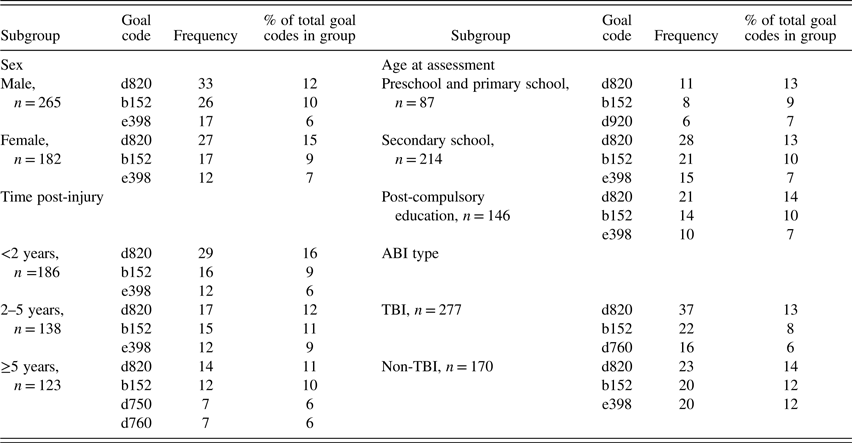
Sex did not appear to be associated with the proportion of goal codes across the different ICF-CY domains [χ2(2) = 4.12, V = .096, p = .13]. The top three two-level classification goal codes for both males and females were the same and were d820 (school education), b152 (emotional functions), and e398 (support and relationships, other specified) (Table 4)
The top three goal codes per subgroup

ABI = acquired brain injury; TBI = traumatic brain injury.
Age at Assessment
Figure 1 shows the distribution of goal codes across ICF-CY domains according to age at assessment. There was an overall association between age at assessment and the proportion of goal codes across the different ICF-CY domains [χ2(4) = 10.83, V = .11, p = .029]. There was an association with the proportion of EF goal codes [χ2(2) = 9.14, V = .14, p = .010], with the proportion of EF goal codes increasing with age. However, the effect size was small, and when this was corrected for multiple comparisons, it did not reach the level of significance (corrected level of significance, p < .005). There was also an association between the proportion of AP goal codes [χ2(2) = 6.93, V = .12, p = .031] with the proportion of AP goals decreasing with age. The effect size was small, and the significance was not maintained when corrected for multiple comparisons (corrected level of significance, p < .005). There was no association between age group and BF goal codes [χ2(2) = .25, V = .024, p = .88]. The top two two-level classification goal codes (Table 4) in all age groups were d820 (school education) and b152 (emotional functions). e398 (support and relationships, other specified) was the third most common goal code in secondary school and post-compulsory education participants, and d920 (recreation and leisure) was the third most common in preschool and primary school participants.
Distribution of goal codes across ICF-CY domains according to age at assessment.

ABI Type
The distribution of goal codes across the ICF-CY domains according to ABI type is shown in Figure 2. There was an overall association between ABI type and the proportion of goal codes across the different ICF-CY domains [χ2(2) = 6.77, V = .12, p = .034]. ABI type was associated with the proportion of EF goal codes [χ2(1) = 6.85, V = .12, p = .0089], with a greater proportion of EF goal codes in the non-TBI group. This was not significant when corrected for multiple comparisons (corrected level of significance p < .005), and the effect size was small. There was no association between ABI type and the proportion of BF [χ2(1) = .47, V = .033, p = .49] goal codes. There was no association between ABI type and the proportion of AP [χ2(1) = 1.99, V = .067 p = .16] goal codes. The top two two-level classification goal codes in participants with both TBIs and non-TBIs were d820 (school education) and b152 (emotional functions). The third most common two-level classification goal codes were d760 (family relationships) in participants with TBIs and e398 (support and relationships, other specified) in the non-TBI group.
Distribution of goal codes across ICF-CY domains according to ABI type. ABI = acquired brain injury; TBI = traumatic brain injury.

Time Post-Injury
There was no association between time post-injury and the proportion of goal codes across the different ICF-CY domains [χ2(4) = 5.47, V = .078, p = .24]. The top two two-level classification goal codes in all groups were d820 (school education) and b152 (emotional functions) (Table 4). The third most common two-level classification goal code was e398 (support and relationships, other specified) in participants under 5 years post-injury. In participants ≥5 years post-injury, goal codes d760 (family relationships) and d750 (informal social relationships) jointly became the third most common.
DISCUSSION
This study sought to increase understanding of the neuropsychological rehabilitation goals that young people identify in the post-acute community phase following an ABI, extending previous literature on post-ABI outcomes that focused more on impairments such as neuropsychological functioning and psychiatric diagnosis. The results provide a picture of what young people with ABIs believe is important for wellness. The broad range of community neuropsychological rehabilitation goals identified is in keeping with previous studies (Mbale et al., Reference Mbale, Taylor, Brabin, Mallewa and Gladstone2017; McCulloch et al., Reference McCulloch, De Joya, Hays, Donnelly, Johnson, Nirider, Roth, Saliga and Ward2016) and reflects the diversity of the common consequences of childhood brain injury (Anderson & Catroppa, Reference Anderson and Catroppa2006), which may need to be met by community services. Our first hypothesis was that the community neuropsychological rehabilitation goals of young people with ABIs will span across the ICF-CY domains of BS, BF, AP, and EF. This hypothesis is partially supported, as while there was a large proportion of goals in the BF, AP, and EF domains, only one goal was a BS goal code. This is likely explained by the setting as children with physical (body structure) rehabilitation goals may have been seen within different services.
The associations found in this study were of a small effect size and were not significant when corrected for multiple comparisons. There was no association between sex and the types of goals young people with ABIs had, and no difference in the most common two-level classification goal codes that males and females had. Consequently, our second hypothesis that there will be no association between sex and the distribution of goal codes across the ICF-CY domains, but the most common two-level classification goal codes will be different for males and females, is only partially supported. There was an association between age and goal types with an increasing emphasis on EF as children moved into, and progressed through, adolescence. This supports our third hypothesis that the proportion of EF goal codes will increase with increasing age at assessment. Our fourth hypothesis that young people with non-traumatic brain injuries will show a greater proportion of EF goal codes than those with TBIs is supported. There was an association between ABI type and the proportion of EF goal codes, with young people with non-traumatic ABIs having a greater proportion of EF goal codes than those with TBIs. Our fifth hypothesis predicted that with increasing time post-injury the proportion of BF goal codes will decrease, and the proportion of AP goal codes will increase. This hypothesis was not supported as no association was found between time post-injury and the proportion of goal codes across the different ICF-CY domains. This suggests that goals around AP are highly important to young people at all points in the post-ABI journey.
Over half of the goal codes were AP goal codes, with 94% of participants having at least one AP goal code. These most commonly related to school education, family relationships, recreation and leisure, carrying out the daily routine, and informal social relationships. These aspects of participation are crucial to wellbeing in enabling young people to achieve a sense of purpose in society and fulfil their personal and social goals (Foresight, 2008), emphasizing the importance of a holistic approach to neuropsychological rehabilitation.
Without adequate support from family, friends, and the wider community, a young person’s ability to participate in meaningful life situations can be impaired after an ABI (Thompson et al., Reference Thompson, Elliott, Willis, Ward, Falkmer, Falkmer, Gubbay and Girdler2016). Participation needs to be considered alongside contextual and environmental factors (Ciccia & Threats, Reference Ciccia and Threats2015; Greenham et al., Reference Greenham, Hearps, Gomes, Rinehart, Gonzalez, Gordon, Mackay, Lo, Yeates and Anderson2015), including family functioning (Yeates et al., Reference Yeates, Taylor, Walz, Stancin and Wade2010) and the relationships with others that are key components of wellness. Consequently, for neuropsychological rehabilitation services to affect change for young people with ABIs, it would seem crucial to engage their school, family, friends, and the wider community.
Emphasizing the importance of considering participation alongside environmental factors, the top two-level classification goal code irrespective of age, sex, injury type, and time post-injury was to participate in school education (d820). There are cognitive, social, behavioral, and psychological aspects to education (Ylvisaker et al., Reference Ylvisaker, Todis, Glang, Urbanczyk, Franklin, DePompei, Feeney, Maxwell, Pearson and Tyler2001) that contribute to the importance of this goal. However, understanding regarding ABIs among educators may be limited (Linden et al., Reference Linden, Braiden and Miller2013). This is reflected in the common two-level classification of environmental goal codes around individual attitudes of people in positions of authority (e430 – which for most young people was a reference to the attitudes of teachers), and education and training services, systems, and policies (e585). This supports the important role of the attitudes and understanding of those around young people with ABIs in shaping supportiveness of relationships, on the one hand, and scaffolding for learning, on the other (Gracey et al., Reference Gracey, Olsen, Austin, Watson, Malley, Reed, Byard and Fine2015). Consequently, community neuropsychological rehabilitation services should ensure they are resourced to work closely alongside school to optimize a child or young person’s participation, as well as support their longer-term education and training.
The difference in goal types across age bands supports a conceptualization of rehabilitation that maintains a strong developmental focus (Anderson & Catroppa, Reference Anderson and Catroppa2006; Byard, Fine & Reed, Reference Byard, Fine and Reed2011). As young people with ABIs progress through adolescence, the psychosocial (Steinberg, Reference Steinberg2008) and educational (Gamino et al., Reference Gamino, Chapman and Cook2009) scaffolds that exist routinely for younger children begin to fall away as society demands increasing independence. However, for adolescents with ABIs, the neuropsychological consequences increase the challenge of this, and there is an increasing need for environmental support, in terms of supportive relationships, the attitudes of others, and services, systems, and policies. The developmental change in rehabilitation goals was also seen at an individual code level, with secondary school and post-compulsory education young people having a greater preference for support and relationships (e398), while primary school children placed more importance on recreation and leisure (d920).
The greater proportion of EF goal codes seen in young people with non-traumatic ABIs may reflect a lower level of societal awareness of the impact of relatively rare causes of pediatric ABIs, such as strokes, infections, and brain tumors (NHS England, 2013), on young people compared with TBIs. This interpretation is supported by the increased importance of the two-level classification code e398 (support and relationships, other specified) in the non-TBI group. However, the small effect size and lack of significance between ABI types and the types of goals suggests that services can be designed to meet the needs of young people with any ABI rather than being restricted to specific types of ABIs or arbitrarily based on diagnostic criteria, as indicated in UK’s specialist healthcare commissioning guidance (NHS England, 2013).
This study is further evidence that young people with ABIs require appropriate psychological and psychiatric support. Emotional functioning was the second most common goal across sex, age at assessment, and time post-injury groups. The development of psychiatric disorders in young people after ABIs is common (Max et al., Reference Max, Wilde, Bigler, MacLeod, Vasquez, Schmidt, Chapman, Hotz, Yang and Levin2012), and the levels of emotional problems between young people with ABIs and children referred to mental health service have been found to be similar (Gracey et al., Reference Gracey, Watson, McHugh, Swan, Humphrey and Adlam2014). Consequently, this study supports models of rehabilitation that include a strong psychological perspective (Gracey et al., Reference Gracey, Olsen, Austin, Watson, Malley, Reed, Byard and Fine2015) to support wellness.
Strengths and Limitations
This study used a relatively large and heterogeneous clinical sample, with a large number of goal codes for analysis, and 90% initial concordance between coders. However, the findings may not be generalizable as it was conducted within a single service and the participants had highly complex psychosocial needs. Further research is needed to assess the validity of these findings across different clinical populations of young people with ABIs and in different services. The role of healthcare professionals in the goal-setting process may have biased the results, but the 87 different two-level classification goal codes are supportive of young people being encouraged to identify goals that reflected their individual needs. The effect sizes seen in this study were small and did not meet the level of significance when the Holm–Bonferroni correction was applied, thus necessitating cautious interpretation. While the use of ICF-CY enabled a large number of goals to be analyzed, the richness of individual goals was lost, and this may have been a reason why no differences were detected in the goals of males and females. Further qualitative research exploring the individual rehabilitation goals of young people with ABIs could build on the findings of this study. Associations about wellness can only be inferred from this study as no specific measures of wellbeing or wellness were administered.
CONCLUSION
Young people with ABIs approach community neuropsychological rehabilitation with a wide range of goals that require an individualized and interdisciplinary approach and should be viewed with a context-sensitive and developmental perspective. Overwhelmingly, young people with ABIs want to participate alongside their uninjured peers in school, family, and community life. Supporting this, both directly and through a consideration of environmental factors, is vital for the wellness of young people. Consequently, the findings of this research support models of neuropsychological rehabilitation that combine direct rehabilitative interventions with attention to social context, psychological understanding, and systemic working across agencies. Community neuropsychological rehabilitation services should ensure that they work in an individualized, context-sensitive, and interdisciplinary manner to optimize the environmental supports around a young person with ABI to maximize their participation. Ensuring that young people and their families have access to psychological support that understands and addresses their emotional difficulties is also vital. Ongoing research into participation-focused interventions and outcome measures, and measures of environmental or contextual factors, is now required to ensure that the goals of young people with ABIs can be addressed in an evidence-based manner.
ACKNOWLEDGMENTS
We thank the young people and their families who have made this work possible, and the clinical team who have supported them through their neuropsychological rehabilitation journeys. F.G. and S.W. were supported by the National Institute of Health Research (NIHR) Collaborations for Leadership in Applied Health Research and Care East of England Programme. R.H.M. was supported by an academic and clinical fellowship in psychiatry jointly funded by the University of Cambridge and Cambridgeshire and Peterborough NHS Foundation Trust. The views expressed are those of the authors and not necessarily those of the NHS, the NIHR, the University of Cambridge, or the Department of Health and Social Care.
CONFLICTS OF INTEREST AND FUNDING
S.W. holds a clinical management role overseeing the service within which the data were collected. The authors declare that there are no other conflicts of interest. There are no sources of financial support to declare for this paper.