




Introduction
Money is a puzzling social phenomenon. People take to the use of money as easily and thoughtlessly as a duck takes to water, yet they possess only a ‘weak form of inductive knowledge’ (Simmel, [Reference Simmel and Frisby1900] Reference Simmel and Frisby2004: 191) about money and know little or nothing about the modern monetary order. Few are familiar with the distinction between public cash and private credit money or with the gradual privatization of payment methods. Many still assume that money is backed by precious metals such as gold, though the gold standard was abolished internationally in 1971. Money myths like these – about the state’s printing press or the persistence of the gold standard – are disseminated widely among the general population (Kraemer et al., Reference Kraemer, Jakelja, Brugger and Nessel2020). Such myths are not merely illusory or fictional but are collectively shared and deeply rooted in society, possessing remarkable resilience even in extraordinary times of crisis such as the global financial crisis of 2008 and the euro crisis of 2010.
Beyond its economic function, money is a social institution, the stability of which depends on shared understandings, beliefs, and expectations (Zelizer, Reference Zelizer1994; Simmel, [Reference Simmel and Frisby1900] Reference Simmel and Frisby2004). In this sense, the functioning of the modern monetary order relies not only on formal expertise and institutional design but also on widely shared forms of practical knowledge and beliefs (Carruthers, Reference Carruthers2011; Dodd, Reference Dodd2014). Recent research on the social foundations of monetary order has emphasized that trust in financial institutions, monetary governance, and credit systems is sustained by such socially embedded understandings, even when explicit knowledge is limited or absent (Carruthers and Ariovich, Reference Carruthers and Ariovich2010; Beckert, Reference Beckert2016).
How broadly do such myths extend? While existing findings suggest that the general public possesses limited knowledge of the monetary order, this study examines whether this also holds true for professionals responsible for financial decision-making. We draw on survey data, collected in 2023, to examine the knowledge of regional politicians and business professionals in the Austrian state of Styria. The findings demonstrate that the dissemination of money myths extends widely, not only to the general public, but even to some extent to professional actors with budget responsibilities. By focusing on monetary beliefs among regional professional groups, our empirical study deepens understanding of the socio-cultural foundations of the complex modern monetary order, contributing to debates on how financial systems remain legitimate and operational despite widespread epistemic opacity.
The article proceeds as follows. The first section provides a brief overview of existing research on public knowledge and ignorance about the modern monetary order and discusses the relevance of a sampling strategy focusing on regional politicians and business professionals. The second section outlines the standardized survey methodology that we employed, focusing on knowledge about money creation and money backing. The analyses that we conducted addressed the following key questions: Do regional politicians and business professionals know how money is created and what institutional role private commercial banks play in the process of money creation? Do respondents know that modern money is not backed by gold or other precious metals? The third section discusses our results. We contrast our empirical findings with results from a previous population-wide survey on money knowledge in Austria (Kraemer and Jakelja, Reference Kraemer and Jakelja2026), showing that even among regional politicians and business professionals, illusions about money creation and money backing by gold are widespread. The fourth section and the conclusion reflect on the broader significance of our results.
In contrast to approaches that classify the beliefs that we capture as ‘folk ideas’ (Braun, Reference Braun2016; Diessner, Reference Diessner2023) or ‘fictional expectations’ (Beckert, Reference Beckert2016), we argue that the concept of money myths is better suited to analyzing collective beliefs about money creation and money backing that extend beyond the general population to mid-level decision-makers in politics and business. Whereas fictional expectations relate to imagined future states under uncertainty, money myths are primarily oriented toward the current foundations of the monetary order, often transplanting past arrangements, such as gold backing, onto the present. Building on the notion of folk theories, the concept of money myths emphasizes that such beliefs are not merely cognitive simplifications but socially shared belief structures that provide symbolic anchors in a monetary system characterized by high institutional opacity. In playing this anchoring role, these myths help to sustain a basic sense of ontological security in everyday monetary life.
State of research
Money knowledge of the population
Since the financial crisis of 2008, a growing debate on money knowledge has emerged within the social sciences, focusing particularly on the concept of financial literacy. Scholars, primarily from the field of economics, have studied issues related to financial planning, borrowing, spending, and investing, as well as people’s understandings of financial risks, fees, and market dynamics (Lusardi and Mitchell, Reference Lusardi and Mitchell2011; Reference Lusardi and Mitchell2023; Kaiser and Menkhoff, Reference Kaiser and Menkhoff2017; Celiktas and Yilmaz, Reference Celiktas and Yilmaz2021, Reference Lusardi and Mitchell2023). Based on the assumption that higher levels of financial literacy improve financial decision-making, many scholars advocate for the expansion of financial education programs both within and outside the educational system (Reifner and Schelhowe, Reference Reifner and Schelhowe2010).
Sociology, and especially the new economic sociology (White, Reference White1981; Granovetter, Reference Granovetter1985), has long ignored the modern financial and monetary order as a subject of research. Over the past two decades, however, numerous studies have emerged analyzing financial markets (Knorr-Cetina and Bruegger, Reference Knorr-Cetina and Bruegger2002; MacKenzie and Millo, Reference MacKenzie and Millo2003; Krippner, Reference Krippner2005; Reference Krippner2011; Froud et al., Reference Froud, Johal, Leaver and Williams2006; Preda, Reference Preda2009; Goldstein and Fligstein, Reference Goldstein and Fligstein2017) and the institutions of the monetary order (Carruthers, Reference Carruthers2011; Ganßmann, Reference Ganßmann2011), with a particular emphasis on the role of central banks (Velthuis, Reference Velthuis2015; Braun, Reference Braun2016; Wansleben, Reference Wansleben2023; Westermeier, Reference Westermeier2024) and the terms of the legal mandate to create new money (Huber, Reference Huber2017; Sahr, Reference Sahr2022).
Alongside these institutionally oriented approaches within the sociology of money, a cultural sociology of money has emerged, which emphasizes that money is not merely a neutral medium of exchange but is embedded in social relations, moral classifications, and culturally specific meanings (Zelizer, Reference Zelizer1994; Dodd, Reference Dodd2014; Bandelj, Wherry and Zelizer, Reference Bandelj, Wherry and Zelizer2017). This body of literature is important for the present argument because it demonstrates that monetary practices are always mediated by shared interpretations.
Despite their valuable contributions, both approaches within the sociology of money have paid comparatively little attention to the question of how actors understand – or misunderstand – the institutional foundations of the monetary order itself. Systematic empirical research on public knowledge about the monetary order remains scarce. In his discussion of understandings of money, Hook (Reference Hook2022: 210–211) refers to two indicative but relatively methodologically opaque sources: a Swiss master’s thesis (Nietlisbach, Reference Nietlisbach2015) and a survey conducted by the monetary reform initiative Positive Money (2014) among British Members of Parliament. While both suggest that only small minorities recognize the role of private banks in money creation, these sources are not directly comparable to representative survey evidence. To our knowledge, the Austrian population survey by Kraemer et al. (Reference Kraemer, Jakelja, Brugger and Nessel2020) remains one of the few systematic empirical studies on public knowledge of money creation and monetary backing. This study found that only 13% of respondents knew that private banks create money by issuing credit (Kraemer et al., Reference Kraemer, Jakelja, Brugger and Nessel2020: 236). Importantly, this lack of knowledge was found to exist across social groups and did not vary substantially by gender, age, education, or class.
Kraemer et al. (Reference Kraemer, Jakelja, Brugger and Nessel2020) distinguish between knowledge, misconceptions or fallacies, and money myths. Respondents are classified as possessing money knowledge if they know that money is created not only by central banks in the form of banknotes and coins but also by commercial banks through lending; if they know that modern money is not backed by tangible assets such as gold; and if they correctly identify the institutional role of the European Central Bank in stabilizing the value of the euro. By contrast, misconceptions or fallacies include a number of false assumptions, such as the belief that private banks print money, that companies create money by issuing shares, or that governments create money by issuing bonds. Money myths refer more specifically to socially shared beliefs such as the assumption that money is created exclusively by the state ‘printing press’ or that all money is ‘backed’ by gold (cf. Kraemer et al., Reference Kraemer, Jakelja, Brugger and Nessel2020: 245, 236).
From knowledge to myths
Myths are prevalent even in modern economies. Contrary to what a simplified reading of the Weberian theory of rationalization might suggest (Weber, Reference Weber, Roth and Wittich1978), economic life is by no means characterized solely by calculative practices and the pursuit of efficiency; it remains replete with contingency and unpredictability (Beckert, Reference Beckert2016). Rather than merely impeding economic action, uncertainty can itself become an object of capitalization, as the emergence of complex financial products such as derivatives has shown (LiPuma and Lee, Reference LiPuma and Lee2004; Pryke, Reference Pryke2007; Lépinay, Reference Lépinay2011). At the same time, contingency in modern economies is managed through symbolic structures that render uncertainty actionable. Anthropological studies of finance have shown that financial markets are organized not only by technical procedures but also by temporal expectations, utopian imaginaries, theological assumptions, and relational metaphors (Maurer, Reference Maurer2002; Miyazaki, Reference Miyazaki2003; Riles, Reference Riles2004). Myths can be understood as part of this broader symbolic repertoire: they satisfy a need for simplified explanations and help actors cope both with the contingency of economic action and the value relativism of the money-driven modern economy (Simmel, [Reference Simmel and Frisby1900] Reference Simmel and Frisby2004).
Myths take on a particularly significant role in relation to money because of money’s opaque, mysterious qualities and the way in which it saturates social life (Deutschmann, Reference Deutschmann2011; Ganßmann, Reference Ganßmann2011; Yuran, Reference Yuran2015). Economic actors sell elaborately produced goods in exchange for digital sequences of numbers (deposits) or pieces of paper (cash). The vast majority of people are willing to engage in dependent wage labor in order to earn income with which to buy desired goods. Meanwhile, economic experts have disagreed for generations on what money really is, as reflected in long-standing debates between exchange and credit theorists of money (e.g., Hicks, Reference Hicks1967; Kiyotaki and Wright, Reference Kiyotaki and Wright1989; Wray, Reference Wray1998; Ingham, Reference Ingham2004a). But what exactly do we mean when we refer to money myths?
Conceptual clarification: Folk theories, fictional expectations, and money myths
In the social sciences, popular beliefs about money have been described in different ways: as ‘money illusions’ or ‘money myths’ (Schmölders, Reference Schmölders1966; Deutschmann, Reference Deutschmann2011; Ganßmann, Reference Ganßmann2011; Simmel, [Reference Simmel and Frisby1900] Reference Simmel and Frisby2004), more recently as ‘folk theories’ or ‘folk ideas’ (Braun, Reference Braun2016; Diessner, Reference Diessner2023), and in broader economic sociology as ‘fictional expectations’ (Beckert, Reference Beckert2016). Braun’s notion of folk theories of money (2016) refers to widely shared public understandings of how money works, such as the idea that money is a quantity directly controlled by central banks. Such beliefs matter because the legitimacy of central banks depends, at least in part, on being perceived as acting in accordance with dominant public understandings, even where these diverge from the actually existing institutional mechanisms of money creation. Research has also shown that misconceptions about central bank money creation are not confined to the general public but can also inform expert practices, even within central banks themselves (Holmes, Reference Holmes2014; Diessner, Reference Diessner2023). While these approaches provide important insights, they do not fully capture the symbolic and stabilizing function of the beliefs examined here. The concept of money myths proposed in this paper foregrounds precisely this function, locating it within everyday understandings of the monetary order under conditions of institutional complexity and epistemic opacity.
Beckert’s concept of fictional expectations captures the imaginary future states of the world that actors construct under conditions of fundamental uncertainty (Beckert, Reference Beckert2016). Beckert explicitly applies this argument to money when he argues that money relies on the fictional expectation that collectively accepted signs without intrinsic value will be accepted ‘as a means of payment in the future’ (Beckert, Reference Beckert2016: 106). This is an important point of departure, because it highlights the forward-looking temporal structure of monetary confidence. Money myths, however, differ analytically from fictional expectations because they are not primarily oriented toward an open and unknowable future but toward the assumed present and imagined past foundations of the monetary order. They do not project future states of the world but rather provide simplified and symbolically charged representations of how money is assumed to exist and to be grounded, for instance in gold, state authority, or central bank money creation. In this sense, money myths help make the present monetary order appear meaningful, reliable, and ontologically secure, whereas fictional expectations concern the anticipated continuation of monetary acceptance into the future.
In a more explicitly critical vein, Mellor (Reference Mellor2019) treats money myths as politically consequential misconceptions that obscure the social and public foundations of money. This perspective is useful because it shows that beliefs about money are not merely cognitive errors but can shape political imaginaries and institutional possibilities. Our use of the concept, however, differs in one important respect: rather than treating money myths primarily as misconceptions to be debunked, we conceptualize them as socially shared belief structures that help stabilize confidence in a monetary order that remains institutionally complex and epistemically opaque.
Against this backdrop, the concept of money myths developed here builds on the notion of folk theories while placing greater emphasis on their symbolic and stabilizing function. Money myths are socially shared belief structures that provide symbolic anchors in a monetary system characterized by high institutional opacity. Our definition thus resonates with classical anthropological approaches that understand myths as socially shared narratives contributing to the stabilization of social and institutional orders (Malinowski, Reference Malinowski1926). The following empirical analyses apply this distinction to examine how politicians and business professionals relate to different forms of monetary belief under conditions of epistemic opacity.
The two myths examined in this paper are the beliefs that money is backed by gold and created exclusively by state authorities or central banks (Kraemer et al., Reference Kraemer, Jakelja, Brugger and Nessel2020). These capture different symbolic dimensions of the monetary order. The belief that money is backed by gold is rooted in the desire for a time-stable anchor of monetary value in an otherwise volatile and unpredictable economy. Gold appears as a substantial and historically durable reference point that promises stability beyond the institutional fragility of modern fiat money. In this sense, the gold myth can be understood as one manifestation of what Vasantkumar (Reference Vasantkumar2019) calls ‘gold standard thinking’ – the persistence of precious-metalist understandings of monetary value after the abandonment of gold convertibility. In contrast, the belief that all money is created by state authorities or central banks simplifies the institutional complexity of money creation. It assumes that commercial banks merely mediate credit by lending depositors’ savings, whereas private banks in fact create deposit money through balance-sheet expansion when extending credit to firms or households (Reference McLeay, Radia and ThomasMcLeay et al.,2014; Hook, Reference Hook2022). Taken together, these two myths are not merely isolated errors of knowledge but simplified and symbolically charged understandings of how money is grounded and how it comes into existence.
Research focus: Professional money knowledge and money myths
Having conceptualized money myths as socially shared belief structures that stabilize confidence under conditions of epistemic opacity, the empirical question we pose is whether such beliefs are confined to the general population or persist even among actors with professional responsibilities in monetary, fiscal, and credit-related contexts. This question is highly pertinent because institutional complexity blurs the boundary between laypeople and experts: practical financial competence may coexist with limited explicit knowledge of the institutional foundations of money creation and money backing.
Existing research on professional and political knowledge in monetary and fiscal contexts has focused primarily on central banking and monetary-policy expertise, including communicative practices within central banks (Holmes, Reference Holmes2014), political views on monetary policy and central-bank accountability (Rose, Reference Rose2002; Ehrmann and Fratzscher, Reference Ehrmann and Fratzscher2011; Ferrara et al., Reference Ferrara, Masciandaro, Moschella and Romelli2022, Reference Ferrara, Masciandaro, Moschella and Romelli2023), and the influence of economists on fiscal policy, taxation, and technocratic policy regimes (Christensen, Reference Christensen2017; Reed, Reference Reed2018; Christensen and Mandelkern, Reference Christensen and Mandelkern2022). This literature shows that monetary and fiscal knowledge is shaped by specific institutional and professional settings. However, it provides little systematic comparative evidence on how actors outside central banking with budgetary or credit-related responsibilities understand the institutional foundations of money itself. In contrast to studies of financial literacy, which examine practice-oriented financial knowledge, studies of money illusions, which address the limited understanding of inflation, and studies in political economy, which focus on knowledge, trust, and institutional authority, our approach examines broader theoretical knowledge about the current monetary order among politicians and business professionals. What do people in positions of budgetary responsibility know about money creation and money backing? Do they know more than the general population, or do they rely on money myths?
To address this question, we surveyed regional politicians and business professionals about their beliefs concerning the institutional foundations of the monetary system, focusing particularly on money creation and money backing. The actors in our sample operate at middle levels of decision-making in the public and private sectors and are directly or indirectly involved in monetary and credit-relevant decisions: politicians decide on public budgets and new debt, while business professionals make or prepare credit-related decisions in small and medium-sized enterprises, for instance when financing investments or innovations. Despite their apparent differences, both groups occupy positions of regional responsibility that require them to routinely prepare for, make, and justify practical financial decisions. We therefore examine whether, compared to the general population, politicians and business professionals possess more knowledge about the monetary order. While the everyday responsibilities of these actors may involve closer engagement with monetary issues, these responsibilities might primarily require practical financial competence rather than explicit knowledge of the institutional foundations of fiat money, central bank money, and private credit money. This tension between practical financial competence and theoretical money knowledge is the starting point of our empirical analysis.
Methods
Case selection and comparative design
Survey data is particularly well suited to capturing the dissemination of shared beliefs about financial and monetary institutions because it allows for the identification not only of individual misconceptions but also of socially patterned forms of knowledge and ignorance. Our empirical analysis combines two survey datasets that differ in scope and sampling logic but are analytically complementary. The first is a representative survey of the residential population in Austria conducted in 2017 (Kraemer and Jakelja, Reference Kraemer and Jakelja2026), which provides a population-level benchmark for the distribution of money knowledge. To our knowledge, this remains one of the few representative population surveys that systematically capture knowledge of money creation and money backing using standardized measures.
The original survey (cf. Kraemer and Jakelja, Reference Kraemer and Jakelja2026) included standardized items that operationalize money knowledge across three dimensions: money creation, money backing, and institutional responsibility for the value of money. In the present article, these data are reanalyzed with a focus not on knowledge per se, but on the prevalence of common misconceptions, specifically those defined above as money myths. Accordingly, the analysis is less concerned with the overall scores across the three dimensions of money knowledge and instead focuses on specific combinations of answers, above all those indicating the belief that money is backed by gold and the belief that money is created exclusively by central banks.
The second dataset consists of two original surveys conducted in 2023 among regional politicians and business professionals in the Austrian federal state of Styria. These surveys are not intended to be representative of all professionals in Austria. Rather, they provide a structured and empirically accessible case that allows for a controlled comparison between the general population and specific groups of actors who are routinely involved in fiscal, budgetary, or credit-related decision-making.
Styria is analytically relevant because, as one of Austria’s economically significant federal states, it combines a diversified economic structure with marked internal variation. It includes the metropolitan area of Graz – a university city, administrative center, and hub for knowledge-intensive services – as well as extensive rural regions shaped by small and medium-sized enterprises, industrial production, tourism, and agriculture. This combination of urban and rural contexts, service and industrial sectors, and heterogeneous socio-economic structures makes Styria a suitable setting for exploring how monetary beliefs are distributed across different segments of regional professionals.
The regional focus was also shaped by the design of the primary data collection methods. Data collection was integrated into a teaching project, and field access to business professionals was gained through a collaboration with the Styrian Economic Chamber (Wirtschaftskammer). While such access did not eliminate potential selection biases or ensure a statistically representative sample, it enabled the recruitment of respondents from a broad range of economic sectors and firm sizes. Our comparative design is therefore best understood as enabling a contrast to be drawn between a population-level benchmark and a regionally grounded professional sample. Our aim is not to generalize statistically from Styria to Austria as a whole but to examine whether and to what extent patterns observed in the general population can also be found among actors with professional responsibilities in economic and political fields.
Survey instrument and items
The instruments of the regional surveys included a set of standardized items designed to capture respondents’ understandings of money creation and monetary backing. Respondents were presented with multiple-choice and true/false questions addressing, first, assumptions about the institutional sources of money creation and, second, beliefs concerning the backing of money. The wording of the questions followed the instruments used in the population survey (Kraemer et al., Reference Kraemer, Jakelja, Brugger and Nessel2020; for full documentation see Kraemer and Jakelja, Reference Kraemer and Jakelja2026) to ensure comparability across samples. Full question wording and item order are provided in English translation in Appendix 1.
Sampling and sample characteristics
To investigate whether regional professionals know more about the institutional foundations of the modern monetary order than the general population, we carried out three online surveys of regional actors in politics, business, and public administration or statutory corporatist organizations (Sozialpartner). Due to insufficient sample sizes among public servants working in administration or statutory corporatist organizations, the present analysis is limited to the two surveys of politicians and business professionals. The sample of politicians to whom we sent an online questionnaire was prepared with the help of students, who created a mailing list of all Styrian politicians holding office at the European, national, regional, or municipal level. The response rate was very high at 34% (395 of 1149); however, the survey was only completed by 70% of those respondents (275). The survey for business professionals was administered online and promoted through the newsletter of the Styrian Economic Chamber, the regional branch of a compulsory association for businesses in Austria. While we do not have further information on the response rate to this survey, the completion rate among respondents who started the survey was higher than in the sample of politicians (79% or 160 out of 203). The two surveys analyzed here were administered between July and August 2023. No incentives were provided.
Our sample of politicians had an average age of 51 years (SD = 12.0). 74% of the sample were male, while 26% were female. 36% of politicians held a university degree. In terms of political affiliation, most participants were members of either the conservative Austrian People’s Party (ÖVP; 43%) or the Social-Democratic Party (SPÖ; 32%). Members of the far-right Freedom Party (FPÖ; 5%) were clearly underrepresented in comparison to their share in the original mailing list, whereas members of the Greens (6%), the liberal NEOS (1%), and the Communist Party (KPÖ; 3%) were overrepresented. The remaining 10% identified themselves as being either independent candidates or members of a local party. Of all surveyed politicians, 80% reported maintaining regular employment or enterprise alongside their political mandate. This was in part explained by the high share of local councillors (66%), vis-à-vis a smaller number of (vice-)mayors (27%) and regional politicians holding office at the state, federal, or European level (4%). A small number (3%) of respondents preferred not to state their current office.
Our sample of business professionals had an average age of 53 years (SD = 11.4), with 68% being male and 32% female. 32% of the surveyed professionals held a university degree. The composition of businesses by economic sector was as follows: Craft (58 businesses; 36%), Consulting (42 b.; 26%), Commerce (37 b.; 23%), Tourism (10 b.; 6%), Transportation (6 b.; 4%), Industry (4 b.; 3%), and Banking/Insurance (3 b.; 2%). Most businesses were small: single-person businesses were most represented (65 b., 41%), followed by businesses of 2–9 employees (59 b.; 37%), of 10–49 employees (21 b.; 13%), of 50–249 employees (10 b.; 6%), and of 250 or more employees (5 b.; 3%).
The data from politicians was weighted by party affiliation in combination with level of governance, based on the original mailing list. The weighting of business professionals was based on population data on the economic structure of Styria and accounted for firm size cross-tabulated with business sector. Due to this weighting process, the number of valid cases for estimates in the upcoming section differs numerically from the realized sample sizes; these, however, do not reflect the omission of cases due to missing values. Further details on the survey methodology employed and the sample characteristics are provided in Appendix 2.
Results
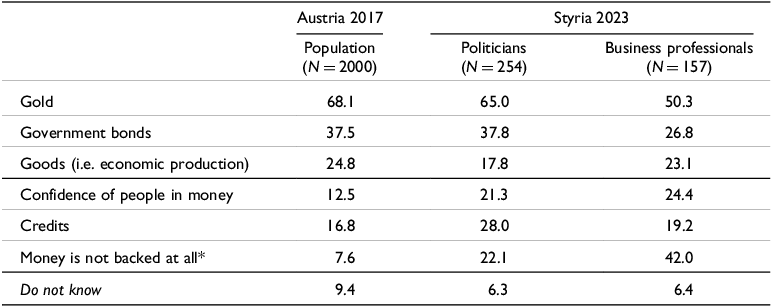
As noted above, the prevalence of myths was captured using the ‘money knowledge’ index constructed by Kraemer et al. (Reference Kraemer, Jakelja, Brugger and Nessel2020). Table 1 summarizes the weighted frequency distribution of responses to the multiple-choice question on the backing of money. Compared to the general population (8%), significantly more politicians (22%) and business professionals (42%) knew that money is not backed at all, with the difference in knowledge between the two professional groups possibly stemming from differing professional tasks and the types of information with which they regularly engage. Nevertheless, many regional politicians (65%) and business professionals (50%) surveyed also stated that money is backed by gold, close to the 68% who shared this belief in the broader population.
Knowledge about the backing of money.

Table 1. Long description
A table comparing knowledge about the backing of money among different groups in Austria and Styria. The table has 8 rows and 4 columns. The columns are labeled as Austria 2017 Population (N=2000), Styria 2023 Politicians (N=254), and Styria 2023 Business professionals (N=157). The rows are labeled as Gold, Government bonds, Goods (i.e., economic production), Confidence of people in money, Credits, Money is not backed at all, and Do not know. Row 1: Gold, 68.1, 65.0, 50.3. Row 2: Government bonds, 37.5, 37.8, 26.8. Row 3: Goods (i.e., economic production), 24.8, 17.8, 23.1. Row 4: Confidence of people in money, 12.5, 21.3, 24.4. Row 5: Credits, 16.8, 28.0, 19.2. Row 6: Money is not backed at all, 7.6, 22.1, 42.0. Row 7: Do not know, 9.4, 6.3, 6.4.
Notes: Displayed are the shares of the sample that ticked the option (multiple choices were possible). The option with an asterisk (*) is the only correct answer according to Kraemer et al. (Reference Kraemer, Jakelja, Brugger and Nessel2020).
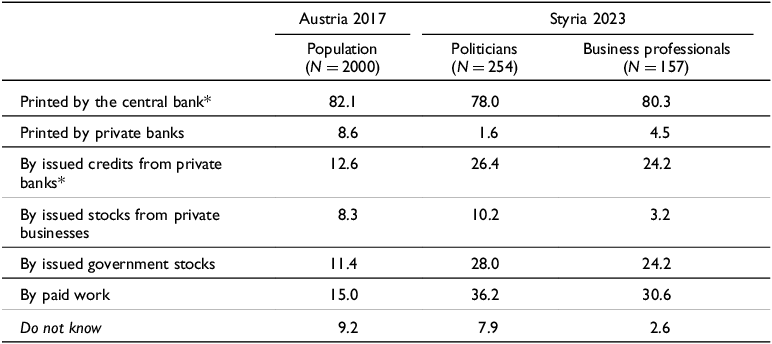
The second dimension of the money knowledge index, capturing beliefs about money creation, is displayed in Table 2. The results show that a high share (about four out of five) of respondents across all three samples knew that money is printed by the central bank. A much lower share, meanwhile, knew that money is also created by private banks when they extend credit. The shares of those with knowledge about private bank money creation were, however, about twice as high among politicians (26%) and business professionals (24%) compared to the general population in 2017 (13%). Interestingly, the belief that money is created by paid work was also more prevalent among professionals (politicians 36% and business professionals 31%) than among the general population (15%), possibly reflecting renewed debates on inflation, fiscal deficits, and monetary policy in the period preceding the survey.
Knowledge about the creation of money.

Table 2. Long description
The table compares beliefs about money creation among the general population in Austria in 2017 and among politicians and business professionals in Styria in 2023. It has three columns: Austria 2017 Population (N = 2000), Styria 2023 Politicians (N = 254), and Styria 2023 Business professionals (N = 157). The rows represent different beliefs about money creation, including printed by the central bank, printed by private banks, issued credits from private banks, issued stocks from private businesses, issued government stocks, by paid work, and do not know. Each cell contains a percentage value indicating the share of respondents with that belief. Notable trends include a high share of respondents knowing that money is printed by the central bank and lower shares knowing that money is created by private banks. Politicians and business professionals had higher knowledge about private bank money creation compared to the general population.
Notes: Displayed are the shares of the sample that ticked the option (multiple choices were possible). The options marked with asterisks (*) are in combination the only correct answer according to Kraemer et al. (Reference Kraemer, Jakelja, Brugger and Nessel2020).
To summarize, we conducted online surveys of regional politicians and business professionals in order to examine differences in money knowledge in relation to the findings of a previous study of the population at large (Kraemer et al., Reference Kraemer, Jakelja, Brugger and Nessel2020). The following sections interpret the results, addressing first the myth that money is backed by gold, and second, the myth that money is created solely by the central bank’s printing press. Each money myth is examined by first introducing its socio-cultural genesis and subsequently linking it to the empirical findings.
Money backing
This section first reconstructs why the belief in a commodity-based foundation of money remains historically and culturally plausible before turning to the empirical prevalence of the gold myth. In historical, cultural, and political–economic research, the importance of precious metals such as gold and silver for human societies has been studied extensively (Bernstein, Reference Bernstein2000; Zorach and Phillips, Reference Zorach and Phillips2016; Mountford and Tuffnell, Reference Mountford and Tuffnell2018). This literature has focused, in particular, on the central function of the ‘gold standard’ in the development of modern token money (Bordo and Schwartz, Reference Bordo and Schwartz1984; Eichengreen, Reference Eichengreen1992; Bordo, Reference Bordo1999; Knafo, Reference Knafo2006).
Although modern fiat money is no longer backed by gold, the belief that money requires a commodity-based anchor remains widespread. This belief draws part of its plausibility from the historical experience of European monetary orders, in which metallic coinage, paper money, credit instruments, and later gold-backed monetary regimes coexisted in complex ways. As Ingham (Reference Ingham2004b) argues, by the late seventeenth century a ‘dual monetary system’ of private credit and public metallic coinage had emerged unevenly across Europe, with the two forms remaining structurally distinct before their subsequent hybridization in England through formal convertibility. The Austrian case illustrates a related historical layering. The Habsburg monarchy introduced paper money in the form of ‘Bancozettel’ in the eighteenth century, while the ‘Maria-Theresien-Taler’ was introduced in 1751 as a trade coin beyond the territorial reach of the issuing state (cf. Jobst and Kernbauer, Reference Jobst and Kernbauer2016). While such examples do not directly explain the contemporary gold myth, they show why the idea that money requires a metallic or commodity-based anchor remains culturally plausible.
The question of what should ground monetary value also surfaced as an open political conflict in the United States. Carruthers and Babb (Reference Carruthers and Babb1996) show how the conflict between ‘greenbackers’ and ‘bullionists’ in postbellum America made the social construction of money publicly visible in a moment of monetary crisis. In the aftermath of the Civil War, greenbackers defended state-issued paper money as a politically adjustable monetary form, while bullionists advocated a return to gold-backed money as a safeguard against arbitrary state intervention. In ordinary times, however, the constructed character of money must remain collectively backgrounded for money to function smoothly as a social institution, as Mary Douglas’ (Reference Douglas1986) theory of institutions would suggest.
The sociology of money adds a further layer to this argument by showing how modern money becomes increasingly detached from material substance. Simmel ([Reference Simmel and Frisby1900] Reference Simmel and Frisby2004: 149) describes the increasing symbolization of money from a cultural-historical perspective. According to Simmel, money progressively sheds its substantive value: while earlier forms of money were materially tied to valuable substances such as gold or silver, modern money increasingly takes the form of token money without intrinsic value, no longer deriving its validity from its material substance, but rather from its capacity to indicate the relative value of demanded goods (Ingham, Reference Ingham2004a). In this form, money becomes an ‘absolute’ means, since its use is not tied to any specific economic, social, or symbolic purpose (Simmel, [Reference Simmel and Frisby1900] Reference Simmel and Frisby2004: 209). Yet this neutrality can be reappropriated through ‘fictional earmarking’ practices, which assign money to specific ends despite its formal fungibility (Kraemer et al., Reference Kraemer, Jakelja, Brugger and Nessel2024). The symbolic openness of modern money is also reflected in anthropological analyses that highlight how monetary and credit relations are embedded in moral and symbolic orders rather than being reducible to technical knowledge or material substance (Peebles, Reference Peebles2010).
Economic history adds a further qualification: gold did not simply disappear with the rise of modern token money but retained an institutional role well into the twentieth century. Following intermittent periods of gold standard adoption earlier in the nineteenth century, most countries operated under the gold standard from the 1880s until the First World War. The gold standard emerged again in modified form under the Bretton Woods system from 1944 to 1971, during which the U.S. dollar was convertible into gold at a fixed rate. The Bretton Woods system of fixed exchange rates represented the last historical phase of an international monetary system in which gold played a central role. Under this arrangement, the U.S. dollar functioned as the reserve currency and was fixed at USD 35 per troy ounce of gold (Bordo, Reference Bordo1999: 393–512). Even after the collapse of Bretton Woods in the early 1970s, gold has remained in high demand. This persistent demand is not easily explained by reference to gold’s material qualities alone. The German pioneer of behavioral economics Günter Schmölders (Reference Schmölders1966: 216–239; Reference Schmölders2006: 121–122) sought to capture this phenomenon through the concept of the ‘gold illusion’, the collective attribution of intrinsic meaning and importance to gold beyond its material qualities, such as scarcity, durability, or appearance. As Schmölders argues, gold has long been linked symbolically with ideas about immortality and stability.
Historical and cultural anthropological research has described the transcendental symbolism of gold and silver and the obsessive ‘greed’ for precious metals, placing emphasis on their intercultural, intertemporal, and supranational significance (Bernstein, Reference Bernstein2000; Ferguson, Reference Ferguson2008). Making the case for this line of research, Schmölders (Reference Schmölders1966) invites us to picture an extraterrestrial observer puzzling over the sheer effort and devotion humans invest in extracting gold from deep within the earth and cleaning, melting, stamping, and registering it – only to bury it again in hermetically sealed vaults. In addition to capturing the symbolic allure of precious metals, Schmölders’ thought experiment also points to a broader monetary logic, recently explored by Peebles and Luzzatto (Reference Peebles and Luzzatto2025). In their analysis of how gold sequestration might be used as a model for a proposed carbon-backed currency, the authors show that monetary value is not reducible to the material usefulness of the substance from which it is produced but depends instead on collective practices of extraction, certification, valuation, and storage that transform the substance in question into a monetary reserve. There are few obvious or simple explanations for such practices, especially in an age of fiat money and in view of gold’s more practical uses in industry, technological infrastructure, and product development. The following analysis nonetheless shows that the ‘gold illusion’ is not a phenomenon of the past.
Gold remains symbolically present today, even though its crucial role for the stability of political orders or the monetary system has vanished. To operationalize the prevalence of the myth concerning gold, we use the ‘money knowledge’ index developed by Kraemer et al. (Reference Kraemer, Jakelja, Brugger and Nessel2020), which was also included in the original dataset (for full documentation see Kraemer and Jakelja, Reference Kraemer and Jakelja2026). From this index, we employ the question concerning beliefs about what money is backed by and analyze the share of respondents selecting the option ‘gold’.
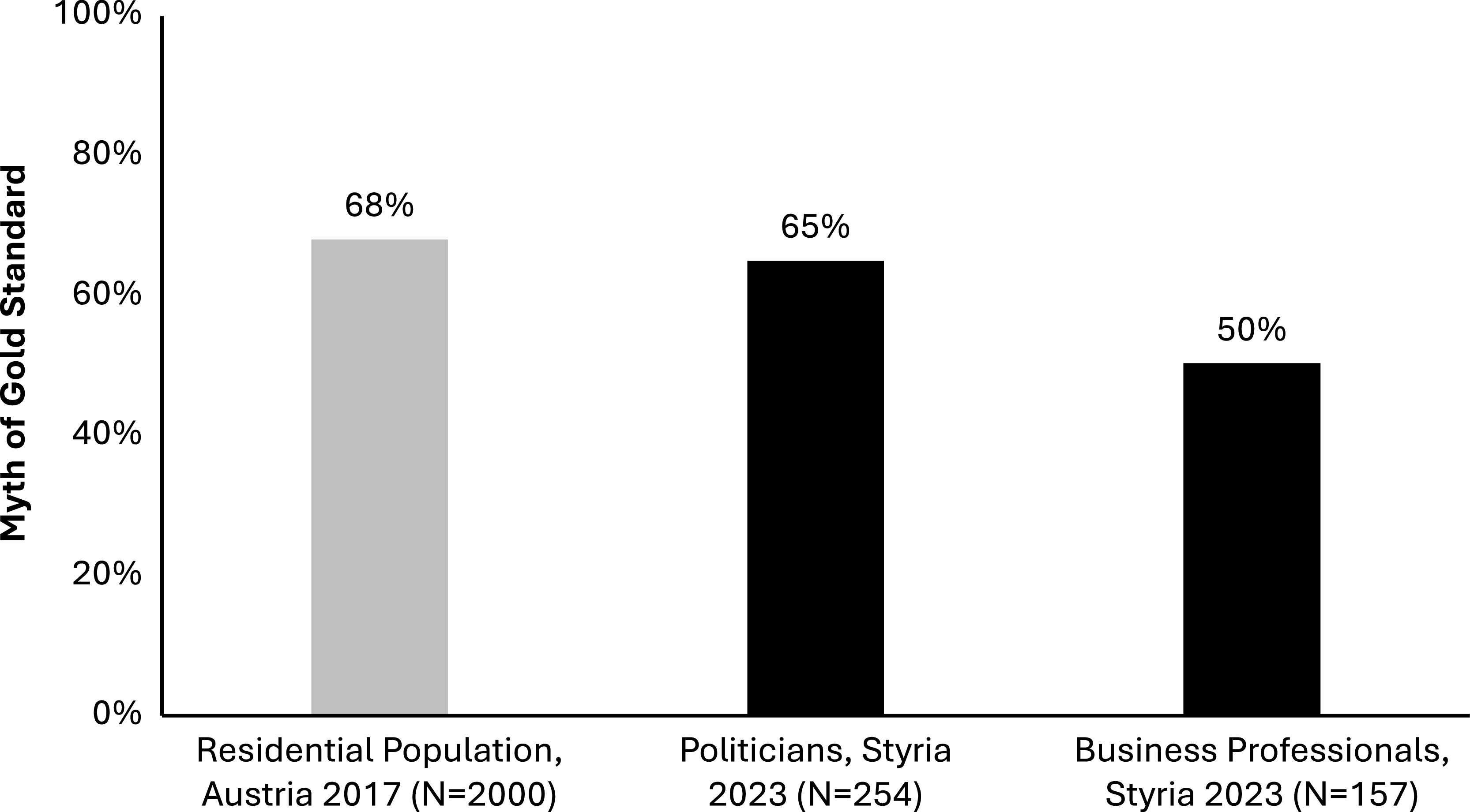
As shown in Figure 1, 68% of the Austrian population believe that money is backed by gold. For many people, gold appears to remain a symbolic anchor that promises time-stable security for the duration of their lives. As Schmölders (Reference Schmölders1966, Reference Schmölders2006) theorizes, this ‘gold illusion’ is not confined to the general population but is also present among professionals. Despite the abandonment of gold convertibility decades ago, many politicians in the region of Styria still believe that money is backed by gold; among business professionals in Styria, every second person assumes that money is backed by gold. A Chi2 test indicates that belief in this myth is not independent of the sample (χ 2(2) = 20.9, p < .001; Cramér’s V = 0.09). Pairwise comparisons help to unpack this pattern further: the general population and politicians do not differ significantly (χ 2(1) = 0.9, p = .357, φ = 0.02), whereas business professionals are significantly less likely than either group to believe that money is backed by gold (vs. the general population: χ 2(1) = 19.8, p < .001, φ = 0.10; vs. politicians: χ 2(1) = 8.0, p = .005, φ = 0.14).
Prevalence of the myth of the gold standard among the Austrian residential population in 2017 (grey) and among politicians and business professionals in Styria in 2023 (black).

Due to the small number of cases and the large number of categories within these variables, it is not possible to reliably conduct an analysis that further differentiates respondents’ answers by political party or branch of business. Nonetheless, the results indicate that the gold myth is prevalent not only among the general population but also among mid-level decision-makers, especially those in politics.
Money creation
The previous section examined the beliefs of regional politicians and business professionals regarding money backing. The following section turns to their understanding of money creation. The analysis starts from the assumption that the institutional foundations of the modern monetary order in general, and private bank money creation in particular, remain poorly understood if respondents lack insight into how money comes into existence. If professionals have little knowledge of how money is produced and by which financial actors, it can be concluded that they are unfamiliar with the constitutive differences between public central bank money and private credit money that are central to understanding the modern monetary system.
As noted above, the new economic sociology has largely neglected the financial and monetary order as a fundamental object of research. Building on recent theoretical contributions which emphasize the role of state authorities and private financial actors in the process of money creation (e.g., Huber, Reference Huber2017; Sahr, Reference Sahr2022), we asked regional politicians and business professionals how they believe money comes into existence. It is a widespread belief – long prevalent in economics and broadly accepted by the public – that only central banks are able to create money through their ‘printing presses’, while commercial banks merely act as intermediaries lending depositors’ savings. As a number of recent contributions make clear, however, private banks create new money through balance-sheet expansion when issuing credit to firms or households (Hook, Reference Hook2022; McLeay, Reference McLeay, Radia and Thomas2014).
To operationalize belief in the myth that money is created exclusively by the central bank, we used a different item from the same ‘money knowledge’ index (Kraemer et al., Reference Kraemer, Jakelja, Brugger and Nessel2020), focusing on perceptions of money creation. Respondents were classified as holding the printing press myth if they correctly identified that money is printed by the central bank but failed to select the second correct option, namely that money is also created through credit issued by private banks.
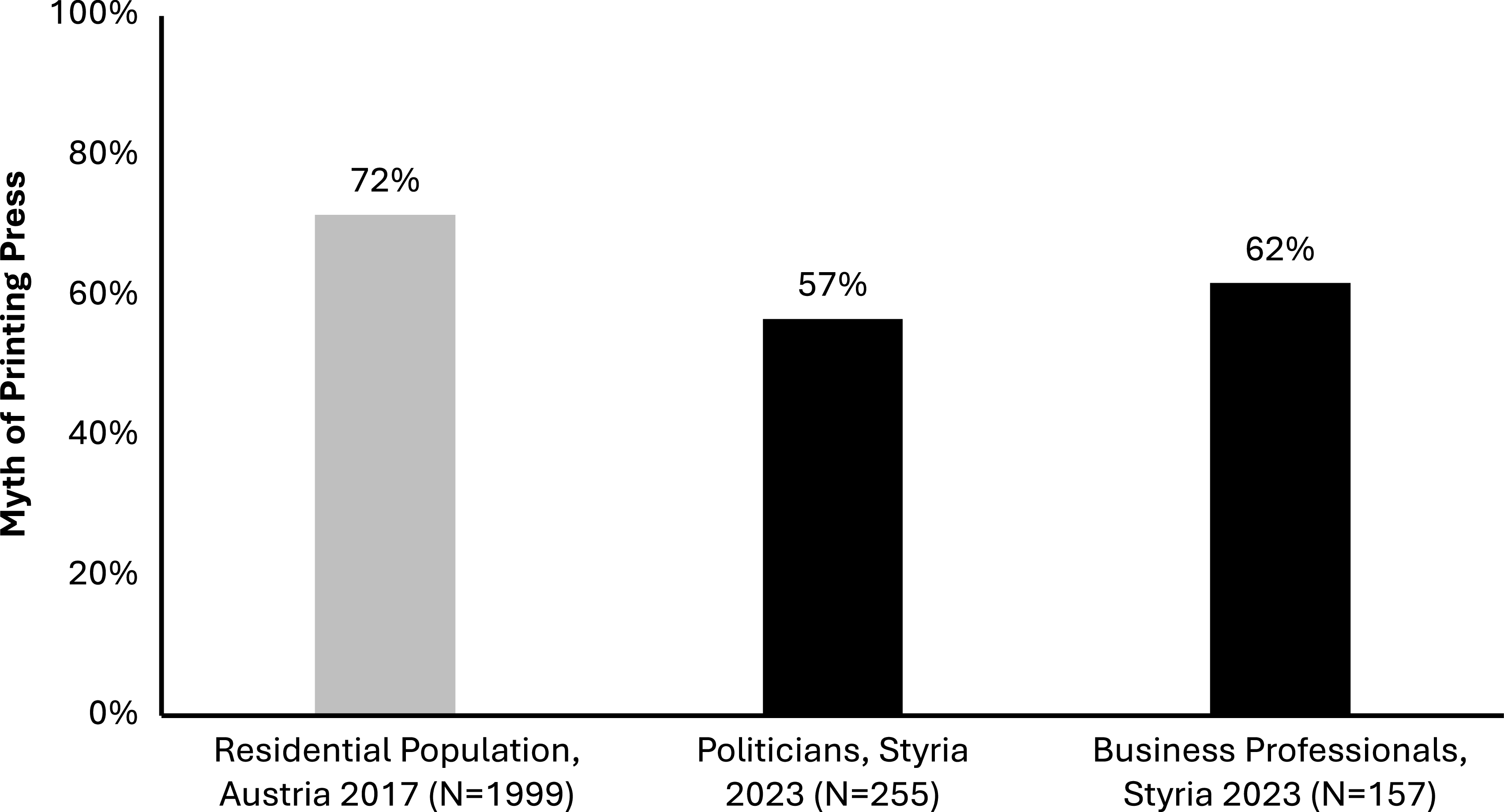
The prevalence of this myth across all three samples is depicted in Figure 2. The highest share (72%) is again found among the Austrian residential population of 2017, followed by business professionals (62%) and politicians (57%) in the region of Styria. A Chi2 test shows that the printing press myth is not independent of the sample (χ 2(2) = 28.8, p < .001; Cramér’s V = 0.11). Further comparisons reveal that the share is higher among the general population than among politicians (χ 2(1) = 23.8, p < .001; φ = 0.10) and business professionals (χ 2(1) = 6.3, p = .012; φ = 0.05). Despite the statistical significance of these differences, the small effect sizes indicate that the difference between the general population and professional groups is substantively limited. Additionally, no significant differences in the dissemination of the printing press myth were found between politicians and business professionals (χ2(1) = 0.9, p = .337; φ =0 .05).
Prevalence of the myth of the printing press among the Austrian residential population in 2017 (grey) and among politicians and business professionals in Styria in 2023 (black).

Taken together, the findings on money creation show that the printing press myth remains widespread across all groups. This is particularly striking in light of the actual composition of the euro area money supply: in 2025, currency in circulation amounted to EUR 1.569 trillion, while overnight and short-term deposits amounted to EUR 14.172 trillion (ECB, 2025a, 2025b, 2025c). In other words, cash issued by the Eurosystem accounts for only a small share of the broad money supply, whereas the vast majority exists in the form of bank deposits. The belief that money is created exclusively by central banks issuing coins and banknotes therefore points to limited knowledge of the institutional foundations of the modern monetary order.
Discussion: Money myths, epistemic opacity, and the promise of eternity
This study examined whether regional politicians and business professionals know more about the institutional foundations of money than the general population. The findings reveal that while politicians and business professionals possess slightly more knowledge about money creation and money backing than the general population, money myths about the monetary order remain widespread among these groups. The gold myth is particularly persistent: although business professionals are more likely than the general population to know that money is not backed by any physical assets, half of this group continues to believe that money is backed by gold; among politicians, the share is even higher and close to that of the general population. The printing press myth remains similarly widespread. A majority of respondents in all three groups believe that money is created exclusively by central banks, even though most of the broad money supply exists in the form of bank deposits.
These findings are sociologically relevant because the surveyed actors are not merely laypersons detached from monetary and financial decision-making. Politicians decide on public budgets, debt, and fiscal priorities; business professionals make or prepare credit-related decisions in small and medium-sized enterprises. Their everyday work therefore involves money in practical and consequential ways. Yet, as our results demonstrate, this practical involvement does not necessarily translate into explicit knowledge of the institutional foundations of fiat money, central bank money, and private credit money. The findings point to a tension between practical financial competence and theoretical money knowledge. Professionals seem to be able to act proficiently within monetary and credit relations without possessing a detailed understanding of the institutional mechanisms through which money is created or stabilized.
This tension should not be interpreted merely as a consequence of individual knowledge deficits; it points to a broader feature of modern monetary orders, connected to the fact that participation in complex institutions does not always require reflexive knowledge of their underlying mechanisms. Monetary practices rely on routinized procedures, institutionalized rules, and taken-for-granted assumptions that allow actors to operate within the system without requiring an elaborate understanding of its infrastructural foundations. In this respect, the findings resonate with prior works showing that expertise and institutional practice often depend less on comprehensive theoretical understanding than on situated routines, operational competence, and interpretive coherence. Halliday’s (Reference Halliday2018) discussion of ‘plausible folk theories’ is useful here because it shows that simplified beliefs may persist even in contexts marked by expertise and institutional complexity. Similarly, McGoey’s (Reference McGoey2012) work on ignorance suggests that limited knowledge and selective non-knowing are not merely failures of cognition but may become functional resources in complex organizations and governance settings. This should not be taken to suggest that money myths are strategically produced by the surveyed professionals, however. Rather, it suggests that simplified monetary beliefs can coexist with competent practice and may help sustain orientation where institutional complexity exceeds everyday understanding.
Money myths can therefore be interpreted as socially shared belief structures that bridge institutional opacity and practical confidence. They do not reflect a mere lack of information. Rather, they provide simplified and culturally resonant images of how money is grounded and how it comes into existence. In this respect, money myths operate at the intersection of knowledge and belief. They stabilize confidence not by providing accurate institutional explanations, but by offering symbolic anchors that make the monetary order appear meaningful, reliable, and practically usable, thereby contributing to a basic sense of ontological security in everyday monetary life. The printing press myth anchors money in state authority: money appears as something created and guaranteed by public institutions. The gold myth, by contrast, anchors money in a substantial and historically durable material reference point. Both myths simplify the monetary order, but they do so in different symbolic registers.
The state-centered anchoring of the printing press myth should be understood, at least in part, as the product of two mutually reinforcing dynamics. First, educational lag contributes to the continued circulation of simplified textbook models in which central banks appear as the primary creators of money, while commercial banks are presented mainly as intermediaries between savers and borrowers (Botos, Reference Botos2016; Hook, Reference Hook2022). Second, central bank communication has historically reinforced a state-centered understanding of money. As Braun (Reference Braun2016) argues, central banks have strong reasons to sustain public trust in money by emphasizing their role in controlling the money supply and safeguarding price stability. Only more recently have central banks and international financial institutions communicated more explicitly that commercial banks create deposit money when extending credit (McLeay, Reference McLeay, Radia and Thomas2014; Mellor, Reference Mellor2019).
The stabilizing function of money myths becomes especially visible when one considers the symbolic role of state authority in monetary crises. In financial or currency crises, state-authorized actors and institutions act as lenders of last resort and publicly reaffirm their commitment to stabilizing money, bank deposits, or currencies. Such moments are not merely technical interventions. They also have a performative dimension. As Bourdieu argues in his lectures On the State (Reference Bourdieu2014: 10), state institutions monopolize claims to validity through performative speech acts and thereby construct a ‘mysterious reality’ of their own. In such situations, governments and central banks assume an authoritative role that underpins the state’s claim to function as a ‘central bank of symbolic capital’ (Bourdieu, Reference Bourdieu2014: 217). The ‘whatever it takes’ vow made by Mario Draghi, then President of the European Central Bank, at the peak of the euro crisis is a prominent example of such a symbolic reaffirmation. Money myths are not produced by these acts alone, but they can be stabilized by them, because they resonate with the expectation that money is ultimately anchored in a publicly authorized order.
In ordinary times, by contrast, such explicit performative interventions are not continuously required. The everyday reliability of money is repeatedly confirmed in practice (Beckert, Reference Beckert2016). A sequence of numbers on a bank account or a piece of paper issued as cash is not experienced as a meaningless sign but as a usable claim that can be mobilized across a wide range of transactions. Although institutional and structural constraints can limit the usability of particular payment instruments in specific situations (Kraemer and Gasser, Reference Kraemer and Gasser2026), under normal conditions, expectations of monetary usability are rarely disappointed. Goods can be purchased, debts can be settled, wages can be paid, and credit relations can be maintained. Everyday reliability provides a ‘true’ anchor point for money myths in social reality. Myths are therefore not merely arbitrary fantasies. They simplify the institutional foundations of money but are anchored in repeated practical experiences of monetary usability. Their plausibility rests on the fact that money normally works.
Against this background, the gold myth can be understood as an intensified form of the money myth because it translates the general promise of monetary reliability into an image of material permanence and intergenerational security. Pure token money creates what Deutschmann (Reference Deutschmann2011) calls a promise, or even a prophecy, of ‘absolute wealth’. This promise rests on the capacity of money to suspend – at least in the imagination – the ‘gravitational forces’ of social and cultural orders. With money, almost anything becomes possible. Social class, ethnicity, nationality, shared beliefs, place of birth, or gender appear secondary in the face of the imaginative power of money as an ‘absolute means’ (Simmel, [Reference Simmel and Frisby1900] Reference Simmel and Frisby2004). In the modern economy, as Marx and Engels ([Reference Marx and Engels1848] Reference Marx and Engels1998: 54) famously put it, ‘all that is holy is profaned’; money offers a secular promise of boundless convertibility. The myth of money is based on the fictitious promise that the social, temporal, material, and spatial boundaries of human existence might be transcended. This universal promise of wealth remains largely immune to banking and financial crises as long as it can be protected from devaluation (Pistor, Reference Pistor2019).
The myth of money as the absolute promise of boundless wealth comes into its own in gold. In the gold myth, this promise – sustained by money myths in both ordinary times and extraordinary times of crisis (Kraemer and Steg, Reference Kraemer and Steg2025) – is elevated into a promise of eternity. Following Simmel ([Reference Simmel and Frisby1900] Reference Simmel and Frisby2004) and Schmölders (Reference Schmölders1966: 216–239), gold can be understood as a timeless material carrier of the cultural idea of ‘absolute wealth’. Historical and cultural anthropological research on gold shows that this promise of eternity is a trans-civilizational social phenomenon (Bernstein, Reference Bernstein2000; Zorach and Phillips, Reference Zorach and Phillips2016; Mountford and Tuffnell, Reference Mountford and Tuffnell2018). Gold exerts an almost magical attraction in both premodern and modern societies because it appears to resist decay, devaluation, and historical contingency. Schmölders’ notion of ‘primordial fear’ (Urangst) is relevant here: the gold myth represses the existential fear of human finitude and social instability by providing a supposedly safe haven of immortal material value. Gold thus offers a stable bridge across the historical contingencies of social orders and across the succession of generations.
This promise of eternity is not only symbolic in a weak sense; it can become socially real in the sense captured by the ‘Thomas theorem’ (Thomas and Thomas, Reference Thomas and Thomas1928). The belief that gold offers lasting security may shape saving practices, inheritance strategies, and interpretations of monetary crisis, even if modern money is no longer backed by gold. Like other money myths, the gold myth has a ‘true’ anchor point in the social world. Gold is not primarily a vehicle for appreciation. Rather, over long historical periods, it has functioned as an effective hedge against inflation, particularly in relation to paper currencies (Jastram, Reference Jastram1977; Bernstein, Reference Bernstein2000). This practical historical experience reinforces the symbolic plausibility of the gold myth. The gold myth is therefore not reducible to ignorance of monetary institutions. Instead, it condenses a wider cultural desire for permanence, materiality, and intergenerational security in an otherwise abstract and institutionally complex monetary order.
The empirical findings do not allow us to determine whether or how money myths directly shape concrete professional decisions. Survey data can show the distribution and prevalence of such beliefs, but not how they are articulated in concrete situations or used practically. The analysis should therefore be read in an exploratory sense. That money myths circulate among regional politicians and business professionals in addition to the general public suggests that symbolic representations of monetary stability may form part of the background assumptions through which actors relate to money in practice, even where explicit institutional knowledge remains limited. Future research should examine how different forms of money knowledge – technical, practical, experiential, and symbolic – are distributed across professional fields and how they are mobilized in specific decision contexts.
Conclusion: Knowledge, belief, and monetary order
The empirical findings in this article show that myths about money creation and money backing are widespread not only among the general population but also among regional politicians and business professionals. Although these professional groups possess somewhat more money knowledge than the general population, many respondents continue to believe that money is created exclusively by central banks or that it is backed by gold. This finding is striking because these actors routinely participate in fiscal, budgetary, or credit-related decision-making. It points to a paradox: actors may participate competently in monetary and financial practices while lacking explicit knowledge of the institutional foundations of the monetary order. This suggests, in turn, that different forms of money knowledge – practical, symbolic, and institutional – are unevenly distributed across social roles.
Based on an empirical comparison between the general population and professionals in politics and business, our study shows that specific knowledge of the institutional foundations of money remains limited across the general population and the two professional groups alike, suggesting that money myths are not merely lay misconceptions but function as broader interpretive resources in contexts of monetary opacity. The article contributes to the sociology of money and finance by conceptualizing money myths as socially shared belief structures that provide symbolic anchors in an opaque monetary system. In contrast to fictional expectations in Beckert’s (Reference Beckert2016) sense, money myths are not primarily oriented toward the future, and in contrast to folk theories in Braun’s (Reference Braun2016) sense, their significance does not lie only in cognitive simplification or communicative legitimacy. Their distinctive feature is their symbolic and stabilizing function. They render money meaningful, reliable, and practically usable even where its institutional foundations remain poorly understood.
Our analysis also suggests that the gold myth occupies a special position within this broader constellation. While the printing press myth simplifies the institutional process of money creation, the gold myth gives monetary value a material and transhistorical reference point and transforms the promise of monetary stability into a promise of eternity. In this sense, gold functions as a symbolic carrier of the idea of ‘absolute wealth’ and as a culturally resonant response to the volatility and abstraction of modern fiat money.
These findings do not imply that money myths directly determine professional decisions. Rather, they suggest that monetary governance and everyday financial practice rest on a layered structure of knowledge, belief, and institutional authority. Modern monetary systems can operate despite limited explicit understanding because actors rely on routinized practices, institutional guarantees, and symbolic anchors that stabilize confidence. Future research should examine how such myths are mobilized in professional settings and how they interact with technical expertise, practical experience, symbolic orientations, and institutional authority. The study thus opens a broader agenda for analyzing the symbolic foundations of monetary governance under conditions of epistemic opacity.
Supplementary material
The supplementary material for this article can be found at https://doi.org/10.1017/fas.2026.10061.
Acknowledgements
We would like to thank the journal’s editorial team as well as the two anonymous reviewers for their helpful comments and suggestions. An earlier version of the empirical findings was presented at the Annual Meeting of the Society for the Advancement of Socio-Economics (SASE) 2025 in Montréal. We are grateful to the master’s students of the two-semester research workshop – Julia Enzi, Markus Jochim, Cora Lackner, Gerald Maurerbauer, Florian Ptak, Maximilian Puchmayr – for their contributions to the data collection. We also thank the co-instructors, Linda Ahlers and Luka Jakelja, for their valuable substantive feedback. For their assistance in surveying economic decision-makers, we extend our gratitude to Ewald Verhounig of the Styrian Chamber of Commerce, who facilitated the distribution of the questionnaire, and to Thomas Krautzer from the Institute of Economic, Social and Business History at our faculty, who supported access to the field. Finally, Heidi Kurz contributed to the coding of open-ended response categories, while Maximilian Puchmayr contributed to the calculation of statistical weights. The authors also acknowledge financial support from the University of Graz.
Funding statement
This work was supported by the Oesterreichische Nationalbank under Grant 17080.
Competing interests
The authors report there are no competing interests to declare.


 Open access

