Introduction
Patients with bipolar disorder may require hospitalisation during a manic episode for the rapid control of their symptoms, which are frequently distressing and may result in behaviours potentially injurious to self and others (1). The schedules used for administering medications in the outpatient setting may not satisfy the needs of hospitalised patients with bipolar mania. A more rapid dose escalation regimen that reduces the time to establish an effective dose could, if well tolerated, offer hospitalised patients the benefits of more timely treatment with opportunities for earlier recovery and discharge. Investigations of rapid dose escalation schedules in patients with bipolar mania have, to date, provided generally favourable outcomes for lithium, valproate, carbamazepine and olanzapine (Reference Goldberg, Garno, Leon, Kocsis and Portera2–Reference Keck, McElroy and Bennett6), as well as quetiapine (Reference Hatim, Habil and Jesjeet7–Reference Pajonk, Schwertner and Seelig9).
Quetiapine is a psychotropic agent licensed for the treatment of schizophrenia and acute bipolar mania (Reference Bowden, Grunze and Mullen10–Reference Vieta, Mullen, Brecher, Paulsson and Jones14). Recently, quetiapine has also received Food and Drug Administration approval for use in the treatment of bipolar depression based on two trials of similar design Reference Calabrese, Keck and Macfadden(15,Reference Thase, Macfadden, Weisler, Chang, Paulsson and Khan16). The approved dosing regimen for quetiapine in bipolar mania is 100 mg on day 1, 200 mg on day 2, 300 mg on day 3 and 400 mg on day 4, followed by flexible dosing up to 600 mg/day on day 5 and up to 800 mg/day from day 6 onwards.
A study of quetiapine dose escalation in patients hospitalised with schizophrenia observed that rapid dose escalation to 800 mg in 4 days had a tolerability profile similar to that of standard dose escalation Reference Smith, McCoy, Hamer-Maansson and Brecher(17). Another study of rapid initiation of quetiapine (800 mg by day 4) in schizophrenia showed a good tolerance and was associated with a faster onset of action than conventional initiation Reference Pae and Kim(18). In schizophrenia and schizoaffective disorder, a randomised, multicentre, parallel-group, open study of rapid dose initiation of quetiapine (800 mg by day 4) had a higher proportion of patients who experienced adverse events (AEs) as compared with conventional initiation, although withdrawals because of AEs were comparable Reference Boidi and Ferro(19). Rapid initiation of quetiapine was generally well tolerated and effective in this setting.
A similar dose escalation schedule in patients hospitalised with bipolar mania was reported to be well tolerated by 95% of patients, with significant improvement in symptoms by day 7 Reference Smith, McCoy, Hamer-Maansson and Brecher(17). In another open-label study, which investigated quetiapine combined with traditional mood stabilisers in acutely ill patients with bipolar mania, a 3-day titration schedule for quetiapine (attaining 600 mg/day on day 3) was as effective and well tolerated as a 5-day schedule that achieved 400 mg/day on day 5 Reference Pae, Nassir Ghaemi and Kim(8).
In the context of these favourable study outcomes, the FATIMA study (FAst TItration of quetiapine fumarate in bipolar I MAnia) has evaluated the safety and tolerability of a rapid dose escalation of quetiapine in acutely ill patients with bipolar I disorder experiencing a manic episode, with a schedule similar to that investigated by Hatim et al. Reference Hatim, Habil and Jesjeet(7): 200 mg on day 1; 400 mg on day 2; 600 mg on day 3; and 800 mg on day 4, followed by flexible dosing between 400 and 800 mg/day as a function of clinical response. The FATIMA study also assessed the therapeutic efficacy of rapid dose escalation of quetiapine in these patients.
Material and methods
This study was a 21-day, open-label, multicentre phase II pilot investigation of the safety, tolerability and efficacy of a rapid dose escalation of quetiapine in the treatment of patients during a bipolar I manic episode. Twenty-nine patients from 13 study centres in Belgium were treated and analysed. The first patient was enrolled on 22 January 2004 and the last patient completed the study on 19 November 2004.
This study was conducted in accordance with ethical principles derived from the Declaration of Helsinki and was consistent with International Conference on Harmonization (ICH)/Good Clinical Practice (GCP) guidelines, applicable regulatory requirements and the AstraZeneca policy on bioethics. All patients provided written consent prior to study procedures. Patients were provided with oral and written information on the nature and purpose of the study, the participation and termination conditions, and risks and benefits.
Study population
Male and female patients aged 18 years or older were eligible to enter the study if they were hospitalised with mania (with or without psychotic features) and met Diagnostic and Statistical Manual of Mental Disorders, 4th edition (DSM-IV) diagnostic criteria for bipolar I disease. Patients were required to have a Young Mania Rating Scale (YMRS) score of at least 20 and a Clinical Global Impressions Severity of Illness (CGI-S) score of at least 4 at inclusion, and had to remain as inpatients for at least the first 7 days of the study.
Exclusion criteria included a DSM-IV Axis I disorder other than that permitted; any clinical disorder that made the patient unsuitable for treatment; prior treatment with quetiapine that was discontinued for lack of efficacy or AEs; commitment hospitalisation; treatment with clozapine within 28 days of inclusion; and any treatment with a depot antipsychotic medication within one dosing interval before day 1.
Antipsychotic agents other than the study medication were not permitted during the study. Antidepressants and mood-stabilising medications including lithium carbonate and valproate, if taken for at least 4 weeks and at stable doses before entry into the study, could be continued at the discretion of the investigator. Benzodiazepines could also be continued or could be introduced during the study, at the discretion of the investigator.
Study medication
The quetiapine dose escalation schedule was 200 mg on day 1 (100 mg in the morning and 100 mg in the evening, or 200 mg in the afternoon or evening); 400 mg on day 2 (200 mg in the morning and 200 mg in the evening), 600 mg on day 3 (300 mg in the morning and 300 mg in the evening) and 800 mg on day 4 (400 mg in the morning and 400 mg in the evening).
From day 5 to the end of the study, the quetiapine dose could be adjusted between 400 and 800 mg/day at the discretion of the investigator according to the patient's clinical response. Investigators were encouraged not to withdraw patients because of ‘lack of efficacy’ until the quetiapine dose had been increased to 800 mg/day, unless the patient could not tolerate this dose.
Treatment compliance was assessed from returned tablet counts. A patient who took at least 75% of the total tablets prescribed was classified as ‘compliant’.
Safety assessments
The primary safety outcome measure was the proportion of patient dropouts attributed to adverse drug reactions during the first 7 days of quetiapine treatment. Secondary safety outcomes included serious AEs (i.e. life-threatening or fatal, requiring hospitalisation or resulting in disability) and other significant AEs categorised as: (1) severe: incapacitating, with inability to perform normal activities; (2) moderate: discomfort sufficient to interfere with normal activities; and (3) mild: awareness of sign or symptom, but easily tolerated.
Safety assessments also included clinically significant changes in vital signs (assessed on days 1–7 and at the end of the study); incidences of clinically significant electrocardiogram changes (day 1, day 5 and at the end of the study); and incidences of extrapyramidal symptoms measured by Barnes Akathisia Rating Scale (BARS) and Simpson-Angus Scale (SAS) scores (days 1–7, day 14 and at the end of the study).
Efficacy assessments
Efficacy, a secondary outcome, was measured by change in YMRS total and individual item score and by CGI-S score on days 1, 5, 7 and 14 and at the end of the study.
Statistical analyses
This study was exploratory and not powered to address predefined hypotheses; the focus of analyses was therefore on descriptive statistics. Therefore p-values are descriptive rather than confirmatory. Wilcoxon's matched-pairs signed-rank test was used to evaluate the changes from baseline (day 1) for continuous variables. All analyses were conducted at the nominal significance level of 0.05, with no adjustment for multiple comparisons.
The safety population comprised all randomised patients who took at least one dose of study medication. The intent-to-treat (ITT) population included all randomised patients who took at least one dose of the study medication and who had post-baseline efficacy data. By-visit analyses of efficacy were based on observed cases, while endpoint efficacy analyses utilised the last observation carried forward (LOCF) approach.
Patient disposition
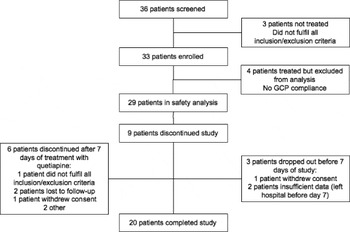
In total, 36 patients were screened and 33 patients were enrolled in the study. Four patients who received treatment were excluded from analysis when site audit revealed that they did not fulfil the inclusion and exclusion criteria. A total of 29 patients from 13 study centres were treated and analysed for safety and tolerability. The ITT population, comprising 27 patients, was analysed for efficacy; two additional patients were excluded from the ITT population because of insufficient efficacy data—they left the hospital before day 5. The disposition of patients is summarised in Fig. 1.
Patient disposition (completion or discontinuation).

Results
Baseline characteristics
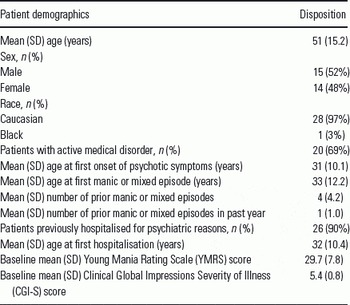
The baseline characteristics of the patients who participated in the study are presented in Table 1.
Baseline demographic characteristics (safety population, n = 29)

Patient disposition
Because of low patient recruitment, 29 patients instead of the planned 60 patients were treated and analysed. Refusal by patients to be hospitalised contributed to the low patient recruitment. Nine patients (31%) discontinued the study before completion, including three patients (10%) who withdrew before day 7 by leaving the hospital (n = 2) or withdrawing consent (n = 1).
Doses administered over the first 4 days matched those specified in the protocol. The median dose on day 5 was 800 mg (range 400–800 mg) and on day 6 to day 18 was 600 mg; thereafter, median doses decreased to 500–550 mg. The rate of treatment compliance was at least 98% from day 8 onwards.
The concomitant medications most frequently taken (i.e. in ≥15% of patients) were lithium carbonate (24%), paracetamol (17%), trazodone hydrochloride (17%) and benzodiazepines including lorazepam (38%), lormetazepam (28%), clorazepate dipotassium (24%) and diazepam (21%). All mood stabilisers had been initiated before the clinical study, while benzodiazepine therapy was commenced in some patients during the study. Six patients received olanzapine during the screening period and terminated this therapy before initiating study medication. Another patient received olanzapine until day 7, which was considered a protocol violation.
Safety and tolerability
Primary safety outcome. The primary safety measure in the study was the proportion of patient dropouts because of an adverse drug reaction during the first 7 days of quetiapine treatment. No patient withdrew because of an adverse drug reaction during this period.
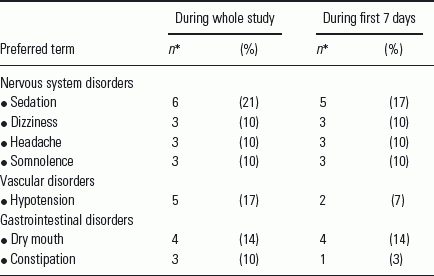
Secondary safety outcomes. Twenty-three patients (79.3%) reported 58 AEs during the 21-day study period, with 18 patients (62.1%) describing 42 AEs during the first 7 days (Table 2). The most common AEs during these periods included sedation, somnolence, hypotension diagnosed from clinical symptoms and dry mouth. Of the nine patients who reported sedation or somnolence during the study, six had symptoms persisting for 6 days or less.
Number (%) of patients with the most commonly reported adverse events (Incidence ≥10%) (safety population, n = 29)
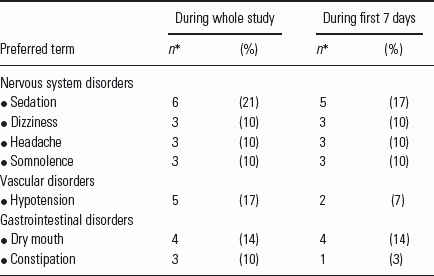
* Number of patients with adverse event.
Most of the AEs were mild (n = 32) or moderate (n = 17) in severity. Four patients (13.8%) reported nine severe AEs comprising malaise (n = 1), oedema (n = 1), dysarthria (n = 1), somnolence (n = 1), urinary incontinence (n = 1), confusional state (n = 1), hyperhidrosis (n = 1) and hypotension (n = 2). One serious AE was reported, a case of intervertebral disc protrusion, which was considered unrelated to study treatment.
Nineteen patients (65.5%) reported 34 potentially drug-related AEs during the study, including 15 patients (51.7%) with 28 events during the first 7 days. One patient required temporary cessation of drug treatment because of severe hypotension at day 1 (quetiapine dose 200 mg/day). This patient left the hospital the following day (day 2) for a non-treatment-related reason and thereby discontinued the study. The quetiapine dose was adjusted in eight patients because of AEs, in two during dose escalation (on days 3 and 4). In 6 of these patients, dose adjustment was for somnolence or sedation. A further patient had hypotension and another patient had a combination of dry mouth, hypokinesia, muscle rigidity, vertigo and vomiting.
Vital sign parameters showed no consistent changes over time, other than a decrease in mean standing systolic blood pressure (SBP) between baseline (day 1) and day 2 [from 126 (SD 15.8) to 118 (SD 14.3) mm Hg]; thereafter, the SBP remained stable. No clinically relevant ECG abnormalities were reported.
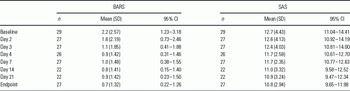
The mean (SD) BARS score decreased by 1.3 (2.0) between baseline (day 1) and day 4, with no further change till the end of the study (Table 3). At day 4 (n = 26), the BARS score improved relatively to baseline in 11 patients (42%), unchanged in 14 (54%) and worsened in one (4%). At the end of treatment (n = 27), 13 patients (48%) improved, 12 (44%) retained their baseline BARS score and two (7%) had worsened.
Changes in extrapyramidal symptoms, measured by mean (SD) Barnes Akathisia Rating Scale (BARS) and Simpson–Angus Scale (SAS) scores (safety population)

The mean (SD) SAS score decreased progressively during the study by 2.0 (4.5) relatively to baseline (Table 3). The SAS score improved in 12 patients (46%), remained unchanged in 10 (38%) and worsened in four (15%) at day 4 (n = 26). At the end of treatment (n = 27), 13 patients (48%) improved, 11 (41%) retained their baseline SAS score and three (11%) had a worse score.
Efficacy outcomes
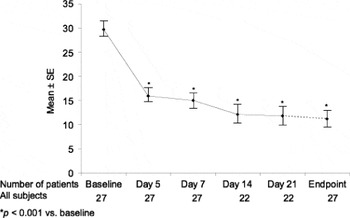
The mean (SD) YMRS total score decreased from 29.7 (7.8) at baseline to 15.9 (8.0) at day 5 (p < 0.001) and decreased further to 11.8 (9.6) by day 21 (p < 0.001). Improvements in YMRS total score relative to baseline were statistically significant at all time points (p < 0.001) (Fig. 2).
Mean total (SE) YMRS scores over time (ITT population, observed cases to day 21; endpoint, LOCF).

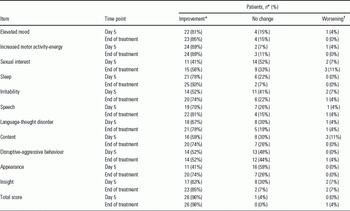
Total YMRS score numerically improved in 96% of patients by day 5 and this proportion was maintained till the end of the study. On considering individual YMRS items, the proportions of patients who showed improvement in score of at least 1 point by day 5 ranged from 41% (appearance and sexual interest) to 89% (motor activity-energy) (Table 4). For some YMRS items (including motor activity-energy, elevated mood and disruptive-aggressive behaviour), the proportion of patients who showed improvement by day 5 was maintained till the end of the study. During the same period from day 5 to the end of the study, 10% of patients showed additional improvements in the items of speech and language/thought disorder; approximately 15% of patients demonstrated additional improvements in sexual interest, sleep and content; and 20% of patients showed additional improvements in irritability, insight and appearance.
Changes in YMRS item scores over time (ITT population, n = 27)

* Number of patients with YMRS score per item.
† Improvement and worsening were defined as a change in score of at least +1 and −1, respectively.
Response rates (i.e. at least a 50% improvement in YMRS total score) were 41% at day 5 rising to 78% at the end of the study. Remission rates (i.e. a YMRS total score of 12 or less) were 41 and 70%, respectively.
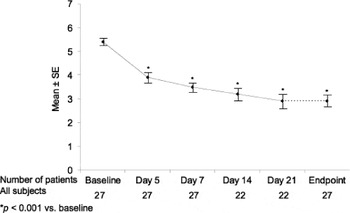
The mean (SD) CGI-S score decreased from 5.4 (0.8) at baseline to 3.9 (1.2) at day 5 (p < 0.001) and to 2.9 (1.4) at day 21 (p < 0.001). Decreases in CGI-S score relative to baseline were statistically significant at all time points (Fig. 3). The CGI-S score improved in 85% of patients at day 5 without change in the remaining patients. By the end of treatment, the CGI-S score improved in 93% of patients, with no change in one further patient and a decrease in score by 1 point in the remaining patient.
Mean (SE) total CGI-S scores over time (ITT population, observed cases to day 21; endpoint, LOCF).

Discussion
This study demonstrates that rapid dose escalation of quetiapine over 4 days is generally well tolerated in patients with bipolar mania. Although about half the study participants (51.7%) experienced potentially drug-related AEs during the first 7 days, no patient discontinued the study for this reason during this period, which was the study's primary endpoint. Dose reduction was required in two patients during the escalation phase. Most AEs were mild or moderate and the most common events—sedation or somnolence—were frequently transient, persisting for 6 days or less. Extrapyramidal symptoms, measured by mean SAS and BARS score, improved in most patients during quetiapine therapy, most notably during the first 4 days.
The tolerability and safety outcomes in this study reflect those in other studies investigating conventional dose escalation schedules for quetiapine in bipolar mania and bipolar depression, which concluded that quetiapine is well tolerated in these patient groups (Reference Bowden, Grunze and Mullen10–Reference Sachs, Chengappa and Suppes13,Reference Calabrese, Keck and Macfadden15). The data are also consistent with the dose escalation studies of Hatim et al. Reference Hatim, Habil and Jesjeet(7), Pae et al. Reference Pae, Nassir Ghaemi and Kim(8) and Pajonk et al. Reference Pajonk, Schwertner and Seelig(9), who observed that the tolerability profile of quetiapine is not significantly altered by rapid dose titration.
Hatim et al. Reference Hatim, Habil and Jesjeet(7) reported that dose escalation of quetiapine to 800 mg by day 4 in 20 patients with bipolar mania was associated with a 95% completion rate at week 1, with no dose adjustment required for AEs during escalation in completers. The most common AE (in 70% of patients) was a decrease in SBP or diastolic blood pressure during dose escalation, although only one patient experienced associated symptoms. BARS and SAS scores remained unchanged. Pae et al. Reference Pae, Nassir Ghaemi and Kim(8) observed that rapid dose titration of quetiapine following a 3-day schedule (200 mg/day on day 1; 400 mg/day on day 2; and 600 mg/day on day 3) did not differ in terms of discontinuation rates or change in SAS or BARS score from a 5-day schedule (to 400 mg/day on day 5). The most common AEs over the 21-day study in the 20 patients with bipolar mania, who were concurrently receiving traditional mood stabilisers, were dry mouth (69% with the rapid titration schedule, 86% with the conventional schedule) and sedation (39 and 57%).
A rapid dose escalation of quetiapine potentially offers more prompt control of symptoms in patients hospitalised for severe mania. In this study, dose escalation of quetiapine to 800 mg/day over 4 days led to a significant improvement in the symptoms of acute mania by day 5 (the first assessment) and maintenance of symptom improvement at the end of the study. YMRS total scores improved in 96% of patients and CGI-S scores improved in 85% of patients at day 5. By study end, YMRS and CGI-S scores improved in 96 and 93%, respectively. Nine of the 11 YMRS items improved in more than 50% of patients by day 5 and all item scores either maintained or improved until study end. Reflecting these symptom improvements, conventionally defined response and remission rates were both 41% at day 5, rising to 78 and 70%, respectively, at the end of the study.
These efficacy outcomes confirm the results of Hatim et al. Reference Hatim, Habil and Jesjeet(7), who described significant improvements in YMRS, CGI-S and Positive and Negative Syndrome Scale (PANSS) scores by day 5 of quetiapine treatment (all p < 0.0001 vs. baseline). A response to quetiapine, defined as a ≥50% reduction in YMRS score, was observed in more than 75% of patients by day 7, which was maintained to day 21. Pae et al. Reference Pae, Nassir Ghaemi and Kim(8) observed significant improvements in YMRS and CGI scores associated with rapid dose escalation of quetiapine, although significant improvements were also achieved by the conventional escalation schedule (all p < 0.0001 vs. baseline).
Our results are in line with a recent paper Reference Vieta, Goldberg, Mullen, Vågerö and Paulsson(20) analysing the available evidence from randomised clinical trials regarding the effective dose range and optimal dose of quetiapine when treating bipolar I disorder patients with acute mania. The mean last-week median dose among responders suggests that 600 mg/day of quetiapine is an effective target dose in acute mania, with most responders receiving doses within the range of 400–800 mg/day. Dose escalation was rapid, with 92% of patients treated with monotherapy and 80% of patients treated with combination therapy (lithium or divalproex) reaching doses of 400 mg/day by day 4, in accordance with protocol-defined dosing guidance.
The limitations of this study include low patient numbers, the lack of a comparator group and an open-label design. The use of benzodiazepines during the study is a potential confounder, although it would be impractical to conduct a clinical study in this patient population without recourse to benzodiazepine co-therapy. In spite of these study limitations, the results presented here suggest potential clinical benefits for the control of symptoms in patients hospitalised with bipolar mania, as dose escalation of quetiapine to 800 mg by day 4 offered a reduction in symptoms within 5 days without compromising the tolerability and safety of therapy.
In conclusion, the rapid dose escalation schedule for quetiapine investigated in the FATIMA study was effective in reducing symptoms of bipolar mania within 5 days in acutely ill hospitalised patients, without compromising tolerability and safety. Escalation of quetiapine to a dose of 800 mg over 4 days may be considered in patients with bipolar I disorder hospitalised with a manic episode to achieve rapid alleviation of their symptoms.
Conflict of interest
Dr Constant and Dr Seghers have served on speaker's bureaus for AstraZeneca. The other authors have no financial interests to disclose.
Acknowledgements
This study was supported by a grant from AstraZeneca Pharmaceuticals (D1441L00022). We thank Bill Wolvey, BSc (PAREXEL MMS), who provided medical writing support on behalf of AstraZeneca.