


Introduction
Depression is common among adolescents, with up to 24% of young people experiencing a clinically significant depressive episode by the time they are 18 years old (NHMRC, 1997). Rates are higher among specific groups, including young people from low socio economic communities (Palpant, Steimnitz, Bornemann and Hawkins, Reference Palpant, Steimnitz, Bornemann and Hawkins2006), those alienated from mainstream education (Denny, Clark, Fleming and Wall, Reference Denny, Clark, Fleming and Wall2004) and those involved with justice services (Townsend et al., Reference Townsend, Walker, Sargeant, Vostanis, Hawton and Stocker2010). Depression in adolescence predicts future episodes of depression and is associated with increased rates of suicidal behaviour and a range of poor health outcomes (Birmaher et al., Reference Birmaher, Ryan, Williamson, Brent, Kaufman and Dahl1996).
The majority of young people who are depressed do not receive evidence-based treatments (Zachrisson, Rodje and Mykletun, Reference Zachrisson, Rodje and Mykletun2006). This is a function of both external factors, such as a lack of appropriately trained therapists (Marks and Cavanagh, Reference Marks and Cavanagh2009) and internal factors, such as low rates by young people of seeking help from health professionals or indeed from any adults whom they do not know (Rickwood, Deane and Wilson, Reference Rickwood, Deane and Wilson2007). Young people in ethnic minority groups, low socio-economic communities and early school leavers face particular challenges in accessing mental health care (Freudenberg and Ruglis, Reference Freudenberg and Ruglis2007; Palpant et al., Reference Palpant, Steimnitz, Bornemann and Hawkins2006). Efforts to increase the uptake of evidence-based treatments include the development of computerized Cognitive Behavioural Therapy (cCBT) programmes that might help with capacity (requiring fewer trained therapists) and with person centred, internal barriers. For example, young people might be able to access cCBT directly via the internet or via persons with whom they have existing relationships.
There is evidence that cCBT can be effective for adults with depression (Andrews, Cuijpers, Craske, McEvoy and Titov, Reference Andrews, Cuijpers, Craske, McEvoy and Titov2010) and emerging evidence that this is also the case for young people (Richardson, Stallard and Velleman, Reference Richardson, Stallard and Velleman2010). However, cCBT programmes provided over the internet have had low completion rates among adults (Waller and Gilbody, Reference Waller and Gilbody2009). Programmes that include personal encouragement and support (often not by a specialist mental health provider) have generally greater rates of completion (Marks, Cavanagh and Gega, Reference Marks, Cavanagh and Gega2007). To promote access to and completion of cCBT among adolescents a range of strategies may be important. For example, cCBT can be offered via Primary Care Providers (Marks et al., Reference Marks, Cavanagh and Gega2007) or via schools, as trialled in Australia (O'Kearney, Kang, Christensen and Griffiths, Reference O'Kearney, Kang, Christensen and Griffiths2009). For young people who are in alternative schooling or intensive youth work programmes, youth workers and other social service staff with whom they work closely could be engaged in providing access to cCBT.
Little is known about the attitudes of social service providers to cCBT. Existing studies include surveys of mental health professionals (MacLeod, Martinez and Williams, Reference MacLeod, Martinez and Williams2009; Richard and Gloster, Reference Richard, Gloster and Hersen2006; Stallard, Richardson and Velleman, Reference Stallard, Richardson and Velleman2010; Whitfield and Williams, Reference Whitfield and Williams2004) and health professionals (Gun, Titov and Andrews, Reference Gun, Titov and Andrews2011). Only one of these studies (Stallard et al., Reference Stallard, Richardson and Velleman2010) focused specifically on the use of cCBT with children and adolescents. No studies have investigated attitudes to cCBT among youth workers or non-health social service providers. The attitudes towards cCBT of these workers may differ from those of health clinicians, as many focus on the development of strengths and skills and on providing support (Krueger, Reference Krueger2005; Mitchell, Reference Mitchell2009b) rather than on the diagnosis and treatment of specific disorders. Yet social services staff do perform a wide array of mental health care roles (Mitchell, Reference Mitchell2009b) and youth workers and others working in similar settings may have contact with young people who are on the margins of mainstream communities and who under-use health services (Rickwood, Deane, Wilson and Ciarrochi, Reference Rickwood, Deane, Wilson and Ciarrochi2005). For some young people they might be particularity important in facilitating mental health care (Rickwood et al., Reference Rickwood, Deane, Wilson and Ciarrochi2005). For example, young people in Alternative Education programmes have difficulty accessing health care but are frequently supported by tutors (Clark, Smith, Raphael, Jackson, Denny et al., Reference Clark, Smith, Raphael, Jackson, Denny and Fleming2010; Clark, Smith, Raphael, Jackson, Fleming et al., Reference Clark, Smith, Raphael, Jackson, Fleming and Denny2010). Thus youth workers and social service providers may influence teenagers’ uptake of cCBT programmes. They could inform young people about cCBT or potentially support them to use it. Additionally, they may have important insights and concerns that could help improve cCBT programme content or delivery methods.
This study aimed to investigate attitudes to cCBT among a range of youth work service providers from trainees and youth leaders to service managers. We were interested in providers’ attitudes and opinions that might impact on the potential utilization of cCBT through youth work service providers.
Method
Because this is a relatively unexplored area, focus groups and semi structured interviews (where there was just one participant) were used.
Participants
A purposive sample (Quinn Patton, Reference Quinn Patton2002) of providers of youth services in the Auckland region of New Zealand was approached in order to gain views from a range of providers, from early career trainees to experienced sector leaders. The sample included diverse cultural groups and staff from services that focused on: reducing youth re-offending; reducing gang recruitment; youth development (particularly among young people having difficulties in school); and alternative schooling (for young people alienated from mainstream schools). The majority of services were based in high deprivation communities. They were spread throughout the greater Auckland region, including central, suburban and rural fringe areas. Eleven of 12 sites formally invited agreed to participate.
Seven focus group and four individual semi-structured interviews were held with a total of 40 people (24 male, 16 female) including 18 youth workers or other professionals engaged to work directly with young people in youth services; 3 tutors or teachers in alternative schooling programmes; 6 managers of youth services; 2 youth work trainers or lecturers; 5 peer leaders (young people trained and supported to work voluntarily with youth) and 6 trainees (youth work or social work students).
Procedure
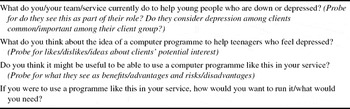
Interviews and groups took place during 2008 and 2009 at the participants’ workplace or training course. They took 30-90 minutes and were facilitated by TF (a New Zealand European PhD candidate and social worker with experience working in youth health services and post graduate experience in carrying out interviews and focus groups in community settings). An interview guide was used (Table 1), and discussion was encouraged. Questions were open ended and were generated to encourage discussion on issues that would be likely to affect possible use or support of cCBT by providers. As is appropriate in inductive focus group research (Quinn Patton, Reference Quinn Patton2002) an iterative process was used where earlier findings refined the interview questions and ideas. Groups took place as a cCBT programme (SPARX) was being developed by our team; thus earlier groups were introduced to the concept of cCBT and were shown printed images from the prototype of our programme, while later ones were able to try out a level of the programme on a computer. Although some feedback specific to the SPARX programme was gained, the focus of discussion was on cCBT in general and that is what is reported here. Field notes were kept and audio recordings made and transcribed by a professional transcriber.
Interview guide

Data analysis
A general inductive approach (Thomas, Reference Thomas2006) was used. I (TF) closely read and re-read transcripts multiple times to consider the meaning in text. Text segments were then identified and clustered into meaningful categories. Within each category statements indicating agreement or divergence of opinions was looked for. While transcripts were read without pre-set theories the research questions (Table 1) were kept in mind and data did follow these broad areas. Thus the general or upper level categories were linked to the research questions. The more specific categories or themes were derived from multiple readings of the transcripts and field notes. Six transcripts were independently reviewed by a research fellow and themes under each research question identified. Final categories were derived after viewing both sets of themes and reviewing raw data. Raw text was coded into relevant categories. Within each category quotations that highlighted or expressed the theme clearly were selected as examples. As this was completed, transcripts were re-read multiple times to ensure that coding reflected the raw data accurately. Following peer review the themes were presented more clearly in the text of this article and additional quotes were included.
Ethics
Ethics approval was granted by the University of Auckland Human Subjects Ethics committee. Participants gave their own consent. No inducements were offered.
Results
Findings are presented under each of the four key research questions and within these are grouped into themes, categories or dimensions of responses. Quoted responses are taken directly from the raw text. The disproportionate number of responses from service managers and trainers reflects the imbalance in depth of responses to the questions asked. Tutors or teachers are all labelled as “tutors”, and trainers or lecturers as “trainers” in order to protect confidentiality within small occupational groupings.
Current responses to young people with depression
In terms of how participants currently respond to young people who might be feeling down or depressed, the overarching theme was that “youth services care”. Participants considered that developing close relationships with young people and supporting them if they were feeling down or distressed were important parts of their role. There was no dissent from the idea that youth services and youth workers would in some way respond to the emotional needs of their clients.
I mostly do group work at the moment, but if I was worried about someone of course I would talk with them one on one. (Youth worker)
If our kids are in trouble, obviously we naturally go to the social worker and see what's happening there, or the guidance counsellor. (Youth worker)
[Our agency] is interested in how young people deal with problems, resilience and feelings. How can we help them deal with feelings, not make things worse. (Manager)
However participants varied markedly in how they would do this, and tended to diverge into two categories. These were labelled as “not mental health orientated” and “mental health orientated”. These groups were of roughly equal size. The former generally felt depression was not their focus and they seldom saw it in their clients although occasionally they noted that clients had been distressed or suicidal.
They're [clients] just being happy. Every now and again you see someone, but you can gradually connect with them. Maybe [name] has, but I don't think I have come across a case where a young person was really into that area of depression. (Manager)
Mostly we don't focus on whether the kids have depression. They could have – but it's the behaviour, attitude and getting into trouble that are the focus. But depression could be there. (Youth Worker)
Often these participants reported that mental health problems were difficult to identify. Some felt young people might hide their depression or occasionally be suicidal without previous indication. These participants generally reported that their approach would be to build a trusting, caring relationship with a distressed young person, whatever the specific problem the young person faced. They reported that if this connection was done well, with someone whom that young person could relate to, the young person would talk with them and feel supported. Participants responding in this way sometimes described referral to mental health or counselling services as an option but generally had seldom used it.
Some we refer, like we, I don't know if we have done. But most of the kids we work with we kind of have a way of connecting, and most of the kids that we work with respond because of our environment. It's a very safe, very open, very family environment, so kids can open up really quickly. (Manager)
You can have someone come in and they will be sad and confused and that. . . If you have a close bond with them, then they will come and talk to you. They just want to speak to somebody who they trust. (Peer leader)
The second cluster of participants considered depression was common among their client group and described responding to depression, suicidality or other mental ill-health as part of their role. They often had an explicit range of strategies that they might use if a young person was feeling down. These participants were called “mental health orientated”.
People think youth work equals mentoring, activities etc. But youth workers are more than that. They are the people young people disclose issues to. If the young person is not feeling good. . . you can't ring the [mental health service] then and there and make an immediate referral. Young people want help at that time. They don't want to go to someone else, later. Youth workers need to be able to deal with their needs. Therapy skills are an important part of that. (Manager)
They [youth workers] are not a counsellor or a therapist, but if they are the first person/the person that the young person talks to, then they will need to have some involvement, skills in recognizing, responding to issues and getting help. (Trainer)
This cluster of participants described a range of ways in which they responded to depression within their professional identity and service. These included group programmes, mentoring, psychotherapy, meetings with families, working with counsellors and others. Some of the participants in this group who did not currently offer psychotherapy had plans for training in this area. Although many had referred clients to Child and Adolescent Mental Health Services (CAMHS) they often expressed some sadness or frustration that mental health services had not engaged successfully with their clients or that the young people did not want to be referred there.
There is the [CAMHS]; some people go there, though this is not very appealing to young people. (Youth worker)
The final theme identified within this section “mental health services unappealing for ‘our’ kids” reflected suggestions from both mental health and less mental health orientated participants that mental health services might not successfully engage young people who were from their communities and cultural groups. In contrast, they considered having close relationships with young people in their own communities to be a strength of youth work services.
They [young people] would rather just talk to someone from the [neighbour]hood. (Peer leader)
They [clients]do not fit the norm of what is out there and we are always talking about how difficult it is to get help for your kids. . . they do not fit the norm of what is out there. (Youth worker)
[Mental health service] doesn't work for our kids. It might work for kids from [wealthier suburbs] but it doesn't work for our kids. They don't go there. How do we bridge that gap? How do we make it applicable to our kids here. Even [local community service], I still feel they are far removed from the kids who have twisted issues in their lives, from the rough, rugged and raw kids. I feel there is a big hole there. In their ability to connect. (Manager)
Attitudes towards computerized programmes to help with depression
Participants expressed both overall responses and specific perceived advantages and disadvantages or concerns regarding cCBT. None of the participants were currently utilizing cCBT.
Overall responses. Responses to the concept of computer programmes for depression spanned a broad spectrum, from enthusiasm to caution. The participants who were most enthusiastic about the concept were generally those who were “mental health orientated” and viewed or tried out a module of the SPARX cCBT programme on a computer, rather than simply hearing about it or viewing printed screen shots from the prototype of the SPARX programme. Enthusiastic comments included the following:
It's the bazooka! – I mean in dealing with things it's not a little weapon – little gun or something it's the bazooka – it's big – this could make a real impact. (Manager)
Its ace! (Youth worker)
Others who viewed the cCBT programme were also positive although not as enthused. The majority of participants fitted into this category. Here are some example responses:
Pretty sweet. I want to keep playing it. Kind of makes you understand key techniques that you already knew. (Youth worker)
It's better than counselling. (Peer leader)
Unexpected, better quality than expected for a Ministry [of Health supported] game. (Trainee)
Other participants thought the programme would be useful for some clients: particularly for boys, those who are “into technology”, those who are less likely to talk, or those who do not use mental health services.
I have dealt with a number of students this year who might benefit from this. They wouldn't go to [mental health service] but would do something. They are into computers. (Tutor)
Be good for young people who don't have the words for what they are feeling. (Youth worker)
Several people considered that it might be a useful step before engaging in one to one therapy.
Boys don't have the language to talk about what's going on. If the model gives them the language then they will use it. You need to give them the language base. Once that's created you can have the conversations. (Manager)
Finally a minority of participants were cautious about the programme. This included some peer leaders who thought it was better to talk to someone than to use cCBT. However, all the peer leaders agreed that cCBT would be considerably more appealing than talking to a stranger about feelings and that teenagers should be offered a range of options for dealing with depression.
Some people. . . they don't have the words. But, for some others, if people love you, they just want to speak to somebody who they trust. . . People have their own style, but for me, I'd rather talk. (Peer leader)
Others were classified as “cautious” as they focused on questions that they would wish to see addressed, such as ensuring safety or having support for cCBT. These concerns are included in the following sections.
Likes and dislikes or concerns about computerized therapy. Participants expressed a range of likes and dislikes about cCBT. The most frequently identified advantage was the potential appeal or ability of cCBT to engage young people, and thus operate as a form of gateway to getting help. That is that young people might be open to utilizing cCBT and through this to become be more willing or able to talk with their youth service provider.
It's hard to get them to talk, sometimes people just shut down completely, but this might put them in a position where they can talk. (Youth worker)
I think this is a good tool, especially if you just met somebody. It's better to do this than just straight away say “oh why are you feeling down?” and stuff like that. And it's good because they get stuff from here and then probably go on to the next level, by meeting each other face to face. This could be like a starting, then you could elaborate. (Peer leader)
The second advantage related to ideas about the potential power of cCBT as a therapeutic tool to create change.
I think it's a great idea – it's potentially transformative for young people. The youth worker has a good relationship – and sees the young person, but this could help shift things, be part of a transformative process. Youth workers can feel quite under resourced. This can help them have access to good skills. (Trainer)
For us depression is just a huge topic and something I know for us can be quite hard. Unless it's at the point of suicide there is not a lot that is available to us about how to help them. You sort of think to yourself, I wish I'd picked that up or I wish I'd known more about what to do and this is where something like this could help. It could really be a help for our kids. (Youth worker)
It even changes the way you are thinking as you go through. (Youth worker)
The participants who were particularly enthused or positive about the programme tended to report both these advantages. However, the majority of participants focused on the former (cCBT as engaging and facilitating access to help).
Third, there were specific elements of cCBT that were thought to be appealing to young people. These included the use of computers; the young person not having to talk with a stranger; and the young person having a higher level of control than they might experience in therapy.
You have to let the kids drive practice, what you focus on – they are interested in computers so we have let this be our way in. . . .they don't want to read, not so into talking maybe. (Youth worker)
Anything that is web-based for young people, the more the better, because young people love being able to do things in their own time and their own way. (Tutor)
In terms of disadvantages, the most frequently expressed concerns centred on whether cCBT might displace personal contact. Some participants were concerned that this might reduce their role and a few were adamant that cCBT should be used with youth work support and not as a standalone intervention.
I wonder about the byproduct. What's to gain from putting them in front of a screen and what's lost? What about the human contact and that. (Youth worker)
The work we do is through relationships, we are human beings. (Youth worker)
I hope it doesn't come to a place where it replaces us! (Youth worker)
My staff are awesome. You could have it as a tool, not a “referral”. (Manager)
The second major area of concern expressed by several participants was client safety and the need to be assured that cCBT would not increase clinical risk.
Safety, with anything they do safety is paramount. The staff need to know what's doing. Young people need to feel safe. [However] I think there is potential there. (Manager)
You would need a say in who got to use it and where etc, so it didn't cause more harm. (Youth worker)
Third, participants occasionally voiced the concern that cCBT might not appeal to all young people, especially those who were very distressed.
They might open up more with a physical game like chucking the ball around than they would with this. (Trainee)
It might come across as patronizing, if I'm depressed, [if I've] asked you for help. (Youth worker)
Utility of computerized therapy in youth services
In general, participants said it would be useful to use cCBT in services that they worked in. Responses varied from highly enthusiastic to those who were cautious and highlighted training needs or needs for controlled use of cCBT (see next section). Participants’ interest in using computerized therapy did not appear to be related to role, training, age or ethnicity. However, in general those who were more “mental health orientated” and were generally positive about computerized therapy were most interested in using cCBT.
We want to run it here, can we have the exclusive? (Manager)
It could be a great tool for youth workers. . .so that they can get on with what they are good at and offer support to young people. (Manager)
[We/I] wouldn't just put young people onto the programme without knowing what they were getting themselves into. (Manager)
No participant said that they would not consider using cCBT or that there was no role for such an approach in their service.
How participants might wish to use cCBT
Participants had various ideas about how they might want to use cCBT. While cCBT was presented in focus groups and interviews [by TF] as a possible tool for young people with depression, several groups of participants suggested it should be offered to all the young people in their programmes. This approach was suggested for several reasons. First, it was described as consistent with youth work practices of offering interventions to whole groups of young people rather than identifying individuals with pathology. Second, offering the intervention to all young people might reduce embarrassment for distressed young people. Third, a whole group approach would mean that young people who need the intervention are not missed. This could otherwise be problematic, as clients might have unrecognized depression and might not seek help, and personnel might not identify those who are distressed.
I work in a youth development model, strengths based, groups. . . I would avoid labeling, the whole embarrassment thing, offer it to the whole group. The whole group could benefit. (Youth worker)
You would need to get everyone to do it otherwise the right ones, those with depression, wouldn't get access to it. If you put everybody on it if they are keen to continue they can and if they don't need it they might drop out and that's okay. (Tutor)
Some suggested that a cCBT programme should be supported by someone to lead it and manage risk.
Something like that would be quite a non direct way to address issues and they might feel a bit better about sharing stuff if it was through something like that rather than dealing directly with the person. As long as there is contact with the person as well to kind of drive it and make sure they are safe and whatever, I think it would be quite good. (Tutor)
Participants had diverging opinions regarding how controlled access to cCBT should be. Some respondents thought cCBT should be made available so that young people could access it without needing to go through another person; others considered that access should be managed by someone such as themselves.
It would be good to have a tool; anything that is helpful is good. It would be good to put it on the library computers, then [young people] can access it through the library. (Trainer)
Yes. Yes. [I would use something like this] as a resource for youth workers etc to supply with discretion to who they know could use it. Only if I could have a say in who got to use it and where etc so it didn't cause more harm. (Youth worker)
It is key to have somebody to talk through a lot of the stuff with too and maybe to explain if they have any further questions. (Youth worker)
Participants identified a range of needs for themselves if they were to support a cCBT programme. Foremost among these was training and the opportunity to become familiar with the programme, the evidence behind the programme and how safety would be ensured.
Youth workers would need to know what it was about, believe in it, have tried it. (Trainer)
Some youth workers are very isolated. You would need to make sure they were trained and connected, so if the young person wanted to talk to them then they can respond and refer. (Trainer)
You'd need to do training and you need follow-up training. Have an update day every year and have back up for when you get stuck. (Tutor)
For some services limited space and computers would be a barrier. Finally, appropriate information for young people to take home to parents would be required.
The computer issue is a bit of a barrier. We don't really have any computers, just our work computers, none specially for this. (Youth worker)
Where could we put them [computers] if we had some? Maybe in the corner of the room. (Youth Worker)
Discussion
The aim of this study was to investigate the attitudes of providers of youth work services to cCBT. It is the first study of attitudes to cCBT among providers outside of health and therapy fields. This was considered important as many youth service providers have close relationships with young people who have unmet mental health needs. Our analysis indicated that youth work service providers are interested in supporting the emotional needs of their clients and many are interested in using cCBT. They would wish to use it in a range of ways including with groups of young people, and they identified needs for training and resources to be able to utilize it.
Youth work service providers regard building relationships with young people as a particular strength of their role and consider supporting young people when they are distressed an important part of what they do. Some explicitly consider the mental health needs of their clients and have specific responses to depression, while others do not. Most would respond to clients who were distressed or depressed by extending their existing caring relationships with young people (providing more caring, or specific psychotherapeutic attention). Youth work service providers are concerned that mental health services may not successfully engage with their clients. There are few other studies in this area, although Mitchell (Reference Mitchell2009b) found non-medical health and social services personnel provided considerable mental health care. They preferred supportive, understanding roles over identifying pathology and offering illness-specific referral or treatment (Mitchell, Reference Mitchell2009a, Reference Mitchell2009b). This is consistent with the preferences expressed here. Participants in this study described offering increased support in response to distress in young people in their services, without necessarily referring elsewhere or formally identifying disorder.
Our finding that youth work service providers are interested in the idea of computerized therapy for depression is consistent with studies of health providers and therapists in Australia (Gun et al., Reference Gun, Titov and Andrews2011) and the UK (Stallard et al., Reference Stallard, Richardson and Velleman2010; Williams and Martinez, Reference Williams and Martinez2008). The providers who were most positive about cCBT were those who more actively considered the mental health needs of their clients, and who saw a prototype cCBT programme. Providers’ perceptions of their clients’ needs have previously been identified as significant in whether evidence-based interventions are implemented (Mitchell, Reference Mitchell2011). The significance of how programmes are presented should also be considered. Our finding that exposure to a computerized intervention increased acceptability is in line with a previous study that reported higher interest in cCBT among those who saw a demonstration programme compared to those who only heard about it (Mitchell and Gordon, Reference Mitchell and Gordon2007).
The concerns expressed by some participants about cCBT potentially displacing contact with helping professionals and about ensuring client safety are similar to concerns expressed in surveys of therapists and health providers (Gun et al., Reference Gun, Titov and Andrews2011; MacLeod et al., Reference MacLeod, Martinez and Williams2009; Stallard et al., Reference Stallard, Richardson and Velleman2010). However, whether cCBT does in fact reduce the uptake of personal support has not been established. Additionally, people who work as therapists or youth workers may place a higher value on face to face professional support than the general public. Indeed, several studies have found the public to be more positive than therapists about cCBT (Waller and Gilbody, Reference Waller and Gilbody2009). Questions regarding the management of client safety when clients are using cCBT may be addressed through screening and monitoring processes. Whether these processes would be sufficient to assure safety and be reassuring to helping professionals remains to be seen.
Participants in this study had diverse opinions about how cCBT might be best offered within youth services. Some would consider offering it to individuals who were distressed; however, many suggested offering cCBT to whole groups of young people in youth work programmes. Universal use of the “Moodgym” cCBT programme in two schools did not show strong results (O'Kearney, Gibson, Christensen and Griffiths, Reference O'Kearney, Gibson, Christensen and Griffiths2006; O'Kearney et al., Reference O'Kearney, Kang, Christensen and Griffiths2009). However, the use of depression treatment programmes in groups with increased risk is likely to be more promising than universal, unselected approaches (Horowitz and Garber, Reference Horowitz and Garber2006). Given the high rates of depression and challenges in providing mental health services to young people in intensive youth work programmes, such as alternative education and justice settings, such an approach should be investigated.
Some providers would wish to have an external provider to lead and oversee safety of clients on a programme offered in this way; others considered that they would do this themselves. Providers also diverged on whether they considered cCBT should be made available for young people to access on their own or whether access should be facilitated through providers such as themselves. Mental health professionals have strongly preferred the latter (Stallard et al., Reference Stallard, Richardson and Velleman2010) and completion of cCBT programmes without personal support is low (Waller and Gilbody, Reference Waller and Gilbody2009). However, an oft cited strength of cCBT is that it might increase treatment for those who are depressed but not utilizing helping professionals.
Participants in this study identified that to use cCBT they would need training to ensure familiarity with the programme/s, understanding of the evidence for the programmes, and confidence with how safety issues would be managed. Stallard et al. (Reference Stallard, Richardson and Velleman2010) and others have identified similar training needs to support the utilization of cCBT by therapists. Additionally for some youth services, access to computers and private spaces are limited and could limit the utilization of cCBT.
Strengths and limitations
The most significant limitation is that this is a small study of a specific population; therefore the generalizability is limited. Second, TF who carried out the interviews was involved in the development of the SPARX cCBT programme and participants were aware of this. Although full and frank discussion was encouraged, this may have led to a social desirability bias. Third, although participants were asked their opinions of cCBT, they were exposed to one specific cCBT programme (SPARX). Computerized CBT programmes vary widely in their content and presentation; participants’ responses may have been different had they been shown a different example. However, this is the first research on attitudes to cCBT outside of health or therapy staff, the second that is youth specific, and one of few outside of the UK or USA. It involved a range of providers from managers to trainees from diverse practice settings. As such, it is a useful exploratory analysis of attitudes of providers of alternative education and intensive youth work programmes.
Implications
Youth work service providers were interested in utilizing cCBT. Some thought that offering this tool, with the support of personnel who have unique skills in building relationships with disaffected young people, might be transformative for clients. Many thought that cCBT would appeal to young people and might facilitate access to further personal support. The interest expressed here suggests that youth services offer a promising avenue for extending the availability of cCBT to young people.
Previous studies have shown that cCBT can be effectively facilitated by non mental health specialists (Cavanagh, Seccombe and Lidbetter, Reference Cavanagh, Seccombe and Lidbetter2011; Farrand, Confue, Byng and Shaw, Reference Farrand, Confue, Byng and Shaw2009; Williams and Martinez, Reference Williams and Martinez2008). Although mental health services back-up should be available, the skills required to facilitate the use and completion of cCBT programmes appear to be engagement and support (Williams and Martinez, Reference Williams and Martinez2008). The UK National Institute for Health and Clinical Excellence (NICE) guidelines for adults with depression (National Institute for Health and Clinical Excellence, 2009) recommend that the use of cCBT programmes should be monitored and supported by a trained practitioner. Youth service providers may be well placed to facilitate access to cCBT for some young people, either with the support of trained practitioners or, perhaps, with appropriate support, by becoming trained practitioners themselves.
Whether this interest in cCBT might translate into its utilization in youth services is far from certain. New interventions are seldom adopted on the basis of evidence (Aarons, Wells, Zagursky, Fettes and Palinkas, Reference Aarons, Wells, Zagursky, Fettes and Palinkas2009), or even interest (Stallard et al., Reference Stallard, Richardson and Velleman2010) alone. Rather, there are multiple critical factors; among providers these include their attitudes to the intervention, its compatibility with their existing values and approaches, their assessment of client needs, and the availability of resources (Aarons and Palinkas, Reference Aarons and Palinkas2007; Mitchell, Reference Mitchell2011). We have found positive attitudes towards cCBT as well as some caution. Providers’ existing approaches were based on personal supportive relationships with young people; whether cCBT is seen as a tool or a threat to these approaches is likely to be important. Further, utilization of cCBT in this sector is likely to be promoted by providers’ awareness of unmet mental health needs among clients, their exposure to cCBT, and access to resources such as training and computers.
Summary
Youth work service providers are interested in utilizing cCBT. This offers a promising avenue for extending the availability of CBT to vulnerable young people if questions of support and safety can be appropriately addressed. How providers would wish to do this needs to be considered. The current findings suggest they prefer to do this in the context of their own caring relationships with young people without labelling or referring on, and that some would prefer to offer this with groups rather than individually. Resources including training and support would be required.
Non mental health specialist providers can have an important role in extending the use of cCBT; their opinions need to be considered in cCBT dissemination strategies.
Acknowledgements
The New Zealand Ministry of Health funded the development of the SPARX cCBT programme but had no involvement in the design, conduct of the study, analysis of the data, or write up of the results. TF was funded through a New Zealand Tertiary Education Commission Top Achievers Doctoral Scholarship and was paid to work part time on the development of the SPARX programme. The copyright for the SPARX programme is held by Uniservices at the University of Auckland.



Comments
No Comments have been published for this article.