When women run for office, they win at the same rate as men. A significant body of research substantiating this claim has been touted by scholars and women's groups alike. “Gender neutral” outcomes, however, mask important sex differences in congressional candidacies. Indeed, extensive research has revealed a gender gap in political ambition: women are more hesitant to run for office and are more concerned about their credentials and viability than similarly situated men.
We demonstrate that the gender gap in political ambition has important implications for gender dynamics in congressional elections. Not only are women less likely to run for Congress than similarly situated men, but we argue that when they do run, they should also be even better candidates than men. Moreover, the same viability concerns that result in a qualifications gap should make those women who do run for office more sensitive to the electoral context, which is influenced by political parties. Evidence suggests that the Democratic Party and its network are friendlier to female candidates than are the Republican Party and its network. Democrats are more likely to support women's candidacies in politically friendly districts and to support women financially. This not only helps explain why female candidates are more likely to be Democrats, but it should also mean that Democratic women will run under more favorable conditions than Republican women.
Analyzing new data on nonincumbent candidates for the U.S. House of Representatives from 1984 to 2010, we find that female candidates in both parties are indeed better candidates and that Democratic women—but not Republican women—enhance their chances of victory by running in politically friendlier districts with more money than their male counterparts. With these advantages, women should win at higher rates than men, but they do not. When we include candidate experience and other important control variables—including those where we find sex and partisan differences—in multiple regression models predicting victory, we find that Democratic women are actually less likely to win than Democratic men. Moreover, Republican women are less likely than Republican men to win even without these statistical controls. Our findings suggest that the widely cited conventional wisdom purporting gender neutral election outcomes masks consequential sex and partisan differences in congressional candidacies, pointing to troubling signs of lingering gender bias in elections.
GENDER DYNAMICS IN CONGRESSIONAL CANDIDACIES
It has become conventional wisdom that when women run in congressional elections they win as often as men (Burrell Reference Burrell1994; Carroll Reference Carroll1994; Cook Reference Cook, Thomas and Wilcox1998; Duerst-Lahti Reference Duerst-Lahti, Thomas and Wilcox1998; Fox Reference Fox, Carroll and Fox2006; Seltzer, Newman, and Leighton Reference Seltzer, Newman and Leighton1997; Smith and Fox Reference Smith and Fox2001; Thomas and Wilcox Reference Thomas and Wilcox1998), including in open-seat races (Gaddie and Bullock Reference Gaddie and Bullock2000; Gaddie, Hoffman, and Palmer Reference Gaddie, Hoffman and Palmer2000; Hoffman, Palmer, and Gaddie Reference Hoffman, Palmer and Gaddie2001). These findings hold for primary elections as well: in most election cycles since 1958, women have been nominated for Congress at the same rate as men, and in several recent election cycles, Democratic women have actually been more likely than men to win their primaries (Lawless and Pearson Reference Lawless and Pearson2008).
A growing body of research casts doubt on these gender-neutral conclusions by highlighting ways in which gender-neutral election outcomes are not the result of gender-neutral election inputs. Drawing upon a national survey comparing women and men in professions that serve as a pipeline to elected office, Lawless and Fox (Reference Lawless and Fox2005; Reference Lawless and Fox2010) find evidence of a gender gap in political ambition that stems from differences in self-perceived qualifications. Strikingly, women are significantly less likely than men with the same professional and personal characteristics to think that they are qualified to run for office. Women also find the electoral environment more challenging than men; Lawless and Fox find that women are significantly more likely than similarly situated men to be daunted by campaign activities, including fundraising, dealing with the press, running a negative campaign, and dealing with party officials, and women are more concerned about the toll a campaign takes on their personal life. Lawless and Fox's findings are consistent with research showing that women are more concerned with their legitimacy and viability as candidates and likelihood of victory than men (Dodson Reference Dodson, Thomas and Wilcox1998; Fowler and McClure Reference Fowler and McClure1989; Fulton et al. Reference Fulton, Maestas, Maisel and Stone2006; Sanbonmatsu Reference Sanbonmatsu2002). Politics remains a male-dominated field, and women may reasonably expect that they have more to lose than men from an unsuccessful (or even a successful) campaign. In most districts, female candidates remain the exception rather than the norm.
Given women's heightened concerns with their qualifications and the negative aspects of campaigning, women should place a higher value on waiting to run for Congress until they have already won and served in elected office. To be sure, electoral experience helps all candidates. Regardless of their sex, quality challengers, defined as nonincumbent candidates with electoral experience, are far more likely to win elections than those without experience (Jacobson Reference Jacobson1989; Jacobson and Kernell Reference Jacobson and Kernell1983; Krasno and Green Reference Green1998; Squire Reference Squire1995). Yet the gender gap in self-perceived qualifications means that having the credentials and experience that come from running for and winning elected office before running for Congress is particularly important for women.
Consistent with the rationale that women are better candidates than their male counterparts, Fulton (Reference Fulton2012) found that congresswomen were rated significantly more favorably than congressmen by a group of politically informed observers in 200 districts in 1998. When Fulton included these incumbent ratings in models predicting election outcomes, congresswomen were actually at a disadvantage. Fulton's research, however, is limited to incumbents running for reelection in one election cycle, whereas our analysis spans fourteen cycles and focuses on the electoral processes that bring women to Congress in the first place.
Political parties play an important role in structuring women's opportunities. Women's concerns about their qualifications and viability should lead them to be more sensitive to the partisan context than men are, as they try to mitigate challenges in a male-dominated political world whenever possible. Parties significantly influence the electoral landscape, including the opportunity structure and candidates' chances of success (Sanbonmatsu Reference Sanbonmatsu2006a). In addition to the tripartite role of parties in the electorate, in government, and as organizations (Key Reference Key1952), recent research has shed light on the role of “parties as networks” that include interest groups, fundraisers, and social movements (e.g., Koger, Masket, and Noel Reference Koger, Masket and Noel2009). While it is important to note that party strength and party activities vary significantly by state and district (Sanbonmatsu Reference Sanbonmatsu2006a), parties may constrain or enhance women's abilities to maximize their chance of winning.
Parties in the United States have had a long legacy of excluding women from significant leadership roles (Sanbonmatsu Reference Sanbonmatsu2006a) and favoring men when recruiting candidates (Carroll Reference Carroll1994; Diamond Reference Diamond1977; Niven Reference Niven1998; Rule Reference Rule1981; Welch Reference Welch1978). Lawless and Fox (Reference Lawless and Fox2010) find that parties continue to fail to recruit women; women in a nationwide sample of potential candidates are significantly less likely than similarly situated men to be asked to run for office by party leaders (see also Fox and Lawless Reference Fox and Lawless2010).
While both parties have weak track records when it comes to supporting women, important differences between the two major parties have emerged regarding the role of women and women's candidacies. Women are an important part of the Democratic Party base. A significant gender gap in the electorate has persisted since 1980, whereby women are more likely to identify as and vote for Democrats (Kaufmann and Petrocik Reference Kaufmann and Petrocik1999; Norrander Reference Norrander1999). There are more Democratic women than Republican women in the candidate eligibility pool (Fox and Lawless Reference Fox and Lawless2010). With an increase in religious conservatives in the Republican Party and liberal feminists within the Democratic Party, the parties have moved farther apart on issues of particular importance to women, with Democrats supporting women's rights and a significant role for women in the public sphere (Freeman Reference Freeman1997; Wolbrecht Reference Wolbrecht2000). Perhaps as a result, women have more opportunities within the Democratic Party organization than they do on the Republican side. Democrats instituted gender quotas for party convention delegates beginning in 1972 (Shafer Reference Shafer1983), increasing women's opportunities to exert influence and further their own political futures, and the Democratic Party culture is more welcoming to and supportive of women (Freeman Reference Freeman1986).
Party differences translate into comparative disadvantages for Republican female candidates. Strong party gatekeeping and recruitment activities make running for office more difficult for Republican women, as the party questions women's viability and fails to recruit women actively (Sanbonmatsu Reference Sanbonmatsu2006a). Although leaders in both parties favor men, women's groups associated with the Democrats' network help to recruit women (Fox and Lawless Reference Fox and Lawless2010). Analyzing state legislative data from 2007, Elder (Reference Elder2012) finds that the Republican identification of a state's electorate, the professionalism of a state legislature, and the influence of the Christian Right depress Republican women's candidacies but not Democratic women's candidacies. On the other hand, the state presence of women's groups, term limits, and women in the workforce enhance Democratic women's candidacies but not Republican women's candidacies. Republican women are also less likely than Democratic women to benefit from the financial support of women's groups, such as EMILY's List (Burrell Reference Burrell, Carroll and Fox2006), suggesting that there may be fundraising differences among Democratic and Republican women. Given the significant partisan polarization characterizing the period we study, stereotypes suggesting that Republican women are more liberal than their male counterparts (Alexander and Andersen Reference Alexander and Andersen1993; Koch Reference Koch2000; McDermott Reference McDermott1997, Reference McDermott1998) may further hinder Republican women's ability to attract support among Republican elites and donors.
Matland and King (Reference Matland, King and Rosenthal2002) find that in heavily Republican states, GOP women are less likely to see themselves as candidates, and voters are less likely to support them. Not surprisingly, then, female GOP incumbents represent districts that are “less Republican” than those of Republican men, while Democratic women are elected in districts that are “more Democratic” than those of their male counterparts (Palmer and Simon Reference Palmer and Simon2006). It is not clear, however, whether these differences reflect the decisions of voters in general elections or whether female candidates are not running in heavily Republican districts to begin with.
These partisan differences help to explain the partisan gap in women's candidacies. Not surprisingly, the partisan gap among female candidates and elected officials is even more pronounced than it is in the electorate. Elder (Reference Elder2012) finds a significant and growing partisan gap among Democratic and Republican women running for the state legislature—the best pipeline to the U.S. Congress. Beyond the partisan differences in the number of women's candidacies, however, we also expect to find a difference in victory rates once we account for district and financial variables. Given that the Democratic Party is more hospitable for female candidates than the Republican Party is, we expect that Democratic women are more likely to run under more favorable circumstances—in politically friendlier districts and with more campaign money—than Republican women. When these important factors are included in models predicting congressional election victories, we expect that Republican women win less often than do Democratic women.
HYPOTHESES, DATA, AND MEASURES
The literature described above informs our expectations of systematic differences in the quality of male and female congressional candidates and partisan differences in the political context surrounding women's candidacies that affect their electoral success.Footnote 1 Our results have important implications: if women are better candidates running under better circumstances but do not win at a higher rate than men do, then gender bias persists. Specifically, we test the following two hypotheses:
H1:
Nonincumbent female candidates running in general elections are more likely than male candidates to have electoral experience.
This first hypothesis follows from the extensive literature on the gender gap in political ambition fueled by differences in self-perceived qualifications. Because women with the same skills and experience are less likely to see themselves as qualified to run for office, women will be more likely to have previous electoral experience when running for Congress.
H2:
Democratic female candidates run under more advantageous circumstances than Republican female candidates, relative to their male counterparts.
The second hypothesis follows from partisan differences in opportunities available to women that emanate from forces largely outside of candidates' control. Although gender-based viability concerns give women in both parties extra incentives to enhance their chances of success by running in politically friendlier districts and out-raising their male counterparts, party influence will affect women's opportunities to accrue these advantages. Because the Democratic Party is more hospitable for women than is the Republican Party, Democratic women, but not Republican women, should run in politically friendlier districts and raise more money than men.
To test these hypotheses, we created a new dataset that matches candidate sex to other data for all general elections to the U.S. House of Representatives from 1984 to 2010. In addition to candidate sex, our data include all election outcomes and candidate characteristics, including party and electoral experience. We also include important controls that potentially differ by sex and party and can exert an impact on campaign outcomes: candidate spending, the political history of the district (including the presidential vote), the electoral margins of the previous candidates, and the type of contest (open or contested by a challenger).Footnote 2 The data span the decades when the number of women running in and winning congressional races increased significantly. Given our expectation that the partisan differences we have outlined will translate into additional advantages and successes for Democratic women relative to Republican women, we analyze the two parties' candidates separately. This approach also helps account for national circumstances that differ for each party's candidates from year to year.Footnote 3
We measure candidate experience with a simple dummy variable: those who have held elected office are coded one, and all others are coded zero (see, e.g., Jacobson and Kernell Reference Jacobson and Kernell1983, Jacobson Reference Jacobson1989). Thus, all state legislators are experienced, but so are mayors, members of boards of supervisors, and other elected local office holders. This measure is based on the intuitive assumption that these previous winners “have some experience of successful campaigning and wider opportunities for developing skills, contacts, and insights” (Jacobson and Kernell Reference Jacobson and Kernell1983, 30).Footnote 4 Most nonincumbent candidates from 1984–2010 had never held elected office; only 23% of Democratic candidates and 21% of Republican candidates were previous officeholders. Yet these electorally experienced candidates were much more likely to win, accounting for 69% of nonincumbent Democratic winners and 64% of nonincumbent Republican winners.
Our examination of the electoral context includes a number of important variables. Candidate finances are measured as each candidate's share of the total two-party spending in the race.Footnote 5 We also gauge the type of contest, as open seats are the most likely to be competitive (Gaddie and Bullock Reference Gaddie and Bullock2000; Jacobson Reference Jacobson2004). From 1984 to 2010, 34% of open-seat contests were decided by 10 percentage points or less, compared to just 10% of incumbent-contested races. The political partisanship of a district's constituency strongly influences a candidate's chances (Maisel and Stone Reference Maisel and Stone1997; Stone and Maisel Reference Stone and Maisel2003), so we include it as an important part of our analysis. We measure partisanship using the two-party presidential vote share for the candidate's party, lagged in midterm elections. Finally, an incumbent's past performance is often taken as an indicator of current political strength, and victory is more likely in districts where the incumbent's last vote share is low.Footnote 6 Thus, we can determine whether women in one party find it easier to run where the incumbent is weak by this measure.
All of these variables—reflecting both the electoral context and the candidate's experience—serve as controls in our models predicting victory. If our expectations are correct, then controlling for these variables should open up a gender gap in candidate success, especially for Democrats.
We do not include information on the nomination process, so we remain formally agnostic about whether any differences we find are due to the number and characteristics of women running in the primary or in the choices that primary voters—or party recruiters—make. That said, women are no less likely—and in some recent Democratic primaries are more likely—to win primaries than their male counterparts (Lawless and Pearson Reference Lawless and Pearson2008). Thus, gender differences in general election candidates almost certainly reflect differences in candidate emergence. Moreover, it is common in the literature on the emergence of experienced candidates to set aside the question of nomination, perhaps because it is assumed that experienced candidates have the best chance of winning the nomination in the first place (Jacobson and Kernell Reference Jacobson and Kernell1983; Jacobson Reference Jacobson1989).
RESULTS
Experience
Our first hypothesis predicts that nonincumbent female candidates will be more likely than their male counterparts to have experience holding elected office. A simple comparison of means confirms this expectation. Of nonincumbent female Democrats, 34% have experience, as do 28% of nonincumbent female Republicans, compared to 21% and 19% of their male counterparts, respectively.
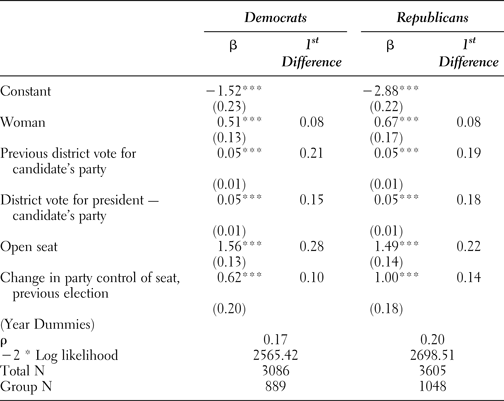
We delve into these differences with a multiple logistic regression in Table 1. The dependent variable is a dummy coded one if the candidate has held elected office, and the candidate's sex is an explanatory variable. The models, run separately by party, include standard controls for a model predicting the emergence of experienced candidates, including the district's previous House vote, the district's presidential vote, and a dummy variable for open-seat contests. We expect all of these variables to yield positive coefficients. To control for the political climate of each particular election cycle, we also include dummies for each election year, which are not shown, and a dummy variable for a change in party control in the previous election since freshman incumbents after a party switch are more attractive targets for experienced challengers than are entrenched incumbents. Finally, to account for the time-series cross-sectional nature of the data, we run a variance components model (Stimson Reference Stimson1985), which corrects for certain statistical problems but otherwise produces standard logit results.Footnote 7
Explaining the emergence of experienced candidates, 1984–2010

Note: Cell entries are coefficients and first differences as described in the text. Dependent variable is a dummy indicating if an experienced nonincumbent of the specified party is running for the seat. All variables have been coded to produce the expectation of a positive coefficient. Missing data have been imputed using Amelia II (Honaker, King, and Blackwell Reference Honaker, King and Blackwell2007), and the models have been estimated in lmer for R. Standard errors are in parentheses. ***p < .001
The estimates are presented in Table 1. We present both coefficients and the effect of these coefficients in terms of probabilities across specified ranges of the independent variables. These “first differences” are calculated as the difference between the mean and the 95th percentile for each of the continuous variables—previous district vote and district presidential vote—and as the difference between zero and one for the remaining variables, which are all dummies.
Consistent with our hypothesis, female candidates are significantly more experienced than male candidates, even in this multivariate specification.Footnote 8 The probability that both Democratic and Republican women are experienced is eight points higher than for men, all else equal. This is a considerable difference, considering that the overall proportion of experienced candidates is 0.23 for Democrats and 0.21 for Republicans. Moreover, it is notable that experience survives despite the strong, statistically significant effects we expected for the other variables, which range from around 0.10 to around 0.28.Footnote 9
Partisan Differences
Party influence in the electoral process is more likely to hinder Republican women than Democratic women. Partisan differences in women's opportunities, combined with women's heightened concerns about their viability, should lead to important partisan differences in women's candidacies. Specifically, we expect that Democratic women will run under more favorable circumstances relative to their male counterparts than will Republican women.
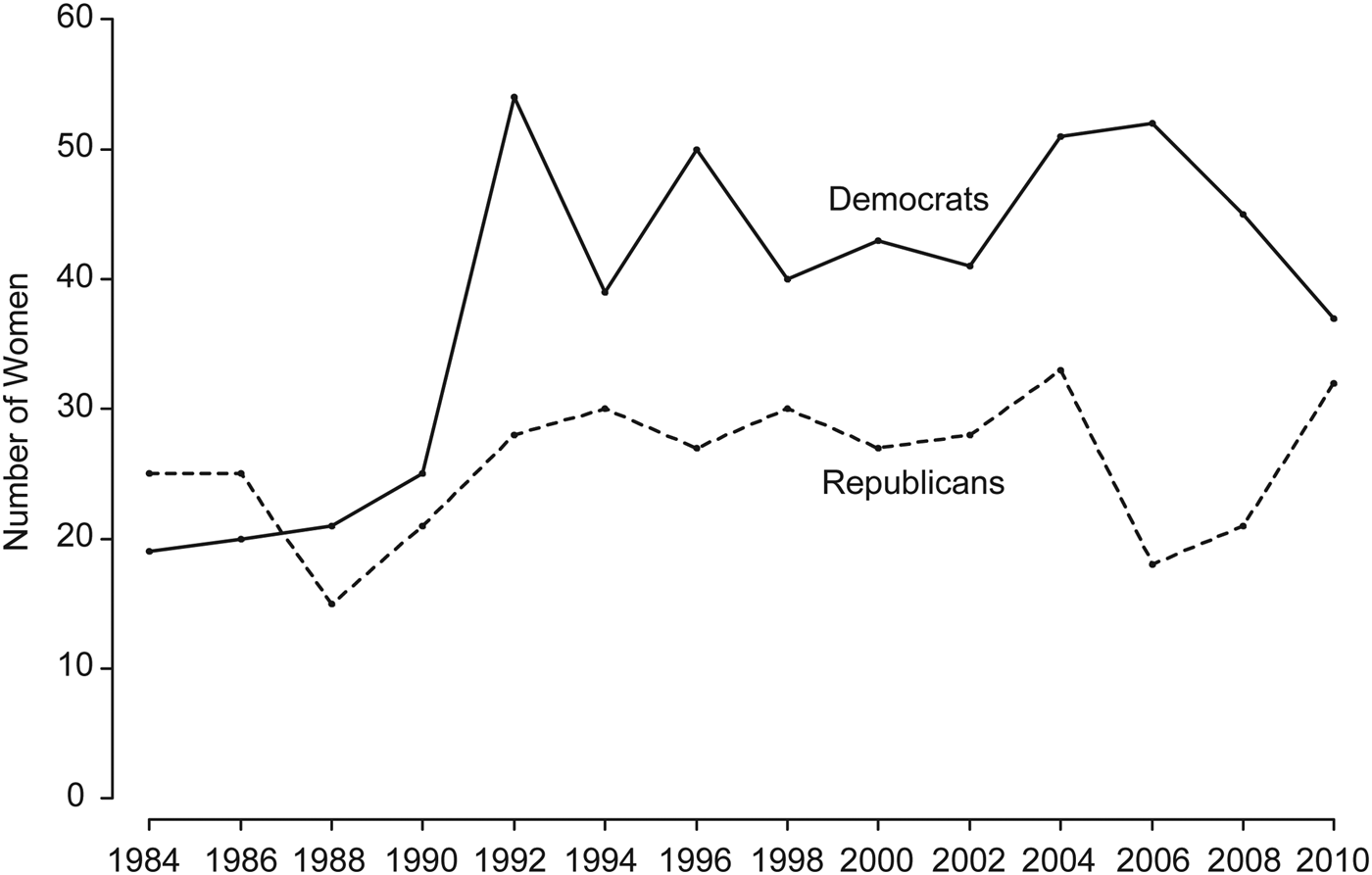
Since 1992, dubbed the “Year of the Woman,” when a record 106 women ran for the House, a partisan gap in women's candidacies has persisted over time.Footnote 10 As shown in Figure 1, the average number of nonincumbent female Democrats rose from 21 between 1984 and 1990 to 45 from 1992 to 2010, while the number of nonincumbent Republican women remained comparatively flat, increasing from an average of 21 before 1992 to an average of 27 in 1992 and after (although with some signs of growth in 2010).Footnote 11
Number of female nonincumbents.
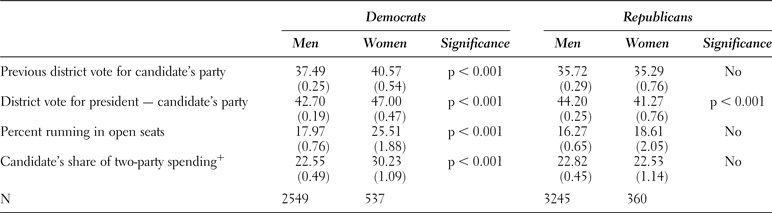
The Democratic Party and its network are more likely to encourage and fund female candidates than the Republican Party and its network (Elder Reference Elder2012; Fox and Lawless Reference Fox and Lawless2010; Sanbonmatsu Reference Sanbonmatsu2006a). Table 2 suggests that the electoral terrain is indeed rockier for Republican women than it is for Democratic women. It presents differences in means for campaign spending, open-seat contests, and district partisanship, revealing that Democratic female candidates run with significant advantages when compared to their male counterparts, whereas Republican women are at a disadvantage relative to Republican men.
Sex differences in congressional candidacies, by party
Notes: Cell entries are means, and the “Significance” column reports the results of a two-sample, two-tailed t test. +Uncontested seats have been removed from the calculation for spending since the question is whether there are differences between male and female candidates who have already entered the campaign.
Democratic women raise significantly more campaign money than Democratic men, and they are significantly (p < 0.01) more likely to run in open seats and run in districts that are more favorable to the party, measured in terms of the previous vote for the Democratic congressional and presidential candidates in the district. All of these factors increase their chance of victory.Footnote 12 Republican women, however, do not have these advantages, and when it comes to district partisanship, they are at a disadvantage. The districts they run in are, on average, about three percentage points less Republican than the districts their male counterparts run in, making it more difficult to win. With the exception of the lagged House vote, the results are consistent if all of these variables are added to a multiple regression model predicting female candidate emergence.Footnote 13
Election Victories
Our findings have important implications. Women who are more experienced, running in more favorable districts, and spending more money, ought to be more likely to win than men. When sex and partisan differences are accounted for in a multiple regression framework, it becomes clear that congressional elections are not, in fact, gender neutral for women in either party.
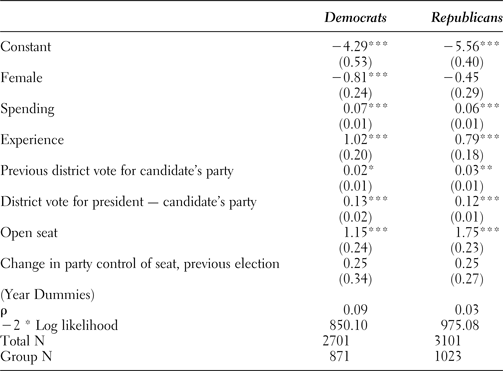
The partisan differences in rates of victory that flow from the biases in process we have identified are striking, even without multivariate models. Between 1984 and 2010, Democratic women received about 3.1 percentage points more of the two-party vote than Democratic men, while Republican women received 1.5 points less than Republican men. When these differences in votes are translated to wins and losses, however, the advantage for Democratic women disappears (and is statistically insignificant), while the disadvantage for Republican women actually increases to a gap of 4.4 percentage points.Footnote 14Table 3 presents the results of a logit model with candidate victory as the dependent variable. The coefficients reveal that women in both parties do, in fact, win at lower rates than men once the important differences in electoral experience, district characteristics, and fundraising are included as controls. Among Republicans, the coefficient for sex is negative but not significant, and while it does suggest that a Republican victory is less likely when a Republican woman is in the race, it seems much of the disadvantage in the difference of means can be attributed to the unfriendly politics of the districts where Republican women tend to run. For Democrats, however, the difference is large and statistically significant, indicating that Democratic women are less likely to win than similarly situated Democratic men in this fully specified model.
Explaining victories, 1984–2010
Notes: Cell entries are coefficients and first differences as described in the text. Dependent variable is a dummy indicating Democratic victory for the “Democrats” equation and Republican victory for the “Republicans” equation, and all variables have been coded to produce the expectation of a positive coefficient. Uncontested seats have been omitted from the analysis. Missing data have been imputed using Amelia II (Honaker, King, and Blackwell Reference Honaker, King and Blackwell2007), and the models have been estimated in lmer for R. Standard errors are in parentheses. *p < .05; **p < .01; ***p < .001
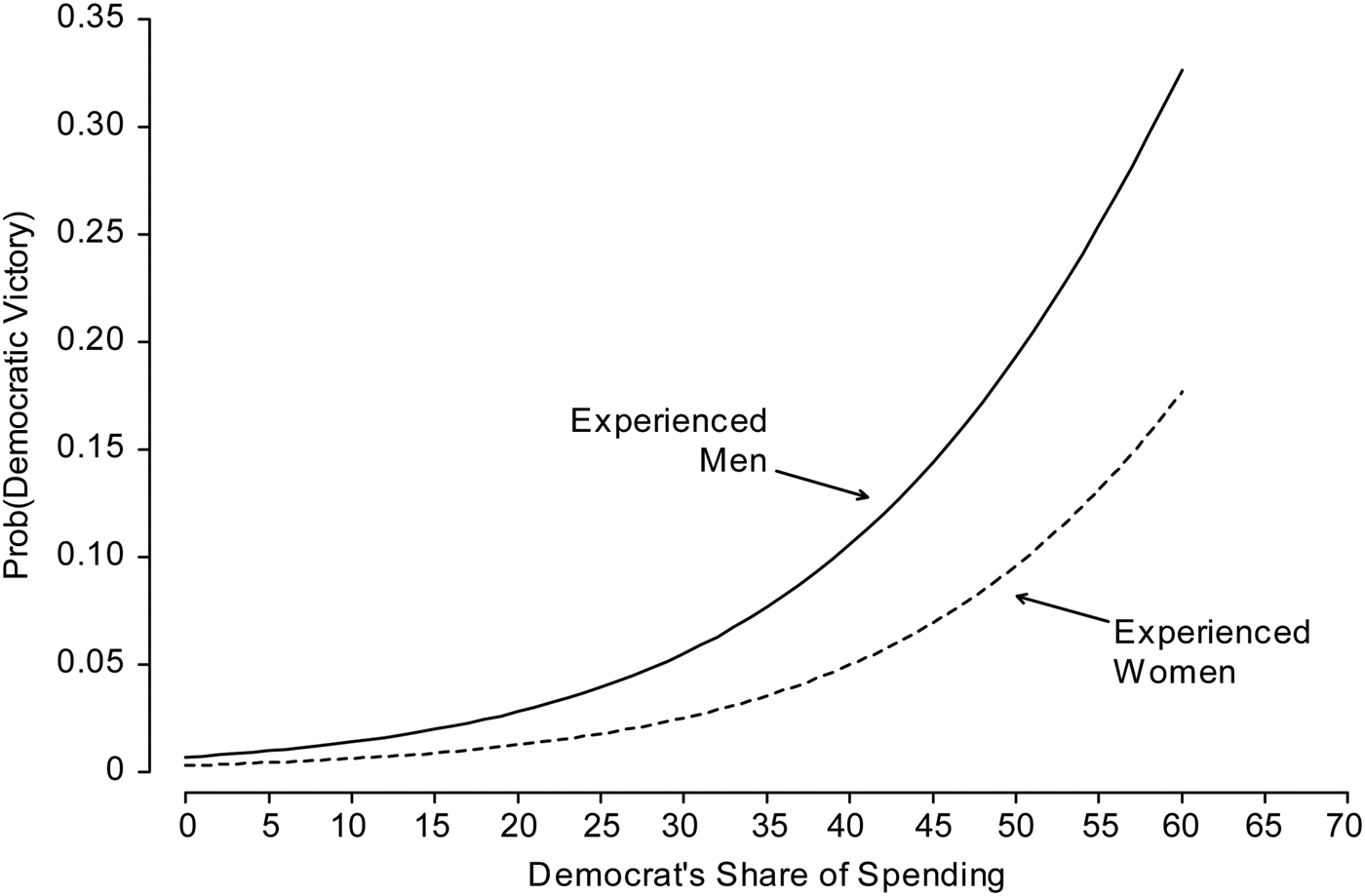
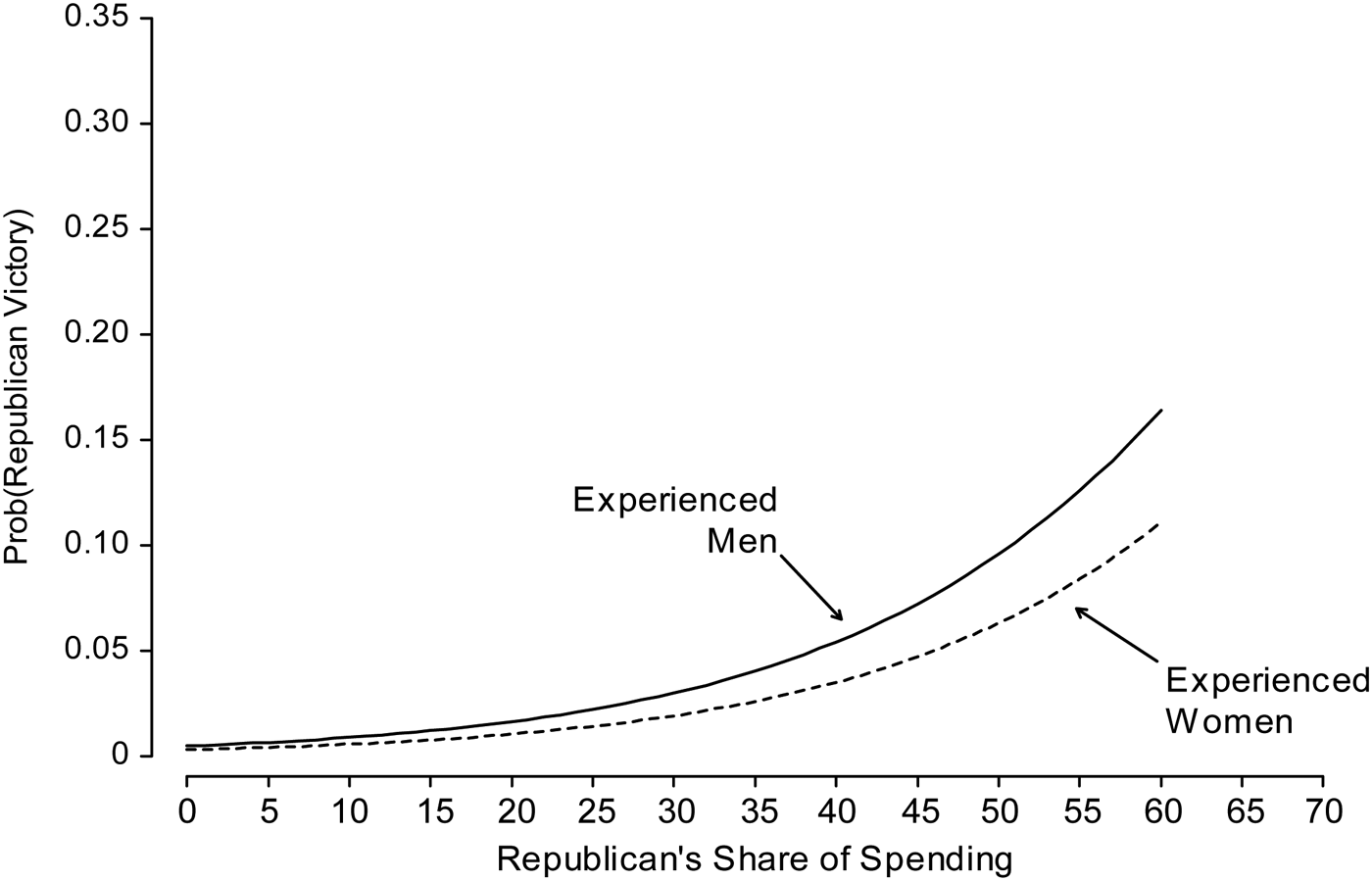
Figures 2 and 3 translate these gender effects into predicted probabilities. We calculate these results for an experienced candidate running against an incumbent, keeping all other variables at their sample means. The effect of candidate sex is now quite large. For Democrats, shown in Figure 2, the probability that a woman wins a race where she spends as much as her opponent is about eight points lower than it is for a similarly situated man. The predicted effect of sex is smaller for Republicans, as shown in Figure 3: a woman at parity with her opponent in spending has a probability of winning that is about five points lower than for a comparable man. Moreover, because the odds of a nonincumbent victory are low to begin with, these differences mean that women have about half the chance of their male counterparts at winning these races: 8% versus 16% for Democrats, and 4% versus 9% for Republicans. Of course, not all challengers are experienced, and rarely do challengers spend as much as the incumbents they run against, but under those conditions, women are at a disadvantage.
Predicted probability of victory, Democratic candidates. Note: Graph shows the probability of a Democratic victory as predicted from the equation in Table 3. Results are for experienced candidates, holding all other variables except spending and gender at their sample means.
Predicted probability of victory, Republican candidates. Note: Graph shows the probability of a Republican victory as predicted from the equation in Table 3. Results are for experienced candidates, holding all other variables except spending and gender at their sample means.
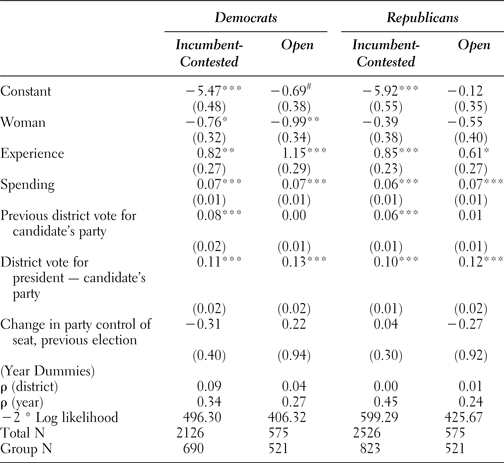
Do women have an even harder time winning against incumbents than they do winning open seats, relative to men? Table 4 shows that the results are consistent when we split the sample into races contested by incumbents and open seats without any incumbent running. Among Democrats, women are less likely to win in both types of contests. Among Republicans, the coefficient is negative for women but not statistically significant. For both parties, women are more disadvantaged in open seats; however, the difference between the coefficients in the open-seat and incumbent-contested models is not statistically significant, leading us to conclude that the dynamics of the gender effect are broadly similar in both types of races.
Explaining victories, 1984–2010, incumbent-contested and open seats, separately
Note: Cell entries are coefficients and first differences as described in the text. Dependent variable is a dummy indicating Democratic victory for the “Democrats” equation and Republican victory for the “Republicans” equation, and these two groups have been further split into incumbent-contested and open seats. All variables have been coded to produce the expectation of a positive coefficient. Uncontested seats have been omitted from the analysis. Missing data have been imputed using Amelia II (Honaker, King, and Blackwell Reference Honaker, King and Blackwell2007), and the models have been estimated in lmer for R. Standard errors are in parentheses. #p < .10; *p < .05; **p < .01; ***p < .001
These results suggest that conventional wisdom needs some revision. Female candidates in each party are better qualified than male candidates. Yet women in both parties are not performing as well as they should be, given their advantages. Although nonincumbent Democratic women are as likely to win as nonincumbent men at the bivariate level, they are significantly less likely to win once differences in experience, spending, and district characteristics are controlled. Republican women, by contrast, do not even manage to win as often as Republican men without any statistical controls, largely because they lack the other advantages that Democratic women have. While previous explanations of the dearth of congresswomen have focused on women's reluctance to run, the fact that women, especially Democratic women, win less often than men once women's advantages are accounted for must be added to the list of explanations.
DISCUSSION AND CONCLUSIONS
Nonincumbent female candidates in both parties are more likely than their male counterparts to have held elected office before running for the House of Representatives. These results confirm our theoretical expectations, which were based on research showing a gender gap in political ambition, that women are more likely than men to be concerned about their credibility and to rely on their qualifications when considering a run for office (Dodson Reference Dodson, Thomas and Wilcox1998; Fowler and McClure Reference Fowler and McClure1989; Lawless and Fox Reference Lawless and Fox2005; Reference Lawless and Fox2010; Sanbonmatsu Reference Sanbonmatsu2002).
In the male-dominated arena of electoral politics, it is hardly surprising that women considering a bid for Congress would be more likely than men to wait to run until they have the self-perceived qualifications, resources, connections, and credibility that come with experience holding elected office. These differences translate into gender differences in governing as well. Indeed, once elected, congresswomen continue to outwork their male colleagues by sponsoring more legislation and bringing more federal dollars to their districts (Anzia and Berry Reference Anzia and Berry2011), shepherding more bills through the legislative process (Volden, Wiseman, and Wittmer Reference Volden, Wiseman and Wittmer2013), and delivering more speeches on the House floor (Pearson and Dancey Reference Pearson and Dancey2011). Politically engaged observers recognize such differences, rating female incumbents more highly than male incumbents (Fulton Reference Fulton2012).
Qualifications are not the only way to smooth the path to office; district characteristics and fundraising are also very important. Women have incentives to seek advantages in these domains as well, but their opportunities to do so are constrained by parties. The Democratic Party is more hospitable to women than is the Republican Party, with important implications that extend beyond the partisan gap in the number of women's candidacies. Nonincumbent Democratic women run in congressional districts that increase their chances of a favorable reception and victory. Specifically, Democratic women are more likely than Democratic men to run in open seats and in seats that favor Democratic candidates. Money is a factor as well. Despite—or more likely, motivated by—perceptions that women face higher hurdles when it comes to fundraising, Democratic women spend more money than Democratic men, all else equal. Greater resources allow Democratic women to run more professional campaigns that maximize the spread of their message, their credibility, and their contact with voters.
Nonincumbent Republican women are also more experienced than their male counterparts, but their campaign advantages end there. Republican women and men spend the same amount of campaign money, and Republican women run under relatively disadvantageous circumstances compared to their male counterparts—that is, in more Democratic-leaning districts. It is possible that Republican Party leaders actually facilitate women's candidacies in these Democratic-leaning districts. Although Republican women are disadvantaged relative to their Democratic opponents in such districts, they may fare better than a male Republican challenger, since women in both parties tend to be seen as more liberal (Alexander and Andersen Reference Alexander and Andersen1993; Koch Reference Koch2000; McDermott Reference McDermott1997, Reference McDermott1998) and since Democratic voters are more likely to support a Republican woman than a Republican man (Matland and King Reference Matland, King and Rosenthal2002). More research is needed to identify the sources and consequences of these partisan differences in women's candidacies.
As scholars have consistently reported gender neutral victory rates in congressional elections, there has been a shift away from research analyzing bias in electoral outcomes in favor of research exploring why more women do not run for office in the first place. Indeed, recent research on gender and candidate emergence has made important contributions (e.g., Fulton et al. Reference Fulton, Maestas, Maisel and Stone2006; Lawless and Fox Reference Lawless and Fox2005; Reference Lawless and Fox2010). Our analysis of nonincumbent congressional candidacies corroborates many of these findings: women, particularly Democratic women, tend to run for Congress only when they are better prepared and better situated to run a viable campaign than their male counterparts.
We show that gender neutral election results in House elections are not the product of a gender neutral process. Instead, male and female nonincumbent candidates win at approximately the same rates despite the advantages women possess. Among Democrats, rough parity in victory rates at the bivariate level turns into a statistically significant disadvantage when controls are added, while among Republicans, women win less often even without controls.
Our data cannot explain the gender bias we uncover—that is, why women in both parties, especially the Democratic Party, are less likely to win than similarly situated men. Perhaps there remain differences in women's candidacies—or the perception of their candidacies by the media, political elites, and voters alike—that we have not accounted for. The media, for example, are less likely to focus on policy issues when covering female candidates (Kahn Reference Kahn1996) and more likely to discuss gender, marital status, and children (Bystrom et al. Reference Bystrom, Banwart, Kaid and Robertson2004). Sanbonmatsu (Reference Sanbonmatsu2006a, Reference Sanbonmatsu2006b) finds that party leaders in some states believe that candidates of one sex have an electoral advantage that affects recruitment and gatekeeping. Discrimination may linger at the polls. Social desirability effects in surveys may mask some resistance among the electorate to electing a female president (Streb et al. Reference Streb, Burrell, Frederick and Genovese2008). Scholars have also demonstrated that when elections focus on issues of terrorism, defense, and homeland security in the post-9/11 era, women are disadvantaged (Falk and Kenski Reference Falk and Kenski2006; Lawless Reference Lawless2004). The fact that gender dynamics in congressional races vary across contests and by party, however, suggests such discrimination is complicated and contingent. Unfortunately, our data do not allow us to analyze these questions further, but more research on such topics would be a welcome addition to the discussion.
We suspect that our findings would also generalize to both lower-level elections and statewide elections. Even in the 2008 Democratic presidential nominating contest, Hillary Clinton emphasized her experience, although perhaps at the expense of stressing the need for change (see Carroll Reference Carroll2009). Additional research is needed to determine whether similar gender dynamics affect contests for offices that range from city council to governor.
For now, we emphasize that the conventional wisdom that women and men win at the same rate is not as ironclad as it seems, at least when it comes to nonincumbent candidacies for the U.S. House of Representatives. Women must be better candidates and run under better circumstances to fare as well as men. Democratic women do both: they are better candidates, more likely to run in open seats, more likely to run in Democratic districts, and better able to raise money than their male counterparts. Only with all of these advantages do Democratic women attain so-called gender neutral outcomes. The conventional wisdom also obscures important partisan differences. Republican women are better candidates, but parties constrain their opportunities, and they suffer electorally as a result. In order for women to make truly big gains in the U.S. House of Representatives, not only must more women run for office, but women in both parties must also win at the same rates and under the same circumstances as men.