Introduction
The aim of this paper is to summarise progress in the development of reflexive methods at Çatalhöyük over the past 20 years, and to describe some recent innovations that have used digital and 3D technologies to enhance the original reflexive aims. While digital technologies were not at the forefront of the methods described in an initial account of reflexive methods published in Antiquity (Hodder Reference Hodder1997), it has become clear that many of the original aims can be enhanced by the use of new generations of computer-assisted technologies for visualisation, recording and planning. We do not describe the full use of digital technologies at Çatalhöyük; for example, laser scanning is being used as part of the documentation for conservation evaluation. The wider use of digital technologies has been discussed by Forte et al. (Reference Forte, Dell’Unto, Issavi, Onsurez and Lercari2012). The aim in this paper is to consider those aspects of digital technologies that relate to the reflexive aims of the project, thereby adding to the continuing discussion of reflexive archaeological practice (see Berggren Reference Berggren2001; Berggren & Hodder Reference Berggren and Hodder2003; Chadwick Reference Chadwick2003; Hodder Reference Hodder2003; Yarrow Reference Yarrow2003; Edgeworth Reference Edgeworth2006; Bender et al. Reference Bender, Hamilton and Tilley2007; Castaneda Reference Castaneda, Castaneda and Matthews2008; Silliman Reference Silliman2008; G. Carver Reference Carver2011; M. Carver Reference Carver2011). While we recognise the widespread use of digital technologies in archaeology (e.g. Levy Reference Levy2013), our focus here is on their use not only to increase the accuracy and detail of recording methods, but also to further reflexive aims, defined in general terms as the situating of recording within its social and interpretative contexts.
The evolution and evaluation of reflexive methods at Çatalhöyük
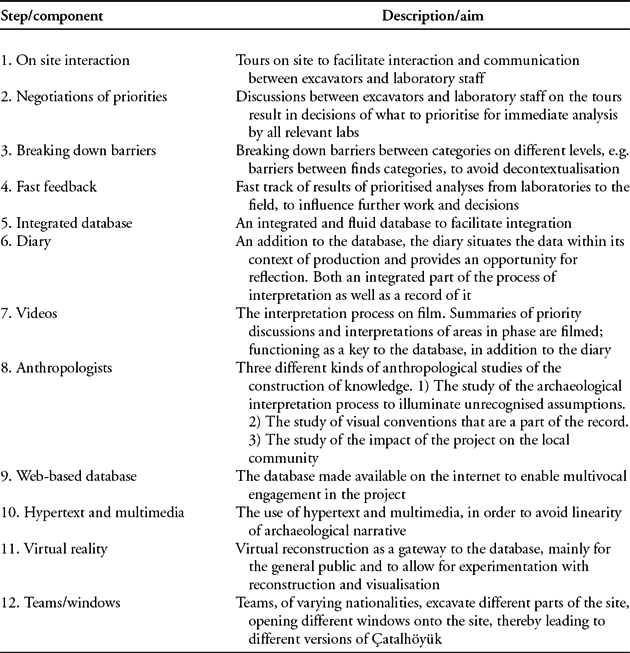
While the main established struts of reflexive method consist of emphases on interpretation at the trowel's edge and documentation of the documentation process (Hodder Reference Hodder1997, Reference Hodder2000b, Reference Hodder, Maschner and Chippindale2005), Berggren and Nilsson (in press) have recently evaluated 12 components of reflexive methods as they have been used at Çatalhöyük since the project began in 1993 (Hodder Reference Hodder and Hodder2000a). The 12 components (Table 1) were conceived as interwoven parts of the methodology of investigation at Çatalhöyük. However, some of them have been difficult to integrate, while others have become part of the archaeological practice on site. In short, the implementation of these components has been both more and less successful than expected. A reason for these rather inconsistent results may be that reflexivity at the beginning of the project was regarded as a methodological matter, with reflexive methods added as an envelope surrounding excavation and recording. More recently, there has been a shift in the project towards the view that a reflexive stance may be achieved directly within the excavation and recording methods, and the digital methods discussed below have contributed to this change.
Twelve components of a reflexive archaeology at Çatalhöyük (as defined by Hodder Reference Hodder and Hodder2000a).

As an example of the varied responses to the 12 components, anthropologists (Table 1, component 8) worked closely with the field team in the early years of the project (e.g. Bartu Reference Bartu and Hodder2000; Hamilton Reference Hamilton and Hodder2000). More recently, studies of knowledge production have shifted towards evaluation of the documentation process rather than of the people (Berggren & Nilsson in press; Mickel in press). Much of the anthropological work has, instead, focused on the local community (e.g. Yalman Reference Yalman2005) and on public engagement and multivocality (e.g. Atalay Reference Atalay2010, Reference Atalay2012, in press). The project has also had longstanding collaborations with artists and illustrators, both in terms of enhancing research and developing ways in which the site is presented to the public (Swogger Reference Swogger and Hodder2000; Moser et al. Reference Moser, Atalay, Camurcoglu-Cleere, Hodder, Orbasli and Pye2010; Earl Reference Earl2013; Perry Reference Perry2013).
Web-based information has become standard since the 1990s and is part of how the project has published its results. The integrated database (Table 1, component 5) was meant to emphasise fluidity and flexibility. However, the Microsoft Access database that was built for the project has not allowed the fluidity that was sought, and attempts are underway to move to a web-based system, open linked data, and a long-term ‘living archive’ (Esteva et al. Reference Esteva, Trelogan, Rabinowitz, Walling and Pipkin2010; Grossner et al. Reference Grossner, Hodder, Meeks and Engel2014).
Project teams of different nationalities and archaeological traditions have participated in the project. These different windows into Çatalhöyük have resulted in different perspectives (e.g. Tringham & Stevanović Reference Tringham and Stevanović2012), but they have also resulted in a fragmentation of the project, on both geographic and scientific levels. The different teams have been mixed recently and brought into closer dialogue, resulting in homogenisation, but also in a better understanding of the various perspectives.
The priority tours
Every other workday, laboratory teams send representatives to visit all areas of the excavation for updates on work progress. Excavators discuss their area, the units they have recently excavated, and their interpretation of these current contexts. Initially, priority tours were intended to involve laboratory staff in the interpretative process during excavation; in 1997 the purpose shifted, so that field and laboratory teams now work together to choose units of particular research value that will be sorted and analysed, on a quick turn-around, in order to answer specific questions and provide immediate feedback to the excavators from laboratory analysis. Priority tours allow for laboratory staff to better understand the context of the finds they examine, and enable excavators to make more informed interpretations about deposits and, therefore, improve decision-making in the field.
In evaluating the 12 components, Berggren and Nilsson (in press) found that the on-site interactions taking place during the priority tours have become integrated and central parts of the work process (components 1–4 in Table 1). This is where interaction, communication, negotiations, breaking down barriers and feedback take place. The priority tours have been an important source of communication between excavators and laboratory staff. However, they have also illuminated an imbalance, or faultline, between laboratory and field staff (Hamilton Reference Hamilton and Hodder2000). There is a structural imbalance and hierarchy embedded in the project, with excavators coming mainly from the developer-funded world and academic researchers based in the laboratories. To some degree every laboratory is encouraged to develop its own research questions—a structure related to the funding strategies of the project. As a result, the laboratory staff may be regarded as independent researchers while the excavators are the paid labour of the project. More recently, the project has tried to bridge this faultline by involving excavators in the research of the project, a strategy also pursued by a team from the University of California at Berkeley (Tringham & Stevanović Reference Tringham and Stevanović2012).
The diary
The diary has provided a particularly important counterpart to the otherwise strict and codified documentation system that uses single context recording. In the early years of the project, under-communicated objectives and imbalanced participation resulted in an uneven use of the diary, both in making entries and in using the information. Initially, only the excavators were supposed to write entries, to expose their assumptions and preconceptions, while members of laboratory staff were not. This added to the separation between the two groups. Lately, everyone in the project has been expected to participate in writing the diary. All team members are informed at the beginning of each season that they should aim to create two entries each week. Moreover, since 2012, an excerpt from one diary entry each day has been posted in highly visible areas of the dig house, making the diary database a conspicuous, tangible and ever-changing aspect of the project's environs. After beginning this initiative, the number of entries jumped from 7 by East Mound team members in 2011 to nearly 150 entries in 2012 and 2013—an increase which can be only partially explained by the fact that 2011 was a study season, entailing less extensive excavation. These results suggest the efficacy of the ‘diary entry of the day’ for increasing participation in this recording medium.
Content of the diary has, likewise, varied over the years. Not only do recent diaries include diverse perspectives on the research process—representing excavation supervisors, laboratory heads and students—but the platform for writing diary entries has also been altered. Participants are now given brief guidelines for diary entries. They are also given the opportunity to ‘tag’ their entries with topics, as well as to respond to entries written by other team members; this creates digital links between records and encourages researchers to contribute to each other's work. The diary medium thereby serves the dual purpose of providing a broader, more nuanced context regarding the research process—enhancing communication and dialogue between team members.
An extension from the original methods, but closely linked to diary writing and the documentation of the documentation process, has been the introduction of ‘the daily sketch’. This at first involved daily sketching on a printed photo of the area being excavated at the moment by the excavator (see Figure 1). With the introduction of tablet PCs, the daily sketch is now ‘drawn’ digitally on a photo displayed on the screen of the tablet. Explanations of the work done and the interpretations of the object being excavated, and its relation to other features or layers, are drawn and written on the photo. The daily sketch is integrated into the database and can be searched by the object being excavated—for example, the building, the feature or the layer. This has shown to be very helpful as a record of work progress as well as in the interpretation process, both as a visual aid for the excavator to remember the various steps of work and for other excavators that need to understand a certain area (as when taking over the excavation from someone else or when excavating a nearby area).
Example of a daily sketch at Çatalhöyük. Photograph and annotation: Burcu Tung.

The application of 3D visualisation
Over recent years, the use of 3D scanning and image-based 3D modelling has been developed at Çatalhöyük. This is another effort in a long line of digital experimentation on site (Tringham & Stevanović Reference Tringham and Stevanović2012), and it has become clear that these techniques facilitate various aspects of a reflexive approach. In particular, in conjunction with the use of on-site tablets (see below), they allow more information to be concentrated at the moment of excavation and interpretation in the trench. We have tried to develop 3D techniques in the field in order to bring information to trowel's edge more effectively, quickly and interactively.
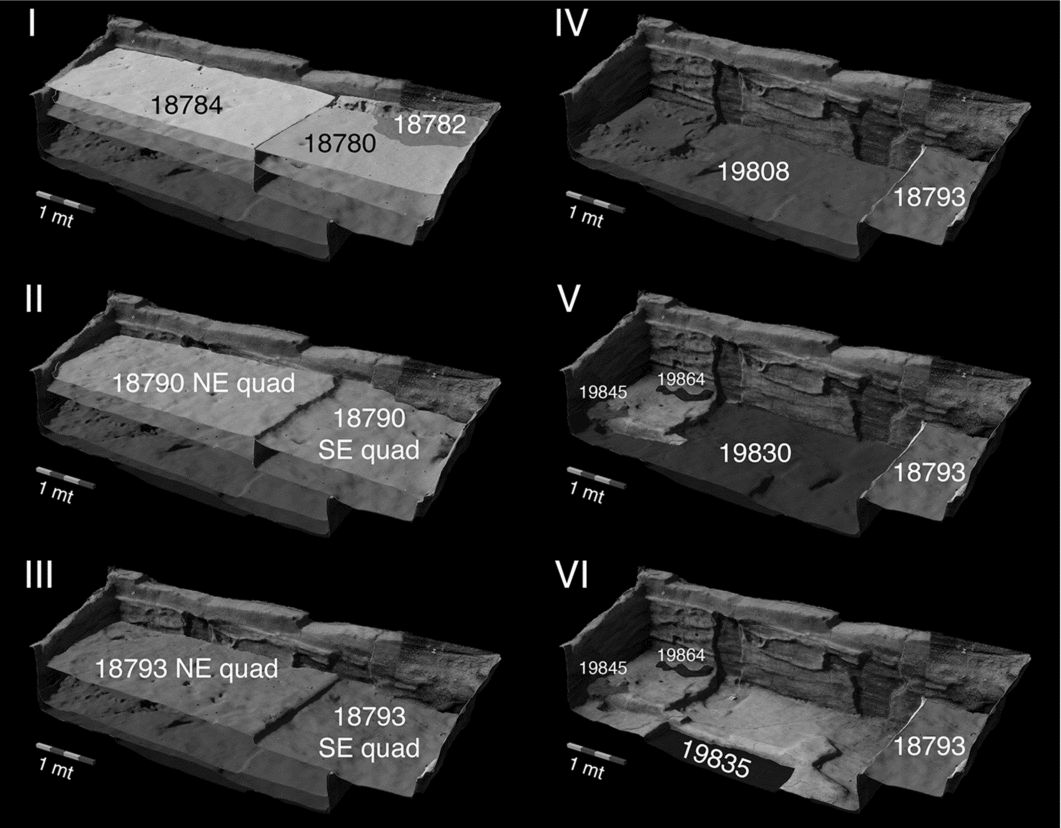
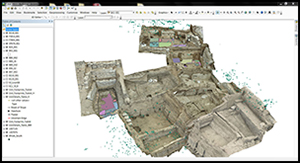
In 2009 and 2010, an on-site digital experiment was started with the aim of recording every phase of excavation of a single Neolithic house (Building 89) in 3D using laser scanning, image-based 3D modelling and photogrammetry. The goal is to make the excavation process virtually reversible in a simulated environment at levels ranging from laptop computers to virtual immersive systems. Indeed, the entire excavation strategy of Building 89 was designed with these immersive systems in mind, and the simulation involves a virtual browsing of all the layers and stratigraphy (Figure 2) within a collaborative virtual environment. 3D recording has been implemented at two main levels. At the micro-scale, all of the stratigraphy of Building 89 is recorded using image-based modelling. Image-based modelling allows for the creation of accurate 3D visualisations of the archaeology within the time frame of the excavation (Forte et al. Reference Forte, Dell’Unto, Issavi, Onsurez and Lercari2012). There is a large range of software available (commercial and open source), and we decided to use Agisoft Photoscan (Callieri et al. Reference Callieri, Dell’Unto, Dellepiane, Scopigno, Soderberg, Larsson, Artusi and Fellner2011; Verhoeven Reference Verhoeven2011; Dellepiane et al. Reference Dellepiane, Dell’Unto, Callieri, Lindgren and Scopigno2013; Agisoft 2014; Dell’Unto Reference Dell’Unto, Campana and Remondino2014). Image-based 3D modelling has since been used by other excavation teams at Çatalhöyük, although, unlike the strategy for Building 89, these areas are modelled several times per season, at significant points in the excavation process (i.e. pre-excavation, post-excavation and mid-season models, which are created when buildings are in phase). This product proved to be efficient, despite having to acquire and process a large number of pictures on site every day. At the macro-scale, all the key excavation areas are laser scanned in their entirety (Figure 3). These scans started in 2012 in the East Mound, with the aim of annually recording the status of the excavation. The survey has been implemented using a Faro Focus 3D Shift Phase laser scanner; this makes the visualisation of each area of the excavation possible in high resolution with the aim of taking measurements or calculating volumes. This also allows us to visualise specific details of the archaeology in different seasons and therefore monitor the decay of features, walls or buildings. Irrespective of the technique used, all the 3D data are integrated into the intra-site GIS (see below).
Geo-referenced virtual reconstruction of the western stratigraphy of B89 based on computer vision models. Source: Nicola Lercari.

3D GIS of the south shelter visualised using Arcscene. The buildings displayed in the screenshot have been excavated in different years by different teams. The screenshot shows the field documentation realised by the archaeologists working in Buildings 80, 89 and 118, imported and visualised in spatial relation to the models of the buildings.

In an effort to extend the application of 3D recording techniques at Çatalhöyük, a programme of 3D burial recording using image-based 3D modelling was initiated in 2012. After a brief training session on photograph recording techniques and use of the software, members of the Human Remains team began to independently produce 3D models of burials. Initially, the technique was used only to document completely exposed skeletons, but by producing geo-referenced models at each stage of the excavation process the team could virtually reconstruct the often-complicated sequence of interments underneath house floors. Consecutive sub-floor burials at Neolithic Çatalhöyük frequently occur within a single house platform. As such, earlier interments are often disturbed by the grave cuts of later ones, a process which results in truncated skeletons and an abundance of mingled bone within grave fills. In addition, burials were sometimes reopened in order to retrieve and/or redeposit crania and other bones. In these situations, 3D modelling has greatly improved our ability to reconstruct and interpret mortuary practices.
An initially perplexing sequence of bone and partially disturbed primary skeletons uncovered in 2012 (Figure 4) provides an example of reflexive re-interpretation based on 3D digital modelling. The uppermost layer consisted of a circular deposit of disarticulated limb bones and several crania. Directly beneath this deposit was the tightly flexed headless skeleton of an adult male and, just below this, an earlier primary adult burial that had been heavily disturbed. It was unclear at the time of excavation whether the cranium and mandible of the adult male had been removed before burial or whether the grave had been reopened some time later to retrieve them. By recording 3D models at each stage of the excavation process, however, we were able to see that the circular deposit of bones lay in a small cut, located directly above the area where the head of the earlier skeleton would have been. Thus, we were able to positively identify, for the first time at Çatalhöyük, a ‘skull retrieval pit’ and to show that, after the removal, loose bones from at least two additional individuals had been carefully placed in the pit before it was resealed. This finding confirms that skull retrieval at Çatalhöyük was intentional and targeted, rather than being the result of accidental disturbances to earlier burials.
False colour 3D models produced in Meshlab showing stages of the excavation of a skull retrieval pit in Space 77: left) upper burial layer showing circular fill of skull retrieval pit (dotted circle) above a primary flexed adult burial; centre) middle burial layer after removal of soil from skull retrieval pit, revealing disarticulated skeletal elements placed in cut for skull retrieval pit; parts of the underlying primary flexed adult skeleton are now visible; right) lower burial level after full exposure of the primary flexed adult headless skeleton.

Intra-site GIS as a tool for data integration and visualisation
Geographic information systems (GIS) were under-appreciated components of integrated and reflexive methods at the start of the project; these were not initiated until 2009. One of the main objectives of the use of GIS on the project, more recently, has been to develop a tool for integrating different types of data, produced by different participants in the project (both field and laboratory staff). In order to meet these goals, the GIS team and various members of the Çatalhöyük Research Project have worked closely together on the creation of a GIS geodatabase (ESRI ArcGIS), which now forms, together with the database, the core of the Çatalhöyük digital archive. The GIS geodatabase provides meaningful structure to the spatial data produced by the project, and its flexibility allows the organic incorporation of an increasing range of data collected on site, including three-dimensional spatial data. During the past year, the increasingly central role played by the Çatalhöyük GIS, both during the excavation process and laboratory work, convinced us to migrate our personal geodatabase to an ArcSDE geodatabase in order to allow multiple users access and editing of the GIS data.
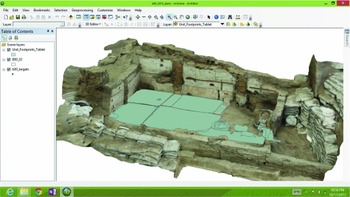
Since the 3D recording project was initiated, the Çatalhöyük GIS geodatabase has served as the main repository and display space for the image-based modelling data recorded on site. During the course of excavation, geo-referenced image-based models are imported into the GIS geodatabase and seamlessly integrated with other spatially related data, providing instant feedback to the field team (Figure 5). However, a number of technical issues needed to be addressed before a reliable workflow could be produced. This ultimately involved the creation of multi-patch feature classes in the GIS whose attribute tables were arranged in meaningful fields in order to make the models easily queryable (see ESRI 2012). The Çatalhöyük intra-site GIS has significantly enhanced our ability to present and interpret archaeological data, serving as a virtual space in which barriers between diverse datasets are broken down. An important step in the development of the Çatalhöyük GIS as a reflexive tool has been the implementation of GIS packages on tablet PCs used in the field.
3D GIS of Building 80 visualised using Arcscene. The screenshot shows the field documentation (2D polygons in green) recorded by the archaeologists working in Building 80 imported and visualised in spatial relation to the model of the building created using image based modelling. Source: Justine Issavi.

Information at the trowel's edge: the role of tablets in the production of knowledge
In 2013, the systematic use of tablets in the field was introduced in three different excavation sections in the South Area at Çatalhöyük, as part of the broader goal of moving towards paperless recording. The affordable cost of tablet technology, the wider development of the hardware technology itself, and the availability of tablet PCs robust enough to cope with the physical pressures of site work (specifically heat and dust) have allowed the expansion of tablet use at sites like Çatalhöyük. Pompeii, for example, is well known for pioneering efforts in the use of mobile technology in digital recording, replacing field notebooks and pro forma entirely with Apple iPads (Ellis & Wallrodt Reference Ellis and Wallrodt2012). The success of the mobile recording initiative at Pompeii has inspired other projects, such as the Proyecto de Investigación Arqueológico Regional Ancash in Peru, which similarly employs iPads and has experimented with software and workflows to streamline data collection (DeTore & Bria Reference DeTore and Bria2013). Other projects, such as the Temple of the Winged Lions Cultural Resource Management initiative, are using tablets specifically to enhance visualisation and educational possibilities (Levy et al. Reference Levy, Tuttle, Vincent, Holland, Richter, Petrovic and Kuester2013). The choices made at Çatalhöyük, in terms of hardware, software and methodology, drew on the successes and drawbacks of such initiatives in order to integrate the various intertwined forms of data produced at the site. Moreover, our particular focus was on revising and improving Çatalhöyük's reflexive methodology, while keeping three central goals in mind:
-
• Ensuring no data would be lost in the transition from paper to digital records;
-
• Creating a workflow with a manageable learning curve that could be utilised by team members with diverse technological backgrounds;
-
• Ensuring an increased overall efficiency when compared with traditional paper drawings.
The release of the Windows 8 operating system provided a software platform that would enable us to capitalise on existing software solutions utilised by the project (i.e. the Microsoft Access site database and ESRI's ArcGIS 10 intra-site geodatabase), without reliance on bespoke software solutions or app technology. Although there is the desire to move to total paperless recording, the main emphasis, to date, has been on the use of tablets to create digital drawings of excavated features. This preliminary focus on the graphic archive was, in part, due to several logistical issues that have prevented database access on site. The three areas selected for tablet recording in 2013 were Buildings 80 and 118, which developed a workflow incorporating ESRI's ArcGIS 10.1, and Building 89, utilising open source QGIS as the main digitising solution. Both workflows use vector points collected by the total station and raster orthophotos taken with the site SLR camera as source data.
As this workflow was developed and implemented, it soon became clear that tablet recording was a suitable replacement for the traditionally hand-drawn graphic archive—even exceeding initial expectations on several levels (Figure 6). In addition to enabling the archaeologist to produce a robust, accurate and ultimately efficient graphic archive, the tablet allowed improved engagement between excavation and recording. The tablets became an indispensable repository of all past and present information relevant to the excavation, channelling a variety of data types. Archive reports, containing relevant information about previous excavation seasons, became available at the touch of a finger; older plans (including those of James Mellaart's excavations of 1961–65) could be successfully imported into the GIS and superimposed upon recent plans and drawings. Running current matrices, as well as relevant ones from past seasons, could be edited and annotated with ease; field notes and sketches were also organised and housed on the tablet. Finally, the integrated 3D models could be easily accessed within the GIS.
Using the tablet in the trench. Photograph: Nicolo Dell’Unto.

By combining tablets, GIS and 3D models, the excavator has a unique opportunity to review the whole excavation process while in the field, and the technologies serve as a useful reflexive tool in their own right. This instant and convenient availability of information has a direct influence on the archaeologist and allows better-informed decisions and interpretations. As such, the tablets offer a number of potential ways to improve excavation recording methodologies by facilitating the reflexive engagement of the excavator in the archaeological process.
Conclusions
Figure 7 attempts to summarise the generation of knowledge at Çatalhöyük, from the acquisition of field data, through the archaeologist as an agent for recording and interpretation, towards the creation and dissemination of output, both as an archive resource and in terms of publication. This structure is perhaps necessarily hierarchical because it is related to the recording system, which is based upon single-context recording methodologies (Spence Reference Spence, Harris, Brown and Brown1993). However, the diagram also demonstrates how the various stages of knowledge production are impacted and informed, recursively, by the application of the various reflexive methods employed by the project as they have developed and been added to in the ways outlined above.
Workflow summary diagram. Source: James Taylor.

The ‘reflexive loop’ might be seen as an ideal, although historically it has been difficult to implement fully (see above and Berggren & Nilsson in press). There are several factors that deserve some further consideration here—since, in a very real way, the use of the tablets in the field addresses some of these problems. One impact of the tablets is in mitigating some of the social and structural faultlines identified above. Their use forces all members of the field team to train in, and develop a range of, ‘non-traditional’ skill sets (3D modelling, geo-rectification, digitisation and GIS data manipulation), historically reserved for specialist team members. Whilst the coordination and management of this technology still requires a degree of specialisation, the knock-on effect of the diversification of skills is an overall democratisation of the knowledge creation process. Everyone on site is contributing and, recursively, benefiting from the easy, integrated flow of data and interpretative information through the tablets.
This democratisation is further reinforced by the fact that team members very quickly begin to develop a much deeper understanding of the digital data structure of the project and, by implication, what happens to the data once it leaves the site and how it fits into the process of interpretation. The tablets bring many aspects of data manipulation, validation and interpretation, which are ordinarily reserved for certain ‘privileged’ individuals during the post-excavation process, into the field at the trowel's edge.
The tablets also directly address a number of issues arising from the fragmentary nature of various components that make up the recording system as a whole. Entering data into the database was physically and temporally separated from recording in paper diaries, and certain levels of interpretative analysis were completed digitally in the evenings, distanced from the field. Even in the field, different logs and recording sheets were often stored in different files, kept on different boards and filled in at different times (both on and off site); such are the practicalities of most ‘paper’ excavations.
At Çatalhöyük, the recording documentation was developed to try to accommodate this fragmentation, but it is fair to say that nothing has had such an integrative impact upon the recording process as the adoption of tablet PCs. This can be clearly seen in Figure 7, which gives some indication of the degree to which the tablet facilitates a more reflexive approach to recording by allowing the operator to switch at will between graphics, written observations and interpretations, stratigraphy and ‘old data’ or publications. The result is a more holistic overview of the data collation and interpretative process on the fly, in the field, as the action unfolds. This ‘deep integration’ of data and interpretation inevitably informs and supports the process of generating knowledge output.
More specifically, the tablets, and the suite of associated digital technologies that they allow in the field, serve to realise a number of the original 12 components of reflexive archaeology (see Table 1). As discussed above, they have a democratising effect, and therefore serve to break down barriers (component 3) and hierarchies between various team members. They integrate data (component 5) from the database, the GIS and the 3D models. Many of the technologies referred to in components 9, 10 and 11 seem dated in the light of these modern technologies; however, for precisely this reason, the tablets and the technology they harness can be seen to dramatically supersede, and improve upon, the technologies envisioned when these steps were originally conceived. Finally, the different visions of the site that flourish within the international teams (component 12) are drawn together as the tablets, diaries and the increasing emphasis upon free interpretation of the various digital datasets by all team members facilitate a subtle form of digitally based multivocality.
It remains the case, however, that as archaeology as a discipline becomes ever more fragmented into specialised areas of knowledge, challenges to integrated interpretation and contextual understanding within the field process increase. As noted above, a good reflexive methodology will try to institute a recording structure which places “the individual archaeologist at the forefront of a recursive, interactive web of interpretation and discussion” (Chadwick Reference Chadwick1998; 113). It will emphasise interpretation as part of the primary recording; it will allow for easy reflection and dialogue, preferably on site; and it will allow all members of the project access to a holistic overview of the data so that interpretations about individual artefacts, or stratigraphic units, or higher order stratigraphic groupings and features, can be made in their broader context (Carver Reference Carver2009). At Çatalhöyük, there have been successes and failures in the implementation of reflexive methods. Many of the problems have derived from faultlines between field and laboratory staff, or from the practical separation of ever more complex forms and types of data. While it might have been thought that GIS and 3D visualisation would encourage further fragmentation and distancing from the trowel's edge, in practice their use—especially when combined with the adoption of tablet PCs in the field—has led to a maturing and expansion of the original reflexive objectives.