The Brazilian herd of buffalo is the largest herd outside the Asian continent. According to FAO (2009) there are around 1·2 million head of buffaloes in Brazil. While some of the Brazilian herd is utilized for meat production, most breeders aim at dairy farming owing to the attractive commercial profit that is associated with this activity. Such a profit comes mostly from the greater yield of dairy products, especially Mozzarella cheese (Tonhati et al. Reference Tonhati, Ceron Muñoz, Oliveira, Lima, Albuquerque and Faro2008).
Dairy females' longevity is a really important trait in a herd affecting overall profitability in the dairy industry. A high female longevity is desirable because the cost of rearing a heifer is high and moreover it allows a greater proportion of culling decisions to be based on production, instead of involuntary culling. Dairy females have been selected intensively for productivity traits whilst longevity within the herd has decreased. One measure of longevity is the stayability trait (Vollema & Groen, Reference Vollema and Groen1996). Stayability is defined here as the ability to stay in the herd measured in years after the first calving.
Early studies in dairy cattle indicated that stayability heritability was low (0·02–0·05; Hudson & Van Vleck, Reference Hudson and Van Vleck1981). Since then, many studies of the genetic variation of stayablity traits have been published, confirming the expressive environmental influence on this trait (Madgwick & Goddard, Reference Madgwick and Goddard1989; Short & Lawlor, Reference Short and Lawlor1992; Vukasinovic et al. Reference Vukasinovic, Moll and Kunzi1997). Despite the lack of studies in buffaloes, the results available indicate that the genetic variation of these traits can be greater than for dairy cattle (Pander et al. Reference Pander, Dhaka and Singh2002).
Female stayability can be registered for each buffalo as a continuous trait represented by the number of days for which the buffalo stayed in the herd (Martinez et al. Reference Martinez, Koch, Cundiff, Gregory and Van Vleck2004) or as a discrete trait, attributing the value 0 to a buffalo that did not stay and a value of 1 for a buffalo that stayed in the herd for a certain time (Silva et al. Reference Silva, Eler, Ferraz and Oliveira2003; Martinez et al. Reference Martinez, Koch, Cundiff, Gregory and Van Vleck2005; Queiroz et al. Reference Queiroz, Figueiredo, Silva, Espasandin, Meirelles and Oliveira2007).
In a breeding programme, knowing the genetic and environmental variations of the traits that are used as selection criteria is very important. Similarly to reproductive traits, heritability estimates for stayability are low (Hudson & Van Vleck, Reference Hudson and Van Vleck1981; Short & Lawlor, Reference Short and Lawlor1992) irrespective of whether they were registered as continuous variables (with normal distribution) or discrete variables (with binomial distribution) or whether in beef milk cattle or buffalo.
Inclusion of the stayability trait in breeding programmes can permit selection of animals able to have daughters with a higher stayability, so reducting rearing costs and increasing cumulative milk production in the herd.
The aim of this study was to estimate the heritability and evaluate the possibility of using the stayability trait as a selection criterion in buffaloes.
Material and Methods
The information used in the present study was obtained from female buffaloes born between 1984 and 2001, in nine herds located in the State of São Paulo in Brazil that integrate the Dairy Bubaline Test Program developed by the Animal Science Department of São Paulo State University, Jaboticabal-SP, Brazil. These herds consisted of Murrah breed animals managed on pastures consisting mainly of Brachiaria spp. and Panicum spp.
Dietary supplementation is generally adopted, especially during the dry season (April–September) and consists of chopped sugarcane or grass silage as forage and cotton seed, barley and soy as concentrates. Control of ectoparasites was by pharmaceutical applications, twice a year on average.
Mating was natural or by artificial insemination. Herds were milked twice daily. The milk test was conducted monthly and buffaloes were milked with calves beside them. Calves were weaned when 9 months old.
The data used in the analyses consisted of 1016 Murrah female buffaloes, daughters of 78 sires, extracted from a database with 4219 lactations from 1646 buffaloes. The number of daughters by sire was 12·13, and 33% of the sires had daughters in more than two herds. To ensure consistency of data, the following were not included in the analyses: animals without age at first calving, animals without milking test data, animals for which the milking test was not started until 60 d after the first calving and animals for which the first calving registration was outside the age bracket of 740–1260 d.
The stayability (ST) trait was defined as the ability to stay in the herd for one (ST1), two (ST2), three (ST3), four (ST4), five (ST5) or six years (ST6) after the first calving. Those that successfully remained in the herd for the given time were assigned the value 1 whilst the value 0 was assigned to those that had been culled. For each female, the last milking test was considered to be the date on which she was culled. For example in a ST2 analysis, a buffalo that calved for the first time at age 1 152 d (3·15 years old) and had its last milking test at age 1728 d (4·73 years old) was assigned the value 0 (failure) for ST2; i.e. it did not stay in the herd for 2 years after the first calving. It shows that these traits have a binomial response.
The same traits were considered as continuous variables (in days) and denominated the stayability in days (STD) up to one (STD1), two (STD2), three (STD3), four (STD4), five (STD5) or six years (STD6) after the first calving. For the buffaloes that stayed in herd after a specific age (ST=1, indicating success), the STD trait was registered as the values of 365, 730, 1095, 1460, 1825 and 2190 d, respectively, for STD1, STD2, STD3, STD4, STD5 and STD6; when buffaloes were culled (ST=0), the STD trait was registered as the difference in days between the last milking test and the first calving.
The effect of birth season was divided into two seasons owing to few observations in certain months; the season 1 consists of the dry period (April–September) and season 2 the rainy period (October–March). The birth year included the period 1984–2001 for ST1, 1984–2000 for ST2, 1984–1999 for ST3, 1984–1998 for ST4, 1984–1997 for ST5 and 1984–1996 for ST6, considering the opportunity of remaining in the herd after the first calving. Records for buffaloes that had not yet reached the specific ages studied were eliminated. The same was considered for each STD.
For the traits ST1 and STD1, the analysis model considered as the following as fixed effects: breeding herd, birth year and season, and the age at first calving as a (co)variable. Animal and the temporary environment were considered as random effects. For the other traits, the model was the same, excluding age at first calving (AFC) because it was not significant in previous analysis. Analyses using models that included total milk yield during the first lactation, truncated at 270 d, were also realized. The total milk yield during the first lactation effect was considered as two classes: class 1, milk yield up to 1500 kg and class 2, milk yield >1500 kg. Any interaction between main effects was not considered in order to avoid classes without variation. The animal model used can be described as:

where:
Y is the observation vector (ST1 up to ST6);
β is the fixed effects vector;
a is the random additive genetic effects of the animal;
e is the residual or temporary environmental random effects;
X and W are incidence matrices of the respective effects.
Binomial distribution of the data was assumed for ST at different ages, with the probit link function, in which the ST probability is given by g(μ)=Φ−1, in which Φ is a normal accumulated distribution function and the residual variance was fixed in a unit of the measure (σe2=1). In these analyses, the variance components were estimated by approximate restricted maximum likelihood. For STD at different ages, normal distribution of the data was assumed, with μ=Xβ and Var=σe2, and the variance components were estimated by restricted maximum likelihood. All analyses were performed using the ASREML software program (Gilmour et al. Reference Gilmour, Cullis, Welham and Thompson1999), in single-trait analyses, including a parental matrix containing 1694 animals.
ASREML iterates for n iterations unless convergence is achieved first. Convergence is presumed when the REML log-likelihood changes less than 0·002*current iteration number and the individual variance parameter estimates change less than 1%. The number of 1000 iterations was used.
Results
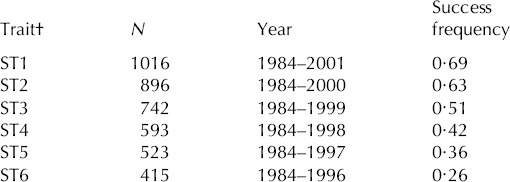
The number of observations, years of birth and ST success frequency (1–6 years after first calving) are shown in Table 1.
Number of observations (N), birth year and stayability (ST) success frequency of dairy buffaloes at six specific ages
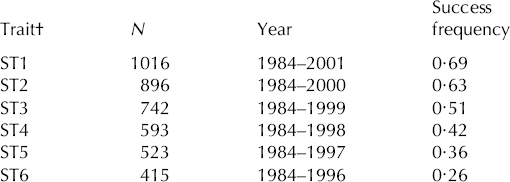
† ST1: Stayability for 1 year after first calving; ST2: Stayability for 2 years after first calving; ST3: Stayability for 3 years after first calving; ST4: Stayability for 4 years after first calving; ST5: Stayability for 5 years after first calving; ST6: Stayability for 6 years after first calving
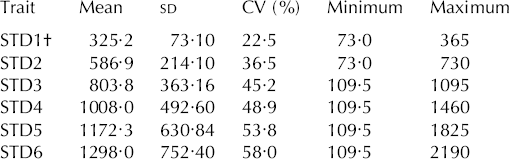
For STD, data for each age are shown in Table 2.
Mean, sd, coefficient of variation (CV), maximum and minimum value for stayability (STD) of dairy buffaloes at six specific ages
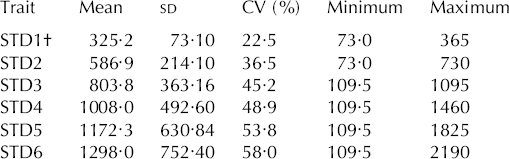
† STD1 were culled 1 year after first calving; STD2 were culled 2 years after first calving; STD3 were culled 3 years after first calving; STD4 were culled 4 years after first calving; STD5 were culled 5 years after first calving; STD6 were culled 6 years after first calving
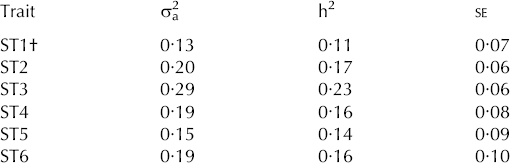
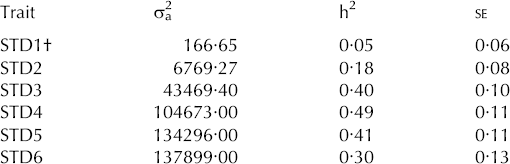
Additive genetic variances, heritability coefficients and estimated se for the traits ST1, ST2, ST3, ST4, ST5 and ST6 are shown in Table 3, and for the traits STD1, STD2, STD3, STD4, STD5 and STD6 they are shown in Table 4.
Additive genetic variance (σa2), heritability estimates (h2) and se for the traits ST1, ST2, ST3, ST4, ST5 and ST6
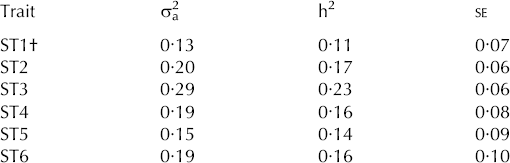
† ST1: Stayability for 1 year after first calving; ST2: Stayability for 2 years after first calving; ST3: Stayability for 3 years after first calving; ST4: Stayability for 4 years after first calving; ST5: Stayability for 5 years after first calving; ST6: Stayability for 6 years after first calving; σa2=additive genetic variance; h2=heritability; se=se of the heritability estimate
Estimates of additive genetic variance (σa2), heritability estimates (h2) and se for traits STD1, STD2, STD3, STD4, STD5 and STD6
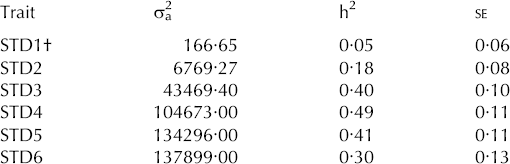
† STD1: were culled 1 year after first calving; STD2: were culled 2 years after first calving; STD3: were culled 3 years after first calving; STD4: were culled 4 years after first calving; STD5: were culled 5 years after first calving; STD6: were culled 6 years after first calving; σa2=additive genetic variance; h2 heritability; se=se of the heritability estimate
The two ways of expressing buffalo stayability in the herd, ST and STD, can be considered as the same trait analysed in different ways. However, the heritability estimates for stayability expressed and analysed in the binary manner (ST) varied from 0·11 to 0·23, while for the same trait analysed continuously (STD) the heritability estimates were higher, varying from 0·05 to 0·49, except for STD1.
Discussion
In Table 1, as expected, the more advanced the age, the lower the stayability success percentage in the herd. It is also seen that 4 years after the first calving, more than half of the female buffaloes (58%) were culled. A higher ST mean (0·63±0·45) was reported by Short & Lawlor (Reference Short and Lawlor1992) in Holstein cows 4–5 years after the first calving. Peeva & Ilieva (Reference Peeva and Ilieva2007) reported that 25·9% of buffaloes in a herd in Bulgaria were culled after the first lactation. It is difficult to make comparisons of ST means obtained in this study with others in the literature because of the different definitions of this trait. Moreover, the mean values are strongly dependent on the herd yield, herd region, as well as on management decisions.
Madgwick & Goddard (Reference Madgwick and Goddard1989) reported heritability coefficients of 0·05, 0·04, 0·01, 0·02, 0·04, 0·02, 0·03, 0·09 and 0·09, respectively, for stayability up to 1, 2, 3, 4, 5, 6, 7, 8 and 9 years after first calving for Australian dairy cattle. Short & Lawlor (Reference Short and Lawlor1992) analysed stayability in the herd up to 54 and 84 months of age, reporting heritability estimates of 0·06 and 0·05, respectively. Vanraden & Klaaskate (Reference Vanraden and Klaaskate1993) analysed the months in milk up to 84 months of age for Holstein cows and reported a heritability estimate of 0·09; the authors also evaluated the cows' stayability in the herd up to 36, 42, 48, 54, 60 and 72 months of age, reporting heritability estimates of 0·03, 0·04, 0·06, 0·07, 0·07 and 0·08, respectively. In buffaloes, Pander et al. (Reference Pander, Dhaka and Singh2002) in a review, reported heritability values of 0·14 for stayability in the herd. In all the studies mentioned above, the heritability estimates for dairy cows' stayability in the herd were lower than the estimates obtained in the present study.
Although STD was analysed assuming it had a error normal distribution, the errors might not be normal and identically distributed. As variance increases very much, stayability time increases. It could explain the higher values for estimated heritabilities and se for these traits when compared with ST.
In general, the literature shows that for dairy cattle, heritability estimates for ST increase as the cow age increases. However, this was not observed in the present study, in which the highest heritability estimates were observed for ST3 and STD4.
Heritability values similar to the estimates obtained in this present study were reported by Queiroz et al. (Reference Queiroz, Figueiredo, Silva, Espasandin, Meirelles and Oliveira2007) and they were 0·27, 0·27 and 0·23 for ST up to 48, 60 and 72 months of age, using the threshold model in Caracu cattle.
Heritability estimates for dairy buffalo stayability in the herd varied from low to medium magnitude, suggesting that sire selection for this trait can lead to a herd genetic improvement. Considering the heritability value estimates and that the expression of this trait occurs later in the female's life, it is better to use in the sire selection the ST3 trait than the ST trait at higher ages. Values of heritability estimates for STD seem to have a lower probability of being true than the estimates for ST, suggesting that stayability could be studied using a binomial response and the threshold model.
Whether to adjust or not adjust stayability in the herd for milk production at first lactation depends on the selection aims. Vollema & Groen (Reference Vollema and Groen1996) discussed two ways of considering longevity as a selection aim: uncorrected longevity and functional longevity (corrected for milk production). They also highlighted that the heritability estimates for functional longevity are lower than for uncorrected longevity and the genetic correlation between them is high.
Stayability at age 3 years (ST3) may be suggested to be an adequate trait because: it shows a higher heritability estimate than all other ST; it contains a larger number of observations in the records, which permits better accuracy in the prediction of breeding value; owing to the serial nature of STAY to a specific age, selection for ST3 should have a favourable influence on ST to later ages (Snelling et al. Reference Snelling, Golden and Bourdon1995); and it is obtained earlier during the reproductive life of the animals, reducing the generation interval. However, further studies are needed to determine genetic and phenotypic correlations among studied traits.
Recently, traits related to longevity have been included in dairy cattle breeding programmes in order to promote the sustainability of the production system, reducing costs. However, care is required in recommending selection based on traits that can only be determined later in the female's life. It may prolong the generation intervals and reduces the annual genetic progress. However, a fact that happens in the herds is that stayability is only measured after the first lactation, at a minimum of 36 months of age. So an alternative could be the use of traits correlated with longevity and measured earlier in the female's life, such as milk production at the first lactation and conformation traits. Because of this, further studies of genetic variability in longevity traits are required in dairy buffaloes.
Conclusions
Heritability estimates for stayability obtained in the present study suggest that the trait shows genetic variation in the considered population. However, further studies are necessary to determine genetic and phenotypic correlations among stayability at different ages.
The authors thank the buffalo breeders of the milk test programme who provided the data for the study and also to the Conselho Nacional de Desenvolvimento Científico e Tecnológico (CNPq) and to the Fundação de Apoio à Pesquisa do Estado de São Paulo (FAPESP) for financial support.