Rapid automatic naming (RAN) is a behavioral task that measures how quickly and accurately individuals name sets of pictured stimuli. RAN relies on the coordination of multiple processes into a synchronized access and retrieval mechanism for fluent naming of a series of pictured stimuli (Bowers & Wolf, Reference Bowers and Wolf1993; Torgesen, Wagner, & Rashotte, Reference Torgesen, Wagner and Rashotte1994; Torgesen, Wagner, Rashotte, Burgess, & Hecht, Reference Torgesen, Wagner, Rashotte, Burgess and Hecht1997; Wolf & Bowers, Reference Wolf and Bowers1999). Thus, this measure reflects efficient lexical access and retrieval processes inherent in processing language. To date, the majority of research pertaining to RAN tasks has focused on naming speed as the measure of lexical processing efficiency. Although children produce errors when naming pictured stimuli (McMillen, Griffin, Peña, Bedore, & Oppenheim, Reference McMillen, Griffin, Peña, Bedore and Oppenheim2020), previous work has reported relatively low error rates overall on RAN tasks and limited predictive ability between RAN accuracy and word reading (e.g., Compton, Reference Compton2003). However, further investigation of children’s accuracy on this timed picture-naming task is important as accuracy provides insight into breakdowns in lexical processing and reflects the quality of stored lexical representations.
Robust connections between the semantic, phonological, and orthographic information stored within the lexicon are integral to rapid and accurate lexical processing. Theoretically, a breakdown in the efficiency (i.e., speed and accuracy) of lexical processing would result in slow and/or inaccurate performance on RAN tasks (see Wolf & Bowers, Reference Wolf and Bowers1999). Difficulty with speeded naming tasks may be indicative of few and/or weak connections among lexical items, resulting in underspecified linguistic and orthographic representations (Wolf & Bowers, Reference Wolf and Bowers1999). Slowed lexical processing would result from poor quality of lexical representations, which could cause reduced activation spreading to other systems for further processing. However, slow and inaccurate performance on these timed picture-naming tasks may be secondary to cognitive–linguistic factors implicated in typical development for dual language learners. While RAN is an indicator of reading ability (e.g., Wolf & Bowers, Reference Wolf and Bowers1999), there is currently limited information on typical patterns of speed and accuracy performance on the RAN task for bilingual children. The aims of this study include evaluating longitudinal changes in lexical processing efficiency, as measured by the speed and accuracy on a RAN task, and examining how RAN performance is impacted by dual lexical development in young English language learners (ELLs).
Lexical processing in bilinguals
Simultaneous bilingual adults experience relatively poorer performance on time-constrained lexical processing tasks, including picture-naming and verbal fluency, compared with monolingual adults (Bialystok, Reference Bialystok2007). For young ELLs in the United States, linguistic processing may be more effortful because these children are often required to learn a second language in an educational setting where there is little support from their first language. Kohnert and her colleagues found that young elementary school ELLs are slow and inaccurate when naming pictured items on a confrontational-naming task, regardless of language status. However, as children gain more control over their lexical systems with increased language experience and general cognitive development, they become faster and more accurate at naming pictures within and across languages (Kohnert, Reference Kohnert2002; Kohnert, Bates, & Hernandez, Reference Kohnert, Bates and Hernandez1999). While confrontational-naming tasks rely on an individual’s ability to name pictured items, they do not repeat stimuli and are typically untimed. In contrast, serial RAN tasks use a repeated picture-naming design and are timed; thus, children are asked to name stimuli as quickly as possible. As such, the task demands are greater for RAN, where there is increased pressure on cognitive and linguistic processing mechanisms to rapidly and accurately access and retrieve lexical items. In addition, the repeated paradigm inherent to RAN tasks theoretically primes previously named lexical items, resulting in greater lexical competition in comparison to confrontational-naming tasks. While confrontational naming and RAN place different demands on the cognitive–linguistic system, inferences pertaining to lexical processing efficiency can be drawn from studies utilizing confrontational-naming tasks.
Using a confrontational-naming task, Kohnert (Reference Kohnert2002) found evidence of a linguistic shift to English dominance, as indicated by relatively poorer accuracy and slower naming in Spanish while English performance consistently improved; this shift occurred in middle to late elementary school. Lack of efficiency on naming tasks may be secondary to (a) increased interference and competition between the dual lexical systems in bilinguals (Bialystok, Reference Bialystok2007; Bialystok, Luk, & Kwan, Reference Bialystok, Luk and Kwan2005), (b) weak lexical connections secondary to relatively lower frequency of use (e.g., Gollan et al., Reference Gollan, Slattery, Goldenberg, Van Assche, Duyck and Rayner2011), (c) an immature inhibitory control mechanism (Green, Reference Green1998), and/or (d) pressure exerted from the sociolinguistic context (Gibson, Oller, Jarmulowicz, & Ethington, Reference Gibson, Oller, Jarmulowicz and Ethington2012; Oller et al., Reference Oller, Jarmulowicz, Gibson, Hoff, Caunt-Milton, Kulatilake and Woo2007).
Interference may be the result of a bottleneck effect between languages, where lexical information is in competition, resulting in slowed verbal production and/or less accurate performance on naming tasks (see Howard, Nickels, Coltheart, & Cole-Virtue, Reference Howard, Nickels, Coltheart and Cole-Virtue2006, for information concerning lexical competition). Interference effects at the lexical level are well documented in research pertaining to adult bilinguals (e.g., Colomé & Miozzo, Reference Colomé and Miozzo2010; Costa, Miozzo, & Caramazza, Reference Costa, Miozzo and Caramazza1999). Alternatively, the relatively poorer performance on naming tasks for bilinguals in comparison to monolinguals may be secondary to the quantity and quality of lexical connections. Fewer and/or weaker connections would hinder efficient spreading activation, resulting in slowed lexical processing and verbal production in comparison to monolingual language-learners. Thus, when compared with monolinguals, weaker lexical connections for bilinguals would be due to less frequent exposure and use of each language.
Weaker lexical connections between phonological, semantic, and orthographic representations may result in less efficient lexical processing. This position is posited by the frequency lag hypothesis (Gollan et al., Reference Gollan, Slattery, Goldenberg, Van Assche, Duyck and Rayner2011; formerly known as the weaker links hypothesis: see Gollan, Montoya, Cera, & Sandoval, Reference Gollan, Montoya, Cera and Sandoval2008; Gollan, Montoya, Fennema-Notestine, & Morris, Reference Gollan, Montoya, Fennema-Notestine and Morris2005; Gollan, Montoya, & Werner, Reference Gollan, Montoya and Werner2002; Gollan & Silverberg, Reference Gollan and Silverberg2001). This theory provides support for our hypothesis, where impoverished lexical connections result in slower and possibly less accurate performance on RAN tasks for bilinguals relative to monolinguals. For sequential bilingual (or ELL) children who have limited experience with their second language and presumably less well-developed lexical representations, we predict that they will have poorer performance on RAN tasks, particularly in their second language (L2), English.
In addition to the frequency lag hypothesis, Oller et al. (Reference Oller, Jarmulowicz, Gibson, Hoff, Caunt-Milton, Kulatilake and Woo2007) proposed a sociolinguistic account for lexical access in bilingual children. According to this position, when the L2 is the predominant language in the environment (e.g., school), bilingual children are required to use their first language (L1) less, resulting in a suppression of the L1. This decrease in L1 use would cause the relative levels of activation of the L1 lexicon to be lower than that of the L2 lexicon (Costa, Santesteban, & Ivanova, Reference Costa, Santesteban and Ivanova2006). Relatively limited activation of the L1 may in turn lead to decreased readiness for expression in the L1 while still maintaining adequate levels of activation for language comprehension (see also Linck, Kroll, & Sunderman, Reference Linck, Kroll and Sunderman2009).
Critical to this sociolinguistic view is the implication of a suppression mechanism, which would improve lexical processing in the language required for functioning in each context, as well as potentially aiding vocabulary learning in the L2. This reasoning falls in line with a model of bilingual lexical access called the inhibitory control model proposed by Green (Reference Green1998). According to this model, bilinguals experience an increase in the relative activation of the ambient language while the other language is suppressed. This interaction between relative activation and suppression would facilitate access and retrieval of words in the target language while simultaneously increasing difficulty for processing words in the nontarget language. An example of this proposal comes from studies by Gibson et al. (Reference Gibson, Oller, Jarmulowicz and Ethington2012), where young Spanish-speaking ELL children had difficulty accessing expressive vocabulary in their L1 while demonstrating typical performance on receptive vocabulary in the L1. The investigators did not find a large magnitude in the gap for the children’s L2, English. This discrepancy in access to vocabulary knowledge—called the receptive-expressive gap—provides evidence of potential differences in relative activation levels across lexicons and a suppression mechanism, which would be determined by top-down functioning to facilitate communication within the sociolinguistic context.
RAN and reading
Inefficient lexical processing, as measured by the RAN tasks, is particularly important for identifying children with reading impairments. However, differential diagnosis is hindered for bilingual children, as poorer performance on lexical processing tasks may be a function of cognitive and/or linguistic factors typical for developing ELLs. Although the precise relationship between RAN and reading is not well understood, the current consensus it that, regardless of language, monolingual children with reading deficits tend to have poorer performance on RAN tasks than their monolingual peers who are proficient readers (e.g., Bowers & Wolf, Reference Bowers and Wolf1993; Wolf & Bowers, Reference Wolf and Bowers1999). In addition, in some languages RAN is the best predictor of reading ability, even after accounting for phonological awareness (e.g., in German and Dutch; de Jong & van der Leij, Reference de Jong and van der Leij1999; Wimmer, Reference Wimmer1993). However, the relationship between reading and RAN is dependent upon the type of stimuli used in the naming task (e.g., Araújo, Reis, Petersson, & Faísca, Reference Araújo, Reis, Petersson and Faísca2015).
There are four primary types of RAN tasks: objects, colors, letters, and digits. Alphanumeric (digits and letters) RAN is more strongly related to both decoding accuracy and reading fluency than nonalphanumeric (objects and colors) RAN. In addition, RAN color loses predictive ability for word reading outcomes after the first grade; however, the predictive relation with alphanumeric RAN remains strong through the third grade (Georgiou, Parrila, Kirby & Stephenson, Reference Georgiou, Parrila, Kirby and Stephenson2008). Regardless of the RAN task, there is a direct link with reading ability, which may be due to the reliance of these two types of behavioral tasks on many of the same foundational cognitive–linguistic processes required for successful reading and serial naming (see Norton & Wolf, Reference Norton and Wolf2012, for a review).
Recently, work with bilingual children has revealed associations between RAN tasks and reading within and across languages. For Norwegian–Swedish simultaneous bilingual children, RAN predicted reading scores across orthographies; thus, performance on the RAN task in Norwegian predicted later reading in Swedish and performance on the RAN task in Swedish predicted later reading in Norwegian (Furnes & Samuelsson, Reference Furnes and Samuelsson2011). RAN performance has also been explored in Spanish-speaking ELLs in the United States. Wood, Bustamante, Fitton, Briwn, and Petscher (Reference Wood, Bustamante, Fitton, Brown and Petscher2017) found that while 42% of ELLs in kindergarten were unable to complete a RAN task in English, by first grade only 12% were unable to complete the task.
Exploring the relationships between RAN performance and reading, Manis and colleagues found that the speed of RAN objects measured in kindergarten was significantly correlated with all second grade oral language and literacy measures, and that RAN measured in kindergarten was the second strongest within language predictor of later reading. Because of the significant within- and cross-linguistic relations between the measures, the authors state that this evidence supports RAN as a language-general—not language-specific—process (Lindsey, Manis, & Bailey, Reference Lindsey, Manis and Bailey2003; Manis, Lindsey, & Bailey, Reference Manis, Lindsey and Bailey2004). Consequently, the processing reflected in the RAN tasks is not bound to a single lexicon; rather, the efficiency with which lexical information is accessed and retrieved seems to be part of a shared, underlying lexical system. Based on this work, we believe that a predictive relationship between lexical processing tasks and reading could be particularly important for ELL children as their performance on the majority of diagnostic assessments is impacted by their limited knowledge of English—the language they are expected to use for reading and academic success. However, practitioners need more information concerning typical patterns of ELL children’s speed and accuracy performance on lexical processing tasks to better inform diagnostic decisions.
Summary and research questions
A number of factors may potentially contribute to poorer naming for bilingual children in comparison to their monolingual peers. These lexical, cognitive, and/or environmental factors inevitably influence lexical processing efficiency on RAN tasks. The current investigation evaluated RAN speed and accuracy performance across Spanish and English for the ELL children, and compared the ELL children’s performance in English to a group of their monolingual English-speaking peers. This work guides our understanding of how lexical processing, in the context of rapid naming, can be influenced by dual lexical development and provides support for researchers and clinicians who work with ELL children.
-
1. Do ELL children demonstrate a linguistic shift in processing efficiency where they become faster and more accurate in English as compared with Spanish over time?
Consistent with reports from Kohnert (Reference Kohnert2002), as ELL children gain more experience with their second language, a linguistic shift in lexical processing was hypothesized to occur where they became faster and more accurate in English than in Spanish on the RAN Objects task over time. Specifically, it was predicted that at the beginning of kindergarten (Time 1) ELL children would initially perform slower and less accurately on the RAN task in English as compared with Spanish. However, by the second grade (Time 3), ELL children would become increasingly more proficient (i.e., faster and more accurate) in English as compared with Spanish.
-
2. When comparing groups of children, are monolingual English-speaking children significantly faster and more accurate on a RAN objects task than their Spanish-speaking ELL peers?
Monolingual English-speaking children were expected to be significantly faster and more accurate at all points in time compared to their Spanish-speaking ELL peers. There were two interrelated reasons for this expectation. First, as ELL children were developing a dual lexical system, they were expected to be experiencing lexical interference, which would impede accurate and rapid performance on the RAN task (see Bialystok, Reference Bialystok2007; Bialystok et al., Reference Bialystok, Luk and Kwan2005). Second, because monolingual children had experience in only one language, their lexical connections would theoretically be stronger compared to those of ELL children because of their divided language experience. The accumulated frequency of use in only one language would strengthen lexical connections, resulting in more efficient processing for monolinguals. In accordance with the frequency lag hypothesis, ELLs, in contrast, would have divided frequency of use, causing weaker lexical connections within and across both lexicons (see Gollan et al., Reference Gollan, Slattery, Goldenberg, Van Assche, Duyck and Rayner2011). As such, the theoretically weaker links among lexical information would cause slower and less accurate processing for ELL children in their second language as compared with monolingual children in their native language. This position would support the frequency lag hypothesis proposed by Gollan et al. (Reference Gollan, Slattery, Goldenberg, Van Assche, Duyck and Rayner2011).
Methods
Participants
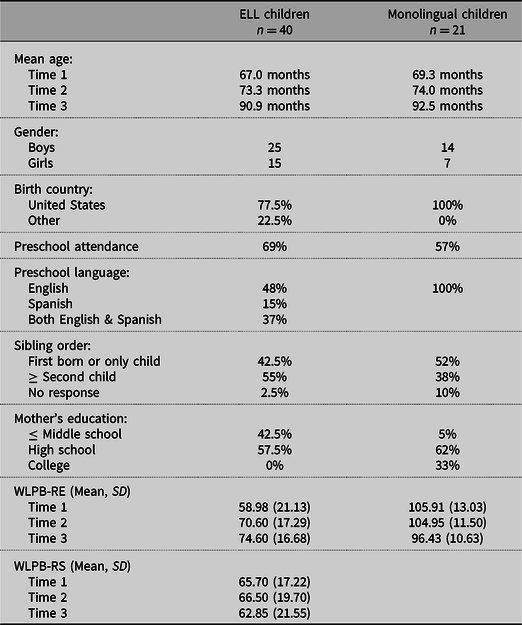
Participant data were compiled from a five-year longitudinal project, which focused on the impact of dual language acquisition on literacy skills in early school-aged ELLs. The current study included rapid automatic naming of objects (RAN objects) data for 40 Spanish-speaking ELL children (25 boys, 15 girls), mean age 5.5 years (SD = 4.30 months), and 21 monolingual English-speaking children (14 boys, 7 girls), mean age 5.6 years (SD = 3.78 months) at the beginning of kindergarten. All children attended one of two schools in Tennessee. For ELL children, parents reported that all children were exposed to Spanish from birth and began learning English as a second language in either preschool or kindergarten. Once in kindergarten, which was a full day educational setting, English was the language used for instruction and literacy activities. As seen in Table 1, the majority of ELLs were born in the United States (77.5%) and had an older sibling (55%). In addition, 69% of the ELL children attended preschool, with 85% of those ELL children receiving at least some English input. All ELL mothers were born outside of the United States, and the average self-rating for English proficiency was 1.3 on a 5-point scale (0 = nada/no English, 5 = muy bien/very well) when their children entered kindergarten. Thus, the profile of this group of ELLs is heterogeneous and represents the range of language experiences that children raised in the United States typically encounter. At the time of testing, all children were healthy and had no known speech, language, hearing, or cognitive impairments. Participants were excluded if they repeated kindergarten (n = 1), if they had withdrawn from the longitudinal study (n = 9), or if they could not complete the practice section prior to testing at all points in time (n = 2).
Demographic information for English language learners (ELL) and monolingual children
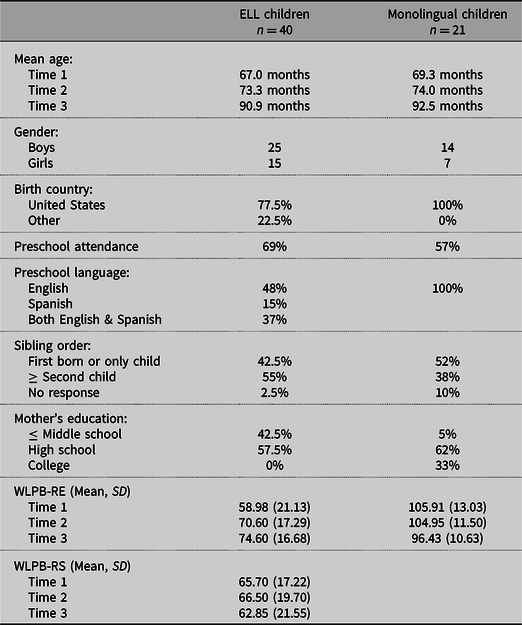
Note: ELL children born outside of the United States were from Mexico (n = 8) or Honduras (n = 1). The mean age of arrival into the United States was 3;0 (range: 1–5 years). ELL children’s mother’s indicated that they were from Mexico (n = 33), Honduras (n = 2), or El Salvador (n = 3); three mothers did not provide a response. On a 5-point rating scale, ELL children’s mother’s reported their English proficiency (Mean = 1.3; SD = .56) as none (n = 10), some (n = 18), fair (n = 11), or very good (n = 1). Vocabulary data are standard scores from the expressive vocabulary subtests of the Woodcock Language Proficiency Battery—Revised English (WLPB-RE; Woodcock, Reference Woodcock1991) and the Woodcock Language Proficiency Battery—Revised Spanish (WLPB-RS; Woodcock & Muñoz-Sandoval, Reference Woodcock and Muñoz-Sandoval1995).
Materials
All children were given a battery of tests, which included the expressive vocabulary subtests from the Woodcock Language Proficiency Battery Revised—English form (WLPB-RE; Woodcock, Reference Woodcock1991) and the Woodcock Language Proficiency Battery Revised—Spanish form (WLPB-RS; Woodcock & Muñoz-Sandoval, Reference Woodcock and Muñoz-Sandoval1995), and the RAN objects task from the Comprehensive Test of Phonological Processing (CTOPP; Wagner, Torgesen, & Roshotte. Reference Wagner, Torgesen and Rashotte1999). The CTOPP is a standardized test used to measure phonological processing skills in monolingual English-speaking children. For the ELL children, the RAN objects subtest was administered in both Spanish and English using identical procedures provided in the CTOPP manual because normed RAN tests in Spanish did not exist at the time of this study (see Wagner et al., Reference Wagner, Torgesen and Rashotte1999, for procedural information). Due to the difficulty of the task, only Form A of the RAN objects test was administered at all times for both languages.
The words used for the RAN objects task were compared across English and Spanish for lexical frequency, syllable length, and lexical stress pattern. Lexical frequency for each word was collected in English from the Corpus of Contemporary English database (Davies, Reference Davies2009) and in Spanish from El Corpus de Español database (Davies, Reference Davies2002). No significant difference for word frequency across languages was found, t (4) = –1.13, p = .323. Words differed across languages with regard to syllable length and lexical stress pattern. In English, all words were monosyllabic, whereas in Spanish words were bi- or trisyllabic and contained trochaic or iambic lexical stress patterns, respectively.
Equipment
All RAN data were analyzed using Time Frequency Analysis Software Program for 32 bit Windows (TF32; Milenkovic, Reference Milenkovic2010). TF32 is a software program used to acoustically analyze speech through frequency waveform. Coders manually manipulated the TF32 cursors along the spectrogram for optimal measurement precision of offline calculations for total test completion time and pauses (i.e., interitem hesitations greater than 2 s) for each participant.
Test administration
Testing was conducted during the first quarter upon entry into kindergarten (Time 1), during the last quarter before completing kindergarten (Time 2), and as a follow-up during the middle of the second grade (Time 3). Children were tested individually in a relatively quiet location within their schools by trained examiners. Examiners were native speakers of either English or Spanish who administered tests in their native language. Each child received a battery of tests in only one language per day; thus, testing in English and Spanish did not occur on the same day. The language order in which children were tested—either in English or in Spanish—was balanced across all children in the longitudinal project; thus, approximately half of the ELL children in each school were tested in English first and then in Spanish at each test time. Instructions were provided in the target language, and children were verbally prompted to speak only that language throughout testing.
Prior to RAN testing, each child was allowed practice trials to ensure that they could complete the target task. For the RAN objects subtest of the CTOPP, the procedures for the practice portion of the RAN task diverged from the instructions in the manual. For the current study, the practice trials were expanded to include an expressive–receptive–expressive sequence where each child was asked to name each of the six pictured items featured on the RAN test. If the child accurately named the items in the target language on the first trial, then the child continued on to the test. If the child mislabeled one or more of the pictures in the target language or if he or she did not provide a label for a picture, then he or she was given a receptive trial where he or she had to identify the pictures while the examiner named them in a random order. Once the child passed the receptive trial, he or she was given another opportunity to complete the expressive trial. If all of the pictured objects were accurately named, then the child continued on the RAN test. If the child was not able to complete the final expressive trial, he or she was not administered this task.
Once the children passed the practice trials on the RAN objects task, they were provided with verbal instructions and a visual model of the task. The serial order of picture presentation was the same at all times and for both languages. All practice trials and testing for all tests administered were recorded for subsequent scoring and analysis.
Children were also administered the expressive vocabulary subtests from the WLPB-RE and/or the WLPB-RS at each test point by native speakers of each language. While monolingual children received the English form only, ELL children completed both the Spanish and the English expressive vocabulary subtests.
Scoring
For the RAN objects task, three trained investigators listened to the recorded data to determine children’s speed and accuracy. Error coding included both the original scoring method from the CTOPP and an expanded coding system that we developed. The CTOPP manual describes three types of errors: substitutions, skips, and pauses (Wagner et al., Reference Wagner, Torgesen and Rashotte1999, pp. 30–31). Because both monolingual and bilingual children produced errors that were not included in the original coding scheme described in the CTOPP manual, four expanded error codes were adopted to account for all of the error types produced on this task. The expanded errors included code-mixing,Footnote 1 addition, repetition, and auto-correction. All errors were coded and combined to create a total errors composite for accuracy. Because pauses and the other errors could coincide, both were coded in the final analyses; thus, errors that overlapped were double coded.
Rate was defined as the total time to task completion (Wagner et al., Reference Wagner, Torgesen and Rashotte1999, p. 31) and was calculated from the recorded data using the acoustic software program, TF32 (Milenkovic, Reference Milenkovic2010). The measurement for total time began immediately after the instructions (i.e., after the examiner finished the phrase “ready, set, go”) and ended after the final phoneme of the last item on the test (i.e., after the /t/ in “boat”). All times were calculated to the nearest second. Infrequent testing errors occurred within the sample including comments from the examiner or the child losing his or her place; each of these testing flaws inflated individual completion times. To correct for this, the amount of time that a child was off-task or the examiner was speaking was measured and deducted from the total completion time.
The WLPB-RE and WLPB-RS were administered by native speakers of each language according to published guidelines. Standard scores were derived according to the manuals and used for this study.
Reliability
Interrater reliability for RAN objects speed and accuracy was calculated by one coder using a random selection of 10% of the total sample. For ELL children’s speed in English and Spanish, the coder’s calculations for speed were within an average of 1 s for each language. For monolingual children’s speed, coders were found to be within 20 ms on average. For ELL children’s accuracy in English, coders had 92.9% agreement overall. For accuracy in Spanish, coders had 95.3% agreement on all codes. For monolingual children, coder agreement was found to be 93.3% overall.
Results
Descriptive statistics
Due to variations in children’s language experiences and backgrounds, preliminary analyses were conducted to explore potential confounds. Differences between preschool language groups, mother’s education, birth country, and sibling order were explored using univariate analyses if variance (ANOVAs). These independent variables were included together as fixed factors within the models, and RAN accuracy and speed across languages at each time point served as the dependent variables. All fixed factors were categorical with two levels, except for preschool language, which comprised four levels: English only, Spanish only, bilingual Spanish–English, and no preschool attendance.
For Spanish RAN accuracy at Time 1, Levene’s statistic was significant (p = .006) indicating that the assumption of homogeneity of variance was not met. To correct this violation, a stricter significance level of p < .01 was used to evaluate the results for this model (Stevens, Reference Stevens2012); after the correction was applied, no significant values were found. A main effect for preschool language group, F (3, 20) = 6.10, p = .004, partial η2 = .48, emerged for Spanish RAN speed at Time 3. Post hoc analyses using Tukey’s honestly significant difference showed that children who attended preschool in a Spanish-only environment (M = 67.64, SD = 21.00) were slower at naming pictured objects than children in a bilingual Spanish–English environment (M = 47.26, SD = 9.59; p = .009) and in comparison with their peers who did not attend preschool (M = 48.24, SD = 6.68; p = .010). No significant differences emerged between children in the Spanish-only group and their peers in the English-only preschool language group (M = 56.06, SD = 15.23; p = .221). No other significant differences were found across all other models of RAN speed and accuracy.
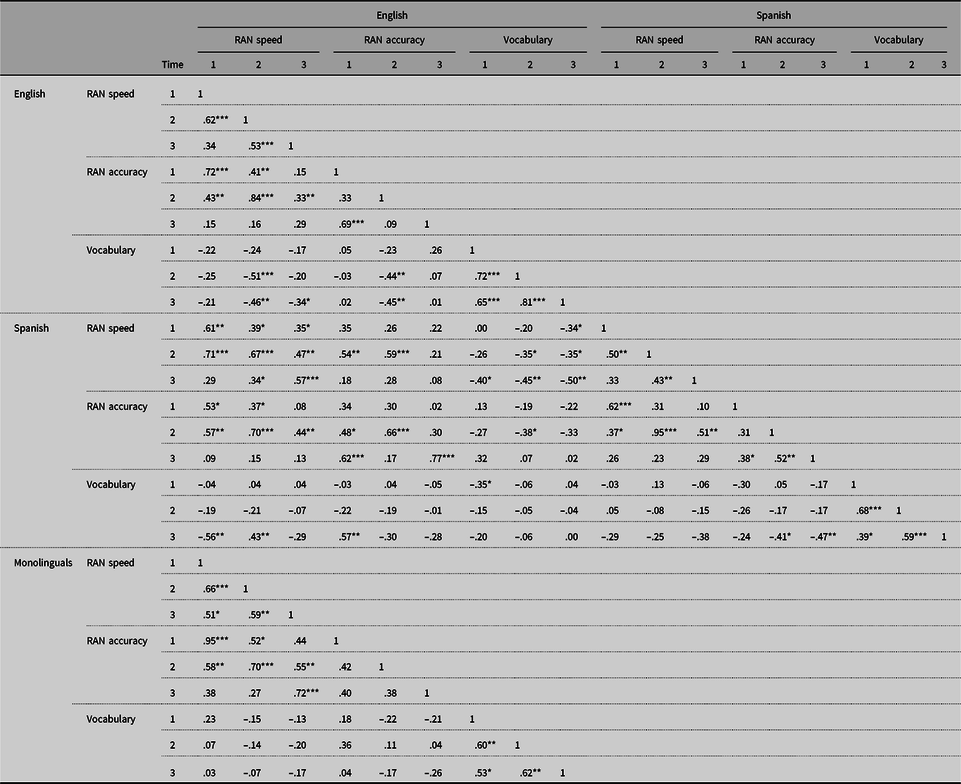
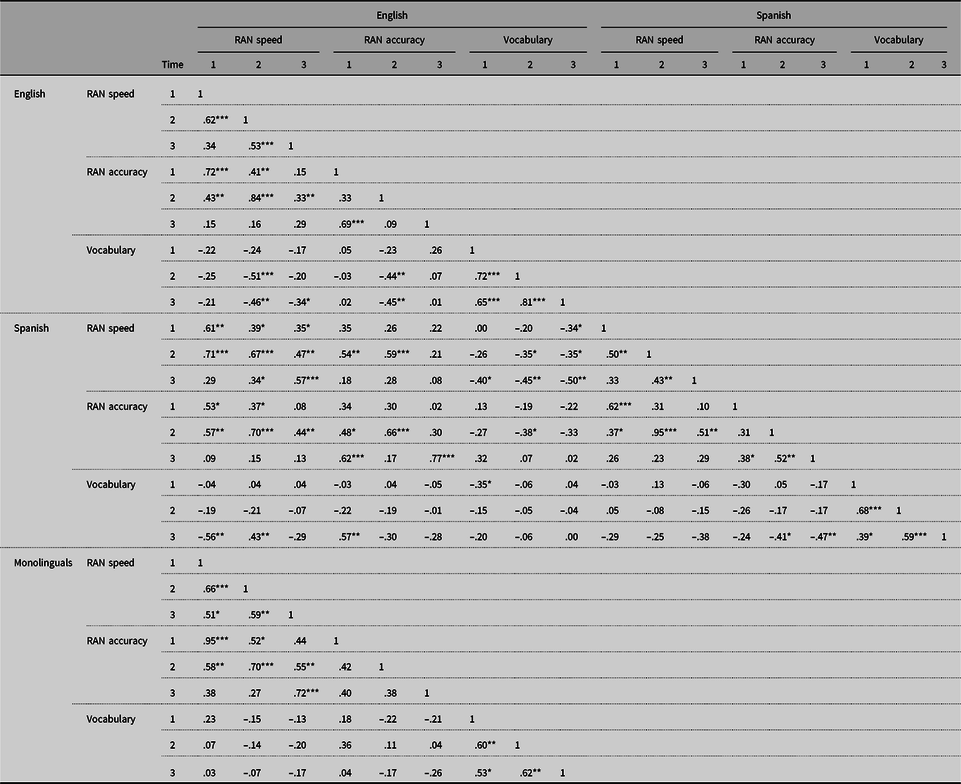
To further evaluate factors related to lexical processing for ELLs, Pearson product moment correlation coefficients were conducted to explore the relationship between the RAN measures (i.e., speed and accuracy) and expressive vocabulary, as measured by standard scores from the WLPB-RE (Woodcock, Reference Woodcock1991) and the WLPB-RE (Woodcock & Muñoz-Sandoval, Reference Woodcock and Muñoz-Sandoval1995). Correlations between the English measures were explored for the monolingual children. See Table 2 for correlations both groups of children.
Correlations between RAN speed, RAN accuracy, and expressive vocabulary across time for English language learners and monolingual children
*p ≤ .05. **p ≤ .01. ***p ≤ .001.
For correlations between RAN speed and accuracy, significant within-language correlations emerged for ELL children in English and Spanish for measures at Time 1 (English: r = .72, p < .001; Spanish: r = .62, p < .001) and Time 2 (English: r = .84, p < .001; Spanish: r = .95, p < .001); Time 3 was nonsignificant for both languages. For monolingual children, RAN speed and RAN accuracy were significantly correlated at all points in time (Time 1: r = .95, p < .001; Time 2: r = .70, p < .001; Time 3: r = .72, p < .001). These positive relationships indicate that, for both groups of children, those who produced more errors were slower at naming the pictured objects on the RAN task.
Across languages for the ELL children, correlations were most consistent across time for RAN speed, suggesting that children who were fast in English were also fast in Spanish, even across different testing points. RAN accuracy across languages was less consistent across time, but very strong at Time 2 (r = .66, p < .001) and Time 3 (r = .77, p < .001). Thus, during the later time points, children who produced more errors in English also tended to have higher error production in Spanish.
With regard to expressive vocabulary, significant within-language correlations emerged with English RAN speed at Time 2 (r = –.52, p = .001) and Time 3 (r = –.34, p = .034), English RAN accuracy at Time 2 (r = –.45, p = .003), and Spanish RAN accuracy at Time 3 (r = –.44, p = .009) for the ELL children. No significant relationships between the RAN measures and expressive vocabulary were found for monolingual children. Thus, the association between expressive vocabulary knowledge and lexical efficiency is inconsistent for children, regardless of the number of languages spoken, and changes over time for ELLs.
Cross-linguistic comparisons for ELL children
To answer the first research question, evidence of a linguistic shift from Spanish to English was explored using speed and accuracy performance on the RAN objects task.
Speed
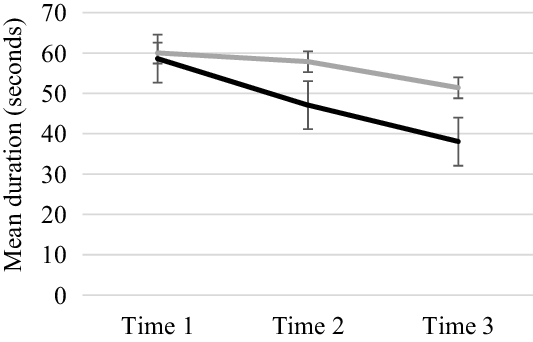
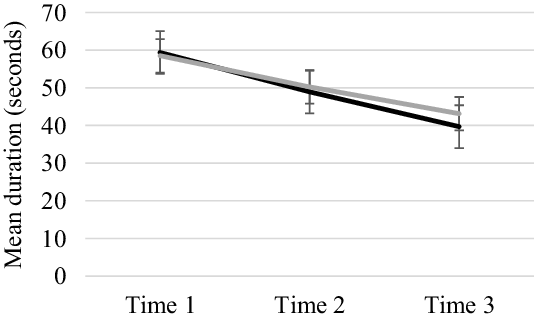
A two-way repeated-measures ANOVA was conducted to measure changes in speed over time and across languages. Mauchley’s test of sphericity indicated that the assumption of sphericity was not met for time, χ² (2) = 6.92, p = .031. To account for this violation, a Greenhouse–Geisser correction was used to interpret the main effect for time. The assumption of sphericity was met for the Time × Language interaction, χ² (2) = 2.14, p = .343. A significant Time × Language interaction was found, F (2, 40) = 5.38, p = .009, η² partial = .66. This interaction demonstrated that ELL children’s completion speed in seconds was dependent upon the language of the RAN task. A paired samples t test revealed that children performed significantly faster in English (M = 50.82, SD = 14.28) than Spanish at Time 2 (M = 62.93, SD = 21.04), t (36) = –4.70, p < .001, Cohen’s d = 0.67, and at Time 3 (English: M = 39.41, SD = 10.50; Spanish: M = 52.22, SD = 13.47), t (36) = –6.83, p < .001, Cohen’s d = 1.06. No significant difference between languages was found at Time 1 (English: M = 58.56, SD = 17.96; Spanish: M = 60.51, SD = 10.83; p = .522).
Significant main effects were found for both time, F (1.53, 30.65) = 19.94, p < .001, η² partial = .50, and language, F (1, 20) = 39.56, p < .001, η² partial = .66. For time, post hoc analyses using a Bonferroni correction for the pairwise comparison revealed significant differences across all points in time. That is, ELL children became significantly faster from Time 1 (M = 59.33, SE = 2.96) to Time 2 (M = 52.48, SE = 2.62, p = .003, Cohen’s d = 0.84), from Time 2 to Time 3 (M = 44.73, SE = 2.43, p = .006, Cohen’s d = 0.77), and overall from Time 1 to Time 3 (p < .001, Cohen’s d = 1.11). For language, a post hoc analysis using a Bonferroni correction for the pairwise comparison revealed that performance in English (M = 47.93, SE = 2.55) was significantly faster than performance in Spanish (M = 56.43, SE = 2.28, p < .001, Cohen’s d = 1.38). See Figure 1 for a longitudinal comparison of naming speed across languages.
A comparison of English language learners naming speed over time in English and Spanish (n = 21).

Errors
A two way repeated measures ANOVA was conducted to measure changes in the total number of errors produced within and across languages over time. Mauchley’s test of sphericity indicated that the assumption of sphericity was met, χ² (2) = 2.94, p = .230, for time; however, this assumption was not met for the Language × Time interaction, χ² (2) = 7.57, p = .023. In order to account for this violation, the Greenhouse–Geisser correction was used to interpret the results of the interaction.
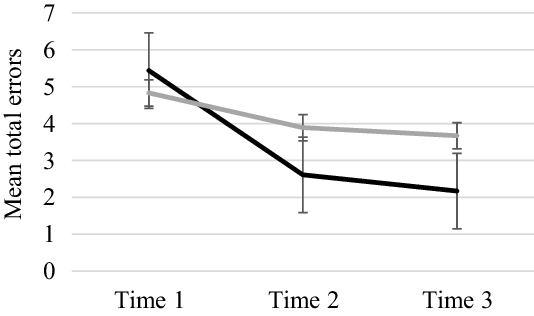
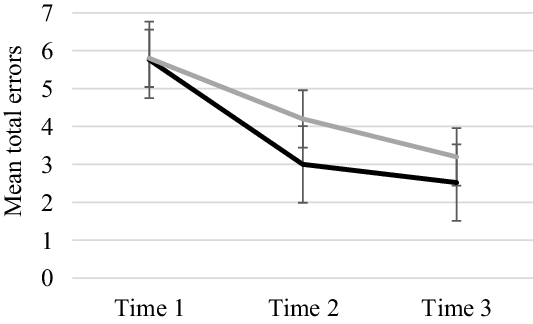
The repeated measures ANOVA revealed that the Time × Language interaction was not significant (p = .412), nor was there a significant main effect for language (p = .095). A main effect of time emerged where ELL children produced significantly fewer errors over time, F (2, 34) = 6.55, p = .004, η² partial = .28. A Bonferroni post hoc correction was used to evaluate the pairwise comparisons, which showed that children produced significantly fewer errors overall from Time 1 (M = 5.14, SE = .82) to Time 3 (M = 2.92, SE = .44, p = .017, Cohen’s d = 0.74). Error production from Time 1 to Time 2 (M = 3.25, SE = .67, p = .065) and from Time 2 to Time 3 (p = 1.00) were not significant. See Figure 2 for a comparison of the total errors produced in each language over time.
A comparison of the total errors produced over time for English language learning children (n = 18) in Spanish and English.

Overall, these analyses explored whether performance patterns in speed and accuracy from kindergarten through second grade provided evidence of a linguistic shift in lexical processing efficiency. In general, the data supported our hypothesis, where ELL children became significantly faster in processing lexical items in English than in Spanish over time; however, we found that speed data were a better indicator of this shift, as no statistical difference was found for the accuracy data. Although the accuracy data were not statistically significant, a general descriptive trend indicated poorer performance at Time 1 in English than in Spanish with a rapid shift to the opposite pattern by Time 2.
Comparisons of RAN performance across monolingual and ELL children
To answer the second research question, longitudinal speed and accuracy performance in English on the RAN objects task was compared across groups of children using speed and accuracy.
Speed
A mixed between-within ANOVA was conducted to measure the changes in speed over time and across groups. Mauchley’s test of sphericity indicated that the assumption of sphericity was met χ² (2) = 5.40, p = .067, for time. Interestingly, and in contrast to the extant literature, the Time × Group interaction was not significant (p = .609) nor was there a significant main effect for group (p = .723). Thus, the group of monolingual children (M = 50.63, SE = 2.81) was not significantly faster than the group of ELL children (M = 49.33, SE = 2.33). The amount of time to complete the task was remarkably similar across the two groups at each time point.
A significant main effect for time was found, F (2, 94) = 32.92, p < .001, η² = .41, where both groups became significantly faster over time. A post hoc analysis using a Bonferroni correction for the pairwise comparison showed that overall, children became significantly faster from Time 1 (M = 58.95, SE = 2.67) to Time 2 (M = 49.59, SE = 2.26, p < .001, Cohen’s d = 0.66), from Time 2 to Time 3 (M = 41.41, SE = 1.57, p < .001, Cohen’s d = 0.66), and from Time 1 to Time 3 (p < .001, Cohen’s d = 1.06). See Figure 3 for a comparison of speed over time for the two groups of children.
A comparison of naming speed over time for English language learners (n = 29) and monolingual children (n = 20) in English.

Errors
A mixed between-within ANOVA was conducted to measure the changes in the mean number of total errors produced in English over time and across groups of children. Code-mixing errors were not included in these analyses as monolingual children could not produce this error type.
Mauchley’s test of sphericity indicated that the assumption of sphericity was met for time, χ² (2) = 4.10, p = .129. For the Time × Group interaction, the results from this analysis mirror the results from the speed analysis, where the interaction was not significant (p = .660) nor was there a main effect of group (p = .471). A significant main effect for time was found, F (2, 94) = 11.43, p < .001, η² partial = .20, where both groups produced significantly fewer errors over time. Post hoc Bonferroni correction analysis for the pairwise comparison showed that, across both groups, children produced significantly fewer errors from Time 1 (M = 5.78, SE = .75) to Time 2 (M = 3.60, SE = .46; p = .012, Cohen’s d = 0.46) and from Time 1 to Time 3 (M = 2.86, SE = .47; p < .001, Cohen’s d = 0.72); no significant difference was found between Time 2 and Time 3 (p = .603). See Figure 4 for a comparison of the total errors produced in each group of children over time.
A comparison of the total errors produced in English over time for English language learners (n = 29) and monolingual children (n = 20).

In sum, contrary to our hypothesis, ELL and monolingual children’s performance was extraordinarily similar across both speed and accuracy. Although both groups of children became faster and more accurate on the RAN objects task over time in English, there were no significant group differences at any point in time. Although the difference was not significant, ELL children were actually slightly faster and more accurate at naming pictured items by the end of kindergarten (i.e., Time 2). This finding was surprising given that ELL children were reported to have limited experience with English prior to entering kindergarten, presumably promoting less stable English lexical representations; thus, they were expected to produce more errors than their monolingual peers. This may mean that in addition to a rapid acquisition of English lexical processing proficiency, ELL children could have an advantage secondary to their executive function skills and/or lexical differences.
Discussion
Previous investigations have established that the lexical processing reflected in the RAN task is an important predictor of reading ability for monolingual and bilingual children (e.g., Manis et al., Reference Manis, Lindsey and Bailey2004; Wolf & Bowers, Reference Wolf and Bowers1999). However, to our knowledge, this is the first study to take an in-depth look at longitudinal speed and accuracy performance patterns on a RAN objects task across languages for ELL children and across groups of children. This information provides insight into how lexical processing is influenced by the quality and quantity of linguistic knowledge stored in long-term memory, as well as how lexical processing efficiency shifts in response to second language experience for young sequential bilingual children. Findings from these studies are discussed using the frequency lag hypothesis (Gollan et al., Reference Gollan, Slattery, Goldenberg, Van Assche, Duyck and Rayner2011) and a sociolinguistic account as frameworks for explaining lexical processing efficiency for ELL children.
RAN speed and RAN accuracy were highly correlated for both groups of children, indicating that those who were slower at naming pictures were also less accurate. This is not surprising given that (a) hesitations were included as an error type, where more hesitations would result in longer durations, and (b) children who are slower tend to be less accurate on lexical processing tasks, as there is not a reliable speed–accuracy trade-off for young children (e.g., Kohnert, Reference Kohnert2002). We also examined whether or not variations in ELL children’s language experiences significantly affected their RAN speed and accuracy across time and languages. Only a main effect of preschool language group emerged for Spanish RAN speed at Time 3. ELLs who attended Spanish-only programs were slower at naming pictured objects than their peers who received exposure to both languages (Spanish and English) in a preschool setting or their peers who did not attend preschool. No significant differences between the Spanish-only and the English-only preschool language groups were found. While this finding runs contrary to what we would intuitively expect (i.e., faster naming in Spanish for ELLs who had more opportunities for building robust lexical representations in Spanish), it is likely that other factors drive this finding, including the dynamic nature of the quantity and quality of language exposure. Future investigations should include a measure of language exposure at each time point to evaluate concurrent and predictive effects on lexical processing efficiency.
In addition, we evaluated how children’s performance (i.e., speed and accuracy) on the RAN task was related to their expressive vocabulary. Only ELL children had significant correlations, indicating that higher expressive vocabulary knowledge facilitated naming speed at Times 2 and 3 in English only. Higher vocabulary also resulted in fewer errors at Time 2 in English and Time 3 in Spanish. No significant correlations emerged between the RAN measures and expressive vocabulary for the monolingual children.
The lack of consistent correlations between vocabulary and RAN measures for either group of children was surprising given previous studies that have shown a positive relationship between lexical processing efficiency and lexical knowledge. For example, Marchman, Fernald, and Hurtado (Reference Marchman, Fernald and Hurtado2010) found that young bilinguals who had larger receptive vocabularies had faster lexical processing, as measured by a looking-while-listening recognition paradigm, than those with smaller vocabularies. However, knowledge in the language system may be leveraged differently for lexical processing during comprehension in comparison to during production. Based on literature from word learning studies in young children (e.g., Gray, Pittman, & Weinhold, Reference Gray, Pittman and Weinhold2014) it may be that low neighborhood density facilitates naming in young typically developing children, particularly when ELLs are in the early stages of L2 learning.
The first research question examined longitudinal changes in lexical processing efficiency using RAN performance (speed and accuracy) in both English and Spanish for ELL children in kindergarten through second grade. The ELL children were actually significantly faster over time in their L2, English, than in their L1, Spanish. This was surprising given that these children had been reported by their parents to have had limited experience with English upon entry into kindergarten. While we believe that this shift is secondary to improved lexical processing efficiency in their L2, syllable length varied across the two languages. The words in Spanish were primarily bisyllabic and the words in English were primarily monosyllabic; thus, phonological differences may be a confounding factor that should be further explored in future studies. While accuracy was not significantly different across languages, the trend showed that ELLs produced fewer errors in their L2; relatively large standard deviations may account for the lack of significant differences. Although previous research using a RAN objects task has shown that Spanish-speaking ELL children shift language proficiency from their L1 to their L2 during the middle of elementary school, the timing of this shift in the present study appears to have occurred earlier than has been previously shown (Kohnert, Reference Kohnert2002; Kohnert et al., Reference Kohnert, Bates and Hernandez1999). This shift may be indicative of greater efficiency for lexical access and retrieval for their L2 as compared with their L1 by the end of kindergarten (i.e., Time 2).
The second research question compared English performance on the RAN task between Spanish-speaking ELL children and their monolingual English-speaking peers. Previous research reported poorer performance on discrete naming and verbal fluency tasks for bilingual individuals as compared with monolinguals (Bialystok, Reference Bialystok2007; Bialystok, Craik, & Luk, Reference Bialystok, Craik and Luk2008; Gildersleeve-Neumann, Kester, Davis, & Peña, Reference Gildersleeve-Neumann, Kester, Davis and Peña2008), but these studies did not include serial RAN. For the current investigation, it was hypothesized that young monolingual English-speaking children would be faster and more accurate on the RAN task in English than their Spanish-speaking ELL peers. Surprisingly, we did not find a monolingual advantage for speed or accuracy; monolingual children were not significantly faster or more accurate than their ELL peers. These results were contrary to what we had predicted, given that the ELL children had limited experience with English prior to entering a formal academic setting. The nonsignificant group difference was also surprising in light of the discrepancy in maternal education, which was slightly higher for the monolingual children in comparison to ELLs. As maternal education is directly related to vocabulary learning and lexical processing efficiency (e.g., Hoff, Burridge, Ribot, & Giguere, Reference Hoff, Burridge, Ribot and Giguere2018; Paradis & Jia, Reference Paradis and Jia2017), we had expected that this would result in greater efficiency for the monolinguals; this was not the case in our study.
Taken together, these studies show patterns of efficient lexical processing across languages for the ELL children despite the complexity of developing a dual lexical system. At the beginning of kindergarten, ELL children had limited experience with English; thus, their Spanish lexicon was assumed to contain more robust lexical representations due to strong, interconnected lexical information as compared with the English lexicon, which would contain fewer words with limited interconnectivity. Monolingual children would also be expected to have dense phonological neighborhoods with strong lexical connections supporting the representations in their English lexicons. The strength and number of connections between lexical information might be expected to affect lexical processing efficiency and lexical accessibility (e.g., Gollan et al., Reference Gollan, Slattery, Goldenberg, Van Assche, Duyck and Rayner2011), such that the ELL children with fewer, strong connections for frequent items in the L2 would experience facilitation effects for accessing and retrieving lexical items as compared with a denser neighborhood. In addition, as lexical processing is intrinsically linked to global cognitive processing, including the mechanisms inherent to executive functioning, ELL children may receive facilitatory effects from relatively better inhibition in comparison to their monolingual peers (Green, Reference Green1998). Based on our findings, we propose that, rather than experiencing inhibitory effects during naming from weaker lexical links, low neighborhood density in conjunction with increased activation of the L2 may allow young ELL children to have faster and more accurate performance on the RAN objects task in English as compared with performance in their L1 and in comparison to their monolingual English-speaking peers.
Lexical accessibility and processing
ELL children in this study performed significantly faster in English than in Spanish, demonstrating more efficient lexical processing in their L2, which was comparable to the lexical processing speed of their monolingual peers. No significant group differences in speed or accuracy performance on the RAN were found for the ELLs and their monolingual peers. Although both of these findings were unexpected, one possible explanation for these finding stems from a sociolinguistic account. It is possible that a priming effect secondary to environmental context could cause increased activation of the English lexicon relative to the Spanish lexicon, because the ELL children were immersed in an English-only environment. Other studies evaluating lexical structure and access to linguistic information in bilingual children have proposed that this sociolinguistic account, in conjunction with a suppression mechanism, may lead to facilitation of the second language while suppressing the activation of the first language (Gibson et al., Reference Gibson, Oller, Jarmulowicz and Ethington2012; Linck et al., Reference Linck, Kroll and Sunderman2009; Oller et al., Reference Oller, Jarmulowicz, Gibson, Hoff, Caunt-Milton, Kulatilake and Woo2007). Collectively, findings from previous research and the current investigation support Green’s (Reference Green1998) inhibitory control model, where environmental constraints would suppress the language not frequently used in the environment while simultaneously allowing for greater relative activation for the language primarily used in the environment. For the ELL children in our study, testing took place in an English-only formal educational setting. Thus, under these circumstances, children’s L1, Spanish may have been suppressed while their L2 received greater activation secondary to immersion in the English environment.
Increased relative activation of the L2 and/or suppression of the L1 could lead to facilitation of accurately and rapidly naming items in English while simultaneously inhibiting efficient naming in Spanish. The pressure from immersion in the English-only environment requires ELL children to adapt quickly; thus, relative activation and suppression within the lexical system would better allow ELL children to successfully communicate in their new environment. This bridge between the sociolinguistic account and the cognitive mechanisms required for efficient naming is evidenced by these children’s performance on the RAN task. ELL children in this study were fast and accurate at serially naming pictured objects in English, which supports these theories (i.e., sociolinguistic account and cognitive mechanisms). Observation of the individual error codes also revealed a pattern, providing further supporting evidence. Specifically, code-mixing occurred during the RAN task only in Spanish at Time 1 and Time 3. This means that while children were naming items in Spanish, they substituted an English name for a target stimulus item. For example, a child may have produced the following: “silla, estrella, lápiz, fish, llave ….” This example demonstrates the increased availability of English lexical items even when the task context required the use of Spanish.
While we believe that ELL children are experiencing a priming effect of their L2 secondary to sociolinguistic pressures, the effect of additional variables affecting bilingual development cannot be ruled out. As the majority of ELL children in our study were born and raised in the United States, they most likely had at least some exposure to English prior to entering elementary school through daily communications, media, older siblings, and/or preschool attendance. While varying language experiences with a high amount of English exposure is typical for developing bilingual children in the United States, this variable may have impacted our study. In particular, it is possible that children who received exposure to English dominantly in preschool may have had stronger lexical representations in their L2, resulting in faster naming speed compared with Spanish. In particular, with regard to the shift in lexical processing efficiency, it cannot be ruled out that the effect found in our data coincide with a shift in the quantity of L2 use in the home environment by parents or siblings. While the mothers of the ELL children reported that their English proficiency was limited at Time 1 (see Table 1), it may be that as their children gain more exposure to English in the classroom, more English vocabulary is used at home with their parents. Future investigations of lexical processing should account for language input and output (e.g., Bedore, Peña, Griffin, & Hixon, Reference Bedore, Peña, Griffin and Hixon2016) to further inform the sociolinguistic account.
Although the ELL children in this study were more proficient in naming items in English relative to Spanish, these data do not support the frequency lag hypothesis (Gollan et al., Reference Gollan, Slattery, Goldenberg, Van Assche, Duyck and Rayner2011). According to this hypothesis, lexical representations with fewer and weaker connections would impede efficient naming, resulting in slower and less accurate naming on a timed task (i.e., RAN task). In our original hypothesis we proposed that the ELL children in this study had weaker lexical representations in English as compared with Spanish; however, they were actually faster and more accurate on the RAN task in English. This does not support the frequency lag hypothesis. If our data supported the frequency lag hypothesis, we would expect to see performance patterns showing the opposite. That is, because these ELL children had more practice with and exposure to their L1, the more frequent use of Spanish would cause stronger, more abundant lexical connections, resulting in faster and more accurate RAN performance in Spanish. However, contradicting the theory, the data in these studies showed better RAN performance in their L2 than in their L1.
The impact of lexical density on processing
An alternate explanation for the unexpected pattern of results is that the ELL children’s increased efficiency for processing linguistic information in English may be secondary to lower neighborhood density for the L2. That is, relative to their monolingual peers, these ELL children may have sparser phonological neighborhoods resulting from fewer words stored in their English lexicon (see Bialystok et al., Reference Bialystok, Craik and Luk2008). For example, for monolingual English-speaking children who have robust vocabulary knowledge, the word cat would reside in a dense neighborhood with many other interconnected words varying by a phoneme (e.g., bat, sat, can, cut, cot; Luce & Pisoni, Reference Luce and Pisoni1998; Vitevitch, Luce, Pisoni, & Auer, Reference Vitevitch, Luce, Pisoni and Auer1999). ELL children who are developing their L2, in contrast, would have fewer lexical items in their L2 resulting in lower neighborhood density. ELLs might be more efficient at accessing and retrieving words in English, specifically because there is less competition in the lexicon for these relatively high frequency words. In contrast, the larger, more densely packed neighborhoods represented in the monolingual children’s lexicon would result in higher competition and potentially slower word retrieval during naming.
With regard to picture naming during word-learning paradigms, studies of monolingual and bilingual adults have found that learners benefit from high-density neighborhoods (Nair, Biedermann, & Nickels, Reference Nair, Biedermann and Nickels2017; Storkel, Armbrüster, & Hogan, Reference Storkel, Armbrüster and Hogan2006). These findings are somewhat inconsistent in studies of referent identification and naming in young monolingual English-speaking children, where there is an advantage for learning words from low-density neighborhoods (e.g., Gray & Brinkley, Reference Gray and Brinkley2011; Gray et al., Reference Gray, Pittman and Weinhold2014). Gray et al. (Reference Gray, Pittman and Weinhold2014) proposed that young monolingual children experience less competition among lexical items when they have lower neighborhood density. We believe that our data provide some support for this position and extend this proposal to ELL children who are in the early stages of English vocabulary learning. Overall, the limited number of significant correlations between vocabulary and efficiency on the RAN task, particularly at the beginning of kindergarten, may indicate that young ELL children experience less interlexical competition due to low neighborhood density in comparison to their monolingual peers. The effects of lexical competition and priming may be additive, where the combination of lexical priming secondary to immersion, active lexical processes, and/or a less-densely packed L2 facilitate lexical processing in the ELL children’s second language. Future investigations should aim to disentangle the effects of these positions.
Summary and future directions
In sum, this research suggests that lexical processing for ELL children is impacted by both lexical density of the developing dual lexical system as well as the accessibility of lexical information stored in long-term memory. Theoretically, the fast and accurate RAN performance in English demonstrates that ELL children may have suppression of their L1 while simultaneously experiencing increased relative activation of their more sparsely populated L2. Thus, ELL children benefit from sparsely populated neighborhoods in their English lexicons, which receive greater relative activation secondary to immersion in the English environment. The RAN objects task used in the present study was from a well-regarded standardized test, the CTOPP (Wagner et al., Reference Wagner, Torgesen and Rashotte1999); however, other RAN tasks may generate different patterns in performance, including the production of more expanded errors. RAN letters, for example, may produce more code-mixing errors during the RAN task in Spanish because these young ELL children may not have been taught their letters in their native language; however, this may also be dependent upon the educational context as this would be true for immersion settings but not necessarily for bilingual settings. Future research should investigate performance on other RAN tasks and account for the potential influence of the environment (i.e., immersion or bilingual setting) on performance.
With regard to environment, parents reported that all ELL children were exposed to Spanish from birth. Thus, to the best of our knowledge, all ELL children were functionally Spanish speakers who had limited English proficiency at the beginning of kindergarten. Parent/caregiver and teacher reports of language exposure would allow for improved control of this factor, as it is possible that degrees of exposure and proficiency could influence the outcomes. Nevertheless, the limited correlations between vocabulary and the RAN measures suggest that performance on the RAN task taps into a mechanism beyond the breadth of lexical knowledge. We believe that the patterns of change over time are strong and not likely artifacts of the data. A future direction for this line of work includes incorporating a fine-grained measure of language exposure at each time point to control for potential effects on the outcome measures.
For the RAN task stimuli, the words used were direct translations from English to Spanish. While there were no significant differences in the lexical frequency, there were differences in the syllable length and lexical stress patterns across languages. The literature on naming speed and syllable length in adults shows mixed results, where some studies have found shorter naming latencies for longer (trisyllabic) words in English (Alario et al., Reference Alario, Ferrand, Laganaro, New, Frauenfelder and Segui2004) and in Chinese (Bates et al., Reference Bates, D’Amico, Jacobsen, Székely, Andonova, Devescovi and Wicha2003), while other studies have shown longer latencies (Santiago, Mackay, Palma, & Rho, Reference Santiago, MacKay, Palma and Rho2000) or no effect of syllable length at all (e.g., Snodgrass & Yuditsky, Reference Snodgrass and Yuditsky1996). Thus, while these lexical characteristics may have had a facilitative effect on lexical processing in English, the words used in this investigation were highly concrete, imageable, and frequent words in each language. Future investigations should evaluate the cross-linguistic effects of these lexical characteristics on lexical processing in bilingual children.
Increasing the number of children would allow for the likely production of more errors. With a greater number of errors, future research should also investigate the relation between the expanded error coding system and later word reading in ELL children. It may be that children who produce more expanded errors, or errors overall, may later be poorer readers. As such, the relation between error production and word reading performance should be directly explored in monolingual and ELL children in future research.
In conclusion, this work demonstrates that Spanish-speaking ELL children experience a rapid shift in lexical processing efficiency from their first language to their second language by the end of kindergarten. The speed and overall accuracy that they achieve is commensurate with their monolingual English-speaking peers. Clinicians and researchers may use tasks, such as RAN object naming, to gain insight into children’s lexical processing abilities. However, additional factors such as environmental constraints, lexical density, and the strength of lexical connections may influence or mediate lexical processing efficiency for ELL children.
Acknowledgements
Thank you to all of the students and their families who participated in this study. We would also like to thank the public schools who agreed to support this project, as well as the coders from the University of Memphis who contributed to this study. This research was funded by the NICHD Grant R01 HD046947 awarded to D. Kimbrough Oller, as well as a Diversity Grant (2010-2011) from the Tennessee Board of Regents.