Introduction
Evaluation of agricultural innovations in complex farming systems is a necessary but elusive task. Quantifying the economic and risk trade-offs from the adoption of various interventions targeted at resource-constrained smallholder farmers remains a challenge for agricultural development agencies (e.g. Antle et al., Reference Antle, Basso, Conant, Godfray, Jones, Herrero, Howitt, Keating, Munoz-Carpena, Rosenzweig, Tittonell and Wheeler2017; Dixon et al., Reference Dixon, Gulliver, Gibbon and Hall2010).
Smallholder farmers play a key role in achieving food security by producing around 80% of food in Asia and Africa (Food and Agriculture Organization of the United Nations, 2012) but are faced with low productivity, land degradation, rising production costs and/or labour shortages (World Bank, 2018). Decades of research, policy interventions and development projects have attempted to address these challenges through the promotion of new technologies or practice changes at the farm level in an attempt to increase yields, income, efficiency, resilience and/or food security in smallholder farms (Dixon et al., Reference Dixon, Gulliver, Gibbon and Hall2010; Schreinemachers et al., Reference Schreinemachers, Squeros and Lukumay2017; Sheahan and Barrett, Reference Sheahan and Barrett2017). But despite the potential benefits, many of the innovations have failed to achieve the desired level of adoption by farmers and local communities, meaning that smallholder farmers may have not benefitted as much as they could have in many regions (e.g. Valdivia et al., Reference Valdivia, Antle and Stoorvogel2017). An example is the Conservation Agriculture (CA) package that despite being heavily promoted has an estimated adoption rate of 5% (e.g. Brown et al., Reference Brown, Nuberg and Llewellyn2017a; Giller et al., Reference Giller, Witter, Corbeels and Tittonell2009; Mupangwa et al., Reference Mupangwa, Mutenje, Thierfelder and Nyagumbo2016; Ndah et al., Reference Ndah, Schuler, Uthes, Zander, Traore, Gama, Nyagumbo, Triomphe, Sieber and Corbeels2014; Ward et al., Reference Ward, Bell, Droppelmann and Benton2018).
Disappointing adoption rates of agricultural innovations can often be explained by a combination of enabling environment, economic drivers, risk factors, broader social context, extension effort, level of farmer engagement and sometimes the technologies themselves (e.g. Giller et al., Reference Giller, Witter, Corbeels and Tittonell2009; Mwinuka et al., Reference Mwinuka, Mutabazi, Graef, Sieber, Makindara, Kimaro and Uckert2017; Sheahan and Barrett, Reference Sheahan and Barrett2017; Valdivia et al., Reference Valdivia, Antle and Stoorvogel2017). Yet, these factors are seldom combined in ex-ante evaluations of agricultural innovations promoted by agricultural development projects. The real value of innovations is often poorly assessed due to weak ex-ante impact processes, simplistic or non-existent adoption estimates, lack of suitable tools or data, and/or failure to include whole-farm trade-offs and risk (Connor et al., Reference Connor, van Rees and Carberry2015; Valdivia et al., Reference Valdivia, Antle and Stoorvogel2017). In the absence of objective measures, there is a tendency for project proponents to assume full adoption of innovations, when it is very rarely the case.
Conversely, comprehensive cost-benefit analyses of agricultural opportunities are often too complex and costly to undertake for many innovations (e.g. Clark and Tilman, Reference Clark and Tilman2017; Fineman et al., Reference Fineman, Fenton and Radlinski2009; Khodakarami et al., Reference Khodakarami, Fenton and Neil2007; Muthoni et al., Reference Muthoni, Guob, Bekundaa, Sseguyac, Kizitod, Baijukyae and Hoeschle-Zeledonf2017; Yet et al., Reference Yet, Constantinou, Fenton, Neil, Luedeling and Shepherd2016). Indeed, some rely on abstract econometric analyses or on hybrid Bayesian networks that make probabilistic inference on complex domains with a large number of variables, others on spatial information and others still generally focus on project management issues/risks (e.g. risk of unexpected budget blowouts, schedule delays and staff changes), rather than on the likely uptake of the agricultural innovation itself (although Yet et al., Reference Yet, Constantinou, Fenton, Neil, Luedeling and Shepherd2016 did include an adoption component in their approach).
Of note, large models such as DREAM (HarvestChoice, 1995), IMPACT (Herrero et al., Reference Herrero, Gonzales-Estrada, Thornton, Quiros, Waithaka, Ruiz and Hoogenboom2007), NUANCES-FARMSIM (Van Wijk et al., Reference Van Wijk, Tittonell, Ruffino, Herrero, Pacini, de Ridder and Giller2009) and the global initiative AgMIP (Rosenzweig et al., Reference Rosenzweig, Jones, Hatfield, Ruane, Boote, Thorburn, Antle, Nelson, Porter, Janssen, Asseng, Basso, Ewert, Wallach, Baigorria and Winter2013), as well as agent-based models applied to agriculture (e.g. Berger, Reference Berger2001), are very useful for assessing the potential triple-bottom-line (economic, social and environmental) benefits of technology diffusion and adoption at a larger scale, but simulation of a range of market, trade, technology and research scenarios by geographic and socio-economic clusters remains an expertise- and data-hungry process inaccessible to most. And while many research proposals may require an impact pathway and an estimated impact to be described, these are often of a more qualitative nature (e.g. Davila et al., Reference Davila, Sloan and van Kerkhoff2016).
Attempts to combine economic simulation and adoption projections in the evaluation of innovation opportunities have been made (Mwinuka et al., Reference Mwinuka, Mutabazi, Graef, Sieber, Makindara, Kimaro and Uckert2017; Schreinemachers et al., Reference Schreinemachers, Squeros and Lukumay2017), which suggests that multi-tool approaches are starting to pave the way for more realistic evaluations of changes at the farm level. In addition, systems-dynamics models have been employed to link production with value chain processes, simulating uptake of technologies and inputs (e.g. Rich et al., Reference Rich, Ross, Baker and Negassa2011), while, for example, the TOA-MD model (Antle, Reference Antle2011) has combined means and variations of input parameters that result in benefit distributions which can be interpreted as adoption probabilities. Nevertheless, some evaluation and prioritisation approaches, such as highly specialised econometric methods (e.g. Mwinuka et al., Reference Mwinuka, Mutabazi, Graef, Sieber, Makindara, Kimaro and Uckert2017), tend to add unnecessary complexity. Others require that reliable adoption data are readily available, which is seldom the case (e.g. Antle, Reference Antle2011).
While such examples demonstrate a continuing interest in combining an examination of economic and adoption drivers in smallholder contexts, so far, very few approaches have been proposed that incorporate systematic farming systems analysis and evaluation of agricultural innovations into relevant Research for Development (R4D) projects. To fill this gap, we developed Value-Ag, a multi-tool platform that combines key elements of bio-economic modelling, risk analysis and adoption theory to evaluate the short-cycle impact of agricultural innovations in smallholder farming systems. The key engines of Value-Ag are the Integrated Analysis Tool (IAT) (McDonald et al., Reference McDonald, MacLeod, Lisson and Corfield2019) and the Smallholder Adoption and Diffusion Outcome Prediction Tool (ADOPT) (Brown et al., Reference Brown, Nidumolu, Kuehne, Llewellyn, Mungai, Brown and Ouzman2016; Kuehne et al., Reference Kuehne, Llewellyn, Pannell, Wilkinson, Dolling, Ouzman and Ewing2017).
The IAT captures most trade-offs and synergies of the typical crop-livestock smallholder farm, including crop yield variability simulated with the biophysical model Agricultural Systems Modelling and Simulation (APSIM) (Holzworth et al., Reference Holzworth, Huth, deVoil, Zurcher, Herrmann, McLean, Chenu, van Oosterom, Snow, Murphy, Moore, Brown, Whish, Verrall, Fainges, Bell, Peake, Poulton, Hochman, Thorburn, Gaydon, Dalgliesh, Rodriguez, Cox, Chapman, Doherty, Teixeira, Sharp, Cichota, Vogeler, Li, Wang, Hammer, Robertson, Dimes, Whitbread, Hunt, van Rees, McClelland, Carberry, Hargreaves, MacLeod, McDonald, Harsdorf, Wedgwood and Keating2014), and simulation of livestock and whole-farm performance over time. A key aim of conducting biophysical and economic modelling of smallholder systems is to better understand how production and consumption pathways could generate improved levels of farming system performance and positive welfare outcomes for the smallholder communities.
Smallholder ADOPT provides a prediction of adoption outcomes. It is based on the concept that the characteristics of the innovation and the farmers will determine the relative advantage that they gain from the innovation, and that this will determine the potential peak adoption level. Previously, the prediction of adoption outcomes often relied on best-guess estimates, but the ADOPT tool has introduced a structured process of quantifying the effect of adoption influences to generate a prediction of adoption outcomes. This approach contrasts with other adoption and impact pathway theories, such as stepwise adoption frameworks (e.g. Brown et al., Reference Brown, Nuberg and Llewellyn2017b; Byerlee and Hesse De Polanco, Reference Byerlee and Hesse De Polanco1986) and the Innovation Systems (e.g. Douthwaite and Hoffecker, Reference Douthwaite and Hoffecker2017; Schmid et al., Reference Schmid, Brummer and Taylor2017; Smits, Reference Smits2002), which rely on qualitative, non-binary processes that account for a dynamic network of agents interacting with a specific economic area under a particular institutional infrastructure and involved in the generation, diffusion and utilisation of technology.
We hypothesise that the novel linking of these tools via the Value-Ag platform will improve the evaluation of agricultural research projects targeting locations with similar biophysical and socio-economic characteristics. Value-Ag enables a relatively quick assessment by project stakeholders of the potential production, economic/risk impacts and adoptability of changes in a farming system (i.e. management, crops, forages, prices, costs), while offering the flexibility to explore different intervention levels, scenarios and systems more widely.
In summary, Value-Ag could make a direct contribution to in-country research capacity and better decision-making by allowing users (research/extension professionals, project managers and others) to identify the factors driving the value of innovations and the rate of adoption at the project level, and how altering these could affect economic outcomes. Moreover, benefits from this approach could flow on to improvements in farm productivity and profitability, resilience to climate change (e.g. by simulating catastrophic years), resource-use efficiency, food security and rural livelihoods. Ultimately, Value-Ag results could provide funders of Research, Development, Extension and Management (R D E & M) with clear, consistent and comparable benchmarks across a range of scenarios that will contribute to higher value for agricultural development investments.
In this paper, we outline the Value-Ag framework in detail and use a simplified hypothetical example to illustrate its potential to evaluate agricultural innovations in the smallholder context. A simplified hypothetical example allows the reader to better focus on the methodology, which can be explained in detail within paper length constraints. The application of Value-Ag to a fully developed case study in southern Laos is described in Monjardino et al. (Reference Monjardino, Philp, Kuehne, Denton, Phimphachanhvongsod and Sihathep2020).
Materials and Methods
The Value-Ag concept
Agricultural systems include multiple biological, economic and social constraints, interactions, synergies, risks and trade-offs over time, which all contribute to the complexity of the farmer’s decision-making process (e.g. Antle et al., Reference Antle, Basso, Conant, Godfray, Jones, Herrero, Howitt, Keating, Munoz-Carpena, Rosenzweig, Tittonell and Wheeler2017; Hardaker et al., Reference Hardaker, Lien, Anderson and Huirne2015).
The Value-Ag framework (Figure 1) takes such complexity into account by combining key elements of bio-economic modelling, risk analysis, adoption theory and impact assessment to help determine the net value of an agricultural innovation for a specific group of smallholder farmers. In other words, Value-Ag compares the economic performance of a group of smallholder farms over a set number of years, with and without a particular agricultural innovation, and predicts their multi-year adoption to determine the likely value of that innovation to them.
The Value-Ag framework combines whole-farm economic modelling, risk and uncertainty at the farm level with adoption and short-cycle impact of an agricultural innovation to estimate its likely value to smallholders.

The main goal of Value-Ag is to introduce consistency and structure in the socio-economic and risk analysis of complex agricultural systems and to deliver a range of standard outputs that benefit and empower its users by assessing the value of specific innovations and allowing comparisons to be made between competing investments. While Value-Ag does not directly extend to institutions, services or markets, it captures some of the broader socio-economic influences via the adoption component of the framework, as well as sensitivity analysis. Overall, the strengths of the proposed approach in terms of systems integration, quantification of change, scaling potential and contribution towards achieving some of the global SDGsFootnote 1 could have wide-ranging applicability in the developing world where mixed smallholder farming systems prevail (Dixon et al., Reference Dixon, Gulliver, Gibbon and Hall2010; Reynolds et al., Reference Reynolds, Kropff, Crossa, Koo, Kruseman, Molero Milan, Rutkoski, Schulthess, Balwinder-Singh, Sonder, Tonnang and Vadez2018).
The processes and tools by which Value-Ag calculates profit and incorporates risk at the farm level, predicts adoption, and assesses impact at the targeted farmer population level, and then quantifies the value of a generic innovation for a case study are described next.
Calculating profit
Value-Ag calculates the economic performance of a smallholder farming system by employing the whole-farm bio-economic IAT model (McDonald et al., Reference McDonald, MacLeod, Lisson and Corfield2019). This simulation tool represents a typical smallholder farm while providing the flexibility to accommodate a diverse range of production systems with different combinations of management, soil and climate, as well as variations in commodity prices and seasonal climate.
Underlying all versions of the IAT is the integration of three simulation modules, as illustrated in Figure 2: (1) economic simulation module, (2) livestock simulation module and (3) externally simulated crop and forage inputs. The IAT interface combines the three modules in a ‘creep’ budgeting approach, where users make incremental changes in farm management to explore the impact of different options. This approach involves re-specifying various input and output variables in a systematic manner to explore the system response to these changes. In other words, the user ‘creeps’ around the various responses in a systematic fashion to examine whether there is a shift towards or away from a more satisfactory position than the starting one.
Conceptual framework of the Integrated Analysis Tool (IAT) underlying Value-Ag (adapted from McDonald et al., Reference McDonald, MacLeod, Lisson and Corfield2019).

By including all the activities that are available to, or necessary for the household to meet its needs and objectives, the model provides an accurate guide to whether exploiting different crop, forage and animal options will make the household better or worse off. While annual net profit represents the main economic output, the insights from the IAT are not restricted to financial gains and losses, as the output also includes information on farm labour allocation, food and feed yields, and surplus resources which might be usefully employed within or outside the farming enterprise. A more detailed description of the IAT, including mathematical structure and assumptions, can be found in McDonald et al. (Reference McDonald, MacLeod, Lisson and Corfield2019).
Incorporating risk and uncertainty
The risks faced by farmers include yield risk, price risk and input supply risk. Yield and price risks contribute directly to financial risk, which is ultimately most important to them (Hardaker et al., Reference Hardaker, Lien, Anderson and Huirne2015).
Other than finding off-farm employment, saving or using credit markets, reducing interest rates by using informal borrowing (e.g. loans from family members), smallholder farmers often cope with risk by diversifying production (Kahan, Reference Kahan2008). For example, including a legume crop in a crop-livestock system has the potential to both increase overall profit and reduce downside risk in the drier seasons, partly due to healthier animals from a more nutritious and abundant diet, and hence an increasingly resilient livestock system (e.g. Monjardino et al., Reference Monjardino, Philp, Kuehne, Denton, Phimphachanhvongsod and Sihathep2020).
Seasonal variability affects crop and forage yields, in turn impacting on livestock yields and economic outcomes. Yield risk is incorporated in the economic analysis by representing the year-to-year variability of crop and forage production over the analysed period via imported APSIM yield outputs that are adjusted annually subject to available rainfall (Figure 1) or farm yield data, if available. This allows livestock performance, farm profit and financial risk to vary according to the climatic conditions over the period of the analysis.
Smallholder farmers are typically risk averse, meaning that they may be willing to sacrifice some expected income (risk premium) to reduce the probability of below-average income (Hardaker et al., Reference Hardaker, Lien, Anderson and Huirne2015). The risk from price volatility is often smallholder farmers’ greatest concern (Kahan, Reference Kahan2008) and is incorporated in this study to a limited extent by simply testing variation in commodity prices via sensitivity analysis.
The climate risk and level of farmer risk aversion associated with each scenario is assessed through a set of metrics borrowed from a profit-risk-utility framework described in Monjardino et al. (Reference Monjardino, Hochman and Horan2019) (Figure 1). In brief, each risk profile is determined through the combination of standard deviation (SD) and coefficient of variation (CV) of the 10-year average net profit, probability of a positive net profit [P(π ≥ 0)] and conditional value at risk of the lowest 10% of net profits (CVaR0.1) as a measure of downside risk. In addition, (risk-neutral) average net profit is adjusted for risk and risk aversion through an equation representing risk-adjusted net profit for each scenario: Rπ = π - (0.5 * r/π * V), where Rπ is the risk-adjusted average net profit, π is the n-year risk-neutral average net profit, r is a coefficient of relative risk aversion and V is the variance of the average net profit (calculated as SD2). The r values vary between 0 and 4 (0 = no risk aversion, i.e., risk-neutral decision maker; 1 = low risk aversion; 2 = moderate risk aversion; 3 = high risk aversion and 4 = very high risk aversion). The default coefficient of relative risk aversion used in this analysis is 2, indicating a moderate level of risk aversion.
Predicting adoption
Value-Ag predicts adoption of innovations via Smallholder ADOPT (Figure 1). This is a refinement of the developed country version of ADOPT (Kuehne et al., Reference Kuehne, Llewellyn, Pannell, Wilkinson, Dolling, Ouzman and Ewing2017), which is based on a conceptual framework developed from well-established adoption theory and literature (Feder and Zilberman, Reference Feder and Zilberman1985; Lindner, Reference Lindner1987; Rogers, Reference Rogers2003) (Figure 3). Smallholder ADOPT considers four key aspects of adoption: (1) characteristics of the innovation, (2) characteristics of smallholder farmers, (3) the relative advantage to smallholder farmers from using the innovation and (4) smallholder farmers’ learning of the relative advantage of the innovation. The influences on adoption found in the literature were conceptualised as related to either (1) learning about relative advantage or (2) the actual relative advantage. Similarly, each adoption influence was also identified as being related to the target population or to the innovation.
Conceptual framework of the Smallholder ADOPT tool underlying Value-Ag (adapted from Kuehne et al., Reference Kuehne, Llewellyn, Pannell, Wilkinson, Dolling, Ouzman and Ewing2017).

The conceptual framework has four quadrants. The two left-hand quadrants – the population-specific influences on the ability to learn about the innovation and the learnability characteristics of the innovation – only influence the time taken to reach peak adoption; they do not influence the peak level of adoption. The two right-hand quadrants – the relative advantage for the population and the relative advantage of the innovation – influence both the time taken to reach peak adoption and the peak adoption level. The influence on the time taken to reach peak adoption occurs in two ways because relative advantage also affects the learning of relative advantage node.
Users of Smallholder ADOPT respond to a series of Likert-scaled questions aimed at identifying a qualitative measure for each of the adoption influences. The responses are attributed numeric values, which are then used in functions that represent how the variables relate to each other, and the influence they have on adoption and diffusion. The outputs of the tool are years for ‘Time to Peak Adoption’ and a percentage for the ‘Peak Adoption Level’. The expected diffusion of the innovation is displayed using the widely used S-shaped cumulative adoption curve. Predictions for the cumulative level of adoption for the first 10 years are extracted from Smallholder ADOPT for use as an input into the Value-Ag framework.
Assessing impact
While Value-Ag is not designed to assess the effects of agricultural changes across the entire value chain (i.e. triple-bottom-line impact), it offers a convenient platform to assess the economic benefits of a new technology or practice change at the farming system level, and therefore the likelihood of it being adopted at the project/regional scale. Value-Ag is intended as a tool to evaluate the short-cycle impact of innovations systematically, even though it also captures some elements of food security (e.g. home consumption), livelihood and well-being (e.g. household income), sustainability (e.g. soil condition) and contextual effects (e.g. social drivers of adoption).
The linking of these models involves a novel process by which selected economic outputs (i.e. annual net profit) of the baseline and the innovation scenarios are transferred from the IAT into the Value-Ag platform to allow the annual results of each simulation trial to be summarised as the net present value (NPV) of annual net profit, calculated as (1):
 $${\rm{NPV}} = \sum\nolimits_{t = 0}^N {[(R - C)/(1 + i)t]}$$
where R is annual gross revenues from livestock and produce sales, C is annual variable costs (i.e. production and marketing) and annual total fixed costs, t is time in years (commonly a short-to-medium term of up to 10 years) and i is real discount rate.
Calculation of the NPV employs a default real discount rate based on the current interest rates for borrowers in the rural region. A discount rate is used to compare benefits and costs that occur at different times, and a high discount rate better reflects the reality of many resource-poor farmers, who have pressing needs to provide for their families and so cannot afford to sacrifice short-term income, even if it would result in greater benefits in the long term.
The principal economic criterion used to compare the two scenarios is the net value of innovation, which is calculated as the difference between the NPV of annual net profit of the innovation scenario and the baseline scenario that, in this case, is a farm with no innovation (e.g. legume crop).
The final and novel part of the Value-Ag approach involves two key steps:
1) Out scaling the farm economic benefit by multiplying the annual net profit outputs of the baseline and the innovation scenarios by the number of farms covered by the project case study (e.g. village), assuming they are similar vis-à-vis innovation and socio-economic context;
2) Overlaying the annual net values from adopting the innovation over the number of years analysed (i.e. the difference between annual net profits with and without the innovation) with the data points for the first 10 years (in this example) of predicted cumulative adoption extracted from Smallholder ADOPT used to establish the net value of the adopted innovation for the entire smallholder population targeted by the project case study.
The linkage between the different models- – farming system (IAT) and farmer population (Smallholder ADOPT) – is possible based on the assumption that the target farmer population is well defined and relatively homogeneous in terms of farm type, socio-economic dynamics and exposure to the innovation (e.g. via project engagement/extension activities). While heterogeneity always exists among farms (see Discussion for more on the issue of farm typologies), Value-Ag provides the framework to project the economic performance of an individual representative farm across a larger population according to adoption outcomes (Figure 1). Crucially, this feature enhances the potential applicability of both base models, because until now IAT simulations have not been used beyond the farm level, nor have Smallholder ADOPT predictions been coupled with farm economics for more meaningful insights, by being able to better predict economic outcomes.
The approach assumes that the level and speed of adoption of the innovation by the farmer population targeted by the project case study influences the potential increase in agricultural productivity, and when it occurs. Other factors, such as productivity benefit per unit of use (e.g. ha), the extent of use of the innovation on the farm, the presence of competing technologies, as well as other market and household drivers (e.g. price loops, family dynamics) also contribute to the overall impact of innovation adoption on productivity gains.
Results
Whole-farm profitability
The standard Value-Ag output is illustrated here through a simplified hypothetical example of a typical crop-livestock smallholder farming system (baseline scenario) and a generic innovation type, for example, a small area of the farm grown to a new forage crop to broaden the livestock feed base as well as market opportunities (innovation scenario). Actual Value-Ag results for a fully developed case study in Laos are reported by Monjardino et al. (Reference Monjardino, Philp, Kuehne, Denton, Phimphachanhvongsod and Sihathep2020).
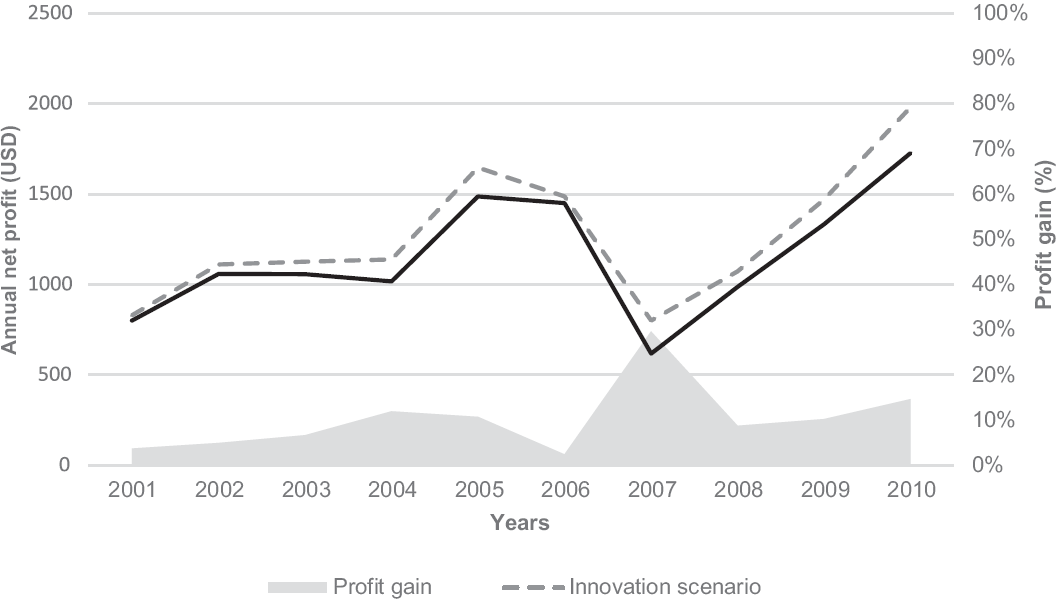
As shown in Figure 4, introducing an innovation into the baseline scenario would have been an economically attractive proposition over the 10-year period investigated. For this hypothetical case, the net profit gain for the innovation scenario varied between 2% (year 6) and 30% (year 7), with an average net profit gain of 10% recorded over the entire period. While these values are indicative only, they illustrate the type of results a Value-Ag analysis generates. Overall, profit gains/losses can be traced to relative changes in annual gross margins of the simulated crop and livestock enterprises, as well as to the extra benefits and costs directly attributed to the innovation. Using a real discount rate of 20% to reflect most smallholders’ reality, the scenario with the innovation returned a higher NPV of annual net profit than that simulated for the scenario without the innovation (i.e. baseline), resulting in a positive net value of innovation at the farm level (the actual value is calculated for each specific case study).
Example of IAT-simulated annual net profit ($) over 10 years for a baseline (solid black line) and innovation (dotted grey line) scenarios, and % farm profit gain of the innovation relative to the baseline (light grey area).

Risk and risk aversion
Likewise, it is possible to explore the innovation’s effect on risk given a certain level of farmer risk aversion. In this hypothetical case, over 10 years, CVar0.1 (or downside risk) was reduced by 9.8%, despite no change in P(π ≥ 0), and the CV of net profit keeping constant at ~0.3 over the entire period in both the baseline and the innovation scenario, suggesting a slight reduction in risk exposure overall. In addition, the innovation scenario was responsible for an increase in the risk premium by 9.5%, resulting in an increase of 9.8% in the risk-adjusted net profit due to a default moderate level of risk aversion. In this hypothetical example, a more resilient livestock enterprise was the main contributor to overall risk mitigation, especially from year 4 of the analysis onwards.
Adoption and scaling potential
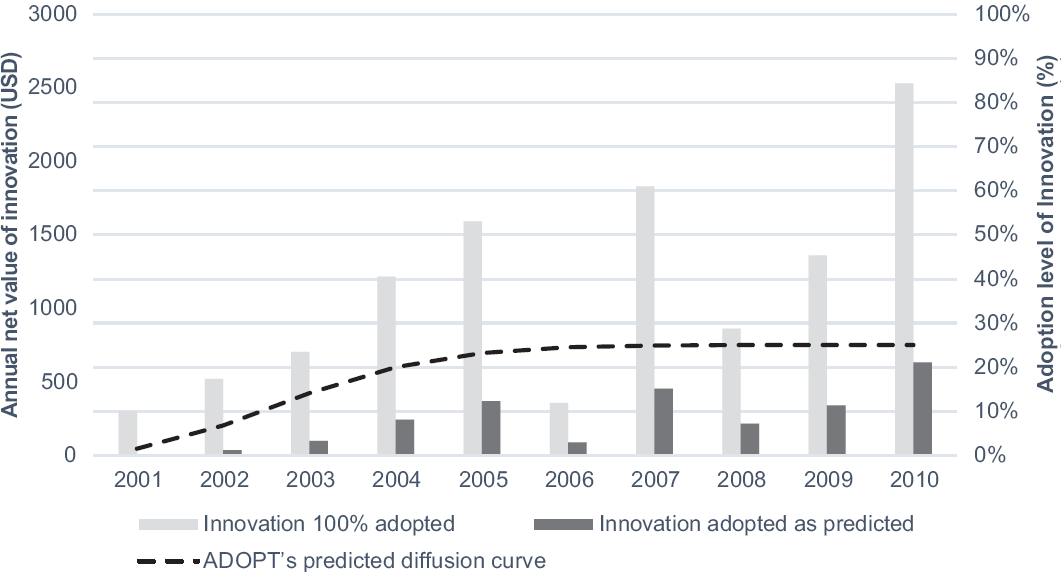
Based on the above results, the standard annual net values of innovation over 10 years for the simulated farm were out-scaled across the total number of farms assumed to be part of the study (e.g. a village of 10 farms, in this example). This showed the annual net value of the innovation for the entire smallholder population targeted by the study if the innovation was fully adopted (Figure 5). In this case, overlaying the annual net value of the innovation with the curve from the Smallholder ADOPT output that predicted a peak level of adoption of 27% occurring in 11 years allowed us to determine the net value of the adopted innovation for the entire smallholder population targeted by the study (Figure 5). The prediction of the adoption curve in this hypothetical analysis was based on default (generally average) responses for all questions, including a risk-neutral context (Q3) (see Supplementary Table S1). While including this innovation was found to be a relatively economically attractive proposition at the farm level over the 10-year period investigated (based on the assumed model parameters), the actual likelihood of intensifying this traditional crop-livestock farming system relied on more than just economic outcomes.
Annual net value of the innovation for the entire smallholder population (10 farms) targeted by the project case study, assuming full adoption of the innovation (light grey bars) and predicted adoption of the innovation (dark grey bars) using Value-Ag to combine the economic assessment with a predicted diffusion curve (adoption rate) determined by Smallholder ADOPT (dotted black line represents 27% adoption in 11 years).

Sensitivity analysis
Sensitivity analysis was used to test the robustness of the simulated results to variation in model parameter values, some of which might be subject to uncertainty or change at different times and places. Key IAT parameters tested often include crop yields and commodity prices used in calculations (e.g. Monjardino et al., Reference Monjardino, Philp, Kuehne, Denton, Phimphachanhvongsod and Sihathep2020). Overall, sensitivity to IAT parameter changes can be analysed individually or combined in factorial analysis.
Smallholder ADOPT can also be used to generate sensitivity analyses for changes in various adoption influences (see Kuehne et al. (Reference Kuehne, Llewellyn, Pannell, Wilkinson, Dolling, Ouzman and Ewing2017) for a discussion of the use of sensitivity analyses). This process allows users to identify the influences having the largest impact on peak adoption level and/or the time taken to reach peak adoption level and to adjust them if it is feasible. Overall, the sensitivities of each adoption influence will vary according to the characteristics of the innovation and the target population for which it is being considered. As an example, we illustrate the effect of farmer risk aversion/orientation on predicted adoption outcomes and the resulting annual net value of the innovation. In this case, we varied the response to the Smallholder ADOPT Q3 on risk orientation from the default risk-neutral option setting (almost none have a minimising production risk as a strong motivation) to the higher four levels of risk orientation of the target population (a minority/about half/a majority/almost all, etc. have minimising production risk as a strong motivation). The results show that peak adoption varied between 27% in a risk-neutral context (Figure 6a) and 21% in a highly risk-averse context (Figure 6e). In all five scenarios, time to peak adoption remained unchanged at 11 years (Figure 6–e). These results apply to the related response to Smallholder ADOPT Q21 on risk exposure of the innovation (default: small increase in risk). For example, for a moderately risky innovation, adoption would have peaked at 19% (risk neutral) down to 11% (very risk averse) over 15 years (results not shown). In addition, the impact of each corresponding level of farmer risk aversion on the farm net profit is illustrated in Figure 6f for both the baseline and the innovation scenarios.
Impact of sensitivity analysis of risk orientation of the farmer population (based on five levels of farmer risk aversion: (a) neutral, (b) low, (c) moderate, (d) high and (e) very high on the predicted diffusion curve determined by Smallholder ADOPT (dotted black line) and the resulting annual net value of the innovation for the entire smallholder population (10 farms) targeted by the project case study (dark to light grey bars moving from neutral to very high aversion). The impact of each level of farmer risk aversion on the farm net profit is illustrated in (f).

Discussion
Decision making at the farm and project level
The gap in ex-ante impact evaluation of agricultural innovations at both farm and project level has prompted the development of a novel multi-tool approach that can help evaluate the likely economic and risk benefits of specific innovations adopted by smallholder farmers. The Value-Ag framework achieves this goal by enhancing the understanding of underlying bio-economic and risk trade-offs and socio-economic adoption drivers that can aid the successful design and delivery of intensification options for smallholders by making the value of potential changes to the system more explicit. Compared to various other approaches discussed in Introduction in terms of complexity, flexibility, data accessibility, expertise and time requirements, metrics relevance, ease of use, etc., Value-Ag has the advantage of handling relatively rapid, flexible and systematic assessments of alternative agricultural options while relying on accessible data sets, broad expertise and an inclusive process.
Value-Ag’s capacity to estimate gains in yield and profit accompanied by changes in downside risk and risk premium when moving from a conventional to a more intensive scenario can be particularly useful in persuading farmers to adopt context-specific interventions for increased farm profitability and resilience. Concerns about differences in farmer attitudes to risk are captured to some extent in a typical Value-Ag analysis by:
1. choosing a short-to-medium term planning horizon; while a 5-year simulation may be a more realistic time frame in the smallholder context, 10 years can better illustrate the potential of the tool which is important to consider in the development of these systems;
2. accounting for off-farm labour and potential investment activities at the household level;
3. conducting a sensitivity analysis on key model parameters influencing the household risk profile, such as commodity prices, crop yields and on/off-farm labour;
4. quantifying the effect of five levels of risk aversion on farm net profit (Figure 6f);
5. framing the broader attitudes of the farmer population to profit and risk when considering an innovation for their farms (captured in Smallholder ADOPT); and
6. using a high discount rate in the NPV calculations, thus reducing the magnitude of future benefits relative to the present.
In addition, many smallholder regions around the world are often affected by social and political risks, which can give rise to risk-mitigating strategies such as migration (seasonal, temporary or permanent). While these broader influences are beyond the scope of Value-Ag, it nevertheless captures some of the most important dimension of household and labour flows that may occur from migration.
Overall, implementation of agricultural technologies will only occur if these innovations are adapted to suit the production objectives and fundamental system properties of a range of farm types (e.g. household and employment structures, attitudes to risk). Currently, a core assumption in Value-Ag is that a single farm typology applies across the case study/village targeted by the project. While simplistic, this assumption still provides a good indication of the likely value of a specific innovation across a selected and relatively homogeneous farmer population. Nevertheless, replicating the Value-Ag analysis across several different farm types would be possible. Such analysis would essentially involve varying key relevant parameters in the whole-farm simulation, likely adjusting the risk aversion level, and choosing different ADOPT responses related to the farmer population for each farm-type scenario.
And even though Value-Ag cannot account for all possible socio-economic scenarios, it is a flexible framework that captures much of smallholder farmers’ actions. For example, the IAT allocates farm labour by ability/availability of all family members, including elderly, teenagers and young children, both male and female. There is also inclusion of off-farm work for different family members and a range of wages, as well as the option to hire casual labourers at peak times, who could be migrant farmers or other people. This is important, because dynamics of local and seasonal labour availability is likely to influence specific management decisions considering overall demand for agricultural labour in the region. Likewise, Smallholder ADOPT captures a range of socio-economic influences on the decisions of farmers but is limited by the local, complex, diverse, dynamic and unpredictable realities of smallholder farmers.
Ultimately, Value-Ag can assist with identifying and prioritising agricultural opportunities by determining their effect on farm profit and household income and adding in a consideration of risk and farmer risk aversion as well as the likelihood of adoption. Moreover, by identifying practices that have the potential to help mitigate the effects of a drying climate and improve efficiency of resource use, Value-Ag can provide evidence to those seeking to improve resilience and sustainability of smallholder farms. More generally, better informed decision-making at the farm level (i.e. by farmers based on advice stemming from research projects) could result in enhanced rural livelihoods, with potential flow-on impacts on community cohesion, national prosperity and regional stability.
Validation and participatory training
Validation of Value-Ag is ongoing, with the integrated tool so far tested on specific case studies involving the introduction of a legume crop in the baseline system, both in rotation with a traditional rice crop in Southeast Asia (Monjardino et al., Reference Monjardino, Philp, Kuehne, Denton, Phimphachanhvongsod and Sihathep2020) and with intercropping with maize in South Africa (unpublished results). The IAT component has been extensively applied to the smallholder context in China (Komarek et al., Reference Komarek, Bell, Whish, Robertson and Bellotti2015), India (Kumar et al., Reference Kumar, Sravya, Pramanik, Dakshina, Balaji, Samuel, Prestwidge and Whitbread2017; Mayberry et al., Reference Mayberry, Ash, Prestwidge, Godde, Henderson, Duncan, Blummel, Ramana Reddy and Herrero2017, Reference Mayberry, Ash, Prestwidge and Herrero2018), Pakistan (Shafiullah, Reference Shafiullah2012), Southeast Asia (Gabb et al., Reference Gabb, Bell, Basuno, Prestwidge, Prior and Guppy2017; Lisson et al., Reference Lisson, MacLeod, McDonald, Corfield, Pengelly, Wirajaswadi, Rahman, Bahar, Padjung and Razak2010; Monjardino et al., Reference Monjardino, Philp, Kuehne, Denton, Phimphachanhvongsod and Sihathep2020; Parsons et al., Reference Parsons, McDonald, Ba, Tuan, Lisson, Corfield, Phung, Quan, Van, Ngoan and Lane2012) and Africa (Mayberry et al., Reference Mayberry, Ash, Prestwidge, Godde, Henderson, Duncan, Blummel, Ramana Reddy and Herrero2017, Reference Mayberry, Ash, Prestwidge and Herrero2018; Rigolot et al., Reference Rigolot, Watson, Herrero, Delma, Vall, Andrieu, Yakouba, Ouedrago, Ziebe, Dowe, Kolyang, Prestwidge, McDonald, Stirzaker, Bruce and Carberry2015) and has been used in project planning and development of intervention strategies in low and high rainfall areas.
Smallholder ADOPT has also been tested with target users in several developing countries (e.g. Akroush and Dhehibi, Reference Akroush and Dhehibi2015; Dhehibi et al., Reference Dhehibi, Nejatian, Al-Wahaibi, Atroosh, Al Yafei, Al Otaibi, Al Hendi and Belgacem2017; Farquharson et al., Reference Farquharson, Martin, McCorkell, Scott, Sotheary, Phaloeun, Sophors, Sinath, Monida, Sinarong and Sokun2013; Mwinuka et al., Reference Mwinuka, Mutabazi, Graef, Sieber, Makindara, Kimaro and Uckert2017), and with historical diffusion data in Ethiopia, India and Laos (Brown et al., Reference Brown, Nidumolu, Kuehne, Llewellyn, Mungai, Brown and Ouzman2016).
Overall, the opportunity for research/extension professionals to work alongside farmers in a Value-Ag workshop setting allows valuable insights into farmer decision making and attitudes to risk, input/enterprise trade-offs and identified constraints to adoption of the specific innovations (Crawford Fund, 2018). The decision/thinking process required to explore Value-Ag’s potential can significantly contribute to the knowledge and confidence required to build the capacity of all stakeholders.
Farming systems research and global food security
As mentioned earlier, a strength of Value-Ag is that it enables a relatively rapid assessment of the potential production, profit-risk profile and adoptability of changes in a farming system that result from the combination of the biophysical environment and socio-economic context at the farm and village/project level. This capability reinforces the value-adding role of integrated modelling in addressing complex issues in farming systems research, as well as its potential to significantly contribute to global food and nutrition security through better decision making at the farm, project and funding levels (Antle et al., Reference Antle, Basso, Conant, Godfray, Jones, Herrero, Howitt, Keating, Munoz-Carpena, Rosenzweig, Tittonell and Wheeler2017; Reynolds et al., Reference Reynolds, Kropff, Crossa, Koo, Kruseman, Molero Milan, Rutkoski, Schulthess, Balwinder-Singh, Sonder, Tonnang and Vadez2018).
Another strength of Value-Ag is its flexibility, not just by combining quantitative and qualitative information specific to site and project/region but also by its potential wider applicability. While the IAT component of Value-Ag was originally developed to suit mixed crop-livestock smallholder systems, it could be used to explore specific enterprise combinations, such as different cropping options. Likewise, it could be used to evaluate the whole-farm performance of specific components of CA or the combined technologies as a package. Furthermore, Value-Ag could be employed to better evaluate the effect of variable market conditions on farmer decision-making and adoption of changed practices or new technologies, for example, by drawing parameters such as commodity prices, input and transportation costs, and supply chain transaction costs from data distributions, and/or by conducting more complex factorial analyses.
Benchmarking government policy and R4D investment
Value-Ag could be used to explore the impact of policies and regulations, such as input subsidies, agricultural trade, environmental protection and even food security, on the profitability and dynamics of agricultural systems. The key is to generate credible evidence of possible outcomes from a range of different policy-related scenarios and allow a more flexible approach to be created when undertaking out scaling projects across different agro-ecological environments and policy settings. In particular, Value-Ag’s ‘what if’ scenario-building capability is useful for informing government of the likely adoption/behavioural responses by farmers in relation to changing economic characteristics and influences, such as those associated with the subsidisation of agricultural inputs and core components of new innovations (e.g. farm mechanisation equipment).
Given the significant investments that governments from developing countries make in relation to the provision of subsidies, there are little ‘hard data’ currently available that demonstrate the net benefits of these policies in terms of increased productivity, profitability and adoptability. This aspect of Value-Ag offers an opportunity to influence government policy in relation to the provision of agricultural subsidies and how it can be best managed from a policy development and implementation perspective (e.g. impact of policy advice on input price/use, level of capital investment, farm profitability and resilience). This in turn can inform further Value-Ag analysis to assess the likely risk-return and adoption impact of government investment into the technology, so that government policy can be fine-tuned through modelling utilising adjusted farmer decision-making responses.
The strength of Value-Ag’s evidence-based process and ability to make valid comparisons between competing demands for scarce financial resources could allow research funders, development agencies, credit providers and policy-makers access to more rigorous benchmarks, stronger performance measures and better understanding of adoption processes in order to better determine the likely value and effectiveness of R D E & M strategies.
Conclusions
We provide proof of concept of Value-Ag, a systematic methodology to help users better understand the value gained from the adoption of agricultural innovations for smallholder farmers. The multi-tool approach is a novel combination of bio-economic modelling, risk analysis, adoption prediction and impact assessment to help determine the likelihood of agricultural innovations being adopted and then paying off over time. In addition, the use of Value-Ag has potential as a valuable participatory training platform to improve research capacity building, farmer engagement, project implementation and overall benchmarking of agricultural research projects.
Overall, Value-Ag is suited to developing case studies with agricultural innovations that are expected to improve crop yield and/or animal performance and assess the relative benefits of each innovation over time given the predicted level of its adoption. The process involves exploring enterprise and profit-risk trade-offs, comparing intervention levels and allowing ‘what-if’ scenarios and sensitivity analyses. The main outcomes for a particular case are useful insights for improving farm productivity and profitability while reducing risk exposure from an agricultural innovation, as well as the opportunity to out-scale these changes across the agricultural development project according to predicted adoption outcomes. Notably, Value-Ag offers a platform to evaluate agricultural innovations in a clear, consistent and comparable manner across projects, therefore increasing the scrutiny of projects so that they deliver greater value for money, as well as fostering a more results-focused learning culture in developing countries.
Acknowledgements
This work, which included Value-Ag development and training activities in Laos and Cambodia in 2016, and South Africa in 2017, was directly or indirectly supported by the Australian Centre for International Agricultural Research (ACIAR project SMCN/2012/075), The Crawford Fund (Australia), The University of Adelaide (Australia), the Cambodian Agriculture Research and Development Institute (CARDI, Cambodia), The National Agriculture and Forestry Research Institute (NAFRI, Lao PDR), the University of KwaZulu-Natal (South Africa), the Umngeni Resilience Project (South Africa), Meaningful Social Research (Australia), and the Commonwealth Scientific and Industrial Research Organisation (CSIRO, Australia). In addition, we thank John Dixon from ACIAR and Shalander Kumar from ICRISAT for proof-reading the article, and Brendan Brown (now CIMMYT) for co-delivering the workshop in South Africa.
Supplementary material
For supplementary material for this article, please visit https://doi.org/10.1017/S0014479720000204