Introduction
Lichenomphalia Redhead et al. is a small genus of lichenized Basidiomycota in the Agaricales, family Hygrophoraceae (Lodge et al. Reference Lodge, Mahajabeen, Matheny, Aime, Cantrell, Boertmann, Kovalenko, Vizzini, Dentinger and Kirk2014). This group, briefly known as Botrydina Bréb. (Redhead & Kuyper Reference Redhead and Kuyper1987) and Phytoconis Bory (Redhead & Kuyper Reference Redhead and Kuyper1988), was separated from the genus Omphalina (Bull.) Quél. based on its lichenized habit by Redhead (Reference Redhead1984) and Kuyper (Reference Kuyper1986), subsequently supported by molecular studies (Redhead et al. Reference Redhead, Lutzoni, Moncalvo and Vilgalys2002). Lichenomphalia currently includes 13 accepted species (Index Fungorum Partnership 2016), forming the only agaricoid lichenized fungal genus. The recognition of lichenized species in this genus and their separation from similar, non-lichenized taxa is not always straightforward, particularly for those taxa that produce inconspicuous, granular algal thalli, which has led to confusion about the biological nature of material forming the basis for certain species. Even more confusing has been, and still is, the separation of small brown agaricoid basidiolichen species from each other because species boundaries in the group are unclear.
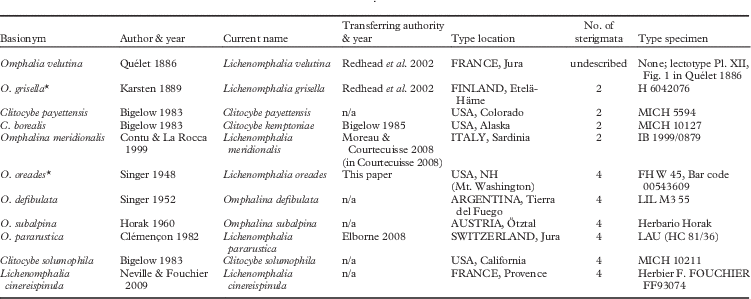
The present study was prompted by the discovery of a small, brown agaric basidiolichen on a barren mountain top in Newfoundland in 2012, for which various names were initially available. Table 1 lists the species that we have been able to find which might fit that description. They come from three centuries and three continents, and have either primarily 2- or 4-spored basidia. Type specimens are available for all but one species, Lichenomphalia velutina, for which no type or authentic material is known and the original illustration by Quélet (Reference Quélet1886) has been chosen as lectotype (Jørgensen & Ryman Reference Jørgensen and Ryman1989). In addition to these taxa, Singer & Clémençon (Reference Singer and Clémençon1972) considered Omphalina rustica (Fr.) Quél. to be an earlier epithet for the allegedly 2-spored L. velutina but O. rustica is currently interpreted as a non-lichenized species of Arrhenia Fr. (Redhead et al. Reference Redhead, Lutzoni, Moncalvo and Vilgalys2002). Reviewing these taxa, we considered it likely that our species might fit with Omphalina oreades Singer because both are 4-spored species from the Appalachian Range in North America. Described from Mt. Washington by Singer (Reference Singer1948), O. oreades was collected again from the same site by Bigelow (Reference Bigelow1968), who treated it in Clitocybe (Fr.) Staude as C. albimontana Bigelow because Singer’s epithet, oreades, was being used in Clitocybe by C. oreades Murrill. Both Singer and Bigelow noted 4-spored basidia and an absence of clamp connections; subsequently Bigelow (Reference Bigelow1983) noted the presence of algal granules representing the lichen thallus.
Brown agaricoid basidiolichen species described in the literature
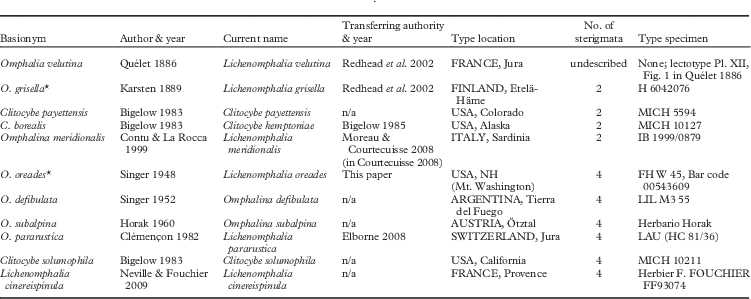
Species are grouped by basidial sterigma number and then oldest to most recent description.
* Species used in this study.
The primary aim of this study was to use the ITS rDNA fungal barcoding locus (Schoch et al. Reference Schoch, Seifert, Huhndorf, Robert, Spouge, Levesque and Chen2012) to determine whether the Newfoundland species indeed belonged to the genus Lichenomphalia and, by analyzing appropriate type specimens, whether it was O. oreades, another previously described species, or represented a new taxon. Secondary aims were to identify its photobiont and provide an illustrated circumscription of the taxon.
Material and Methods
Specimens were photographed in situ and collected from Mt. Ignoble near Humber Village, above the Humber River, and Big Level in the Long Range Mountains, Gros Morne National Park, both parts of the Appalachian range in Newfoundland. Macroscopic descriptions were based on fresh material. Specimens were air dried, without the use of additional heat. Microscopic examination was carried out on fresh and dried material and spores measured from both spore print and squash mount using a Zeiss 392560 microscope with Apo 100/1.25 at ×1000 magnification (oil immersion), mounting the material in 2% KOH. Basidiospores were measured to 0·5 µm precision expressed as range and mean. Recorded measurements deviating from 0·5 µm increments are due to calculation of a lens correction factor. Specimens from Duke University were examined for basidial sterigma count in ammoniacal Congo Red using a Zeiss photomicroscope with phase contrast Apo 63/1.4 at ×630 magnification (oil immersion); unfortunately, only one of three specimens sequenced (Lutzoni Reference Lutzoni1997; Zoller & Lutzoni Reference Zoller and Lutzoni2003) had any remaining hymenial tissue for examination.
New sequences of the internal transcribed spacers of ribosomal DNA (ITS rDNA) from selected sporocarps of the target fungus and related species were generated following the protocol used for extraction and sequencing of Lepidostromataceae (Hodkinson et al. Reference Hodkinson, Moncada and Lücking2013; Sulzbacher et al. Reference Sulzbacher, Wartchow, Ovrebo, Sousa, Baseia, Moncada and Lücking2016). Additional sequences, including from type material of published names, were generated using previously published techniques (Saar & Voitk Reference Saar and Voitk2015). Algal sequences were obtained by subjecting algal granules on soil near the base of five collections to either CTAB DNA isolation following Grube et al. (Reference Grube, DePriest, Gargas and Hafellner1995) or a bead-beating protocol with a GeneJET Plant Genomic DNA Purification Kit (Fermentas Life Sciences). PCR of the ITS rDNA followed Beiggi & Piercey-Normore (Reference Beiggi and Piercey-Normore2007) and DNA sequencing followed Doering & Piercey-Normore (Reference Doering and Piercey-Normore2009). For community genomic DNA (algal cells and substratum), PCR and Illumina sequencing of the D1 variable domain of the 26S rDNA, and processing of the raw sequence data, we followed the protocols of Asemaninejad et al. (Reference Asemaninejad, Weerasuriya, Gloor, Lindo and Thorn2016).
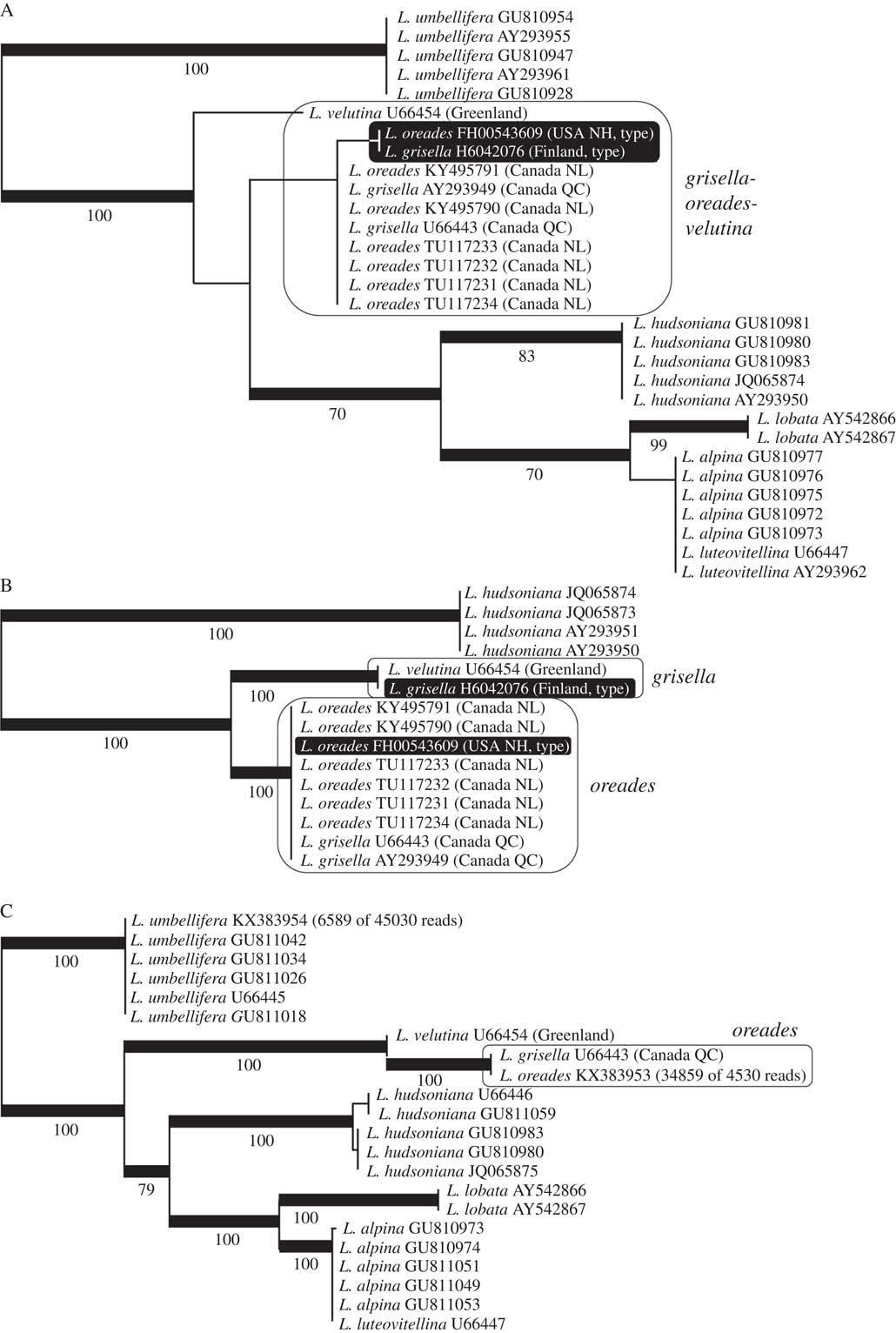
To illustrate the placement of the target species within the genus Lichenomphalia and to determine its closest relative, the newly generated ITS rDNA sequences were aligned with selected sequences representing the genus Lichenomphalia s. lat., using L. umbellifera (L.) Redhead et al. as internal outgroup following previous studies (Table 2, Fig. 1). Sequences were arranged into a multiple sequence alignment (MSA) using BioEdit 7.09 (Hall Reference Hall1999) and automatically pre-aligned with MAFFT 7.294 using the “--auto” option (Katoh et al. Reference Katoh, Asimenos and Toh2009). Since ITS sequences are difficult to align within Lichenomphalia s. lat., the unaligned sequences were also subjected to assessment of alignment ambiguity through the Guidance web server (Penn et al. Reference Penn, Privman, Ashkenazy, Landan, Graur and Pupko2010a , Reference Penn, Privman, Landan, Graur and Pupkob ), and columns with less than 95% alignment reliability were removed. This was done for two datasets: the entire set of Lichenomphalia s. lat. sequences (49 operational taxonomic units (OTUs)), and a subset representing a supported clade including the target species with the addition of L. grisella (P. Karst.) Redhead et al., L. hudsoniana (H. S. Jenn.) Redhead et al. (internal outgroup) and L. velutina (15 OTUs).
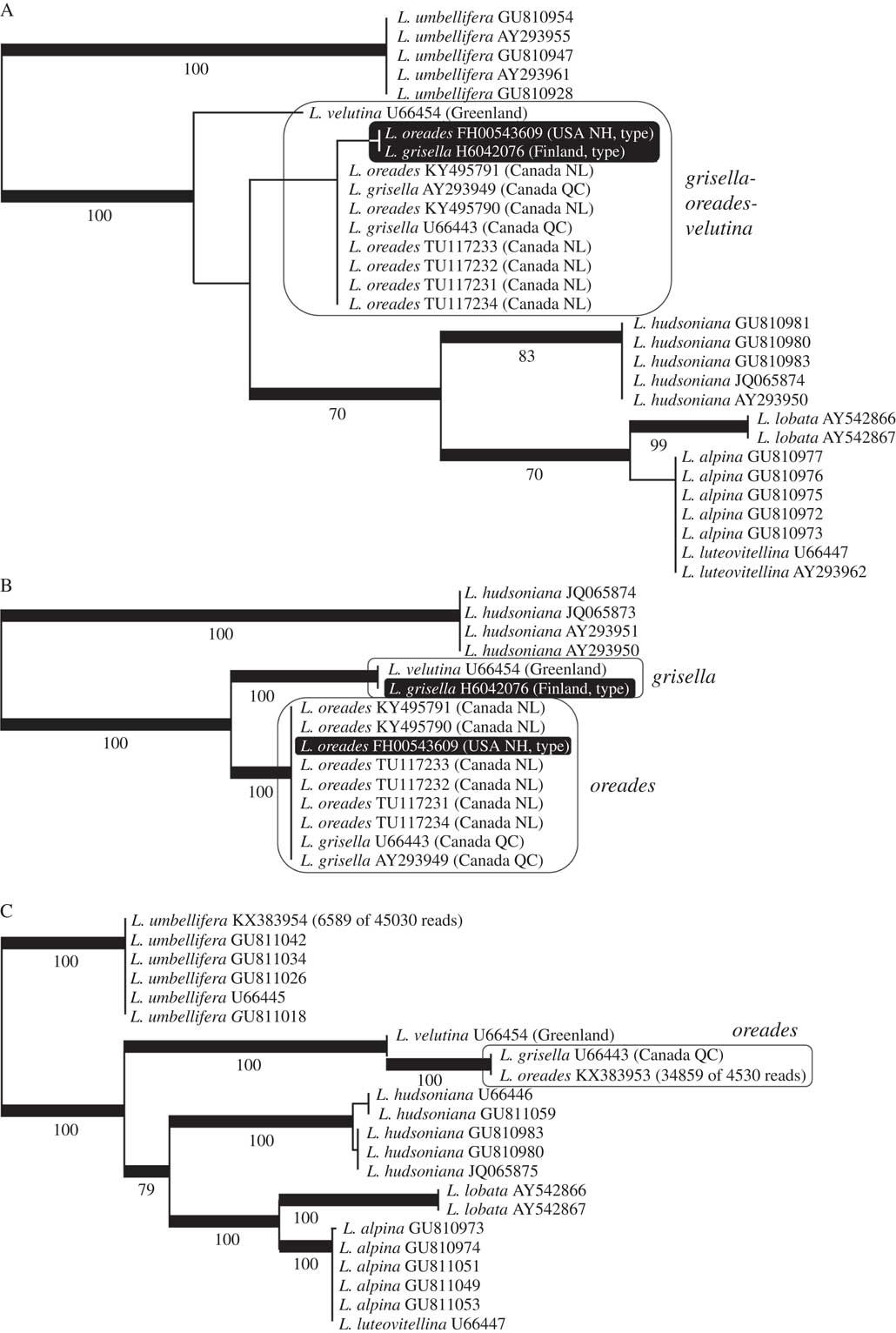
Maximum likelihood phylogenetic trees of the Lichenomphalia dataset, identified by GenBank number, and with location indicated for studied collections. Branches with bootstrap values ≥70% are thickened and support values are given below the branch. Type specimens with black background. A, maximum likelihood tree for ITS, all OTU’s, internally rooted in L. umbellifera inferred with 534 ambiguously aligned columns (out of 847) removed which also removed segments required for proper species identification within the grisella-oreades-velutina complex, resulting in false clustering. B, maximum likelihood tree for an ITS subset of the Lichenomphalia dataset after removal of 283 ambiguously aligned columns (out of 761) leaving a reduced dataset with most diagnostic columns retained and with the added phylogenetic signal for species identification, the 2-spored type of Omphalia grisella from Finland clusters in a clade with a collection identified as Omphalina velutina, from Greenland; the 4-spored Newfoundland collections, together with the 4-spored holotype of O. oreades from New Hampshire and two specimens from Québec identified as Omphalia grisella, form a clade of their own on a highly supported sister arm. C, maximum likelihood tree for the nuLSU dataset, including Illumina environmental sequence data for L. oreades.
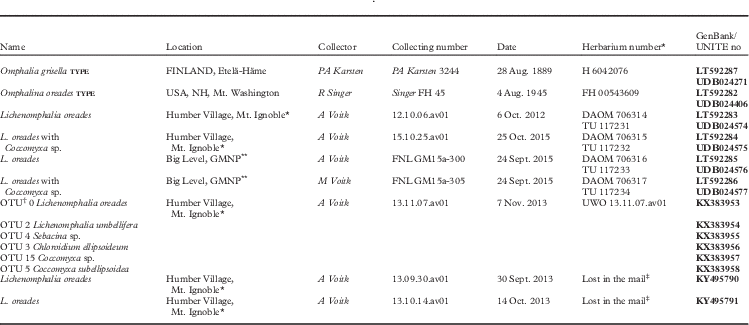
New sequences from the brown agaricoid basidiolichen species used in this study
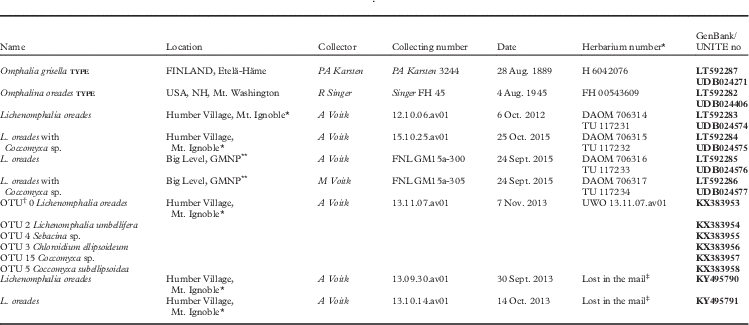
* CANADA, Newfoundland and Labrador; 48°59'57''N, 57°45'04''W.
** CANADA, Newfoundland and Labrador, Gros Morne National Park; 49°43'38''N, 57°48'30''W.
† Operational taxonomic unit (OTU) designated in analysis of sequences derived from sample substratum using Illumina MiSeq.
‡ These two specimens were unicates sent by AV to the Field Museum for DNA extraction and sequencing and upon return to AV were lost in the mail. We included the sequences here, because the DNA extracts are available and the sequences match those of the other specimens of this taxon collected in the same area.
The final alignments were subjected to a maximum likelihood search using RAxML 8.2.0 (Stamatakis Reference Stamatakis2006) with the GTR+Gamma model, with parametric bootstrapping using 500 replicates. For algal sequences, BLAST searches in NCBI GenBank, alignments and phylogenetic analysis were conducted using MEGA6 (Tamura et al. Reference Tamura, Stecher, Peterson, Filipski and Kumar2013).
New collections used in this study were deposited in DAOM, FH, TU and UWO (fungaria codes as per Index Herbariorum, Thiers (Reference Thiers2016)); raw Illumina sequence data were deposited in GenBank’s Sequence Read Archive, Accession number SRP076466; assembled sequences were deposited in GenBank and some duplicates in UNITE (Table 2).
Results
Macroscopically, the separate descriptions of Omphalina oreades by Singer (Reference Singer1948) and Bigelow (Reference Bigelow1968) matched the Newfoundland collections. Microscopic examination of tissues and measurements of basidiospores and hymenial components revealed Singer’s type of O. oreades to be identical to these collections. On sequencing, the Newfoundland collections matched two GenBank deposits labelled Omphalina grisella from Schefferville, Québec. This identification did not seem felicitous because since its description (Karsten Reference Karsten1889), the type material of O. grisella has been shown to have 2-spored basidia (confirmed by us) whereas our collections had four spores. Sequenced specimens originally identified as O. grisella (Lutzoni 930822-6=U66443 and 930822-5=AY293949) (Lutzoni Reference Lutzoni1997; Zoller & Lutzoni Reference Zoller and Lutzoni2003) were clampless but had no hymenium remaining to confirm the number of sterigmata per basidium. However, contemporary collections also identified by Lutzoni as O. grisella (Lutzoni 930825-3 and 930816-9) had 4-spored basidia and were otherwise identical to our specimens of O. oreades. In contrast, specimens originally identified as O. velutina (Lutzoni 930812-1=U66454 and 930805-1) (Lutzoni Reference Lutzoni1997) were clampless, had 2-spored basidia, and were identical to the holotype of O. grisella.
Phylogenetically, based on analysis of the complete Lichenomphalia s. lat. dataset of ITS sequences with ambiguously aligned columns removed, the type of O. oreades clusters with the type of L. grisella (Fig. 1A); in the reduced dataset, it clusters with strong support with the specimens from Newfoundland, whereas the type of L. grisella clusters with a sequence labelled L. velutina from Greenland (Fig. 1B). This topological discrepancy came about because the removal of ambiguously aligned columns in the complete dataset left only 37% (313 of 847) of the original alignment columns. Among the removed columns were all columns that, while ambiguously aligned across all species of Lichenomphalia, are diagnostic to delimit species in the L. oreades-L. grisella clade. On the other hand, a single, non-ambiguous column was retained that exhibited variable polymorphism which produced two artefactual clusters in this clade. In contrast, for the reduced dataset with a much lower level of alignment ambiguity, 63% (478 of 761) of the original alignment columns remained, including the columns that contain the phylogenetic signal required to properly separate the two species. The most abundant fungal 26S rDNA sequence recovered by Illumina sequencing of community DNA from soil and the algal crust at the base of one fruiting body of O. oreades (13.11.07.av01) yielded a match to the same sequence in GenBank identified as L. grisella, from Schefferville, Quebec (Fig. 1C). Also present were sequences matching multiple GenBank accessions identified as L. umbellifera, as well as an unidentified species of Sebacina Tul. & C. Tul. (not shown).
The only publicly available sequence of putative Arrhenia rustica, deposited without phylogenetic analysis (Geml et al. Reference Geml, Timling, Robinson, Lennon, Nusbaum, Brochmann, Noordeloos and Taylor2012), did, indeed, fall within Arrhenia, not Lichenomphalia. As our phylogeny (Fig. 1) is limited to Lichenomphalia, this placement is not shown here. Because O. oreades falls into Lichenomphalia and is not conspecific with any known species of that genus, its correct name should be L. oreades. Below we make the transfer, redescribe and illustrate the species, and explore the identity of its photobiont.
Unfortunately, the herbarium holding the type collection of L. pararustica, Musée et Jardins Botaniques Cantonaux (LAU), did not respond to our loan requests. Bigelow’s collections of an unresolved 2-spored species from Washington State could not be located in NY, MICH, the online records of the Consortium of Pacific Northwest Herbaria (2016), or Mycology Collections Portal (2016).
Lichenomphalia oreades (Singer) Voitk, Thorn & I. Saar comb. nov.
MycoBank No.: MB 819711
Basionym: Omphalina oreades Singer, Pap. Mich. Acad. Sci. Arts Lett. 32: 123 (1948). (FH00543609—holotype!).
Homotypic synonym: Clitocybe albimontana H. E. Bigelow, in Bigelow & Barr, Rhodora 68: 178 (1966).
Synonyms: Omphalina grisella sensu Lutzoni (Reference Lutzoni1997) non (P. Karst.) M. M. Moser, Lichenomphalia grisella sensu Redhead et al. (Reference Redhead, Lutzoni, Moncalvo and Vilgalys2002) non (P. Karst.) Redhead, Lutzoni, Moncalvo & Vilgalys.
(Fig. 2)
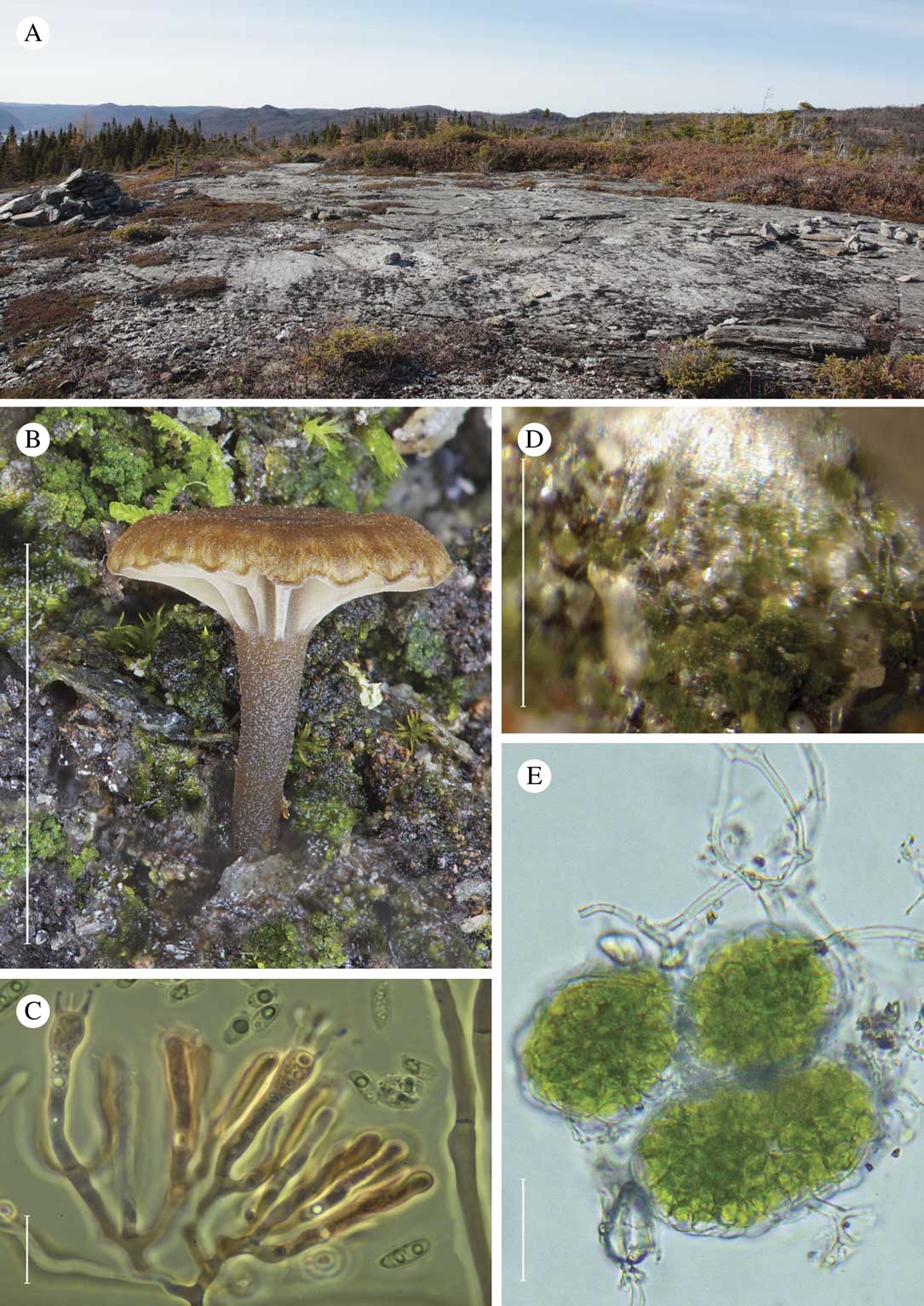
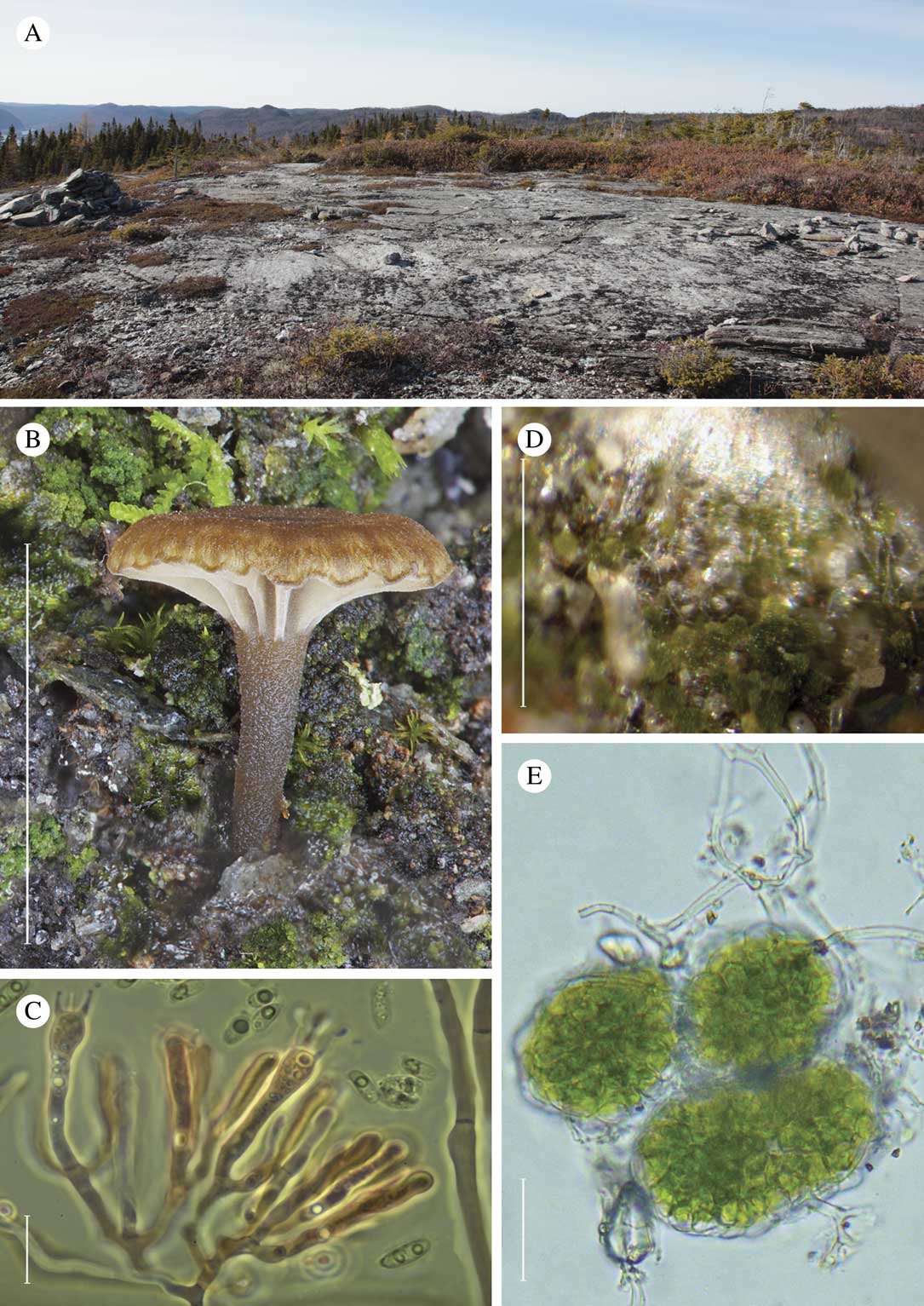
Lichenomphalia oreades. A, habitat, Mt. Ignoble near Humber Village, Newfoundland (NL), mountain top below tree line (287 m a.s.l.) showing a mixture of bare rock and heath; L. oreades fruits in granitic silt found in cracks in the rock. B, L. oreades in situ, Mt. Ignoble, NL, 6 October 2012 (12.10.06.av01); note the copious thallus granules on the ground. C, basidia and spores, mounted in 10% ammonia and dyed with Congo Red SDS; note the lack of clamp connections, 4-spored basidia and elongated, vacuolar spores. D, base of stipe (light-coloured structure at upper end) of a rehydrated specimen; note green algal granules intimately associated with fine mycelia emanating from the stipe. E, detail of thallus structure; note tile-like appearance of enveloping mycelium, clear and flat at the periphery in cross-section. Scales: B=10 mm; C=10 µm; D=100 mm; E=20 µm.
General. A small, brown, agaric, lichenized basidiomycete, with 4-spored basidia and a granular thallus, apparently confined to alpine, arctic and subarctic habitats, currently known only from the northern Appalachian range of North America.
Fruiting body macroscopic characters. Stem length usually greater than cap diam. Pileus 2–9 mm wide, edges initially inrolled, then concave, plane at maturity with a shallow central depression, radially ribbed over the gills, with increasingly crenate margin, no veil, surface smooth but minutely pebbly, hygrophanous, translucent when moist, beige to tan and dark brown radial bands alternate over the gills. Lamellae moderately to distantly spaced, moderately decurrent, some lamellulae, occasional forking, low cross-veining in advanced age, edges smooth, buff cream. Stipe 0·5–2·0×4–11 mm, even to slightly tapered downwards, no ring or ring zone, variably but markedly pruinose, becoming glabrous, base often slightly curved and covered by white tomentum intimately associated with the lichen thallus in soil, concolorous with cap. Flesh light, odour unremarkable. Spore print white.
Fruiting body microscopic characters. Basidiospores (10 collections, 17 fruit bodies, 274 spores) 6·7–8.5–10·1×2·9–4.3–5·8 µm, Qave=2·0; 1–2 droplets, prominent apiculus; basidia 6–8×20–35 µm, 4 sterigmata (0–20%, 2 sterigmata), vacuolar; no cystidia; no clamp connections; lamellar trama of interwoven to sub-parallel, broad, thin-walled, branching, clampless hyphae; pileipellis a cutis, some incrusted brown pigment in its hyphae; stipitipellis of parallel, cylindrical hyphae 3–6 µm broad, with bundles of erect, tubular, thin-walled end cells projecting at a right angle up to 100 µm from stem; true caulocystidia absent.
Thallus morphology. The thallus is of the Botrydina type (Poelt & Oberwinkler Reference Poelt and Oberwinkler1964; Oberwinkler Reference Oberwinkler2012), a granular mass of lichenized algal globules on the substratum around the base of the fungal fruiting body (Fig. 2B), attached to visible hyphae at the base of the stem (Fig. 2D); globules 20–100 µm diam. Larger globules composed of conglomerates of smaller globules. Globules are enveloped by flat, adpressed hyphal cells, and are interconnected by a hyphal matrix (Fig. 2E); enveloping cells angular, 4–9 µm diam. and 2–4 µm thick. Interconnecting hyphae thin-walled, 1·5–3·0 µm in width, in agreement with the findings of Redhead & Kuyper (Reference Redhead and Kuyper1987). Thread-like hyphal cells seem to communicate directly with a network of flattened cells coursing through the globules, forming septa that compartmentalize the algal aggregates into smaller units, permitting intimate contact between individual algal cells and the hyphal network.
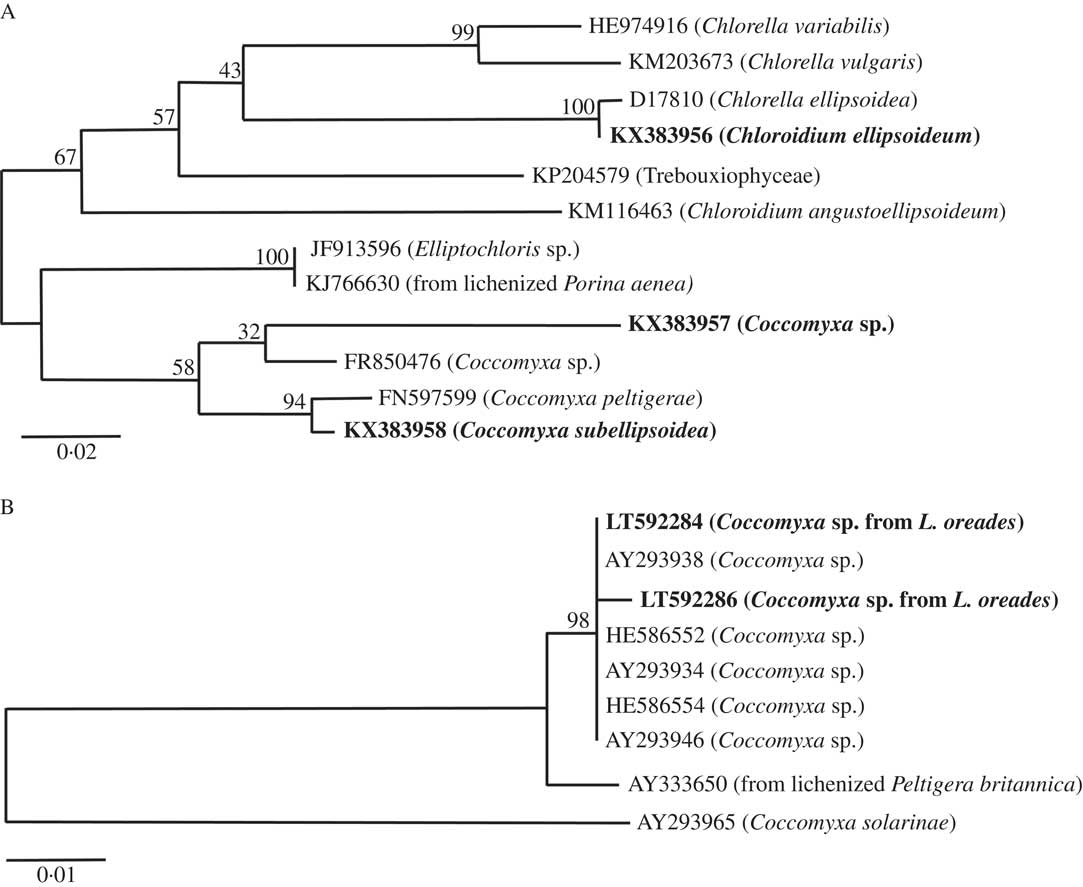
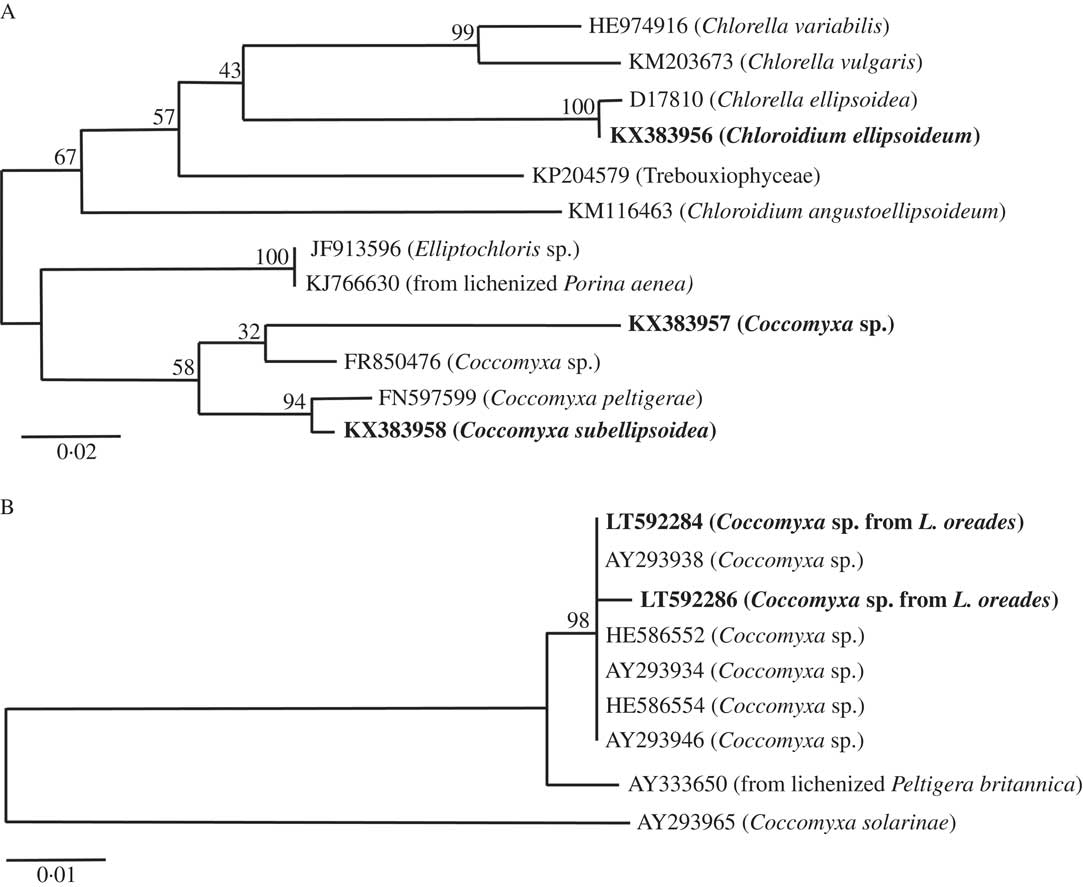
Photobiont (Fig. 3). The algal sequences from soil and the algal crust at the base of one fruiting body of L. oreades (13.11.07.av01) are shown in the 26S rDNA phylogeny (Fig. 3A). The most abundant sequence matches GenBank collections identified as Chloroidium ellipsoideum (Gerneck) Darienko et al., and the second matches Coccomyxa subellipsoidea E. Acton; a third, unidentified species of Coccomyxa Schmidle was also present in low numbers. Algal ITS rDNA sequences from another collection (15.10.25.av01) are shown in Fig. 3B; the two sequences recovered fall within a highly supported clade with members of an undetermined Coccomyxa sp.
Maximum likelihood phylogeny of green algal sequences obtained from soil samples. Samples from this study in bold. Bootstrap values from 300 resamplings shown above nodes. A, 26S rDNA, based on an alignment of 248 nucleotides with three indels (1–3 nt each) and LogL=−1010·57. B, ITS rDNA, based on an alignment of 500 nucleotides with eight indels (1–2 nt each) and LogL=−886·14. The basal position of the alga from P. britannica is consistent with the findings of Lohtander et al. (Reference Lohtander, Oksanen and Rikkinen2003).
Ecology, distribution, phenology. Alpine to subalpine and arctic habitat, solitary to gregarious, exposed in sandy cracks and crevasses of bare rock, or on turf, among lichen, moss, liverwort and ericaceous plants, but often away from vascular plants. Lichenomphalia umbellifera, Clavaria argillacea Pers., and Arrhenia obscurata (D. A. Reid) Redhead et al. were noted in the proximity of the Mt. Ignoble collections. Reported in July and August on Mt. Washington in Newfoundland, the species appears most abundantly in September and October, rarely at the end of July. It recovers from freezing to sporulate during the thaw but seemingly is unable to revive after drying. To date, it is genetically confirmed only from the northern Appalachian range in North America.
Additional specimens examined (see Table 2 for specimens examined from which new sequences were generated for this study). Canada: Newfoundland and Labrador: Humber Village, Mt. Ignoble, 48°59'57''N, 57°45'04''W, 277 m, pioneer soil in rock cracks on barren mountaintop, 2012, A. Voitk 12.10.31.av02 (FH 00458214); ibid., 2013, A. Voitk 13.07.24.av01 (DAOM 706318); ibid., 2013, A. Voitk 13.08.31.av02 (DAOM 706322); ibid., 2013, A. Voitk 13.10.09.av02 (DAOM 706319); ibid., 2015, A. Voitk 15.09.08.av03 (FH 00458215); Gros Morne National Park, Big Level, 49°43'38''N, 57°48'30''W, 716 m, turf among ericaceous plants, 2015, M. Voitk, coll. Foray Newfoundland & Labrador (FNL) GM15A-280 (FH 00458216); ibid., 2015, M. Voitk, coll. FNL GM15A-299 (DAOM 706319); ibid., 2015, A. Voitk, coll. FNL GM15A-303 (DAOM 706319); ibid., 2015, M. Voitk, coll. FNL GM15A-306 (FH 00458217). Québec: Saguenay Co., Schefferville, 54·8°N, 66·8°W (approx.), c. 521 m, on soil among young mosses, 1993, F. Lutzoni 930822-5 (DUKE 0011662, as L. grisella); ibid., 1993 F. Lutzoni 930822-6 (DUKE 0011663, as L. grisella); north of Kuujjuarapik, east of the mine, 55·3°N, 77·7°W (approx.), c. 15 m, terricolous in the large spaces between polygons of Cladina stellaris, 1993, F. Lutzoni 930825-3 (DUKE 0011665, as L. grisella).—Greenland: Nuuk, near the cement factory, 64·2°N, 51·7°W (approx.), c. 90 m, on disturbed soil on a small tussock, 1993, F. Lutzoni 930816-9 (DUKE 0011660, as L. grisella).
Lichenomphalia grisella (P. Karst.) Redhead et al. Finland: Etelä-Häme, Mustiala, near Myllyperä manor, 60·8°N, 23·8°E, 110 m (approx.), dry, gravelly places, 1889, P. Karsten 3244 (Holotype!), (H6042076).—Greenland: Disko Island: Arctic Station at Godhavn, 69°15'17''N, 53°31'10''W, 39 m (approx.), terrace soil, 1993, F. Lutzoni 930812-1 (DUKE 0011658, as L. velutina).—Iceland: Myvatn Lake, on soil at edge of sulphurous crater, 65·7°N, 16·9°W, 288 m (approx.), 1993, F. Lutzoni 930805-1 (DUKE 0011658, as L. velutina).
Discussion
Basidial sterigma count
All Newfoundland collections of Lichenomphalia oreades from two different sites, as well as the type collection from a third, were 4-spored, whereas the type of L. grisella was 2-spored, as was the collection from Greenland that fell in the L. grisella clade. The differences were statistically significant (Chi-squared; P=0·02) but apply only to the populations studied, and do not exclude the possibility that other populations of either species have different sterigma counts. For example, Bigelow (Reference Bigelow1983) reported a 2-spored brown basidiolichen from Rainier National Park in Washington State, USA, which he considered conspecific with Clitocybe albimontana (a synonym of L. oreades). Unfortunately, we were unable to locate the collection and are therefore unable to determine whether it is this species or another. Whether designated primarily 2- or 4-spored, most of the species in Table 1 are noted to have some basidia with the other count. In our 4-spored collections, the incidence of 2-spored basidia varied from 0–20%. Unpublished data from our other ongoing investigations include an example of 2-spored and 4-spored collections of a species of Arrhenia from different regions, occupying the same phylogenetic clade. The limited samplings here do not exclude a similar possibility, and many specimens from several different regions are needed before we can conclude that the sterigma count is a globally reliable character for separating these species, which is work well beyond the scope of the present investigation.
Relationship to Lichenomphalia grisella
The only brown basidiolichen described before Omphalina oreades for which type material is available is Omphalia grisella, currently known as Lichenomphalia grisella. Our molecular type studies have demonstrated that the two are sister species, providing a sound foundation for application of the name L. grisella. They seem to be macroscopically indistinguishable but L. grisella has 2-spored basidia, whereas L. oreades has 4-spored basidia. The type locality of L. grisella is a gravelly clearing in the lowland boreal forest, whereas that of L. oreades is an arcto-alpine setting; the habitat differences may be circumstantial rather than differentiating characters.
Relationship to Lichenomphalia velutina
The only small, brown basidiolichen, described before either Lichenomphalia grisella or L. oreades, is Omphalina velutina, currently L. velutina. Although the protologue did not mention associated lichen granules, Quélet’s (Reference Quélet1886) illustration, which was selected as the lectotype by Jørgensen & Ryman (Reference Jørgensen and Ryman1989), fits well with either species. To date, the only sequences of L. oreades come from the Appalachian range of eastern North America. We were unable to obtain type material of the 4-spored European L. pararustica for examination or analysis, and there are no rDNA sequences of “L. velutina” from Europe. Therefore, we have no geographical evidence to suggest that L. oreades is a later synonym for L. velutina. Significantly, the protologue of L. velutina does not describe the number of sterigmata (Quélet Reference Quélet1886) and there is no other type material for such determination.
Parenthetically, the same paucity of information hinders synonymizing L. velutina with L. grisella. The current interpretation of L. velutina as a European 2-spored species (Elborne Reference Elborne2008, Reference Elborne2012) is based on recent collections rather than the type specimen. Its synonymization with L. grisella (Redhead & Kuyper Reference Redhead and Kuyper1987; Barrasa & Rico Reference Barrasa and Rico2001) began prior to sequence-based phylogenies linked to basidial sterigma count. For example, as recently as 1995, Kuyper synonymized the alpine Omphalina velutina (which he considered a 2-spored species) with the lowland Omphalia grisella (a 2-spored species), the alpine Omphalina oreades/Clitocybe albimontana (a 4-spored species) and the alpine Omphalina pararustica (another 4-spored species). The type location for L. velutina in the European Alps is virtually identical to that of the 4-spored L. pararustica, and the type locality for the 4-spored Omphalina subalpina is also nearby, which makes it quite possible that all are conspecific 4-spored species. This alpine setting differs from the type locality of L. grisella, although that does not necessarily exclude L. grisella from consideration. Indeed, Favre (Reference Favre1955) identified as Omphalia grisella a 2-spored collection from the same region as Quélet’s Omphalina velutina. Therefore, even if molecular studies provide a different interpretation to Favre’s collection, he has documented that 2-spored brown basidiolichens are also native to the Alps, in addition to the previously named 4-spored ones. Much more study of material from the European Alps in addition to a much wider geographical sampling and, ideally, study of the types listed in Table 1 would be required before a decision about epitypifying L. velutina can be made; again, work which is well beyond the scope of this study. Since we lack information to circumscribe L. velutina, we recommend the use of L. oreades for collections phylogenetically conspecific with the species described by Singer, and L. grisella for those conspecific with that described by Karsten. The number of additional species within the complex and the placement of L. velutina and other taxa named in Table 1 remains to be determined.
Lichenomphalia oreades and its peers
Lichenomphalia oreades is the fourteenth accepted species in Lichenomphalia. It is the fourth agaricoid basidiolichen to be recorded for the Canadian province of Newfoundland and Labrador (NL). The others are L. alpina (Britzelm.) Redhead et al., L. hudsoniana and L. umbellifera (Voitk Reference Voitk2006). Lichenomphalia oreades is distinguished from the others, whose fruiting bodies are partly or entirely yellow, by its brown coloration. Lichenomphalia hudsoniana is further distinguished by its discoid to leafy algal thallus (“Coriscium type”) and white stem, L. alpina by its entirely yolk yellow colour (cap, gills and stem) and the most common species, L. umbellifera, by its tan to ochraceous cap (fading to whitish) and stipe with a purplish or brownish apex. Of the four, only L. umbellifera is found in lowland woods as well as on arcto-alpine turfland. Lichenomphalia oreades can be distinguished from L. grisella (not yet known from North America with certainty) by its 4-spored basidia, and from similar brown Arrhenia species sharing the same habitat by the presence of a granular lichen thallus, as well as the absence of clamp connections. In addition to the four agaricoid lichenomphalias, we know of three clavarioid basidiolichens in the province: Multiclavula corynoides (Pers.) R. H. Petersen, Multiclavula mucida (Pers.) R. H. Petersen and Multiclavula vernalis (Schwein.) R. H. Petersen. In NL, the first is found on exposed, damp, roadside, sandy soil, the second on dead or rotten wood in lowland forests, and the last in moist arcto-alpine pioneer soils (Voitk Reference Voitk2017). To date, foliose, non-stipitate basidiolichens have not been identified in the province.
In addition to its turfy habitat, L. oreades is the only basidiolichen species we have observed fruiting in cracks of bare rock, as on Mt. Ignoble. Lichenomphalia umbellifera, which fruits only on turfy areas on Mt. Ignoble, can be found from May onwards. In turfy areas of Mt. Washington L. oreades has been reported in July, but in the cracks of bare rock on Mt. Ignoble its earliest appearance is the beginning of August. Mt. Ignoble is a burn bald (bare rock exposed after a forest fire c. 85 years ago) below the tree line that has failed to recover because of loss of topsoil and constant exposure to wind, rain and sun. We suspect that the fruiting time is later in an otherwise milder climate because the exposed rock face, kept clear of insulating snow in the winter, does not provide the protection against frost that a turfy heathland might and consequently the mycelium dies each winter, making fruiting dependent on new growth of last year’s spores. Only a life strategy depending on a mutualistic association allows this species to survive in such a harsh setting.
Photobiont
We are unable to identify the algal partner of L. oreades with certainty. The most common alga recovered, Chloroidium ellipsoideum, has been described as the dominant member of the free-living algal crust, frequently recorded on roofing tiles, plaster, concrete, soil and rocks, in the absence of symbiotic basidiolichens (Darienko et al. Reference Darienko, Gustavs, Mudimu, Rad Menendez, Schumann, Karsten, Friedl and Pröschold2010). It has also been reported (as Chlorella ellipsoidea) by Lumbsch & Schmitt (Reference Lumbsch and Schmitt2001) as the closest match to sequences derived from the inconspicuous, granulose lichens Trapeliopsis granulosa (Hoffm.) Lumbsch and T. flexuosa (Fr.) Coppins & P. James, which could be expected in the same habitat. However, because the photobiont was not cultured and the morphology not examined, this relationship remains unconfirmed. Therefore, despite its abundance and propinquity to L. oreades in our setting, C. ellipsoideum may not be the partner of L. oreades but either a free-living algal species on the thallus or surrounding soil, or the partner of an undetected species of Trapeliopsis Hertel & Gotth. Schneid. The second most frequent alga recovered, Coccomyxa subellipsoidea, has been identified as the symbiont of both Lichenomphalia umbellifera and L. oreades, the latter identified as Omphalina grisella (Zoller & Lutzoni Reference Zoller and Lutzoni2003; Malavasi et al. Reference Malavasi, Škaloud, Rindi, Tempesta, Paoletti and Pasqualetti2016), and is most likely the true symbiont here. A number of Lichenomphalia species, particularly L. oreades, are frequently found fertile on quite barren rocky substrata and these might explain records of “epilithic” isolates of Coccomyxa subellipsoidea that cluster with the remaining sequences that are shown as symbiotic (lichenized) in Figure 6B of Malavasi et al. (Reference Malavasi, Škaloud, Rindi, Tempesta, Paoletti and Pasqualetti2016). Those “epilithic” isolates may well have been on barren substrata together with their Lichenomphalia mycobiont which went undetected because it was not fruiting.
Comment
Our aim was to identify the 4-spored species collected in NL. We can state confidently that it is Lichenomphalia oreades and that it differs from its sister species, L. grisella. Although somewhat less certain, we have a reasonable idea about the identity of its symbiont. In the course of our studies, we learned that from a molecular standpoint “Omphalina velutina” sensu Lutzoni (Reference Lutzoni1997) is conspecific with the type of “O. grisella” while “O. grisella” sensu Lutzoni (Reference Lutzoni1997) is conspecific with “O. oreades”; their molecular signatures were the basis for Redhead et al. (Reference Redhead, Lutzoni, Moncalvo and Vilgalys2002) to recognize two taxa. However, without considerably more study we can only speculate about the relationship of these two small, brown, agaricoid basidiolichens to other similar taxa in Table 1. We suspect that molecular type studies will show that there are not 11 such species globally but probably two to four, and that several of these species will prove to be conspecific with each other. We also suspect that species in the Northern Hemisphere have a circumpolar distribution, as reported by Geml et al. (Reference Geml, Timling, Robinson, Lennon, Nusbaum, Brochmann, Noordeloos and Taylor2012), and are not limited to North America or Eurasia. Furthermore, we suspect that the sterigma count in this group will be shown to have taxonomic significance. Lastly, we suspect that after appropriate study L. velutina may either be declared an ambiguous name and formally proposed for rejection, or may be re-interpreted and arbitrarily epitypified as one of the known circumpolar species.
We thank the herbaria of the Finnish Museum of Natural History (H), Harvard University (FH), Duke University (DUKE), and their respective staff, for the loan of type specimens and Nimalka Weerasuriya for Illumina sequencing. We also thank the staff of Gros Morne National Park and Foray Newfoundland & Labrador for access via helicopter to remote highlands of the Park. Thanks are also due to Scott Redhead and one anonymous reviewer who improved the manuscript. IS was supported by the Estonian Research Council (IUT20-30) and the European Regional Development Fund (Centre of Excellence EcolChange). Some of the sequence data were generated as part of the project ‘Phylogenetic Diversity of Mycobionts and Photobionts in the Cyanolichen Genus Dictyonema, with Emphasis on the Neotropics and the Galapagos Islands’ (DEB 0841405 to George Mason University; PI J. Lawrey; Co-PIs: R. Lücking, P. Gillevet). The Pritzker Laboratory at The Field Museum provided logistical support for the sequencing work by BM.