Significant outcomes
-
• Brain-derived neurotrophic factor (BDNF) can be regarded as a marker for reduced neuroplasticity in a variety of psychiatric disorders.
-
• S100B before treatment may be useful to identify patients in whom either more positive or more negative symptoms persist after 6 weeks of treatment.
Limitations
-
• Small sample size.
-
• Relatively short follow-up period.
Introduction
Since the concept of schizophrenia was formulated by Kraepelin and Bleuler, there is an ongoing debate on the aetiological and pathophysiological factors of psychoses. Over the past decades, increasing evidence has emerged that the prototypic psychotic disorder, schizophrenia, has to be considered as a progressive, neurodevelopmental disorder (Reference Van Haren, Cahn, Pol and Kahn1,Reference Owen, O'Donovan, Thapar and Craddock2).
The neurodevelopmental trajectory of the human brain is characterized by an increase in grey matter during early childhood and a subsequent decrease during puberty, which can be attributed to a process called ‘synaptic pruning’ (Reference Gogtay, Giedd and Lusk3,Reference Shaw, Kabani and Lerch4). Exaggerated synaptic pruning has been associated with very early onset of first psychotic symptoms (Reference Arango, Moreno and Martínez5). Accordingly, adult patients with schizophrenic psychoses show excessive grey matter loss that is paralleled by white matter increase in the first and second decade of their illness (Reference Van Haren, Hulshoff Pol and Schnack6). It has been postulated, that this excessive synaptic pruning leads to reduced synaptic connectedness (‘connectivity’), which enhances the susceptibility to develop schizophrenia and related psychoses (Reference McGlashan and Hoffman7). Connectivity can be established indirectly by measuring neurotrophic factors involved in the development and maintenance (‘plasticity’) of the central nervous system (CNS) (Reference Durany and Thome8). Some of these neurotrophic factors like brain derived neurotrophic factor (BDNF) and S100B, that both pass the blood brain barrier (Reference Pan, Banks, Fasold, Bluth and Kastin9,Reference Marchi, Cavaglia, Fazio, Bhudia, Hallene and Janigro10) and of which the peripheral levels correlate well with those in the CNS, have been extensively investigated in psychotic disorders [BDNF: (Reference Karege, Schwald and Cisse11,Reference Pillai, Kale and Joshi12); S100B: (Reference Rothermundt, Falkai and Ponath13,Reference Steiner, Bogerts, Schroeter and Bernstein14)].
BDNF is the most abundant neurotrophic factor in the brain and plays a crucial role in development, proliferation, regeneration, survival and maintenance of neuronal function of the CNS (Reference Pirildar, Gönül, Taneli and Akdeniz15,Reference Twiss, Chang and Schanen16). Serum BDNF levels have repeatedly been reported to be decreased in first-episode and chronic schizophrenia (Reference Green, Matheson, Shepherd, Weickert and Carr17,Reference Buckley, Pillai and Howell18). Consistent associations between BDNF levels and symptom profile of psychotic disorders, however, have not been found as yet (Reference Chen, Wang and Wang19,Reference Jindal, Pillai, Mahadik, Eklund, Montrose and Keshavan20), whereas the results about the effects of class or dosage of antipsychotics on the serum concentration of BDNF are very contradictory (Reference Toyooka, Asama and Watanabe21,Reference Pedrini, Chendo and Grande22).
S100B is a calcium-binding protein involved in intracellular energy metabolism in the CNS. Depending on the concentration, its extracellular effect is either trophic or toxic. In nanomolar concentrations, S100B stimulates neurite outgrowth and enhances survival of neurons during development and after injury. In micromolar concentrations, however, it induces apoptosis (Reference Schäfer and Heizmann23,Reference Donato24). With respect to schizophrenia, enhanced levels of S100B and a positive correlation with negative symptoms are repeatedly reported (Reference Lara, Gama and Belmonte-de-Abreu25–Reference Rothermundt, Ahn and Jörgens27). Treatment with antipsychotics over a relatively short period of time has been shown to normalize S100B serum levels (Reference Ling, Tang and Jiang28,Reference Sarandol, Kirli, Akkaya, Altin, Demirci and Sarandol29). In addition, some evidence is available suggesting a relationship between S100B levels and neurocognitive parameters (Reference Pedersen, Diedrich and Kaestner30) as well as severity of symptoms (Reference Rothermundt, Falkai and Ponath13).
Thus, serum concentrations of these two neurotrophic proteins express to some extent the functional status of the brain, particularly its neuroplasticity. Moreover, circumstantial evidence is available that their concentrations correlate with either severity of symptomatology or symptomatic changes during antipsychotic treatment.
Aims of the study
The present study was designed to investigate whether the neurotrophic proteins BDNF and S100B may be biomarkers for the identification of a specific symptom profile or responsiveness to treatment in patients with psychotic disorders irrespective of their classificatory status.
Materials and methods
Patient recruitment
Patients were recruited over a period of 30 months at the Vincent van Gogh Institute for Psychiatry, a large psychiatric teaching hospital in the South of the Netherlands. The study was performed according to the Dutch medical ethical guidelines (CCMO registration number NL20469.097.07), approved by the Board of Directors of the hospital and in full accordance with the Helsinki Declaration.
All patients provided written informed consent before entering the study. Included were adult patients (male/female, age range 18–65 years) admitted for psychotic symptomatology, for which pharmacological intervention with antipsychotics was warranted. As exclusion criteria served proven genetic syndrome, intellectual disabilities and relevant somatic or neurologic diseases. Patients unable to provide informed consent were also excluded.
During the study period, a total of 194 patients were admitted and subsequently screened for eligibility. Because of severity of psychotic illness, 71 patients had to be excluded for informed consent, whereas 23 did not meet the inclusion criteria. From the remaining 100 patients, 20 refused to participate, yielding a study population of 80 subjects of whom 58 completed the study period of 6 weeks. The latter group (n = 58) was included in the analyses.
Treatment process and diagnostic procedures
All patients were treated with first- or second-generation antipsychotic agents during the study period. Pharmacological interventions were performed by the treating psychiatrist according to hospital standards. At baseline, the Comprehensive Assessment of Symptoms and History (CASH) (Reference Andreasen, Flaum and Arndt31) was applied from which classification according to DSM-IV was done. Severity and distribution of symptomatology were assessed at baseline and after 6 weeks of treatment by means of the Positive and Negative Syndrome Scale (PANSS) (Reference Kay, Fiszbein and Opfer32) and the Clinical Global Impression scale for severity and improvement (CGI-S/CGI-I) (Reference Guy33).
Biochemical assessments
Patients
At both time points of clinical assessment, blood samples were collected to measure serum levels of BDNF and S100B. Sampling was performed between 08:00 and 10:00 a.m. and serum was stored at −80°C until analysis. BDNF was measured by a double antibody sandwich enzyme-linked immunosorbent assay (ELISA; Promega, Madison, Wisconsin, USA) and S100B levels by a two-site one step ELISA (Sangtec, Bromma, Sweden).
Controls
BDNF and S100B levels of control subjects were extracted from a database of the neuropsychiatric laboratory of Erasmus Medical Centre (EMC) comprising data from staff members and students of the EMC and subjects from the general community. None of the control subjects neither their first degree relatives had a history of psychiatric illness. For the S100B assay, control subjects were matched for both age and gender. As we could not find any correlation between BDNF and age in our control group (50 men and 25 women, age 27.5 ± 6.8 years; p = 0.908), for the BDNF assay control subjects were matched for gender only. Consequently, separate control groups were created for BDNF (n = 75) and S100B (n = 77).
Statistics
The Student's t-test was used for normally distributed variables (PANSS scores), the Mann–Whitney U-test was used for non-normally distributed variables (BDNF/S100B serum levels) and a χ 2-test was used for binary variables. A paired t-test (PANSS total and subscales) or Wilcoxon's Signed Rank test (BDNF/S100B serum levels) was used to analyse changes between time points. The Kendall τ-test was used to establish correlations between BDNF/S100B serum levels and clinical variables. Between-group differences were determined by univariate analysis of (co)variance (AN(C)OVA). All analyses were two tailed. Significance was set at p < 0.05. Data are presented as mean ±SD, unless stated otherwise.
Results
Patient characteristics
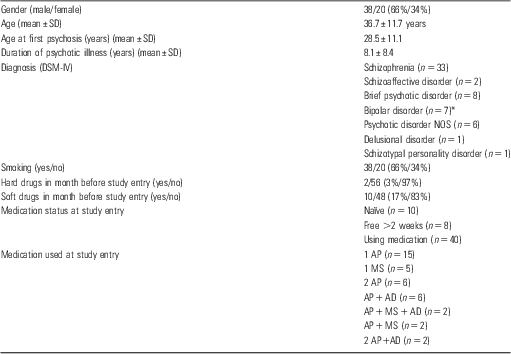
The main characteristics of the 58 patients that completed the study are outlined in Table 1. Mean duration of psychotic illness was 8.1 (±8.4) years. According to DSM-IV, 33 patients were classified as schizophrenia, whereas in the remaining 25 patients various diagnoses from the schizophrenia spectrum were made. Eighteen patients were free from psychotropics at least 2 weeks before study entry. Duration of treatment in the medicated patients varied from 2 weeks to >10 years.
Patient characteristics at baseline (n = 58)

AD, antidepressant (any); AP, antipsychotic agent (any); MS, mood stabilizer (any).
*Manic episode with psychotic features.
Clinical and biochemical treatment effects
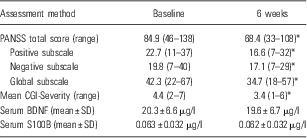
Clinical and biochemical parameters of the patients are outlined in Table 2. As reflected by the score on the CGI-S the study group was ‘moderately to markedly ill’ (score 4.4). Concerning treatment efficacy, a mean reduction of 20% (p < 0.001) on the PANSS total score was noted, corresponding with the generally used definition of ‘response’. Reductions on PANSS positive, negative and global scores were 24%, 14% and 18%, respectively (all p < 0.001). On the CGI-S, a mean reduction of 23% was noticed.
Clinical and biochemical parameters of the patients at baseline and after 6 weeks of treatment (n = 58)

BDNF, Brain-derived neurotrophic factor; CGI, Clinical Global Impression; PANSS, Positive and Negative Syndrome Scale.
*Difference significant versus baseline (all p < 0.001).
The mean serum levels of BDNF and S100B were significantly lower as compared with controls (BDNF: 20.3 ± 6.6 versus 24.4 ± 6.7 μg/l, p ≤ 0.001; S100B: 0.063 ± 0.032 versus 0.069 ± 0.029 μg/l, p < 0.05). With respect to BDNF, mean age of the patients was higher compared with control subjects (36.7 ± 11.7 and 27.5 ± 6.8 years, p < 0.001). However, this age difference did not result in differences in serum BDNF levels, as there was no correlation between age and BDNF levels in the study sample at both time points (the non-parametric Kendall's τ-test showed p-values of 0.143 and 0.323, respectively). Moreover, the laboratory involved found no correlation between age and BDNF levels in healthy subjects (n = 75, p = 0.908). Serum levels of BDNF and S100B did not change significantly during 6 weeks of treatment with antipsychotics.
Possible confounding factors
Since several factors could possibly influence serum levels of neurotrophic proteins, data were scrutinized for effects of smoking, body mass index, abuse of soft or hard drugs, medication status (naïve, free >2 weeks or medicated), antipsychotic class (first- or second-generation agent), co-medication (antidepressants or mood stabilizers), diagnostic category (schizophrenia or non-schizophrenic psychoses), gender and age.
Baseline BDNF levels were significantly lower in medication naïve patients as compared with medication-free and medicated patients (15.4 ± 6.6, 20.6 ± 5.6 and 21.5 ± 6.5 μg/l, respectively, p = 0.022). In addition, serum levels of S100B were positively correlated with age at both time points (Kendall's τ 0.197 and 0.212, respectively, p < 0.05). Moreover, patients who had used soft drugs before study entry (n = 10) had significantly lower levels of S100B after 6 weeks of treatment (0.067 ± 0.033 vs. 0.042 ± 0.015). Finally, neither of the other parameters, especially gender, diagnostic category and co-medication, were found to have any influence on serum levels of either neurotrophic protein. For all analyses of BDNF and S100B values, medication status, respectively, age and use of soft drugs, were used as covariates.
Sample division according to baseline biochemical parameters
No correlations were established between BDNF and S100B levels on one hand and PANSS scores on the other hand at both time points in the total patient sample (Kendall's τ, all p > 0.05). In order to detect possible differences in symptom profile or symptomatic improvement between patients with high and low levels of neurotrophic proteins, the sample was divided into three subgroups [lowest quarter (L-BDNF/S100B), highest quarter (H-BDNF/S100B), and middle group (M-BDNF/S100B)]. After analysis, all factors that might influence PANSS scores (see: possible confounding factors) appeared to be equally distributed between the BDNF and S100B subgroups demonstrating that they could not have influenced any of the outcome measures. At baseline, mean levels of BDNF and S100B varied significantly from each other. All differences remained significant during the study period [BDNF: 12.9 ± 2.3 (at baseline) and 12.8 ± 4.9 (after treatment) (L: n = 14), 19.4 ± 2.5 and 19.9 ± 4.6 (M: n = 30), 29.7 ± 4.1 and 25.5 ± 6.3 μg/L (H: n = 14); S100B: 0.034 ± 0.005 and 0.044 ± 0.011 (L: n = 14), 0.054 ± 0.009 and 0.058 ± 0.025 (M: n = 29), 0.107 ± 0.030 and 0.088 ± 0.041 μg/L (H: n = 15), all p ≤ 0.001].
As to BDNF levels, no differences concerning psychopathological profile, symptom severity and symptomatic improvement were found between the three subgroups.
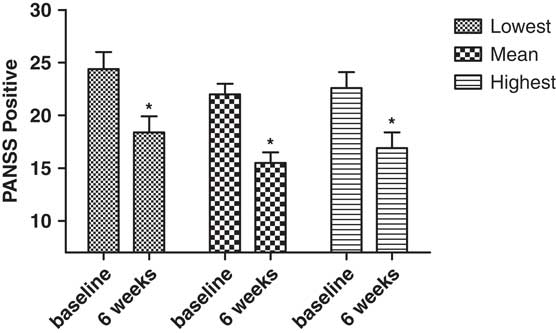
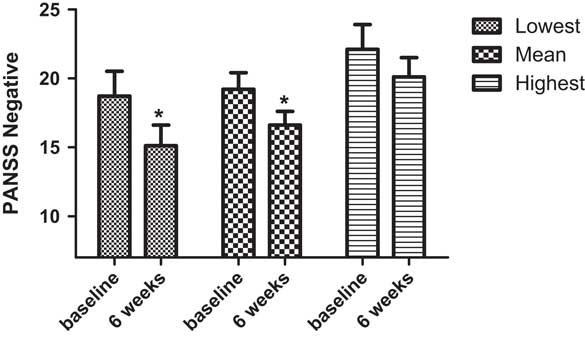
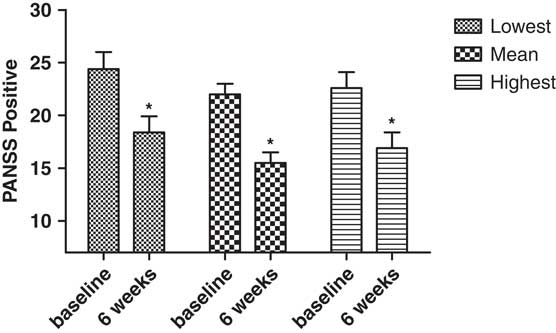
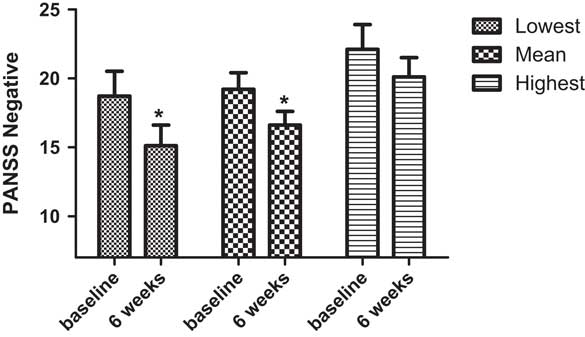
As compared with M-S100B, PANSS scores in H-S100B and L-S100B were significantly higher at baseline (p = 0.003; data not shown). After 6 weeks of treatment, L-, M- and H-S100B subgroups showed a significant decrease on the various PANSS scores, except for the score on the PANSS negative subscale in H-S100B (p = 0.347). Thus, negative symptoms did not improve in the subgroup with high baseline S100B levels. As can be seen in Figs. 1 and 2, in the L-S100B subgroup, the reduction in positive symptoms was less pronounced as compared with the H- and M-subgroups, reflected by a significantly higher mean PANSS positive score in the L-S100B subgroup after 6 weeks (between-group differences p = 0.001). In contrast, as could be expected, mean PANSS negative score after 6 weeks was significantly higher in the H-S100B subgroup (between-group differences p = 0.009).
PANSS positive scores at baseline and after 6 weeks of treatment of the low (n = 14), middle (n = 29) and high (n = 15) subgroups, according to their baseline serum levels of S100B. Between-group differences: univariate analysis of variance, corrected for age and soft drugs, baseline p = 0.003, 6 weeks p = 0.001. *Within-group differences: paired t-test, all p ≤ 0.001. PANSS, Positive and Negative Syndrome Scale.
PANSS negative scores at baseline and after 6 weeks of treatment of the low (n = 14), middle (n = 29) and high (n = 15) subgroups, according to their baseline serum levels of S100B. Between-group differences: univariate analysis of variance, corrected for age and soft drugs, baseline p = 0.011, 6 weeks p = 0.009. *Within-group differences: paired t-test, p ≤ 0.006 in L- and M-S100B, H-S100B p = 0.347. PANSS, Positive and Negative Syndrome Scale.
Discussion
In the present study, serum levels of the neurotrophic proteins BDNF and S100B were measured in a group of patients with psychotic disorders before and after 6 weeks of treatment with antipsychotics. It was found that levels of BDNF are lowered in patients with an acute psychotic episode irrespective of diagnostic category, psychopathological profile or treatment effectiveness. Furthermore, no effects were found for age or gender.
Interestingly, reduction of positive symptoms was less pronounced in patients with a relatively low S100B level, whereas virtually no effect of treatment on negative symptoms was found in patients with a relatively high S100B level. The observation of lower serum levels of BDNF is in agreement with the findings by several other investigators (Reference Pirildar, Gönül, Taneli and Akdeniz15,Reference Green, Matheson, Shepherd, Weickert and Carr17,Reference Jindal, Pillai, Mahadik, Eklund, Montrose and Keshavan20,Reference Toyooka, Asama and Watanabe21) and supports the hypothesis that psychotic disorders, of which schizophrenia is most widespread, may be considered as neurodevelopmental disorders indeed. Comparable observations have been made in patients with uni- and bipolar affective disorders (Reference Buckley, Pillai and Howell18,Reference Post34,Reference Schroeter and Steiner35). These observations indicate that BDNF may have pathophysiological implications across diagnostic boundaries. With respect to the effect of psychotropics on BDNF levels, equivocal results have been reported (Reference Pirildar, Gönül, Taneli and Akdeniz15,Reference Pedrini, Chendo and Grande22,Reference González-Pinto, Mosquera and Palomino36).
Nearly all literature mentions enhanced serum levels of S100B in schizophrenia (Reference Lara, Gama and Belmonte-de-Abreu25,Reference Rothermundt, Ahn and Jörgens27,Reference Qi, Xiu and Chen37). The present observation of subnormal S100B concentrations can therefore not easily be explained. This finding should be considered cautiously, especially as the difference between patients and controls was present at baseline only and the size of the study sample was modest. However, as S100B has neurotoxic as well as neurotrophic effects, it could be that this lower S100B level at baseline reflects deficiencies in neuroprotective mechanisms.
Comparable considerations have to be taken into account for the observation that, in this study, more severe positive psychotic symptoms are associated with lower S100B levels. It could be speculated that subnormal levels of this neurotrophic protein might initially induce positive symptoms while during the course of disease S100B levels might raise, resulting in the development of negative symptoms due to a neurotoxic effect of the higher S100B levels in the brain.
The present observation that severity of negative psychotic symptoms is associated with higher S100B levels is in agreement with other reports (Reference Rothermundt, Ponath, Glaser, Hetzel and Arolt26,Reference Ling, Tang and Jiang28,Reference Sarandol, Kirli, Akkaya, Altin, Demirci and Sarandol29) and is suggestive for either a neurotoxic effect or a compensatory mechanism for damage already done. It should be stressed, however, that the H-S100B subgroup consisted of 15 patients only.
Although all potentially confounding factors have been included in the analyses (Reference Steiner, Bogerts, Schroeter and Bernstein14), interpretation of the here presented data has still to be done carefully as the study comprised a relatively small sample size with many differences between individual patients. The sample size, however, can be considered moderate when compared with other studies on BDNF or S100B, with study numbers varying between 18 and 88 patients with respect to BDNF (Reference Twiss, Chang and Schanen16,Reference Chen, Wang and Wang19) and 12 and 98 patients with respect to S100B (Reference Steiner, Bogerts, Schroeter and Bernstein14,Reference Rothermundt, Ponath, Glaser, Hetzel and Arolt26).
Given the diagnostic uncertainties in psychiatry in general (Reference Nasrallah, Tandon and Keshavan38,Reference Bromet, Kotov and Fochtmann39), instead of focusing on a particular category of psychoses (e.g. DSM-IV schizophrenia), the here chosen approach of including psychotic disorders irrespective of their classification may disclose a psychopathological phenotype that is associated with the functional status of one of the investigated neurotrophic proteins. This, in turn, may have consequences for either treatment or course of disease. It is therefore suggested that studies on pathophysiological determinants, for example, neurotrophic proteins, of major psychiatric diseases like psychoses and affective disorders, should preferably follow a so-called dimensional approach searching for endophenotypes (Reference Verhoeven, Tuinier and Van der Burgt40–Reference Linscott and Van Os42).
In conclusion, this study, for the first time, demonstrates that patients with a relatively low serum level of S100B show less reduction in severity of positive psychotic symptoms after treatment with antipsychotics, whereas those with a relatively high S100B level hardly show any improvement of negative symptoms. Further studies are warranted to elucidate the pathophysiological significance and potential clinical implications of these observations.
Acknowledgements
The authors indebted to A.E.S. Sijben, MSc, PhD from ABC/Opes for statistical analyses and to Mrs A. Voskuilen-Kooijman from the Neuropsychiatric Laboratory of the Erasmus Medical Centre for biochemical analyses.
Authors’ Contributions
W. Verhoeven designed the study and wrote the protocol. N. van de Kerkhof performed all clinical assessments. D. Fekkes was responsible for biochemical analyses. F. van der Heijden contributed to subsequent versions of the paper. All authors contributed to the clinical study and approved of the final version of the manuscript.
Financial Support
None.
Statement of Interest
None.
Ethical Standards
The authors assert that all procedures contributing to this work comply with the ethical standards of the relevant national and institutional committees on human experimentation and with the Helsinki Declaration of 1975, as revised in 2008.