Petroleum refining industries are a source of toxic chemicals including benzene, toluene, nitric oxides, and carbon monoxide. Being a volatile organic compound, benzene is a heavily used industrial chemical, a petroleum by-product, and an additive in unleaded gas. It is a ubiquitous environmental pollutant that exerts significant deleterious health effects.Reference Rothman, Smith and Hayes 1 - Reference Snyder and Hedli 4 Human exposure to benzene increases the risk of developing carcinogenesis, specifically, leukemia, lymphoma, aplastic anemia, pancytopenia, and chromosomal aberrations.Reference Smith 3 , Reference Khalade, Jaakkola and Pukkala 5 - Reference Marchetti, Eskenazi and Weldon 8 In addition, several adverse respiratory effects including pulmonary edema, acute granular tracheitis, laryngitis, bronchitis, and massive hemorrhaging are associated with benzene exposure.Reference Avis and Hutton 9 , Reference Winek and Collom 10 Moreover, exposure to benzene can cause a wide range of adverse effects on central nervous system, hematologic, hepatic, and renal functions.Reference Dundarz, Turkbay and Akay 11 - Reference Mandiracioglu, Akgur and Kocabiyik 15 Previous research has demonstrated that communities living near petroleum refineries have health risks from increased exposure to benzene and other toxic chemicals. 16
The precise mechanism of benzene-induced toxicity is poorly understood. Studies on benzene metabolism, pharmacokinetics, hemotoxicity, cytotoxicity, genotoxicity, and carcinogenicity are starting to converge on a small set of overlapping hypotheses about the most probable biological mechanisms of benzene toxicity and carcinogenicity.Reference Whysner, Vijayaraj Reddy and Ross 17 , Reference Goldstein 18 Multiple possible mechanisms of action are involved in benzene toxicity. The production of free radicals leading to oxidative stress, immune system dysfunction, and decreased immune surveillance are possible mechanisms of benzene-induced toxicity.Reference Smith 3 The toxic effects of benzene are thought to arise from its metabolism, which leads to numerous metabolites including phenol, benzoquinone, muconaldehydes, hydroquinone, and catechol.Reference Kim, Vermeulen and Waidyanatha 19 Of these metabolites, benzoquinone and muconaldehydes are regarded as the most toxic chemicals with significant health effects.
In Texas City, Texas, a 2010 flaring disaster at the BP refinery facility lasted 40 days and led to the release of over 500,00 pounds of toxic chemicals, including over 17,000 pounds of benzene into the skies. 20 - Reference Evans 22 Consequently, the air in nearby communities was contaminated with the toxic emission, which threatened the health of over 50,000 local residents living in Texas City, according to the Galveston County District Clerk’s Office. Initial studies on the potential health effects of ambient benzene exposure resulting from the BP flaring disaster revealed that benzene exposure significantly altered hematologic and hepatic functions in exposed subjects compared with unexposed subjects.Reference D’Andrea and Reddy 23 - Reference D’Andrea, Singh and Reddy 26 Specifically, our earlier studies with pediatric subjects demonstrated that children exposed to benzene from the BP flaring event experienced significantly altered hematologic and liver functions.Reference D’Andrea and Reddy 23 , Reference D’Andrea and Reddy 25 Similarly, a pilot study revealed that benzene exposure significantly altered hematologic and hepatic functions in adults.Reference D’Andrea, Singh and Reddy 26 To further substantiate the findings of these studies, we conducted a large study to assess the health consequences of benzene exposure in adults exposed to benzene from the BP refinery plant in Texas City, Texas. Clinical outcomes of exposed adults were compared with measurements in a group of unexposed adults.
Methods
Subjects
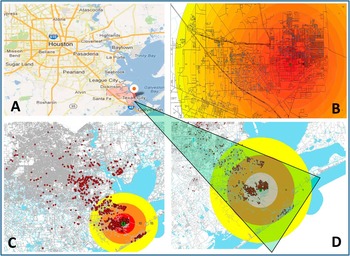
This retrospective study was approved by an Institutional Review Board. The methodology for subject selection and medical evaluation was reported previously.Reference D’Andrea and Reddy 23 - Reference D’Andrea, Singh and Reddy 26 In short, we reviewed the medical charts of adults who underwent clinical (including laboratory) evaluations between June 2010 and October 2012. As shown in Figure 1, residential areas affected by the BP refinery emission were identified and the residents exposed to the emission were selected for the study. The subjects self-reported exposure to benzene following the flaring disaster from April 6, 2010, through May 16, 2010. Unexposed subjects were drawn from primary care clinics located approximately 30 to 50 miles away from the BP refinery plant.Reference D’Andrea and Reddy 23 - Reference D’Andrea, Singh and Reddy 26 Unexposed subjects were individuals who visited the clinic for a routine wellness checkup. They were selected randomly by the primary care physician. Demographic and clinical laboratory data were collected retrospectively from medical charts.
Map Showing the Location of the BP Refinery Facility in Texas City, Texas. A. Location of Texas City, Texas. B. Depicted intensity of benzene exposure from the BP incident in the surrounding neighborhoods of Texas City. The red, orange, and yellow colors depict the higher (red) to reduced (orange) to low (yellow) intensity of benzene exposure. C. Scattered dots represent the location/address of the study participants who were exposed to benzene following a flaring incident at the BP refinery and surrounding areas. D. A closer look at the area affected by the benzene exposure and the address of the study participants (scattered dots). (Color image available online.)

The study was conducted according to the ethical principles of the Declaration of Helsinki. To comply with the Health Insurance Portability and Accountability Act (HIPAA), confidentiality of the participants’ information was secured by utilizing text encryption, password protection, and limited personnel involvement.
Chart Review and Data Gathering
Study investigators reviewed the medical charts of the benzene-exposed and unexposed subjects. Clinical data including white blood cell (WBC) counts, platelet counts, and hemoglobin, hematocrit, blood urea nitrogen (BUN), creatinine, alkaline phosphatase (ALP), aspartate amino transferase (AST), and alanine amino transferase (ALT) levels were evaluated and compared between the exposed and unexposed groups. All laboratory tests were performed by an accredited laboratory facility (LabCorp, Laboratory Corporation of America, Houston, TX).
Statistical Analysis
We used descriptive statistics to assess data variables, producing means and standard deviations from WBC, platelets, hemoglobin, hematocrit, creatinine, BUN, ALP, AST, and ALT. To determine statistically significant differences between the benzene-exposed and unexposed groups, student’s t-tests were used. The significance level was predetermined at an alpha level of 0.05.
Results
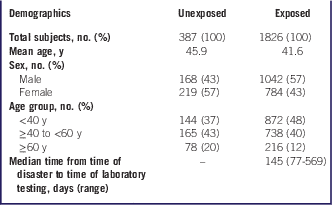
A total of 2213 adults were included in this study. Of the 2213 subjects, 387 were unexposed and 1826 were exposed to benzene. Demographic data are presented in Table 1. The mean age of the unexposed and benzene-exposed subjects was 45.9 and 41.6 years, respectively. Among unexposed subjects (n=387), there were 43% male (n=168) and 57% female (n=219) subjects. In the benzene-exposed group (n=1826), there were 57% male (n=1042) and 43% female (n=784) subjects. The median time from the time of the disaster to the time of laboratory testing was 145 days (range, 77-569 days).
Demographics of the Study Subjects Unexposed or Exposed to Benzene

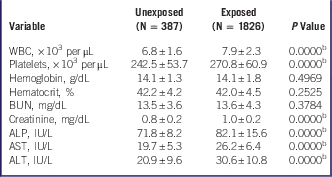
The hematologic and hepatic profiles of the unexposed and exposed groups are presented in Table 2. Benzene-exposed subjects had a significantly higher mean WBC count than in unexposed subjects (7.9±2.3 versus 6.8±1.6×10³ per µL, P=0.000). Similarly, the mean platelet count in the benzene-exposed group was significantly higher than in the unexposed group (270.8±60.9 versus 242.5±53.7×10³ per µL, P=0.000). The mean serum creatinine levels were also significantly higher in the benzene-exposed group than in the unexposed group (1.0±0.2 versus 0.8±0.2 mg/dL, P=0.000). No significant differences were observed in the mean hemoglobin (g/dL), hematocrit, or BUN levels between the 2 groups.
Comparison of Hematologic and Hepatic Indexes Between Subjects Unexposed or Exposed to BenzeneFootnote a

a Abbreviations: ALP, alkaline phosphatase; ALT, alanine amino transferase; AST, aspartate amino transferase; BUN, blood urea nitrogen; WBC, white blood cells.
b P=0.001.
The mean serum ALP levels were higher in subjects exposed to benzene than in unexposed subjects (82.1±15.6 versus 71.8±8.2 IU/L, P=0.000). Mean serum AST levels were significantly higher in the benzene-exposed subjects than in the unexposed subjects (26.2±6.4 versus 19.7±5.3 IU/L, P=0.000). The mean serum ALT levels were also significantly higher in the benzene-exposed group than in the unexposed group (30.6±10.8 versus 20.9±9.6 IU/L, P=0.0000).
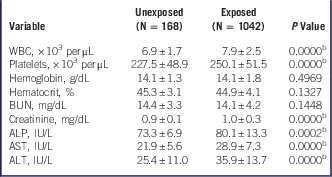
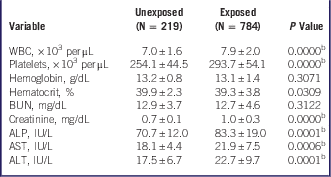
Tables 3 and 4 present the differences in hematologic and hepatic markers between the benzene-exposed and unexposed subjects by sex. The mean WBC count was significantly higher in both male (7.9±2.5 versus 6.9±1.7×10³ per µL, P=0.000) and female (7.9±2.0 versus 7.0±1.6×10³, P=0.000) subjects exposed to benzene than in the respective unexposed subjects. Similarly, the mean platelet count in male (250.1±51.5 versus 227.5±48.9×10³ per µL, P=0.000) and female (293.7±54.1 versus 254.1±44.5×10³ per µL, P=0.000) subjects exposed to benzene was significantly higher than in the unexposed subjects. The mean hemoglobin (g/dL), hematocrit (%), and BUN (mg/d) levels did not differ significantly in the male or female subjects between the benzene-exposed and unexposed groups.
Comparison of Hematologic and Hepatic Indexes Between Male Subjects Unexposed or Exposed to BenzeneFootnote a

a Abbreviations: ALP, alkaline phosphatase; ALT, alanine amino transferase; AST, aspartate amino transferase; BUN, blood urea nitrogen; WBC, white blood cells.
b P=0.001.
Comparison of Hematologic and Hepatic Indexes Between Female Subjects Unexposed and Exposed to BenzeneFootnote a

a Abbreviations: ALP, alkaline phosphatase; ALT, alanine amino transferase; AST, aspartate amino transferase; BUN, blood urea nitrogen; WBC, white blood cells.
b P=0.001.
The mean serum ALP levels were significantly higher in male (80.1±13.3 versus 73.3±6.9 IU/L, P=0.0002) and female (83.3±19.0.1 versus 70.7±12.0 IU/L, P=0.0001) subjects in the benzene-exposed group than in the unexposed group. Similarly, the mean serum AST levels were significantly higher in male (28.9±7.3 versus 21.9±5.6 IU/L, P=0.0006) and female (21.9±7.5 versus 18.1±4.4 IU/L, P=0.0001) subjects in the benzene-exposed group than in the unexposed group. The mean serum levels of ALT were also higher in male (35.9±13.7 versus 25.4±11.0 IU/L, P=0.000) and female (22.7±9.7 versus 21.9±5.6 IU/L, P=0.0001) subjects in the benzene-exposed group than in the unexposed group.
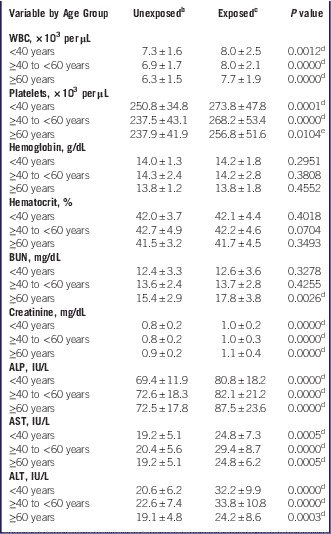
To determine if the subjects’ age had any impact on the health effects of benzene exposure, we grouped adult subjects into age groups of <40 years (unexposed, n=144; exposed, n=872), ≥40 to <60 years (unexposed, n=165; exposed, n=738), and ≥60 years (unexposed, n=78; exposed, n=216) and compared the clinical outcomes between the unexposed and benzene-exposed groups. The results in Table 5 show the differences in hematologic and hepatic markers between exposed and unexposed subjects among the 3 age groups. Although the mean WBC count decreased with increasing age in the unexposed group, it remained stable in the benzene-exposed groups. However, irrespective of age, the mean WBC count had significantly increased in all benzene-exposed age groups compared with their matched unexposed age groups. A decreasing trend in the mean platelet count was seen with increasing age in both the unexposed and benzene-exposed groups. Subjects in the <40 years age group had a higher platelet count than did those in the ≥40 to <60 years or ≥60 years age groups. The benzene-exposed group also had a significantly increased mean platelet count compared with the unexposed group irrespective of their age.
Comparison of Hematologic and Hepatic Indexes by Age Group Between Subjects Unexposed and Exposed to BenzeneFootnote a

a Abbreviations: ALP, alkaline phosphatase; ALT, alanine amino transferase; AST, aspartate amino transferase; BUN, blood urea nitrogen; WBC, white blood cells.
b Unexposed <40 years: n=144; unexposed ≥40 to <60 years: n=165; unexposed ≥60 years: n =78.
c Exposed <40 years: n=872; exposed ≥40 to <60 years: n=738; exposed ≥60 years: n =216.
d P=0.05.
e P=0.001.
No significant differences were found in the mean hemoglobin, hematocrit, and BUN levels between the unexposed and benzene-exposed subjects in any of the 3 age groups, except for significant increases in the mean BUN levels in subjects aged ≥60 years in the benzene-exposed group compared with the unexposed group. Serum creatinine levels were significantly higher in the benzene-exposed subjects than in unexposed subjects, irrespective of age. Similarly, the serum levels of hepatic enzymes (ALP, AST, and ALT) were significantly higher in benzene-exposed subjects than in unexposed subjects, irrespective of age (Table 5).
Discussion
Human exposure to benzene is associated with serious adverse health effects resulting in chronic organ toxicity with an increased risk of carcinogenesis.Reference Khalade, Jaakkola and Pukkala 5 , Reference Vlaanderen, Lan and Kromhout 27 - Reference Nishikawa, Izumo and Miyahara 29 The detrimental effect of benzene exposure on human health has become a major public concern around the world. Therefore, a thorough understanding of the health consequences of benzene exposure is important for developing approaches to assess the risk in affected communities. The analyses in this study sought to further characterize the changes in hematologic and hepatic functions associated with benzene exposure from the prolonged toxic release of the BP flaring disaster in adults, building on earlier study findings.Reference D’Andrea, Singh and Reddy 26 This study, to the best of our knowledge, is the first and largest of its kind to assess hematologic and hepatic functions in adult subjects exposed to benzene and to compare them with corresponding measurements in unexposed subjects. Furthermore, we were unable to identify any other human population studies evaluating the toxic effects of a prolonged (40 days) exposure to a large amount (more than 500,000 pounds) of toxic chemicals, including more than 17,000 pounds of benzene.
Our findings indicate that adult benzene-exposed subjects had significant alterations in their hematologic and hepatic functions, including increased mean WBC and platelet counts. These results are consistent with findings from our pilot studyReference D’Andrea, Singh and Reddy 26 and previously published reports by other investigators on hematologic changes in subjects exposed to benzene.Reference Liu, Tsai and Kuo 30 , Reference Ray, Roychoudhury and Mukherjee 31 In an earlier study, Liu et alReference Liu, Tsai and Kuo 30 reported that WBC, lymphocyte, monocyte, and eosinophil counts were significantly higher in benzene-exposed subjects than in unexposed subjects. Similarly, Ray et alReference Ray, Roychoudhury and Mukherjee 31 reported significantly increased WBC counts in subjects exposed to benzene compared with control subjects. In contrast, other studies found significant decreases in WBC and platelet counts in benzene-exposed subjects compared with unexposed subjects.Reference Rothman, Smith and Hayes 1 , Reference McHale, Zhang and Lan 32 , Reference Avogbe, Ayi-Fanou and Cachon 33 It should be noted that the subjects in our study were exposed to a toxic release that contained not only large amounts of benzene but also other toxic chemicals that may have contributed to the differences in the hematologic indexes observed. Furthermore, Ceresa et alReference Ceresa, Grazioli and Monteverde 34 reported that a reduction in the platelet count was not a consistent finding in the majority of cases resulting from chronic benzene exposure.Reference Aksoy, Dincol and Akgun 35
Hemoglobin, hematocrit, and BUN levels were similar among the benzene-exposed and unexposed subjects. However, serum creatinine levels were significantly increased in the benzene-exposed group. It is well established that serum creatinine levels are an important index for kidney function. Thus, these findings suggest that individuals exposed to benzene may be at risk of impaired renal function in the future. These findings are consistent with previously published studies demonstrating significantly elevated serum creatinine levels in subjects exposed to benzene or petroleum products.Reference Al-Helaly and Ahmed 36
Benzene and other chemicals present in petroleum refining have been shown to impact liver function. Serum levels of ALP, AST, and ALT are markers for hepatic functionReference Innerfield 37 and are reportedly affected by exposure to benzene and other petroleum products. In this study, serum levels of ALP, AST, and ALT were elevated among benzene-exposed subjects compared with unexposed subjects. These results support the findings of our pilot study.Reference D’Andrea, Singh and Reddy 26 Moreover, our results agree in part with those in other published studies documenting increased liver enzymes in subjects exposed to benzene, petroleum products, and organic solvents.Reference Chang, Joe and Park 38 - Reference Fernández-D’Pool and Oroño-Osorio 42 Thus, our results further support previous findings that subjects exposed to benzene may be at higher risk of hepatic tissue toxicity. One possible explanation for the increased serum levels of these enzymes could be the overproduction or release of enzymes from the liver cells in response to stimuli of hepatocellular injury or cell death.
A subgroup analysis was performed to further understand the influence of variables on benzene-exposure-related changes in adult subjects. Specifically, we compared the outcomes by sex as well as by age groups (<40 years, 40-60 years, and >60 years) between the exposed and unexposed subjects. The results indicated that both hematologic and hepatic functions were significantly affected in the benzene-exposure group compared with the unexposed group irrespective of sex or age.
Limitations
There are several limitations to interpreting the findings of this study. Foremost, this study was conducted by use of a cross-sectional design. Therefore, it is difficult to infer causality with the use of such a study design because the clinical outcomes were measured at one time point after exposure to benzene. Thus, causality can only be an assumption. Hence, further verification of these and other study findings is needed through additional prospective randomized studies. However, planning randomized studies to evaluate the health effects of benzene and other toxic release from a disaster may not be practical. Because this study was not a prospective controlled trial, the outcomes observed could be influenced by compounding factors that are inherent to the study design. These included lack of baseline data prior to benzene exposure (however, it may not be possible to assess this for such a disaster), the cross-sectional study design, and the retrospective nature of this study. In addition, the methods used in this study did not follow a predefined scheme of the protocol, which may have biased the interpretation of the findings; specifically, the variables included in this study could not be analyzed in a controlled way. Future studies should follow benzene-exposed subjects prospectively to detect potential long-term risks for carcinogenesis and other toxic effects.
The results of the present study suggest that benzene exposure may lead to detrimental health effects including impairment of hematologic, hepatic, renal, and other organ functions. In addition, significant scientific evidence links benzene exposure with an increased risk of carcinogenesis.Reference Smith 3 , Reference Khalade, Jaakkola and Pukkala 5 - Reference Marchetti, Eskenazi and Weldon 8 However, the latency period of cancer resulting from the benzene exposure makes it difficult to study. Nonetheless, it is crucial that the exposed subjects be monitored over time with periodic health checkups and routine laboratory blood work to further detect any long-term risk for carcinogenesis and other toxic effects of the benzene.
Conclusion
The results of this retrospective study indicate that individuals exposed to the benzene released from the prolonged BP flaring disaster have an increased risk of developing both hematologic and hepatic abnormalities. The hematologic alterations include higher WBC, platelet counts, and creatinine in the benzene-exposed subjects than in the unexposed subjects. Increased levels of ALP, AST, and ALT in serum indicate hepatic injury in those exposed to benzene. Additional studies are underway to further explore the health consequences in residents exposed to benzene in Texas City, Texas.