Employee performance has been one of the most important areas of interest by researchers in organizational behavior. This interest has not only been focused on task or in-role performance (Williams & Anderson, Reference Williams and Anderson1991; Borman & Motowidlo, Reference Borman and Motowidlo1993), but also on extra-role performance. The latter is conceptualized mostly in the form of organizational citizenship behaviors (OCBs) and has been receiving increasing attention in the literature. Organ (Reference Organ1988) defined OCB as ‘behavior(s) of a discretionary nature that are not part of the employee's formal role requirements, but nevertheless promote the effective functioning of the organization’ (p. 4). Scholars have used different labels for OCB-type behaviors. These include prosocial organizational behavior (Brief & Motowidlo, Reference Brief and Motowidlo1986; O'Reilly & Chatman, Reference O'Reilly and Chatman1986; George, Reference George1990, Reference George1991; George & Bettenhausen, Reference George and Bettenhausen1990), extra-role behavior (Van Dyne, Cummings, & McLean Parks, Reference Van Dyne, Cummings and McLean Parks1995), organizational spontaneity (George & Brief, Reference George and Brief1992; George & Jones, Reference George and Jones1997) and contextual performance (Borman & Motowidlo, Reference Borman and Motowidlo1993, Reference Borman and Motowidlo1997; Motowidlo & Van Scotter, Reference Motowidlo and Van Scotter1994; Van Scotter & Motowidlo, Reference Van Scotter and Motowidlo1996). The literature on OCB has continued to evolve as the researchers have attempted to better understand the concept as well as its determinants and outcomes (e.g., Podsakoff, Whiting, Podsakoff, & Blume, Reference Podsakoff, Whiting, Podsakoff and Blume2009; Lavelle, Reference Lavelle2010; Jiang & Law, Reference Jiang and Law2012; Spector, 2013).
Earlier studies directly linked such discretionary and cooperative behaviors with individual or unit performance (Podsakoff & MacKenzie, Reference Podsakoff and MacKenzie1994, Reference Podsakoff and MacKenzie1997), as well as to effective and efficient functioning of the organizations (e.g., Organ, Reference Organ1997). Organizations function more effectively and overall performance is likely to get better when employees perform extra-role behaviors that help coworkers, supervisors, and the organization to achieve results along with their expected in-role behaviors (e.g., Karambayya, Reference Karambayya1989; George & Bettenhausen, Reference George and Bettenhausen1990; Borman & Motowidlo, Reference Borman and Motowidlo1993; Podsakoff & MacKenzie, Reference Podsakoff and MacKenzie1997). Moreover, employees might benefit from such behaviors through rewards from the organizations, improved peer evaluations and improved quality of work life. This is despite the evidence that OCB can result in some negative and undesirable consequences for individuals such as role overload, stress and work-family difficulties (e.g., Bolino & Turner, Reference Bolino and Turner2005; Somech & Drach-Zahavy, Reference Somech and Drach-Zahavy2013).
In today's global business environment increasingly characterized by flatter organizational structures, increased autonomy and responsibility of employees and teams as well as highly competitive markets (Blyton & Dastmalchian, Reference Blyton and Dastmalchian2006); differential effects of discretionary behavior contributions of employees to organizational effectiveness become even more visible. In line with this and in order to explain the difference among people in engaging in such voluntary extra-role behaviors, researchers have studied the antecedents of OCB for almost three decades (see Podsakoff, MacKenzie, Paine, & Bachrach, Reference Podsakoff, MacKenzie, Paine and Bachrach2000 for a review). Podsakoff et al. (Reference Podsakoff, MacKenzie, Paine and Bachrach2000) have identified four major categories of OCB predictors, (a) individual/employee characteristics, (b) task characteristics, (c) organizational characteristics, and (d) leadership behaviors. For individual/employee antecedents of OCB, research has mostly focused on contextual and positive employee attitudes such as organizational commitment and job satisfaction (Bateman & Organ, Reference Bateman and Organ1983; Lee & Allen, Reference Lee and Allen2002). In addition, the dispositional characteristics of individuals such as affect (George, Reference George1990; Zeinabadi, Reference Zeinabadi2010) and personality (Konovsky & Organ, Reference Konovsky and Organ1993) have been examined in the literature as playing an important role in promoting OCB.
Within the OCB literature, consensus has not been reached on the relative contributions of contextual and personality related or dispositional antecedents in promoting such constructive behaviors. To investigate the effects of dispositional characteristics, some earlier studies (e.g., Organ & Lingl, Reference Organ and Lingl1995; Konovsky & Organ, Reference Konovsky and Organ1996) focused on one or more of the personality characteristics in relation to the ‘Big Five’ personality dimensions of agreeableness, consciousness, extraversion, openness to experience and emotional stability (McCrae & Costa, Reference McCrae and Costa1987). These studies found only partial support for the trait conscientiousness to predict OCB. On the other hand, results of a laboratory experiment by Comeau and Griffith (Reference Comeau and Griffith2005) suggested a different personality dimension, agreeableness, as a predictor of OCB. As an alternative to the ‘Big Five’ framework, dispositional affect has also yielded ambiguous findings in its relation to OCB. While positive affect (PA) did not appear as a predictor of OCB in Organ and Konovsky's (Reference Organ and Konovsky1989) research, it came out as playing a role in providing emotional help to others in the workplace in another study conducted in a recruitment firm (Toegel, Anand, & Kilduff, Reference Toegel, Anand and Kilduff2007). Such studies were conducted mostly in Western cultures, though there has been growing interest on the antecedents of OCB from the rest of the world. Due to such ambiguous results in previous research, there is still a need for investigating the contribution of personality aspects in better understanding OCB in the literature.
In addition to dispositions, organizational commitment, as an individual level contextual antecedent, has received a great deal of attention from researchers in explaining OCB. With the recent global trends in societies where workforce is increasingly becoming more educated, flexible and boundaryless (Dastmalchian & Blyton, Reference Dastmalchian and Blyton1998, Reference Dastmalchian and Blyton2001; Blyton & Dastmalchian, Reference Blyton and Dastmalchian2006), the focus on organizational commitment as the driving force of an employee to stay in a job has shifted to alternative commitment foci such as occupation or work group commitments (Cohen, Reference Cohen2003; Liu & Cohen, Reference Liu and Cohen2010). This is particularly the case in today's tough economic times with job-reduction strategies for employers, where organizations are less likely to be willing to hire long-term employees, which has led to the assertion that employees are becoming less likely to commit to the organization – and perhaps more likely to commit to their occupation or their work group (Cohen, Reference Cohen2003). A few studies have been conducted based on such viewpoint, investigating the effects of multiple commitments on work outcomes including performance, withdrawal, absenteeism and turnover (Blau, Reference Blau1986; Randall & Cote, Reference Randall and Cote1991; Cohen, Reference Cohen1993, Reference Cohen1999, Reference Cohen2003; Liu & Cohen, Reference Liu and Cohen2010). The results of these studies suggest further investigation for a clarification of outcomes related with different commitment foci. For a better understanding of the influence of multiple commitments on OCB, further research is needed to provide more conclusive evidence for both scholars and practitioners.
Despite the growing amount of research on OCB antecedents, there has been limited research on the relative effects of dispositions and contextual facets of the concept for professional employees. A key aim of the current study is to investigate the relative roles of dispositional affect and multiple commitments in explaining OCBs among professionals. Specifically, our purpose is to examine the contributions of affect on OCBs and to better understand the contributions of multiple commitments in explaining such cooperative behaviors for professionals. We will explore that OCBs, while evidently influenced by affect and personality as well as attitudinal factors, would nevertheless be impacted by the managerial recruitment and selection processes. It follows that organizational decision makers have the ability to exercise discretion in designing the jobs and the organizational attributes in order for the work environment to be more favorable for employees.
As mentioned above, OCB is a complex concept whereby it is influenced by many variables at the individual, task, organizational and leadership levels. Research reported in the extant literature is conducted using samples derived from various occupational groups, reporting, by and large, quite distinct findings. There is evidence in the literature suggesting differences in occupations in terms of their work behaviors due to a host of reasons including gender or gender-dominance of professions (e.g., Drogosz & Levy, 1996; Kidder, 2002), the need for interaction and interpersonal relations (e.g., Nikolaou, 2003), or the history and culture of specific professional or occupational groups (Bacon, Blyton, & Dastmalchian, Reference Bacon, Blyton and Dastmalchian2010). Consistent with this, we believe different occupational groups and communities demonstrate different patterns of behaviors and that in studying the effects of organizational actions on employee attitudes and behaviors ‘occupational difference as a potentially important factor is generally overlooked’ (Bacon, Blyton, & Dastmalchian, Reference Bacon, Blyton and Dastmalchian2010: 1225). Similarly, the role of occupation on OCB has been under-explored in the fields of human resources and organizational behavior, as has been identified more broadly by organizational scholars (e.g., Barley, Reference Barley1996; Lawrence, Reference Lawrence1998). Since different occupations require different education or training, selection and socialization processes, occupation by itself has a potential to have an influence in explaining OCBs. Earlier studies of OCB have not included occupation as an independent variable in their models. Therefore, an additional aim of this study is to contribute to OCB literature by examining the relationship between occupation and OCBs.
THEORETICAL FRAMEWORK AND HYPOTHESES
OCBs
The structure and dimensions of the OCB construct have been a major concern for researchers since the introduction of the construct in the early 1980s in organizational behavior literature. OCBs cover a wide spectrum of work-related constructive behaviors. Different dimensions, mostly overlapping with each other were offered during the discourse of the construct. Organ, a leading researcher on OCB, came up with a classification of it to include dimensions of altruism, courtesy, cheerleading, peacekeeping, conscientiousness, sportsmanship, and civic virtue (Organ, Reference Organ1988; Reference Organ1990a; Reference Organ1990b). Empirical research (e.g., MacKenzie, Podsakoff, & Fetter, Reference MacKenzie, Podsakoff and Fetter1991; Podsakoff & MacKenzie, Reference Podsakoff and MacKenzie1994) has shown that managers often had difficulty in recognizing some of these fine distinctions and tend to think of altruism, courtesy, cheerleading, and peacekeeping in a single helping behavior dimension. Conceptually, helping behavior is a second-order latent construct, consisting of Organ's (Reference Organ1988, Reference Organ1990a, Reference Organ1990b) altruism, courtesy, peacekeeping, and some aspects of his cheerleading dimensions (Podsakoff, Ahearne, & MacKenzie, Reference Podsakoff, Ahearne and MacKenzie1997). Helping behavior has been identified as an important form of citizenship behavior by almost every researcher interested in the construct (Smith, Organ, & Near, Reference Smith, Organ and Near1983; Organ, Reference Organ1988, Reference Organ1990a, Reference Organ1990b; Graham, Reference Graham1989; Williams & Anderson, Reference Williams and Anderson1991; George & Brief, Reference George and Brief1992; Borman & Motowidlo, Reference Borman and Motowidlo1993, Reference Borman and Motowidlo1997; Van Scotter & Motowidlo, Reference Van Scotter and Motowidlo1996; George & Jones, Reference George and Jones1997).
As a dimension of OCB, helping behavior involves voluntarily helping others with, or preventing the occurrence of work-related problems. Organ (Reference Organ1990b) has defined sportsmanship as ‘a willingness to tolerate the inevitable inconveniences and impositions of work without complaining’ (p. 96). This includes Organ's (Reference Organ1988) original sportsmanship dimension together with some part of conscientiousness aspect. Focusing on the remaining part of Organ's (Reference Organ1988) original conscientiousness dimension, one arrives at the OCB dimension of civic virtue. Civic virtue is the behavior indicating that an employee responsibly participates in, and is concerned about the life of the organization. This dimension stands for a macro-level interest in the organization as a whole. Such behavior is shown by a willingness to participate actively in the organization's governance (e.g., attend meetings, engage in policy debates, express one's opinion about what strategy the organization ought to follow, etc.), to monitor its environment for threats and opportunities (e.g., keep up with changes in the industry that might affect the organization), and to look out for its best interests (e.g., reporting fire hazards or suspicious activities, locking doors, etc.) even at a personal cost.
Research has suggested that helping, civic virtue and sportsmanship behaviors have the potential of improving organizational and work unit performance. Such improvements in performance are through: (a) reducing the need to allocate scarce resources to purely maintenance functions (Organ, Reference Organ1988); (b) liberating these resources for more productive purposes (Organ, Reference Organ1988; Borman & Motowidlo, Reference Borman and Motowidlo1993); (c) increasing coworker or managerial productivity (Organ, Reference Organ1988; MacKenzie, Podsakoff, & Fetter, Reference MacKenzie, Podsakoff and Fetter1991, Reference MacKenzie, Podsakoff and Fetter1993; Podsakoff & MacKenzie, Reference Podsakoff and MacKenzie1994); (d) serving as a means for coordinating activities between team members and work groups (Karambayya, Reference Karambayya1989); and (e) help the organization in improving its ability to attract and retain the best-fit people by making it a desirable place to work for (Organ, Reference Organ1988; George & Bettenhausen, Reference George and Bettenhausen1990). In other words, citizenship behaviors are suggested to increase organizational and work unit performance since they lubricate the social machinery of the organization, reduce friction and increase efficiency (Smith, Organ, & Near, Reference Smith, Organ and Near1983; Borman & Motowidlo, Reference Borman and Motowidlo1993).
Dispositional affect
Affect has been examined in the literature in two different forms: dispositional and situational. Situational affect (affect as a state) is evaluated with emotions and mood for a rather short and specified period of time, while dispositional affect (affect as a trait) reflects more long-term and durable feelings, as part of one's personality in general (Watson, Clark, & Tellegen, Reference Watson, Clark and Tellegen1988). Although states may sometimes seem more appropriate to predict situation-related attitudes or behavior, traits are accepted as the precursors of states as dispositional antecedents of attitudes and/or behavior (e.g., George, Reference George1991; Reference George1992). Affect is claimed as a personality structure representative of generalized affective states (Clark & Isen, Reference Clark and Isen1982) and to understand where the affective states come from, personality traits become a major concern (George, Reference George1992). Research provides evidence for the stability of such trait for periods as long as 30 years (Williams & Shiaw, Reference Williams and Shiaw1999). Dispositional affect consists of two independent dimensions rather than being opposites, positive and negative affect (Watson, Clark, & Tellegen, Reference Watson, Clark and Tellegen1988). Individuals high on the trait PA have an overall sense of well-being and evaluate themselves as being active, enthusiastic and tend to hold a positive outlook; while being able to experience positive affective states over time and across situations (George, Reference George1992). Individuals who are low on PA tend to hold a weaker sense of well-being and have lower self-efficacy. People high on negative affect are more likely to hold a negative outlook and experience negative states over time and across situations. They are more prone to hold aversive feelings like anger, guilt, and fear. Individuals who are low on negative affect tend not to hold a negative outlook and are less likely to experience negative states (Watson, Clark, & Tellegen, Reference Watson, Clark and Tellegen1988; George, Reference George1992).
Studies on contextual performance have suggested personality characteristics to be particularly good predictors of contextual performance (e.g., Borman & Motowidlo, Reference Borman and Motowidlo1993; Van Scotter & Motowidlo, Reference Van Scotter and Motowidlo1996; Morgeson, Reider, & Campion, Reference Morgeson, Reider and Campion2005). However, the studies examining the relationship between individual differences and OCB have provided ambiguous results (e.g., Smith, Organ, & Near, Reference Smith, Organ and Near1983; Organ & Konovsky, Reference Organ and Konovsky1989; George, Reference George1991; Nikolaou & Roberston, Reference Nikolaou and Robertson2001). For instance, Organ and Konovsky (Reference Organ and Konovsky1989) examined the influence of the personality trait of PA on OCB and found that when PA was studied simultaneously with cognition, it did not add to the explanation of variance in OCB. From a mood perspective, George (Reference George1991) tested the relationship between PA as a personality trait, mood as a state and citizenship behaviors. His results suggested the relationship of mood state to OCB, when measured separately. George and Brief (Reference George and Brief1992), argued for the importance of the trait PA to measure organizational spontaneity, which is a similar construct to OCB. In a study, Ball, Trevino, and Sims (Reference Ball, Trevino and Sims1994) found no significant relationship between negative affect and OCB. Organ (Reference Organ1994), in a review of empirical studies of affect related measures of personality and OCB, found weak and insignificant results for relationships of such measures and OCB.
An important theoretical development of notice in linking dispositional affect and attitudes or behaviors is Forgas and George's (Reference Forgas and George2001) affect infusion model (AIM). According to AIM, affect has a direct impact on individuals’ cognitions and behaviors. AIM suggests people's attitudes to be partially a function of the affect that ‘infuses’ or influences their cognitive processing in forming evaluations of the attitude object in question. The AIM implicitly appears as a direct effects model, which does not assume any mediating influence between affect and cognition. Employees with the disposition of PA are more likely to perceive their work environment in a more positive way (George, Reference George1996). In addition, people with a more positive outlook might well be inclined to preserve such feelings (e.g., Isen & Baron, Reference Isen and Baron1991; Williams & Shiaw, Reference Williams and Shiaw1999). Similarly, research has shown that people with negative affect are likely to interpret the stimuli from the external world negatively, and stay distant from their external world in the workplace by holding back from prosocial and helping actions and behaviors (e.g., Agho, Price, & Mueller, Reference Agho, Price and Mueller1992; Somech & Ron, Reference Somech and Ron2007).
Given the ambiguous findings with respect to the relationship between dispositional affect and OCB, there is still a need for further investigation of such relationship. It would be reasonable to expect that people holding a general positive outlook in general are more likely to perform cooperative gestures compared with people holding a negative outlook. Therefore, we suggest that:
Hypothesis 1: Dispositional affect is likely to directly influence OCBs. Specifically, dispositional PA will positively relate to OCBs, while negative affect will negatively relate to OCBs.
Organizational and occupational commitments
Commitment has been attracting the attention of both academics and practitioners since 1970s. The concept has been defined differently over time, yet the most frequently used definitions incorporate some kind of an attitude that reflects the feelings of attachment to, identification with or loyalty to, the object of commitment (Morrow, Reference Morrow1993). The construct of organizational commitment was first proposed as a way of explaining the unsatisfactory findings in relation to the effects of job satisfaction on work behaviors (Mowday, Porter, & Steers, Reference Mowday, Porter and Steers1982). Lack of commitment was offered as an explanation for lack of relationships between job satisfaction and employee work behaviors such as absenteeism, turnover or even employee theft (Morrow, Reference Morrow1993). To have a better understanding of the construct and locate its contribution in both theory and practice, Allen and Meyer (1990) came up with three components of commitment labeled as affective, continuance and normative. These three components were linked to three general themes of affective attachment, perceived costs and obligation, which according to Allen and Meyer (1990) better explained the nature of the relationship between employees and the organization. Employees with strong affective attachment to the organization tend to remain in the organization because they want to, those with strong continuance commitment because they need to and those with strong normative commitment because they ought to do so.
More recently, research on commitment has recognized the importance of occupational commitment as a distinct focus, along with other objects of commitment like organization, supervisor, team and customer (Meyer, Stanley, Herskovitch, & Topolnytsky, Reference Meyer, Stanley, Herscovitch and Topolnytsky2002; Meyer, Becker, & Vandenberghe, Reference Meyer, Becker and Vandenberghe2004). As the relationship between employees and employers become less stable and organizations continue to restructure, it is not unlikely that employees shift their loyalty to a broader base like their occupations (Snape & Redman, Reference Snape and Redman2003). Lee, Carswell, and Allen (Reference Lee, Carswell and Allen2000) have defined occupational commitment as the ‘psychological link between an individual and his/her occupation that is based on an affective reaction to that occupation’ (p. 800). One with higher occupational commitment strongly identifies with and has positive feelings about his/her occupation (Blau, Reference Blau1985). Based on the three dimensional (affective, continuance, and normative) view of organizational commitment, Meyer, Allen, and Smith (Reference Meyer, Allen and Smith1993) have presented evidence for a three dimensional structure of occupational commitment (Meyer, Allen, & Smith, Reference Meyer, Allen and Smith1993). When applied to occupational commitment, affective commitment implies a person's affective attachment to his/her occupation, continuance commitment involves the individual's assessment of the costs associated with leaving one's occupation, and normative commitment refers to a person's sense of obligation to remain in his/her occupation.
Cohen (Reference Cohen1993, Reference Cohen2006) suggests that a reason for the interest in multiple commitments is employees simultaneously being exposed to more than one object of commitment in the workplace and an understanding about the process and magnitude of just one focus of commitment at a time might remain inadequate. Another reason for the interest in multiple commitments is that different commitments are suggested to be important predictors of work outcomes including performance, withdrawal, tardiness, and absenteeism (Blau, Reference Blau1986; Cohen Reference Cohen2003). There is still need for evidence and call for research (Baruch, Reference Baruch1998) for differentiating between the types of behavior multiple commitments can significantly predict. Organizational commitment has been studied as an important antecedent of OCB (e.g., Brief & Motowidlo, Reference Brief and Motowidlo1986; O'Reilly & Chatman, Reference O'Reilly and Chatman1986, Organ & Ryan, Reference Organ and Ryan1995; Podsakoff et al., Reference Podsakoff, MacKenzie, Paine and Bachrach2000). Podsakoff et al. (Reference Podsakoff, MacKenzie, Paine and Bachrach2000) in their meta-analysis reported positive correlations of organizational commitment, especially affective organizational commitment, to types of OCB. Employees with strong psychological attachment or high commitment to the organization are supposed to be motivated to contribute meaningfully to the organization than less committed employees (Lee, Reference Lee2001). Meyer and Allen (Reference Meyer and Allen1991) argued that affectively committed employees direct their attention to aspects of their work performance that are believed to be valuable to the organization. In an empirical study among UK National Health Service nurses, Lee (Reference Lee2001) found prosocial organizational behavior of helping to be significantly explained by occupational commitment.
Lee (Reference Lee2001) offers two mechanisms to explain the relationship between organizational commitment and OCBs, social identity theory (SIT) and social exchange theory (SET). SIT suggests a social psychological perspective to understand the antecedents and consequences of social identification in organizations. According to this theory, people tend to classify themselves and others into various social categories, such as organizational membership, gender and age cohorts or perhaps into occupational groups which would lead to the perception of belongingness to collective, a work group or an organization (Tajfel & Turner, Reference Tajfel and Turner1985; Ashforth & Mael, Reference Ashforth and Mael1989). As a result, this process of social identification affects co-operative and altruistic behaviors – thus a dimension of citizenship behaviors (Podsakoff et al., Reference Podsakoff, MacKenzie, Paine and Bachrach2000). Furthermore, perception of belongingness may lead to a redefinition of one's work role within the organization (Morrison, Reference Morrison1994). For instance, employees high in affective commitment perceive their roles more broadly, and are more likely to engage in citizenship behaviors like helping others. In a similar way, O'Reilly and Chatman (Reference O'Reilly and Chatman1986) showed evidence that a high level of commitment was related to prosocial behavior such as voluntary participation and contributions beyond those narrowly defined by work roles (Lee, Reference Lee2001). SET (Thibaut & Kelley, Reference Thibaut and Kelley1959; Adams, Reference Adams1965) suggests that people who are committed to their company for various reasons will increase their effort on the job through mechanisms of social reciprocity. SET also suggests that increased effort on the job would serve as a means to receive rewards from colleagues, supervisors and/or the organization as a whole. Alternatively, when employees experience positive exchanges with the organization, they will reciprocate with higher levels of commitment, which in turn will motivate them to contribute to the organization with in-role behaviors such as reduced turnover and absenteeism, improved performance or extra-role behaviors. The relationship of commitment to OCB (Meyer et al., Reference Meyer, Stanley, Herscovitch and Topolnytsky2002) shows that commitment is likely to provide the impetus for employees to be more involved in informal activities such as OCBs in the organization.
Our focus in this study will be on affective and normative commitments since the meta-analytic findings of a study by Podsakoff et al. (Reference Podsakoff, MacKenzie, Paine and Bachrach2000) shows insignificant correlations between continuance commitment and OCB types (0.01 with altruistic behaviors and 0.05 with generalized compliance). Perhaps this type of commitment concerned with costs of leaving the object of commitment is related with other work outcomes like in-role performance (rather) than voluntary cooperative behaviors. In line with social identity and SETs, people who have a sense of belongingness and affective attachment to their object of commitment (organization and occupation), and/or have positive exchanges with respect to such concerns are expected to be more likely to go beyond in-role performance and perform extra-role behaviors like helping coworkers and having a general concern for their organizations. Similarly, people who have a sense of loyalty to their organizations and occupations are expected to be likely to engage in such extra-role behaviors. In addition, the findings in the literature on occupational commitment provide support for our position in this paper (e.g., Cohen, Reference Cohen2003, Reference Cohen2007; Liu & Cohen, Reference Liu and Cohen2010; Yousaf, Sanders, & Shipton, Reference Yousaf, Sanders and Shipton2013). That is occupational commitment, or one's emotional identification with one's profession, has been generally reported to have positive associations with organizational commitment. This is despite the fact that each one of these commitment types – and the normative vs. affective sides of each (e.g., Meyer & Parfyonova, Reference Meyer and Parfyonova2010) has different associations with organizational performance and employee performance constructs.
Furthermore, we expect that commitments as contextual variables will add variance in predicting OCBs above and beyond the variance explained by dispositional affect. In other words, in examining the relationship between commitments and OCBs, dispositional affect will serve as a control variable. The rationale for this expectation is that the dispositional characteristics are likely to be more enduring (as long as 30 years) and are likely to be shaped earlier in a person's life and are thus less likely to be affected by contextual factors (which include the current experiences in the job or workplace). Therefore, we propose our second hypothesis:
Hypothesis 2a: Affective commitments (organizational and occupational) are likely to explain OCBs significantly above and beyond the variance explained by dispositional affect.
Hypothesis 2b: Normative commitments (organizational and occupational) are likely to explain OCBs significantly above and beyond the variance explained by dispositional affect.
Occupation (profession)
Researchers have investigated individual work outcomes among groups of people who belong to diverse occupations. Some of these studies compared such work or performance outcomes across occupations, others have reported results that belong to unique occupations and examined work behaviors in these occupational domains. Yet, to our knowledge, no studies on OCB have included occupation as an independent variable in their models. Occupation is referred to as the major business activity in which one engages in life for making a living. Although in commitment literature occupation is sometimes interchangeably used with profession and career, it is suggested to be a broader concept in the sense that it encompasses both professionals and nonprofessionals (Meyer, Allen, & Smith, Reference Meyer, Allen and Smith1993). For an occupation to be considered a profession, it is suggested that it should have certain characteristics that socially define and control the behavior of its members (Filley, House, & Kerr, Reference Filley, House and Kerr1976; Kerr, Von Glinow, & Schriesheim, Reference Kerr, Von Glinow and Schriesheim1977). A profession is usually characterized by an abstract body of knowledge, existing code of ethics and provision for formal training (Von Glinow & Novelli, Reference Von Glinow and Novelli1982). Professions can be characterized by an orientation toward service, maintenance of education and performance quality standards, and licensing of practitioners (Freidson & Rhea, Reference Freidson and Rhea1965; Kerr, Von Glinow, & Schriesheim, Reference Kerr, Von Glinow and Schriesheim1977; Von Glinow & Novelli, Reference Von Glinow and Novelli1982).
Different occupations or professions are distinct from one another by cognitive, affective and technical requirements. These are likely to lead to varying in-role and extra-role performance outcomes (e.g., Drogosz & Levy, 1996; Kidder, 2002). Task-related characteristics including feedback, routinization and intrinsic satisfaction, are suggested to have consistent relationships with OCBs (Podsakoff et al., Reference Podsakoff, Whiting, Podsakoff and Blume2000, Reference Podsakoff, MacKenzie, Paine and Bachrach2009). Podsakoff et al. (Reference Podsakoff, MacKenzie, Paine and Bachrach2000) in their meta-analysis suggested task characteristics to be important yet underemphasized in the literature as determinants of OCBs and called for further research. In this study we intend to do respond to this call by examining occupation's role as an explanatory variable in predicting OCBs while controlling for the effects of dispositional affect and multiple commitments. Therefore:
Hypothesis 3: Occupation will have an impact on OCBs significantly above and beyond those by dispositional affect and multiple commitments.
METHODOLOGY
Subjects and procedure
A questionnaire was developed and administered to measure the constructs OCBs, dispositional affect, and organizational and occupational commitments. Targeted sample included professionals from two occupational groups, teachers and engineers, working in Istanbul. A total of nine companies were visited for engineering participants from diverse businesses including information technology, automotive, food processing and control, and manufacturing. For teacher participants, 11 high schools were visited. Engineers returned 181 of the 250 questionnaires distributed, representing a 72% response rate, and teachers returned 185 of the 330 questionnaires, with a 56% response rate. The final sample following missing values analyses yielded equal number (180) of usable questionnaires from both occupational groups, making our total for a total useable sample 360 individuals. The sample was composed of 199 females (57.5%) and 147 (42.5%) males, as reported by 346 participants. Of the 171 engineers who reported their gender, 60.2% were males and 39.2% were females. Of the 175 teachers reporting their gender, 75.4% were females and 24.6% were males. Three hundred four people reported their age, which was asked in intervals. The reported median age fell within the range of 31-35. Full-time work experience of the respondents yielded a mean of 10.4 years.
Measures
OCBs
OCBs were measured by the three commonly recognized and conceptually distinct dimensions of helping, civic virtue, and sportsmanship behaviors (Organ, Reference Organ1988, Reference Organ1990a, Reference Organ1990b; Podsakoff & MacKenzie, Reference Podsakoff and MacKenzie1994; Podsakoff et al., Reference Podsakoff, Ahearne and MacKenzie1997). Podsakoff et al.'s (Reference Podsakoff, Ahearne and MacKenzie1997) 13-item scale was used to measure three types of OCBs. The scale was subjected to an exploratory factor analysis with principle components extraction and varimax rotation for the 13 items in the scale. One item originally used to measure helping behavior (I encourage others when they are down) was excluded from the scale due to high loadings on more than one factor. Confirming Podsakoff et al.'s (Reference Podsakoff, Ahearne and MacKenzie1997) original scale, six items loaded on helping behavior, 3 items loaded on civic virtue behavior and three items loaded on sportsmanship behavior. A sample item for each of the behaviors included: ‘I willingly share expertise with others’ for helping, ‘I attend and actively participate in meetings’ for civic virtue and ‘I always focus on what is wrong with our situation, rather than the positive side (reverse item)’ for sportsmanship behaviors. Respondents were expected to report their behaviors on a 7-point Likert-type scale ranging from strongly disagree (1) to strongly agree (7). Reliability scores measured by Cronbach's α for helping, civic virtue and sportsmanship were 0.85, 0.69, and 0.70, respectively.
Dispositional affect
Positive and negative affectivity schedule (PANAS) developed by Watson, Clark, & Tellegen (Reference Watson, Clark and Tellegen1988) was used to measure dispositional affect. Positive and negative affect, as two distinct dimensions of dispositional affect, are captured with 20 adjectives, 10 for each disposition. PA items included the adjectives alert, attentive, enthusiastic, interested, excited, inspired, proud, determined, strong, and active. Negative affect descriptors were upset, hostile, distressed, afraid, irritable, scared, guilty, nervous, ashamed, and jittery. Participants were asked to indicate the extent to which they generally feel the way each adjective stated on a scale ranging from 1 (not at all to) to 7 (extremely). PANAS has been extensively validated (for validation evidence, see Watson, Reference Watson1988; Watson, Clark, & Carey, Reference Watson, Clark and Carey1988; Watson, Clark, & Tellegen, Reference Watson, Clark and Tellegen1988). The item ‘alert’ was excluded from the final measure due to its vague meaning in Turkish language. An exploratory factor analysis with principle components extraction and varimax rotation yielded three factors for PANAS, accounting for 57.8% of the variance. Nine items of PA remained, while two factors came out for negative affect items. This factor structure was confirmed with an additional factor analysis for only negative affect items, explaining over 60% of the variance. The first factor consisted of five factors including scared, nervous, distressed, jittery, and upset. Conceptually, these items pertain to one's negative orientations in one's self, irrelevant of any object necessary to induce such states, named as internal negative affect. The second factor included the items ashamed, irritable, hostile, guilty and afraid; which indicate the feelings that are likely to come out with/of the interactions of individuals with others and named as others-oriented or social negative affect. The reliability coefficients for PA, internal negative affect and social negative affect were 0.89, 0.83, and 0.78, respectively.
Organizational and occupational commitments
We used Meyer and Allen's (Reference Meyer and Allen1991) and their later work (Meyer, Allen, & Smith, Reference Meyer, Allen and Smith1993) to define and measure organizational and occupational commitments. In this study, based on the findings in the literature (Meyer et al., Reference Meyer, Stanley, Herscovitch and Topolnytsky2002), we used two aspects of commitment – namely, affective and normative commitments. Six items pertaining to affective organizational commitment, three items for normative organizational commitment, five for each of affective and normative occupational commitments were used to measure the dimensions of organizational and occupational commitments. These specific items were selected after an exploratory factor analyses conducted for commitment items from Meyer, Allen, and Smith's (Reference Meyer, Allen and Smith1993) organizational and occupational scales. Sample items were ‘I really feel as if this organization's problems are my own’ (affective organizational commitment), ‘I would feel guilty if I left my organization now’ (normative organizational commitment), ‘I am enthusiastic about this profession’ (affective occupational commitment) and ‘I feel a responsibility to this profession to continue in it.’ Respondents were expected to indicate their level of agreement with the statements on a 7-point scale (1 = strongly disagree, 7 = strongly agree). Reliability scores for affective and normative organizational and occupational commitments were 0.87, 0.72, 0.83, and 0.78.
Occupation
This variable was measured with a dichotomous variable with ‘0’ for engineers and ‘1’ for teachers.
FINDINGS
Since our data was collected from self-report responses to questionnaires, in order to check for the presence of common method variance, Harman's single-factor test was conducted (Harman, Reference Harman1967; Podsakoff & Organ, Reference Podsakoff and Organ1986). First, all the study variables were entered into an exploratory principle components analysis with no rotation forced to one factor. At the next step, all variables were entered into another principal components analysis using varimax rotation. In the initial analysis, when all the variables were forced to load on one factor, 34% of the variance was explained (did not reach the 50% level). As a result of the second analysis, three factors with eigenvalues >1 emerged to account for 61% of the variance. The first factor explained 21%, second factor explained an additional 21% and the third factor explained 19% of the variance. Since no single factor emerged from the second factor analysis accounting for most of the explained variance, common method variance is assumed not present. In addition, confirmatory factor analyses were performed using AMOS to check for the expected superiority of the three behavioral dimensions of OCBs (helping, civic virtue, and sportsmanship) to one factor. As expected, the results for the three-factor correlated model (χ2(48) = 76.183, χ2/df = 1.587, RMSEA = 0.040, pclose = 0.817, CFI = 0.981, GFI = 0.966, PGFI = 0.594) revealed a better fit compared with one factor model (χ2(54) = 368.112, χ2/df = 6.817, RMSEA = 0.127, pclose = 0.000, CFI = 0.794, GFI = 0.840, PGFI = 0.582). OCB rather came up as a higher order factor in further analysis.
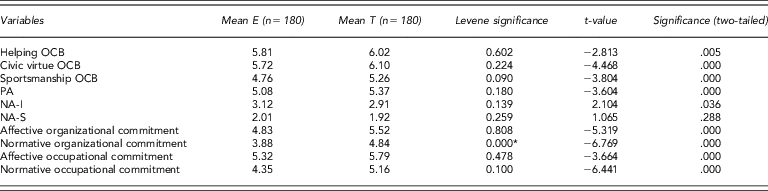
Prior to going on with hypotheses testing, multicollinearity of the items was assessed and t-tests were conducted to see the mean differences between the two groups. Multicollinearity of the items was investigated using variance inflation factors (VIFs). Hair, Black, Babin, Anderson, and Tatham (Reference Hair, Black, Babin, Anderson and Tatham2006) suggested VIFs fewer than 10 for the non-presence of multicollinearity. The VIFs for the variables ranged between 1.043 and 1.865. The results of the t-tests are displayed in Table 1. These results suggest that the two occupational groups, engineers and teachers as shown by their group means were different in terms of all three types of citizenship behaviors, dispositional affect (except social negative affect), affective attachment to the organization and occupation as well as their loyalty to their institutions and professions. Teachers were more likely to experience helping behaviors (6.02 vs. 5.81, p < .01), show a general concern for the organization (6.10 vs. 5.72, p < .001) and behave in a sportsman way (5.26 vs. 4.76, p < .001) compared with engineers. All the variables, but normative organizational commitment had equal variances, confirmed by insignificance of F-values in Levene's test.
Comparisons of occupation means and equality of variances
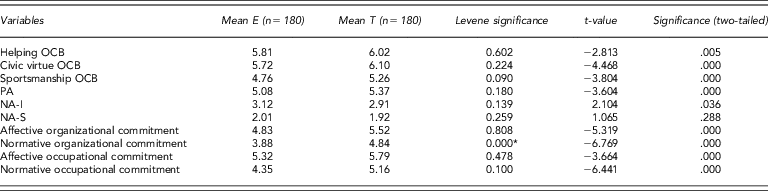
Notes. Degrees of freedom = 358.
E = engineers; OCB = organizational citizenship behavior; NA-I = internal negative affect; NA-S = social negative affect; T = teachers.
*p < .05.
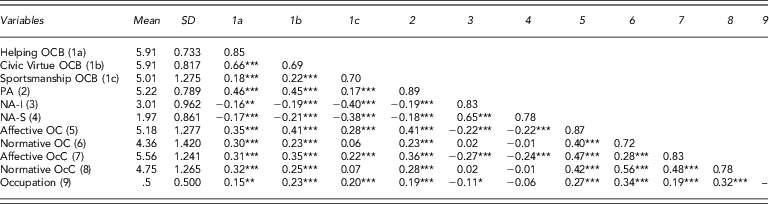
Means and standard deviations of the study variables, intercorrelations between the variables and scale reliabilities (along the diagonal in parentheses) are displayed in Table 2. The results suggest that helping behavior had positive and significant correlations with other behavior dimensions of civic virtue and sportsmanship. Helping behavior also had positive and significant associations with the independent variables of PA, and all the commitment variables. Table 2 shows that helping behavior had negative correlations with the dimensions of negative affect, and with internal and social negative affect. Civic virtue behavior was positively correlated with sportsmanship behavior and the rest of the independent variables. It was also shown to be negatively correlated with the two negative affect dimensions, internal and social negative affect. Sportsmanship behavior had significant positive correlations with PA, affective organizational and occupational commitment and with occupation. Sportsmanship behavior had relatively stronger negative correlations, compared with other OCB dimensions, with negative affect dimensions. This OCB dimension was not correlated significantly with normative organizational and occupational commitments. These indicate that all three dimensions of OCBs relate to affect, commitment, and occupation variables.
Descriptive statistics, reliabilities (in parentheses) and intercorrelations among study variables

Notes. n = 360.
NA-I = internal negative affect; NA-S = social negative affect; OC = organizational commitment; OcC = occupational commitment; PA = positive affect.
*p ≤ .05, **p ≤ .01, ***p ≤ .001.
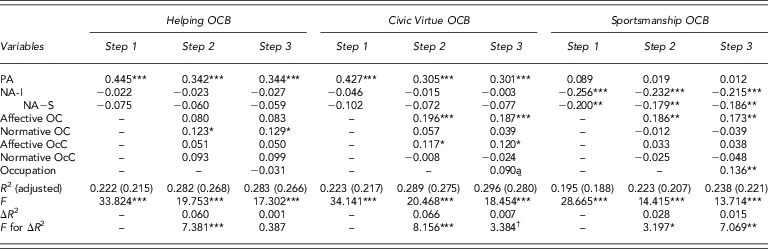
To test the research hypotheses, a hierarchical regression analysis was performed for each of the citizenship behaviors, helping, civic virtue, and sportsmanship. In the first step, dispositional PA, and the two dimensions of negative affect were entered. The second step tested the additional explained variance by the four commitment forms (affective organizational and occupational, normative organizational and occupational), followed by the additional effect of occupation in the third step. The results of the regression analyses are presented in Table 3.
Hierarchical regression results for OCBs
Notes. n = 360.
NA-I = internal negative affect; NA-S = social negative affect; OC = organizational commitment; OcC = occupational commitment; PA = positive affect.
†p ≤ .10, *p ≤ .05, **p ≤ .01, ***p ≤ .001.
First hypothesis expected the direct effects of dispositional affect on OCBs. The results of the first step in hierarchical regression for helping behavior (R 2 = 0.222, F = 33.824, p ≤ .001) suggest PA (β = 0.445, p≤.001) as a significant predictor of such behavior. Similarly, PA (β = 0.427, p ≤ .001) also came out to be a significant predictor of civic virtue behavior (R 2 = 0.223, F = 34.141, p ≤ .001). Sportsmanship behavior (R 2 = 0.195, F = 28.665, p ≤ .001), on the other hand, was predicted in a negative direction by both internal negative affect (β = −0.256, p ≤ .001) and social negative affect (β = −0.200, p ≤ .001). Thus, this hypothesis finds support. These results suggest that professional workers with high positive outlook are more likely to help coworkers and be concerned about their organizations, while those holding a general negative outlook are likely to complain about trivial matters in the organization. These findings indicate that dispositions seem to be a major antecedent of citizenship behaviors. In other words, positive and negative affect as personality traits explain helping, civic virtue and sportsmanship behaviors as OCB dimensions in a significant and strong way for highly professional employees.
Second set of hypotheses predicted that context-related variables of affective and normative organizational and occupational commitment would explain additional variance in OCBs above and beyond the variance explained by dispositional affect. Hierarchical regression analyses suggest findings in line with this expectation in the second steps, when dispositional affect was controlled for in the first step. Above and beyond the remaining direct effect of PA (β = 0.342, p ≤ .001), helping behavior (R 2 = 0.282, F = 19.753, p ≤ .001) was significantly predicted by normative organizational commitment (β = 0.123, p ≤ .05) in a positive direction. Civic virtue behavior (R 2 = 0.289, F = 20.468, p ≤ .001), in addition to the significance of PA (β = 0.305, p ≤ .001) as a remaining predictor in the second step, was significantly explained by affective organizational commitment (β = 0.196, p ≤ .001) and affective occupational commitment (β = 0.117, p ≤ .05). Sportsmanship behavior (R 2 = 0.223, F = 14.415, p ≤ .001) was explained positively by affective organizational commitment (β = 0.186, p ≤ .01) above and beyond the main and remaining significant negative effects of internal (β = −0.232, p ≤ .001) and social (β = −0.179, p ≤ .01) negative affect. With a similar reasoning as above, this set of hypotheses also get partial support.
The third hypothesis was related to the explanatory power of occupation on OCBs beyond the dispositional and contextual variables. This hypothesis was tested with the third step in the hierarchical regression analysis performed for each behavior. Despite the fact that all three models were significant at the final stage of the hierarchical regression analyses, the additional explanatory power of occupation for helping behavior was insignificant, whereas it was significant at the level of p = .07 for civic virtue and at a level of p = .01 for sportsmanship behaviors. Occupation was able to positively explain significant additional variance in civic virtue (β = 0.090, p ≤ .10) (R 2 = 0.296, F = 18.545, p ≤ .10) and sportsmanship (β = 0.136, p ≤ .01) (R 2 = 0.238, F = 13.714, p ≤ .001) behaviors, above and beyond the variance explained by affect and commitment.
DISCUSSION AND CONCLUSION
The study reported here was designed to examine the determinants of OCB. It investigated the relative contributions of personality related and contextual determinants in explaining helping, civic virtue, and sportsmanship behaviors. Data were collected from two professional groups, teachers and engineers. The aim of the study was also to shed light on the theoretical and practical implications of determinants of cooperative behaviors in order to better understand their implications on organizational and individual members’ well being. Additionally, in an increasingly flat and global world we live (Friedman, Reference Friedman2005; Blunsdon, Reed, Blyton, & Dastmalchian, Reference Blunsdon, Reed, Blyton and Dastmalchian2010), there is a need for better understanding the application of the models in different cultural settings. This study provides evidence based on data from Turkish professionals.
One of the more significant contributions of this study is to examine the role of occupation (or profession) as an independent variable in understanding OCBs. Although a variety of work attitudes and outcomes have been studied distinctly under different samples and settings from various occupational groups, none of those studies looked at the role of occupational or professional groups on the different attitudes and outcomes related with their work.
In order to study the impact of dispositions on OCBs, positive and negative affect as personality trait dimensions were hypothesized to have direct relationships with citizenship behaviors. PA came out to predict helping and civic virtue behaviors; its predictive power did not decrease much when the contextual variables were also in the equation. It remained as a significant and positive predictor of both behavior types. Sportsmanship behavior on the other hand, was impacted negatively by negative affect. People with internal and social negative outlook were more likely to complain about trivial problems in the organization. Our findings overlap with the ones from literature in the sense that certain behaviors can be predicted by distinct dispositional variables (e.g., Konovsky & Organ, Reference Konovsky and Organ1996). Further, citizenship behaviors were found to be related to several personality constructs (Borman, Penner, Allen, & Motowidlo, Reference Borman, Penner, Allen and Motowidlo2001; Bowling, Wang, & Yan Li, Reference Bowling, Wang and Yan Li2012). AIM (Forgas & George, Reference Forgas and George2001), which implies a direct influence of affect on individual's cognitions and behaviors, might be relevant in this context. PA has a potential to lead to increased social awareness through increasing employees’ willingness to engage in prosocial behaviors and hence practicing OCBs as a means of protecting their emotional states (e.g., Isen & Baron, Reference Isen and Baron1991; Williams & Shiaw, Reference Williams and Shiaw1999). Negative affect is suggested to inhibit helping behaviors (e.g., Agho, Price, & Mueller, Reference Agho, Price and Mueller1992). Individuals with high negative affect have a tendency to increase the distance between self and others and hence to decrease their willingness toward prosocial acts (George, Reference George1990; Somech & Ron, Reference Somech and Ron2007). In line with such reasoning, perhaps one of the most interesting findings from our study was a two factor structure for negative affect, targeted toward one's self (internal negative affect) and targeted toward others (social negative affect). Justifying the two-factor structure of negative affect is beyond the focus of the present study, but remains an issue that requires further investigation. Clarifying the relationship between personality and different dimensions of OCB, our findings suggest that positive personality orientation increases the likelihood of altruistic behaviors and general positive concerns about the organizations, while negative personality orientations decrease the sportsmanship behaviors.
In this study, multiple commitments, as contextual variables in relation to affective and normative organizational and occupational commitments, were hypothesized to explain helping, civic virtue and sportsmanship behaviors, above and beyond the variance explained by dispositional affect variables. Helping behavior was significantly explained by normative organizational commitment above and beyond dispositional PA. Helping behavior being influenced by one's loyalty to his/her institution appears to be a relatively new finding. In this connection, the literature suggests a different set of findings in that affective organizational commitment is a significant predictor for helping behaviors (e.g., Podsakoff et al., Reference Podsakoff, MacKenzie, Paine and Bachrach2000). A possible explanation for our different finding may be the societal cultural values and setting. In a study conducted among young executives from different cultural settings, Kabasakal, Dastmalchian, and Imer (Reference Kabasakal, Dastmalchian and Imer2011) found collectivistic values to be the only predictor of helping behavior for a Turkish sample. Under such conditions, it could be reasonable to think that people (even professionals) with strong feelings of affiliation with their groups could help others due to commitment on a loyalty or obligation basis to their organization.
Civic virtue behavior was significantly predicted with affective organizational and occupational commitments above and beyond the variance explained by PA. Professionals being affectively attached to their organizations and occupations were more likely to show a general concern for and have a feeling of responsibility to their organizations. Affective organizational commitment being more strongly related with civic virtue behavior than affective occupational commitment could be explained with target similarity in theory of reasoned action (Fishbein & Ajzen, Reference Fishbein and Ajzen1975; Ajzen & Fishbein, Reference Ajzen and Fishbein1980). Fishbein and Ajzen (Reference Fishbein and Ajzen1975) formalized the theory by suggesting that the maximal prediction of behavior by attitude occurred when the attitude corresponded to behavior in terms of action, context, time and target. Thus, in the current study, civic virtue behavior related with organization is predicted by an attitude toward organization more strongly than an attitude toward another target, occupation.
Sportsmanship behaviors were positively explained with affective organizational commitment, above and beyond the variance explained by dispositional negative affect. Professionals affectively attached to the organization were less likely to complain about trivial workplace matters.
In theoretical terms, the study offered SIT (Tajfel & Turner, Reference Tajfel and Turner1985) and SET (Thibaut & Kelley, Reference Thibaut and Kelley1959; Blau, Reference Blau1964) as frameworks for investigating the relationship between multiple commitment foci and OCBs. The findings are in line with the expectations of both SIT and SET in such a way that the greater the identification with the organization (SIT), and the greater the benefits from the organization (SET); the higher is the likelihood of OCBs. It can be noted that the first mechanism (SIT) is appropriate for affective commitment (related to identification with or belongingness to some human aggregate such as an organization or an occupation), while the second one (SET) for normative commitment, which is related to moral understanding. Our findings show that the SIT mechanism can be observed for civic virtue and sportsmanship, while the SET for helping behaviors.
Occupation was examined, as far as we know, for the first time in OCB literature, as an independent variable to explain OCBs. Many researchers have been interested in explaining contextual attitudes and behaviors of people from different occupations or professions to organizational actions (e.g., Bogler & Somech, Reference Bogler and Somech2004; Cohen & Kol, Reference Cohen and Kol2004; Paré & Tremblay, Reference Paré and Tremblay2007; Bacon, Blyton, & Dastmalchian, Reference Bacon, Blyton and Dastmalchian2010). Some researchers have attempted to define OCBs pertaining to a specific occupation or profession (e.g., Oplatka, Reference Oplatka2006). Occupation or profession was deemed as an important variable since it involves both contextual and dispositional elements. The dispositional part concerns an individual's existence with his/her occupation for an indefinite amount of time (until the time she/he leaves the occupation). Starting with getting a special training for the profession, an individual invests a portion of her/his life to that profession and usually earns a living out of it. In addition, dispositional characteristics of people might play a role in their choice of occupation or profession. The contextual aspect is mostly relevant with the place, affiliation or activity in that the individual realizes an investment in the profession or in the organization. Occupation appeared as a significant predictor of voluntary workplace behaviors of sportsmanship. Teachers were more likely to behave in a sportsman way than the engineers. This could be explained with the rationale pertaining to the nature of the professions, with teaching being more human oriented and engineering, more technical oriented. Civic virtue behavior is also suggested as a potential candidate to be influenced by occupation/profession, since regression results reported it almost significant. Investigations under different samples and sample sizes might yield stronger relationships. Helping behavior appeared as a more general construct and was not affected by occupation as a variable.
On another line of thinking, occupations/professions that have different ratios of men and women might have different norms and expectations. Within the framework of the present study, the teaching profession has a traditionally higher ratio of women compared with that of the engineering occupation. Indeed, the gender split in the two professions are different. There are more women teachers than men, while the gap between the gender types in the engineers was less compared with that of teachers, with some unreported gender information. Previous research has found that women are more concerned than men with helping others (Bridges, Reference Bridges1989; George, Carroll, Kersnick, & Calderon, Reference George, Carroll, Kersnick and Calderon1998). However, in the study, occupation was not found to be a significant predictor of helping behavior. In other words, belonging to the teaching profession did not suggest any difference in terms of the helping dimension of OCBs. Future research needs to analyze how traditionally more masculine or feminine occupations would differ in terms of various OCB dimensions.
Though the present study has strong findings for the suggested antecedents of OCBs, it also has some limitations. The respondents are not likely to represent a general population, since data was collected from a single city (Istanbul) in a different cultural context, Turkey. So, the cultural setting can both be strength in providing an important contribution to the literature in terms of OCB antecedents and a weakness in terms of the generalizability of the results. In addition, data was collected by self-report ratings of professionals for all measures, and although common method variance was checked with a single-factor test, it still has a slight potential to influence the results of the study. Future research, designed with the inclusion of more of potential relevant antecedents, in larger samples and cross-cultural settings, could yield more accurate results about a general framework of OCB.
Both contextual and personality antecedents appeared as strong predictors for explaining OCB. Our results could serve as providing insights for personal and managerial implications in some aspects. For highly professional employees, supervisors are encouraged to acknowledge the function of social exchange principles in the work environment. They are advised to display supportive behaviors toward employees, since such behaviors have a potential to increase employees’ positive evaluations of the institution and could lead to the engagement of cooperative behaviors on employees’ behalf. One specific example for such supportive behaviors would be creating a work environment that helps people develop a sense of belongingness or feel that they are ‘part of the family,’ to benefit more from their macro-level interest in the organization. Further, our findings have practical implications in line with enhancing the occupational commitment of highly professional employees. We suggest that occupational commitment can be improved by investing in the professional development of the employees, by showing concern and interest for training and development and by involving them in projects that would lead to enhancement of their professional careers.
Dispositional variables indeed proved to be even more powerful compared with the contextual ones. Organizations can utilize our findings in relation to dispositional affect to create better working environments that facilitate the creation of more positive mood and inhibit the emergence of more negative affect. Findings suggest that organizations need to pay more attention to the dispositions of employees by creating positive work climates through increasing the positive and minimizing the negative inputs and experiences. Positive climates can be created by increasing support and providing autonomy to employees (e.g., Patterson, Warr, & West, Reference Patterson, Warr and West2004; Farooqui, Reference Farooqui2012). Negative climates can be minimized by eliminating interactions that create hostile and distressing work environments. These findings also point to a better employee selection process, which could provide the managers with an improved fit between employees and organizations.
Consistent with the suggestions in the literature (e.g., Barley, Reference Barley1996), occupation has a potential for opening fruitful research avenues in studying work behaviors and attitudes. The present study has opened a door to consider aspects of occupation in examining determinants of OCB.
Acknowledgements
Authors would like to thank the two anonymous reviewers for their valuable comments and suggestions for finalizing the manuscript.