





Introduction
Weed management in a crop of young carrots is a major challenge due to the crop’s slow early growth and poor competitiveness with weeds (Colquhoun et al. Reference Colquhoun, Rittmeyer and Heider2017; Van Der Weide et al. Reference Van Der Weide, Bleeker, Achten, Lotz, Fogelberg and Melander2008). Many growers rely heavily on herbicides, but the availability and efficacy of these products is increasingly limited due in part to concerns regarding their negative effects on environmental and human health (Hongoeb et al. Reference Hongoeb, Tantimongcolwat, Ayimbila, Ruankham and Phopin2025; Pimentel and Burgess Reference Pimentel, Burgess, Pimentel and Peshin2014). Overreliance on herbicides has also contributed to the spread of herbicide-resistant weeds (Heap Reference Heap2020) including common purslane (Portulaca oleracea) (Masabni and Zandstra Reference Masabni and Zandstra1999) and Powell amaranth (Amaranthus powellii), which have become resistant to herbicide linuron (Dumont et al. Reference Dumont, Letarte and Tardif2016). Weeds are particularly challenging for organic production of carrots (Perruzi et al. Reference Peruzzi, Gianni, Fontanelli, Raffaelli and Barberi2007), which represented 18% of all carrots grown in the United States in 2021 (USDA-NASS 2021). Organic growers often rely on mechanical cultivation as one of their main ways of managing weeds (Bond and Grundy Reference Bond and Grundy2001; Melander et al. Reference Melander, Rasmussen and Bàrberi2005). However, those methods increase soil degradation and they are labor-intensive and costly (Van Der Weide et al. Reference Van Der Weide, Bleeker, Achten, Lotz, Fogelberg and Melander2008; Zwickle et al. Reference Zwickle, Wilson, Bessette, Herms and Doohan2016). A paucity of farm workers and rising wages are also placing greater pressure on carrot growers to explore alternatives to weed control, including electrocution (Galbraith Reference Galbraith2023) and laser weeding (Besançon et al. Reference Besançon, Colquhoun and Sosnoskie2025).
Mechanical cultivation tools, including those that target the between-row zone (e.g., sweeps; basket weeders) and the in-row zone (e.g., finger weeders and torsion weeders), can be used to help manage weeds in carrot crops. However, the selectivity of these tools—their ability to kill weeds without killing or injuring crops—is often low and inconsistent, particularly for in-row weeds at early carrot growth stages (Champagne Reference Champagne2022; Peruzzi et al. Reference Peruzzi, Gianni, Fontanelli, Raffaelli and Barberi2007; Tilton Reference Tilton2018). For example, Tilton (Reference Tilton2018) reported selectivity indices (percent of carrot survival divided by the percent of weed survival) for grass weeds in carrots ranging from 3 to 25 for hilling disks, and from 1.4 to 6.8 for finger weeders.
Finger weeders and hilling disks are both cultivation tools used to help manage weeds in the in-row zone of various crops (Bowman Reference Bowman2002). Although use of these tools is relatively uncommon in carrot production, both in-row tools can be used 2 to 4 wk after carrot emergence, when carrots have at least three leaves, to prevent carrot injury (Bowman Reference Bowman2002). Finger weeders most effectively control weeds at the cotyledon to 2-leaf stage, with precise steering required to keep the crop row centered between the “fingers” of the tool (Mohler et al. Reference Mohler, Teasdale and DiTommaso2021). The angle and distance between the fingers can be adjusted to change the tool intensity and mechanism of action (Parks et al. Reference Parks, McCollough and Gallandt2025). Hilling disks can be used to push soil into the crop row to cover weeds. To avoid burying the crop or damaging crop roots, it is important to regulate both the depth of the disks and their proximity to the crop row. Cultivation with these tools is typically repeated weekly to control newly germinating weeds until 4 wk after emergence, which is generally considered the end of the critical weed-free period for carrots (Bevan et al. Reference Bevan, Bond and Lennartsson1993). Hilling disks are typically alternated with other tools to avoid repeatedly moving soil into the crop row (Bowman Reference Bowman2002).
Hilling disks and finger weeders use different mechanisms of primary action, which affect their selectivity (i.e., their ability to kill weeds without killing or injuring crops) given differences in crop and weed characteristics. Hilling disks take advantage of a height difference between the crop and weed to selectively bury weeds. Finger weeders—depending in part on how they are set and the soil conditions—more often kill weeds through uprooting (Parks et al. Reference Parks, McCollough and Gallandt2025; Peruzzi et al. Reference Peruzzi, Martelloni, Frasconi, Fontanelli, Pirchio and Raffaelli2017; van der Schans et al. Reference van der Schans, Bleeker, Molendijk, Plentinger, van der Weide, Lotz, Bauermeister, Total, Baumann, van der Schans and Bleeker2006), so their selectivity likely depends more on a difference in anchorage force between crops and weeds (Connors and Brainard Reference Connors and Brainard2025).
Cultural weed management strategies that increase carrot size or strength can also be exploited to improve selectivity (Connors and Brainard Reference Connors and Brainard2025; Kurstjens and Perdok Reference Kurstjens and Perdock2000). For example, Colquhoun et al. (Reference Colquhoun, Rittmeyer and Heider2020) showed that adjusting cultivars, plant spacing, and timing can improve weed management outcomes in carrot fields. Other studies have also found that tolerance to cultivation may depend on the carrot cultivar (Champagne Reference Champagne2022; Tilton Reference Tilton2018). For example, Tilton (Reference Tilton2018) found that cultivars such as Bolero, were sometimes more tolerant of in-row cultivation tools than others, due to their more rapid and uniform early growth. However, Champagne (Reference Champagne2022) found no significant difference in mortality of nine carrot cultivars from tine harrowing or finger weeding at the 2-leaf stage, even though they differed in root branching and shoot morphology.
Another way of improving carrot early vigor and tolerance to stresses, including mechanical cultivation, may be to more aggressively grade seeds so that only the large seed classes within a seed lot are planted. Ecological literature has many examples of the advantages of large seeds for establishment and survival under stresses including shade, drought, and herbivory (Moles and Westoby Reference Moles and Westoby2004). However, relatively few studies have examined the potential for seed grading to improve tolerance to stresses imposed by weed management in an agricultural context. In spring wheat (Triticum aestivum L.), Guillen-Portal et al. (Reference Guillen-Portal, Stougaard, Xue and Eskridge2006) found that larger sizes of wheat seeds increased yield and competitive ability with wild oats (Avena fatua L.) by suppressing the wild oat panicle production and seed weight. In soybeans [Glycine max (L.) Merr.], Place et al. (Reference Place, Reberg-Horton, Carter and Smith2011) found that larger seed sizes resulted in larger petiole length and plant height and reduced weed biomass when assessed at 7 wk after emergence.
In carrots, several studies have demonstrated that seed sizes from a single seed lot often vary by a factor of two to three times (Currah and Salter Reference Currah and Salter1973; Gray and Ward Reference Gray and Ward1985; Tilton Reference Tilton2018) and that such differences may result in greater early biomass (Tilton Reference Tilton2018) or yield (Austin and Longden Reference Austin and Longden1967). For example, Tilton (Reference Tilton2018) found that large seed fractions of a commercial seed lot of the cultivar Bolero resulted in larger seedlings and improved tolerance to a torsion weeder in 1 yr, although improved tolerance to other forms of in-row cultivation was not observed. Results of simulation modeling based on carrot and weed characteristics also suggest that carrots grown from larger seeds can improve the selectivity of mechanical cultivation, but their effects vary based on weed species and growth stage, as well as the precision of the tools under field conditions (Connors and Brainard Reference Connors and Brainard2025).
Our primary objectives for this study were to 1) evaluate the efficacy and selectivity of finger weeders and hilling disks under field conditions in organic carrot production; and 2) determine whether carrot seed size influences carrot tolerance to cultivation with either of these tools. Secondary objectives included evaluating the impacts of tools and seed size on carrot quality and yield. We hypothesized that a larger seed size would lead to taller, better rooted carrots at the time of cultivation, which would increase their tolerance to cultivation with tools that bury or uproot. We also hypothesized that a cultivation sequence that alternates tools with different mechanisms of action (finger weeder and hilling disks) would more effectively kill weeds without killing carrots than repeated use of a single tool (finger weeder) because the tool sequence would target weeds based on different traits.
Materials and Methods
Experiment Site
This experiment was conducted at the Michigan State Horticultural Teaching and Research Center in Holt (42.673705°N, 84.484900°W) in 2021 and 2022. The soil was a Spinks loamy-sand (a sandy, mixed, mesic Lamellic Hapludalf), pH 6.5, and with 74.8% sand, 17.8% silt, and 7.4% clay. Adjacent fields were used in the 2-yr study.
Experimental Design
This experiment evaluated the effects of three cultivation tool sequences and two carrot seed size classes on crop and weed mortality, biomass, and crop yield. Treatments consisted of six combinations of tool sequence and seed size class (Table 1), replicated four times, for a total of 24 plots. Plots were arranged in a split-plot design with cultivation tool sequence as the main plot factor, and seed size as the subplot factor. Three cultivation tool sequences were evaluated: 1) finger weeding for all cultivations; 2) finger weeding alternated with hilling disks for two (2021) or three (2022) cultivations; and 3) an uncultivated, hand weeded control. Hilling disks alone were not evaluated to prevent buildup of soil in the in-row zone, so alternating with finger weeding was necessary to level the bed before hilling again. All cultivation treatments were hand weeded once, within the week following the last cultivation event, to minimize potential effects of late-season weed competition on yield. The seed size factor consisted of large and small classes from the same commercial seed lot of carrots (cultivar Bolero; Johnny’s Selected Seeds, Winslow, ME). Seeds were separated using typical methods (Brandenburg Reference Brandenburg1977). In particular, seeds were air column–separated using a 757 South Dakota seed blower (Seedboro Equipment Co., Chicago, IL) following a two-step process: 1) air pressure was gradually increased by opening the seed blower aperture to 2.6 cm until approximately 25% of the seeds were collected at the top of the aspiration column (small seeds); 2) small seeds were removed from the top and the air pressure increased (by opening the seed blower aperture to 3.8 cm) until approximately 25% of the seeds were left at the bottom of the tube (large seeds). This method resulted in a class of large seeds with a mean seed weight 31% greater (P < 0.001) than that of the class of small seeds.
Seed size and cultivation tool sequence for experimental treatments.

Table 1. Long description
A table with six rows and four columns. The columns are labeled Treatment number, Seed size class, and Weeding sequence with sub-columns Cultivation 1, Cultivation 2, and Cultivation 3. The rows detail the treatment number, seed size class, and the specific cultivation tools used in each of the three cultivations. Row 1: Treatment number 1, Seed size class Small, Cultivation 1 Hand weeding, Cultivation 2 Hand weeding, Cultivation 3 Hand weeding. Row 2: Treatment number 2, Seed size class Large, Cultivation 1 Hand weeding, Cultivation 2 Hand weeding, Cultivation 3 Hand weeding. Row 3: Treatment number 3, Seed size class Small, Cultivation 1 Finger weeder, Cultivation 2 Finger weeder, Cultivation 3 Finger weeder. Row 4: Treatment number 4, Seed size class Large, Cultivation 1 Finger weeder, Cultivation 2 Finger weeder, Cultivation 3 Finger weeder. Row 5: Treatment number 5, Seed size class Small, Cultivation 1 Hilling disk, Cultivation 2 Finger weeder, Cultivation 3 Hilling disk. Row 6: Treatment number 6, Seed size class Large, Cultivation 1 Hilling disk, Cultivation 2 Finger weeder, Cultivation 3 Hilling disk.
a Cultivation 1 occurred 22 d after carrots were planted (DAP) in 2021 and 22 in 2022. Cultivation 2 occurred at 43 DAP in 2021 and 34 DAP in 2022. Cultivation 3 occurred at 45 DAP in 2022.
b The mean weight of seeds in the small-size class was 1.93 mg (SD ±0.08 mg). The mean weight of seeds in the large-size class was 2.53 mg (SD ±0.06 mg).
Carrots were sown using a three-row tractor-mounted seeder (Jang Automation Co., Seoul, South Korea) belly mounted to a 520 series cultivating tractor (Tilmor, Dayton OH). Plots were 6.1 m long in three rows, 38 cm wide and with 1.3 to 2.5 cm in-row spacing, thinned to approximately 2.5 cm at 14 d after planting (DAP). Each plot had three adjacent permanent quadrats (1.25 × 0.1 m each) in the middle row to track weed and carrot densities throughout the experiment. From approximately 6 to 12 DAP, carrot emergence was counted daily in one quadrat from each plot to determine whether seed size influenced the rate and extent of emergence. In 2021, 6 d after planting, prior to carrot emergence, the plots were flame weeded using a propane flame weeder, a common practice in organic carrot production. In 2022, carrots emerged before flame weeding could be accomplished, so no flame weeding occurred. In both years, basket weeding (Tilmor) was used to manage between-row weeds as needed (Table 2), leaving a 10- to 12-cm uncultivated strip centered on the crop row to evaluate in-row hilling disk and finger-weeder efficacy.
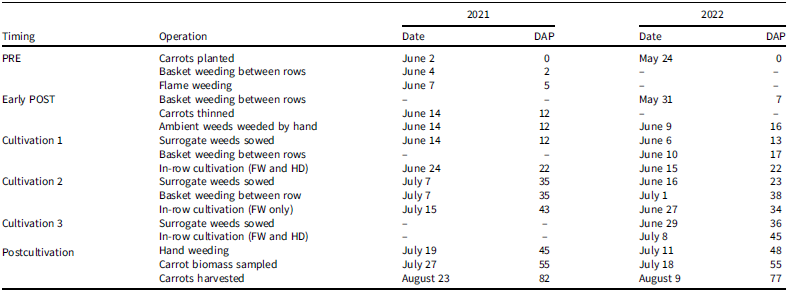
Summary of timing of key field operations, 2021 and 2022. a

Table 2. Long description
The table compares the timing of key field operations for carrot cultivation in 2021 and 2022. It has four columns: Timing, Operation, 2021, and 2022. The 2021 and 2022 columns are further divided into Date and DAP (Days After Planting). The table includes operations such as planting, weeding, cultivation, and harvesting, with specific dates and DAP values for each operation. Row 1: PRE, Carrots planted, 2021: June 2, 0; 2022: May 24, 0. Row 2: PRE, Basket weeding between rows, 2021: June 4, 2; 2022: No data. Row 3: PRE, Flame weeding, 2021: June 7, 5; 2022: No data. Row 4: Early POST, Basket weeding between rows, 2021: No data; 2022: May 31, 7. Row 5: Early POST, Carrots thinned, 2021: June 14, 12; 2022: No data. Row 6: Cultivation 1, Ambient weeds weeded by hand, 2021: June 12, 12; 2022: June 9, 16. Row 7: Cultivation 1, Surrogate weeds sowed, 2021: June 14, 12; 2022: June 6, 13. Row 8: Cultivation 1, Basket weeding between rows, 2021: No data; 2022: June 10, 17. Row 9: Cultivation 1, In-row cultivation (FW and HD), 2021: June 22, 24; 2022: June 15, 22. Row 10: Cultivation 2, Surrogate weeds sowed, 2021: July 7, 35; 2022: June 16, 23. Row 11: Cultivation 2, Basket weeding between rows, 2021: July 7, 35; 2022: July 1, 38. Row 12: Cultivation 2, In-row cultivation (FW only), 2021: July 15, 43; 2022: June 27, 34. Row 13: Cultivation 3, Surrogate weeds sowed, 2021: No data; 2022: June 29, 36. Row 14: Cultivation 3, In-row cultivation (FW and HD), 2021: No data; 2022: July 8, 45. Row 15: Postcultivation, Hand weeding, 2021: July 19, 45; 2022: July 11, 48. Row 16: Postcultivation, Carrot biomass sampled, 2021: July 27, 55; 2022: July 18, 55. Row 17: Postcultivation, Carrots harvested, 2021: August 23, 82; 2022: August 9, 77.
a Abbreviations: DAP, days after carrot planting; FW, finger weeder; HD, hilling disk; POST, postemergence; PRE, preemergence.
For each of the three planned in-row cultivation events, two species of surrogate weeds were sown 8 to 11 d prior to cultivation in one of the three permanent quadrats per plot, using separate quadrats for each cultivation. Following the approach of previous cultivation studies (Brown and Gallandt Reference Brown and Gallandt2018; Kolb et al. Reference Kolb, Gallandt and Molloy2010), surrogate weeds were chosen to evaluate tool efficacy rather than relying on ambient weeds, which generally exhibited low and inconsistent densities across the experimental area. Surrogate weed species included Red Spike red amaranth (Amaranthus cruentus) and Mighty Mustard condiment mustard (Brassica juncea) (Johnny’s Selected Seeds). Two hundred seeds of each species were mixed with sand, sprinkled on the soil surface within the designated quadrat, and covered with a thin layer of loose soil. This resulted in 30 to 100 emerged weed seedlings per quadrat for each species, ranging in size from cotyledon to 1-leaf stage at the time of cultivation (Table 3), except for the second cultivation in both years. For those cultivation events, surrogate weed emergence was low and inconsistent, so ambient and surrogate weeds were aggregated to evaluate weed mortality.
Mean height and anchorage force of surrogate weeds and carrots at the time of each cultivation event.a,b

Table 3. Long description
The table presents data on the height, anchorage force, leaf stage, and age of various plants across three cultivation events. It includes measurements for red amaranth, mustard, carrots (large seed), and carrots (small seed) for the years 2021 and 2022. The table is organized into three main sections: First cultivation, Second cultivation, and Third cultivation. Each section lists the plant types in rows and the measured parameters in columns. The parameters include height in centimeters, anchorage force in Newtons, leaf stage in number of leaves per plant, and age of the plant in days and degree days. For example, in the First cultivation section, red amaranth has a height of 0.79 cm in 2021, an anchorage force of 0.35 N, a leaf stage of cotyledon, and an age of 11 days and 141 degree days. The table provides a comprehensive comparison of the growth and development of these plants over the two years.
a Abbreviations: cot, cotyledon; GDD, growing degree days; N, newton (a measure of force, m kg s−2).
b Leaf number, days from sowing, and degree days from sowing of all plants are also provided for reference. For carrot height and anchorage force data, different letters indicate significantly different values at P < 0.10.
c Height to tallest leaf.
d The base temperature was 5 C.
Cultivation Treatments
The first cultivation occurred 22 DAP, when carrots were at the 1- to 2-leaf stage and approximately 3.5 cm tall (Table 3). At the second cultivation, carrots had 4 to 6 leaves and were 11 cm tall in 2021, and in 2022 carrots had 2 to 3 leaves and were 10 cm tall. In 2022, a third cultivation event was done when carrots were at the 4- to 6-leaf stage and 21.5 cm tall.
In-row cultivation treatments were accomplished with 33-cm-diam medium durometer finger weeders (Tilmor) or 15-cm-diam hilling disks (K.U.L.T. Kress Duo) cutaway disks set to hill belly mounted to a manually steered Tilmor 520 cultivating tractor. Fingers were calibrated with the goal of scrubbing soil from the in-row zone to uproot weeds, rather than pushing soil into the row to bury them. This involved raising the toolbar such that the floating arm sloped downward slightly until soil was observed moving out of the crop row in the calibration area. This setting corresponded to an upward tilt of the fingers of approximately 15o relative to the soil, an angle very similar to that reported by Parks et al. (Reference Parks, McCollough and Gallandt2025) to achieve soil removal from the in-row zone. The finger weeder was set to leave a minimum gap of approximately 1 cm between tips of the fingers when lowered in the soil, centered on the crop row. Tractor speed was determined in practice beds by gradually increasing speed and observing carrot mortality in the calibration area with the goal of maximizing weed mortality while maintaining less than 10% crop mortality. The resulting speed was 7 km h−1 for the second cultivation event in 2022, and 8.6 km h−1 for all other cultivation events. In 2021, finger weeded treatments at the first cultivation event were not aggressive enough to penetrate the soil surface and kill weeds consistently in the experimental area, so the finger weeder was operated a second time through each plot with the same settings within 1 h of the first cultivation. The angle of hilling disks was set to 12 cm between the fronts of the disks and 17 cm between the backs (approximately 10° from the crop row). Calibration was conducted by adjusting driving speed such that soil moved fully into the crop row with peak height at the crop line approximately 1.5 to 3 cm higher than the precultivation level. Our goal was to maximize weed burial while avoiding complete burial of more than 10% of carrots. The speed required to achieve this outcome ranged from 2 to 3 km h−1 depending on soil conditions. Note, however, that in all cases, differences in soil conditions or carrot growth between the calibration and experimental areas resulted in variation in the amount of soil movement and crop mortality observed with these settings.
In the uncultivated, hand weeded control treatments, no in-row weeding was performed between the precultivation and postcultivation counts to evaluate potential weed and carrot mortality independent of in-row cultivation tools. However, these treatments were hand weeded shortly after post counts of each cultivation event to minimize weed competition with carrots. Cultivated treatments were also hand weeded 3 to 4 d after the last in-row cultivation to minimize competition.
Data Collected
Before each cultivation event, carrot height and anchorage force were measured from six carrots in each plot (72 carrots from each size class) to assess differences in traits of carrot seedlings from different seed size classes that might influence crop mortality. In particular, we measured the height of the tallest leaf as a proxy for carrot tolerance to burial from hilling disks, as well as the root anchorage force as a proxy for carrot tolerance to uprooting forces applied by the finger weeders (Connors and Brainard Reference Connors and Brainard2025). The anchorage force of each plant was measured by attaching a force gauge (FGV-100XY; Shimpo, Kyoto, Japan) to carrot shoot tissue via a ridged clip (Crocodile Mouth Tarp Clips-004, 9 × 3 × 2 cm; Outus, Chicago, IL) and pulling up slowly until the plant was uprooted. The maximum force recorded during this uprooting process was used as an estimate of the anchorage force following Fogelberg and Gustavvson (Reference Fogelberg and Gustavsson1998). Except for the first cultivation in 2021, surrogate weed heights and anchorage forces were also measured using the same procedure for three individuals of each species per plot at the same time as the carrot measurements.
To assess plant mortality, carrot and surrogate weeds were counted in the in-row zone of one 1.25-m by 0.10-m quadrat per plot immediately before and 2 to 3 d after each cultivation event. At the second cultivation event in both years, low and inconsistent emergence of surrogate weeds resulted in inadequate densities of individual species to assess mortality, so weed counts were aggregated across multiple species. In particular, at the second cultivation event in 2021, surrogate weed counts were combined with ambient weeds in an adjacent 1.25 m by 0.10 m to obtain total weed counts, which included approximately 36% red amaranth, 25% condiment mustard, 12% large crabgrass [Digitaria sanguinalis (L.) Scop.], 12% common purslane (Portulaca oleracea L.), and 15% carpetweed (Mollugo verticillata). For the second cultivation in 2022, surrogate weeds were combined to obtain total weed counts consisting of approximately 70% red amaranth and 30% condiment mustard.
Carrots were harvested at 82 DAP in 2021 and 77 DAT in 2022 from the three quadrats (3.75 row-m total) where emergence and cultivation mortality had been evaluated in each plot. A random subsample of 15 plants from these quadrats were collected, separated into root and shoot tissue, and dried to measure dry root and shoot biomass. Remaining carrots from the three quadrats were separated into marketable versus unmarketable (undersized (<15 cm diam), forked, nubbed, insect damage/cracked/visible defects) categories. In 2022, an unmarketable category for bent carrots (visually categorized based on deviation of approximately 1 cm or more from linear) was also included. For each plot, the number of carrots within each category was counted, then total fresh weight and total root weight were measured.
Data Analysis
Data were analyzed using the MIXED procedures in SAS software (v. 9.4; Statistical Analysis Software, Cary, NC). Years were analyzed separately due to the differences in the number of cultivation events (Table 1) between years. For responses evaluated before cultivation events (anchorage force and height), only the fixed effect of carrot seed size was evaluated. For responses evaluated after cultivation events (weed and crop mortality, biomass, and yield), the effects of seed size, cultivation tool sequence, and their interactions were evaluated with seed size and cultivation tool considered as fixed effects and replicate as a random effect. Plots with fewer than 20 total weeds before cultivation were excluded from analysis of weed mortality from cultivation, which totaled three plots each from different treatments, allowing at least three replicates of each treatment to be analyzed. To evaluate hypothesized impacts of seed size on carrot tolerance to mechanical cultivation tools, mortality data from hand weeded control treatments were excluded from that analysis. Data were analyzed separately by year. Shapiro-Wilks and Levene tests were used to check for normality and homogeneity of residuals. As necessary, responses were transformed to meet those assumptions, and a Box-Cox test was used to find the best transformation. When no transformation was possible (due to heterogeneity of residuals), a linear mixed model with unequal variances in the GLIMMIX procedure (with SAS software) was used to account for heterogenous structure (Milliken and Johnson Reference Milliken and Johnson2009). Following the process described by Crawford and Williams (Reference Crawford and Williams2018), treatment differences were considered significant at α = 0.10 to reduce the likelihood of Type II error and improve detection of potentially important treatment effects. When the main or interactive effects of seed size or tool were significant (P < 0.10), means were separated using a Tukey HSD test (P < 0.10) with a Tukey adjustment for multiple comparisons.
Results and Discussion
Seed Size Effects on Carrot Emergence and Early Growth Characteristics
Seed size affected total carrot emergence only in 2021 (Table 4) and timing of emergence only in 2022 (Table 4; data not shown). In 2021, carrots grown from small seed fractions (SS carrots) had approximately 20% greater total emergence than carrots grown from large seed fractions (LS carrots), but emergence did not differ by seed size in 2022. Greater emergence of SS compared with LS carrots in 2021 was likely an artifact of our seed sorting method. In particular, the seed disk on the planter in 2021 resulted in less consistent sorting of small seeds than large seeds. To control for this effect, seedlings from both seed size classes were thinned to a uniform density before the first cultivation. In 2022, seed size did not affect total emergence, although a slightly larger percentage of LS carrots (95%) than SS carrots (87%) had emerged 9 d after planting (DAP). However, both seed sizes had equivalent emergence by 10 DAP, and no other effects of seed size on emergence timing were detected.
Summary of ANOVA (P-values) for effects of seed size and cultivation tool sequence on carrots, 2021 and 2022. a

Table 4. Long description
The table presents ANOVA P-values for the effects of seed size and cultivation tool sequence on various carrot growth metrics over two years, 2021 and 2022. The table has 12 rows and 8 columns. The columns are labeled as follows: Response variable, Seed size 2021, Tool sequence 2021, S x T 2021, Seed size 2022, Tool sequence 2022, S x T 2022, and Associated table or figure. The response variables include emergence, first cultivation, height, anchor force, mortality, second cultivation, third cultivation, harvest, total yield, marketable yield, and yield per plant. Each row lists the P-values for the corresponding response variable across different conditions. Notable trends include significant effects of seed size on emergence in 2021 and on various metrics such as height, anchor force, and yield in both years. The table also references associated figures and tables for further details.
a Abbreviations: NA, not applicable; S, seed size; T, tool sequence.
In both years, seed size had a significant effect on mean carrot height and anchorage force at the time of the first cultivation, when carrots were in the 1- to 2-leaf stage (Table 4). At this stage, LS carrots were 1.4% to 8% taller and had 20% to 25% greater root anchorage force on average than SS carrots (Table 3; Figure 1). The effects of seed size on carrot growth characteristics at the time of later cultivation events differed by year (Table 3). In 2021, at the time of the second cultivation, when carrots were in the 4- to 6-leaf stage, LS carrots were 23% taller and had 44% greater root anchorage force than SS carrots. However, in 2022 seed size had no detectable effect on carrot growth at either the second or third cultivation when carrots had 2 to 3 or 4 to 6 leaves, respectively.
Cumulative distributions for anchorage force (measured in Newtons, N) (A and C) or height (B and D) for carrots from small seeds (SS) versus large seeds (LS) (based on size classes) at the first cultivation timing in 2021 (A and B) and 2022 (C and D). Vertical lines show hypothetical uprooting forces or burial depths corresponding to observed mortality of carrots from the small seed–size class.

Previous studies have demonstrated similar effects of carrot seed size on emergence and early growth characteristics. For example, several studies have observed that carrot seed grading had minimal effect on emergence timing (Currah and Salter Reference Currah and Salter1973; Gray and Steckel, Reference Gray and Steckel1983a) but substantial effects on seedling size (Austin and Longden Reference Austin and Longden1967; Gray and Steckel Reference Gray and Steckel1983b; Hole et al. Reference Hole, Morris and Cowper1987; Tilton Reference Tilton2018). Tilton (Reference Tilton2018) found that seed size predicted plant biomass at the cotyledon and 1-true leaf stage, but that seed size did not correlate with plant size at the time of cultivation for later stage carrots.
Seed Size Effects on Carrot Tolerance to Cultivation
At the time of the first cultivation in 2022, when carrots were in the 1- to 2-leaf stage, LS carrots had lower mortality than SS carrots, although the effect was only marginally significant (P = 0.063) (Table 5). In particular, carrot mortality at the first cultivation event in 2022 was 26% for LS carrots compared with 35% for SS carrots and did not differ based on cultivation tool. In contrast, at the first cultivation in 2021, seed size had no detectable effect on carrot mortality. When cultivation occurred later, carrot mortality was generally low (0% to 12%) and unaffected by seed size category, regardless of cultivation tool (Table 5).
Effects of carrot seed size and cultivation tool sequence on carrot and weed mortality, 2021 and 2022.a,b

Table 5. Long description
The table presents data on the effects of carrot seed size and cultivation tool sequence on carrot and weed mortality for the years 2021 and 2022. It is divided into three main sections: Cultivation 1 (FW or HD), Cultivation 2 (FW), and Cultivation 3 (FW or HD). Each section contains data for different variables such as carrots, red amaranth, mustard, and weeds. The table includes columns for seed size (large and small), tool sequence (FW, FW, FWd, HD, FW, HDd), and ANOVA P-values for seed size and tool sequence. The data is presented in percentages for each variable and year. Notable trends include variations in mortality rates based on seed size and tool sequence, with specific P-values indicating the significance of these factors. The table provides a comprehensive overview of how different cultivation practices affect plant mortality.
a Abbreviations: FW, finger weeder; HD, hilling disk.
b Statistical significance (P < 0.1) is indicated by different letters within the same column.
c Weeds in 2021 included red amaranth, condiment mustard, large crabgrass, common purslane, and carpetweed. In 2022, weeds included red amaranth and condiment mustard (see Materials and Methods for details).
d The third cultivation event (hilling vs finger weeder) occurred only in 2022.
Greater tolerance to cultivation of LS compared with SS carrots at the first cultivation in 2022 but not in 2021 was most likely due to a combination of more aggressive cultivation in 2022 and differences in the effect of seed size on anchorage force and height distributions (Figure 1). At the time of the first cultivation, the cumulative distribution of anchorage forces for LS versus SS carrots was similar across years, with divergence between LS and SS carrots occurring only at anchorage forces greater than approximately 0.7 N (Figure 1, A and C). Based on observed carrot mortality from finger weeding (Table 5), it is likely that uprooting forces applied by the finger weeder were well above 0.7 N in 2022 but not in 2021, which led to higher mortality of SS carrots in 2022. Under that uprooting force, LS carrots were more tolerant than SS carrots, likely due to the large difference in their anchorage forces (Figure 1C). However, this difference in carrot cultivation tolerance was likely not observed in 2021 because of the lower uprooting force used, since there was only a minimal difference in anchorage force of SS and LS carrots at that uprooting force (Figure 1A). Similarly, greater observed tolerance of LS carrots to cultivation from hilling at the first cultivation in 2022 than 2021 was likely due to a combination of more aggressive hilling, and a greater divergence in heights between LS and SS carrots (Figure 1, B and D).
When cultivation occurred late, when carrots had 4 to 6 leaves (e.g., the second cultivation in 2021 and the third cultivation in 2022), a lack of seed size effects is not surprising given the large size advantage of both LS and SS carrots compared to weeds (Table 3). When these cultivations occurred, carrot anchorage forces and heights were at least 10 times greater than target weeds, and tool settings used to kill those weeds had no detected effect on carrot mortality, regardless of seed size class (Table 5). At the second cultivation in 2022, carrots were smaller (2- to 4-leaf stage), and more vulnerable to cultivation, but seed-class differences in anchorage force and height, which had been substantial at the 1- to 2-leaf stage, were no longer detected (Table 3). This lack of differences in carrot characteristics at the second cultivation in 2022 was likely due to selective removal of smaller carrots that occurred with more aggressive cultivation at the first cultivation in 2022 compared with 2021.
Previous studies also found inconsistent effects of carrot seed size or cultivar on tolerance to cultivation (Champagne Reference Champagne2022; Tilton Reference Tilton2018). Champagne (Reference Champagne2022) found that although carrot cultivars differed in their root branching and shoot morphology at the 2-leaf stage, they did not differ in their tolerance to cultivation with finger weeders or flextine weeders. Tilton (Reference Tilton2018) observed that seedlings from large seeds had greater tolerance to cultivation with a torsion weeder in one of two years, but not to flextine weeders, finger weeders or hilling disks. As with our study, Tilton (Reference Tilton2018) found that benefits of larger carrot seedlings were only detected when carrots were subjected to tools (e.g., torsion weeder) or tool settings resulting in high levels of carrot mortality.
The variability in results found in other studies and between years in our study emphasize that cultivation tolerance is likely context-dependent. Modeling potential selectivity may be one way to better understand likely differences in cultivation tolerance (Connors and Brainard Reference Connors and Brainard2025; Kurstjens et al. Reference Kurstjens, Kropff and Perdock2004). Kurstjens et al. (Reference Kurstjens, Kropff and Perdock2004) developed a model of selectivity for cultivation tools that uproot using data on the distribution of root anchorage forces of crops and weeds at the time of cultivation to predict potential selectivity of uprooting tools. Similarly, Connors and Brainard (Reference Connors and Brainard2025) used anchorage force and height data to evaluate the potential efficacy (i.e., the highest attainable weed mortality for a fixed level of crop mortality) of tools that either uproot or bury. Using carrot and weed data, they concluded that potential efficacy was generally higher for tools that bury weeds than for those that uproot, but that it depended on cultural practices such as stale-seed bedding, which shifted the relative size advantage of carrots over weeds. Similarly to how we used differences in relative anchorage forces and heights to understand our observed carrot cultivation tolerance differences from seed sizes, these models include trait differences between crops and weeds to predict which cultivation tools might be most effective, and could help inform timing, calibration settings, and optimal cultural practices.
Cultivation Tool Effects on Carrot and Weed Mortality
Carrot mortality at all timings was unaffected by cultivation tool sequence (Table 5). Not surprisingly, carrot mortality was highest when the first cultivation occurred, when carrots were in the vulnerable 1- to 2-leaf stage (Table 3). Carrot mortality at this stage was 13% in 2021 and 27% to 35% in 2022, depending on seed size category, but did not vary by tool (Table 5). When cultivation occurred later—when carrots were at the 2- to 6-leaf stages—mortality from both tools was low regardless of tool sequence.
The effects of cultivation tool and tool sequence on weed mortality varied with timing and year (Table 5). At the first cultivation event in 2021, cultivation efficacy was low and did not differ between the finger weeder and hilling disk, ranging from 21% mortality of condiment mustard to 42% mortality of red amaranth. In contrast, in 2022, red amaranth mortality was higher (66%) when the hilling disk was used than when the finger weeder was used (43%), although condiment mustard mortality (51%) did not differ between the two tools. At the second cultivation in 2021, finger weeders were roughly twice as effective at killing weeds when they followed hilling disks, compared with the first cultivation event, although this difference was not statistically significant (P = 0.106). This difference was not observed in 2022. Although we analyzed all weed species combined after the second cultivation, this likely had minimal effect on our mortality results because the weeds at that time had relatively similar heights and anchorage forces compared to the carrots, which were much larger (Table 3). At the third cultivation event—which occurred only in 2022—efficacy did not differ between finger weeders and hilling disks and ranged from 76% mortality of condiment mustard to 88% mortality of red amaranth (Table 5).
Our carrot mortality results emphasize the importance of pre-plant strategies such as stale-seed bedding and early weeding with flaming equipment to manage weeds in young organic carrot crops, because the highest carrot mortality was observed at the earliest cultivation event when carrots were at the 1- to 2-leaf stage. This finding is expected given the slow early growth of carrots, but it is important to recognize that growers rely on other methods for managing weeds at this stage to minimize carrot damage (Peruzzi et al. Reference Peruzzi, Gianni, Fontanelli, Raffaelli and Barberi2007).
Our results are consistent with previous those of previous studies suggesting that for carrots at early growth stages, hilling is a better strategy than uprooting (Connors and Brainard Reference Connors and Brainard2025; Tilton Reference Tilton2018). Tilton (Reference Tilton2018) also found that use of hilling disks had greater efficacy and selectivity in weeding among carrots than finger weeders in one trial, although both studies reported no significant differences between these tools in two other trials. Based on differences in anchorage force and height between carrots and various weeds, Connors and Brainard (Reference Connors and Brainard2025) also predicted that burial generally had greater potential efficacy than uprooting, particularly for grass weeds, and when coupled with stale-seed bedding.
Effects of Seed Size on Carrot Yield
In both years, seed size had a large effect on yield, independent of tool sequence (Table 3). In 2021, LS carrots produced 18% greater total yield and 23% greater marketable yield than SS carrots (Table 6). Similar benefits were also observed in 2022, with LS carrots producing 15% greater total yield and 17% greater marketable yield than SS carrots. In 2021, LS carrots also produced higher total and marketable fresh root weights per plant than SS carrots, although fresh root weight was not different between seed sizes in 2022.
Effects of carrot seed size and cultivation tool on yield and final number of carrots, 2021 and 2022.a,b

Table 6. Long description
A table comparing the effects of carrot seed size and cultivation tool on yield and final number of carrots over two years. The table has 12 rows and 12 columns. The columns are labeled as follows: Factor, Yield Total 2021, Yield Total 2022, Yield Marketable 2021, Yield Marketable 2022, Carrot number Total 2021, Carrot number Total 2022, Carrot number Marketable 2021, Carrot number Marketable 2022, Root fresh weight per plant Total 2021, Root fresh weight per plant Total 2022, Root fresh weight per plant Marketable 2021, Root fresh weight per plant Marketable 2022. The rows are labeled as follows: Seed size main effect, Tool main effect, FW, FW, FW, HD, FW, HD, Hand weeded, ANOVA, Seed size, Tool, Seed size x tool. Row 1: Seed size main effect, 1189 a, 1136 a, 1059 a, 867 a, 23.3, 24.6, 18.2, 18.1, 52.2 a, 47.3, 59.7 a, 49.2. Row 2: Seed size main effect, 1006 b, 988 b, 862 b, 744 b, 24.8, 22.1, 17.8, 16.4, 40.6 b, 44.3, 47.9 b, 46.4. Row 3: Tool main effect, 1088, 840 b, 959, 572 b, 21.3 b, 17.6 b, 16.8, 11.7 b, 52.3 a, 48.4 a, 58.6 a, 49.9 a. Row 4: Tool main effect, 1035, 1143 a, 903, 936 a, 23.2 ab, 23.8 Ab, 16.8, 18.8 a, 44.8 b, 48.2 a, 53.3 b, 49.8 a. Row 5: Tool main effect, 1168, 1203 a, 1020, 910 a, 27.5 a, 29.7 a, 20.5, 21.1 a, 42.2 b, 40.3 b, 49.5 b, 43.7 b. Row 6: ANOVA, P-value, 0.036, 0.098, 0.027, 0.098, 0.374, 0.318, 0.804, 0.360, 0.001, 0.250, <0.001, 0.219. Row 7: Seed size, 0.520, 0.026, 0.526, 0.027, 0.052, 0.100, 0.126, 0.007, 0.036, 0.080, 0.001, 0.087. Row 8: Tool, 0.203, 0.227, 0.774, 0.230, 0.324, 0.129, 0.450, 0.445, 0.738, 0.276, 0.790. Row 9: Seed size x tool, 0.203, 0.227, 0.774, 0.230, 0.324, 0.129, 0.450, 0.445, 0.738, 0.276, 0.790.
a Abbreviations: FW, finger weeder; HD, hilling disk.
b Statistical significance (P < 0.1) is indicated by different letters within the same column.
c The third cultivation (disk hilling vs finger weeder) occurred only in 2022.
Other studies have also demonstrated the benefits of graded, vigorous seeds on carrot yield (Austin and Longden Reference Austin and Longden1967; Chipenete et al., Reference Chipenete, dos Santos, Pinheiro, da Silva, Pazzin and Da Silva2021), although the mechanisms responsible for those improvements are unclear. In general, large vigorous seeds of many plant species are known to improve survival under stresses such as shade, drought, and herbivory conditions (Moles and Westoby Reference Moles and Westoby2004). For carrots, well-known examples of such stresses include wind (Brainard and Noyes Reference Brainard and Noyes2012), and pathogens such as the fungus Alternaria radicina (Kodde et al. Reference Kodde, Teunissen, Van Diemen, Horn, Uehlinger and Groot2021), which commonly plague commercial carrot production. Although this study did not attempt to understand the mechanisms behind this difference, it is possible that the rapid early growth of LS carrots in our study may have more tolerance to those stresses. Alternatively, LS carrots may have more successfully captured nutrient or water resources, which limited the growth of SS carrots at early growth stages.
Effects of Tool Sequence on Carrot Yield
The effect of tool sequence on carrot yield differed between the two years but did not vary with seed size (Table 6; no significant tool × seed size interactions). Finger weeding had no negative effect on yield in 2021 but marketable yield was reduced by 37% in 2022. In contrast, the hilling–finger weeder sequence did not reduce yield compared with yield in the hand weeded control plots in either year.
Reductions in yield from finger weeding in 2022 were due largely to reductions in carrot density, rather than reductions in carrot size per plant (Table 6). Finger weeding in 2022 resulted in a 26% reduction in the final carrot number and a 38% reduction in the final marketable carrot number compared with hand weeding. However, as commonly observed with carrots (Ascard and Mattsson Reference Ascard and Mattsson1994; Tilton Reference Tilton2018), these stand reductions were partially offset by an increase in carrot weight per plant as intraspecific competition was reduced. In 2021, this compensatory effect was sufficient to completely offset potential yield reductions due to stand loss from finger weeding. For the alternating tool sequence (hilling disk–finger weeder), high rates of carrot mortality that occurred at early cultivation events, particularly in 2022 (Table 5), were also largely offset by increases in carrot fresh weight per plant (Table 6), resulting in no detected reduction in yield compared with hand weeded control plots.
Practical Implications
Weed management in young carrots continues to be a major challenge for growers. Mechanical cultivation can be an effective strategy for managing weeds, but improved understanding of optimal tool type and settings, and cultural practices aimed at increasing carrot vigor are needed.
Our results support the idea that seed grading—beyond that typically found in commercial carrot seeds—can improve carrot tolerance to stress and increase crop yield. Larger seeds resulted in carrot seedlings (LS carrots) with increased root anchorage force and height at the time of early cultivation events; improved tolerance to early cultivation in one of two years; and 15% to 18% higher yield than SS carrots independent of cultivation strategy. Therefore, for many carrot growers, the use of larger seeds may provide sufficient increases in yield and revenue to justify higher seed costs.
Results from this study reinforce previous research suggesting that at critical early growth stages in carrots, in-row cultivation tools and settings that bury weeds may have greater potential for selective weed control than those that uproot them. At some times, disks used to hill and bury small in-row weeds were more effective than finger weeders that were set to uproot. Hilling provided greater efficacy at the first cultivation event in 2022 and yields were greater relative to finger weeding alone in one of two years. These results reflect tool settings and their mechanism of action as much as the tools themselves, since finger weeders can be adjusted to both uproot and bury (Parks et al Reference Parks, McCollough and Gallandt2025). As with many studies involving mechanical cultivation, our results were variable across years and timings and reflect the variability and complex interactions between tool settings, and soil and environmental conditions, and the relative size of crops and weeds (Gallandt et al. Reference Gallandt, Brainard, Brown and Zimdahl2018).
High carrot mortality and low weed control efficacy at when cultivation occurs early emphasize the ongoing challenge of achieving selectivity in the in-row zone of carrots at early stages. However, our study demonstrated clear benefits for both cultivation tolerance and yield of grading seeds beyond levels typical in commercial seed lots. Our results suggest that additional studies to characterize the potential benefits of seed grading for other seed lots and cultivars may justify the higher seed costs associated with this approach. Future work is needed to improve the precision of traditional tools in weed and crop management and to reduce the variation in tool forces (Connors and Brainard Reference Connors and Brainard2025; Gallandt et al. Reference Gallandt, Brainard, Brown and Zimdahl2018). In addition, artificial intelligence and robotic technologies (Fennimore et al. Reference Fennimore, Slaughter, Siemens, Leon and Saber2016) hold promise for improving cultivation selectivity.
Acknowledgments
We thank Erin Burns and Zachary Hayden for their guidance. We also thank Johanna Flies, Daniel Priddy, Brandon Scott, Lily Ariaga, and Shane Adams for their assistance with data collection and field maintenance.
Funding
Support for this research was provided in part by Michigan State University AgBioResearch funds and by U.S. Department of Agriculture–National Institute of Food and Agriculture grants GNC21-324 as part of the Sustainable Agriculture Research and Education project) and 2018-51300-28426 as part the Organic Agriculture Research and Extension Initiative.
Competing Interests
The authors declare none.



 Open access

