Introduction
Dementia is one of the major causes of disability and dependency among older people worldwide. Despite intense research, there are still no treatments available that may cure or even alter the progressive course of degenerative dementias (World Health Organization, 2012). However, an increasing body of evidence confirms that the person with dementia has the ability to cope with the disease, and live a meaningful life, if provided adequate support (Byrne-Davis et al., Reference Byrne-Davis, Bennett and Wilcock2006). In this context, research on determinants of Quality of Life (QOL) of patients with dementia and interventions to increase QOL (Logsdon et al., Reference Logsdon, McCurry and Teri2007) are current priorities in dementia care.
QOL is a broad concept of complex definition (WHOQOL Group, 1997), assuming particular challenges in dementia. Specific definitions of QOL in dementia have been developed. Initial conceptualizations by Lawton (Reference Lawton1994) suggested four dimensions for health-related QOL in dementia: behavioral competence, objective environment, psychological well-being, and perceived QOL. Further developments have occurred (Jonker et al., Reference Jonker, Gerritsen, Bosboom and Steen2004; Byrne-Davis et al., Reference Byrne-Davis, Bennett and Wilcock2006), but all models value the patient with dementia own view of his or her QOL, and acknowledge patient's mood as a central aspect of the theoretical construct.
Three assessment approaches have been suggested: (1) direct observation of behaviors and activities assumed to be related to QOL, (2) proxy report by a family member or caregiver, and (3) self-report by the person with dementia (Naglie, Reference Naglie2007). Accordingly, several assessment measures were developed and validated, and the choice between them should be based on the severity of the dementia, care type, care setting, and specific QOL domains an intervention focuses on (Scholzel-Dorenbos et al., Reference Scholzel-Dorenbos2007).
Extensive research has demonstrated that patients with mild-to-moderate dementia can reliably rate their own QOL (Logsdon et al., Reference Logsdon, Gibbons, McCurry and Teri1999; Scholzel-Dorenbos et al., Reference Scholzel-Dorenbos2007; Banerjee et al., Reference Banerjee, Samsi, Petrie, Alvir and Treglia2009). Furthermore, patients tend to rate their QOL higher than their caregivers, and different predictors are associated with each of these ratings (Naglie, Reference Naglie2007). Patients’ adaptation to the illness (as occurs with other chronic conditions) and loss of insight can increase patients QOL. Caregiver burden and depression might influence negatively caregivers’ interpretation of patients’ QOL (Naglie, Reference Naglie2007). The use of both the patient's and the caregiver's opinions on the patients’ QOL allows for broader and complementary perspectives on the phenomenon and the implementation of more effective measures to improve QOL (Logsdon et al. Reference Logsdon, McCurry and Teri2007; Bosboom et al., Reference Bosboom, Alfonso, Eaton and Almeida2012; Gómez-Gallego et al., Reference Gómez-Gallego, Gómez-Amor and Gómez-Garcia2012).
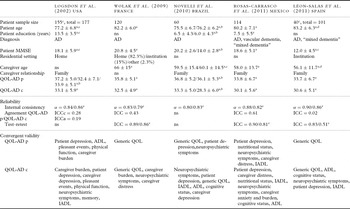
Quality of Life–Alzheimer's disease (QOL-AD) is a QOL assessment scale developed specifically for patients with dementia (Logsdon et al., Reference Logsdon, Gibbons, McCurry and Teri1999; Reference Logsdon, Gibbons, McCurry and Teri2002). It includes self and proxy reports on patient QOL and is based on Lawton's model of QOL in dementia. It was reviewed by patients, caregivers, and experts to maximize content and facial validity. The instrument comprises 13 items: physical health, energy, mood, living situation, memory, family, marriage or close relationship, friends, self as a whole, ability to do chores around the house, ability to do things for fun, money, and life as a whole. All items are scored considering the patient's current QOL. It uses simple and straightforward language. Responses are structured in a four-choice Likert scale, consistent across all the questions. It has been translated and adapted to several countries and cultures, maintaining strong psychometric properties (Wolak et al., Reference Wolak2009; Novelli et al., Reference Novelli, Nitrini and Caramelli2010; Rosas-Carrasco et al., Reference Rosas-Carrasco, Torres-Arreola, Guerra-Silla, Torres-Carrasco and Gutiérrez-Robledo2010; Léon-Salas et al., Reference Léon-Salas, Logsdon, Olazarán and Martínez-Martín2011). QOL-AD has been used in studies in the community (Novelli et al., Reference Novelli, Nitrini and Caramelli2010), in acute care setting (Sheehan et al., Reference Sheehan2012), and long-term care (Hoe et al., Reference Hoe, Hancock, Livingston and Orrell2006). Family caregivers (Léon-Salas et al., Reference Léon-Salas, Logsdon, Olazarán and Martínez-Martín2011) and professional caregivers (Gómez-Gallego et al., Reference Gómez-Gallego, Gómez-Amor and Gómez-Garcia2012) have been included as proxies. It has been used consistently in patients with mild cognitive impairment (MCI; Teng et al., Reference Teng, Tassniyon and Lu2012) and in several types of dementia with Mini-Mental State Examination (MMSE) above 10 (Wolak et al., Reference Wolak2009; Novelli et al., Reference Novelli, Nitrini and Caramelli2010). Table 1 summarizes the results of the original study and the most recent cultural adaptations and validations published. In spite of being translated and adapted into Brazilian Portuguese, cultural and intelligibility problems arise when using this Brazilian translation in Portugal.
Review of study population characteristics and psychometric properties of QOL-AD original validation article and recently published transcultural validation studies

aMean±SD; banalysis performed in separate groups; cgroup that completed QOL-AD; dtotal group; eQOL-AD p/QOL-AD c.
ns = not specified; α = Cronbach's α; AD = Alzheimer's disease; ADL = Barthel Index of Activities of Daily Living; IADL = Lawton and Brody Instrumental Activities of Daily Living; ICC = Intraclass correlation coefficient, one-way random, single measures; ICCa = ICC two-way mixed, single measures, absolute agreement; ICCc = ICC two-way mixed, single measures, consistency; MCI = mild cognitive impairment; MMSE = Mini-Mental State Examination; QOL = Quality of Life; QOL-AD c = QOL-AD caregiver report; QOL-AD p = QOL-AD patient report.
Portuguese reality is one of aging population. In 2009, 18% of the Portuguese population was over 65 years of age, compared with an average of 16.5% in the European Union (25 countries; Carrilho and Patrício, Reference Carrilho and Patrício2010). The same authors found that from 1960 to 2009, people aged over 75 years more than tripled in Portugal. In a recent study, Nunes et al. (Reference Nunes, Silva, Cruz, Roriz, Pais and Silva2010) found a prevalence of 12.3% cognitive impairment, and 2.7% dementia in a rural/urban population aged 55–79 years from northern Portugal (Nunes et al., Reference Nunes, Silva, Cruz, Roriz, Pais and Silva2010). Given the increased prevalence of dementia with age (World Health Organization, 2012), dementia has become a major public health problem. However, little is known about the QOL of patients with dementia in Portugal, and there is no dementia-specific QOL scale adapted to the Portuguese reality. In this context, we aimed to translate, adapt, and validate the QOL-AD to European Portuguese.
Methods
Translation and cultural adaptation
Translation and cultural adaptation of QOL-AD followed state-of-the-art recommendations (Wild et al., Reference Wild2005). Permission of the original scale leading author (R. Logsdon) was obtained. Two independent translations, by Portuguese medical doctors with good knowledge of English language, were developed and merged in an expert consensus meeting, obtaining a first translation into European Portuguese. Back translations into American English were performed by two independent, professional, American native translators, blinded to the initial scale. The back translations were reviewed and merged by the first author and sent to the scale author (R. Logsdon) for analysis and suggestions. The comments of the scale author were addressed in an expert meeting (including three neurologists, one psychiatrist, one senior nurse, four clinical neuropsychologists, and one general practitioner), where comprehensibility and semantic equivalence of the translation were discussed. A pilot test was conducted in a group of ten patient–proxy pairs (patients with MCI, Alzheimer's disease or vascular dementia and their caregivers), followed by an interview to address understandability and coverage of the theoretical construct. This group was not included in the validation sample. The facial and content validity of the Portuguese translation were assumed after this process (Wild, et al., Reference Wild2005).
Sample
A convenience sample of 126 patient–proxy pairs was enrolled, between May 2011 and January 2012. A total of 173 patients were invited to participate. Of these, 47 were excluded for not meeting the inclusion criteria: other diagnosis of dementia (17), patient with MMSE below 10 (24), caregiver not meeting the inclusion criteria or not having an informant (4), patient serious hearing and/or visual impairment (2).
The group with cognitive impairment comprised 104 patient–proxy pairs recruited at a central academic hospital (Hospital de Santa Maria) dementia clinic, an outpatient memory clinic (Memoclínica), and a long-term care dementia unit in Hospital do Mar, a geriatric and palliative care hospital. To be included, patients had to be 50 years or older, native Portuguese speakers, with a diagnosis of MCI, defined according to European Consortium on Alzheimer's Disease criteria (Portet et al., Reference Portet2006), “probable” or “possible” Alzheimer's disease according to the National Institute of Neurological and Communicative Disorders and Stroke and the Alzheimer's Disease and Related Disorders Association (NINCDS-ADRDA) criteria (McKhann et al., Reference McKhann, Drachman, Folstein, Katzman, Price and Stadlan1984), or “probable” vascular dementia according to the National Institute of Neurological Disorders and Stroke–Association Internationale pour la Recherche et l'Enseignement en Neurosciences (NINDS-AIREN) criteria (Róman et al., Reference Róman1993). Since, in prior international research, the QOL-AD showed more consistent results in mild-to-moderate dementia (Logsdon et al., Reference Logsdon, Gibbons, McCurry and Teri2002; Hoe et al., Reference Hoe, Hancock, Livingston and Orrell2006), only patients with MMSE score ≥10 were included in the present study. To ensure good knowledge of the patient's preferences and feelings and a reliable proxy report on patient QOL, caregivers were required to be responsible for the supervision and care of the patient with at least 20 hour per week contact with the patient, and able to read and write. When the patients had no family caregiver that fulfilled the inclusion criteria, professional caregivers that met all the inclusion criteria were included as proxies.
Exclusion criteria for patients were acute health problems in the 30 days prior to the interview and incapacitating sensory limitations that prevented the questionnaire completion (severe visual or hearing impairment). Caregivers with cognitive deficit, confirmed by MMSE scores above cut-off for age and education (Morgado et al., Reference Morgado, Rocha, Maruta, Guerreiro and Martins2009), were also excluded.
Test–retest was done 2 weeks apart, in a group of 20 patient/caregiver pairs. Only patients in long-term care were selected for this purpose. Although this was mainly on account of convenience, it also allowed us to explore test–retest reliability in a clinically stable subsample as desirable.
To compare the ability of QOL-AD to discriminate patients with MCI, patients with dementia, and patients without cognitive impairment, a comparison group of 22 participants without cognitive impairment, and their informants, was also recruited in a family practice clinic. The comparison group participants were native Portuguese speakers, 50 years of age or older, living at home, without cognitive impairment (confirmed by MMSE above cut-off for age and education; Morgado et al., Reference Morgado, Rocha, Maruta, Guerreiro and Martins2009), and with the same exclusion criteria as the patients in the study group. The comparison group informants had to be able to read and write, have no cognitive impairment, and have close contact with the patient (including face to face contact with the patient, of at least 20 hour per week, during the previous month). The study was approved by the Ethics Committee of Hospital de Santa Maria. All participants gave written informed consent.
Measures
QOL-AD (Logsdon et al., Reference Logsdon, Gibbons, McCurry and Teri2002). The final European–Portuguese version, obtained after translation and cultural adaptation as described above, was used. It is composed of two identical scales. According to the instructions of the original instrument, one questionnaire is administered to the patient in interview format and the other is filled by the caregiver. The caregiver is asked to report the patient's feelings about himself or herself. Two independent scores are obtained (patient and caregiver scores). Following R. Logsdon's recommendations, the scores were analyzed separately. The scales have 13 items, answered in a four-choice Likert scale (minimum score 13, maximum 52, indicating better perceived quality of life). Each scale is considered valid if up to one item is missing.
The translated and validated (Wild, et al., Reference Wild2005) Portuguese versions of the following instruments were used (de Mendonça and Guerreiro, Reference de Mendonça and Guerreiro2008) for construct validity. These instruments have been used in other QOL-AD validation studies (Logsdon et al., Reference Logsdon, Gibbons, McCurry and Teri1999; Novelli et al., Reference Novelli, Nitrini and Caramelli2010; Léon-Salas et al., Reference Léon-Salas, Logsdon, Olazarán and Martínez-Martín2011).
Mini-Mental State Examination (MMSE; Folstein et al., Reference Folstein, Folstein and McHugh1975) is a screening instrument for cognitive impairment, providing a total score ranging from 0 to 30 (higher scores indicating better cognitive status). The normative cut-off values for the Portuguese population adjusted to education level were used (Morgado et al., Reference Morgado, Rocha, Maruta, Guerreiro and Martins2009).
Lawton and Brody Instrumental Activities of Daily Living Scale (IADL; Lawton and Brody, Reference Lawton and Brody1969) is a scale made up of eight items (using the telephone, shopping, preparing meals, maintaining the home, laundry, transport, compliance with treatment and managing money). In this study, the original scoring was used: minimum score 0, maximum 8 (total independence).
Barthel Index of Activities of Daily living (ADL; Mahoney and Barthel, Reference Mahoney and Barthel1965). This index measures the performance on basic activities of daily living necessary for independence in self-care, such as hygiene, dressing, eating, and sphincter continence. The maximum score is 100 and minimum is 0 (total dependence).
Geriatric Depression Scale (GDS; Yesavage et al., Reference Yesavage1983) is a self-report scale used to evaluate the presence of depressive complaints in the elderly. The short version (15 items) was used for this study. The minimum score is 0, and the maximum is 15, with higher scores indicating higher levels of depressive symptoms.
Satisfaction with Life Scale (SWLS; Diener et al., Reference Diener, Emmons, Larsen and Griffin1985). This scale assesses global satisfaction with life, reflecting subjective well-being (minimum 5, maximum 35).
Charlson Index (Charlson et al., Reference Charlson, Pompei, Ales and McKenzie1987). This index measures the presence of 22 pre-set medical conditions, with a relative weight for each pathology. Increasing scores indicate higher one-year mortality risk.
Neuropsychiatric Inventory (NPI; Cummings et al., Reference Cummings, Mega, Gray, Rosenberg-Thompson, Carusi and Gorbein1994). The NPI is used to assess severity and frequency of behavioral and psychiatric symptoms in patients with dementia. The 12-item version was used, including the assessment of hallucinations, delusions, agitation/aggression, dysphoria/depression, anxiety, irritability, disinhibition, euphoria, apathy, aberrant motor behavior, sleep and night-time behavior change, appetite and eating changes (minimum score 0, maximum 144). Emotional distress experienced by the caregiver in relation to the behavior was also rated (NPI-distress). This score is obtained asking the caregiver “how emotionally distressing do you find this behavior?”. Responses are rated on a 6-point scale (0: not at all, 5: very severely or extremely), ranging from 0 to 60.
Patients and caregivers completed the interviews and questionnaires independently, blinded to each other responses. Patients completed QOL-AD patient version, MMSE, GDS, and SWLS. Patient instruments were administered in interview format by medical doctors or psychologists who were not clinically responsible for the index patient, after reliability training in the use of these scales. Caregivers completed QOL-AD caregiver version, ADL, IADL, Charlson Index, and NPI, all regarding the patient. Caregivers also completed MMSE, GDS, SWLS, and NPI-distress about themselves. Scales self-completed by the caregivers were reviewed with the interviewers to clarify any questions about responses. According to the scales instructions, MMSE, Charlson Index, NPI, and NPI-distress were completed by the caregiver in interview format.
Sociodemographic information, both for the patient and for the caregiver/proxy, was recorded (sex, age, marital status, education, relationship).
Statistical analyses
Data were analyzed using SPSS for Windows, version 17.0 (Chicago, IL). The statistical significance level was set to p < 0.05. All confidence intervals were set at 95% probability.
Feasibility/acceptability data
Feasibility and acceptability were assessed by refusal rate, percentage of missing data (acceptable if <10%; WHOQOL Group, 1997), possible and observed range, measures of central tendency and dispersion (kurtosis and skewness, acceptable limits −1 and +1; Terwee et al., Reference Terwee2007) for total scores and for each item. Floor and ceiling effects for total scores were analyzed (percentage of respondents listing the minimum and maximum score, respectively), with an acceptable limit of 15% (Terwee et al., Reference Terwee2007).
Reliability
Internal consistency was determined using Cronbach's α (minimum acceptable 0.70) (Scientific Advisory Committee of the Medical Outcomes Trust, 2002) and corrected item–total correlation (minimum acceptable 0.40; Terwee et al., 2007). Comparison between patient and caregiver report was done using Students’ t-test. The test–retest stability was assessed using the intra-class correlation coefficient (ICC), one-way random model, single measures, considering an acceptable value of ≥0.70 (Scientific Advisory Committee of the Medical Outcomes Trust, 2002). Agreement between patients and caregivers QOL ratings was assessed using the ICC, two-way mixed model, single measures, for consistency and absolute agreement, replicating the original validation study (Logsdon et al., Reference Logsdon, Gibbons, McCurry and Teri2002).
Construct validity
Convergent and divergent validity was studied calculating the Spearman correlation coefficients between QOL-AD and other measures. Based on previous research, we hypothesized that patient ratings would correlate negatively with patient's depressive symptoms (GDS), comorbidities (Charlson Index), and neuropsychiatric symptoms (NPI), and positively with functional ability (ADL and IADL) and satisfaction with life (SWLS). Caregiver reports were hypothesized to correlate with the same factors as above, and also with caregiver factors: negatively with caregiver distress (NPI-distress) and caregiver depressive symptoms (GDS); positively with caregiver satisfaction with life (SWLS). We hypothesized cognition to be unrelated to patient-reported QOL (divergent validity) and negatively correlated to caregiver report.
Comparisons of QOL-AD in different groups
The ability to differentiate known groups was also studied, determining the total QOL-AD score differences among participants without cognitive impairment, patients with MCI, and patients with dementia, using one-way ANOVA followed by the post hoc Bonferroni test. For the sake of group homogeneity, we chose to include only community dwelling patients in this analysis, selecting all patients with cognitive impairment living at home and comparing it with the group without cognitive impairment enrolled in the community.
Results
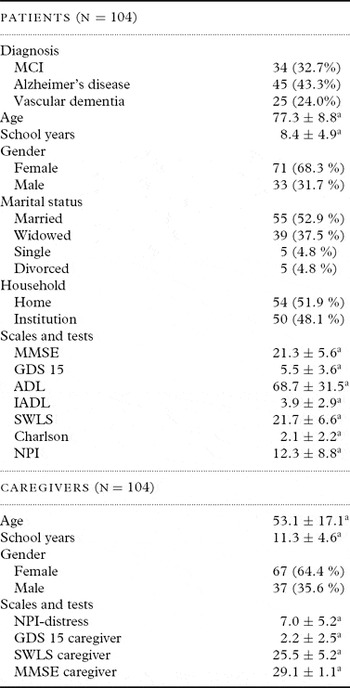
The sociodemographic characteristics of the study sample are shown in Table 2 (n = 104 patient/caregiver pairs). Patients mean age was 77.3 (±8.8) years. Most patients and caregivers were female. Caregivers were mainly family members (spouses 36%, other family member 20%), and in 44% of the cases a professional caregiver was enrolled.
Patients and caregivers sociodemographic and clinical characteristics
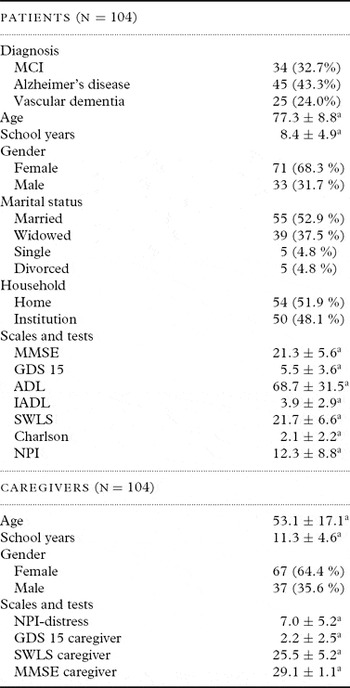
aMean ± standard deviation.
MCI = mild cognitive impairment; MMSE = Mini-Mental State Examination; GDS 15 = Geriatric Depression Scale 15 items; ADL = Barthel Index of Activities of Daily living; IADL = Lawton and Brody Instrumental Activities of Daily Living scale; SWLS = Satisfaction with Life Scale; Charlson = Charlson Comorbidity Index; NPI = Neuropsychiatric Inventory; NPI-distress = Neuropsychiatric Inventory Caregiver Distress.
Feasibility/acceptability data
There were no refusals to participate, and all QOL-AD questionnaires were valid (answer to one item was missing in 12 patient and 8 caregiver questionnaires).
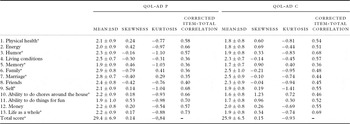
QOL-AD scores were as follows: for patient-rated QOL-AD: 29.4(±6.9) (observed range 17–46); for caregiver-rated QOL-AD: 25.9(±6.5) (observed range 13–39) (Table 3). Patient ratings were significantly higher than caregiver ratings (Student's t (103) = 4.301, p < 0.001). Distributions of the total scores showed no floor (1% for patient-rated QOL-AD, 0% in the other scores) or ceiling effects (0% in all scores).
QOL-AD scores distribution and item reliability

*Items with significant differences between patient and caregiver ratings, Student's t-test, p < 0.05.
QOL-AD p = QOL-AD patient report score; QOL-AD c = QOL-AD caregiver report score.
The measures of central tendency and symmetry were within the acceptable limits: the distribution of the total scores and individual item responses revealed skewness and kurtosis usually between −1.0 and 1.0 (Table 3).
Reliability
The reliability analysis revealed QOL-AD Cronbach's α of 0.867 for patient report and 0.858 for caregiver report. The group with MCI had Cronbach's αof 0.881 for patient and 0.793 for caregiver; for the dementia group Cronbach's α was 0.863 for patient and 0.872 for caregiver. The corrected item–total correlation showed values ≥ 0.4 in the large majority of the items (Table 3).
Test–retest QOL-AD patient ICC was 0.916 (95% CI = 0.803–0.966, p < 0.001) and test–retest QOL-AD caregiver ICC 0.923 (95% CI = 0.819–0.968, p < 0.001), corresponding to a high test–retest stability.
The agreement between QOL-AD ratings completed by the patient and the caregiver was positive but low. The ICC values were 0.258 (95% CI = 0.070–0.429, p = 0.004) for consistency and 0.229 (95% CI = 0.046–0.399, p = 0.004) for absolute agreement.
Construct validity
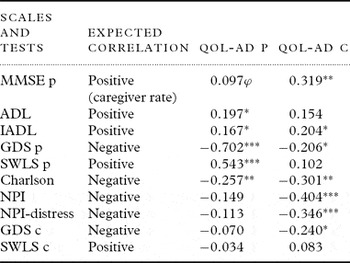
Convergent and divergent validity results are shown in Table 4. Patient-reported QOL-AD correlated most significantly with lower levels of patient depressive symptoms and higher satisfaction with life. Caregiver ratings revealed moderate but highly significant correlations with lower neuropsychiatric symptoms and lower caregiver distress. QOL-AD total scores correlated most strongly with patient factors (depressive symptoms and satisfaction with life). Patient cognition is not correlated to patient-reported QOL.
Convergent/divergent validity of QOL-AD. Spearman's ρ correlation of QOL-AD scores with other measures

*p < 0.05; **p < 0.01; ***p < 0.001; ϕ = divergent validity.
MMSE = Mini-Mental State Examination; GDS = Geriatric Depression Scale 15 items; ADL = Barthel Index of Activities of Daily living; IADL = Lawton and Brody Instrumental Activities of Daily Living Scale; SWLS = Satisfaction with Life Scale; Charlson = Charlson Comorbidity Index; NPI = Neuropsychiatric Inventory; NPI-distress = Neuropsychiatric Inventory Caregiver Distress; p = patient; c = caregiver.
Comparisons of QOL-AD in different groups
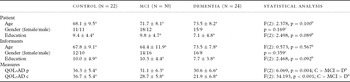
Differences in QOL-AD among the comparison group of participants without cognitive impairment, the MCI group, and the dementia group are shown in Table 5. As previously stated, this analysis involved a sub-group of community-dwelling patients. There were no significant differences in demographic characteristics among the three groups. The QOL-AD patient rating was higher in patients without cognitive impairment as compared with both patients with MCI and patients with dementia. The QOL-AD informant rating was significantly different among the three groups, with better QOL for individuals with no cognitive impairment, intermediate for patients with MCI, and lower for patients with dementia (Table 5).
Comparison of QOL-AD scores in different groups (community-dwelling participants without cognitive impairment (“control”), patients with MCI, and patients with dementia)

aMean±SD; bANOVA one-way, followed by Bonferroni post hoc analysis when appropiate; cChi-square.
MCI = mild cognitive impairment; p = patient; c = caregiver; QOL-AD = Quality of Life–Alzheimer's Disease.
Discussion
QOL is an important outcome measure in dementia studies (Mack and Whitehouse, Reference Mack and Whitehouse2001) and generic QOL assessment tools are not adapted to the specificity of the patient with dementia (Naglie, Reference Naglie2007). In Portugal, there was not any validated scale for QOL assessment in dementia patients. After the review of the existing instruments, QOL-AD emerged as a promising tool, due to the inclusion of both the patient's and caregiver's opinions on QOL assessment, simplicity, strong psychometric properties, adaptability to different cultures and care contexts (Logsdon et al., Reference Logsdon, Gibbons, McCurry and Teri2002; Scholzel-Dorenbos et al., Reference Scholzel-Dorenbos2007). These features make it useful in research, as well as in clinical practice. So we translated and validated the QOL-AD in Portugal. To allow better comparison of the results, the original validation protocol (Logsdon et al., Reference Logsdon, Gibbons, McCurry and Teri2002) and subsequent validation studies were analyzed, and a similar approach followed.
The version obtained after state-of-the-art translation and adaptation procedures was tested in patients with cognitive impairment and MMSE ≥ 10, since the results of previous validation studies revealed more consistent results in this patient group (Logsdon et al., Reference Logsdon, Gibbons, McCurry and Teri2002; Léon-Salas et al., Reference Léon-Salas, Logsdon, Olazarán and Martínez-Martín2011).
Acceptability results are particularly important for the use in clinical practice. The present results were quite promising from this point of view. There were no refusals to participate and all the questionnaires were suitable for analysis. These results are better than those described in other studies where no MMSE limit was defined as inclusion criteria (Logsdon et al., Reference Logsdon, Gibbons, McCurry and Teri2002; Hoe et al., Reference Hoe, Hancock, Livingston and Orrell2006; Léon-Salas et al., Reference Léon-Salas, Logsdon, Olazarán and Martínez-Martín2011), and are probably related to better patient cognitive status. Reviewing questionnaires with the caregivers had the advantage of clarifying doubts and help prevent missing data. Future research and clinical practice should use this approach as a standard part of administration.
The large majority of the items revealed symmetry, dispersion indexes, and item-to-total correlation, within acceptable limits, which strengthens the idea that the items are adequate. High internal consistency was observed, as in other studies (Table 1), and it was not affected by the severity of cognitive impairment (being very good both in the group with MCI and in the group with mild–moderate dementia). The test–retest stability for the total score of the scale (at two weeks) was excellent, either for the patient or the caregiver version. The selection of a clinically stable population in long-term care probably contributed to improve test–retest experimental conditions, allowing for an adequate exploration of the reliability of the scale.
We found significantly lower results for proxy-rated QOL than for patient-rated QOL. These results are consistent with the vast majority of studies on self- and proxy-rated QOL, either in persons with dementia (for a recent and thorough review see Banerjee et al., Reference Banerjee, Samsi, Petrie, Alvir and Treglia2009) or in healthy elderly adults (Lapid et al., Reference Lapid2011). These results are independent of the application method of the scale. Selai et al. described similar results with Quality of Life Assessment Schedule, a patient-/caregiver-rated measure of QOL applied to both patient and caregiver in interview format (Selai et al., Reference Selai, Trimble, Rossor and Richard2001).
QOL is a complex and broad concept, reflecting the way the individual appraises several internal and external factors of his or her own life (Byrne-Davis et al., Reference Byrne-Davis, Bennett and Wilcock2006). Feelings of self-efficacy and coping mechanisms in the face of apparent losses may not be apparent to the caregiver (Carr et al., Reference Carr, Gibson and Robinson2001). Besides, in dementia, a lack of insight also plays a role in QOL evaluation by the individual (Hurt et al., Reference Hurt, Banerjee and Tunnard2010). Therefore, some differences in self- and proxy-rated QOL are predictable, as well as a distinct correlation pattern with other constructs. All these factors contribute to strengthen the need to evaluate self-rated QOL, taking into account that this evaluation is reliable. However, in our view, the difference between patient and caregiver scoring of patients’ QOL, and the different factors associated with these different perspectives, should not be considered “errors of evaluation” by the caregiver. As in other diseases that decrease autonomy, in dementia it is not possible to look independently at the patient: the patient and the caregiver form a dyad that must be evaluated together. Furthermore, caregivers’ views on the patient should be analyzed and carefully understood, in order to develop feasible and effective measures to improve the patient QOL (Logsdon et al., Reference Logsdon, McCurry and Teri2007).
The correlations found between patient self-evaluated QOL-AD and depressive symptoms, satisfaction with life, functionality (basic and instrumental activities of daily living), and presence of comorbidities are consistent with the theoretical construct (Lawton, Reference Lawton1994; Jonker et al., Reference Jonker, Gerritsen, Bosboom and Steen2004; Byrne-Davis et al., Reference Byrne-Davis, Bennett and Wilcock2006) and other studies with QOL-AD (Table 1). No association was found between the patient-rated QOL and cognitive status, in accordance with the majority of studies using different scales of QOL in dementia (Banerjee et al., Reference Banerjee, Samsi, Petrie, Alvir and Treglia2009).
Different correlations were found for caregiver-reported QOL-AD (Table 4). Caregiver ratings were mostly influenced by the presence of neuropsychiatric symptoms in the patients, caregiver distress, lower cognitive status, and higher patient comorbidities. These convergent validity results for caregiver-rated QOL-AD are consistent with the findings of other validation studies, as mentioned in Table 1.
QOL-AD ratings in the groups without cognitive impairment, MCI, and dementia were also compared and tested. Self-QOL ratings were significantly lower in patients with cognitive deficit than in participants without cognitive impairment. Caregiver ratings were also significantly different among participants without cognitive impairment, patients with MCI, and patients with dementia, being progressively lower with worsening cognitive deficit. This result is consistent with findings from Rosas-Carrasco et al. (Reference Rosas-Carrasco, Torres-Arreola, Guerra-Silla, Torres-Carrasco and Gutiérrez-Robledo2010) in a similar population.
Some limitations in the present study are recognized. A convenience sample in the Lisbon area was selected, so the results may not be generalized to the whole population. Patients with different diagnoses and distinct residential settings were included. Despite this, we obtained strong psychometric results that compare favorably with previous studies (Table 1). Including professional caregivers, in cases where no family caregiver fulfilled the inclusion criteria, can also be considered a limitation. Professional caregivers have been involved in studies on QOL in dementia mainly in long-term care or nursing homes and have been confirmed as reliable raters of patient QOL (Hoe et al., Reference Hoe, Hancock, Livingston and Orrell2006). Moreover, recent studies with QOL-AD have compared the proxy QOL rating by family members and professional caregivers, concluding that family and professional ratings tend to correlate to each other, but not to the patients ratings (Gómez-Gallego et al., Reference Gómez-Gallego, Gómez-Amor and Gómez-Garcia2012). This topic should receive further attention in future studies, since a large proportion of patients with dementia are cared for by professional caregivers.
Nonetheless, further studies will be needed to deepen the knowledge on QOL in patients with cognitive impairment due to MCI or dementia in the Portuguese cultural context.
In conclusion, we carried out the translation, cultural adaptation, and validation of the QOL-AD scale for European Portuguese, following international recommendations. The version obtained has proved suitable to the needs of patients with cognitive impairment. The psychometric properties of acceptability, reliability, and validity seem globally strong and encouraging. The Portuguese version of QOL-AD is proposed as a valuable tool for researchers and clinicians in the care for patients with dementia in Portugal.
Conflict of interest
None
Description of authors' roles
H. Bárrios, A. Verdelho, and A. de Mendonça designed the study. R. Logsdon participated in study design. H. Bárrios and S. Narciso participated and supervised data collection. H. Bárrios and A. de Mendonça analyzed the data and wrote the manuscript. A. Verdelho, M. Gonçalves Pereira, R. Logsdon assisted in study design and writing the paper. All authors approved the final version of the manuscript.
Acknowledgments
We are grateful to all the participants in the study for their collaboration, and to the colleagues of the Dementia Group and Laboratory of Language at Institute of Molecular Medicine, Faculty of Medicine University of Lisbon for their valuable contributions, and help with data collection. We thank Hospital de Santa Maria, Memoclínica and Hospital do Mar for the facilities provided.