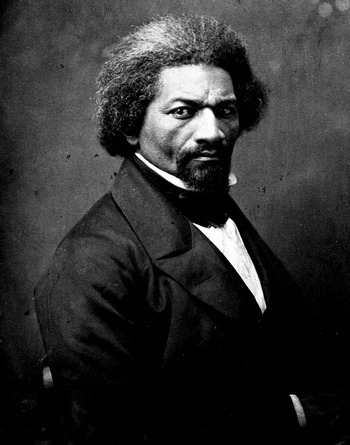
Once [you] let the black man get upon his person the brass letter, U. S., let him get an eagle on his button, and a musket on his shoulder and bullets in his pocket; and there is no power on the earth, or under the earth, which can deny that he has earned the right to citizenship in the United States.
Frederick DouglassFootnote 1I feel more inclined daily, to press the army on further and further; and, let my opposition be in life what it will, I do firmly vow, that I will fight as long as a star can be seen and if it should be my lot to be cut down in battle, I do believe … that my soul will be forever at rest.
Sergeant Charles BrownFootnote 2With these words both Frederick Douglass and Sergeant Charles Brown frame an image of patriotism and manhood around the black Civil War soldier. In reading these words, these “images” from the Civil War, in this way, a contemporary reader can imagine in a moment the sense of bravery and pride that existed in the act of pinning and wearing the emblematic eagle and the brass button. In this essay I discuss portraits of black soldiers made both in photographic studios and in campgrounds that connect to the ideas of democracy and patriotism as expressed in the words of Frederick Douglass. I also hope to highlight the numerous acts of courage, and their rewards, as well point to the low points for black soldiers in the war. From inequities in pay to discriminatory practices in the field, and from inadequate health services to the shared experiences of all soldiers, I hope to build on the story the portraits tell, to shine a light on the hopefulness of black soldiers, the sense of what could be won out of loss.
These images of African American soldiers help to form a richer history and understanding of the importance of photography in telling the broader history of the black soldier in the war. In presenting these pictures, I hope to engage the reader in the expressive act of portrait making and how dreams of freedom and emancipation could be both imagined and made possible through a photographer's lens.
On 21 December 1860, the State of South Carolina formally seceded from the Union in response to Abraham Lincoln's election as President, an act that effectively ignited the flame that would become the War between the States. Seven states joined South Carolina to form the Confederacy; four more states seceded after the war began in April 1861. Immediately upon his inauguration, President Lincoln called for 75,000 new troops for the Union Army; African American men were excluded from this initial call-up. Many black men who would eventually fight for the Union had to protest to the government to allow them to serve. There were draft riots in New York City, and generalized unrest across the northern states, in which white men complained that they were dying in large numbers while black men didn't have to fight and die. This was a potent argument; as the war waged on and manpower became scarce, the administration began to eagerly recruit African American soldiers.
Before the war, a good number of free black men, including farmers, religious leaders, and abolitionists, were activists against slavery and in the cause of having black servicemen in the military; they understood how vital it was that African Americans be engaged fully as citizens. That black men be allowed to serve, and fight, was never more critical, given the realities of the war, to end slavery and preserve the Union. When the call came, black soldiers enlisted with pride and were deeply moved by the grand send-offs from their hometowns. The outpouring of support and good wishes that came from both races in their communities was unlike anything they had experienced before – such as when New York's 20th United States Colored Troops (USCT) left for the war after completing basic training:
By the end of 1863, some 37,000 African-Americans had enlisted in the Union Army, in fifty-eight segregated regiments known as the United States Colored Troops. Another 3,200 served in the Union navy on fully integrated warships. In three years of combat and supporting duties approximately one in five of the African-Americans who fought lost their lives for the nation.Footnote 3
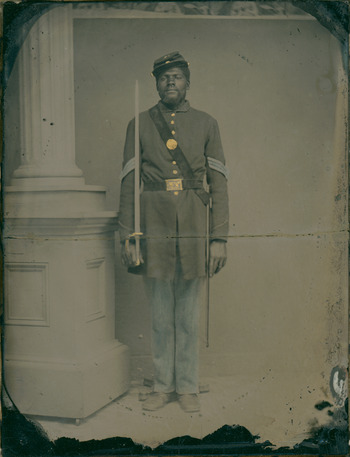
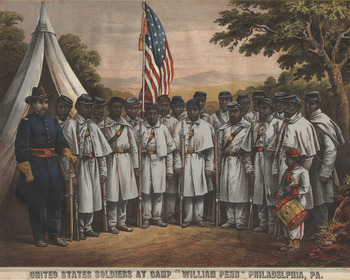
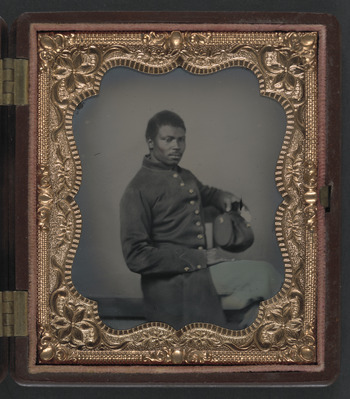
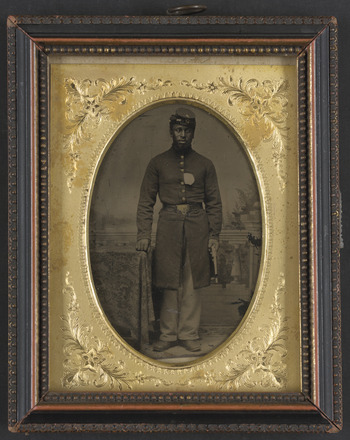
One of their first gestures in proving their worthiness as soldiers and fighters was to stand in front of the camera and to be photographed, to be depicted as men who had made a choice – a choice of freedom. As soon as they were given uniforms, from forage caps to weapons, they posed holding their arms. Whether standing alone, or in a group, they held flags, rifles, and banners, while looking directly into the camera lens – as if sending a message of undeniable patriotism. The visual narrative suggests their sense of commitment and courage.
They came from every state in the Union and from Canada. Some escaped from enslavement to join the war effort once the government made it legal for black men to serve. Others were free men who joined the military specifically to fight for an end to slavery. At Camp Belger in Carroll County, Maryland, Christian Fleetwood signed with the 4th United States Colored Infantry and was issued a
forage cap, or kepi, bearing a brass bugle and, above it, the numeral 4; one uniform coat of dark blue wool; one overcoat; one pair of light blue woolen trousers; one pair of bootees, or brogans; two pairs of drawers; two pairs of stockings; two shirts; one knapsack; one canteen; one haversack, a case for carrying rations; one cartridge box; one cap pouch; and two blankets, one of wool, the other rubber.Footnote 4
Men (free and enslaved) left their wives and families to fight and, like Fleetwood, walked into photo studios carrying and wearing the items they'd been issued.
John Boston, enslaved in Maryland, left his owner and joined a New York regiment of the Union Army. In a letter to his wife he described his quest:
Uptown Hill [Va.]
January the 12 1862
My Dear Wife
It is with grate joy I take this time to let you know Whare I am. I am now in Safety in the 14the Regiment of Brooklyn. Th Day I can Adress you thank god as a free man. I had a little truble in getting away But as the lord led the Children of Isrel to the land of Canon So he led me to a land Whare freedom will rain in spite of earth and hell
Dear you must make your Self content I am free from al the Slavers Lash and as you have chose to Wise plan of Serving the lord I hope you Will pray Much and I will try by the help of god To Serv him With all my hart. I am With a very nice man and have All that hart Can Wish But My Dear I cant express my grate desire that I Have to See you.
I trust the time Will come When we Shal meet again. And if We don't meet on earth We Will Meet in heven Whare Jesas ranes. Dear Elizabethe tell Mrs. Ow[e]n[s] that I trust that She Will Continue her Kindess to you and that god Will Bless her on earth and Save her in grate eternity. My Acomplemnts to Mr. Owens and her Children may They Prosper through life. I never Shall forgit her kindess to me. Dear Wife I must Close rest yourself. Contented I am free. I Want you to rite to me Soon as you Can Without Delay. Direct your letter to the 14th Regiment New York State Militia Uptowns Hill Virginia. In Care of Mr. Cranford Comary. Write my Dear Soon as you C
Your Affectionate Husban Kiss Daniel For me
John BostonFootnote 5
This letter reveals the difficult choices enslaved men had to make as self-emancipators – to leave their families to perhaps years of enslavement and brutal torture. They were sometimes able to join local regiments. The 54th Regiment Massachusetts Volunteer Infantry is a case in point. Massachusetts did not have a large African American male population, for instance, so anti-slavery activist and orator Frederick Douglass put out a call for black men to join the ranks. Posters were circulated that offered a hundred dollars at the end of one's service, pay of thirteen dollars a month, and state aid to families. While some men made the journey to Massachusetts so that they could fight, others enlisted in force in their home and neighboring states:
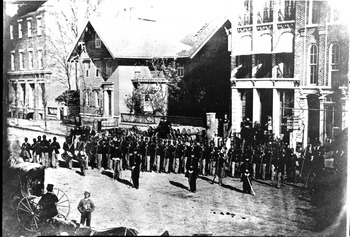
This … photograph [Figure 10] shows members of the 127th Ohio Volunteer Infantry, the first African American regiment recruited in Ohio during the Civil War. The regiment was formed in 1863, and was subsequently designated as the 5th Regiment, United States Colored Troops. The photograph was taken in Delaware, Ohio, on Sandusky Street near the Ft. Delaware Hotel. In May 1863, Massachusetts became the first state to organize a regiment of African Americans. Because Ohio did not then allow black men to join its regiments, many Ohioans enlisted in the 54th and 55th Massachusetts Regiments. In the summer of 1863, Ohio Governor David Tod authorized the recruitment of African Americans, and the 127th was formed in Delaware, Ohio, between August and November 1863 as an African American regiment organized under white officers.Footnote 6
The Ohio census of 1860 shows that the black male population between the ages of fifteen and forty was 7,100, yet the federal enlistment records indicate that more than 5,900 men joined the Union Army from Ohio. While some made the journey to Ohio from Kentucky and Indiana, these numbers show how much African Americans contributed to the war as soldiers, and how many made the ultimate sacrifice. During the war years, “on the Union side, 604,000 combatants were wounded, of whom 360,000 died; of the Confederacy, 480,000 soldiers were wounded and 244,000 died. For every combat casualty, two soldiers suffered from disease. Medical illness, especially infectious disease, resulted in more deaths during the war than combat.”Footnote 7 Some 30,000 black soldiers died of various diseases during the war, from smallpox to dysentery.
Black presence and participation in the Confederate army are, of course, a much more nuanced and complex story. But the portraits of black soldiers tells us so much.
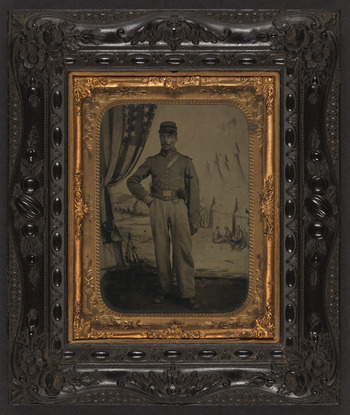
The wartime photographic experience – making portraits of soldiers in uniform in front of backdrops that illustrated battlegrounds – was designed to communicate with and engage the viewer in ideas of citizenship and self-representation. For the soldiers, the very act of having their portraits made both represents and embodies freedom. The photographers’ understanding of battle is revealed by their use of painted studio backdrops, which foregrounded an idealized battlefield to create a specific narrative of bravery. Both the soldiers and the photographers were invested in how their images were made, used, displayed, and distributed. These points are key in recognizing how some of the photographers regarded black people's interests in their own images and image making. The transformations that took place in the first twenty-five years of photography are key as there were ongoing changes to the medium over time – from cased images to paper prints to the photographic album to the dissemination of images.
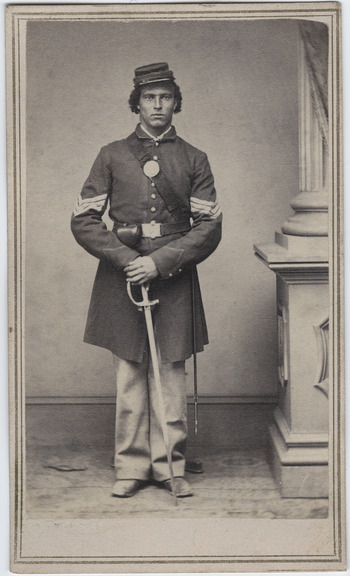
In capturing the experience of war, photography reveals the character of the black Union soldier and his quest for full citizenship, and documents the quest for freedom among free and enslaved black Americans. Some photographers traveled great distances to photograph soldiers in military camps, while others preserved the memories of the war through souvenir photographs and other visual memorabilia in their home studios. They provided a curious public with full-length and three-quarter-length portraits of black soldiers standing in front of flags, holding their weapons and gear. Heroism is projected by such images, including a hand-colored ambrotype of a twenty-three-year-old farmer from Adrian, Michigan named Sergeant Henry F. Steward, a tall young soldier standing next to a pillar holding a sword upright at his side. Sergeant Steward enlisted on 4 April 1863, and was mustered in (formerly inducted) on 23 April. A noncommissioned officer, as were all black officers, Steward was actively engaged in the recruiting of soldiers for the regiment. He died of disease at the regimental hospital on Morris Island, South Carolina on 27 September 1863, and his estate was paid a fifty-dollar state bounty.Footnote 8
Many black soldiers served the Union Army as servants and laborers during the war, while others fought on battlefields; the visual narrative explored their commitment and courage. While most African American men were presented as hyper-masculine, a few wrote that they were discontent with their menial roles. James Henry Gooding, a corporal in the 54th Massachusetts, complained to President Lincoln from Morris Island, South Carolina on 28 September 1863:
Your Excellency, Abraham Lincoln:
Your Excellency will pardon the presumption of an humble individual like myself, in addressing you, but the earnest solicitation of my comrades in arms besides the genuine interest felt by myself in the matter is my excuse, for placing before the Executive head of the Nation our Common Grievance.
On the 6th of the last Month, the Paymaster of the Department informed us, that if we would decide to receive the sum of $10 (ten dollars) per month, he would come and pay us that sum, but that, on the sitting of Congress, the Regt. [regiment] would, in his opinion, be allowed the other 3 (three). He did not give us any guarantee that this would be, as he hoped; certainly he had no authority for making any such guarantee, and we cannot suppose him acting in any way interested.
Now the main question is, are we Soldiers, or are we Laborers? We are fully armed, and equipped, have done all the various duties pertaining to a Soldier's life, have conducted ourselves to the complete satisfaction of General Officers, who were, if anything, prejudiced against us, but who now accord us all the encouragement and honors due us; have shared the perils and labor of reducing the first stronghold that flaunted a Traitor Flag; and more, Mr. President, today the Anglo Saxon Mother, Wife, or Sister are not alone in tears for departed Sons, Husbands, and Brothers. The patient, trusting descendant of Africa's Clime have dyed the ground with blood, in defence of the Union, and Democracy. Men, too, your Excellency, who know in a measure the cruelties of the iron heel of oppression, which in years gone by, the very power their blood is now being spilled to maintain, ever ground them in the dust.
But when the war trumpet sounded o'er the land, when men knew not the Friend from the Traitor, the black man laid his life at the altar of the Nation, – and he was refused. When the arms of the Union were beaten, in the first year of the war, and the Executive called for more food for its ravenous maw, again the black man begged the privilege of aiding his country in her need, to be again refused.
And now he is in the War, and how has he conducted himself? Let their dusky forms rise up, out of the mires of James Island, and give the answer. Let the rich mould around Wagner's parapet be upturned, and there will be found an eloquent answer. Obedient and patient and solid as a wall are they. All we lack is a paler hue and a better acquaintance with the alphabet.
Now your Excellency, we have done a Soldier's duty. Why can't we have a Soldier's pay? You caution the Rebel chieftain, that the United States knows no distinction in her soldiers. She insists on having all her soldiers of whatever creed or color, to be treated according to the usages of War. Now if the United States exacts uniformity of treatment of her soldiers from the insurgents, would it not be well and consistent to set the example herself by paying all her soldiers alike?
We of this Regt. were not enlisted under any “contraband” act. But we do not wish to be understood as rating our service of more value to the Government than the service of the ex-slave. Their service is undoubtedly worth much to the Nation, but Congress made express provision touching their case, as slaves freed by military necessity, and assuming the Government to be their temporary Guardian. Not so with us. Freemen by birth and consequently having the advantage of thinking and acting for ourselves so far as the Laws would allow us, we do not consider ourselves fit subjects for the Contraband act.
We appeal to you, Sir, as the Executive of the Nation, to have us justly dealt with. The Regt. do pray that they be assured their service will be fairly appreciated by paying them as American Soldiers, not as menial hirelings. Black men, you may well know, are poor; three dollars per month, for a year, will supply their needy wives and little ones with fuel. If you, as Chief Magistrate of the Nation, will assure us of our whole pay, we are content. Our Patriotism, our enthusiasm will have a new impetus, to exert our energy more and more to aid our Country. Not that our hearts ever flagged in devotion, spite the evident apathy displayed in our behalf, but we feel as though our country spurned us, now we are sworn to serve her. Please give this a moment's attention.
James Henry GoodingFootnote 9
Milton Holland, another soldier who fought in the 5th US Colored Infantry, was characterized as “brave, aggressive, fearless, uncompromising”Footnote 10 when he fought at Petersburg and Richmond. The evidence of the commitment that black soldiers had in achieving full citizenship is found in their own words and images. Holland enlisted as a free man on 19 April 1861, at the start of the Civil War, and recruited a company of men to join him. He wrote a letter to the Athens, Ohio newspaper that had been taken over by (Colonel Nelson H.) Van Voorhees, for whom Holland had worked at the 3rd Ohio Volunteer Infantry Regiment.
Norfolk, Va.
Jan. 19, 1864
Dear Messenger:
You will be reminded of the company of colored soldiers raised by myself in the county of Athens, and taken to Camp Delaware, 25 miles north of Columbus, on the Olentangy. It has since been mustered into the service in the 5th Regt. U. S. Colored Troops. The regiment is organized, and has been in active service for three months. Our company is C – the color company – in which you may remember of the flag presentation, made by the kind citizens of Athens, through Mr. Moore, at which Mr. [John Mercer] Langston was present and received it, pledging in behalf of the company, that they would ever be true to the flag, though it might be tattered or torn by hard service, it should never be disgraced. I am happy to say that those colors have been used as the regimental colors for several months, and we had the honor of forming the first line of battle under their floating stars. We now have new regimental colors, and the old ones are laid away in my cabin, and I am sitting now beneath them writing.
The regiment though young, has been in one engagement. The men stood nobly and faced the cowardly foe when they were hid in the swamp firing upon them. They stood like men, and when ordered to charge, went in with a yell, and came out victorious, losing four killed and several wounded. The rebel loss is large, as compared with ours. As for company C she played her part admirably in the charge. Our 4th sergeant, Charles G. Stark, is said to have killed the picket guard while in the act of running away.
I must say of the 5th, that after twenty days of hard scouting, without overcoats or blankets, they returned home to camp, which the soldiers term their home, making twenty-five and thirty miles per day. Several of the white cavalry told me that no soldiers have ever done as hard marching through swamps and marshes as cheerfully as we did, and that if they had to follow us for any length of time it would kill their horses. During that raid, thousands of slaves belonging to rebel masters were liberated. You are aware that the colored man makes no distinction in regard to persons, so I may say all belonging to slaveholders were liberated. We hung one guerilla dead, by the neck, by order of Brig. Gen. E[dward] A. Wild, a noble and brave man, commanding colored troops – the right man in the right place. He has but one arm, having lost his left one at the battle of Antietam, but with his revolver in hand, he was at the head of our regiment cheering us on to victory.
One of the boys belong to Co. D was captured and hung. He was found by our cavalry pickets yesterday and is to be buried today. We hold one of their “fair daughters,” as they term them, for the good behavior of her husband, who is a guerilla officer, toward our beloved soldiers. The soldier was found with a note pinned to his flesh. Before this war ends we will pin their sentences to them with Uncle Sam's leaden pills.
The boys are generally well, and satisfied that though they are deprived of all the comforts of home, and laboring under great disadvantages as regards pay and having families to support upon less wages than white soldiers, still trust that when they do return they will be crowned with honors, and a happier home prepared for them, when they will be free from the abuses of northern and southern fire-eaters. Though we should fall struggling in our blood for right and justice, for the freedom of our brothers in bondage, or fall in defense of our national color, the Stars and Stripes, our home and fireside will ever be protected by our old friend Gov. [David] Tod, by the loyalty of Abraham Lincoln, our Moses, and the all-wise God that created us. Friends at home be cheerful, cast aside all mercenary compensation. Spring forth to the call and show to the world that you are men. You have thus far shown, and still continue to show yourselves worthy of freedom, and you will win the respect of the whole nation. There is a brighter day coming for the colored man, and he must sacrifice home comforts if necessary to speed the coming of that glorious day. I will close my letter in the language of the immortal Henry – ”Give me liberty, or give me death!”
Yours truly,
Milton M. Holland
O. S., Co. C, 5th U.S.C. T.Footnote 11
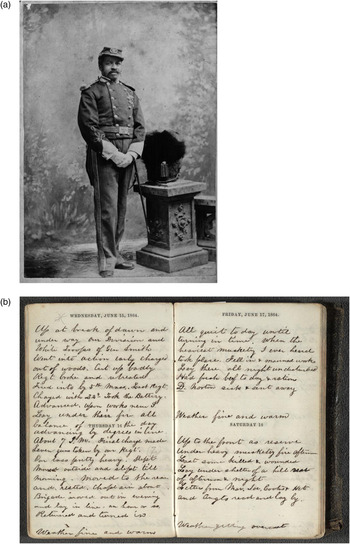
Many of the personal letters and other correspondence solicit profound readings of the images presented in this essay, including Christian A. Fleetwood's diary entry about the Union attack on Petersburg:Footnote 12
WEDNESDAY, JUNE 15, 1864
Up at break of dawn and
under way our Division and
White Troops of Gen Smith
Went into action early charged
Out of woods. Cut up badly
Regt. broke and retreated Regt: Regiment
Fired into by 5th Mass. Last Regt
Charged with 22nd – Took the Battery.
Advanced. Upon works new &
Lay under their fire all
balance of THURSDAY 16 the day
advancing by degrees in line
About 7 P. M. Final charge made
Seven guns taken by our Regt.
Our loss pretty heavy. Slept
Moved outside and slept till
Morning. Moved to the rear
and rested. Chaplain about.
Brigade moved out in evening
and lay in line an hour or so.
Returned and turned in.
Weather fine and warm
Christian A. FleetwoodFootnote 13
A black soldier from Missouri wrote,
[Benton Barracks Hospital, St. Louis, MO, 3 September 1864]
My Children I take my pen in hand to rite you A few lines to let you know that I have not forgot you and that I want to see you as bad as ever now my Dear Children I want you to be contented with whatever may be your lots be assured that I will have you if it cost me my life on the 28th of the mounth. 8 hundred White and 8 hundred blacke solders expects to start up the rivore to Glasgow and above there thats to be jeneraled by a jeneral that will give me both of you when they Come I expect to be with, them and expect to get you both in return. Dont be uneasy my children I expect to have you. If Diggs dont give you up this Government will and I feel confident that I will get you Your Miss Kaitty said that I tried to steal you But I'll let her know that god never intended for man to steal his own flesh and blood. If I had no cofidence in God I could have confidence in her But as it is If I ever had any Confidence in her I have none now and never expect to have And I want her to remember if she meets me with ten thousand soldiers she [will?] meet her enemy I once [thought] that I had some respect for them but now my respects is worn out and have no sympathy for Slaveholders. And as for her cristianantty I expect the Devil has Such in hell You tell her from me that She is the frist Christian that I ever hard say that a man could Steal his own child especially out of human bondage. You can tell her that She can hold to you as long as she can I never would expect to ask her again to let you come to me because I know that the devil has got her hot set againsts that that is write now my Dear children I am a going to close my letter to you Give my love to all enquiring friends tell them all that we are well and want to see them very much and Corra and Mary receive the greater part of it you sefves and dont think hard of us not sending you any thing I you father have a plenty for you when I see you Spott & Noah sends their love to both of you Oh! My Dear children how I do want to see you
[Spotswood Rice]Footnote 14
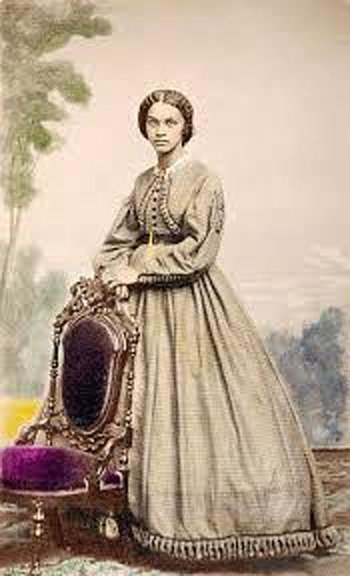
When connected to photographs, these written records not only help us understand what men in the nineteenth century thought about the war; they also help us to imagine the period, by illustrating the triumphs and defeats of historical events. A letter from Lewis Douglass to his fiancée, Helen “Amelia” Loguen, is particularly striking, as he describes the injuries of wounded soldiers from her hometown and at the same time reassures her about his own status. Loguen was the daughter of Reverend Jermain Loguen, a conductor on the underground railroad in Syracuse.Footnote 15
My Dear Amelia
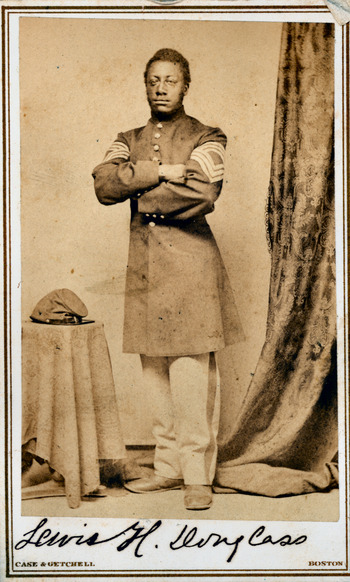
I have been in two fights, and am unhurt. I am about to go in another I believe to-night. Our men fought well on both occasions. The last was desperate we charged that terrible battery on Morris Island known as Fort Wagoner, and were repulsed with a loss of 3 killed and wounded. I escaped unhurt from amidst that perfect hail of shot and shell. It was terrible. I need not particularize the papers will give a better than I have time to give. My thoughts are with you often, you are as dear as ever, be good enough to remember it as I no doubt you will. As I said before we are on the eve of another fight and I am very busy and have just snatched a moment to write you. I must necessarily be brief. Should I fall in the next fight killed or wounded I hope to fall with my face to the foe.
If I survive I shall write you a long letter. DeForrest of your city is wounded, George Washington is missing, Jacob Carter is missing, Chas Reason wounded Chas Whiting, Chas Creamer all wounded. The above are in hospital.
This regiment has established its reputation as a fighting regiment not a man flinched, though it was a trying time. Men fell all around me. A shell would explode and clear a space of twenty feet, our men would close up again, but it was no use we had to retreat, which was a very hazardous undertaking. How I got out of that fight alive I cannot tell, but I am here. My Dear girl I hope again to see you. I must bid you farewell should I be killed. Remember if I die I die in a good cause. I wish we had a hundred thousand colored troops we would put an end to this war.
Good Bye to all Write soon Your own loving LewisFootnote 16
Lewis survived that battle but was diagnosed with typhoid and discharged from the army in 1864. He and Amelia married in 1869 in Syracuse, New York. The photographs and the visual analyses offered by the letters combine to offer the viewer or reader a dynamic visual history of the war and the importance of emancipation. Reading these descriptions, we can imagine the alliances that some of the black soldiers coveted; they also reveal the soldiers’ level of education and their commitment to the war.
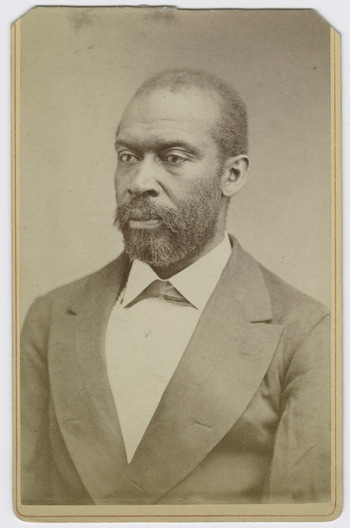
Other intriguing and informative sources include transcribed pension records, newspapers, and the published accounts of Thomas Morris Chester. Born free in Harrisburg, Pennsylvania, Chester was a journalist, attorney, and educator. The Civil War marked the first time that large numbers of reporters, artists, and photographers followed troops into battle.Footnote 17 In 1864, the thirty-five-year-old Chester worked as a reporter for the Philadelphia Press, possibly the only black American covering the Civil War for a major daily. He was in Richmond with the 25th Army Corps in 1865 when Union troops seized the Confederate capital among other war sites. Chester, the son of an oysterman and a self-emancipated woman from Baltimore, arrived in Richmond with black Union troops. He wrote that the sight of slaves greeting Union soldiers was “not only grand, but sublime.”Footnote 18 He also served as a recruiter and enlisted black men from Pennsylvania into the 54th and 55th Massachusetts Regiments. Chester's dispatches were the
only sustained eyewitness account of the activities of black soldiers around Richmond and Petersburg. Chester had a keen eye for detail. His reports, written under the nom de plume Rollin, frequently went beyond mere reporting of battles to include descriptions of how soldiers survived the ordeals of the war. He was particularly empathetic to the suffering soldier … His coverage of the treatment of injured and captured white officers and their black troops aimed to do more than praise their bravery, however; it showed the depth to which man could sink in his pursuit of morally indefensible causes.Footnote 19
Women played a crucial role in the war; mothers, girlfriends, and sisters nursed, mended clothing, cooked, fought, and taught literacy classes to soldiers and children. Contradictions abound regarding the roles of black women; however, historians and specialists continue to uncover evidence, like the little-known story of Cathay Williams,Footnote 20 a cook and laundress who masqueraded as a man using the name William Cathay. Williams is the only black woman identified as serving as a soldier in the Union Army,Footnote 21 joining the 8th Indiana Volunteer Infantry Regiment as early as 1861 at age seventeen. In a 2 January 1876 interview for the St. Louis Daily Times she recalled,
My Father a was a freeman, but my mother a slave, belonging to William Johnson, a wealthy farmer who lived at the time I was born near Independence, Jackson county, Missouri. While I was a small girl my master and family moved to Jefferson City. My master died there and when the war broke out and the United States soldiers came to Jefferson City they took me and other colored folks with them to Little Rock. Col. Benton of the 13th army corps was the officer that carried us off. I did not want to go. He wanted me to cook for the officers, but I had always been a house girl and did not know how to cook. I learned to cook after going to Little Rock and was with the army at The Battle of Pea Ridge. Afterwards the command moved over various portions of Arkansas and Louisiana. I saw the soldiers burn lots of cotton and was at Shreveport when the rebel gunboats were captured and burned on Red River. We afterwards went to New Orleans, then by way of the Gulf to Savannah Georgia, then to Macon and other places in the South. Finally I was sent to Washington City and at the time Gen. Sheridan made his raids in the Shenandoah valley I was cook and washwoman for his staff I was sent from Virginia to some place in Iowa and afterwards to Jefferson Barracks, where I remained some time. You will see by this paper that on the 15th day of November 1866 I enlisted in the United States army at St. Louis, in the Thirty-eighth United States Infantry Company A, Capt. Charles E. Clarke commanding. Captain Charles E. Clarke in the Civil War 6th Infantry at the Battle of Baton Rouge.
The regiment I joined wore the Zouave[Footnote 22 ] uniform and only two persons, a cousin and a particular friend, members of the regiment, knew that I was a woman. They never “blowed” on me. They were partly the cause of my joining the army. Another reason was I wanted to make my own living and not be dependent on relations or friends. Soon after I joined the army, I was taken with the small-pox and was sick at a hospital across the river from St. Louis, but as soon as I got well I joined my company in New Mexico … The men all wanted to get rid of me after they found out I was a woman. Some of them acted real bad to me.Footnote 23
Historian Ronald Coddington writes, “Thousands of slaves served their masters and masters’ sons in the Confederate Army before and after the ‘Black Republican’ in the White House, as some referred to President Abraham Lincoln, issued the Emancipation Proclamation. Many remained with their owners throughout the war.”Footnote 24 Disturbing and complex relationships between slave masters and enslaved soldiers reflect the mystery of the human condition.
Take, for example, two men, Silas Chandler and Confederate soldier Sergeant Andrew Martin Chandler, Company F, 44th Mississippi Infantry. A tintype portrait of the two men (see www.loc.gov/pictures/resource/ppss.00834) depicts Silas seated on a lower chair and Andrew sitting a head taller. The positioning clearly informs the viewer that Silas's status is inferior. However, both are well armed for battle. Andrew proudly holds a small pistol in his left hand, a Colt Single Action Army tucked in the belt of his Confederate uniform, and a short sword in his right hand. Silas's gaze is focused on the lens; he holds a musket in his left hand, a Bowie knife in his right, and a percussion single-shot pistol is slipped between the buttons of his jacket. The tintype represents a complexity of relationships during this history and symbolizes the conflicted loyalty between the two men.
Silas, fifteen years old at the time, received his free papers just before the war began, but chose to stay with his friend and followed him off to war. After the Battle of Shiloh, Andrew was thrown into a Union prison in Ohio. Silas ran back and forth from the prison to the Chandler homestead in Palo Alto, Mississippi, seeing to Andrew's essentials. The boy was soon released, and the two were excited to rejoin their outfit. During the fighting at Chickamauga, Andrew Chandler suffered a great wound to his leg, which the surgeons were ready to amputate. But Silas pulled out a gold coin that the boys had saved to buy some whiskey. Bribing the doctors to let Andrew go, he carried the injured boy on his back to the nearest train. They rode all the way to Atlanta in a boxcar. Once there, the hospital doctors saved the boy's leg and his life. Soon after, they returned to home to Palo Alto, where they continued their friendship until their deaths. Andrew gave Silas land to build a church for the black community and saw that his friend got his Confederate veteran's pension in 1878.Footnote 25
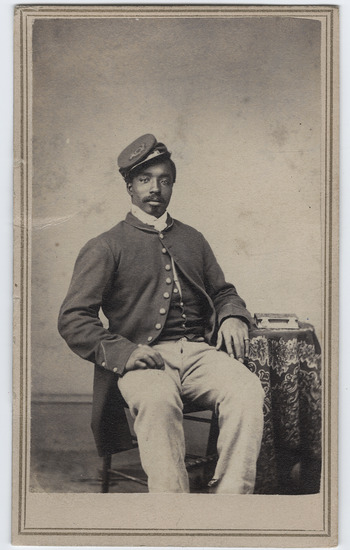
The images of black soldiers of the 108th Regiment of the USCT, produced at Rock Island, Illinois, in 1865 build a composite to this history. The cartes de visite from an album assembled by a white officer, Lieutenant T. F. Wright, show how black soldiers in his regiment were viewed, assessed, and admired. The photographers, Alfred B. Gayford and Conrad Speidel, operated a studio in Rock Island. The carte de visite was an unusual source for information; on the back of those in the Wright album (a unique group of thirty-one individual portraits of officers, noncommissioned officers, and enlisted men of Company F, 108th United States Colored Infantry, in the Randolph Linsly Simpson African-American collection, JWJ MSS 54, at http://brbl-dl.library.yale.edu/vufind/Record/3548096), we find such astonishing handwritten remarks as:
Corporal Rendwick Allen 108 UCST, now Sergeant and an excellent one, and commands obedience.
John Leech, First-rate soldier, prompt and obedient. His father brought him into me in Louisville.
Henry Lively, corporal. Best man in the company, born enslaved in Louisville, Kentucky; freed in summer of 1864 joined Company F of the 108th, mustered out and died at 38 of malaria six years later when he contracted [it] in in Vicksburg. His wife collected his pension, she was pregnant at the time and had another child with him. And two by her white owner.
Henry Price, Pvt., USCT 108, one of the cooks … does his duty faithfully to the satisfaction of the men.
Sergeant Alfred Jackson, USCT 108 – freeman in the army as teamster, is considered one of the best sergeants in the regiment.
Samuel Martin, Sergt. Com. 108 USCT, very light eyes and hair and light complexion … uses no tobacco or stimulant and of soldierly bearing, appreciated by his officers.
Daniel Hodgens, corp. USCT, a bartender and house servant, very bright and steady, can read and write.
Emmit Adams, reads well, makes the morning reports of the company and by his diligence and good conduct has won the esteem of his officers. He was a tobacconist.
The most telling and illuminating description is of James Roberts, described as a drummer in the 108th USCT and also as “a freeman, hard to manage … stubborn and reckless.”
Not everyone was pleased to see formerly enslaved men in uniform, which may be why Samuel Martin was described as being of “light complexion.” White masters and Confederate soldiers were outraged when they encountered self-emancipated men, men who could also be their blood brothers or own offspring. Obviously infuriated when he saw Calvin walking down the street in New Orleans on 23 June 1862, Benjamin Bronson wrote a letter of complaint.
Colonel F. S. Nickerson, Fourteenth Maine Regiment, U.S. A., Lafayette Square:
Dear Sir,
My slave Calvin, a light mulatto, absconded last Friday, 16th inst. On Saturday, as I was passing by Lafayette Square, I found the said slave, with a United States uniform on, standing guard just above the Brooks House on Camp Street, enlisted as a United States soldier, assuming to be a white man; and I have the documents to prove him a slave. I lay these facts before you, trusting you will give me every assistance to recover my lawful property.
Very respectfully,
B. Bronson,
Per E. W. Herrick, Carriage Repository,
74 Carondelet Street
The above slave being a very light color, it would be difficult matter for a stranger to recognize him as a colored man.
B. Bronson, Per E. W. Herrick
In his book A History of the Negro Troops in the War of the Rebellion, 1861–1865, noted historian George Washington Williams writes,
Having examined the case, General Butler issued the subjoined order:
Headquarters Department of the Gulf,
New Orleans, July 7, 1862
Colonel Nickerson, Fourteenth Maine Regiment:
Sir, It having been represented to the General Commanding that you have Enlisted a slave (nearly white) by the name of Calvin, the property of B. Bronson, Esq., who will be recognized and pointed out by Mr. E. W. Herrick, you will forthwith discharge him. This by order of the General Commanding.
By order of
Major-General B. F. Butler.
G. Weitzel, Lieut. U. S. Eng. and Asst. Military Commander.
Williams goes on to describe that in most cases like this one “the rebel slave-holders … dragged their human chattels from before the guns of the Union army!” – notwithstanding Secretary of State William Seward's 1861 order stating, “Persons thus employed and escaping are received into military protection of the United States, and their arrest as fugitives from service or labor should be immediately followed by the military arrest of the parties making the seizure.”Footnote 26
Mass-produced photographs of the war played a major role in visualizing this history:
In addition to the public demand for images of battlefields and newsmakers, photographers profited from the immense market for individual portraits of servicemen … This great demand for portraits was a natural consequence of the departure of hundreds of thousands of young men for the uncertainties of war. Soldiers routinely exchanged portraits with their loved ones before they left for war [and] then transmitted later images by mail. With death an unignorable reality, many soldiers sat repeatedly for portraits in order to ensure the longevity of at least their image and memory.Footnote 27
Scholars, educators, photographers, and other activists also find the retelling of this history in the collective work of exhibitions, displays, news stories, and organized campaigns to build monuments to this memory. An example is found in Daniel A. P. Murray's pamphlet concerning a balanced history on the activities of black soldiers in the civil war.
The pen of the historian has been used to almost exclude any reference to the service of Negro soldiers in the Union army. It is not known that any black men ever distinguished themselves as soldiers. None of the individual acts of unsurpassed bravery, courage, coolness, dash of the Negro regiments are recorded by those who have furnished us history.Footnote 28
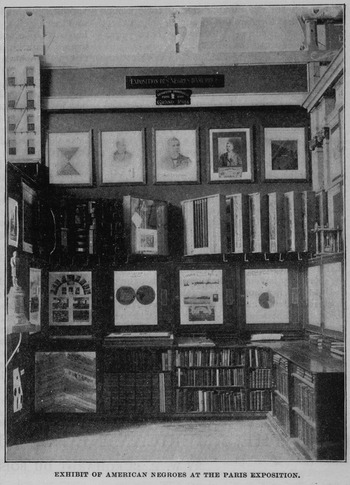
In 1900, Murray; W. E. B. Du Bois, sociologist and educator; Thomas J. Calloway, lawyer and educator; and Andrew F. Hilyer of the National Negro Business League noted this exclusion and included portraits of Medal of Honor recipients from the period of the Civil War in the Exposition des Nègres d'Amérique – the Exhibit of American Negroes – at the Universalle de Paris exposition in the Palace of Social Economy and Congresses. One of the points the distinguished scholars wanted to make with the exhibition was to “show ten things concerning the Negroes in America since their emancipation.”Footnote 29 Reporting on the exhibition installation, Calloway wrote,
Almost the first object seen in the Unites States negro exhibit, with figure and arms in the attitude of speaking, was the statuette of the famous negro scholar and orator, Frederick Douglas [sic] … In the last case to the right was a miscellaneous collection of photographs, charts, etc., showing medal-of-honor men, factories owned or operated by negroes … [and] the True Reformers of Richmond and views of negro soldiers.Footnote 30
The Exhibit of American Negroes was located in a small corner of the building and the display included charts, numerous photographs and albums, maps, 270 books, and more than 1,400 pamphlets focussing on African American history. Du Bois described the exhibit as “honest, straight-forward exhibit of a small nation of people, picturing their life and development without apology or gloss,”Footnote 31 and he included a composite portrait of fifteen Medal of Honor recipients from the American Civil War along with 363 photographs titled Types of American Negros, Georgia, U.S. A. and Negro Life in Georgia, U.S. A. The exposition judges awarded Du Bois a gold medal for his role as collaborator and compiler.
The exhibit provided names and photographs of the men, some in uniform, including
Sergeant William Carney, of Company C of the 54th Massachusetts Colored Infantry, who saved the regiment's flag from being captured; he was the first black soldier to be awarded the Congressional Medal of Honor
Sailor Robert Blake,[Footnote 32 ] rewarded for his bravery on the USS Marblehead
First Sergeant Powhatan Beaty, Company G, 5th USCT, who took charge after all officers had died or were wounded
Sergeant Major Christian A. Fleetwood of the 4th USCT, who rescued the banner when two colors guards had been shot down.
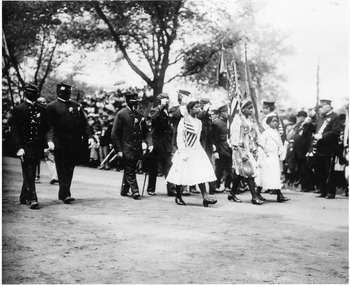
A number of these photographs of military men and scenes of the Civil War contain the quiet dignity found in the act of soldiering. The pride is also found in the photographs of parades and community celebrations honoring the veterans. There is a powerful connection between the photographs, diaries, and letters in the exhibition. Ironically, another exhibit at the Paris Exposition included the noted Shaw Memorial, sculptor Augustus Saint-Gaudens's tribute to Robert Gould Shaw and the 54th Massachusetts Regiment. As Lindsay Harris observes, it “made evident for international audiences the significance of Saint-Gaudens’ monument as a symbol of the New Negro, who had risen from slave to soldier during the Civil War and now faced the challenge of defining himself as an American citizen.”Footnote 33 The images on display in the exposition gave voice to the written record of the newly emerging black free class.
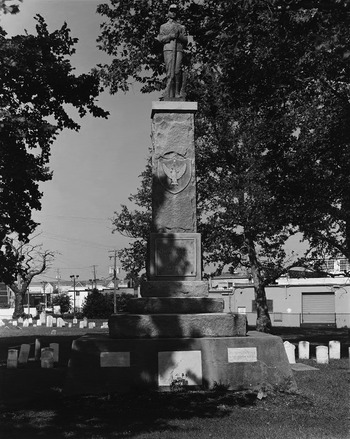
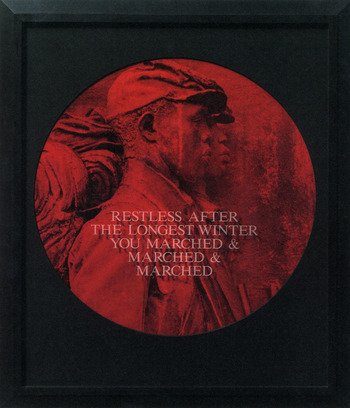
The role of portraiture has evolved since the nineteenth century; today, contemporary photographers like Carrie Mae Weems and William Williams reflect on the individual and community concerns of the Civil War soldier by revisiting monuments and sites – such as the Shaw Memorial and a statue of William Carney in Norfolk – that have had an impact on our collective history and memory. Weems and Williams create new stories about hope and freedom. The expressive act of self-fashioning and self-emancipation is seen in their works and the two monuments represent the idea of resistance.
Black soldiers fought in numerous battles – including those at New Market Heights and Chaffin's Farm, Petersburg, and Richmond, Virginia; Milliken's Bend, Louisiana; and Fort Wagner, James Island, and Honey Hill, South Carolina; and Olustee, Florida. For a number of years, William Williams has photographed the battlegrounds in an effort to document and reimagine the experience of the black Civil War soldier. Taken in 2004, some ninety years after Carney's death in 1908, Williams's photograph titled Sergeant Carney Monument, West Point Cemetery, Norfolk, Virginia captures his heroism and his bravery, positioning the uniformed Sergeant Carney atop a granite column, holding a rifle. The monument was completed in 1920 after twelve years of construction. The notion of resistance and recovering stories is key to these images, as Alan Trachtenberg notes:
The role of African Americans in the struggle against slavery has been long repressed by guardians of certain “official” and privileged versions of the American past. Racial prejudice has been the major cause of the expunging and erasure of the role of blacks in determining their own future. It remains in the interests of some groups vested in continuing and preserving racial inequality to portray African Americans as unable to take command of their own lives, as inherently subordinate.Footnote 34
Williams recognized this absence in history and had the tenacity to research and document to fill the gaps in history. In doing so he made remarkable photographs that revealed a concentrated effort to keep this memory ever-present.
In foregrounding the lived experience of black soldiers like Carney, Carrie Mae Weems's Restless after the Longest Winter You Marched & Marched & Marched, from the series From Here I Saw What Happened and I Cried, makes visible the individual experience through diaristic text etched on glass over a strikingly red-tinted print. Weems uses printmaker Richard Benson's photograph of Saint-Gaudens's monument to dramatize the long marches and cold wintry nights that the soldiers endured in their fight for their freedom. In her work, collective memory and the imaginary remind us about the heavy toll of war and the lives lost. This photograph is cropped closely to focus on the sculpture's profiled portraits of the men “of the 54th Regiment marching down Beacon Street on 28 May 1863 as they left Boston to head south.” Weems cogently focusses her crop on a soldier with what could be sweat dripping from his cap, but it is tarnish, a reaction from the elements found in Boston winters. Both of these works honor the memory of black soldiers, including the 54th Massachusetts, where some seventy-four enlisted men and three officers were killed in 1863 at Fort Wagner, including Colonel Shaw. Sergeant William H. Carney was one of many severely wounded.
The original works presented here represent some of the most compelling writings and visual responses to what was known as the Rebellion. It was important for me to include in this essay new voices and photographs to create a balance of the materials in order to grapple with this history that has often excluded a story about bravery and black soldiers. As we look at these images, it is possible to see what words like Lewis Douglass's “the regiment has established its reputation as a fighting regiment … I wish we had a hundred thousand colored troops – we would put an end to this war”Footnote 35 meant to black troops who were defending the Union and fighting for freedom. The photographs and words function as visual testimony that reflects their pride and determination.
Half-length portrait of Frederick Douglass, n.d., c.1860s, unidentified photographer. Collection of the New-York Historical Society.

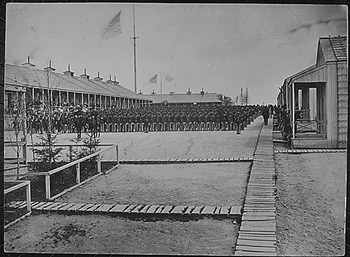
The 26th US Colored Volunteer Infantry on parade, Camp William Penn, PA, 1865. The camp, which was fully operational by 4 July 1863, served as the training ground for eleven regiments comprising nearly 11,000 men in its two years of existence. Photographer unknown. Courtesy National Archives Photo no. 165-C-692.

Unidentified African American soldier in Union artillery shell jacket and shoulder scales in front of painted backdrop showing military camp with flag. Quarter-plate tintype, hand-colored, c.1861–65. Library of Congress Prints and Photographs Division, LC-DIG-ppmsca-37532.

Sergeant Henry F. Steward. A twenty-three-year-old farmer from Adrian, Michigan, Henry Steward enlisted on 4 April 1863 and was mustered in on 23 April. A noncommissioned officer, as were all black officers, Steward was actively engaged in the recruiting of soldiers for the regiment. He died of disease at the regimental hospital on Morris Island, South Carolina, on 27 September 1863, and his estate was paid a fifty-dollar state bounty. Hand-colored ambrotype, 1863. From the 54th Massachusetts Volunteer Infantry Regiment photographs, Photo. 2·162 (also Photo. 72·9).

Christian Fleetwood (1840–1914). Diary entry, 15–22 June 1864. Page 2. Christian A. Fleetwood Papers, Manuscript Division, Library of Congress (147·00·00) (Digital ID# cw0147, cw0147p1).

Sergeant Major Lewis Douglass, Fifty-Fourth Massachusetts Infantry. Photographer unknown. 1863. Carte de visite. Moorland-Spingarn Research Center, Howard University.

Portrait of Helen Ameila Loguen, c.1863. Courtesy of the Onondaga Historical Association.

Thomas Morris Chester, US minister, Liberia. Photographer D. C. Burnite, c.1870. Cartes de visite collection, Schomburg Center for Research in Black Culture/Photographs and Prints Division, New York Public Library. Digital ID: 08sccdv. Record ID: 745793.

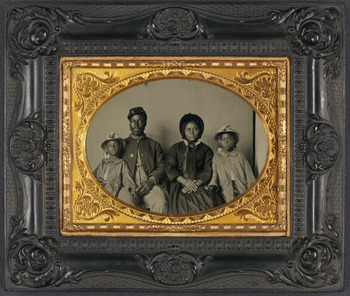
Unknown African American soldier in Union uniform with wife and two daughters. Photograph showing soldier in uniform, wife in dress and hat, and two daughters wearing matching coats and hats. In May 1863, US Secretary of War Edwin Stanton issued General Order No. 143 creating the Bureau of US Colored Troops. This image was found in Cecil County, Maryland, making it likely that this soldier belonged to one of the seven USCT regiments raised in Maryland. Ambrotype, quarter-plate. Library of Congress Prints and Photographs Division, Liljenquist Family Collection of Civil War Photographs, LC-DIG-ppmsca-36454.

127th Ohio Regiment, later designated the 5th US Colored Troop Regiment Ohio Infantry. Photograph showing a portion of the 127th Regiment, Ohio Volunteer Infantry (OVI). Taken in Delaware, Ohio on Sandusky Street immediately south of the Ft. Delaware Hotel, probably in 1863. The 127th Regiment OVI was the first complete African American regiment recruited in Ohio.

Samuel Martin. JWJ MSS 54. Gayford & Speidel, photographers. March 1865. Cartes de visite, Box 35, Yale Collection of American Literature, Beinecke Rare Book and Manuscript Library, Randolph Linsly Simpson African-American collection Folder, 1082–83. Yale University, Beinecke Rare Book and Manuscript Library, Collection of American Literature, Randolph Linsly Simpson African-American Collection, 2042537, Image ID: 1185981. Verso: Samuel Martin, Sergt Com. 108 USCT very light eyes and hair and light complexion … uses no tobacco or stimulant and of soldierly bearing, appreciated by his officers.

Emmit Adams. JWJ MSS 54. Gayford & Speidel, photographers. March 1865. Cartes de visite, Box 35, Yale Collection of American Literature, Beinecke Rare Book and Manuscript Library, Randolph Linsly Simpson African-American collection, Folder 1082–83. Yale University, Beinecke Rare Book and Manuscript Library, Collection of American Literature, Randolph Linsly Simpson African-American Collection, 2042537, Image ID: 1185999. Verso: Emmit Adams, reads well, makes the morning reports of the company and by his diligence and good conduct has won the esteem of his officers … He was a tobaconnist.

James Roberts. JWJ MSS 54. Gayford & Speidel, photographers. March 1865. Cartes de visite, Box 35, Yale Collection of American Literature, Beinecke Rare Book and Manuscript Library, Randolph Linsly Simpson African-American collection, Folder 1082–83. Yale University, Beinecke Rare Book and Manuscript Library, Collection of American Literature, Randolph Linsly Simpson African-American Collection, 2042537, Image ID: 1185965. Verso: a freeman, hard to manage … stubborn and reckless

Medal of Honor Men. Have received Medals of Honor in United States Army and Navy. photographic print on board prepared for the Negro Exhibit of the American Section at the Paris Exposition universelle, 1900, with portraits c.1863–89. Library of Congress Prints and Photographs Division. Portraits of fifteen African American soldiers and sailors, including Sgt. John S. or W.(?) Lawson, Milton M. Holland, Robert A. Pinn, Sgt. Brent Woods, Powhatan Beaty, Corporal Isaiah Mays, Sgt. John Denny, James H. Harris, Dennis Bell, Thomas R. Hawkins, Sgt. William Carney, Christian Fleetwood, Pvt. James Daniel Gardner, Sgt. Alexander Kelly, and Sgt. Thomas Shaw. LC-DIG-ppmsca-08997 (LC-USZ62-91683). Library of Congress Prints and Photographs Division.

William Earle Williams, Sergeant Carney Monument, Norfolk, Virginia, 2004, 2004, gelatin silver print, 9½ × 7½ in. (24·1 × 19·1 cm). National Gallery of Art, Charina Endowment Fund.

Carrie Mae Weems, Restless after the Longest Winter You Marched & Marched & Marched, from the series From Here I Saw What Happened and I Cried, 1995–96, chromogenic color print with etched text on glass. Courtesy of the artist and Jack Shainman Gallery, New York. © Carrie Mae Weems.

African American veterans of the Grand Army of the Republic marching in a Civil War Veteran's Memorial Day parade, New York City, 30 May 1912. Charles L. Blockson Afro-American Collection, Temple University Libraries, Philadelphia, PA.

United States Soldiers at Camp William Penn, Philadelphia, PA, 1863. Chromolithograph, P. S. Duval & Son, Philadelphia, PA. Courtesy of the Charles L. Blockson Afro-American Collection, Temple University Libraries, Philadelphia, PA.

Unidentified African American soldier in Union uniform, 1863–65. Sixth-plate ambrotype, hand-colored. LC-DIG-ppmsca-32088. Library of Congress Prints and Photographs Division.

Sergeant Tom Strawn of Company B, 3rd US Colored Troops Heavy Artillery Regiment, with revolver in front of painted backdrop showing balustrade and landscape, c.1863–65. Liljenquist Family Collection of Civil War Photos, LC-DIG-ppmsca-32668. Library of Congress Prints and Photographs Division.

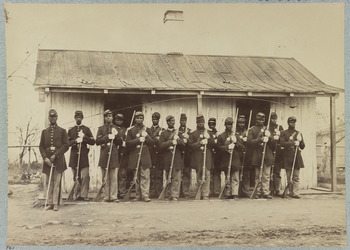
Guardhouse and guard, 107th US Colored Infantry Fort Corcoran near Washington, DC. LC-DIG-ppmsca-34584 LC-B8184-841, Library of Congress Prints and Photographs Division.