Introduction
The efficacy of tonsillectomy in the treatment of chronic tonsillitis remains controversial, with recent comments by the Chief Medical Officer for England implying that many tonsillectomies may be unnecessary.1 A recent randomised, controlled trial of tonsillectomy in children with mild disease suggested there was no major clinical benefit of surgical intervention, compared with ‘watchful waiting’,Reference van Staaij, van den Akker, Rovers, Hordijk, Hoes and Schildre2 although the analysis of this study has been criticised.Reference Little3 Other studies have suggested that benefit may be concentrated in children with more severe disease.Reference Marshall4, Reference Paradise5
Concerns over transmission of spongiform encephalopathy by reusable instruments, and the safety profile of the single-use instruments available at the time, meant that few tonsillectomies were performed in Wales between December 2001 and October 2002, and none between October 2002 and July 2003. As a result, a cohort of patients formed who had been placed on tonsillectomy waiting lists (usually as a result of suffering four to six episodes of acute tonsillitis per year for two or more consecutive years, but occasionally due to other conditions, e.g. sleep apnoea or quinsy), but who had not been operated upon. We investigated these patients' levels of morbidity in early 2003 with a postal questionnaire sent to those patients who had been on the waiting list for at least 12 months.Reference Fox, Tomkinson and Myers6 The results of this questionnaire suggested that both adults and children continued to suffer significant morbidity, with, for example, 60 per cent of children and 50 per cent of adults having had at least three episodes of tonsillitis in the previous six months. We repeated the survey in 2005, with the intention of assessing ongoing morbidity in the cohort, who we expected to be at least six months post-surgery by this stage.
We compared the ongoing morbidity of those who had and had not undergone surgery in 2005, and also compared these results with the patients' initial responses in 2003.
Participants and methods
In January 2005, we sent a postal questionnaire and covering letter to all 431 patients who had responded to the initial tonsillectomy morbidity questionnaire in 2003. A second mailing to non-respondents followed, three months after the first.
To allow matched pairs analysis, the questions asked were the same as in 2003. They concerned frequency of infection, general practitioner visits, and sickness absence from work or school, over the previous six months.
The covering letter was worded based on the assumption that the entire cohort would have undergone tonsillectomy at least six months previously. The questionnaire clearly stated that its purpose was to determine the effect of tonsillectomy, with the sentence:
Now that you/your child have had the operation, it is important to determine its effect, so I am enclosing a further questionnaire asking about your experiences in the past six months.
Respondents to the questionnaire were asked if they had undergone tonsillectomy. We reviewed the case notes of non-responders to determine their tonsillectomy status.
Statistical analysis was carried out using the Statistical Package for the Social Sciences for Windows version 11.5 and Epi InfoTM version 6 software packages. Responses were analysed separately for children (i.e. those aged 16 and under in 2003) and adults (i.e. those aged over 16 in 2003).
Results and analysis
Response rate
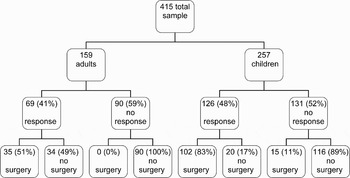
Of the 431 questionnaires, eight were returned undelivered with no forwarding address, six patients had had surgery other than tonsillectomy and two had died of unrelated conditions. This left a total sample of 415 patients, 159 (38 per cent) of whom were adults and 257 (62 per cent) children.
One hundred and ninety-five responses were received, an overall response rate of 45 per cent. The response rate was higher for children (48 per cent) than adults (41 per cent).
Of the 69 adults who responded to the questionnaire, 35 (51 per cent) had undergone tonsillectomy and 34 (49 per cent) had not. None of the 90 non-responders to the adult questionnaire had had their tonsils removed. Of the 126 respondents to the children's questionnaire, 102 (83 per cent) had undergone surgery, compared with only 15 (11 per cent) of non-responders (Figure 1).
Questionnaire distribution and response.

Characteristics of responders and non-responders to the 2005 survey
To assess possible bias arising as a result of the low response rate, responses to the 2003 survey were compared for responders and non-responders to the 2005 survey. There were no significant differences in disease severity in 2003, comparing adult responders and non-responders to the 2005 survey.
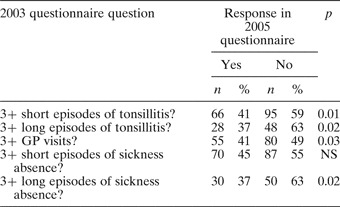
For the children, there was no difference in severity in 2003, comparing responders and non-responders to the 2005 survey, in terms of short sickness absence from school. For all the other survey items (frequency of short and long episodes of tonsillitis, general practitioner visits, and frequency of long sickness absence from school), non-responders to the 2005 survey had experienced significantly more morbidity at the time of the 2003 survey, compared with responders to the 2005 survey (Table I).
Responses to 2003 survey, for responders and non-responders to 2005 questionnaire: children

GP = general practitioner; NS = not statistically significant
Morbidity over time
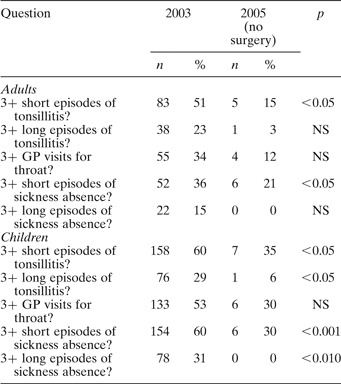
There was a tendency for symptoms to diminish with time, even when no tonsillectomy had been carried out. This was most marked for children. Children who had not undergone surgery were experiencing significantly fewer episodes of tonsillitis and sickness absence from school in 2005 than in 2003. Adults who had not undergone surgery were also experiencing significantly fewer episodes of tonsillitis, general practitioner visits and long-term sickness absence from work in 2005 than were respondents to the 2003 questionnaire (Table II).
Comparison of 2003 respondents with 2005 respondents who had not had tonsillectomy

GP = general practitioner; NS = not statistically significant
Morbidity with and without surgery
Fifty-one per cent of the adults and 83 per cent of the children had undergone tonsillectomy.
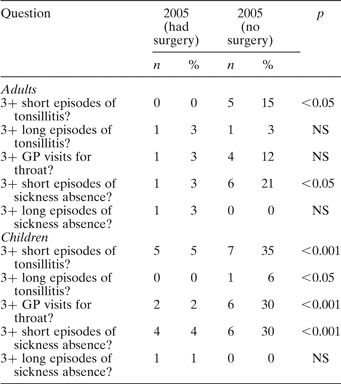
Comparison of adults who had undergone surgery with those who had not showed that the former had experienced significantly fewer short episodes of tonsillitis and short term sickness absence from work, compared with the latter (Table III). Matched pairs comparison, in which individual respondent's overall condition in 2003 and 2005 was compared, showed that adult respondents who had had their tonsils removed reported significant improvement in their condition, compared with those who had not (p = 0.03).
Comparison of 2005 respondents who had and had not undergone tonsillectomy

GP = general practitioner; NS = not statistically significant
Comparison of children who had undergone surgery by 2005 with those who had not showed that the former had experienced significantly less morbidity than the latter, in all areas apart from long term sickness absence from school (Table III). Matched pairs comparison showed that children who had had their tonsils removed reported significant improvement in their overall condition, compared to those who had not (p < 0.001).
Discussion
These results support the hypothesis that the natural history of chronic tonsillitis is one of resolution over time, particularly in adults. As a group, adults who had not undergone surgery experienced significantly less morbidity in 2005 than in 2003, in every area except short term sickness absence from work. Matched pairs analysis of overall morbidity suggests that self-reported morbidity is reduced still further following surgery.
Although there was no statistically significant difference between adults who had and had not undergone surgery, as regards the other outcome measures, the small sample size (69) and the rarity of the outcome measures (only two adults had seen their general practitioner three or more times in the previous six months) mean that the survey was under-powered to detect any difference that may have existed.
Children who had not undergone tonsillectomy showed significant improvement in 2005 compared with 2003, for frequency of short and long infections (p < 0.05). Again, children who had undergone tonsillectomy had significantly better outcomes than those who had not.
Even if tonsillar disease is ultimately self-limiting in children, the children in this study had very prolonged histories. They had all been put on a tonsillectomy waiting list prior to January 2002, and it can be assumed that most, if not all, had had recurrent episodes of tonsillitis for at least six months prior to that. Meanwhile, a substantial proportion of those who had not undergone surgery were continuing to experience morbidity, as shown by the following examples. Thirty-five per cent of children who had not undergone tonsillectomy had had three or more short episodes of tonsillitis in the previous six months (compared with 5 per cent of those who had undergone surgery). Thirty per cent of children who had not undergone tonsillectomy had had three or more general practitioner visits in the previous six months (compared with 2 per cent of those who had undergone surgery). Finally, 30 per cent of children who had not undergone tonsillectomy had had three or more short episodes of sickness absence from school in the previous six months (compared with 4 per cent of those who had undergone surgery).
• The efficacy of tonsillectomy in the treatment of chronic tonsillitis remains controversial; recent comments by the Chief Medical Officer for England implied that many tonsillectomies may be unnecessary
• This study follows a cohort of patients who had been placed on tonsillectomy waiting lists but not operated upon, owing to concerns over safety of instruments with regard to Spongiform encephalopathy transmission
• Morbidity reported by patients suffering from untreated chronic tonsillitis decreases with time
• Tonsillectomy produces significantly greater reductions in morbidity than time alone
These results suggest that the children in this study who underwent tonsillectomy gained significant benefit compared with those who did not. This is further supported by the results of the matched pairs analysis, which indicated that children who had undergone tonsillectomy had significantly better overall outcomes than those who had not.
A recent randomised, controlled trailReference van Staaij, van den Akker, Rovers, Hordijk, Hoes and Schildre2 suggested that tonsillectomy in children conferred no benefit over watchful waiting. However, the children included in the study had mild disease, and would not have met the criteria for addition to the waiting list in Cardiff. (Criteria for addition to the waiting list were four to six episodes of acute tonsillitis per year for two or more consecutive years, although occasionally tonsillectomy for other conditions was accepted; e.g. sleep apnoea or quinsy.)
Study limitations
The main limitation of the study was the low response rate. Questionnaire surveys require a high response rate to be reliable.Reference Drane7 The overall response rate in this survey was 45 per cent. This lower than ideal response rate was likely to have been due, at least in part, to the wording of the covering letter, which implied that the study concerned only those who had had their tonsils removed. The response rate for patients who had undergone tonsillectomy was high, with 137 of 152 (90 per cent) responding.
This study suggests that tonsillectomy does confer significant benefits over watchful waiting in patients appropriately selected for surgical intervention. However, even with strict criteria for selecting patients as suitable for surgery, it is possible that a proportion of those listed would have experienced symptom resolution without surgical intervention, or alternatively would have become accustomed to their symptoms and accepted them as normal. Unfortunately, it is not possible to predict the future behaviour of this disease in any one individual at the time of presentation. The time to resolution in those patients electing to wait may be measured in years, and they are likely to experience significant morbidity, requiring multiple visits to the general practitioner, in the intervening period. This important information should be shared with patients or their parents when discussing the options available for the management of chronic tonsillitis, in order to best inform their decision to wait or to proceed to surgery.