Introduction
General practitioners (GPs) from underdeveloped countries face rapidly aging populations accompanied by the consequent clinical peculiarities such as cognitive impairment (CI; Prince, Reference Prince2000; Mathew and Mathuranath, Reference Mathew and Mathuranath2008). Despite its high prevalence, the value of screening for CI in the elderly remains controversial (Boustani et al., Reference Boustani, Peterson, Hanson, Harris and Lohr2003) although much can be done for CI patients and their caregivers during the course of these diseases. (Fox et al., Reference Fox, Lafortune, Boustani and Brayne2013) Previous studies have shown that CI in the elderly is frequently overlooked by GPs (Barret et al., Reference Barret, Haley, Harrel and Powers1997; Renshaw et al., Reference Renshaw, Scurfield and Orrel2000; Valcour et al., Reference Valcour, Masaki, Curb and Blanchette2000; Jacinto et al., Reference Jacinto, Brucki, Porto, Martins and Nitrini2011). In Brazil, about 75% of the population receive medical care exclusively from the public Unified Health System (UHS) whose healthcare assistance is centered on GPs. (Portal Brasil, 2013) In the UHS, high patient demand has led to briefer GP appointments that are too short for a complete cognitive assessment. With regard to CI screening, it is necessary for GPs to have access to instruments that are easy and quick to apply (Jacinto et al., Reference Jacinto, Brucki, Porto, Martins and Nitrini2012).
Most of the CI assessment tools available in Brazil have been translated from other languages – mainly English – and adapted to our cultural setting. As schooling in elderly from underdeveloped countries such as Brazil tends to be relatively heterogeneous, it is necessary to establish normative and cut-off scores for these CI instruments that are based on studies conducted locally (Prince, Reference Prince2000; Mathew and Mathuranath, Reference Mathew and Mathuranath2008). In the present study, CI screening instruments frequently used by Brazilian specialists in dementia were analyzed to determine which could be most useful to GPs in their working sets.
Methods
Data for this study were drawn from three previous studies whose methods have been reported elsewhere (Jacinto et al., Reference Jacinto, Brucki, Porto, Martins and Nitrini2011; Reference Jacinto, Brucki, Porto, Martins and Nitrini2012; Reference Jacinto, Nitrini, Brucki, Porto, de Mello Franco and de Albuquerque Citero2013). Briefly, 248 patients aged 65 years or older that had been assisted by GPs in a tertiary hospital of the city of São Paulo (Brazil) were evaluated. Considering previously clinical experience of the outpatients’ services, 20% of these patients were expected to be cognitively impaired. Indeed, 52 patients from these 248 were cognitively impaired.
In the assessment, a geriatrician recorded clinical antecedents and use of medications. The Mini-Mental State Examination – MMSE (Folstein et al., Reference Folstein, Folstein and McHugh1975; Brucki et al., Reference Brucki, Nitrini, Caramelli, Bertolucci and Okamoto2003), the short version of the Informant Questionnaire on Cognitive Decline in the Elderly – Short-IQCODE (Jorm, Reference Jorm1994; Bustamante et al., Reference Bustamante2003), the Brief Cognitive Battery – Edu (BBRC-Edu) which comprises: naming ten simple drawings, incidental and immediate memory, learning, category verbal fluency (CVF), the clock drawing test – CDT, delayed recall and recognition tasks (Nitrini et al., Reference Nitrini1994; Reference Nitrini2004; Reference Nitrini, Caramelli, Porto, Fichman and Formigoni2007), the Functional Activities Questionnaire – FAQ (Pfeffer et al., Reference Pfeffer, Kurosaki, Harrah, Chance and Filos1982), Forward and Backward Digit Span, were applied to the patient and an informant. Short-IQCODE and/or MMSE scores were used to classify patients into probable cognitively impaired cases or by using cut-off scores previously suggested for the Brazilian population. Probable cases underwent neuropsychological evaluation using the Dementia Rating Scale (Porto et al., Reference Porto, Charchat-Fichman, Caramelli, Bahia and Nitrini2003), laboratory tests (blood count, thyroid hormones, syphilis serology, liver function, kidney function, vitamin B12, and folic acid levels), and a brain computed tomography (CT) scan (Caramelli et al., Reference Caramelli2011).
Final diagnoses were established in a consensus meeting with the presence of two neurologists specialized in dementia (SMDB, RN) and the geriatrician who had initially evaluated the patients (AFJ), using all available data. The probable cases and a sample of 53 patients considered not cognitively impaired based on the MMSE and/or Short-IQCODE scores were evaluated on the basis of clinical data, performances on the neuropsychological tests and questionnaires for all subjects, and additionally on laboratory and CT results for probable cases. Patients were classified into cases with dementia, cognitive impairment no dementia (CIND), and without cognitive impairment (WCI). Of the 248 elderly patients, three did complete the study and were considered “missings” and 52 were initially classified as cognitively impaired (21 had a final diagnosis of dementia, 22 CIND and six cases were ultimately considered not cognitively impaired). Of the dementia group, six cases were classified as mild, seven were moderate, and eight were severe considering Clinical Dementia Rating (Morris, Reference Morris1993). All 53 individuals classified as not cognitively impaired by the screening instruments had the final diagnosis of WCI in the consensus meeting. The specificity of the screening method (MMSE and/or Short-IQCODE) was 100%, whereas its sensitivity was 82.7%.
The Research Ethics Committee of the Hospital das Clínicas of the Universidade de São Paulo, Medical School, Brazil approved this study.
Statistical analysis
Data were analyzed using SPSS (Statistical Package for Social Sciences) version 11.5 for Windows and “R: A Language and Environment for Statistical Computing” software. Demographic data for the three groups (“dementia”, “CIND,” and “WCI”) were compared using the Kruskall–Wallis test followed by a multiple comparison test (“post hoc”). The Kruskall–Wallis test was used to compare the performances on instruments among the groups, followed by a “post hoc” test. ROC curves were used to determine the sensitivity and specificity of these instruments. Logistic regression was used in order to obtain a score for the combination of the FAQ with three other easy, fast-to-apply instruments: the Clock Drawing Test, Verbal Fluency, and delayed recall item of the Brief Cognitive Battery, while the sensitivity and specificity of these scores were obtained by ROC curve.
Results
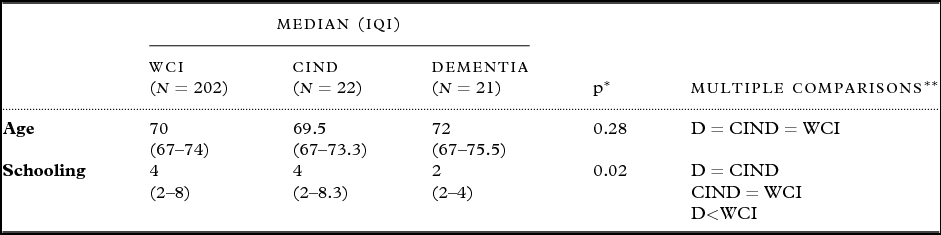
Demographic data for the dementia, CIND, and WCI groups are shown in Table 1. Patients with dementia had a lower educational level than WCI patients.
Median, interquartile interval, and comparisons by age and schooling in the groups

* Kruskall-Wallis Test; **Dunn's post hoc; IQI, inter quartile interval; D, dementia; CIND, cognitive impairment no dementia; WCI, without cognitive impairment.
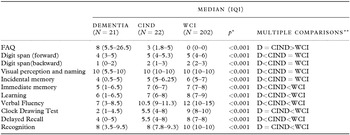
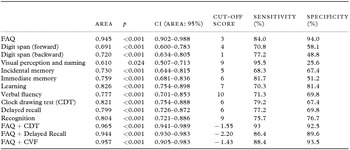
Comparison of performances among the three groups is shown in Table 2. Statistically significant differences were found for all the instruments used. The respective sensitivity and specificity of the instruments are given in Table 3. The combination of a functional questionnaire with a cognitive instrument had higher sensitivity and specificity than using the instruments alone. A FAQ cut-off of 3 in conjunction with a CDT cut-off of 6 proved optimal (93% sensitivity and 92.5% specificity). A higher specificity (93.5%) was attained using a combination of the FAQ (cut-off of 3) with the CVF (cut-off of 10).
Performances on the instruments and comparisons among the three groups

*Kruskall–Wallis Test; ** “post hoc”; D, Dementia; CIND, Cognitive Impairment No Dementia; WCI, Without Cognitive Impairment; IQI, Interquartile Interval; FAQ, Functional Activities Questionnaire.
Area under ROC curve, sensitivity, and specificity of the instruments for “dementia” and “cognitive impairment no dementia” vs. “without cognitive impairment” groups

CI, Confidence Interval; FAQ, Functional Activities Questionnaire; CDT, Clock Drawing Test; CVF, Category Verbal Fluency.
Discussion
In this study, the FAQ showed the highest sensitivity and specificity considering all the instruments used in the cognitive assessment. Three tests were chosen for analysis with the FAQ given they are easy to apply (CDT and CVF) and also, in the case of delayed recall, because this type of memory is usually impaired in early phases of dementia. The most specific score was observed for the FAQ and CVF combination, whereas the most sensitive score was attained with combined use of the FAQ and CDT.
CVF may be the most useful test for GPs since patient writing or drawing is not required plus the test takes only one minute to apply. In this study, CVF failed to show high sensitivity or specificity in the detection of CI when analyzed alone but in combination with FAQ, both sensitivity and specificity were enhanced. Our CVF score of 10 is similar to values obtained in other Brazilian studies although our sample was not stratified into schooling levels as observed in these previous studies (Brucki and Rocha, Reference Brucki and Rocha2004; Caramelli et al., Reference Caramelli, Carthery-Goulart, Porto, Charchat-Fichman and Nitrini2007; Radanovic et al., Reference Radanovic2009). Regarding the delayed recall task of the BBRC-Edu, the present study found lower sensitivity and specificity compared to the study by Takada et al. (Reference Takada2006), although their sample of cognitively impaired individuals contained only dementia cases, while our sample included CIND patients. It is likely that the efficacy of the delayed recall in discriminating CIND from WCI is not as high as for dementia thus explaining the lower sensitivity and specificity seen in the present study. The accuracy of the Clock Drawing Test for CI screening has been previously evaluated (Aprahamian et al., Reference Aprahamian, Martinelli, Neri and Yassuda2009) and shown to be effective for discriminating dementia, but less effective for mild cases of dementia or CIND from normal individuals and that might be the reason for the low specificity of the CDT found in our study when used alone, what was expected since CDT is a test mostly influenced by schooling. The combination of the CDT and FAQ showed the highest accuracy for distinguishing both dementia and CIND from WCI in our study, although the utility of the CDT in populations with lower schooling is well-known.
In their working sets, GPs would require a sheet of paper, a pencil, and about five minutes to perform the CI and functional screening using the FAQ, CVF, and CDT. Despite its high accuracy and the fact that functional scales are not biased by schooling (Perroco et al., Reference Perroco2009), the FAQ has a limitation on its use insofar as an informant is required to be present with the patient where this may not always be possible. These instruments appear to be useful as screening tools for GPs in countries with populations that have heterogeneous schooling.
The clinical implications of our results should be considered. In Brazil, GPs held only 50% of the basic knowledge required for early detection of dementia (Jacinto et al., Reference Jacinto, Nitrini, Brucki, Porto, de Mello Franco and de Albuquerque Citero2013) and thus, establishing instruments and their scores to facilitate this screening process is paramount. The combination of the FAQ and CFV represents a very simple method of increasing the chances of correct screening. Besides, these two instruments can be useful in most of the Brazilian regions’ cultural aspects since FAQ comprises simple daily tasks even in rural areas and CFV allows patients to cite animals that are common in their living areas without restrictions. In the case of patients with higher schooling, the combination of the FAQ and CDT is more suitable.
Conflict of interest
None.
Description of authors’ roles
Alessandro Ferrari Jacinto obtained and analyzed data and wrote the paper. Vanessa de Albuquerque Citero, Sonia Maria Dozzi Brucki, Milton de Arruda Martins, and Ricardo Nitrini revised the paper writing. Claudia Sellitto Porto applied neuropsychological tests.