


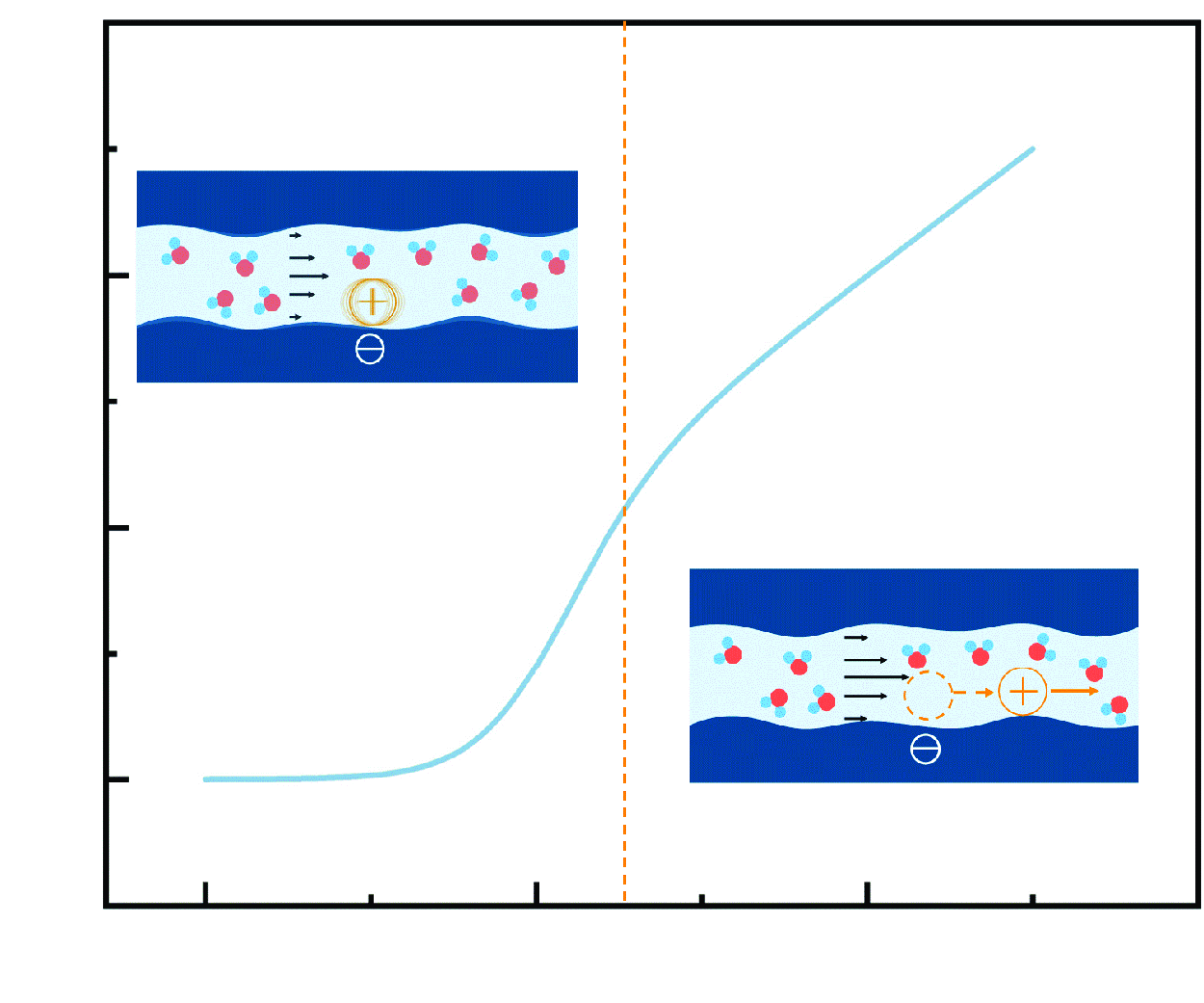



1. Introduction
The flow of water through an electrified surface generates a net ionic current known as streaming current (van der Heyden et al. Reference van der Heyden, Stein and Dekker2005; Bocquet & Charlaix Reference Bocquet and Charlaix2010; Xu, Yan & Xie Reference Xu, Yan and Xie2024), which is one of the fundamental electrokinetic phenomena. The study of streaming current is useful in both fundamental research, such as zeta potential characterisation (Werner, Zimmermann & Kratzmüller Reference Werner, Zimmermann and Kratzmüller2001; Zimmermann, Dukhin & Werner Reference Zimmermann, Dukhin and Werner2001; Lyklema Reference Lyklema2003; van der Heyden et al. Reference van der Heyden, Stein, Besteman, Lemay and Dekker2006; Delgado et al. Reference Delgado, González-Caballero, Hunter, Koopal and Lyklema2007; Storey & Bazant Reference Storey and Bazant2012; Siria et al. Reference Siria, Poncharal, Biance, Fulcrand, Blase, Purcell and Bocquet2013; Emmerich et al. Reference Emmerich, Vasu, Niguès, Keerthi, Radha, Siria and Bocquet2022), and applications like energy conversions (Olthuis et al. Reference Olthuis, Schippers, Eijkel and van den Berg2005; Xue et al. Reference Xue2017; Marcotte et al. Reference Marcotte, Mouterde, Niguès, Siria and Bocquet2020; Alkhadra et al. Reference Alkhadra2022). Downscaling the channel size benefits the energy conversion by ion-layering effects (Gillespie et al. Reference Gillespie, Khair, Bardhan and Pennathur2011; Gillespie Reference Gillespie2012) and enhances the efficiency up to 50 % in Nafion systems (Catalano & Bentien Reference Catalano and Bentien2014; Østedgaard-Munck et al. Reference Østedgaard-Munck, Catalano, Kristensen and Bentien2017) and power density to
 ${\sim}25$
 $\mathrm{mW\,m^{-2}}$
in Mxene membranes (Yang et al. Reference Yang, Qian, Liu, Wang, Ma, Sun, Su, Jarvis, Wang and Lei2022).
The knowledge of electrokinetic phenomena and electrical double-layer theory is still developing. For instance, ion–ion interactions, typically ignored in classical double-layer theories, become critical in high-concentration or divalent electrolyte solutions, named the ionic correlation effect, which precisely describes the electrokinetic phenomena (Storey & Bazant Reference Storey and Bazant2012; Hartkamp et al. Reference Hartkamp, Biance, Fu, Dufrêche, Bonhomme and Joly2018; McEldrew et al. Reference McEldrew, Goodwin, Kornyshev and Bazant2018). Besides, considering the dynamic response of ions under an external field, the description of electrokinetic phenomena is more accurate than the static double-layer theories (Bazant & Squires Reference Bazant and Squires2004, Reference Bazant and Squires2010).
However, the concept of the double layer fails when the critical size of the channel comes to the regime of a single hydrated ion, where only a few water molecules exist in the cross-section of the channel. New technologies and emerging two-dimensional materials enable us to study flows and mass transport at the molecular level (Wang et al. Reference Wang, Boutilier, Kidambi, Jang, Hadjiconstantinou and Karnik2017; Faucher et al. Reference Faucher2019; Aluru et al. Reference Aluru2023). Numerical findings demonstrated that the flow and transport phenomena were inconsistent with the classical understandings such as those of ultrafast water flows (Holt et al. Reference Holt, Park, Wang, Stadermann, Artyukhin, Grigoropoulos, Noy and Bakajin2006; Radha et al. Reference Radha2016; Keerthi et al. Reference Keerthi, Goutham, You, Iamprasertkun, Dryfe, Geim and Radha2021; Itoh et al. Reference Itoh2022), voltage-induced mobility change (Esfandiar et al. Reference Esfandiar, Radha, Wang, Yang, Hu, Garaj, Nair, Geim and Gopinadhan2017), anomalous dielectric constant (Bonthuis & Netz Reference Bonthuis and Netz2012; Fumagalli et al. Reference Fumagalli2018), ionic Coulomb blockade (Feng et al. Reference Feng, Liu, Graf, Dumcenco, Kis, Di Ventra and Radenovic2016; Kavokine et al. Reference Kavokine, Marbach, Siria and Bocquet2019; Cao et al. Reference Cao, Zhou, Shen, Qiu and Guo2024), breakdown of the Nernst–Einstein relation (Li et al. Reference Li, Misra, Li, Yao, Zhao, Zhang, Chen, Blankschtein and Noy2023), quantum friction (Kavokine, Bocquet & Bocquet Reference Kavokine, Bocquet and Bocquet2022) and fluidic memristors (Robin et al. Reference Robin, Kavokine and Bocquet2021, Reference Robin2023; Shi et al. Reference Shi, Wang, Liang, Duan, Du and Xie2023), indicating that underlying new physics still need to be revealed.
Compared with voltage-driven ionic transport, the streaming current in angstrom channels was rarely studied in experiments since previous work was conducted on two-dimensional materials that were either charge-free (Zhou et al. Reference Zhou, Guo, Zhang, Guo and Qiu2023) or homogeneously charged by voltage gating (Marcotte et al. Reference Marcotte, Mouterde, Niguès, Siria and Bocquet2020) or plasma activation (Emmerich et al. Reference Emmerich, Vasu, Niguès, Keerthi, Radha, Siria and Bocquet2022). Mouterde et al. (Reference Mouterde, Keerthi, Poggioli, Dar, Siria, Geim, Bocquet and Radha2019) successfully enhanced the molecular streaming current up to 20 times by voltage gating on carbon nanotubes. Their results showed the ionic mobility derived from the streaming current shows strong nonlinear effects as gating voltage rises, opening a new route to control ion transport. In contrast to non-gated channels, where the streaming conductance grows linearly with applied pressure, voltage gating induces a Péclet-dependent conductance that results in a nonlinear streaming current (Marcotte et al. Reference Marcotte, Mouterde, Niguès, Siria and Bocquet2020). Keerthi et al. (Reference Keerthi, Goutham, You, Iamprasertkun, Dryfe, Geim and Radha2021) studied the molecular streaming in angstrom slits and discovered the very large difference in slip length between graphene and hexagonal boron nitride surfaces, revealing that the electrokinetic mobility of ions increases with the salt concentration and the slipping surface.
However, for most dielectric materials, such as biological ion channels, the surface acquires charges due to dissociation or adsorption of protons or charged species at functional groups (Behrens & Grier Reference Behrens and Grier2001; Noskov, Berneche & Roux Reference Noskov, Berneche and Roux2004; Li et al. Reference Li2019; Tan et al. Reference Tan2020). Thus, the classical electric double-layer theory is not applicable as we have to consider the discrete charged sites in angstrom confinement. In classical colloid science, deprotonated surfaces are typically modelled with a homogeneous surface charge, as the relevant length scales (usually
 $\gt$
100 nm) far exceed the spacing between charged sites (site densities less than
 $\sim 1\,\mathrm{nm^{-2}}$
). However, under angstrom-scale confinement, surface charges become discrete. For example, a 10 nm long channel with a diameter of 1 nm and a surface charge density of
 $-5\ \mathrm{m\,Cm^{-2}}$
contains only one charged site, with most surface atoms remaining neutral. In this regime, classical electric double-layer theory breaks down, and the discrete nature of charged sites must be explicitly considered, where charge distribution may significantly impact the flow (Xie et al. Reference Xie, Fu, Niehaus and Joly2020) and ionic transport in confinement (Kim & Netz Reference Kim and Netz2006; Kavokine et al. Reference Kavokine, Marbach, Siria and Bocquet2019; Xie et al. Reference Xie, Shi, Wang and Wang2023). Thus, the electrokinetic phenomena are still unclear in angstrom channels when the double-layer concept fails.
In this work, we investigated the streaming conductance of charged latent-track angstrom channels. We found that in angstrom-scale latent-track channels, the streaming current emerges when the applied pressure exceeds a threshold value and represents a strong nonlinear increasing feature as pressure increases, inconsistent with the existing understanding of the streaming conductance known as a constant (van der Heyden et al. Reference van der Heyden, Stein and Dekker2005). However, as the diameter increased, the nonlinear feature of streaming conductance gradually weakened and eventually vanished, becoming pressure-independent as described by classical nanofluidic theories. We estimated the surface potential of nanochannels by streaming conductance divided by conduction, which anomalously increases as the channel narrows when external pressure is applied to the membrane. We attributed the pressure-dependent streaming conductance to the presence of counterions bound to the surface charge when channels approach the angstrom scale. The rise in applied pressure increases the hydrodynamic friction on the counterions, increasing the probability of counterions dissociating from the surface charge and thus forming the streaming current. As the channel size increases, the Coulomb interaction between counterions and surface charge reduces, resulting in constant streaming conductance again. We approximated the pressure-dependent streaming conductance by using the one-dimensional (1-D) Kramer escape approach, which qualitatively explained the experimental observation in angstrom channels, including the impacts of applied pressure and size effects. With the defined Damk
 $\ddot {\mathrm{o}}$
hler number, we could identify the pressure-dependent and pressure-independent regimes by a phase diagram of the dimensionless coefficient
 $Da/(Da+1)$
. Our work provides anomalous streaming current phenomena in angstrom channels that show new features in flows and ionic transport at the smallest scale, which is possibly useful for ion separations or energy applications in the future.
2. Systems and characterisation
Figure 1(a) illustrates the fabrication process of latent-track membranes (Wen et al. Reference Wen2016). A
 $12$
 $\unicode {x03BC}\mathrm{m}$
thick polyethylene terephthalate (PET) foil was first irradiated by
 $\mathrm{Kr^+}$
ions with an energy of
 $6$
 $\mathrm{MeV\,u^{-1}}$
with beam density of
 $3\times 10^8$
 $\mathrm{cm^{-2}}$
from the Lanzhou Heavy Ion Research Facility (HIRFL). Then, we irradiated both sides of each specimen under UV light (
 $65$
 $\mathrm{mW\,cm^{-2}}$
) for
 $10$
min to decompose the damaged zone along the latent track (Schauries et al. Reference Schauries, Mota-Santiago, Gilbert, Kirby, Trautmann and Kluth2018). The photo-decomposed polymer molecules could be electrophoretically removed using
 $0.01$
M
 $\mathrm{KCl}$
solution at 50
 $\,^{\circ }\mathrm{C}$
for at least half an hour, named soft etching (Wen et al. Reference Wen2016; Apel et al. Reference Apel, Blonskaya, Ivanov, Kristavchuk, Nechaev, Olejniczak, Orelovich, Polezhaeva and Dmitriev2022; Guo et al. Reference Guo, Li, Wu, Liang, Junaid, Xie, Lu, Duan, Liu and Yao2024). Once the conductance reached a saturated value, we believe all radiolysis products had been removed from the channels, resulting in the formation of 1-D angstrom-scale channels as we characterised by isotherm adsorptions (Xie et al. Reference Xie, Shi, Wang and Wang2023). The membranes were well cleaned and preserved in a thermostat overnight.
(a) The fabrication process of latent-track channels, including heavy ion irradiation (step I), UV irradiation (step II), electrophoresis to remove the radiolysis products in a 50
 $^{\circ }\mathrm{C}$
water bath (step III) and thermal annealing, if needed, in a 70
 $^{\circ }\mathrm{C}$
water bath to increase the channel size (step IV). The schemes are not to scale. (b) The latent-track channels stained by
 $\mathrm{RuO_4}$
are represented as bright straight lines under TEM. We statistically measured the brightness projected onto the bottom line and took half the peak width of the brightness as the channel diameter. (c) The radius calculated from the measured conductance (black squares) increases with annealing time. However, only channels with diameters larger than 2 nm are visible under TEM (yellow triangles). A numerical fit (yellow dashed line) provides a reference for the channel size. Conductance measurements may underestimate channel size due to blockade effects in confinement.

To study the size effects of nanochannels, we developed the channel size by annealing latent-track channels in a water bath at 70
 $^{\circ }\mathrm{C}$
, similar to the method reported by Schauries et al. (Reference Schauries, Mota-Santiago, Gilbert, Kirby, Trautmann and Kluth2018) in air. Annealing enlarges the size of polymer nanochannels, caused by the damaged track halo diffusing into the track core (Schauries et al. Reference Schauries, Mota-Santiago, Gilbert, Kirby, Trautmann and Kluth2018). The naming scheme of specimens is as follows:
 $\mathrm{TA}$
denotes thermal annealing, with the subsequent number indicating the temperature of the water bath (e.g.
 $70$
represents 70
 $^{\circ }\mathrm{C}$
). The number following the dash indicates the annealing time in minutes at the given temperature. An asterisk indicates an additional specimen obtained using the same fabrication process. For example,
 $\mathrm{TA70{-}10}$
refers to a specimen thermally annealed at 70
 $^{\circ }\mathrm{C}$
for 10 minutes and
 $\mathrm{TA70{-}10^*}$
represents an additional specimen thermally annealed at 70
 $^\circ$
C for 10 minutes. The conductance of each specimen was measured by sweeping voltage in a
 $0.01$
M
 $\mathrm{KCl}$
solution at room temperature. However, the radius of angstrom channels can no longer be precisely characterised by the conductance, due to the strong nonlinear features (Xie et al. Reference Xie, Shi, Wang and Wang2023). Here we take the conductance
 $G$
at
 $10$
 $\mathrm{V}$
for later discussion, as our previous work found the calculated radius became closer to the true radius for
 $10$
 $\mathrm{V}$
or even higher voltage scanning due to the counterion blockade effects.
Figure 1(c) shows that the channel diameter characterised by
 $G$
at
 $10$
 $\mathrm{V}$
through Ohm’s law is proportional to the time of annealing, where the grey area indicates the diameter characterised by the conductance after soft etching (step III) but before annealing (step IV). We found the I–V curves (figure S2 of the supplementary material available at https://doi.org/10.1017/jfm.2025.10336) gradually transition from nonlinear to linear features as the channel radius increases. Here, we characterised the latent-track nanochannels using ruthenium tetraoxide staining under transmission electron microscopy (TEM) (Adla, Fuess & Trautmann Reference Adla, Fuess and Trautmann2003). Each specimen was exposed to the vapour of
 $\mathrm{RuO_4}$
solvent over 20 minutes to guarantee reactions with unsaturated functional groups. We embedded membranes in epoxy resin and sliced them into
 $100\,\mathrm{nm}$
sections using an ultrathin slicer (Leica UC7FC7). Each nanochannel could be recognised as a straight, bright line under electron microscopy, as shown in figure 1(b), due to the ruthenium dioxide deposition. We counted the average brightness of the stained region using the software DigitalMicrograph. The averaged diameter of angstrom channels based on the width at half maximum from the TEM image is shown in figure 1(b). The statistical results of the annealed specimen
 $\mathrm{TA70{-}50}$
, which stands for soft etching in a 50
 $^{\circ }\mathrm{C}$
water bath and thermal annealing at 70
 $^{\circ }\mathrm{C}$
for 50 minutes, showed that the typical width of the channel is
 $6.3\,\mathrm{nm}$
, which is almost exactly the same as the value we derived from the conductance of
 $6.1\,\mathrm{nm}$
, shown as orange symbols in figure 1(c).
However, as the channel size decreases to the angstrom scale, the brightness contrast in the stained area becomes apparently lower due to much fewer unsaturated functional groups. We counted the half-maximum of the brightness in TEM images, which is proportional to the amount of
 $\mathrm{Ru}$
molecules penetrating into the polymers, to predict the channel size as a dashed line shown in figure 1(c) (more details are provided in figure S1 of the supplementary material). We numerically fitted the diameter change as a function of annealing time
 $t$
in a 70
 $^{\circ }\mathrm{C}$
water bath as
 $D \sim t^{2.4}$
. The TEM-characterised diameter (
 $D$
) matched well the calculated ones from conductance when
 $D\gt 2\,\mathrm{nm}$
in the absence of nonlinear conduction. But the diameter derived from conductance starts to deviate from the dashed lines for smaller channels. The diameter calculated from the conductance is underestimated, since we found the voltage-activated conductance in latent-track channels (Xie et al. Reference Xie, Shi, Wang and Wang2023) with the hypothesis of counterion blockade that reduces the ionic conductance conduction. The physical interpretation of the numerical fitting remains unclear, in the absence of details like the structures and dynamics of the polymers during thermal annealing. But, at least, the fitting provides a reference value for estimating the channel size, particularly in cases where both conduction measurements and TEM fail to characterise channels with diameters smaller than 2 nm. Table 1 summarises the sizes characterised using different approaches, providing a basis for analysing streaming conductance and comparing between the different methods.
Diameter of channels from calculated conductance, stained specimens under TEM and numerical fitting.

3. Results and discussion
We sealed the left poly(methyl methacrylate) reservoir and clamped a piece of latent-track membrane using two polydimethylsiloxane (PDMS) gaskets, where a surface area of approximately 0.8
 $\mathrm{cm^2}$
of the membrane was exposed to the electrolyte solution, so that the applied pressure could be controlled from the left reservoir using a pressure pump (Fluigent) (figure 2
a). Two
 $\mathrm{Ag/AgCl}$
electrodes were inserted in the reservoirs and connected to a Sub-femtoamp Remote SourceMeter (Keithley 6430) for current recording. Silver wires with a diameter of 0.6 mm and a length of 15 cm were polished with sandpaper for a smooth surface and rinsed with deionised water, and ultrasonically cleaned in ethanol and acetone solutions for 15 minutes to remove possible organic contamination. The cleaned silver wires were immersed in 0.1 M
 $\mathrm{FeCl_3}$
for 15 minutes to produce
 $\mathrm{Ag/AgCl}$
electrodes. The
 $\mathrm{Ag/AgCl}$
electrode area exposed to the salt solutions is approximately 1.9
 $\mathrm{cm^2}$
and shows a difference of a few millivolts (figure S4 of the supplementary material). We filled reservoirs with
 $0.01$
M
 $\mathrm{KCl}$
solution at
 $\mathrm{pH = 5.4}$
, where the Debye length is
 $\sim$
3 nm, which is much larger than the channel radius. A Faraday cage covered the system to reduce the noise level. We measured the streaming current from
 $\mathrm{TA50}$
fabricated by soft etching and free of annealing, which has the smallest conduction among all specimens.
(a) Schematic diagram of the device for streaming current measurement. (b) Schematic description of ion transport across a PET membrane under an external pressure. (c) The current recordings (lower panel) when applied pressure (upper panel) was turned on. (d) The averaged streaming current exponentially increases with applied pressure in specimen TA50, with typical I–V curves in the inset that also show a strong nonlinear feature. (e) The streaming current gradually shows a linear response to the applied pressure as the channel radius grows. The current amplitudes of specimens TA70–40 and CE were divided by factors of 300 and 2
 $\times$
 $10^4$
, respectively, to make a comparison of the
 $\Delta p{-}I_s$
curves over a wide range of channel size.

The typical I–V curve of specimen
 $\mathrm{TA50}$
in the inset of figure 2(d) represents an obvious nonlinear conduction feature. We attributed the high resistance at low voltage to the strong interaction between counterions and surface charge, which may block ionic transport through the 1-D angstrom channel (Xie et al. Reference Xie, Shi, Wang and Wang2023). Increases in applied voltage may increase the probability of counterions releasing from the surface charge, thus opening the channel for conduction. Thus, it is quite interesting to measure the streaming current in our latent-track channel, which is a 1-D charged angstrom-scale system, since the streaming current is directly proportional to the surface charge that may support the counterion blockade mechanisms. The current recordings in figure 2(c) show an obvious current jump from the current noise once pressure was applied at
 $\Delta p = 0.9\ \mathrm{bar}$
, which vanished when the pressure was turned off. We take the average value of current change
 $\Delta {I_1}$
when pressure was turned on and
 $\Delta {I_2}$
when pressure was turned off as the streaming current, to avoid the drift of current noise due to ion concentration polarisation. The fluctuating current after the pressure was turned off was caused by mechanical vibration.
The Helmholtz–Smoluchowski (HS) equation as well as the Poisson–Nernst–Planck (PNP) equations describe the streaming current at a charged wall
 $I_s=\varepsilon _r\varepsilon _0\pi R^2\varPhi \Delta p/\eta L$
, where
 $\varepsilon _r$
,
 $\varepsilon _0$
,
 $R$
,
 $\varPhi$
,
 $\eta$
and
 $L$
are the relative permittivity of water, vacuum permittivity, channel radius, surface potential (or zeta potential in continuum regime), viscosity and channel length, as here we take the form of the HS equation for simplification. The streaming conductance defined as
 $S = I_s/\Delta p$
is independent of applied pressure (van der Heyden et al. Reference van der Heyden, Stein and Dekker2005; Yaroshchuk & Luxbacher Reference Yaroshchuk and Luxbacher2010; Xue et al. Reference Xue, Yeh, Ma and Qian2014):
 $S \sim \varepsilon _r\varepsilon _0 R^2\varPhi /\eta L$
.
However, our experimental results of streaming current in latent-track angstrom channels showed a strong nonlinear feature with
 $\Delta p$
in figure 2(d), which remains nearly at zero below 0.5 bar but dramatically increases as applied pressure exceeds 0.5 bar. The error bars were statistically derived from the measured streaming current in a single experiment. It seems that the streaming current can be activated by applying pressure. We suspect the pressure-dependent streaming conductance is correlated with the impacts of the angstrom channel and heterogeneous surface charge, since it was rarely found even in angstrom-scale channels, with the exception of voltage-gated Péclet-dependent conductance (Mouterde et al. Reference Mouterde, Keerthi, Poggioli, Dar, Siria, Geim, Bocquet and Radha2019; Marcotte et al. Reference Marcotte, Mouterde, Niguès, Siria and Bocquet2020).
We investigate the streaming current of annealed or chemically etched membranes with a wide range of diameters. The mean radius of specimen
 $\mathrm{TA70{-}10}$
, which was annealed at 70
 $^{\circ }\mathrm{C}$
for 10 min, is
 $0.4\,\mathrm{nm}$
derived from extrapolation of numerical fitting by TEM characterisation. Since the streaming current amplitude is proportional to the channel cross-sectional area
 $I_{s} \sim R^2$
, it is challenging to present data spanning a wide range of radii in a small current scale. To better represent the
 $\Delta p {-} I_{s}$
curve across a broad range of channel sizes, the streaming current amplitudes for specimens TA70–40 and CE (chemically etched) were reduced by factors of 300 and
 $2\times 10^4$
, respectively, as shown in figure 2(e). This normalisation enables a direct comparison of the linearity of the
 $\Delta p {-} I_{s}$
curve on the same scale. However, the streaming current still represents nonlinear features in specimen
 ${\rm TA}70{-}10$
, which is less obvious than specimen
 $\mathrm{TA50}$
. As
 $D$
increases to
 $3.4\,\mathrm{nm}$
estimated from conductance measurement in specimen
 $\mathrm{TA70{-}40}$
, the nonlinear features disappear in both streaming current and ionic conduction (figure S2 of the supplementary material). As a control group, we measured the streaming current in specimen
 $\mathrm{CE}$
with a diameter of
 $220\,\mathrm{nm}$
(Apel et al. Reference Apel, Korchev, Siwy, Spohr and Yoshida2001; Mo et al. Reference Mo, Liu, Duan, Yao, Latif, Cao, Chen, Zhang, Zhai and Liu2014). It shows a linear increase in
 $I_s$
with
 $\Delta p$
(figure 2
e) with nearly a constant
 $S$
, represented by purple symbols in figure 3(a).
(a) The normalised streaming conductance (
 $S/S_{max}$
) shows strong pressure dependency in angstrom channels and gradually becomes a constant as radius increases. (b) Normalised
 $S/G$
versus normalised conductance for specimens across a wide range of radius. For small-size channels, the normalised
 $S/G$
decreases with increasing normalised conductance
 $(S/G)_n \sim (G/G_{\it{CE}})^{-1/2}$
, thus being inversely proportional to the radius
 $(S/G)_n \sim R^{-1}$
.

To clearly demonstrate the transition of streaming conductance, we first calculated
 $S=I_{s}/\Delta p$
as a function of applied pressure and normalised the streaming conductance by the maximum value
 $S_{max}$
at applied pressure from 0.7 to 0.9 bar as
 $S/S_{max}$
for the four specimens shown in figure 3(a). For specimen
 $\mathrm{TA50}$
with the smallest conductance and size,
 $S$
presents an exponential rise in applied pressure that deviates from the existing knowledge of the electrokinetic theory approach. The rest of the angstrom-scale channels also showed such a nonlinear feature of the streaming current, although at different levels. We found
 $S/S_{max}$
becomes less pressure-dependent as the channel size grows. When the mean radius
 $R \gt 2\,\mathrm{nm}$
, we found the streaming conductance becomes independent of the applied pressure in specimens
 $\mathrm{TA70{-}40}$
and CE. We could estimate the surface potential
 $\varPhi$
from the streaming conductance divided by ionic conduction
 $S/G \sim \varepsilon _r\varepsilon _0 \varPhi$
, since it is still technically challenging to know the angstrom-channel size from both TEM characterisations and conduction measurement.
Here we normalised
 $S/G$
by the value derived in specimen
 $\mathrm{CE}$
(220
 $\mathrm{nm}$
in diameter),
 $(S/G)_n= ({S}/({S_{\it{CE}}}))\cdot (({G_{\it{CE}}})/{G})$
, where
 $S_{\it{CE}}$
and
 $G_{\it{CE}}$
are streaming conductance and conductance of specimen CE as shown in figure 3(b). The
 $(S/G)_n$
is inversely proportional to the square of normalised conductance
 $G/G_{\it{CE}}$
for small channels. According to the HS equation, the surface potential ought to be independent of channel size; however, our results showed that
 $\varPhi$
increases as the channel narrows, as we discuss later. Additional data for specimens
 $\mathrm{TA50}$
and
 $\mathrm{TA70{-}10}$
are included in figure 3(b), with the original data found in figure S3 of the supplementary material.
We attributed the pressure-dependent streaming conductance to the strong Coulomb interaction between counterions and the carboxyl groups on the surface of latent-track channels (Wang et al. Reference Wang2018), where the Coulomb interaction can be reinforced in 1-D angstrom channels according to previous studies (Teber Reference Teber2005; Kavokine et al. Reference Kavokine, Marbach, Siria and Bocquet2019). Pressure-driven flow within the channels gives hydrodynamic friction to the bound counterions, increasing their probability of releasing surface charge and thus forming the streaming current. We can approximate the streaming current by Kramer’s escape problem with a potential well, considering the counterion transport as the summation of a mean first passage time
 $\tau _{m}$
escaping from the potential well and the time of free drifting
 $\tau _{d}$
. Thus, we have the streaming current as
 $I_{s}= \it{N\Sigma A}/(\tau _{m}+\tau _{d})$
, where
 $\varSigma$
,
 $N$
,
 $A$
and
 $L$
are surface charge density, number of parallel channels, inner wall surface area of nanochannels
 $A=2\pi R L$
and channel length. Time
 $\tau _{m}$
can be approximated in a form of
 $\tau _{m}\sim {\rm e}^{\Delta U_s-c \Delta p}$
, where
 $\Delta U_s$
is the Coulomb interaction energy normalised by
 $k_B T$
and
 $c$
is a friction coefficient for the counterions normalised by
 $k_B T$
. At a steady state, the pressure-driven force equals the friction,
 $2\pi R\lambda L v_w=\Delta p \cdot \pi R^2$
, where
 $\lambda$
is the friction coefficient including the entrance effects and
 $v_w$
is flow velocity. Thus, we have the time of free drifting as
 $\tau _{d}=2\lambda L^2/(\Delta p R)$
. Finally, we have the streaming current in 1-D heterogeneously charged angstrom channels expressed as follows:
 \begin{equation} j_{s} \sim \frac {2 {\it{NL}\varSigma} /R }{\tau _{m}^0 {\rm e}^{\Delta U_s-c \Delta p}+2\lambda L^2/(\Delta p R)}, \end{equation}
where
 $\tau _{m}^0$
is the mean first passage time in the limit
 $\Delta U_s \rightarrow 0$
. Here we can define a Damk
 $\ddot {\mathrm{o}}$
hler number
 $Da = \tau _{d}/\tau _{m}$
to indicate the ratio between the drifting (residence) time of counterion transport through the channel
 $\tau _{d} = 2\lambda L^2/(\Delta p R)$
and the mean first passage time
 $\tau _{m} =\tau _{m}^0 {\rm e}^{\Delta U_s-c \Delta p}$
which describes the dissociation of counterions from the surface charge that can be considered as a chemical reaction. Thus, we can rewrite the equation of streaming current as follows:
 \begin{equation} I_{s} \sim \left[\frac {Da}{1+Da}\frac {\pi N \varSigma R^2}{\lambda }\right]\frac {\Delta p}{L}, \end{equation}
where the factor in square bracket is the Onsager reciprocal coefficient. Thus, we can derive the
 $S/G$
according to the form of streaming current in the form of the HS equation:
 \begin{equation} S/G \sim \varepsilon _r\varepsilon _0 \varPhi \sim \frac {Da}{1+Da} \cdot \varSigma b ,\end{equation}
where
 $b$
,
 $\varepsilon _r$
and
 $\varepsilon _0$
are slip length, relative permittivity of water and vacuum permittivity. Given the challenges in obtaining details such as Coulomb interactions
 $\Delta U_s$
and flow velocity in our polymer angstrom-scale channels, we calculate the dimensionless coefficient using a unitless contour map as a function of applied pressure and channel radii. We first examine the effects of applied pressure on
 $Da$
and streaming conductance. For small
 $Da$
when
 $\tau _{d}/\tau _{m} \ll 1$
, we have
 $Da/(1+Da)\approx Da$
, and the streaming conductance is proportional to
 $Da \sim {\rm e}^{-\Delta U_s + c\Delta p}/R \Delta p$
. This results in an exponential increase of streaming conductance with the applied pressure
 $S \sim {\rm e}^{-\Delta U_s+c\Delta p}$
by (3.2). But, as
 $\Delta p$
exceeds a threshold value, large
 $Da$
leading to
 $Da/(1+Da) \sim 1$
, the streaming conductance reaches a constant value, as shown in figure 4(c) for high
 $\Delta p$
.
(a) Scheme of molecular streaming with a counterion (yellow) strongly bound to surface charge (white), causing pressure-dependent streaming current. (b) The thermal dynamics process of bound ions under the action of hydrodynamic friction can be described by the 1-D Kramer escape problem from a Coulomb potential well. (c) The dimensionless coefficient
 $Da/(Da+1)$
describes the nonlinearity of streaming current as functions of applied pressure and channel radius. The yellow region indicates constant streaming conductance zone. (d) The streaming current flux normalised by surface charge density (
 $j_s/\varSigma$
) as a function of applied pressure in channels of three different sizes, where the colour corresponds to the dashed lines in (c).

Now we focus on the size effects. As channel radius increases, the Coulomb interaction between counterions and surface decreases
 $\Delta U_s \sim R^{-1}$
due to the reinforced Coulomb interaction and large Bjerrum length in confinement, as reported by Teber (Reference Teber2005) and Kavokine et al. (Reference Kavokine, Marbach, Siria and Bocquet2019). The reduced Coulomb interaction
 $\Delta U_s$
in large channels increases
 $Da$
thus leading to
 $Da/(1+Da) \sim 1$
for a linear
 $I_s{-}\Delta p$
curve shown as a purple solid line in figure 4(d). In such a case, the streaming conductance becomes a constant. We assume a constant number of binding sites across channels of different sizes, rather than a constant surface charge density, as the binding sites are generated during irradiation instead of the annealing process, even though the channel size gradually increases with annealing. Thereby, we have the surface charge density inversely proportional to
 $R$
,
 $\varSigma =ne/2\pi RL\sim R^{-1}$
, where
 $n$
is the number of charged sites as a constant. Thus,
 $S/G$
for large
 $Da$
is inversely proportional to the channel radius
 $(S/G)_n \sim \varSigma \sim R^{-1}$
. Previous results (Fumagalli et al. Reference Fumagalli2018) showed that the permittivity of a water channel
 $\varepsilon _r$
decreases as the channel radius becomes of angstrom scale, so we suspect that the surface potential
 $\varPhi$
possibly also increases as the channel size decreases, which well explains the anomalous increases of surface potential in angstrom-scale channels.
Although directly observing ionic transport and detailing ion–wall interactions remain challenging, we believe our findings provide new insights into electrokinetic phenomena in angstrom channels where the concept of the electric double layer fails. We found that the streaming current can only be activated when applied pressure exceeds a threshold value, which was only observed in a voltage-gated carbon nanotube (Marcotte et al. Reference Marcotte, Mouterde, Niguès, Siria and Bocquet2020) although with a different tendency. Our results reveal electrokinetic phenomena when the channel size gets close to an atomically thin Helmholtz layer, which also provide evidence of the counterion-correlated blockade of ionic transport in confinement. A generic external force, including electrical force and hydrodynamic friction force, could release the counterions, forming the ionic current.
Our results with increasing channel radius give a threshold boundary from subcontinuum to continuum transport of
 $\sim$
2 nm, above which size the ionic transport reaches a regime where flux is linearly proportional to the generic force. In such a subcontinuum regime, when the electric double-layer concept fails, the reciprocal factor between water flow and ionic fluxes needs to be reproduced. For instance, although we derived the reciprocal factor in the form of effective surface potential from streaming current, the fluxes of mass transport are no longer a linear summation of the fluxes driven by individual forces, as the fluxes may exponentially respond to a generic force. When
 $\Delta U_s/k_B T\gt 1$
, a threshold pressure is required to activate the streaming current, as described by (3.1). The Coulomb interaction is significantly enhanced in angstrom-scale confinement due to the reduced permittivity, which increases the Bjerrum length of water in confinement. When
 $\Delta U_s/k_B T\lt 1$
, thermodynamic energy enables the counterions to dissociate from the surface charge, induces a negligible
 $\Delta U_s/k_B T$
term, simplifying (3.1) into the conventional HS equation, where no threshold pressure is needed for streaming current generation.
Previous studies have attributed nonlinear ionic transport in angstrom-scale channels to dehydration and self-energy barriers, particularly under voltage-driven conditions (Zhang, Kamenev & Shklovskii Reference Zhang, Kamenev and Shklovskii2005; Zwolak et al. Reference Zwolak, Lagerqvist and Di Ventra2009; Feng et al. Reference Feng, Liu, Graf, Dumcenco, Kis, Di Ventra and Radenovic2016). However, pressure-driven transport shows distinct behaviour – nonlinear streaming currents have not been reported in bare channels, to our knowledge, although the ions also need to overcome the dehydration/self-energy barrier in other types of angstrom-scale channels (Mouterde et al. Reference Mouterde, Keerthi, Poggioli, Dar, Siria, Geim, Bocquet and Radha2019; Marcotte et al. Reference Marcotte, Mouterde, Niguès, Siria and Bocquet2020). We attribute the nonlinearity observed in our system to heterogeneous surface charges, arising from Coulomb interactions between counterions and discrete surface sites. However, the behaviour of ions and water near the surface is quite complicated, which requires further understanding of the surface interactions. Our work probably gives information on the Donnan potential of a dielectric surface through an experimental approach to streaming current. It is still challenging to characterise the water flows and mass transport on such a small scale in polymer channels, but our work may help in understanding something of the flow and transport in confinement. The strong ion–wall interaction will be critical for ionic diffusion and transport in dielectric angstrom-scale channels and may be useful in ionic separation and energy applications.
4. Conclusions
We report pressure-dependent streaming conductance in heterogeneously charged latent-track angstrom-scale channels, which contradicts existing knowledge based on the electrical double-layer theories that the streaming conductance is pressure-independent. To investigate the size effects, we developed the channel size from the angstrom scale to a few nanometres by thermal annealing in a water bath and characterised it by staining under TEM. As the channel radius increases above
 ${\sim}2\,\mathrm{nm}$
, the streaming conductance gradually becomes constant, as predicted by the PNP and HS equations.
We derived the anomalously effective surface potential increasing as the channel narrows by dividing streaming conductance by conduction, which we attribute to the increase in surface charge density with decreasing channel size in angstrom channels. Our hypothesis attributed the pressure-dependent streaming conductance to the strong interaction between counterions and surface charge, where the increase of applied pressure increases the friction force on the bound cations and the probability of release from the surface, thus forming a current. The Coulomb interaction decreased with an increase in channel radius, resulting in a constant streaming conductance.
We quantitatively approximated the ionic transport using the 1-D Kramer escape theory framework, which well explained the pressure-dependent streaming conductance with the impacts of size effects. We derived a phase diagram of dimensionless coefficient
 $Da/(Da+1)$
based on Damk
 $\ddot {\mathrm{o}}$
hler number, which can distinguish between pressure-dependent and pressure-independent regimes as functions of radius and pressure gradient. We discovered pressure-dependent streaming current in heterogeneously charged angstrom channels, where surfaces are charged via deprotonation or physical adsorption processes for dielectric surfaces. Our work is helpful for understanding ionic transport in confinement and may be useful for energy applications and ion separations.
Supplementary material
Supplementary material is available at https://doi.org/10.1017/jfm.2025.10336.
Acknowledgements
The authors thank Professor J. Liu and Professor J. Duan at HIRFL for their help with film irradiation and useful discussions concerning the
 $\mathrm{RuO_4}$
staining TEM characterisation, and the anonymous reviewers for their valuable feedback and suggestions.
Funding
This work was supported by the National Natural Science Foundation of China (nos. 12388101, 12241201, 12075191) and the Fundamental Research Funds for the Central Universities with grant no. D5000210626.
Declaration of interests
The authors report no conflict of interest.



