Introduction
Delirium is a common condition characterized by an acute disturbance in attention and awareness. The occurrence rate of delirium has been estimated at 6%–42% of patients in medical care units and 48%–83% of patients in intensive care units (National Institute for Health and Clinical Excellence, 2010). Delirium imposes a considerable burden on patients, families, relatives, and caretakers in addition to healthcare services. In fact, the development of delirium is associated with a 1.4-day average increase in the length of stay in intensive care units (Salluh et al., Reference Salluh2015), a 1.8-day average increase in the duration of mechanical ventilation (Salluh et al., Reference Salluh2015), a 2.2-fold increase in in-hospital death (Salluh et al., Reference Salluh2015), a 2.4-fold increased risk of institutionalization (Witlox et al., Reference Witlox, Eurelings, de Jonghe, Kalisvaart, Eikelenboom and van Gool2010), a 12.5-fold increased risk of developing dementia (Witlox et al., Reference Witlox, Eurelings, de Jonghe, Kalisvaart, Eikelenboom and van Gool2010), and a 2.5-fold increase in health care costs from the time of hospitalization through one year after discharge (Leslie et al., Reference Leslie, Marcantonio, Zhang, Leo-Summers and Inouye2008).
Most clinical practice guidelines for delirium recommend the use of antipsychotic drugs such as haloperidol, olanzapine, and risperidone when the patients are severely agitated or distressed and present a substantial risk of harm to self and/or others (American Psychiatric Association, 1999; Hatta, Reference Hatta2005; Michaud et al., Reference Michaud2007; Tropea et al., Reference Tropea, Slee, Brand, Gray and Snell2008; National Institute for Health and Clinical Excellence, 2010; American Geriatrics Society Expert Panel on Postoperative Delirium in Older Adults, 2015). Generally, these recommendations are based on expert opinions or low-quality evidence (Cook and American Psychiatric Association, Reference Cook2004; National Institute for Health and Clinical Excellence, 2010). To the best of our knowledge, only four randomized placebo-controlled trials have investigated the efficacy of pharmacological treatment for delirium (Devlin et al., Reference Devlin2010; Girard et al., Reference Girard2010; Tahir et al., Reference Tahir2010; Hakim et al., Reference Hakim, Othman and Naoum2012). Two small trials for screen-detected delirium showed that quetiapine improved delirium duration when compared to placebo (Devlin et al., Reference Devlin2010; Tahir et al., Reference Tahir2010). In addition, one trial for subsyndromal delirium showed that risperidone reduced the occurrence rate of delirium (Hakim et al., Reference Hakim, Othman and Naoum2012), whereas another trial for suspected delirium showed that neither haloperidol nor ziprasidone increased delirium- and coma-free days when compared to placebo (Girard et al., Reference Girard2010).
Regardless of the quality of available evidence, clinicians often face the challenge of choosing a pharmacological treatment option for the management of delirium. In fact, in intensive care units, clinicians prescribe antipsychotic drugs to 39% of patients with delirium (Swan et al., Reference Swan, Fitousis, Hall, Todd and Turner2012). However, there is little consensus among experts on which drugs should be the first-line pharmacological treatment for delirium (Alexopoulos et al., Reference Alexopoulos, Streim, Carpenter and Docherty2004; Morandi et al., Reference Morandi2013). One reason for this is that a one-size-fits-all approach does not fit with treatments for delirium, in which patients present with diverse clinical features. Indeed, clinicians select an initial drug for delirium depending on the patient's individual characteristics (e.g. suitability of oral route administration, delirium subtype, and health status of multiple chronic conditions).
To our knowledge, however, no study has examined which clinical features contribute to experts’ choice of the initial drug for delirium. Therefore, the aim of the present study was to assess expert opinions on the first-line pharmacological treatment for delirium associated with a diverse range of clinical features.
Methods
Study design
We conducted a cross-sectional study of experts in general hospital psychiatry between December 12, 2014 and December 26, 2014. We mailed a self-administered questionnaire, which generally required 15 minutes to complete, to all consultation-liaison psychiatrists/educators certified by the Japanese Society of General Hospital Psychiatry. We included psychiatrists who had a minimum of five years of clinical experience in general hospital psychiatry and who treated at least one patient with delirium per week.
Instruments
The questionnaire included three sections: (1) demographic characteristics (eight items), (2) recommended oral drugs for delirium (eight vignettes), and (3) recommended injection drugs for delirium (four vignettes). Recommended drugs for delirium were considered from two different perspectives. First, we assessed recommendations for patients who could be given drugs by mouth or by a nasogastric tube. Second, we assessed recommendations for patients who were not suitable for oral drug administration because of gastrointestinal surgery, inability to swallow, and/or refusal of drugs.
Assessment of recommended drugs for delirium
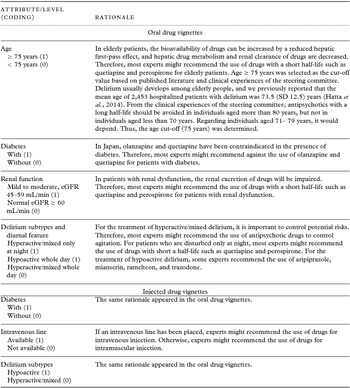
We assessed the drugs recommended for treatment using multiple hypothetical clinical vignettes for delirium with a traditional full-profile conjoint analysis (Orme, Reference Orme2010) (see a sample vignette in Appendix A1). First, we identified potential determinants (attributes) in decision making regarding recommended drugs for delirium, based on the published literature (Hatta, Reference Hatta2005; Okumura et al., Reference Okumura, Ito, Kobayashi, Mayahara, Matsumoto and Hirakawa2010; Hatta et al., Reference Hatta2014), product label information in Japan, and clinical experiences of the steering committee (KH, YK, KW, and TT). Second, we conducted a qualitative pilot study of ten psychiatrists to assess the face validity of the clinical vignettes. Based on the results of the pilot study, we removed some potential attributes: cardiovascular disease, respiratory failure, use of opioids and steroids, and risk of harm to self and/or others. As a result, we identified four key attributes for oral drugs: (1) age (≥ 75 years; < 75 years), (2) diabetes (with; without), (3) renal function (mild to moderate dysfunction; normal), and (4) delirium subtype and diurnal feature (i.e. hyperactive/mixed delirium only at night; hypoactive delirium throughout the whole day; hyperactive/mixed delirium throughout the whole day) (Table 1). We also identified three key attributes for injection drugs: (1) diabetes (with; without), (2) intravenous line (available; not available), and (3) delirium subtype (i.e. hyperactive/mixed delirium; hypoactive delirium) (Table 1). Finally, we employed a fractional factorial design (Orme, Reference Orme2010) to reduce the number of all possible combinations of the attribute levels from 24 (= 2 × 2 × 2 × 3) to 8 for oral drugs and from 8 (= 2 × 2 × 2) to 4 for injection drugs.
Patient attributes and levels

eGFR = Estimated glomerular filtration rate.
Respondents were asked to provide ratings using a 9-point Likert scale, ranging from 1 (strongly discourage) to 9 (strongly recommend), that reflected their recommendations for first-line pharmacological treatments. For each oral drug vignette, they rated the following 14 drugs: (1) aripiprazole, (2) blonanserin, (3) chlorpromazine, (4) haloperidol, (5) levomepromazine, (6) mianserin, (7) mirtazapine, (8) olanzapine, (9) perospirone, (10) quetiapine, (11) ramelteon, (12) risperidone, (13) tiapride, and (14) trazodone. For each injection drug vignette, they rated the following six drugs: (1) chlorpromazine administered by intramuscular route (IM), (2) haloperidol (IM), (3) haloperidol administered by intravenous route (IV), (4) haloperidol (IV) + flunitrazepam (IV), (5) levomepromazine (IM), and (6) olanzapine (IM). We included almost all drugs used for the treatment of delirium in Japan (Someya et al., Reference Someya, Endo, Hara, Yagi and Suzuki2001), irrespective of their recommendation status in package inserts (Meyer-Massetti et al., Reference Meyer-Massetti, Cheng, Sharpe, Meier and Guglielmo2010; Okumura et al., Reference Okumura, Ito, Kobayashi, Mayahara, Matsumoto and Hirakawa2010) and clinical practice guidelines (Hatta, Reference Hatta2005). As a result, respondents rated some drugs, such as chlorpromazine and levomepromazine that are generally not recommended for the treatment of delirium (Hatta, Reference Hatta2005). In Japan, haloperidol (IV) is used with monitoring as this route of administration bears the risk of ventricular tachycardia (Hatta, Reference Hatta2005).
Statistical analyses
All data were analyzed using R version 3.2.0 (R Core Team, 2015), and significance levels were set at 5% for all analyses. Each drug was analyzed separately. First, we conducted a linear mixed-effect model using the restricted maximum likelihood procedure (Pinheiro and Bates, Reference Pinheiro and Bates2000) to estimate the association between the recommendation ratings and the attributes. To account for a potential clustering effect, participant identity was included as a random effect. The model provides intercept and slope parameter estimates. A positive slope implies an average increase in ratings for the particular level (compared to the reference level), whereas a negative slope implies the opposite. Second, the contribution of each attribute to the overall recommendation ratings was evaluated by relative importance scores (Orme, Reference Orme2010). The attribute with the largest slope range is considered to be the most important attribute explaining the variability among the recommendation ratings. Finally, we calculated the predicted values for all possible combinations of the attribute levels from the above-mentioned fitted model, and then we calculated the proportion of experts that would be predicted as being likely to rate a given drug as positive (i.e. “7” or more) on a 9-point scale. Because of space constraints, we present only the top three positively rated drugs.
Results
Participant characteristics
Of the 560 members, 154 completed the questionnaires (response rate: 27.5%). We included 136 experts who met the eligibility criteria in the analysis (Appendix A2). The characteristics of experts are shown in Appendix A3. The majority (89%) of the respondents had practiced at least ten years in general hospital psychiatry. More than 80% of the experts reported that they had prescribed at least one of the following seven oral drugs for the treatment of delirium: risperidone, quetiapine, haloperidol, mianserin, tiapride, olanzapine, and trazodone. Haloperidol was the most commonly used injection drug.
Recommended oral drugs
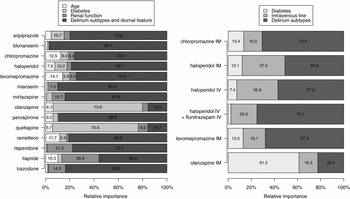
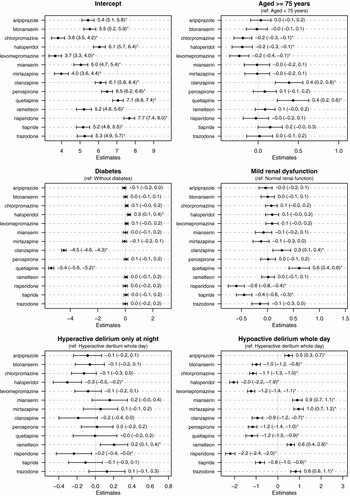
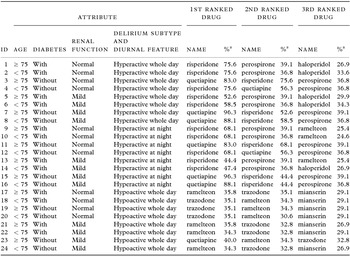
The experts had ranked the delirium subtype as the most important attribute on their recommendation ratings of most oral drugs, with the exception of olanzapine and quetiapine (in the left panel of Figure 1). The average recommendation scores for most oral drugs decreased by at least 0.8 points in the treatment of hypoactive delirium compared to hyperactive delirium, whereas the average scores increased by at least 0.5 points for recommendation ratings of aripiprazole, mianserin, mirtazapine, ramelteon, and trazodone (in the bottom right portion of Figure 2). For the ratings of olanzapine and quetiapine, the average scores decreased by at least 4.5 points when treating patients with diabetes, compared to those without diabetes (in the center left portion of Figure 2). In the treatment of hyperactive delirium, except for patients with comorbid diabetes and renal dysfunction, more than 68% of experts recommended the use of risperidone or quetiapine (Table 2; patient ID: 1–4, 7–12, and 15–16). In the treatment of hyperactive delirium in patients with renal dysfunction in the absence of diabetes, more than 88% of experts recommended the use of quetiapine (Table 2; patient ID: 7–8 and 15–16). However, no oral drug was recommended by over half of the experts in the treatment of hypoactive delirium with any clinical features (Table 2; patient ID: 17–24).
Contribution of each attribute to overall ratings using relative importance scores. Results are shown for recommended oral drugs (left) and for recommended injection drugs (right). IM = intramuscular; IV = intravenous.

Intercept and slopes for recommended oral drugs. A positive slope implies an average increase in ratings for the particular level (compared to the reference level), whereas a negative slope implies the opposite. *p < 0.05.

Recommended oral drugs for all possible combinations of attribute levels

a Denominators represent the number of respondents, and numerators represent the number of respondents predicted as likely to rate positive (7 or more) on a 9-point Likert scale.
IM = intramuscular; IV = intravenous.
Recommended injection drugs
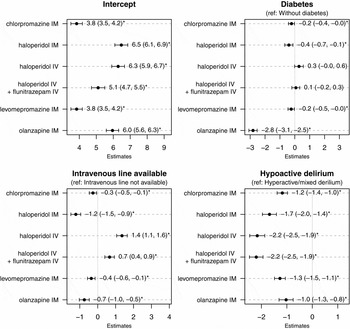
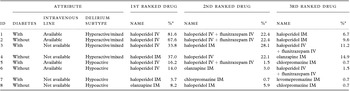
Experts ranked the delirium subtype as the most important attribute on the ratings of most injection drugs, with the exception of olanzapine (in the right panel of Figure 1). The average scores for all injection drugs decreased by at least 1.0 points in the treatment of hypoactive delirium compared to hyperactive delirium (in the bottom right portion of Figure 3). The average score for olanzapine decreased by 2.8 points in patients with diabetes compared to those without diabetes (in the top right portion of Figure 3). In the treatment of hyperactive delirium, more than 67% of experts recommended the use of haloperidol (IV) if an intravenous line had been placed (Table 3; patient ID: 1–2). However, no injection drug was recommended by over half of the experts in the treatment of hypoactive delirium with any clinical features (Table 3; patient ID: 5–8).
Intercept and slopes for recommended injection drugs. A positive slope implies an average increase in ratings for the particular level (compared to the reference level), whereas a negative slope implies the opposite. IM = intramuscular; IV = intravenous; *p < 0.05.

Recommended injection drugs for all possible combinations of attribute levels

a Denominators represent the number of respondents, and numerators represent the number of respondents predicted as likely to rate positive (7 or more) on a 9-point Likert scale.
IM = intramuscular; IV = intravenous.
Discussion
To our knowledge, this is the first study to assess expert opinions on the recommended first-line pharmacological treatment for delirium, given a specific and diverse range of clinical features. Our study produced three major findings. First, more than 68% of experts recommended the use of risperidone or quetiapine as a first-line oral drug in the treatment of hyperactive delirium, except in patients with comorbid diabetes and renal dysfunction. Our findings are somewhat different from the recommendations of clinical practice guidelines. Although most clinical practice guidelines recommend the use of antipsychotics in the treatment of hyperactive delirium, there are no recommendations for individual drugs in the guidelines developed by the American Psychiatric Association (American Psychiatric Association, 1999) and the American Geriatrics Society (American Geriatrics Society Expert Panel on Postoperative Delirium in Older Adults, 2015). Our findings suggest that clinicians select an initial drug depending on both the diverse range of clinical features and the pharmacological properties of antipsychotics in the absence of recommendations for individual drugs in the guidelines. Our finding also differs from that of a previous study in which 91% of European experts identified haloperidol as a first-line drug in the treatment of hyperactive delirium (Morandi et al., Reference Morandi2013). One potential explanation for this discrepancy is that the European study did not differentiate patients who were suitable for oral administration from those who were not (Morandi et al., Reference Morandi2013). Because most atypical antipsychotics such as risperidone can be administered only by the oral route, it may not be surprising that experts recommended the use of haloperidol preferentially, given that it is known that oral administration is not suitable for some patients. In addition, the preference for atypical antipsychotics could result from safety concerns, as several studies have shown that atypical antipsychotics might have a lower propensity than haloperidol to induce extrapyramidal symptoms (Miyaji et al., Reference Miyaji, Yamamoto, Hoshino, Yamamoto, Sakai and Miyaoka2007; Boettger et al., Reference Boettger, Jenewein and Breitbart2015).
Second, more than 88% of experts recommended the use of quetiapine over risperidone in the treatment of hyperactive delirium in patients with renal dysfunction who did not also have diabetes. One potential explanation for this finding is that the pharmacokinetics of quetiapine, in contrast to risperidone, are not altered in renal dysfunction (Thyrum et al., Reference Thyrum, Wong and Yeh2000; McLaren and Marangell, Reference McLaren and Marangell2004). As a result, clinicians do not necessarily adjust the dosage of quetiapine for patients with renal dysfunction (Thyrum et al., Reference Thyrum, Wong and Yeh2000; McLaren and Marangell, Reference McLaren and Marangell2004). Quetiapine also has several clinically useful properties including a sedative effect, a short half-life, and a low propensity to induce extrapyramidal symptoms (Devlin et al., Reference Devlin2010). However, the preference for quetiapine was limited to patients without diabetes, because the Japanese regulatory agency has stated that the use of quetiapine is contraindicated in the presence of diabetes (Okumura et al., Reference Okumura, Ito, Kobayashi, Mayahara, Matsumoto and Hirakawa2010).
Third, no oral or injection drugs were recommended by over half of the experts for treatment of hypoactive delirium with any clinical features, although aripiprazole, mianserin, mirtazapine, ramelteon, and trazodone were preferred by some experts. One potential explanation for this finding is a lack of evidence to inform a decision on the choice of drugs in the treatment of hypoactive delirium (Borthwick et al., Reference Borthwick, Bourne, Craig, Egan and Oxley2006; Carvalho et al., Reference Carvalho2013). Indeed, the American Geriatrics Society recommended that antipsychotics should be avoided for the treatment of hypoactive delirium (American Geriatrics Society Expert Panel on Postoperative Delirium in Older Adults, 2015). At the current stage, the quantity and quality of available evidence are poor (Borthwick et al., Reference Borthwick, Bourne, Craig, Egan and Oxley2006; Carvalho et al., Reference Carvalho2013), making it difficult to reach a consensus on the pharmacological treatment of hypoactive delirium.
It was surprising that some experts recommended the use of ramelteon in the treatment of hypoactive delirium that lasted throughout the day. Although the etiology of this delirium subtype is unclear, a strong decline in melatonin levels during aging can be an associated factor (Srinivasan et al., Reference Srinivasan, Pandi-Perumal, Cardinali, Poeggeler and Hardeland2006). The experts who recommended the use of ramelteon might have expected recovery from the loss of sleep-wake cycle through replenishment of a potent melatonin agonist.
Our study had several important limitations. First, the response rate of 27.5% may lead to a non-response bias; for example, there may have been differences in opinions between responders and non-responders. Second, our study population did not represent the entirety of experts in general hospital psychiatry. Although no accurate data are available on the number of experts in general hospital psychiatry, there are approximately 2,200–3,900 psychiatrists in general hospitals in Japan (Noguchi et al., Reference Noguchi2014). Because there were only 336 experts in our study population, there must be a non-negligible number of experts who are not among the consultation-liaison psychiatrists certified by the Japanese Society of General Hospital Psychiatry. Third, it is unclear to what extent an expert opinion predicts an actual choice of a first-line pharmacological treatment for delirium. Fourth, our results may be influenced by the healthcare system in Japan. For example, according to the Japanese regulatory agency, the use of olanzapine and quetiapine are contraindicated in the presence of diabetes (Okumura et al., Reference Okumura, Ito, Kobayashi, Mayahara, Matsumoto and Hirakawa2010), and this must influence expert opinions on the first-line drug.
Conclusion
We found both areas of agreement and a lack of consensus regarding the first-line pharmacological treatment for delirium with a diverse range of clinical features. In the absence of a definitive treatment trial, most experts preferred to use risperidone or quetiapine for hyperactive delirium. These results highlight a need for a high-quality placebo-controlled trial to allow a definitive conclusion to be reached on the efficacy of risperidone and quetiapine for hyperactive delirium. Further efforts also are needed to routinely collect information that would allow a comparison of the effectiveness and safety of various drugs used in the treatment of delirium in the real-world context of clinical practice.
Conflict of interest
The ICMJE Uniform Disclosure Form for Potential Conflicts of Interest associated with this article can be viewed at online appendix.
Description of authors’ roles
Y.O participated in analysis and drafting of the manuscript. K.H participated in management and supervision of the study group. All authors participated in the study concept and design, and interpretation of data. All authors contributed to and approved the final manuscript.
Acknowledgments
This work was supported by the Japan Society for the Promotion of Science (Grant-in-Aid for Scientific Research (C): 23591728) to KH. The sponsor of the study had no role in the design and conduct of the study; collection, management, analysis, or interpretation of the data; preparation, review, or approval of the manuscript; or the decision to submit the manuscript for publication. We also would like to express our appreciation to Editage for providing editorial assistance.
Supplementary materials
For supplementary material for this article, please visit http://dx.doi.org/10.1017/S1041610215002446.