The central Andes are well known for a tradition of ornate and technologically complex textiles. Much of what scholars know about prehispanic textiles and other perishables is gleaned from coastal contexts because arid conditions promote their preservation, allowing us to chart technological change over the longue durée (e.g., Doyon-Bernard Reference Doyon-Bernard1990). In contrast, the Andean sierra's moist climate has led to the poor preservation of highland textiles, resulting in comparatively less knowledge about them. However, archaeologists often recover camelid fiber textiles on the coast, generating debates about coastal camelid husbandry (see Shimada and Shimada Reference Shimada and Shimada1985; Szpak et al. Reference Szpak, Millaire, White and Longstaffe2014; Tomczyk et al. Reference Tomczyk, Giersz, Sołtysiak, Kamenov and Krigbaum2019; Topic et al. Reference Topic, McGreevy and Topic1987). Some scholars argue that weavers produced camelid textiles with yarns originally spun and dyed in the highlands that were then exchanged with coastal societies (e.g., Rowe Reference Rowe1980:87). Meanwhile, despite an ample discussion of the provenance of camelid textiles on the coast, archaeologists have given less attention to the significance of cotton textiles in the highlands, largely due to a lack of data. We expect that prehispanic communities exchanged textiles as prized commodities and gifts across the Andes, reflected in how the Inka (AD 1400–1534) and Wari (AD 600–1000) empires invested great energy into textile production (Bergh Reference Bergh and Bergh2012; Murra Reference Murra1962; Rowe Reference Rowe, Rowe, Benson and Schaffer1979; Tiballi Reference Tiballi2010). Moreover, evidence for the movement of other kinds of objects such as obsidian (see Burger et al. Reference Burger, Mohr Chavez and Chavez2000) suggests that interregional exchange relationships were critical throughout the prehispanic past. It is thus plausible that people also traded cotton fiber, pre-spun cotton yarn, and woven cotton cloth produced in coastal regions, and we should expect to find these in highland contexts. As such, archaeologists should not make judgments about the location(s) of textile production based on raw material alone; instead, we should examine an assemblage's technical attributes, which may help us determine whether production is local or nonlocal. By establishing the normative production practices for yarn, cordage, and fabrics, researchers can identify deviations that are likely to be nonlocal.
With these complexities in mind, we present a descriptive overview of textiles and cordage from looted tombs at the site of Hualcayán, located in Peru's north-central highlands. We discuss qualitative and quantitative data on a sample of the assemblage with the objective of evaluating how technologically uniform it is. Significantly, textiles from Hualcayán comprise the largest reported assemblage of cotton textiles from the Andean sierra, providing a rare glimpse of highland weaving techniques. Unfortunately, the looted nature of these artifacts makes interpretations about mortuary ritual minimal. Instead, our aim is to understand the assemblage's overall technology, with the goal of identifying communities of weavers (Arnold and Dransart Reference Arnold and Dransart2014). Our results point to the possibility that Hualcayán engaged in trade networks that included pre-spun yarn from coastal communities.
Background
Shared Technological Practice
Recently, scholars of archaeological textiles have turned to the literature on technological practice and embodiment to inform interpretations on the cultural contexts of production and use (e.g., Arnold and Dransart Reference Arnold and Dransart2014; Hendon Reference Hendon2006; Minar Reference Minar2001; Peters Reference Peters, Arnold and Dransart2014). Moving beyond analyses of decorative style, scholars examine the technical attributes of cloth as a way to conceptualize social identities, economic and cultural exchange, and power relations. Anthropological theories on technology, agency, and the inherently relational nature of making things inform this perspective (Dietler and Herbich Reference Dietler, Herbich and Stark1998; Dobres Reference Dobres2000; Ingold Reference Ingold2000). Building on the notion of chaîne opératoire (Leroi-Gourhan Reference Leroi-Gourhan1945; Mauss [1935] Reference Mauss and Schlanger2006), a technological approach privileges the analysis of techniques used to create an artifact. A technique is the nondiscursive knowledge required to carry out a specific action in a manner that is deemed culturally appropriate; this knowledge is learned and taught in particular social milieus (Budden and Sofaer Reference Budden and Sofaer2009). Anthropologists refer to the social groups wherein shared learning occurs as communities of practice (Lave and Wenger Reference Lave and Wenger1991; Wenger Reference Wenger1998). Archaeologists use this approach to understand how shared artifact traits and patterned material culture reflect mediated practices in situated learning contexts (e.g., Bowser and Patton Reference Bowser, Patton, Stark, Bowser and Horne2008; Minar and Crown Reference Minar and Crown2001; Roddick and Stahl Reference Roddick and Stahl2016), thus illuminating possible social boundaries (Dietler and Herbich Reference Dietler, Herbich and Stark1998). By documenting patterns in technological choices across a textile assemblage, we can infer a social group's shared production practices.
Weaving in the Andes
Textile production is a complex, multiphase enterprise shaped by the cultural context (Carr and Maslowski Reference Carr, Maslowski, Carr and Neitzel1995). At its most basic level, a woven fabric is produced by at least the following four steps: (1) producing/procuring raw material, (2) spinning fiber into yarn, (3) planning the woven fabric during the loom setup and warping process, and (4) weaving. Additional steps might include dyeing, embroidering, or painting. Even when studying a single object, archaeologists must acknowledge that this agglutinative process likely drew on the contributions of several discrete communities of textile practice. Any task involved in textile production can be social and may not have taken place in a single locale. The social contexts of cloth production might include a mother teaching her children to spin yarn as she prepares her tribute for a local leader, who later trades the yarn with another community. Once the yarn is received, pairs of weavers would begin warping and setting up the loom in the way they were taught, which may differ from practices in the yarn's origin community. In her study of Paracas Necropolis funerary bundles, Peters (Reference Peters, Arnold and Dransart2014) explored these distinctions in community weaving by examining the ways in which technical attributes covaried within and between styles of fabric. Her work proposes multiple production models for discrete textile styles, which would have required differing crafting communities. She also suggests that some textiles were the product of multiple crafters who contributed during different phases of the object's chaîne opératoire. Peters formulated these proposals by analyzing the yarn and fabric technical attributes, which reflect socially learned practices.
Ethnographic studies in the Andes demonstrate that contexts of social learning inform how communities of crafters conduct their tasks (e.g., Bolin Reference Bolin2006). Communal weaving preferences often frame perspectives on what is the “correct” way to make cloth. This is the case among Isluga camelid herding communities in Chile, where weaving is a public affair, thus promoting discussion among weavers about what techniques are proper (Dransart Reference Dransart2002:123). Such normative practices often shape ethnic and gender identities, as in the Calcha (Medlin Reference Medlin and Rowe1986) and Macha (Torrico Reference Torrico, Arnold and Dransart2014) communities of Bolivia, where specific kinds of technical competence in weaving are expected of women.
Additionally, motor skills like spinning yarn tend to be culturally conservative habits informed by direct observation and imitation (Bolin Reference Bolin2006:99; Minar Reference Minar2001). Ethnographers and archaeologists have identified regional spin direction patterns across the Andes. In Cusco, Peru, anthropologists documented Z-spun yarn as the dominant spin direction (Franquemont Reference Franquemont and Rowe1986:317; Goodell Reference Goodell1968). Meanwhile, Meisch (Reference Meisch and Rowe1998:22) recorded S-spun yarns as the convention in Ecuador's Saraguro community. Scholars have observed similar trends in archaeological contexts, arguing that prehispanic yarns produced on the north coast were consistently S-spun, whereas those on the south coast were Z-spun (Bird Reference Bird, Bennett and Bird1949; Conklin Reference Conklin and Fiske1975; for the Argentinian context, see López Campeny Reference López Campeny2000). For the central coast, there seems to have been more variability, with no clear preference for S- or Z-spun yarn (Wallace Reference Wallace, Rowe, Benson and Schaffer1979). Unfortunately, the lack of evidence has prevented scholars from identifying prehispanic spin direction patterns in the highlands, leaving no baseline comparison for Hualcayán's assemblage. This absence of highland technological data makes the study of Hualcayán's textiles particularly relevant for understanding regional trends in prehispanic spinning and weaving.
The Archaeological Complex of Hualcayán
Ongoing research led by Bria and her team at Hualcayán since 2009 has demonstrated a long-term occupation between 2400 BC and AD 1450 (Bria Reference Bria2017). Hualcayán is a major archaeological complex located in the northern Callejón de Huaylas valley in highland Ancash, Peru (Figure 1; UTM 192388.86 m E, 9015360.46 m S). Its principal areas of occupation and architecture sit atop a sloping plateau at an elevation of ~3,195 m asl, yet a significant portion of the site also covers a terraced mountainside above; together these remains constitute a continuous stretch of ancient structures, terraces, tombs, and artifact scatters extending from 2,700 to 3,900 m asl. Trails up the mountainside, likely based on ancient routes, extend eastward across the Cordillera Blanca. These trails would have facilitated relatively easy interaction with communities living in the parallel Callejón de Conchucos valley east of the Cordillera Blanca and would have provided direct access to prime camelid grazing lands in the high-altitude puna (4,100–4,800 m asl). Meanwhile, Hualcayán's location in the Callejón de Huaylas would have allowed for easy access to the coast via the Santa River. Bria's (Reference Bria2017) research has produced clear evidence that Hualcayán's ancient community engaged in interregional exchange networks throughout much of the site's history, obtaining nonlocal goods, such as obsidian, precious stones, marine shell objects, and prestige ceramics during the Formative period (3000–1 BC), the Early Intermediate period (EIP; AD 1–700), and the Middle Horizon (AD 700–1000).
Topographic map of Hualcayán, showing excavation operations (left); regional map showing site location in Peru (right). (Color online)

Hualcayán has four primary sectors, A, B, C, and D, but the assemblage we describe here was recovered from Sector C. This sector is the site's primary mortuary zone and covers a wide area of the mountainside. Although all other sectors have mortuary contexts, Sector C holds more than one hundred machays. These are single and multichamber aboveground burial structures built beneath natural boulders, usually along cliffsides. Evidence in the form of ceramic style, architecture, and other associated artifacts suggests that people used Sector C primarily in the EIP and Middle Horizon (ca. AD 1–1000) with some reuse during the Late Intermediate period (see Bria Reference Bria2017; Cruzado Carranza Reference Cruzado Carranza2016). Additionally, machays like those in Sector C are known across the Callejón de Huaylas; many were built and used during the transition from subterranean to aboveground ossuaries (chullpas) between the EIP and Middle Horizon (Herrera Reference Herrera2005). Though looted, Hualcayán's machays revealed high quantities of incredibly well-preserved fabrics, including fragments of decorated textiles.
Cultural Context of the Region
In the Callejón de Huaylas, the EIP is defined by the autochthonous development of the Recuay, a culturally affiliated network of communities and polities characterized by chiefly lineages, feasting and ancestor veneration practices, defensive settlement locations, and the use of fine kaolin pottery (Lau Reference Lau2011). Ancestor veneration rituals organized around mortuary structures formed an important component of Recuay culture. During such rituals, fancy ceramics, prestige goods, and food and drink were crucial in mediating power relations, economic exchange, and religious and cultural practices (Gero Reference Gero1992; Lau Reference Lau2002). Bria (Reference Bria2017) documented the emergence of these practices at Hualcayán, where kin-based relationships were fortified through the creation of novel ritual and agricultural activities.
By the mid- to late Middle Horizon (ca. AD 800–900) Recuay traditions faded across highland Ancash following two centuries of increased interregional interaction and the incorporation of foreign commodities into local settings, fueled by Wari imperialism (Lau Reference Lau2011:259–261, Reference Lau2016:150–159). Despite this clear shift in cultural practice, archaeologists have not found substantive evidence indicating direct Wari control in the Callejón de Huaylas and broader highland Ancash (Lau Reference Lau2012). Instead, some Recuay groups participated in the intensified trade networks of the Middle Horizon and valued Wari imperial and other exotic goods, whereas other communities remained insular. At Hualcayán, evidence demonstrates a marked shift in ceramic and commodity consumption in domestic and mortuary spaces. Specifically, new ceramic styles emulating foreign wares, as well as imported vessels, appear in Hualcayán's households and tombs (Bria Reference Bria2017:460–464). We believe that an examination of textile technologies is critical for understanding the cultural, economic, and political transformations that occurred between the EIP and Middle Horizon across the region.
Methods
Our aim was to study the construction techniques of the overall textile assemblage at Hualcayán to identify communities of craft producers. We documented the range of perishable artifact construction types, examined technical attributes, and measured the standardization of textiles and yarns. In doing so, we attempted to re-create the social relations of production in which people learned and practiced particular spinning and weaving traditions.
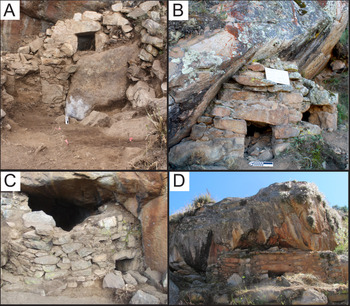
From 2011 to 2012, we recovered 1,445 fiber perishable artifacts from four machays in Hualcayán's Sector C, excavated as Operations 3, 8, 11, and 12 (Figure 2). Unfortunately, all tombs had been looted in the recent past, making a precise understanding of their original deposition impossible; only in rare cases could associations be made between specific textiles and interred individuals. Nevertheless, Grávalos conducted a technical attribute analysis of a combined stratified and random sample (n = 292) equaling 20% of Hualcayán's fiber perishable artifacts.Footnote 1 Table 1 presents the distribution of all perishable artifacts by excavated operation (i.e., machay), including each category of woven cloth.
Machays excavated at Hualcayán in 2011–2012: (a) Operation 3, (b) Operation 8, (c) Operation 11, and (d) Operation 12 (photos by M. Elizabeth Grávalos). (Color online)

Sampled Products by Operation (n = 292).

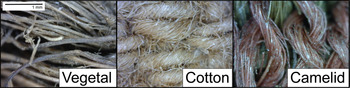
Following Emery (Reference Emery1966), Grávalos (Reference Grávalos2014) classified materials into one of three categories: (1) single-element constructions (e.g., looped fabrics), (2) constructions with one set of elements (e.g., braided cordage, baskets), or (3) constructions with two sets of elements (e.g., woven textiles). Next, she used a Dino-Lite Pro Digital Microscope AM-413ZTA with a maximum magnification of 220× to identify general categories of raw fiber type (Figure 3). Although scanning electron microscopy (SEM) is preferred for identifying fibers at the species level, a magnification of at least 100× is sufficient for accurate identification of archaeological fibers (Tiballi Reference Tiballi2010:45). Semi-rigid vegetal fibersFootnote 2 (e.g., bast) can be easily distinguished from flexible cotton and camelid fibers with the naked eye. However, Grávalos used magnification to differentiate cotton and camelid fibers. Under magnification, cotton appears kinky and fuzzy and has a dull sheen; in contrast, camelid fibers are round and smooth and have a lustrous sheen (Figure 3). Finally, Grávalos examined individual yarn features, including color, final twist direction (Z or S), ply, parenthetical notation, degree of twist, and diameter (Splitstoser Reference Splitstoser2009:135–138). When warps and wefts from woven textiles could be distinguished, she documented yarn attributes for each set of elements.Footnote 3
DinoLite images displaying raw material differences in Hualcayán's assemblage. (Color online)

Following Splitstoser (Reference Splitstoser2009:135), we make a distinction between “yarns” and “cordage.” Structurally speaking, yarns and cordage are the same, consisting of raw fibers that are spun, twisted, or both to use in fabric structures or as ropes. Here we distinguish between relatively thin cotton or camelid yarns and thickly plied or braided vegetal cords. These constructions are distinctive in fiber and were likely used differently.
After Grávalos analyzed the artifacts, we correlated their technological traits to measure the degree of uniformity within the overall assemblage and by individual tomb. We examined specimens by tomb to evaluate the possibility of differing communities of weavers. If materials were produced locally at Hualcayán within a single workshop, we would expect there to be a relatively high degree of uniformity in the overall textile assemblage. This would manifest in specific types of yarns consistently used for particular elements or fabrics (e.g., wefts as always S-spun).
In the next section we present quantitative results on technical attributes and describe the assemblage's design elements, comparing our findings to known fabrics from other Andean regions (e.g., Peru's north coast). Results are divided into several sections that present the data by product type: yarn attributes, cordage, single-element constructions, constructions with one set of elements, and constructions with two sets of elements.
Results
Raw Materials and Yarn Attributes
Here we provide a general summary of yarn structures and examine how they are distributed across Hualcayán's tombs. It should be noted that only a few yarns were analyzed from Operations 8 (n = 8) and 11 (n = 4) because these tombs had been looted considerably.
Fiber Type
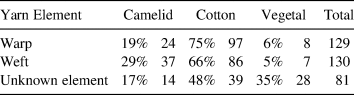
Given Hualcayán's highland context, we were surprised to find that most perishable artifacts were made of cotton, with 65% of woven fabrics consisting entirely of cotton yarns and 12% with mixed camelid and cotton yarns. When evaluating fiber type frequencies at Hualcayán, we looked at the percentages of cotton, camelid, and vegetal fiber types for elements that could be positively identified as warps or wefts (Table 2). Weavers used cotton and camelid yarns relatively equally for warp and weft elements, using camelid yarns slightly more frequently for wefts.
Yarns Elements by Fiber Type (n = 340).

Yarn Structure, Diameter, and Angle of Twist
The structure of yarns is a significant attribute because it represents the step-by-step process of spinning and plying to produce the final yarn for weaving. We used Splitstoser's (Reference Splitstoser2009) parenthetical notation method, which is a visual representation of the compound spin and ply directions of a yarn. We documented eight distinct yarn structure types at Hualcayán, with single-ply S-spun yarns as the most frequent structure (41%), followed by S(2z) yarns (36%). Table 3 summarizes the distribution of all yarn structure types at Hualcayán. There is a clear pattern suggesting a preference for S final twist. At Operation 12, there is an overwhelming majority of S final twist, with only 14 of 114 specimens with Z final twist. At Operation 3, although S final twist is less pervasive, it still dominates, with 155 of 214 specimens. To better understand the S final twist preference, we ran a chi-square contingency test comparing the yarn structure types found at Operations 3 and 12, which was statistically significant (p = 0.0058). However, we observed a different pattern when examining initial spin. At Operation 3, there are 124 specimens with initial Z-spun yarns (58%) and 90 with initial S-spun yarns (42%). At Operation 12, there is a similar pattern, with 63 Z-spun (66%) and 51 S-spun (44%) yarns. These data do not suggest any preference for an S or Z initial spin. Due to the clear variability present in initial spin, we looked at yarn structure types by fiber type across the overall assemblage. We found the most variability in cotton yarns, whereas nearly all fabrics with camelid yarns (n = 54/60) have an S(2z) structure.
Yarn Structure Type by Operation (n = 340).

We measured yarn diameter to gauge relative fineness, a potential indicator of skill. The means and coefficients of variance (CV) for cotton and camelid yarns are relatively similar in Operations 3 and 12. At Operation 3, cotton one-ply and two-ply average 0.379 and 0.573 mm, respectively, with CVs of 0.172 and 0.226. At Operation 12, we observed a similar average diameter of 0.408 mm for cotton one-ply and 0.693 mm for cotton two-ply, with CVs of 0.288 and 0.268, respectively. We documented an analogous pattern for camelid yarns. Operation 3 camelid yarns showed an average respective diameter of 0.354 mm for one-ply and 0.592 for two-ply, with CVs of 0.172 and 0.243. At Operation 12, only two-ply camelid yarns were present, which had a mean diameter of 0.694 mm and a CV of 0.075. These data demonstrate that craft producers spun cotton and camelid fiber into yarns with a similar degree of fineness.
To determine how “hard” or “soft” a yarn was spun, we measured the angle of twist. Spinning “hard” means that the individual spun the yarn with a very tight twist, whereas “soft” spinning creates a loose twist. Usually, the tighter the yarn, the stronger it is. At Hualcayán, with the exception of two-ply cotton yarns, there is a trend toward higher means for the degree of twist of single-ply yarns, whereas the means of two-ply yarns are about 10 degrees lower. We ran an independent two-sample t-test to see whether the angles of twist in cotton and camelid yarn specimens from Operations 3 and 12 were significantly different. For cotton, the results suggested that they were not significantly distinct (p = 0.151). Although not statistically significant, the angle of twist is still relatively low, which points to heterogeneity between the two tomb assemblages. We conducted another t-test for two-ply camelid yarns at Operations 3 and 12, and the results suggest that they are not significantly different (p = 0.630), indicating high uniformity in the angle of twist for camelid two-ply yarns between the two tombs.
Cordage
Hualcayán's cordage appears to have been used for binding deceased individuals during mortuary bundle preparation. This is demonstrated not only by the ubiquity of cordage across the four machays but also by the remains of an intact mummified individual with cordage still loosely wrapped around the body and impressions left on desiccated skin (see Bria Reference Bria2017:458; Grávalos Reference Grávalos2014:93). The creation of mortuary bundles consisting of several layers of fabric and cordage was a relatively common burial practice in the prehispanic Andes. Unfortunately, at Hualcayán we have not recovered any undisturbed mortuary bundles with intact textiles.
Hualcayán's excavation team recovered the majority of cordage from Operations 3 and 11. We analyzed a total of 55 cordage fragments, constituting six types: S(2z), Z(2s), S(3z), and Z(3s) structures, as well as four- and three-ply braids. Craft producers seem to have favored Z final twist over S final twist, the opposite of what we found for yarns used in weaving. Distinct production processes required for camelid and cotton yarns versus vegetal cordage may explain this difference. Craft producers likely used a spindle and weighted whorl for the efficient production of yarns (Bird Reference Bird, Rowe, Benson and Schaffer1979), whereas thick vegetal cordage was probably twisted together by hand or rolling up the thigh (Callañaupa Alvarez Reference Callañaupa Alvarez and Burrous2007:50). Depending on the length and diameter, cordage may have been created by pairs of individuals, whereas spinning is a one-person activity learned through imitation. The differences in these production techniques likely contributed to the observed distinction in final twist between yarns and cordage. Additionally, we found the diameter of cordage to be generally variable, likely related to the desired durability of the rope. Craft producers may have chosen to make some cords thick to withstand the tension of binding a corpse or securing a thick funerary bundle.
Single-Element Constructions
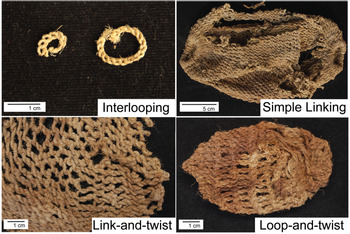
Hualcayán's single-element fabric constructions consist mainly of mesh bags. Our sample includes 26 specimens, all of which are composed of unidentified, semi-rigid vegetal fiber. We documented four distinct single-element construction types: interlooping, simple linking, link-and-twist, and loop-and-twist techniques (Emery Reference Emery1966:30–39; Figure 4). We found simple linking and loop-and-twist specimens in three of the four tombs, whereas interlooped and link-and-twist constructions were only found at Operations 3 and 12, respectively. Significantly, we noticed that the spiral direction of the linked or looped elements was always Z. By spiral direction, we refer to the orientation of the linked structure when the vegetal fiber yarns were used for fabric construction (Splitstoser Reference Splitstoser2009:163), and not the individual yarn twists. The uniform spiral direction may indicate a shared practice in the construction of mesh bags, although there is some variability in yarn structures. Within the assemblage of single-element structures, four yarn types are represented—S, Z, S(2z), and Z(2s)—with a preference for S(2z) yarns (69%).
Hualcayán's single-element constructions made with vegetal fiber. (Color online)

Constructions with One Set of Elements
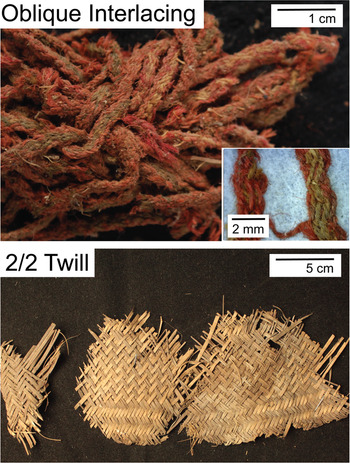
We divided the artifacts in this section into two classes (Figure 5). The first is a group of braided camelid cordage fragments, which have a distinct production process from the vegetal cordage described earlier. These small cords were produced with camelid yarns and appear to be flat four-strand braids, or oblique interlacing (Emery Reference Emery1966:60). We found several of these braided camelid cords in all four tombs (n = 42), with a majority from Operation 3 (n = 29). The oblique interlacing specimens consistently have yarns that are dyed red, along with either blue or yellow yarns. These fragile objects had an average diameter of 2.55 mm, suggesting they were not used as rope. Although ancient weavers often used oblique interlacing for sling production (D’Harcourt Reference D'Harcourt and Brown1962), these objects would not have been durable enough for this function. Instead, they perhaps served as offerings left in the machays or were decorative tassels on woven fabrics.
Constructions with one set of elements at Hualcayán. Smaller image (center right) is a close-up of oblique interlacing. (Color online)

The second artifact class, of which there is only one example, are two fragments from a vegetal mat (Figure 5). We recovered these fragments from Operation 8 and hypothesize that they formed part of a placemat for a funerary bundle. This specimen has a 2/2 twill structure (Adovasio Reference Adovasio1975:225).
Constructions with Two Sets of Elements
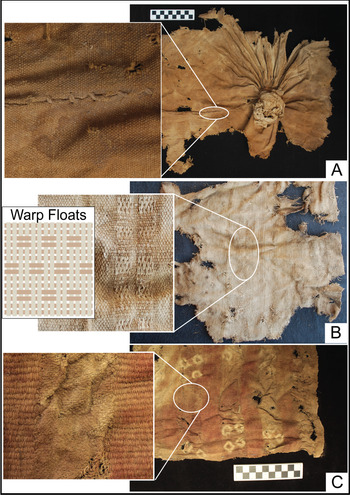
Here we discuss the data on woven textiles by structure type, including yarn attributes and fabric densities. When present, we describe selvage types, as well as design and suprastructural elements. We categorized the textiles into five types, which we describe in detail in this section. People at Hualcayán used four of these textile types—Type I, II, III, and IV cotton plain weaves—for wrapping deceased individuals during mortuary bundle preparation (Figure 6). Many of these fabrics show stains, likely resulting from human decomposition. These textiles are Hualcayán's largest, consisting of multiple fabric webs sewn together with a whipping stitch, probably serving to wrap individuals in several layers before interment. Almost all whipping stitches were sewn in a Z-slant direction, with only 2 of 37 specimens deviating from this norm.
(a) Top of a funerary bundle, with a whipping stitch connecting two cotton Type III Plain Weaves, (b) Type II Plain Weave with float design, and (c) Type IV Striped Plain Weave with resist-dye circles. (Color online)

Type I: Plain Weaves (1/1)
These are plain weaves consisting of single wefts that traverse single warps (1/1). This type includes monochrome cotton, polychrome camelid, mixed polychrome camelid and cotton, and monochrome and bichrome vegetal fabrics. We summarize the yarn data from these groups separately. In monochrome cotton plain weaves, there is variability in yarn structure: 28 specimens have an S-final twist (55%), whereas the remaining 23 have a Z-final twist (45%). At Operation 3, one- and two-ply yarns were used in plain weave construction. The yarns are very fine and tightly spun, with an average thickness of 0.41 mm and a twist angle of 42°. Regarding fabric density, about half of monochrome cotton plain weaves are balanced, and the other half are warp predominant. Simple selvages are represented in this sample; some, but not all, warp selvages display heading cords. As added yarns, heading cords provide strength to textile edges during the weaving process and throughout the textile's use life. Usually, weavers use heavier yarns as heading cords; however, at Hualcayán, they used single-ply yarns; up to seven yarns were grouped together per heading cord shot. Because heading cords are intended to add strength to the textile, weavers would have put these in place on each vertical end of the textile prior to weaving, when warps are initially ordered on the loom. Additionally, some of the weft selvages display warp packing, which stabilizes textile edges.
In contrast, the yarn structures found in polychrome and bichrome camelid plain weaves are uniform. These include striped fabrics and woven bags (see Grávalos Reference Grávalos2014:111–113). This sample consists of six specimens, all of which have S(2z) yarns. These yarns are less tightly spun than cotton yarns, with an average twist angle of 29.72°. The two-ply yarns are extremely fine, with an average diameter of 0.709 mm. After the weaving process, craft producers decorated three of the specimens in this sample with a red colorant using a resist-dye technique; the other three were patterned with stripes.
Nine plain weaves have mixed camelid and cotton yarns. Except for two textiles, weavers always used cotton for warp yarns and camelid fiber for wefts, many of which have colored stripes exhibited in weft elements. However, in examples with cotton wefts, weavers used the colored camelid warps to create stripes on the fabric surface. All camelid yarns are S(2z), whereas the cotton yarns are single-ply S-spun. The cotton yarns exhibit an average diameter of 0.37 mm, and the camelid yarns average 0.475 mm. Both groups of yarns are very fine, and the difference in diameter is due to the difference in ply. Both yarns were spun tightly, with cotton yarns exhibiting an average twist angle of 34.59° and camelid yarns of 29.19°.
Finally, the last group of Type I fabrics is made up of eight vegetal fiber plain weaves. Half of these specimens have warp and weft yarns with a Z(2s(2z)) yarn structure, whereas the other half have yarns with S(2z) structure. All textile fragments but three are monochrome. The vegetal yarns used in this group of artifacts are tightly plied, with a mean angle of twist of 29.69°. On average, Z(2s(2z)) yarns are almost double the diameter of S(2z) yarns, with a mean diameter of 2.11 mm for the former and 1.10 mm for the latter. This is to be expected because the Z(2s(2z)) yarns were re-plied, which would require doubling the S(2z) yarn onto itself to create the finished yarn. All specimens are weft-faced weaves with simple selvages.
Type II: Plain Weaves (2/2)
This type consists of plain weaves with paired wefts that traverse paired warps (2/2). Although Type II fabrics always had single-ply cotton yarns, there was a high degree of variability in the final twist of yarns. The data suggest that there was a preference for S-final twist; approximately one-third of yarns have S-spin, and there is no pattern related to warp/weft or by tomb. The yarns used for Type II fabrics are fine and tightly spun, with an average diameter of 0.402 mm and an angle of twist equaling 40.36°. There is more variability in diameter (CV = 0.213) than in the angle of twist (CV = 0.113). To better understand the variability in yarn diameter and the angle of twist for warps and wefts between the tombs, we further analyzed the data using descriptive statistics. Even when the data are split up by warp and weft, the values for each descriptive statistic are about the same as when they were calculated for warps and wefts together. This suggests that warps (CV = 0.106) were not spun more tightly than wefts (CV = 0.129). In analyzing the overall structure of the Type II fabrics, we found that 10 of 40 specimens with identifiable warps and wefts exhibit a balanced weave density, whereas 30 are warp predominant.
All selvages present on Type II textiles are simple, some of which have heading cords and warp packing. Eleven of the Type II fabrics exhibit a subtle, undyed design motif, created by the float weave technique. Weavers created subtle stripes by “floating” paired warps over one weft pass. Often, warp float designs are paired with darker-colored cotton warps to create additional faint stripes (Figure 6b).
Type III: Plain Weaves (1/2 or 2/1)
This type consists of plain weaves with single warps and paired wefts (1/2) or paired warps with single wefts (2/1),Footnote 4 most of which we recovered from Operation 12. It is noteworthy that 11 of 13 specimens from Operation 12 have warps and wefts with an S-spun yarn structure. All yarns used for these plain weaves are cotton, quite fine, and tightly spun, with an average diameter of 0.384 mm and an average angle of twist of 39.11°. All Type III fabrics are warp predominant. Textiles with intact selvages have simple weft and warp finishes, some of which have heading cords. None of these textiles are dyed or decorated. Figure 6a demonstrates a Type III fabric with a Z-slant whipping stitch conjoining two fabric webs, as well as a vegetal cord securing the top of what was likely a mortuary bundle.
Type IV: Striped Plain Weaves
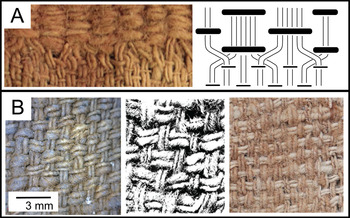
This textile group (n = 8) is uniform in technique, with alternating weft-faced and 2/1 plain weave stripes (Figure 6c). These fabrics exhibit a special technique when transitioning from the weft-faced weave to the 2/1 plain weave, called “warp crossing” (Figure 7a). Ann Rowe (Reference Rowe1980) documented this technique among textiles from the site of Chan Chan on the north coast of Peru, dated to the Late Intermediate period (AD 1000–1476). Hualcayán's warp-crossing technique is slightly different from that of Rowe's assemblage. When the warps are in a weft-faced weave, they are grouped into sets of six, where the wefts are single and traverse six warps at a time. When the warps transition to a 2/1 plain weave, they group into three pairs, where the two outer pairs cross over the adjacent warps. The wefts remain single throughout the fabric structure; however, they alternate between being packed together closely to create a weft-faced weave and being evenly spaced in the 2/1 plain weave. This warp-crossing technique helps lock wefts in place, preventing design distortion. Additionally, Type IV fabrics have red resist-dye circles (Figure 6c). This design element lacks a clear pattern; in some cases, they are grouped in twos, whereas in others they are in sets of four, only appearing on the 2/1 plain weave stripes of the fabric.
Hualcayán's Type IV Plain Weaves share techniques with coastal textiles: (a) Hualcayán's warp-crossing technique (left) and that of Chan Chan (right, image adapted from Rowe Reference Rowe1980); (b) Hualcayán's Type II Plain Weaves (left), the Uhle Collection at the University of California, Berkeley (center, from O'Neale Reference O'Neale1947), and the Virú Valley (adapted from Surette Reference Surette2015:Figure 114). (Color online)

Except for one specimen, the yarns in Type IV textiles are uniform. Seven of the eight artifacts in this group come from Operation 3; the one specimen that differs slightly from the rest is from Operation 12. All wefts in the Operation 3 textiles are single-ply, S-spun yarns, whereas the warps are a mixture of single-ply S- and Z-spun yarns. The warp yarns from the Operation 12 specimen are also S-spun single-ply; however, the weft yarns are S(2z). All yarns from this assemblage are very fine, tightly spun yarns, with an average diameter of 0.358 mm and a 35.62 degree of twist. All selvages are simple, with heading cords on warp selvages.
Type V: Tapestries
Hualcayán's tapestries consist of slit, dovetail, and a mixture of slit and dovetail techniques. Operation 12 yielded the most tapestry fragments (n = 12). Although Operation 3 also had tapestries, all except one were in poor condition, making it difficult to reconstruct iconography. Tapestries contain the most camelid yarns of Hualcayán's assemblage. All weft yarns were spun with camelid fiber, and in one instance, cotton and camelid weft yarns were plied together (see Grávalos Reference Grávalos2014:Figure 5.2). Weavers used both camelid and cotton yarns for tapestry warps; six specimens exhibit all camelid warps, five with all cotton, and five with a mix. The tapestries have four distinct yarn structure types: S, S(2z), Z(2s(2z)), and Z(3s(2z)). In 33 of the 36 specimens, yarns in the tapestries are S(2z); only one fabric exhibits the Z(2s(2z)) and Z(3s(2z)) yarn structures. We did not find any Z-final twists in the tapestries, except for the higher-order yarns just mentioned. Both the Z(2s(2z)) and Z(3s(2z)) structures were created while weaving; warp yarns transition from single S(2z) yarns to groups that were then plied. The purpose of this technique remains unclear; importantly, all yarns were created as S(2z) when the weaving began. Overall, tapestries have very finely spun yarns.
Hualcayán's tapestries have distinctive design motifs. There is a colorful slit and dovetailed tapestry with Wari-influenced iconography, which was likely part of an ornate belt (Figure 8b). To our knowledge, this motif has not been documented elsewhere, though what is preserved is incomplete. The figure displayed may represent a camelid with wing-like appendages and a downturned head, resembling fret motifs common in Wari textiles. It also bears resemblance to what Angeles and Pozzi-Escot (Reference Angeles and Pozzi-Escot2000:Figure 17) identified as a “Staff Deity” shown in profile on a Middle Horizon tapestry belt from Huaca Malena in the Asia Valley. The figure's black outlining, as well as the color blocking, is a known Middle Horizon style (Bergh Reference Bergh and Bergh2012).
Iconography and color: (a) step-fret motifs with slit and dovetail techniques, (b) slit and dovetail techniques showing Middle Horizon iconography, (c) a curved slit tapestry border on a cotton plain weave, (d) Hualcayán's resist-dye fabrics, and (e) a resist-dye Wari patchwork tunic from The Met Museum, Accession #1986.488. (Color online)

Another design element is a repeated stepped fret, present on six tapestries, which weavers created with slit and dovetail techniques (Figure 8a). We believe that each specimen represents individual checkered tunics or mantles because of their color differences. Stepped frets are common iconographic elements in highland and coastal Andean contexts on ceramics and textiles dated to the EIP through the Late Horizon. Although to date no Recuay textiles with stepped frets are known (Lau Reference Lau, Arnold and Dransart2014:333), Recuay ceramicists often portrayed people wearing checkered tunics (Gero Reference Gero1999). However, stepped frets on tapestry tunics also date to the Middle Horizon (e.g., Bergh Reference Bergh and Bergh2012:Figure 148). It is noteworthy that the stepped fret tapestry fragments are broken into similar sizes along diagonals, indicating that the cloth was folded along the bias grain in its original context. This suggests that these tapestries may have been left as mortuary offerings.
Because of the commonality of Wari-influenced resist-dye circles on plain weaves (Figure 8d) and the tapestry belt fragment in the Middle Horizon style (Figure 8b), it seems probable that the entire assemblage of woven textiles dates to the Middle Horizon. Unfortunately, without radiometric dating, we can only speculate about the textiles’ temporal association.
Summary of Results
As described, we documented a uniformity in the spiral direction (Z) of single-element constructions, perhaps indicating shared practices in the production of mesh nets and bags at Hualcayán. Importantly, however, there is considerable variability in the yarns used for Hualcayán's woven fabrics. There is no specific pattern of spinning practice by tomb or for warp or weft elements dependent on fabric structure type. Nevertheless, it is compelling that there is greater variability in yarns used for Type I and II cotton plain weaves than in Type III, IV, and V plain weaves. In fact, most variability in the initial spin of yarns is found in cotton textiles. Additionally, there is a difference between cotton warps and wefts and those of camelid fiber. Cotton yarns exhibit random variability, but there is a difference in the degree of twist between warps and wefts in camelid yarns used in tapestry weaves. In tapestries, the warps are generally more tightly spun than wefts, which might suggest that these yarns were spun with the intention of being incorporated into textiles as warps that would be able to withstand the tension of weaving. This distinction is not found in cotton plain weaves. This may point to a correlation between the complexity of fabric type and the degree of yarn uniformity. Although the sample of finely made and decorated textiles at Hualcayán is small in comparison to undecorated fabrics, we believe there was a uniformity of practice in yarn production for specialized textiles. Importantly, despite the variation in cotton versus camelid fiber yarns, the construction of specific fabric types is relatively homogeneous. Weave densities, suprastructural stitches, and selvage types are all uniform by textile category.
Discussion and Conclusion
Taking into consideration the anthropological evidence on spinning, weaving, and social learning, we propose that Hualcayán's variability in cotton yarns is due to production by multiple communities of craft producers. Although there was a preference for S final twist in Hualcayán's overall yarn assemblage, the initial spin of yarns, particularly cotton, is inconsistent, with almost half S-spun and the other half Z-spun. Given the heterogeneity in cotton yarns, we hypothesize that Hualcayán participated in trade networks with coastal communities, where these yarns may have been originally produced. Because of the small sample sizes of single-element constructions and constructions with one set of elements, our discussion here focuses on yarns and woven fabrics.
We believe that Hualcayán obtained cotton yarns from the coast for two reasons. First, cotton is native to the Peruvian coast, and people have cultivated it in lowland river valleys for millennia. Cotton production in the highlands, outside of a few intermediary ecological zones (e.g., La Galgada; see Grieder et al. Reference Grieder, Mendoza, Smith and Malina1988:133), would have been unlikely in the ancient past just as it is rare currently. Cotton requires warm environments to grow, and temperatures were generally cooler in the prehispanic Andes than today (Thompson et al. Reference Thompson, Mosley-Thompson, Davis, Lin, Henderson, Cole-Dai, Bolzan and Liu1995). To date, researchers have not found highland evidence for cotton agriculture above 1,100 m asl. As such, we suggest that differing communities of craft producers from coastal populations contributed to a bulk supply of pre-spun cotton yarns, accounting for the heterogeneity of yarns in cotton fabrics at Hualcayán.
Looking beyond cotton yarn variability, other evidence connects Hualcayán to the coast. Cotton textiles from the north coast (Figure 7b) and loop-and-twist mesh bags from the Virú Valley (Surette Reference Surette2015:Figures 151–154) bear a striking resemblance to those recovered from Hualcayán. In the Moche Valley, Chan Chan textiles exhibit similar patterning as those from Hualcayán, with alternating weft-faced and 2/1 plain weave stripes with a warp-crossing technique (Rowe Reference Rowe1980). These coastal similarities are noteworthy because they suggest that either entire cotton fabrics were exchanged or that coastal and highland weaving communities influenced each other in style and technique. Rowe (Reference Rowe, Arnold and Dransart2014) argues for coastal–highland relationships among the Late Intermediate period Chancay, reflected in local imitations of highland styles. Similarly, recent isotopic data on Virú and Chancay textiles suggest that their camelid fiber has a highland provenance (Szpak et al. Reference Szpak, Millaire, White and Longstaffe2014). Interestingly, the Virú and Chancay fabrics were produced with local techniques, suggesting that only the raw camelid fiber was imported. In thinking about the provenance of Hualcayán's cotton fabrics, we doubt they were exchanged in their finished form because of the apparent disconnect between the variability in cotton yarn structure and the relative homogeneity in each textile structure type. In general, we found uniform weaving practices across the sample, in which weave densities, selvages, and suprastructural elements are homogeneous. Furthermore, the uniformity in camelid tapestries and camelid yarns points to local textile production. Combined with evidence from the coast implying that camelid fiber was traded from the highlands, we propose that pre-spun cotton yarns may have been traded from the coast through similar exchange networks.
We note that the technical variability in cotton yarns at Hualcayán may be the result of other cultural factors not related to social learning. In the Middle and Late Horizons, camelid fiber textiles were highly standardized sumptuary goods (Cook Reference Cook1996; Murra Reference Murra1962). So perhaps we should expect Hualcayán's camelid yarns to be finer and more homogeneous than cotton yarns. However, because we documented variability in cotton yarns within textiles that were otherwise uniform in weaving technique (e.g., density), we suggest the most likely scenario relates to technological practice learned in specific community contexts.
The Hualcayán assemblage also suggests intra-highland interactions, primarily through designs similar to Wari styles. Although the nature of Wari interaction in highland Ancash is not well understood, Lau (Reference Lau2012, Reference Lau2016) argues that the Callejón de Huaylas served as an economic thoroughfare in the Middle Horizon. At this time, Recuay cultural practices faded as locals embraced and imitated Wari styles. Hualcayán's textiles show an increased cosmopolitanism in the region associated with Wari. A sample of Hualcayán's plain weaves exhibits colorful resist-dye techniques, a design method used frequently in Wari patchwork fabrics (Rowe Reference Rowe and Bergh2012). Tapestry designs, such as color blocking, also bear similarities to Wari styles (Bergh Reference Bergh and Bergh2012). However, because the sample of Wari-influenced fabrics at Hualcayán is small and comes from looted contexts, we hesitate to directly connect Hualcayán to Wari sites.
Looking beyond design style, researchers can observe facets of social life through an inspection of technological attributes. These features yield information about functional intent and planning in craft production, as well as social learning. Our analysis of technical attributes led us to propose that textile production in Hualcayán relied on long-distance relationships between coastal and highland communities. Our work tentatively supports Peters's (Reference Peters, Arnold and Dransart2014) idea that textile production, as an agglutinative process, often involves multiple communities of craft producers. To further contextualize our results, future work at Hualcayán must include direct radiometric dating of textiles. This will help situate Hualcayán's weaving traditions within Andean cultural history, permitting comparison with textiles elsewhere. Our hypothesis can be further tested through technical attribute analysis of other textile assemblages. Although it may be difficult to assess weaving at other highland sites because of poor preservation, comparison with coastal collections could explain the observed variability among cotton yarns at Hualcayán. Doing so may reveal the nature of long-distance exchange and weaving communities of practice in the ancient Andes.
Acknowledgments
We thank the community of Hualcayán, PIARA field school students and staff, Kevin Vaughn, Kathryn DeTore, and Anne Tiballi for supporting this research. We conducted research with Felipe Livora and Elizabeth Cruzado Carranza under Peruvian Ministry of Culture permits N° 107-DGPC-VMPCIC/MC, N° 818-2012-DGPC-VMPCIC/MC, and N° 414-2013-DGPC-VMPCIC/MC. Our study was supported by Purdue University, Vanderbilt University, and the Fulbright-Hays. We thank three anonymous reviewers for their helpful feedback. All photos, except where otherwise indicated, are by the authors.
Data Availability Statement
This study's analytical results are available in Grávalos (Reference Grávalos2014). Artifacts are housed at the Hualcayán Archaeological Complex Laboratory in Peru.