Introduction
In Canada, with its 35 million inhabitants, suicide accounts for 3,600 deaths each year (www.statcan.gc.ca), whereas in Germany (81 million inhabitants) more than 10,000 people commit suicide each year (www.destatis.de). In older adults without dementia several risk factors for suicide have been identified: gender, age, psychiatric disorders (particularly major depression), substance abuse, physical illness, functional impairment, low social support, and stressful life events (Van Orden and Conwell, Reference Van Orden and Conwell2011).
Dementia's incurable and progressive disease course implies significant suffering for both patients and their families and may provoke the wish to hasten death. Every once in a while, after a celebrity with (incipient) dementia commits suicide – as for example did Robin Williams in August 2014 – there is media, public, and professional attention to these patients. Within this coverage, the relationship between suicide and dementia is evoked. Accordingly, numerous psychiatrists and psychologists are usually interviewed and speculate about the potential risk factors for suicide and the prevention of suicide in dementia. Often, superficial recommendations are given on how to deal with suicide ideations and behavior in the context of dementia. However, these important issues bring to light the scarcity of evidence-based data on the prevalence and the risk factors for suicide ideations and behavior (the latter defined as self-harm, suicide attempts, and suicide (Silverman et al., Reference Silverman, Berman, Sanddal, O'Carroll and Joiner2007)) in dementia. Consequently, the rationale for effective recommendations for the prevention and interventions for suicidal behavior of patients with dementia is also lacking.
Suffering from dementia can also underlie the wish to assisted suicide. Recently, this topic has been intensely discussed in the context of new end-of-life laws in many countries, including Canada, the USA, Germany, and France (Emanuel et al., Reference Emanuel, Onwuteaka-Philipsen, Urwin and Cohen2016). In the countries that have already legalized physician-assisted suicide like Switzerland and the Netherlands, the debate increasingly centers on the legitimacy on these end-of-life decisions in psychiatric patients, notably those with dementia (Schmid et al., Reference Schmid, Zellweger, Bosshard and Bopp2016). The ethical, legal, and social questions surrounding assisted suicide are highly complex. In order to address them adequately, however, it is necessary to gather the evidence on the current practice of assisted suicide for patients with dementia (Birnbacher and Dahl, Reference Birnbacher and Dahl2008).
In order to summarize the current understanding on suicide ideations and behaviors as well as assisted dying in dementia a literature review was undertaken. A systematic narrative review was performed that considered all relevant studies investigating the prevalence and risk factors for suicide ideations and behaviors and assisted dying in dementia. The review is the basis for an in-depth discussion of the limitations of the studies; of ethical and legal aspects of assisted dying in dementia; of the design of future studies investigating the relations between dementia and suicide ideations and behaviors; and of recommendations for clinical practice.
Methods
An English, German, and French systematic Medline, Cochrane Library, EMBASE, PSYNDEX, PSYCINFO, Sowiport, and Social sciences citation index literature search of controlled trials, cohort studies, case-control, and cross-sectional studies published up until May/31/2015 was performed. The Medical Subject Heading (MeSH) term “suicide” was combined with the MeSH terms “cognition,” “dementia,” “decision making,” and “assisted dying” with the Title and Abstract terms (TIAB) “End of Life.” An iterative process was used so that all relevant papers could be obtained. Moreover, a further hand search of bibliographical references from selected papers and existing reviews was conducted to identify additional potential studies. Identified abstracts were then independently evaluated by two reviewers (SRD, JDS, RJ) regarding inclusion criteria which were defined as follows: (1) original paper published in an English, German, or French language peer-reviewed journal, (2) paper included patients with (pre-) dementia, (3) paper included information about individuals with suicide ideations, suicidal behavior, or assisted dying. From the abstracts that fulfilled the initial inclusion criteria, full articles were obtained for a final analysis.
Results
Several studies have investigated the prevalence, predictors, and risk factors of suicidal ideation and behavior, which are summarized below.
Prevalence of suicidal ideation and behavior in dementia
In an Australian memory clinic-based study, nine out of 221 dementia patients reported suicide ideations (4%) (Draper et al., Reference Draper, Maccuspie-Moore and Brodaty1998). Moretti and colleagues studied patients with vascular dementia (n = 120) and multi-infarct dementia (n = 120) for 24 months; it was noted that 7 (6%) and 14 (12%) patients, respectively, exhibited suicide ideation upon initial intake, while only two (2%) and 14 (12%) patients reported suicidal ideations at 2 years follow-up (Moretti et al., Reference Moretti, Torre, Antonello and Cazzato2006). Another study reported that out of 111 patients with early-onset Alzheimer's disease (AD), only one had suicidal ideations consisting of a suicide plan and threats, which had not yet been acted on (Sabodash et al., Reference Sabodash, Mendez, Fong and Hsiao2013).
Few studies have evaluated the prevalence of dementia among suicide attempters. Results for such studies generally showed inconsistencies with one another. For example, a Hungarian study examined 62 elderly psychiatric inpatients that had attempted suicide and found that 60% of them suffered from a mild cognitive deficit or mild dementia (Osvath et al., Reference Osvath, Kovacs, Voros and Fekete2005). Conversely, a Swedish case-control study of 103 suicide attempters did not find an association between suicide attempt and dementia (Wiktorsson et al., Reference Wiktorsson, Runeson, Skoog, Ostling and Waern2010). Similarly, two systematic reviews concluded that less than 10% of elderly suicide attempters had a primary diagnosis of dementia (Draper, Reference Draper1996; Chan et al., Reference Chan, Draper and Banerjee2007). A German review reported that between 0% and 27% of suicide attempters (mostly elderly psychiatric inpatients) had a diagnosis of dementia (Schneider et al., Reference Schneider, Maurer and Froelich2001). However, few studies have reported the prevalence of suicide attempts in patients with dementia. Barak et al. (Barak and Aizenberg, Reference Barak and Aizenberg2002) conducted a 10-year retrospective analysis of all elderly patients with dementia that had been admitted to a large Israeli mental health center (n = 351); 16 out of 215 (7.4%) patients with AD were admitted immediately following a suicide attempt. A Chinese survey reported unusually high numbers of suicide attempters in the dementia population: in a one year period, of all the patients with dementia who were admitted into a gerontopsychiatric unit, seven of these patients (12%) had attempted suicide (Tsai et al., Reference Tsai, Tsai, Yang and Hwang2007).
When considering completed suicide, it appears to be a rare occurrence for patients with dementia. The only literature review suggested that a negligible portion of suicide completers had dementia (Haw et al., Reference Haw, Harwood and Hawton2009). Of particular interest is Seyfried et al.’s study (Seyfried et al., Reference Seyfried, Kales, Ignacio, Conwell and Valenstein2011) that examined the national death index and veterans’ affairs data for approximately 300,000 individuals with dementia, of which, 241 had completed suicide (0.8%). A Swedish case-control study of older persons found that dementia was not associated with an increased risk for suicide; in this study, only three out of 85 suicide completers suffered from dementia prior to their death (Waern et al., Reference Waern, Rubenowitz and Wilhelmson2003). Moreover, a Danish case control study that assessed suicide completion over an 11-year period found that out of 5,699 suicide completers, 136 individuals with dementia had committed suicide (Erlangsen et al., Reference Erlangen, Zarit and Conwell2008). In a study based on a 9-year national clinical survey of suicides throughout England and Wales, 118 out of 11,512 suicide completers had a diagnosis of dementia (Purandare et al., Reference Purandare, Voshaar, Rodway, Bickley, Burns and Kapur2009). Additionally, psychological autopsy studies of suicide in later life which retrospectively constructed the circumstances of death from interviews and case notes, supported the view that the risk of suicidal behavior was low in persons with dementia (Cattell and Jolley, Reference Catell and Jolley1995). Furthermore, the psychological autopsy studies showed that most patients with dementia who committed suicide had significant psychiatric comorbidities (Schneider et al., Reference Schneider, Maurer and Froelich2001).
Practice and prevalence of assisted dying in dementia
Hastening death can be realized by suicide but also by assisted suicide or euthanasia. In assisted suicide, a mentally competent patient voluntarily commits suicide, usually by ingesting lethal medication provided by others, e.g. prescribed by a physician. However, for euthanasia, death is caused by the physician who administers an injection or infusion of a lethal substance based on the request of a patient with intact decision-making capacity. Together, assisted suicide and euthanasia can be labeled as “assisted dying.” Today, only a few countries (Belgium, Luxembourg, the Netherlands, Switzerland, Canada, and three American states) have explicit laws permitting and regulating assisted dying. Therefore, the frequency of dementia among persons who choose assisted dying undeniably depends, among other factors, on the end-of-life laws for assisted suicide in a given region.
In the American state of Oregon, for example, where physician-assisted suicide is only permitted under strict conditions, it is legally mandatory that the patient retains decision-making capacity and has a “terminal disease” meaning an “incurable and irreversible disease that has been medically confirmed and will, within reasonable medical judgment, produce death within six months.” As such, most patients who die by assisted suicide suffer from cancer, chronic lung or heart diseases, or amyotrophic lateral sclerosis, dementia is never mentioned in official reports (Oregon_Public_ Health_Division, 2014). In Switzerland, assisted suicide is openly practiced by some organizations and physicians. The official report by the Swiss Federal Bureau of Statistics in 2012 stated that between the years of 1998 and 2009 dementia was present in 0.3% of all cases of assisted suicide (Bundesamt_fuer_Statistik, 2012). In Belgium and the Netherlands, the practice of both physician-assisted suicide and euthanasia are legally possible when certain conditions are met: The patient must have intact decision-making capacity, suffer unbearably without prospect of improvement, and express a voluntary and well-considered request (Heide et al., Reference Heide2007). For 2014 the Netherlands reported 5,306 assisted deaths in total, including 81 (1.5%) for dementia (Regional_Euthanasia_ Review_Committees, 2014). New laws in the Netherlands, Belgium, and Luxembourg enable people to form an advance directive that allows physicians to legally perform euthanasia for people with advanced dementia (Tomlinson and Stott, Reference Tomlinson and Stott2015).
In the latest 2014 Dutch governmental report, 81 cases of assisted dying in dementia patients were mentioned. This number has generally been increasing over the last few years and makes up 1.5% of all assisted dying cases in 2014. Interestingly, most of these patients were individuals with early-stage dementia and were still deemed capable of making the request. Recently, the Dutch “end-of-life clinic,” an organization that provides assisted dying for patients whose physicians refuse it, published its statistics: In their first year, 21 requests from patients with “cognitive decline” (without specification of the severity of the decline or of the number of patients with manifest dementia) were granted, while the same number was rejected (Snijdewind et al., Reference Snijdewind, Willems, Deliens, Onwuteaka-Philipsen and Chambaere2015). No comparable official data have been published for Belgium.
In other countries like Germany and the United Kingdom, there are only few anecdotal case reports of patients with dementia dying by assisted suicide; in fact, most of the patients seeking physician assisted suicide from these countries travelled to Switzerland. From an ethical point of view, the crucial question is whether patients with dementia may still possess the required decision-making capacity to exercise their autonomy. Whether patients in early stages of dementia fulfill the required criteria is still under debate (Gather and Vollmann, Reference Gather and Vollmann2013), although it seems that they retain some criteria of decisional capacity very well (Hamann et al., Reference Hamann2011). Another question concerns the nature of suffering in dementia because most legal regulations require an unbearable suffering on the side of the patient. The fluctuating states of mood as well as the communication difficulties in some forms and stages of dementia make it difficult to assess this criterion. While some argue that suffering does only pertain to the current experience of the patient, others extend this concept to include also suffering from personality changes, loss of dignity and other “critical interests” (Cohen-Almagor, Reference Cohen-Almagor2016). A third major point of discussion regards the question whether advance directives of patients in early stages of dementia (or even before such a diagnosis) should be respected if they call for assisted dying in later stages of the disease (Menzel and Chandler-Cramer, Reference Menzel and Chandler-Cramer2014). Surveys among physicians and other healthcare professionals, mainly from the Netherlands, show that they are relatively hesitant towards assisted dying for patients with dementia, at least more than the public (Tomlinson and Stott, Reference Tomlinson and Stott2015).
Predictors and risk factors of suicidal intentions and behavior in dementia
Although the risk of suicidal behavior does not appear to be elevated in dementia as a whole, recent studies indicated that some subgroups of patients with dementia are more vulnerable for suicidal behaviors than others.
Depression and other psychiatric comorbidities
Depression is the most important risk factor for suicidal behavior in the elderly (Qin, Reference Qin2011). The proportion of individuals suffering from clinically significant depression among patients with dementia and AD is estimated to be 30–50% (Kim et al., Reference Kim, Ha, Yu, Park and Ryu2014; Knapskog et al., Reference Knapskog, Barca and Engedal2014). In the context of AD, depression can be a symptom of AD, e.g. a manifestation of the limbic neurodegeneration or a reaction to the diagnosis of AD itself. That being said, many studies support the view that depression in patients with dementia is significantly associated with suicidal behavior. For example, in a study conducted by Ballard and colleagues that looked at patients with depression and co-morbid mild to moderate dementia, suicidal ideations, measured using the Cornell Scale for Depression in Dementia, occurred in 45% of dementia patients with major depression and 12% with minor depression (Ballard et al., Reference Ballard, Bannister, Solis, Oyebode and Wilcock1996). A study conducted by Draper et al. (Reference Draper, Maccuspie-Moore and Brodaty1998) found that suicidal ideation or the wish to die was self-reported in 4% of 221 patients with dementia and it was significantly correlated with the presence of depressive symptoms. The previously mentioned study examining approximately 300,000 US veterans who had a diagnosis of dementia and 241 of whom had committed suicide identified psychiatric illness (depression, substance abuse, bipolar disorder, anxiety disorders), a history of inpatient or outpatient psychiatric care, and treatment with antidepressants or anti-anxiety medication as risk factors for suicidal behavior (Seyfried et al., Reference Seyfried, Kales, Ignacio, Conwell and Valenstein2011). A national clinical survey of all suicides in England and Wales identified 118 suicides by persons with dementia; psychiatric co-morbidities (e.g. depression, alcohol dependence, and delusional disorder) were present in more than two thirds of the patients. Another study of 118 persons over the age of 80 years with cognitive impairment observed nine (female) patients with suicidal thinking, all of whom had higher scores for depression and higher rates of depressive illness than patients without suicidal thinking (Rao et al., Reference Rao, Dening, Brayne and Huppert1997).
In a Korean study, depression was also identified as a risk factor for suicidal ideation in patients with dementia (Kim and Hyun, Reference Kim and Hyun2013); in a Chinese study, all seven patients with dementia that had previously attempted suicide also had significant clinical depression symptoms upon their hospital admission. Similarly, a number of case reports have linked specific psychiatric symptoms such as aggression, a resurgence of painful memories and command hallucinations with suicide, and self-harm in dementia patients (Haw, Reference Haw2009).
Interestingly, a study based on a 9-year national clinical survey of suicides in England and Wales found that patients with dementia who died by suicide in the first year following their dementia diagnosis were less often prescribed antidepressants when compared to patients without dementia who committed suicide. In the subgroup of 26 individuals with early-onset dementia who died by suicide, 50% had a history of alcohol or drug misuse (Purandare et al., Reference Purandare, Voshaar, Rodway, Bickley, Burns and Kapur2009).
Recent dementia diagnosis
Results regarding the influence of a recent diagnosis of dementia on suicidal behavior are inconclusive. Some case reports (Lim et al., Reference Lim, Rubin, Coats and Morris2005) and studies support the view that suicidal behavior occurs in line with a patient's new diagnosis of dementia. A nationwide longitudinal study from Denmark that used register data reported that hospital-diagnosed dementia was associated with an elevated risk of suicide. It was found that the risk for suicide was higher in the first three months following a diagnosis of dementia; this was especially true for men: A quarter of those who died by suicide were in this post-diagnosis period. However, in the same study, it was shown that 39% of suicide completers with dementia died more than 3 years after the diagnosis of dementia (Erlangsen et al., Reference Erlangen, Zarit and Conwell2008). A study of almost 300,000 US veterans with dementia aged 60 years and older revealed that 241 of them committed suicide. Seventy-five percent of these suicides occurred in patients following their new diagnosis of dementia (Seyfried et al., Reference Seyfried, Kales, Ignacio, Conwell and Valenstein2011). In contrast, a 9-year national clinical survey of suicides in England and Wales found only 16 of the 118 suicides completed by patients with dementia had occurred within the year after their dementia diagnosis. Importantly, five years after the diagnosis of dementia, it was found that 41 patients with dementia had committed suicide (Purandare et al., Reference Purandare, Voshaar, Rodway, Bickley, Burns and Kapur2009).
Many people fear that the disclosure of the diagnosis of AD to patients will prompt depressive symptoms or catastrophic reactions. Mormont et al. (Reference Mormont, Jamart and Jacques2014) assessed the reactions of 100 newly diagnosed patients with mild and moderate AD. It was found that none of the patients or their proxies reported suicide attempts or depressed reactions. Carpenter and colleagues also showed that disclosure of a dementia diagnosis did not prompt significant changes of depression or anxiety, instead the disclosure provided patients and their families with relief (Carpenter et al., Reference Carpenter2008).
Severity of dementia – Degree of insight into the condition
Severity of dementia appears to be inversely associated with suicidal behaviors. While the correlation between suicidal behaviors and the extent of cognitive decline has not yet explicitly been investigated, a study of attempted suicides in older depressed patients that also included patients with cognitive decline showed that suicidal intention was negatively associated with the Mini-Mental-State-Examination (MMSE) score (Upadhyaya et al., Reference Upadhaya, Conwell, Duberstein, Denning and Cox1999). It might be expected that suicide is infrequent in the advanced stages of dementia because of cognitive impairments leading to the loss of insight, as well as the inability to plan and execute an act of self-harm and ultimately to commit suicide (Draper et al., Reference Draper, Brodaty, Low, Richards, Paton and Lie2002). In early/mild disease dementia stages, however, the likelihood that full insight into the incurable nature of the disease and its consequences is maintained. At the same time, these patients who are in the early stages of their disease still have the ability to execute a suicide plan (Cipriani et al., Reference Cipriani, Vedovello, Lucetti, Fiorino and Nuti2013). Case reports have suggested that intact insight, that is understanding the nature of the disease and its future consequences (i.e. loss of mental competence and autonomy), is a risk factor for suicide in patients with dementia (Rohde et al., Reference Rohde, Peskind and Raskind1995). However, when assessed in a large sample of demented individuals in an Australian memory clinic study, suicidal ideation was not found to be associated with the presence of insight of future memory loss (Draper et al., Reference Draper, Maccuspie-Moore and Brodaty1998). The same was found in a smaller study of 118 persons with dementia, aged 81 years and older; there was no association between suicidal ideation and awareness of cognitive impairment (Rao et al., Reference Rao, Dening, Brayne and Huppert1997).
Presymptomatic diagnosis of dementia
Concerns have been raised about the potential risk of presymptomatic diagnosis of AD (i.e. based on genetic testing, cerebrospinal fluid (CSF) and blood biomarkers, and neuroimaging) on suicidal behavior in dementia (Draper et al., Reference Draper, Peisah, Snowdon and Brodaty2010). Genetic testing is available for a number of familial dementias including AD and frontotemporal dementia (FTD). The high penetrance of the relevant genes and therefore high probability for mutation-carriers to develop dementia is undisputable.
Several small studies have investigated that predictive genetic testing for neurodegenerative disorders is associated with an increased prevalence of suicidal behavior. In a small study of persons at risk for developing a familial autosomal dominant form of inclusion body myopathy associated with Paget's disease of bone and FTD caused by mutations in the VCP gene, one third of 102 persons at risk sought out genetic counseling (Surampalli et al., Reference Surampalli2015). In this study, three participants mentioned “planning for suicide” as a significant factor in their decision to receive genetic testing. Two of them tested negative while the participant that tested positive was referred for psychological treatment and follow-up counseling. At the one-year follow-up, this participant's anxiety and depression scores were in the normal ranges. Twenty-nine out of the 102 persons at risk underwent genetic testing, 18 of whom tested positive for the VCP gene mutation. At the one-year follow-up, no cases of suicide were reported. It is important to note that five of the positively tested persons were lost to follow up. Steinbart and colleagues followed 21 individuals at risk for familial AD or FTD who requested genetic testing, 12 of them had positive DNA test results. At the follow-up, between 6 months and 3 years after testing, no suicide attempts were observed (Steinbart et al., Reference Steinbart, Smith, Poorkaj and Bird2001). These studies, in which patients were monitored closely, may, however, not be representative of ordinary clinical practice.
Age
Only a handful of studies have investigated the impact of dementia patients’ age as being a risk factor for suicidal behavior. A diagnosis of dementia at a younger age might be considered or thought of as more dreadful and dire than a dementia diagnosis in older age. Correspondingly, in a sample of US Veterans, Seyfried and colleagues identified younger age as a risk factor for suicide in patients with dementia (Seyfried et al., Reference Seyfried, Kales, Ignacio, Conwell and Valenstein2011). Similarly, the previously discussed Danish register study also showed that younger patients with dementia had a higher relative suicide risk than older patients with dementia. Men and women aged 50–69 years with hospital presentations of dementia had a relative suicide risk of 8.5 and 10.8, respectively as compared to non-dementia patients. In comparison, in another study, those with dementia aged 70 years or older had a threefold greater risk for suicide than persons without dementia (Erlangsen et al., Reference Erlangen, Zarit and Conwell2008). In a British study, 22% of the 118 suicide completers with dementia were under the age of 65 years (Purandare et al., Reference Purandare, Voshaar, Rodway, Bickley, Burns and Kapur2009), a proportion, that is significantly higher than the proportion of presenile cases in dementia. These results are unlike those in cognitively healthy older population where the suicide risk increases with older age (Van Orden and Conwell, Reference Van Orden and Conwell2011).
Type of dementia and suicide behavior
The risk of suicide is three to five times higher in patients with Huntington's disease compared to the general population (Farrer, Reference Farrer1986). The potential reasons and risk factors for suicide in Huntington's disease have been extensively described elsewhere and are therefore excluded from the present literature review.
Apart from Huntington's disease, the majority of studies investigating dementia and suicidal behavior did not differentiate patients based on underlying etiology and types of dementia (Haw, Reference Haw2009). A few studies focused on patients with AD (e.g. Erlangsen et al., Reference Erlangen, Zarit and Conwell2008). Some case reports were published about patients with etiologies apart from AD. For example, Peisah and colleagues presented the pathological data of three individuals that had committed suicide who had either a cognitive impairment or dementia. They found multiple cortical and striatal lacunes and glial scars along with small vessel cerebrovascular disease and AD-related pathology, Lewy body disease and AD-related pathology, and infarcts and small vessel cerebrovascular disease in the frontal lobes, respectively for the three individuals (Peisah et al., Reference Peisah, Snowdon, Kril and Rodriguez2007).
A neuropathological case-control study that compared 28 participants who completed suicide with 56 age- and gender-matched individuals who died of natural causes, showed that Alzheimer pathology was more severe in the patients that had committed suicide (Rubio et al., Reference Rubio, Vestner, Stewart, Forbes, Conwell and Cox2001). However, another study did not detect an increased prevalence of Alzheimer-like neuropathology in suicide victims aged 65 years or older when compared to patients who died in a motor vehicle accident (Peisah et al., Reference Peisah, Snowdon, Kril and Rodriguez2007).
Although impulsivity is a common symptom in behavioral variant FTD reports about suicidal behavior in this population are scarce. A case report was published describing a patient with a recent diagnosis of behavioral variant FTD who committed suicide by hanging (Alberici et al., Reference Alberici, Cottini, Cossedu, Borroni and Padovani2012). Another case report described a patient with dementia with frontotemporal lobar degeneration spectrum caused by a c9orf72 mutation who committed suicide (Synofzik et al., Reference Synofzik, Biskup, Leyhe, Reimold, Fallgatter and Metzger2012). A small, retrospective study detected a slightly increased risk for suicidal behavior in patients with behavioral variant FTD compared to age and gender matched controls. Patients with a previous history of recurrent depressive episodes appeared to have a higher probability of attempting suicide (Fonseca and Machado, Reference Fonseca and Machado2014). A US study compared suicidal behavior in semantic dementia (SD) and early onset AD. Five out of the 25 of patients with SD showed suicidal behavior, two of them committed suicide while only one of the 111 patients with AD who presented suicidal behavior committed suicide. The history of depression and suicidal behavior among patients with SD was significantly greater than in their AD counterparts. The authors concluded that patients with SD were at risk of committing suicide, especially if they have depression and preserved insight (Sabodash et al., Reference Sabodash, Mendez, Fong and Hsiao2013).
In a report about survival and causes of death in a patient sample with frontotemporal lobar degeneration, no cases of suicide were reported for 50 individuals who had died during the observation period (Nunnemann et al., Reference Nunnemann, Last, Schuster, Foerstl, Kurz and Diehl-Schmid2011).
Erlangsen and colleagues (Reference Erlangen, Zarit and Conwell2008) found that women had a higher risk of suicide if they suffered from AD as compared to women who had vascular dementia. There is no other data confirming or contradicting the associations between vascular dementia and suicide.
Profile of cognitive impairment
In the last decade, neuropsychological and neuroimaging studies have been conducted to better understand the neurocognitive aspects of suicidal acts. Despite several limitations in this field of research, including small sample sizes, neuropsychological, and neuroimaging studies support the theory that certain individuals have a specific vulnerability to suicidal behaviors. These findings indicate that cognitive and neural alterations are related to the vulnerability for suicidal behavior rather than the associated psychopathology. A meta-analysis of seven different neuropsychological tests suggested that impairments in value-based decision-making and cognitive inhibition are associated to a specific vulnerability for suicide attempts, in non-dementia population and whatever the age of suicide attempters (Richard-Devantoy et al., Reference Richard-Devantoy, Berlim and Jollant2014a). Of particular interest, autobiographical memory has been found to be significantly less specific in non-dementia patients with a history of suicide attempt compared to those without a history of suicide attempt. Long-term and working memory showed larger impairments in suicide attempters in comparison to non-dementia patients and healthy controls (Richard-Devantoy et al., Reference Richard-Devantoy, Berlim and Jollant2014a). When considering the elderly population, several studies have investigated suicide attempters using neuropsychological tests. Overall, impaired cognitive control is perhaps the most consistent cognitive deficit found among older, depressed suicide attempters compared to depressed non-attempters (Richard-Devantoy et al., Reference Richard-Devantoy, Szanto, Butters, Kalkus and Dobrovski2014b). However, studies investigating whether a certain cognitive profile is a risk factor for suicidal intentions and behavior in patients with dementia have not yet been performed.
Other risk factors
A history of suicide attempts is a well-known predictor for future suicide attempts in patients with psychiatric disorders (Gallego et al., Reference Gallego, Rachmallu, Yuen, Fink, Duque and Kane2015). Previous expression of suicidal behavior and a past history of self-harm have also been reported as risk factors for suicide in patients with dementia. For example, Barak and Aizenberg (Reference Barak and Aizenberg2002) examined patients with AD after a suicide attempt and showed that previous suicide attempts were associated with an increased risk for suicidal behaviors in patients with dementia. Furthermore, it was shown that a prior suicidal attempt was a risk factor for suicidal ideations in patients with dementia (Kim and Hyun, Reference Kim and Hyun2013). In another study, 44% of patients with dementia that committed suicide had a history of self-harm (Purandare et al., Reference Purandare, Voshaar, Rodway, Bickley, Burns and Kapur2009). This same study showed that “life events” in the three months prior to suicide completion did not differ between patients with dementia and patients without dementia.
In the cognitively healthy elderly population, severe or chronic somatic diseases are risk factors for suicidal behavior (Waern et al., Reference Waern, Rubenowitz, Runeson, Skoog, Wilhelmson and Allebeck2002). This does not appear to apply to patients with dementia. The study by Seyfried et al. (Reference Seyfried, Kales, Ignacio, Conwell and Valenstein2011) found that medical burden and somatic comorbidities (e.g. cerebrovascular disease, diabetes with complications, and renal disease) were not associated with a higher risk for suicide in patients with dementia (Seyfried et al., Reference Seyfried, Kales, Ignacio, Conwell and Valenstein2011).
Discussion
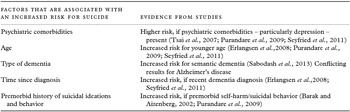
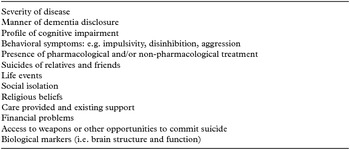
The review of the literature showed that the prevalence of suicidal behavior in dementia is not elevated compared to the general older population. Thus, dementia as a whole does not appear to be a risk factor for suicidal behaviors. However, although published studies are partly inconclusive or even contradictory, there is considerable evidence that some subgroups have a decreased risk, e.g. patients in advanced dementia stages, with a lack of insight into their disease or without psychiatric comorbidities. On the contrary, other subgroups have a significantly increased risk. The latter group includes patients who, for example, are younger, who are in early disease stages, or who suffer from comorbid depression. All risk factors for suicidal behavior in dementia are summarized in Table 1 and should be considered in clinical practice. Nonetheless, it has to be kept in mind, that most of the studies' results regarding prevalence of and risk factors for suicidal behavior in dementia included only small numbers of patients and have not been replicated. Therefore, it is necessary to remain cautious when interpreting the reported findings. At the same time, several risk factors that might play a role for suicidal behavior in dementia have not yet been systematically assessed (Table 2).
Risk factors for suicidal behavior in dementia

Potential risk factors for suicidal behavior that have not yet been investigated in dementia

Furthermore, the review identified a number of papers that raised concern that suicide risk might increase with the opportunity for very early or presymptomatic diagnoses of dementia (Draper et al., Reference Draper, Peisah, Snowdon and Brodaty2010), but there are no systematic findings to support this suggestion. Moreover, only very few studies have investigated the attitudes of cognitively healthy persons, family caregivers and physicians as well as persons with (incipient) dementia towards advanced directives including end-of-life decisions and assisted dying in dementia, which is only legal in a few countries and cases are scarce compared to cancer or other somatic diseases (Regional_Euthanasia_Review_Committees, 2014).
Limitations of current studies
Most studies that investigated the prevalence of dementia in patients with suicidal behavior as well as the risk factors for suicidal behavior in dementia had significant limitations, restricting the validity of their results. In fact, most studies used a retrospective design, consequently, (mild) dementia might have been overlooked or missed in a significant amount of patients. Most studies evaluating the prevalence of dementia in individuals with suicidal ideation or behavior did not systematically screen for mild dementia. For example, some studies did not record organic disorders, while others listed them as either organic brain syndromes or “confusion” without specifically identifying patients of dementia (Beautrais, Reference Beautrais2002; Préville et al., Reference Préville, Hébert, Boyer, Bravo and Seguin2005). In addition, individuals with severe major depression in the context of early dementia might have only been listed as having major depression, while the dementia diagnosis was disregarded (Draper et al., Reference Draper, Peisah, Snowdon and Brodaty2010). Most of the studies reviewed in this paper were difficult to compare because patient samples were heterogeneous with regard to sociodemographic and clinical characteristics, duration, and places of observation (e.g. general population, primary care, psychiatric hospital, gerontopsychiatric unit, etc.). Also, the definitions of suicidal ideations and behavior varied (e.g. active or passive suicidal ideation) and the timeframes for suicidal behavior were different between studies (e.g. suicidal ideation now, last week, last month, ever since diagnosis, lifetime, etc.). Studies that investigated the prevalence of suicidal behavior in dementia rarely accounted for potential confounders for dementia like the presence of other psychiatric disorders, use of psychoactive substances, life events, previous suicide attempts, etc. Most studies did not consider that self-reports, especially in the case of dementia, might be highly unreliable since persons with cognitive deficits might forget how they felt. Furthermore, patients might fear being stigmatized, being placed under psychiatric monitoring or even admitted onto a closed ward, if they report suicidal ideation. Therefore, it is necessary to include observer reports from close relatives in studies investigating suicidal intentions and behavior in patients with dementia.
Recommendations for future studies
Studies about risk factors for suicidal behavior and intentions in dementia are scarce. And yet, the identification of risk factors is a necessary step in allowing for the proper screening of patients at risk, targeting modifiable risk factors, and providing recommendations for appropriate support and treatment throughout the course of the disease.
In order to evaluate the risk factors for suicidal behavior (Tables 1 and 2) in patients with (pre)dementia and in their family caregivers, large prospective longitudinal studies are needed. In order to achieve sufficient patient numbers, collaborative multicenter initiatives are essential. Undoubtedly, psychologists and psychiatrists should be closely involved so that participants who develop suicidal ideations or behavior might be quickly identified and subsequently, the appropriate measures might be taken. Due to the aforementioned reasons, studies should include observer (family caregiver) reports about patients' suicidal ideations and behavior. Efforts should be made to focus on more vulnerable subgroups with higher risk. Furthermore, patients with rare dementia diagnoses (e.g. FTD) as well as early-onset and familial forms (e.g. young onset AD) should be included, since no evidence at all exists for these patient groups regarding their suicide risk. Follow-ups should be conducted for several years after diagnosis in order to detect any changes of risk factors as well as attitudes towards (assisted) suicide throughout the course of the illness.
Additionally, studies must describe the manner in which the diagnosis of dementia was disclosed. So far, several studies on the impact of the diagnosis of dementia have been performed. A systematic literature review (Bamford et al., Reference Bamford, Lamont, Eccles, Robinson, May and Bond2004) concluded that the existing evidence regarding diagnostic disclosure in dementia is inconsistent and limited. Many studies had methodological shortcomings. Studies indicate both negative and positive consequences of the disclosure. For example, Carpenter et al. showed, that disclosure of a dementia diagnosis did not prompt a “catastrophic reaction” in terms of significant changes of depression or anxiety (Carpenter et al., Reference Carpenter2008). Of the 90 individuals that participated in this study, two-thirds were in the very earliest symptomatic stages of dementia (mild cognitive impairment). It is important to note that this study had significant limitations with regards to the generalization of their results. For one, the study was not a “real world study.” The research setting was obvious: participants had been invited to be part of a research project that explored “how individuals respond to receiving news about their memory functioning.” Patients had been given informed consent before entering the study, and therefore were aware of the fact that their reaction to the diagnosis was being evaluated. Furthermore, one-third of the patients received a diagnosis of “no dementia.” Thus, it is not surprising that they did not show any catastrophic reactions. That being said, future studies need to evaluate suicidal ideation and behavior (including observer reports) as well as attitudes towards suicide, assisted suicide and advance directives both before and after the disclosure of a dementia diagnosis. Similarly, the details regarding disclosure needs to be explicitly considered (Were the terms “dementia,” “Alzheimer's,” etc. explicitly mentioned? Was the disease course/the prognosis discussed? Which questions were raised by the patients, which problems occurred, if any?).
More in-depth analyses are also necessary in the context of genetic and biomarker supported diagnosis of very early and presymptomatic dementia. Predictive genetic testing for Huntington's disease is well established and guidelines exist (for example, MacLeod et al. (Reference Macleod2013)). Recommendations for genetic testing of other neurodegenerative diseases have followed, e.g. for familial young onset dementias or amyotrophic lateral sclerosis (Goldman, Reference Goldman2015; Benatar et al., Reference Benatar2016). However, the interpretation of genetic test results and consecutive counseling in autosomal dominant disorders with (almost) complete penetrance is very different to that in in non-familial AD, where the presymptomatic diagnosis is solely based on CSF and imaging biomarkers.
CSF-markers and cerebral amyloid-imaging allow for the diagnosis of AD years before the onset of dementia symptoms. However, existing biomarkers are unable to accurately predict symptom onset and they are not 100% specific to dementia making the interpretation of such findings difficult. Hence, biomarker disclosing raises important clinical and ethical challenges, even more so as the intent to commit “rational” suicide might be one of the motivations to get preclinical diagnoses (Davis, Reference Davis2014). Only recently, a research group had developed a process to maximize the safety and effectiveness of disclosing Positron Emission Tomography (PET) amyloid imaging results to cognitively normal older adults participating in AD secondary prevention trials (Harkins et al., Reference Harkins2015). The psychological impact of disclosing biomarker results to cognitively healthy persons – in the context of secondary prevention studies as well as in clinical practice – yet needs to be explored further. As such, studies should be conducted that investigate how presymptomatic diagnoses are delivered by doctors, how cognitively healthy persons react, and if risk factors for depression, anxiety, and/ or suicidal ideations or behavior need to be considered. Last but not least it needs to be examined, if the disclosure of a presymptomatic diagnosis based on biomarkers changes the health behavior as it has been shown for susceptibility gene (apolipoprotein E) genotype (Chao et al., Reference Chao, Roberts, Marteau, Silliman, Cupples and Green2008).
Assisted dying in dementia raises numerous questions that remain to be answered empirically. It is of major interest to determine how long the capacity to decide about one's own death is retained during the course of dementia, which factors influence this capacity and how this capacity can reliably be assessed. Longitudinal studies are needed to investigate the value of advance directives, including the wish for assisted dying in later stages of the disease. An American study surveyed more than 4,000 people through an online registry for AD prevention on presymptomatic AD. In fact, 11.6% of the cognitively healthy persons that responded stated that they would seriously consider suicide if they were diagnosed as having a high risk for Alzheimer's disease (Caselli et al., Reference Caselli, Coon and Johansson2015). A public survey of 725 citizens from London and South East England found that almost 60% of respondents were in support of physician-assisted suicide in the case of dementia (Williams et al., Reference Williams, Dunford, Knowles and Warner2007).
Most probably, these numbers are significantly lower in patients with an actual dementia diagnosis and the number decreases even more in patients in advanced stages of dementia. It is still unclear how many people with dementia wish to hasten death. It seems theoretically plausible that suicide and assisted dying in dementia may become more prevalent in the coming years with more liberal laws that allow advanced directives for assisted dying in advanced disease stages. Some authors have initiated a debate about the ethical justification for pre-emptive suicide before the onset of dementia and argued that pre-clinical (AD) diagnoses would have value in as much as they would allow individuals to “choose suicide” before this option is taken away from them (Davis, Reference Davis2014).
Clinical implications
Although the suicide risk does not appear to be increased in dementia, dementia does not prevent from suicide and some subgroups of patients appear to have an increased risk for suicidal behavior. Thus, in clinical practice, a brief suicide assessment of patients with dementia is recommended. For patients with one or more risk factors (Table 1), suicidal thoughts and intentions should be evaluated in greater detail, taking into account the urgency and the dangerousness: Do you have suicidal thoughts? How frequent are these thoughts and how long do they last? Do you have specific plans? What are some things that might prevent you from acting on these thoughts? Do you have access to guns or other lethal means? If the assessment provides evidence for an increased suicide risk, appropriate actions must to be taken. These might include close monitoring, involvement of the caregiver, psychological support, diagnosis, and treatment of depression and other psychiatric disorders, if applicable.
At the same time, burden, support, and suicidal behavior of the family and caregivers should also be monitored closely. It is well known that caring for a relative with dementia is burdensome and can lead to depression, yet the topic of suicide in this specific population is largely neglected (van der Lee et al., Reference Van der Lee, Bakker, Duivenvoorden and Droes2014). O'Dwyer and colleagues conducted a cross-sectional survey of 566 family caregivers of patients with dementia (O'Dwyer et al., Reference O'Dwyer, Moyle, Zimmer-Gembeck and De Leo2016). Sixteen per cent of caregivers had contemplated suicide more than once in the previous year. Several more risk factors for suicidal ideation in family caregivers have been identified recently: pre-existing mental health problems, physical health conditions, and conflicts with other family or care staff (O'Dwyer et al., Reference O'Dwyer, Moyle and Van Wyk2013). Nonetheless, a comprehensive, longitudinal study of risk factors for suicidal ideations and behavior in caregivers of patients with dementia is still lacking and is urgently needed.
Conclusion
Prevalence of completed suicide appears not to be increased in patients with dementia. Although no firm conclusions can be drawn due to several limitations and the paucity of available data, our review suggests that some factors may predispose some patients to a higher risk of suicidal behaviors. Clinicians need to recognize that there is a risk of suicidal behavior in persons with dementia, particularly in the months following the diagnosis and in patients of co-morbid depression. Prospective longitudinal studies are required in order to identify markers of suicide risk, which will further shed light onto the potential targets for the prevention of suicidal behavior. The consequences and psychological impact of very early and presymptomatic dementia diagnoses needs to be evaluated in order to provide appropriate recommendations for diagnosis and disclosure. Furthermore, longitudinal studies are necessary in order to investigate the value of advance directives with end-of-life decisions including assisted suicide of persons with dementia. Results may serve as guidelines for clinicians, ethicists and jurisdiction. Above and beyond that, research is crucial in the development of a better understanding of the biological basis of suicide in dementia: Collaborative initiatives uniting neuroimaging and biological approaches would be an important step for the study of suicide in dementia.
Conflict of interest:
None
Description of author's roles:
J. Diehl-Schmid, S. Gauthier, S. Belleville, E. Racine, R. Jox, C. Schüle, G. Turecki, and S. Richard-Devantoy designed the study and wrote the paper. J. Diehl-Schmid, S. Richard-Devantoy, and R. Jox performed the literature review.
Acknowledgments
The Initiation Meeting of the Munich-Montréal Working Group on Dementia and Suicide was supported by a grant for the initiation of international collaborations of the Deutsche Forschungsgemeinschaft (DFG). Serge Gauthier's research is supported by the Canadian Institutes of Health Research, and the Ethical, Legal and Social Issues (ELSI) committee of the Canadian Consortium on Neurodegeneration in Aging (CCNA). Sylvie Belleville's work is supported by the Canadian Institutes for Health Research, the Quebec Consortium for the early Identification of Alzheimers's disease (CIMA-Q) and CCNA (Team 10).
The preparation of the manuscript was supported by a grant from the Bavarian Research Alliance. Sincere thanks to Sara Pichet and Yang Ding who helped to prepare the literature searching and who helped during the meeting of the Munich-Montréal Working Group on Dementia and Suicide in Montréal.