Introduction
In developed democracies, which adhere to a rule of law, public policy processes distribute authority and resources among government and quasi-government organisations and, through them, among their agents, partners and collaborators in the proprietary and non-profit sectors. These distributions reflect a wide variety of political and technical considerations that vary by context. In recent decades, there has arisen in many of these countries a “performance movement”, often associated with New Public Management reforms, whose goal is to promote systematic improvements in effectiveness that can be measured or documented and attributed to specific causal influences, prominently including public policy and management structures and processes.
Classical and modern academic literatures have always been concerned with performance in both broad and specific senses: the growth and efficiency of national and regional economies, the efficiency and effectiveness of public policies and programmes, and democratic outcomes such as equity, representation and participation. In recent decades, emphasis has focused more sharply on the analysis and design of public policies, and the measurement and evaluation of governing institutions and of government agencies, functions, programmes and consociational arrangements such as networks and public–private partnerships.
The subject of this paper is the determination of governmental performance as variously defined in relevant scientific literatures. We shall claim, on the basis of empirical evidence in those literatures and of new research reported here, that the core influences on government performance remain the hierarchically ordered structures – organisations, delegations of formal authority, rules and guidelines, categorised budgets, information exchange and reporting requirements, operational mechanisms – that enable and constrain public administrators in their policy implementation roles.
This is not to say that other factors internal and external to governance systems and government organisations never matter. Context matters. Often, however, “other factors” are incorrectly assumed to have displaced formal, hierarchical authority as determinants of performance and that we are moving towards “governance without government” (Rhodes Reference Rhodes1996; Peters and Pierre Reference Peters and Pierre1998; Lynn Reference Lynn2012a). Our claim is that, to the contrary, the most systematically influential factors remain the structures created by public policy processes and the administrative management they require and authorise (Benz Reference Benz1993).
Our argument is organised as follows. Firstly, we discuss the general thrust of performance-oriented theoretical reasoning in the literatures of traditional public administration, political economy and organisation studies. Next we review an analytic framework, termed a logic of governance (LOG), which has enabled investigators to derive useful insights from about 900 published studies concerned, directly or indirectly, with the determinants of government performance. Then we present findings from our own LOG-based analysis of more recently published research that demonstrates the influence of public policy processes and organisational effectiveness (OE) on government performance. Finally, based on findings reported in these sections, we offer justification for the claim that policy and administrative structures that define and distribute authority and allocate resources are the backbone, albeit not always the whole story, of democratic governance and its performance.
Governance and performance: theoretical considerations
In contemporary public administration, political economics and organisation studies literatures, performance has highly variable, often implicit, meanings. Performance is implicit, for example, in the concept of “accountability”, and “results”, “outcomes”, “effectiveness” and “consequences” are synonyms for performance.
Public administration
Early American administrative reformers took up the issue of how to organise governments to meet the needs and expectations of a rapidly expanding array of public interests and policies. Of equal concern was how to ensure the legitimacy, in the view of a growing, diversifying electorate, of rapidly expanding government authority at all levels (Bertelli and Lynn Reference Bertelli and Lynn2006).
The main challenge was to ensure democratic control over the exercise of bureaucratic discretion. Solutions were bound in the principles of “scientific management”, in particular, the “one best way” to design administrative structures (Taylor Reference Taylor1911). The most famous expression of the structural perspective, Gulick's essay, “Notes on the Theory of Organization”, dealt with issues such as the formulation of principles concerning specialisation, span of control, authority and delegation of responsibility (Gulick Reference Gulick1937). Scientific efficiency was more a rhetorical trope than a practical standard of performance assessment, however. Gaus recognised that the responsiveness of officials to enacted policies is not a matter of law but of the spirit (Bertelli and Lynn Reference Bertelli and Lynn2006). In this vein, the more practical concern for the profession became the sense of democratic responsibility and accountability demonstrated by officialdom.
Based on the body of traditional public administration literature, Bertelli and Lynn (Reference Bertelli and Lynn2001, Reference Bertelli and Lynn2006) identify four distinct and demonstrable qualities of reliable democratic administration – judgment, balance, rationality and accountability – which, they argue, constitute a precept of managerial responsibility. When observed in practice, the authors argue, the precept's qualifies as a general norm of responsible managerial performance as well as grounds for judicial deference when agencies are defendants in litigation. Government performance, then, is a result of democratic processes: systems of governance and mechanisms of delegation, control and accountability together with norms of responsibility they engender. The specific mechanisms to accomplish this goal range from those that emphasise hierarchical delegation and accountability (du Gay Reference du Gay2000; Strøm Reference Strøm2000; Hill and Lynn Reference Hill and Lynn2005; Meier and Hill Reference Meier and Hill2005; Lynn Reference Lynn2008) to those that emphasise the role of private initiative and civil society institutions in defining and achieving policy goals (Salamon Reference Salamon1989; Kooiman Reference Kooiman1993, Reference Kooiman2003; Klijn Reference Klijn2008). In the latter scheme, formal and informal processes of participation and collective action engendering trust matter more than any form of hierarchical and prescriptive performance management.
A specifically performance-oriented literature (e.g. in the journal Public Performance and Management Review) stakes out a middle ground. It has as its staple largely qualitative and case-based assessments of performance measurement and management reforms at all levels of government. The theory informing much of this literature is pluralistic, with a view that contextual influences on agencies encompass a broad range of stakeholders, including policy-makers to whom agency management are putatively responsible (Nyhan and Marlowe Reference Nyhan and Marlowe1995). Rule-of-law considerations and appropriations constraints are not given privileged attention.
Political economics
The literatures of political economics – positive political economy, public choice and the “new economics of organization” – reach a similar result via a more deductive intellectual route.
In the political economy of administration, the administrative system is created and sustained by “a chain of delegation, in which [officials] authorized to make political decisions [principals] conditionally designate others to make such decisions in their name and place [agents]” (Strøm Reference Strøm2000, 266). Agents are accountable to their principals (1) if they are obliged to act on the latter's behalf and (2) if the latter are empowered to reward or punish them for their performance in this capacity. The citizen's role is to control officials, but when we “consider the incumbents of political office as agents of citizens, we have to acknowledge that they are constrained and frequently common agents, whose responsibilities may thus be manifold” (Strøm Reference Strøm2000, 268).
A synthesis of neoclassical and institutional economics based on the concept of transaction costs has been employed by Thráinn Eggertsson (Reference Eggertsson1990) to explain choice at the top of the chain of delegation. The purpose of the state is to create a regime of property rights that provides incentives for actors to maximise its technical economic potential. Such a regime includes the availability of dispute processing by a third party, which in most cases can be supplied only by the state. The concept of hierarchy emphasises the importance of the political chain of delegation whereby higher-level authority purposefully creates, finances and regulates lower-level agents or third parties who are, in principle, accountable for their performance to authorising institutions.
In addition to accounts derived from positive political economy (Lynn Reference Lynn2008), this family of principal–agent explanations includes systems approaches, which focus on interrelationships among entities comprising a system for transforming inputs into outputs in order to achieve some result (Svara Reference Svara1990); approaches in which bureaucratic institutions use their substantial autonomy to supervene upon civil society in order to accomplish organisational and collective goals (March and Olsen Reference March and Olsen1984; Tweedie Reference Tweedie1994; Egeberg 1998; Carpenter Reference Carpenter2001); approaches emphasising “rule-of-law institutions and of administrative law in protecting and enforcing rights and ensuring social justice” (Moe and Gilmour Reference Moe and Gilmour1995; Rosenbloom and O'Leary Reference Rosenbloom and O'Leary1997); and eclectic approaches that acknowledge a variety of intellectual antecedents (Boyne Reference Boyne2003; Meier and O'Toole Reference Meier and O'Toole2007). Another line of reasoning emphasises the control problems that arise within hierarchically ordered administrative systems. Control may be imperfect or weak.
The important insight in these arguments is that public agencies acquire interests and goals of their own that can have a significant effect on the production and distribution of outputs and on their consequences, that is, on performance (e.g. Heinrich Reference Heinrich1999). Thus, the coercive power of the state is invoked to overcome collective action problems that arise in organising the production of public or collective goods.
In contrast to top-down approaches to control, consociational explanations assert that the capacity to produce and distribute public and quasi-public goods is to an increasing extent being organised by private, civil society entities in the form of networks and partnerships.Footnote 1 Hierarchical government, it is argued, is increasingly being subordinated to or supplanted by civil society institutions, either intentionally, as governments rely on them to address problems that are unstable and non-decomposable (Berry et al. Reference Berry, Choi, Goa, Jang, Kwon and Word2004), or unintentionally, as a consequence of weak government controls that create accountability vacuums that are filled by civil society institutions oriented towards “clientelistic” interests (Anheier Reference Anheier2005; Lynn Reference Lynn2008).
In an important series of essays, Moe argues that control comes at a considerable cost in inefficiency. “Political rationality” results in public programmes and organisations that are technically irrational. “As a result of regime restraints and the politics they authorize, the public manager may have to deal with inadequate resources, unreasonable or unrealistic workload or reporting requirements, inconsistent guidance, or missions defined so as to be virtually unachievable” (Lynn Reference Lynn2003, 21). Problems of agency may deepen as the chain of delegation reaches into government organisations themselves. Dunleavy (Reference Dunleavy1992) applies public choice reasoning to the behaviour of employees inside multi-level organisations. In Dunleavy's model, “bureaucrats’ preferences are not exogenously fixed but are endogenously determined within the budget-setting and bureau-shaping processes – activities directed at shaping the nature of work and the work environment – which underlie agencies’ activity” (Dunleavy Reference Dunleavy1992, 254). Brehm and Gates go so far as to argue that organisational cultures form when subordinates look to each other for appropriate behaviours. “Subordinate performance depends”, they argue, based on their empirical research, “first on functional preferences, second on solidary preferences, and lastly on the efforts of the supervisor” (Reference Brehm and Gates1999, 195).
Organisation studiesFootnote 2
The concept of OE as applied to the public sector is based on the reality of administrative discretion and the notion that, as Moynihan (Reference Moynihan2008) sees it, agency managers search for ways to implement public policies within their constrained zone of discretion that are responsive to the organisation's authorised public policy mandates and that further the particular goals of the agency. In general, the literature suggests that the effectiveness of public organisations should be evaluated using multiple criteria such as those implied by introducing the organisation and its managers as principals (Parhizgari and Gilbert Reference Parhizgari and Gilbert2004). However, consensus as to what those criteria should be is lacking, both in public and in private sector research (Gilbert and Parhizgari Reference Gilbert and Parhizgari2000).
A further problem is that most OE models in the organisations literature exhibit shortcomings similar to public administration models discussed earlier: inadequate specification of how factors contributing to effectiveness interact (see Hall Reference Hall1999, for a review).Footnote 3 In their analysis of OE indicators for both public and private sectors, Parhizgari and Gilbert (Reference Parhizgari and Gilbert2004) attempt to overcome this problem by proceeding from an unbounded set of possible indicators towards the identification of particular aspects of actual performance that resonate with managerial reality.Footnote 4 Among other things, the authors conclude that factors explaining OE in the two sectors are not the same.
One approach to OE that holds promise for public sector applications is that of W. Richard Scott. The underlying assumption of Scott's approach is that organisations develop their own notions of effectiveness, which fall into three broad categories reflecting a traditional systems approach: structures, processes and outcomes (Donabedian Reference Donabedian1966; Suchman Reference Suchman1967; Scott Reference Scott1977, Reference Scott2003; Hall Reference Hall1999). In public sector applications, the assumption is that even though departments, bureaus, agencies and offices are constrained in complex ways by expressions of the rule of law, their managers have sufficient discretion to enable a measure of independence in shaping their organisation's notions of effectiveness within those constraints.
Definitions of Scott's effectiveness indicators may be summarised as follows:
• Structural indicators represent the production function, the organisation of work or the organisation's capacity to produce outputs. Structures can be conceived as both enabling and constraining organisational autonomy. For example, managers may be constrained by legislated budget criteria but enabled to direct service providers to classify clients in an ambiguous manner that conforms to budget rules without reducing service priorities for those on whom providers place a high priority.
• Process indicators represent the quantity or quality of work, characterised by levels and types of effort or activity. Scott notes that process indicators are often more valid representations of organisational objectives than outcome indicators because organisational actors have more control over processes. When viewed as an OE indicator, compliance with higher level policy or procedural mandates is likely to be influential down the chain of delegation to the outcomes level. For example, for principals and teachers, “teaching to the test” may appear more productive than promoting intellectual curiosity or emotional maturity. For this reason, however, process indicators that reflect managerial preferences may be only tenuously associated with the outcomes policy-makers and stakeholders envision.
• Outcome indicators represent changes in individuals or organisations that have been the object or target of some kind of policy design, management strategy or service intervention. Outcome indicators are, however, problematic in the public sector for two reasons. Firstly, such indicators may be imposed on organisations by external stakeholders and may, therefore, be incompletely embraced by organisational actors. Secondly, public organisations are often unable to control all the factors that affect outcomes.
Organisation-centred explanations for government performance also provide an intermediate explanation in that they take public organisations as their primary unit of analysis (Holzer and Yang Reference Holzer and Yang2004; Denis Reference Denis2007). Some of the explanations focus on organisational improvement within specific hierarchical contexts. Examples include organisational development approaches designed to improve organisational functioning, interpersonal relationships and agency adaptability to change (Robertson and Seneviratne Reference Robertson and Seneviratne1995; Carnevale Reference Carnevale2003) and approaches that analyse the formation and influence of organisational cultures (Khademian Reference Khademian2002). An implication of much of this literature is that hierarchical control problems within organisations can be ameliorated by insightful management.
Another organisation-centred literature concerned with the quality of publicly supported services is concerned less with context than with the importance of organisational and managerial considerations (Camilleri and Van Der Heijden Reference Camilleri and Van Der Heijden2009). Pollitt's (Reference Pollitt2000) criteria of public service improvement, for example, include not only budgetary savings, improved efficiency and greater effectiveness, but also intermediate outcomes such as improved administrative processes and increase in the overall capacity, flexibility and resilience of the administrative system as a whole. In Syracuse University's Government Performance Project, to take another example, investigators concentrated on what they term “management capacity”, which comprises financial, human resources, information technology and capital management (Ingraham et al. Reference Ingraham, Joyce and Donahue2003).
Contextual influences are seldom entirely absent, however. Rainey and Steinbauer (Reference Rainey and Steinbauer1999) suggest that the most important factors influencing public sector OE are relations with external authorities and stakeholders, autonomy, leadership, professionalism and the motivations of participants. Moynihan and Pandey (Reference Moynihan and Pandey2005) argue that organisational culture, goal clarity, decentralisation of decision-making authority and restrictions on managers’ authority to reorganise units are likely to increase OE. Such accounts do not, however, specify how the various factors might interact within an administrative system.
Performance in LOG
In their Improving Governance: A New Logic for Empirical Research, Lynn et al. (Reference Lynn, Heinrich and Hill2001) propose an approach to governance research designed to identify interactions among variables in an administrative system. They define public sector governance as “regimes of laws, rules, judicial decisions, and administrative practices that constrain, prescribe, and enable the provision of publicly supported goods and services” through formal and informal relationships with agencies in the public and private sectors (Lynn et al. Reference Lynn, Heinrich and Hill2001, 7). Governance, they say, can be conceptualised as a system of hierarchically ordered institutions created along the chain of lawful delegation whose function is to balance the need for administrative discretion with accountability to the rule of law (Kiser and Ostrom Reference Kiser and Ostrom1982; Lynn et al. Reference Lynn, Heinrich and Hill2001). From this conceptual point of departure, the authors have created (Lynn et al. Reference Lynn, Heinrich and Hill2000) an analytic framework they term a logic of governance.
This framework encompasses the following series of hierarchical interactions:
• between citizen preferences and interests expressed politically and the purposes, structures and processes prescribed in public law;
• between prescriptive and enabling public authority and discretionary organisational management and administration;
• between public management/administration and service delivery (direct or contracted out);
• between service delivery and its results: organisational/agent outputs and outcomes, that is, government performance;
• between performance and the reactions of stakeholders that it elicits, expressed politically; and, to complete the circuit;
• between stakeholder reactions and citizen preferences expressed politically.
The LOG serves two important purposes, according to the authors. Firstly, it enables the findings and logic of individual research projects in a framework that identifies potentially influential interactions beyond the defined scope of the project. Thus, it serves as a reminder of the endogeneity of complex governance processes. Secondly, it facilitates integration and comparison of findings from dispersed but potentially complementary bodies of literature. Scholars in particular disciplines, fields and subfields may be focused on a specific stage or aspect of this logic. By searching across these areas, they may discover that a rich set of governance relationships is being investigated using a number of different theoretical lenses.
The LOG approach to governance research is only one of a family of what Hill and Hupe (Reference Hill and Hupe2009, 123) call “alternative general analytical frameworks for the study of public administration”. Consistent with themes in contemporary governance scholarship, Hill and Hupe develop their own “multiple governance framework”, which while accommodating the influence of state action, features a broader range of institutional, organisational and individual interactions, implicitly deemphasising the possible centrality of hierarchical interactions in governance.Footnote 5 Apart from its relative parsimony, an advantage of the LOG framework is that it has been extensively used to analyse public administration and governance literatures. LOG-based investigations have attempted to derive insightful generalisations about governance by analysing the logic and findings of literally hundreds of studies published in dozens of academic journals. Articles were included in the analysis if they explicitly specified causal or reduced form relationships between variables from two or more levels of their analytic framework. Thus, each included study described dependent variables as being causally associated with independent variables at either higher or lower levels in the LOG.Footnote 6
The main findings from previous LOG-based analyses are: (1) the empirical literature relating to governance and performance is overwhelmingly hierarchical (Hill and Lynn Reference Hill and Lynn2005); (2) beginning with policy-making level, each level of governance both affects, and is affected by, choices and actions at higher levels (Forbes and Lynn Reference Forbes and Lynn2005; Hill and Lynn Reference Hill and Lynn2005; Forbes et al. Reference Forbes, Hill and Lynn2006); (3) in the health-care sector in particular, the accumulation of hierarchical authority over the production of outputs and outcomes was significant but complex, that is, field-level personnel had spheres of discretionary authority but such authority was broadly exercised on behalf of objectives set by others (Forbes et al. Reference Forbes, Hill and Lynn2007).
Several caveats were noted by the LOG's authors concerning the database from which such conclusions were derived (Lynn et al. Reference Lynn, Heinrich and Hill2001; Hill and Lynn Reference Hill and Lynn2005). Firstly, individual studies meet the standards of quality established by the various journals; these standards may vary across journals and over time. Secondly, the strategy for selecting publications introduces three kinds of possible bias: the tendency of academic journals to publish positive findings, LOG-investigator bias in favour of articles that feature a verbally or formally transparent causal model, and limitations on the journals included and on years of publication. Finally, the “correct” way to characterise a study's variables and logic can be ambiguous: does “coordination of care” refer to efforts by treatment personnel or the strategies of their supervisors and managers? To the extent possible, variables are coded according to the stated or implied definitions employed in each study.Footnote 7
Governance, organisations and performance
Because the influence of state action through duly constituted governance structures is often overlooked in alternative governance frameworks (Robichau and Lynn Reference Robichau and Lynn2009; Lynn Reference Lynn2011), we have chosen to extend the body of LOG-based research but based on a revised framework. The LOG research cited in the previous section did not conceptualise the specific influence of organisational factors in classifying its variables at various levels. The research reported in this section uses Scott's concept of OE to categorise factors at different levels of governance that directly or indirectly (via administrative mediation) influence system performance. To the extent that the variables used in previous LOG research represented actions occurring within organisations, the reconceptualisation was straightforward.
This revised framework has an important advantage over the original LOG approach. Applying concepts from organisational literature to public management studies helps overcome tendencies to conflate outcome-oriented conceptions of “public sector performance” with “OE”, as if administrative systems and the organisations they comprise were uniformly bent towards achieving the same goals. Thus, we can suggest how the multifarious determinants of governmental performance revealed in published research studies include considerations both of statutory authority and of organisational values.
The empirical analysis was undertaken in two steps: firstly, with the body of studies from 1990 through 2001 included in the original LOG analyses, then with a new sample of studies published from 2002 through 2006. The additional articles used the same criterion as used with the original LOG database: included studies explicitly specified causal relationships between variables from two or more levels of the LOG. However, the analytic approach used to code the additional studies differs in some important aspects from the original studies for reasons, and with consequences, elaborated below.
Re-analysis of 1990–2001 LOG data
In the first stage of the analysis, we selected those studies with independent and dependent variables at the public policy, management, service delivery and output/outcome levels, over 600 studies. We then assigned each of these variables to one of Scott's three categories of effective indicators. We discussed specific coding ambiguities with each other and with previous LOG researchers until agreement was reached.Footnote 8 A number of issues arose during the recoding.
Firstly, there are multiple ways to operationalise “process”. According to Scott (Reference Scott2003, 366), process measures answer two types of questions, “What did you do?” and “How well did you do it?”. Answers to the first question can be represented by measures of either relational behaviour – collaboration between agencies, network relationships and cooperation (Jennings Reference Jennings1994; Agranoff and McGuire Reference Agranoff and McGuire1998) – or principal/agent choices – the degree of employee compliance (Bigelow and Stone Reference Bigelow and Stone1995; Barker and Wilson Reference Barker and Wilson1997; Franklin Reference Franklin2000; Hood Reference Hood2001), managerial decisions about how to allocate time and material resources (Gamoran and Dreeben Reference Gamoran and Dreeben1996) and duration of client participation in a programme (Ahluwalia et al. Reference Ahluwalia, Hogan and Grummer-Strawn1998). Answers to the more ambiguous question “How well did you do it?” take the form of what we term “process-as-output” indicators. These indicators include both “final” outputs, such as the number of clients served, number of vaccines given or mediating activities such as managerial strategies and the implementation procedures of agency programmes. For dependent variables, the majority of outputs-as-process indicators are found at the service-delivery level of the LOG. Despite emphasising different types of processes, all variables that answer either process question reflect effort rather than effect, and are thus coded as processes rather than as outcomes.
A second issue concerned the coding of “efficiency” variables as process or outcome variables. Hannan and Freeman argue that the vast majority of organisations face constraints on costs and thus “profit from a distinction between efficiency and effectiveness” (Hannan and Freeman Reference Hannan and Freeman1977, 110). Following this reasoning, we treat efficiency as a process rather than an outcome indicator (Katz and Kahn Reference Katz and Kahn1966).
Thirdly, the “correct” way to characterise a study's variables using any coding scheme may be ambiguous: does “integration of mental health delivery” refer to a process, output or outcome? To the extent possible, our coding reflects the authors’ stated or implied meanings in each study.Footnote 9
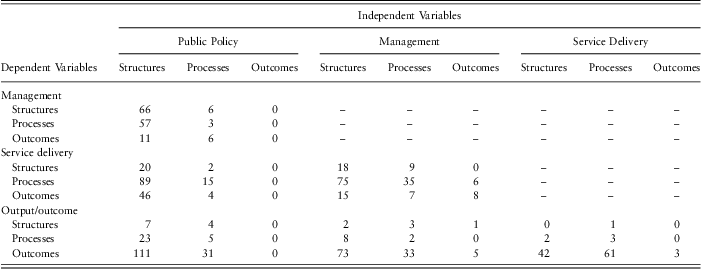
The results of the re-analysis of the original LOG studies are summarised in Table 1. These results can be summarised as follows:
Integrated logic of governance findings (1990–2001)
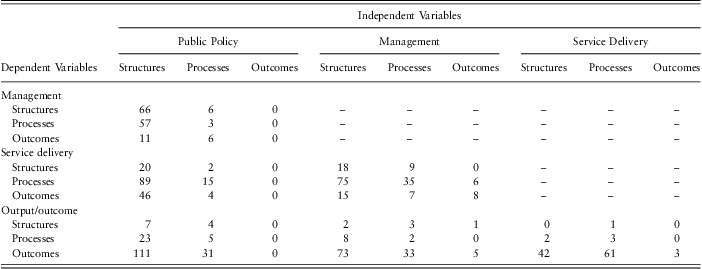
• The outcomes of public policy-making almost always take the form of structures. That is, policy-making typically creates administrative capacity at both management and service-delivery levels of governance. Policy structures are also commonly used to influence service delivery without considering the mediating role of management, a theoretically questionable research design that will be discussed below.
• Managerial discretion (i.e. management as an independent variable) is used both to further shape productive capacity by elaborating administrative structures, and to engage in productive activity that influences both service delivery and administrative system outputs and outcomes.
• The enabling and constraining of capacity by both policy-makers and managers are usually reflected in (i.e. constrain and enable) processes that are outcomes at the service delivery and outputs/outcomes levels.
• Service-delivery processes usually explain outputs/outcomes, in other words, effort produces results.
Thus, step one of the analysis suggests an operational “LOG” that is intuitive and consistent with traditional thinking: whereas policy-makers deal primarily in structuresFootnote 10 and those who deliver services deal primarily in processes, public managers employ both structures and processes in performing their discretionary roles.
Analysis of 2002–2006 literature
In step two of the analysis, we created a new LOG database from over 300 additional research studies published from 2002 through 2006 in the nine US and international journals that regularly publish multi-level empirical research.Footnote 11 Using the same methodology as in the just-described analysis, with two exceptions, independent and dependent variables were assigned to levels in the LOG and then coded according to Scott's OE definitions.
The first exception in methodology concerns the treatment of outputs and outcomes. Coding outputs and outcomes as if they were synonymous, as the original LOG analyses did, obscures the fact that outputs operationally precede outcomes. For this reason, in the second step of our analysis, outputs and outcomes were assigned to hierarchically separate levels of governance. Most, but not all, of the output indicators coded at the service-delivery level in the preceding step are more appropriately coded as outputs. For example, in a study by Steiner (Reference Steiner2003), one of his dependent variables, “quantity and quality of services”, is now coded as an output at the output level because it reflects a “final” output rather than effort. Conversely, the other dependent variables in the study, “intensity and existence of inter-municipal cooperation” and “projects”, are now coded at the service-delivery level as output and process variables, respectively, because they measure effort by municipalities rather than the results of such effort.Footnote 12
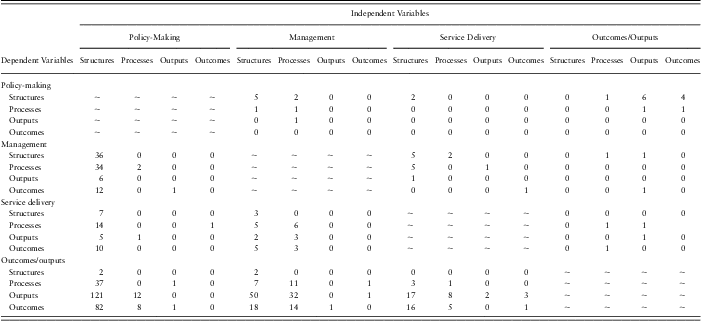
Findings from analysis of the new studies are summarised in Table 2. They are generally consistent with the findings in Table 1. Of additional interest, however, is the fact that over 70 per cent of the modelled relationships skipped levels of governance, a pattern more pronounced than in Table 1. Also notable is that despite the rising popularity of networks and other consociational arrangements as governance mechanisms, few studies use networks in multi-level research as causes or consequences of actions at other levels; network research focuses on within-level network dynamics, behaviours and consequences.Footnote 13
Integrated logic of governance findings (2002–2006)
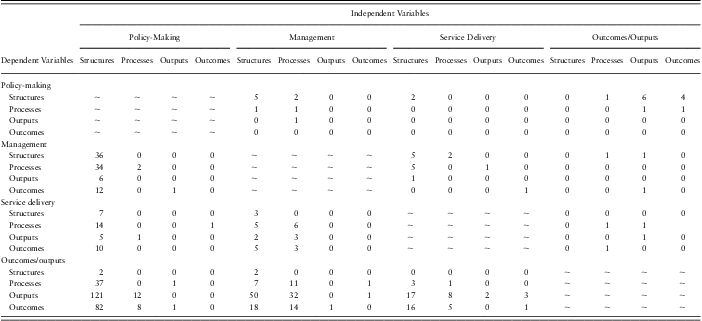
Distinguishing outputs from outcomes reveals that most investigations were output- rather than outcome-oriented. Few empirical models recognise or incorporate an outputs-precede/cause-outcomes logic. Further, a lower proportion of studies incorporated variables at the service-delivery level, a possible manifestation of a growing interest in policy and agency performance over treatment and service-delivery effectiveness as well as an explanation for increased level skipping. In Table 1, around 20 per cent of all independent and dependent variables were coded at the service-delivery level but only 6 per cent were coded as such in Table 2. This change could reflect any of several factors: differentiating between outputs at the service and outputs/outcomes levels, the particular journals chosen for step two, or, as already noted, the influence of the performance movement.
Step two of our analysis, then, produces additional insights concerning the persistence of a hierarchical perspective in recent research on governance, an increase in the questionable practice of level skipping when designing such research, and the lack of precision in the analysis of how outcomes are related to outputs of a multi-level administrative system.
Towards a theory of government performance
The relatively few analyses of governmental performance in the literature, that are both synoptic and quantitative, have foundations in prior conceptual and empirical research (Rainey and Steinbauer Reference Rainey and Steinbauer1999; Boyne Reference Boyne2003; Meier and O'Toole Reference Meier and O'Toole2007). Our modelling efforts also draw explicitly on the analysis of published literature reported above, framed, however, by the reconceptualised LOG. The results summarised in Tables 1 and 2, as well as previous LOG research cited earlier, warrant the assumption that hierarchical relationships down a chain of delegation are significant and quantitatively important determinants of performance. Beyond this general presumption, our results provide further insights into how OE mediates these hierarchical relationships. The predominance of outputs in how “results” are defined in the empirical literature is consistent with the assumption that an outputs-precede-outcomes logic governs the determination of ultimate results. These assumptions constitute basic elements of our model.
The fact that significant number of studies use models that skip levels in the LOG might seem to contradict this logic. Such modelling strategies are questionable, however, if investigators do not consider possibly influential levels of governance in their models for expedient rather than theoretical reasons. An analysis of 112 studies of health-care delivery by Forbes et al. (Reference Forbes, Hill and Lynn2007), which employed an analytic strategy that incrementally aggregated findings from studies of adjacent and non-adjacent levels of governance led the authors to conclude that, “[i]n general, the choices of organizational arrangements, administrative strategies, treatment quality and other aspects of health care services by policy-makers, public managers, physicians, and service workers, together with their values and attitudes toward their work, have significant effects on how health care policies are transformed into service-delivery outputs and outcomes” (p. 453). Omitting levels, in other words, is likely to be conceptually unjustified.
Based on the logic of delegation, control and accountability, and the suggestive empirical findings just cited, the model sketched below includes all levels of an administrative system with one important exception. In the following sections, we develop specific hypotheses that constitute our model of government performance.
The influence of policy structures
As Table 2 shows, in studies with management dependent variables, almost all public policy independent variables are structural. The majority of them represent mandated policy designs or organisational ownership. Further, almost two-thirds of the management structure independent variables are “administrative structures” (e.g. contracting out with private firms). In other words, the enactment of policy structures leads to further structural refinements of the administrative system at the managerial level.Footnote 14 Intuitively, policy-making is primarily about the creation and design, directly and through management-level agents, of administrative capacity and division of labour. These findings are the basis for Hypothesis 1a:
Hypothesis 1a: The governance of and by public management is primarily structural.
In support of this reasoning, Calvert et al. (Reference Calvert, McCubbins and Weingast1989, 590) argue that “concentrating on acts of decision-making rather than on influences over decision-making is a kind of myopia that can lead to false conclusions about where the responsibilities for policies lie”. One implication is that studies whose causal logic begins with managerial decision-making are disregarding a level of explanation that may be decisive in the determination of downstream outputs and outcomes, especially including why managers do what they do.
A striking finding of the literature analysis is that 60 per cent of studies use policy structures to model service-delivery processes (such as enrolment of severely handicapped persons in local programmes instead of in state hospitals) without requiring mediating actions by management.Footnote 15 As already noted, such research designs may compromise the usefulness or validity of study findings. In contrast, some policies go so far as to restrict the extent of managerial discretion and specifically prescribe how the service is to be delivered. Calvert et al. (Reference Calvert, McCubbins and Weingast1989) note in this regard that “in those areas in which they care the most, politicians will expend greater effort and resources in reducing the uncertainty that affords bureaucrats the opportunity for discretion” (p. 590).
In such instances, the extent of managerial discretion may be insignificant. An example is statutes that prescribe how front-line workers are to bill patients for mental health services or set rules for filing claims. That such policies are possible warrants Hypothesis 1b:
Hypothesis 1b: Service-delivery processes may be directly affected by enacted public policies if policies and incentives are, in effect, self-executing.
In a principal–agent relationship, a policy can be said to be self-executing if it satisfies both participation (all participants are better off with than without the policy) and incentive compatibility (agents have no hidden information or information that would require costly audits to discover) constraints (Dixit Reference Dixit2002). Such policies are arguably rare.Footnote 16
The influence of management on service delivery
The influence of policy structures on management and service delivery hardly extinguishes managerial influence. Policy structures enable as well as constrain managerial discretion. Such discretion may in turn be employed to influence government performance in various ways. As noted earlier, managers employ both structures and processes to influence service delivery and its outputs/outcomes, implying that management contributes in significant ways to the ultimate performance of public policies and programmes. Thus, we postulate that both structural and process indicators at the managerial level are determinants of public sector performance, as summarised in the following hypothesis (Brodkin Reference Brodkin1987, Reference Brodkin1990; Hill and Lynn Reference Hill and Lynn2005):
Hypothesis 2: The outputs of service-delivery processes are influenced by public policies as mediated by managerial use of administrative structures and processes to shape the links between enacted policy and service delivery and its proximate consequences.
Principal–agent and other models of organisational dynamics confirm that, although the strengths of top-down effects on service delivery may vary, they are unlikely to be altogether absent or to be negated by external factors, especially if public money or lawful authorities are causes of these effects.
Service delivery and performance
As Table 2 also shows, over 70 per cent of studies that use management-level variables to explain outcomes omit the effects of service-delivery outputs, a potential reason for biased findings. Even if this is not the case, ignoring outputs-precede-outcomes logic may result in an incomplete account of how outcomes are determined. Street-level workers virtually always have some capacity to affect the impacts of policies and management on end users via the outputs of their activities. Accordingly, our final hypothesis reflects the logical and empirical primacy of outputs:
Hypothesis 3: The outcomes of public policies are, all else equal, produced by the outputs of service-delivery processes.
The relationship between outputs and outcomes is a neglected aspect of government performance. James Q. Wilson (Reference Wilson1989) explains why this neglect is unwarranted. He defines outputs as “the work the agency does” and outcomes as “how, if at all, the world changes because of the outputs” (Wilson Reference Wilson1989, 158). Management, Wilson argues, will reflect the transparency of agency outputs and outcomes. Thus, depicting outputs as necessary to achieving outcomes seems intuitive.Footnote 17
A model of government performance
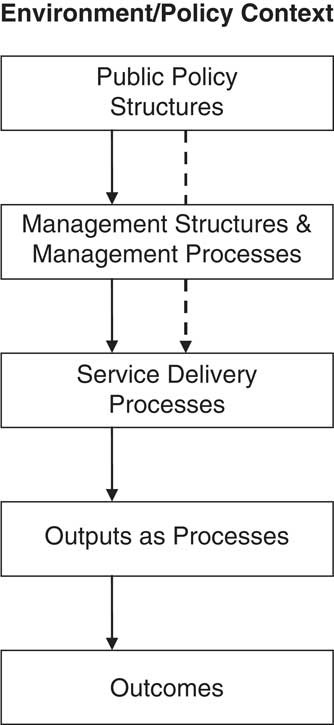
These hypotheses comprise the basis for the graphic depiction of our model of government performance in Figure 1. Direct causal relationships are depicted by solid lines. The dotted line linking public policy structures and service-delivery processes represents a self-executing policy.
Theory of public sector performance. Dotted lines represent potential modelling patterns that skip levels in the logic of governance but still reflect plausible theoretical causal relationships.

We stress that this model does not purport to subsume all possible complexities of implementation across policies, regimes or systems of government. Firstly, in some cases, accountability may be multi-dimensional and multi-directional, that is, pluralistic rather than strictly mission driven. Environmental influences exogenous to the core model may at times impinge on choices endogenous to the model. Secondly, in some contexts, as already noted, interdependencies may be bi-directional; “organisational cultures and sub-cultures” at the service-delivery level, for example, may affect higher-level managerial and policy-maker behaviour. Thirdly, there may be complex interactions within levels, within organisations or as a consequence of networks and collaborations, which influence between-level relationships. Fourthly, public organisations may have more complex missions, have quango-like structures, or be “hollow” or “virtual”. Finally, outcomes, specifically the values of outcome measures, may reflect a wide variety of non-random individual and social factors. Though outcomes may be significantly affected by service-delivery outputs, the explanatory power of the relationship need not be high.
These possibilities suggest two types of complementary modelling strategies depending on investigator focus and data availability. Firstly, more complex causal relationships within the administrative system, such as the influence of service-delivery cultures and processes on management, might be postulated and investigated using appropriate model specifications. Secondly, effectiveness at any level of the administrative system might be influenced by factors exogenous to the system itself (environment/policy context in Figure 1), such as the way public policy-making itself is organised and functions (i.e. the operative policy process) or the influence of community norms and characteristics on service-delivery cultures and processes.Footnote 18 Many of the studies in our literature analysis incorporate complex relationships and variables exogenous to the administrative system.
We argue, nonetheless, that these kinds of considerations constitute variants of our basic model that may modify, but are unlikely to nullify altogether its explanatory value. The influence on governmental outputs of external pressures, organisational cultures, consociational relationships and lengthening chains of delegation relative to the influence of policy structures, organisational management and service delivery can in principle be investigated using elaborated versions of the core model and data sets that allow for testing the relative effects of various structural and procedural configurations.
Why this model?
Prior efforts, cited earlier, to identify types of variables that might be included in a multi-level model of government performance have not provided a general causal account of relationships among multiple levels of governance. Our model, and the analytic framework from which it was derived, provide such an account. The model can contribute to public policy and management scholarship in several ways.
Firstly, with considerable theoretical and empirical support, the model explicitly implicates policy design, agency management, and service-delivery processes and their outputs in the determination of administrative system performance. It does so in a way that reflects a lawful, multi-level chain of delegation characteristic of developed democracies (Selden and Sowa Reference Selden and Sowa2004). Secondly, the model explicitly acknowledges the reality that outputs mediate the relationship between what administrative systems do and how individuals, families, communities, jurisdictions and other objects of public policy interventions are thereby affected. Thirdly, the model, which highlights the influence of administrative hierarchy on performance, has strong empirical support. Hypotheses to the effect that networked institutions of civil society are ascendant are hereby challenged to provide convincing theoretical and empirical evidence for why and how republican institutions no longer approximate the logic of the basic model presented here (Lynn Reference Lynn2012b).