Physical activity improves long-term cardiovascular health, psychological well-being, and academic performance.Reference de Greeff, Bosker, Oosterlaan, Visscher and Hartman1–Reference Penedo and Dahn3 It is also associated with a lower risk of diabetes mellitus and certain types of cancer.Reference Sigal, Armstrong and Bacon4,Reference de Rezende, de Sa and Markozannes5 In an effort to maximise the well-being of Canadian children, the Canadian Society for Exercise Physiology currently recommends that children and youth aged 5–17 years accumulate at least 60 minutes of moderate- to vigorous-intensity physical activity per day.6 They also urge children to participate in vigorous-intensity activity at least 3 days per week.
In contrast to these recommendations, vigorous-intensity physical activity has been linked to an increased risk of arrhythmogenic events for children diagnosed with long QT syndrome, catecholaminergic polymorphic ventricular tachycardia, hypertrophic cardiomyopathy, or arrhythmogenic right ventricular cardiomyopathy. Furthermore, research supports an association between the amount and intensity of physical activity and disease progression and severity for individuals diagnosed with arrhythmogenic right ventricular cardiomyopathy .Reference James, Bhonsale and Tichnell7,Reference Saberniak, Hasselberg and Borgquist8 Consequently, children diagnosed with these conditions are frequently advised to limit their involvement in vigorous-intensity physical activity and to avoid competitive sport.Reference Maron, Udelson and Bonow9,Reference Pelliccia, Fagard and Bjornstad10 This often translates to restriction from organised sports with a moderate or high dynamic component and encouragement to participate in low-intensity physical activity.
Qualitative research suggests that disqualification from sport due to a cardiac diagnosis may have adverse psychological consequences as many athletes develop their self-identity and social networks around sport.Reference Asif, Price and Fisher11 However, limited data exist on how physical activity restriction affects the physical and psychosocial well-being of children diagnosed with an inherited arrhythmia or cardiomyopathy. In this cross-sectional study, we evaluated children diagnosed with long QT syndrome, catecholaminergic polymorphic ventricular tachycardia, hypertrophic cardiomyopathy, or arrhythmogenic right ventricular cardiomyopathy with regard to time involved in moderate- to vigorous-intensity physical activity and measures of health-related quality of life. We hypothesised that physical activity restriction would be associated with less time involved in moderate- to vigorous-intensity physical activity and lower health-related quality of life scores.
Materials and methods
Study population
Children (8–17 years of age) diagnosed with long QT syndrome, catecholaminergic polymorphic ventricular tachycardia, hypertrophic cardiomyopathy, or arrhythmogenic right ventricular cardiomyopathy were recruited to participate through the Stollery Children’s Hospital (Edmonton, AB) and the Alberta Children’s Hospital and the Providence Pediatric Cardiology Clinic (Calgary, AB) from May 2017 to April 2019. Families were informed of the study by a mailed letter or by a healthcare specialist during their medical appointment. Patients were excluded from the study if they were less than 3-month post diagnosis, did not speak English, or if they had additional health concerns that may have impacted their health-related quality of life or physical activity level. Research Ethics Board approval was obtained through the University of Alberta and the University of Calgary and patients provided written informed consent.
Measures
Physical activity
Patients wore an Actigraph GT3X accelerometer (Actigraph LLC) above their right hip at all times during a 7-day period except when sleeping or when immersed in water (i.e. bathing/showering or swimming). Cut-point thresholds published by Evenson et al were used to calculate the intensity of patients’ physical activity and data were reported using 60-second epochs to allow for comparison with published data. A valid day (minimum number of wearing hours) was defined as 10 hours.Reference Evenson, Catellier, Gill, Ondrak and McMurray12,Reference Trost, McIver and Pate13 Data were required for a minimum of 4 days including one weekend day for each patient. Data were not collected over summer vacation (July and August) in an effort to capture a representative week, and total precipitation (mm) was recorded for each day of physical activity data collection to evaluate variation related to weather.
A parent or guardian for each patient completed a questionnaire that included information on the child’s involvement in organised activities and their understanding of the physical activity recommendations. Sport participation was defined as participation in a Class A (low dynamic component), Class B (moderate dynamic component), or Class C (high dynamic component) organised sport throughout a 1-year period post diagnosis.Reference Mitchell, Haskell, Snell and Van Camp14 Physical activity restriction was described as restriction from competitive sport, endurance activities, swimming, and/or weight training.
In addition, parents were asked to rate on a scale of 1–5, how much their child had modified their physical activity because of their diagnosis (1 = not at all and 5 = completely), and how difficult and/or upsetting it was for their child to adjust to the physical activity recommendations (1 = not at all and 5 = very difficult/upsetting). These questions were adapted from a previously used scale that assessed the psychological impact of physical activity restriction in an adult population.Reference Luiten, Ormond, Post, Asif, Wheeler and Caleshu15 Parents were also asked to describe “how often they participated in active sport or vigorous physical activity long enough to get sweaty, during leisure time” within the past 4 months and during their teen years.Reference Godin, Jobin and Bouillon16
Health-related quality of life
Patients completed the Pediatric Quality of Life Inventory 4.0 and the Pediatric Cardiac Quality of Life Inventory to evaluate health-related quality of life.Reference Varni17,Reference Marino, Drotar and Cassedy18 The Pediatric Quality Of Life Inventory is a 23-item generic measure, and the Pediatric Cardiac Quality of Life Inventory is a 23- to 29-item disease-specific measure. Three summary Pediatric Quality of Life Inventory scores were calculated for each patient according to the Pediatric Quality of Life Inventory user guide: physical, psychosocial, and total health. Each scale has a maximum score of 100. In addition, three Pediatric Cardiac Quality of Life Inventory Scores were calculated for each patient: disease, psychosocial, and total impact. The disease and psychosocial impact scales have a maximum score of 50, and the total impact scale has a maximum score of 100. Higher scores for all scales indicate better health-related quality of life.
Paediatric cardiology charts were also reviewed to collect data on diagnosis, symptoms, phenotype, physical activity recommendations, beta blocker therapy, and family history of sudden cardiac arrest. Physical activity restriction was again described based on documentation to avoid competitive sport, endurance activities, swimming, and/or weight training as outlined in the patients’ clinic letter.
Data analysis
Continuous variables are presented as mean with standard deviation. Categorical variables are presented as counts and percentages. The primary relationships examined were the impact of both physical activity restriction and change to physical activity on time involved in moderate- to vigorous-intensity physical activity and measures of health-related quality of life. Physical activity restriction was categorised as restricted versus unrestricted. Modification to physical activity was categorised as no change (rating = 1) versus some change (rating >1). Simple linear regression was used to evaluate for additional variables associated with time involved in moderate- to vigorous-intensity physical activity and with health-related quality of life scores. Time involved in moderate- to vigorous-intensity physical activity, time involved in sedentary behaviour, and Pediatric Quality of Life Inventory scores were compared to normative data using the one-sample t-test. A p-value of <0.05 defined statistical significance. Stata Statistical Software: Release 13 (College Station, TX: StataCorp LP) was used for statistical analysis.
Results
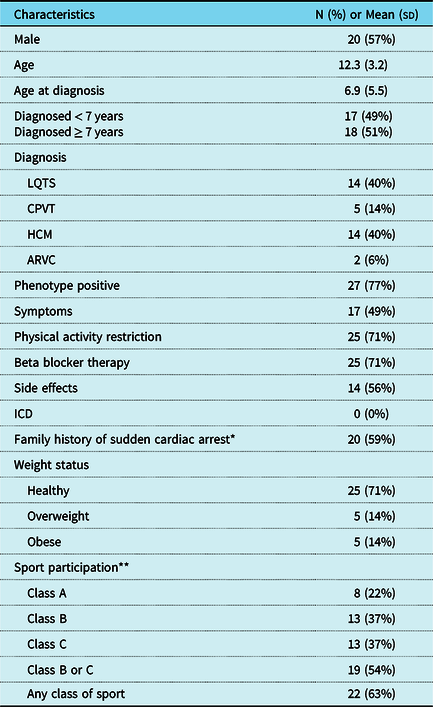
The study cohort included 35 children diagnosed with an inherited arrhythmia or cardiomyopathy from 30 unrelated families. The participation rate was 49% (n = 35/72). Two patients did not meet the minimum requirement of 10 hours of activity data on 4 days (including one weekend day). Although they were included in the study, their activity data were excluded from analysis. In addition, one of them did not complete the Pediatric Cardiac Quality of Life Inventory. Characteristics of the cohort are described in Table 1. Non-patients were older compared to patients with a mean (sd) age of 14.4 (2.7) years.
Characteristics of the cohort (n = 35)

ARVC= arrhythmogenic right ventricular cardiomyopathy; CPVT= catecholaminergic polymorphic ventricular tachycardia; HCM= hypertrophic cardiomyopathy; ICD= implantable cardioverter defibrillator; LQTS=long QT syndrome; N = number; sd = standard deviation.
* Note one patient was adopted and family history was unknown.
** Many children were involved in more than one class of sport.
The mean (sd) age of patients was 12.3 (3.2) years and mean (sd) time since diagnosis was 5.3 (4.2) years. Approximately half (54%) of the cohort were diagnosed with an inherited arrhythmia (long QT syndrome or catecholaminergic polymorphic ventricular tachycardia) and half were diagnosed with a cardiomyopathy (hypertrophic cardiomyopathy or arrhythmogenic right ventricular cardiomyopathy). The majority were phenotype positive (77%) and treated with beta blockers (71%). Seventy-one percent (n = 25/35) were advised to avoid some type of physical activity (competitive sport (n = 21), endurance activities (n = 4), or swimming (n = 4)).
Accelerometers were worn for an average of 13.0 hours/day (range 10.6–14.7 hours/day) for 6.5 days (range 4–8 days). Patients were involved in a mean (sd) of 35 (23) minutes of moderate- to vigorous-intensity physical activity per day with a mean (sd) of 7 (6) min/day of vigorous-intensity physical activity. When the cohort was divided based on the prescription of physical activity restriction, the restricted group participated in an average of 34 (22) min/day of moderate- to vigorous-intensity physical activity compared to an average of 37 (28) min/day for the unrestricted group (p = 0.76). The restricted group participated in an average of 6 (6) min/day of vigorous-intensity physical activity compared to 8 (8) min/day for the unrestricted group (p = 0.61). Of children prescribed physical activity restriction, 52% (n = 13/25) were involved in at least one Class B or Class C sport (defined as moderate or high dynamic, respectively).
Fourteen percent (n = 5/35) of patients accumulated an average of ≥60 minutes of moderate- to vigorous-intensity physical activity per day. Overall, this cohort was involved in less moderate- to vigorous-intensity physical activity per day compared to the Canadian paediatric population (6–17 year olds) (35 versus 55 min/day) (p < 0.001).Reference Colley, Carson, Garriguet, Janssen, Roberts and Tremblay19 The mean (sd) time being sedentary was 439 (90) min/day (median (IQR) = 421 (398–511)) which was similar to normative data (461 min/day) (p = 0.17).Reference Garriguet, Colley and Bushnik20
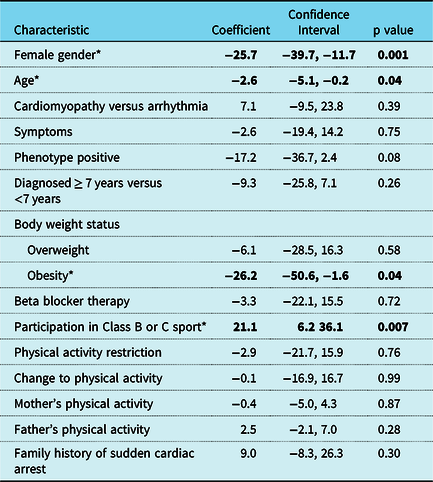
Univariate analyses of factors associated with time involved in moderate- to vigorous-intensity physical activity are described in Table 2. Male gender and participation in a Class B or Class C sport were associated with more time involved in moderate- to vigorous-intensity physical activity, while older age and obesity were associated with less time involved in moderate- to vigorous-intensity physical activity. Neither physical activity restriction nor change to physical activity was associated with time involved in moderate- to vigorous-intensity physical activity.
Factors associated with time involved in moderate- to vigorous-intensity physical activity

Bold represents findings with p < 0.05.
* Significant at p < 0.05.
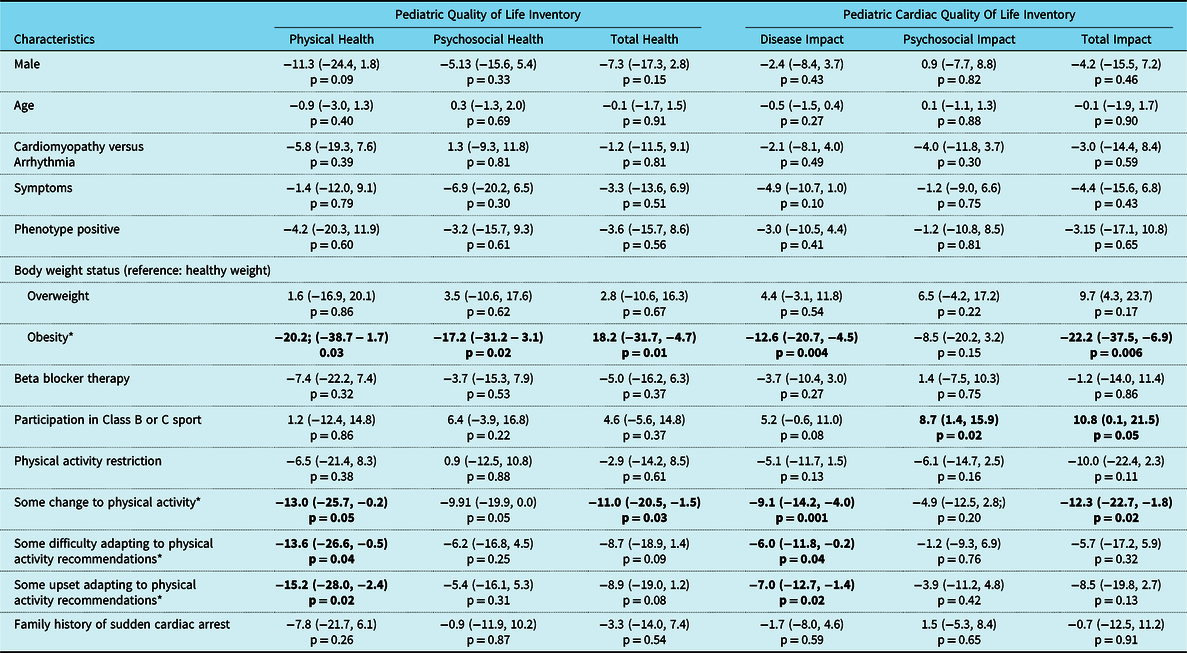
The mean (sd) Pediatric Quality of Life Inventory physical, psychosocial, and total health scores were 82 (19), 78 (15), and 79 (15), respectively. These scores were lower when compared to normative data, reaching significance for total health (physical health: 88 (13), psychosocial health: 82 (14) and total health: 84 (12)) (p = 0.07, p = 0.09 and p = 0.05, respectively).Reference Varni, Burwinkle, Seid and Skarr21 The mean (sd) Pediatric Cardiac Quality of Life Inventory disease, psychosocial, and total impact scores were 38 (9), 38 (11), and 77 (16), respectively. As this is a disease-specific measure, there is no normative data for comparison. On univariate analysis, obesity was associated with lower Pediatric Quality of Life Inventory physical (p = 0.03), psychosocial (p = 0.02), and total health (p = 0.01) scores as well as lower Pediatric Cardiac Quality of Life Inventory disease (p = 0.004) and total impact (p = 0.006) scores (Table 3). Participation in a Class B or Class C organised sport was associated with higher Pediatric Cardiac Quality of Life Inventory psychosocial (p = 0.02) and total impact (p = 0.05) scores (Table 3).
Factors associated with Pediatric Quality of Life Inventory and Pediatric Cardiac Quality of Life Inventory scores (coefficient (95% confidence interval) p value)

Bold represents findings with p < 0.05.
* Significant at p < 0.05.
In total, 51% (n = 18/35) of patients modified their physical activity because of their diagnosis. This included 60% (n = 15/25) of children prescribed physical activity restrictions and 30% (3/10) of the children with no restrictions. Although physical activity restriction was not associated with health-related quality of life scores, change to physical activity was associated with lower Pediatric Quality of Life Inventory physical (p = 0.05), psychosocial (p = 0.05) and total health (p = 0.03) scores, and lower Pediatric Cardiac Quality of Life Inventory disease (p = 0.001) and total impact (p = 0.02) scores (Table 3). Patients were more likely to change their physical activity if they had a family history of sudden cardiac arrest (65% versus 29%); however, the difference was not statistically significant (OR 4.64, 95% CI 0.87, 27.2 p = 0.08).
Parents reported that it was difficult and upsetting for the majority (84% and 84%, respectively) of children who modified their physical activity because of their diagnosis. Children who were reported to have difficultly or upset adapting to the physical activity recommendations also had lower Pediatric Quality of Life Inventory physical health (75 versus 89, p = 0.04 and 74 versus 89, p = 0.02) and Pediatric Cardiac Quality of Life Inventory disease impact (35 versus 41, p = 0.04 and 34 versus 41, p = 0.02) scores (Table 3). Modifications to physical activity were described as follows: 1) stopping participation in sport, 2) modifying the intensity of physical activity, and 3) reducing additional risk factors such as not exercising when hot outside.
Discussion
This study evaluated 35 children with a clinical or genetic diagnosis of long QT syndrome, catecholaminergic polymorphic ventricular tachycardia, hypertrophic cardiomyopathy, or arrhythmogenic right ventricular cardiomyopathy. We recorded time involved in moderate- to vigorous-intensity physical activity, evaluated measures of health-related quality of life, and assessed the impact of physical activity restriction and modification to physical activity on these outcomes. Our cohort was involved in significantly less moderate- to vigorous-intensity physical activity per day (35 min/day) compared to the Canadian paediatric population (6–17 year olds) (55 min/day).Reference Colley, Carson, Garriguet, Janssen, Roberts and Tremblay19 These data suggest that the majority of children in our cohort were making some effort to comply with physician recommendations to limit vigorous activity. In addition, the average time being sedentary was similar between our cohort (439 min/day) and normative data (461 min/day), suggesting that our cohort is involved in more low-intensity physical activity which is also consistent with recommendations.Reference Garriguet, Colley and Bushnik20
Overall, 14% (n = 5/35) of patients in the cohort accumulated an average of ≥60 minutes of moderate- to vigorous-intensity physical activity per day compared to 33% of children in the Canadian paediatric population.Reference Colley, Carson, Garriguet, Janssen, Roberts and Tremblay19 Sweeting et al similarly reported that only 13% of adults diagnosed with hypertrophic cardiomyopathy were meeting the minimum recommendation of 150 min/week of moderate- to vigorous-intensity physical activity.Reference Sweeting, Ingles, Timperio, Patterson, Ball and Semsarian22 Research has shown that decreased cardiorespiratory fitness is a strong independent predictor of cardiovascular disease and all-cause mortality later in life.Reference Gaesser, Tucker, Jarrett and Angadi23 This raises the concern that decreased moderate- to vigorous-intensity physical activity may help protect this patient population from arrhythmogenic events but may increase the risk of other adverse health outcomes later in life. Therefore, the development of cardiac rehabilitation programs that help patients remain safe and fit will be important.Reference Thrush and Vogel24 Factors such as gender, age, body weight status, and sport participation are important factors to consider when developing a personalised fitness plan.
Our cohort had significantly lower Pediatric Quality of Life Inventory total health scores compared to the general population and similar Pediatric Quality of Life Inventory and Pediatric Cardiac Quality of Life Inventory scores when compared to data published on children with long QT syndrome.Reference Czosek, Kaltman and Cassedy25 We found lower health-related quality of life scores for children who were obese and for those who reportedly changed their physical activity because of their diagnosis. Although obesity has previously been identified as a risk factor for impaired health-related quality of life in the general population, the impact of changing one’s physical activity on health-related quality of life has not previously been examined in children with an inherited arrhythmia or cardiomyopathy.Reference Varni, Limbers and Burwinkle26 Half of our cohort modified their physical activity because of their diagnosis and this was described as difficult and upsetting for the majority. Changes to physical activity were reported for both children prescribed physical activity restrictions and those without. Modifications included discontinuation of sport participation, participating at a lower intensity, and avoiding additional risk factors during sport participation.
The negative impact of changing one’s behaviour was previously articulated in a qualitative study on a group of adults diagnosed with hypertrophic cardiomyopathy.Reference Bonner, Spinks, Semsarian, Barratt, Ingles and McCaffery27 They reported that a genetic diagnosis had a higher impact when the individual had to decrease their physical activity and had a lower impact when the individual was not very physically active.Reference Bonner, Spinks, Semsarian, Barratt, Ingles and McCaffery27 Discontinuation of sport removes involvement in an activity that was likely felt to be enjoyable, important in developing and maintaining friendships, managing weight, and dealing with stress.Reference Luiten, Ormond, Post, Asif, Wheeler and Caleshu15 Luiten et al further examined the issue of psychological adjustment to physical activity restriction in a group of adult athletes diagnosed with hypertrophic cardiomyopathy.Reference Luiten, Ormond, Post, Asif, Wheeler and Caleshu15 Approximately, half of their group described it as being upsetting and/or difficult to adjust to the physical activity recommendations. Together, these results highlight the need for psychological support for individuals who discontinue sport participation as they search for a new normal (new social groups and new activities). Additional support may also be beneficial as individuals adapt their level of participation in sport to a lower intensity. Learning how to listen to their body in the presence of peer and self-imposed pressures may have additional challenges.
Study limitations
Our cohort was small and heterogeneous with regard to diagnosis and physical activity restriction, thus limiting our ability to identify more subtle differences between our cohort and normative data. A contemporary comparative normal cohort was not used for data comparison. Although family history of sudden cardiac arrest was not associated with our outcomes, we noted a relatively high incidence of sudden cardiac arrest in the families that participated in the study suggesting a potential bias. Physical activity was reported in 60-second intervals to allow for comparison with published data; however, research has shown that children tend to participate in vigorous-intensity activity in shorter intervals.Reference Nettlefold, Naylor, Warburton, Bredin, Race and McKay28 Therefore, the time involved in moderate- to vigorous-intensity physical activity may be underrepresented in both our cohort and normative data. Finally, we assessed changes to physical activity and adaptation to physical activity recommendations from the perspective of the parent. It would be useful to record the child’s point of view and assess how it correlates with parental views.
Conclusions
We found that, on average, our cohort was involved in less moderate- to vigorous-intensity physical activity and had lower Pediatric Quality of Life Inventory total health scores compared to normative paediatric data. The majority of children who changed their physical activity because of their diagnosis experienced difficulty and upset when trying to adapt to the physical activity recommendations. Change to physical activity rather than physical activity restriction was significantly associated with lower health-related quality of life scores. Results of this study are useful for families and healthcare professionals caring for children who are adjusting to a new cardiac diagnosis of an inherited arrhythmia or cardiomyopathy.
Acknowledgements
The authors are very grateful to the families who participated in this study. The authors are also thankful to the research and nursing staff for their assistance in identifying eligible patients.
Financial Support
Funding was received through the Department of Medical Genetics at the University of Alberta.
Conflicts of Interest
None.
Ethical Standards
The authors assert that all procedures contributing to this work comply with the ethical standards of the relevant national guidelines on human experimentation and with the Helsinki Declaration of 1975, as revised in 2008, and has been approved by the institutional committees (University of Alberta and University of Calgary).
Disclosures
None.