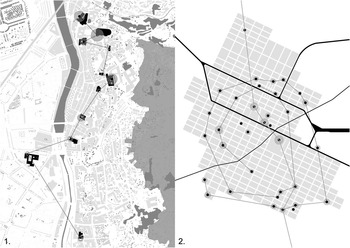
1. INTRODUCTION
Historically, sound art and music have approached sound in parallel and from opposite directions. If visual arts have made use of sound to introduce their proposals in time, music has provided certain incursions into spatial areas as a means of capturing, handling and translating the sound flow. However, today we find a large matrix of hybrid works that deal with space and time as inseparable issues, making it difficult to ascribe them to one particular discipline or another. The city concert devised by the Spanish performer, musicologist, composer and sound artist Llorenç Barber, at the beginning of 1988, is undoubtedly one of these.
To date, these monumental symphonies for bells and bell towers have been heard in more than 150 cities around the world.Footnote 1 They use urban space – a work scope traditionally ascribed to sound art – as ‘physical infrastructure’; at the same time these works are coordinated by ‘musical’ scores – tools traditionally ascribed to music – in order to guide the performance within a reliable framework of coordination among the towers. This hybrid nature seems to be inseparable from the figure of Barber himself. After an academic musical training, his contact in the 1970s with the creative core of the avant-garde music – Darmstadt, Bayreuth and Siena – and the collaboration within an incipient European sound art – Music Context Festival (London 1978), Sonambiente Festival für hören und sehen (Berlin 1996) and Audio Art Festival (Krakow 2000), among many others festivals and symposia – locate Barber’s musical and aesthetical approach in a shared terrain of interlaced references. The voice of John Cage, the language of minimal music,Footnote 2 together with a special attention to the soundscape as an area of creative opportunity for the sound designer,Footnote 3 all underlie without doubt the conceptual genesis of the city concert.
1.1. Concerto versus city concert
Despite being specifically called ‘concerts’ by the author, these works suggest a joint territory for sound art and music. Their intrinsic bipolarity might be synthesised as follows.
First, the city concert is not thought of from the city or in the city, but rather as something devised with and for the city.Footnote 4 In so doing, the city concert transcends the traditional processes of musical composition. The composer should accept beforehand the quantity, quality and spatial distribution of the sound sources: immobile towers.Footnote 5 ‘The urbanism and the historical events of the city dictate the composition, location and boundary of this particularly vast and dispersed orchestra’ (Barber and Palacios Reference Barber and Palacios2009: 201).
In addition, a change in the traditional notion of a specialist performer is implicit in the city concert. Their performers are the very inhabitants of the city – both professional musicians and enthusiastic citizens with little musical knowledge. Therefore, beyond any musical conventionalism, the score becomes a ‘working tool’ devoted to these ‘one-day performers’. It is focused on communicating the author's intentions clearly and precisely and, at the same time, on suggesting a potential territory for creativity. In so doing, the city concert questions the very function of the musical score, as Barber suggests in his own words: ‘The tyrannical control of musical score is the consequence of a mistaken progress. It has sterilised the performer; it has turned the concert hall into a hospital’ (Barber Reference Barber1982: 74).
Furthermore, attending such outdoor events by means of a musical behaviour focused on the stage becomes unworkable.Footnote 6 As if immersed in an immense sound sculpture, the citizen wanders around streets and squares, balconies or terraces, viewpoints or nearby hills ‘making use of that old observation of Duchamp it is the viewer who makes the art work’ (Duchamp in Barber and Palacios Reference Barber and Palacios2009:7). In addition, depending on the size of the performance area, Barber’s concerts have a duration of around 60 minutes (city concerts), of hours (concerts among towns) or even days; this is the case of the so-called De Sol a Sol (‘From Sun to Sun’): a marathon concert in the countryside. Beyond any musical expectation, this spatial and temporal amplification of sound phenomenon opens the listening experience to infinite perceptual horizons.Footnote 7
Finally, the city concert transcends the traditional notion of a composer. ‘People do not go out onto the street to listen to a genius or what have you, they come to listen to their own bells; they come to listen to the city itself’ (Barber in García Reference García2001: 126). Because of the prominence of bells – the most sophisticated ‘city instrument’ in Western culture – the musician remains hidden behind an event that, with a strong sense of community, transcends any individuality; he becomes a kind of cultural activist able to mobilise the spectator towards a living experience with a far-reaching social and cultural impact. All in all, ‘the city concert is more than an artistic event; it gives voice to the archetypical sound of a community’ (Barber Reference Barber1997: 28).
1.2. City writing
At the beginning of this intriguing adventure, Barber set out to ‘compose’ for the ‘city instrument’ armed with the tools of a musician.Footnote 8 Even though his compositional techniques were expected to be clear and comprehensible for the listener (those used by the minimalists), soon it became obvious that they did not work when transferred to an urban space: ‘[My first concert] was a badly written monstrosity because I, as a musician, was prepared for a very different situation. I did not know what sound was; how it was reflected by the walls. It was a disaster; nobody – not even the acoustics experts – explained anything. But this experience was very useful for understanding the sonority of outdoor spaces’ (Barber in García Reference García2001: 121–2).
Due to the chance of writing different concerts for the same city – something unique for a composer – Barber honed his technique until he managed to get the listener to listen to what the city was saying: ‘After experiencing in the streets the first bad concert – one of the worst I have performed in my life – I was given the opportunity to compose a second one for the same city. Thus, I wrote a score totally different from the first one. That was something new: music filled the air’ (Barber Reference Barber2003: 82).
Undeniably, there is specific writing for each instrument: writing for the piccolo is completely different from writing for the alpine horn. But, what is the writing for the city?
Our analysis tries to find the point up to which a musical writing for urban space is still possible, but beyond which the effects expected from a conventional musical space cannot be achieved. It is precisely here that Barber’s contrasting work becomes enlightening.
1.3. Russian dolls
To capture the subtle adjustment over the years, the sense of accuracy and correctness with which Barber has calibrated the connection between time aspects – closer to music – and space aspects – closer to sound art – and even space-time aspects involved in the listening experience, this article proposes a grammatical analysis of ‘nested levels’.
It is structured as follows: section 2, a ‘phonetics’ of sound materials and performance techniques; section 3, a ‘morphology’ of compositional elements concerning their duration, intensity and colour; section 4, a ‘syntax’ manipulation in space and time of these elements; section 5, a ‘narrative’ related to the articulation of these strategies within the whole work; and section 6, a ‘pragmatics’ by which the concert is able to cope with outdoor accidents intrinsic to urban dimension – from wind to road traffic.
Furthermore, there is also a political dimension: the city concert requires mobilising a vast range of people and institutions involved in public spaces.Footnote 9 ‘It is not enough to come up with the idea and write out the score. [The composer] needs qualities of personal charisma, persuasiveness, and tenacity to deal with many other questions necessary for the work’s materialization’ (Laycock Reference Laycok2005: 195).
2. MATERIALS AND PERFORMANCE TECHNIQUES: A PHONETIC STUDY
From contact with the soundscape theories of R. Murray Schafer, Barber begins to develop his own reflection on an ‘ecological’ music that might be able to integrate the sound context. The knowledge reached within Taller de Música Mundana (‘World Music Workshop’),Footnote 10 together with his work on the documentation, conservation and rediscovery of Spanish bells and their ringing, lead him to make the immense leap in scale of working on a city level. From that moment on, Barber’s exploration of outdoor space seems to have no limit.
The sonic materiality of the city concert is enhanced, for example, by cannons and fireworks, ship sirens, metal containers and drums, fanfares or bands. This reminds us of such Futurist experiments as the splendid Siren Symphonies devised by Avraamov. Within the bell towers, horns, whistles and plastic tubes blown by the bell ringers themselves, and even their voices broadcasted over loudspeakers – like sirens in ascending glissandos or street vendors’ calls – seem to imbue the city with that hi-fi dimension of ‘foreground and background’ so yearned for by Schafer in The Tuning of the World.
2.1. Sound materials
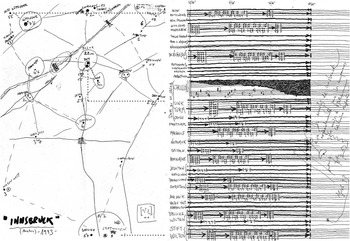
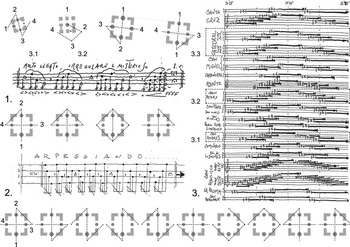
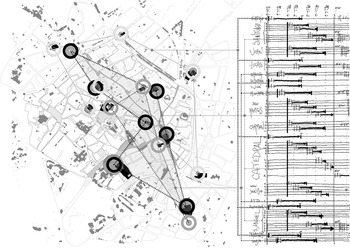
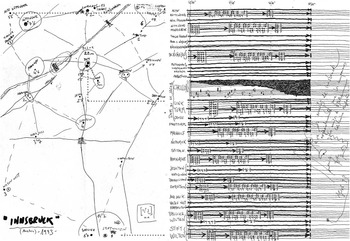
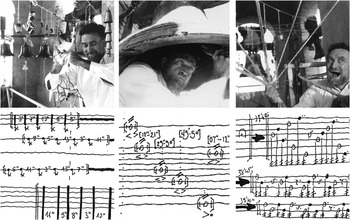
The sound features of the bells provided by each city are of primary importance in defining the compositional strategies to employ. Barber’s work starts with a detailed recognition of the sound material of the city. This allows him to identify the weight and reach of every single bell tower, the sound connections that can be established among them, and whether it is necessary or not to add new bells or portable bell towers (Figure 1).Footnote 11
Campananae Oenipontonae (Innsbruck, 1993) 42’00’’–50’00’’.
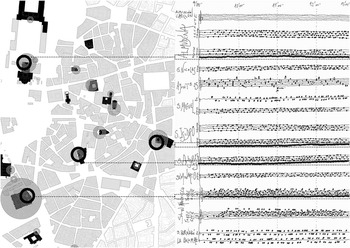
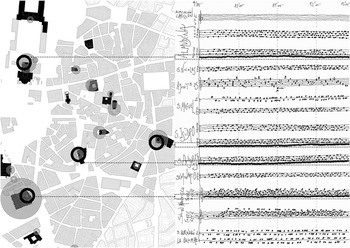
The bell offers two approaches to sound design. First, it can be used according to the frequency of its lowest-pitched partial, called hum. The lower the hum, the larger its reach and presence in the air, and consequently the greater its specific weight in the resulting sound mass. Barber reminds us of his past as an organist by making use of the lowest-pitched bells as ground bass, when there is a particular concern for silence – especially in cities with a dispersed urban morphology. In doing so, he achieves a sonic background against which all kinds of designs can be built (Figure 2). Due to the effectiveness of these ‘city pedals’, over the years, they become more extended with respect to duration and more relevant regarding its structural function within the score.Footnote 12
Bell pedals. Aurea Catena (Madrid, 2007) 9’00’’–15’00’’.
Second, which is especially relevant to composition, is the distribution of its harmonic spectrum: a particularly complex column of countless frequencies more or less tuned. This varies according to each region: while the north of Europe – mainly the Netherlands and the Anglo-Saxon world – is supplied with very precise tuned bells or carillons, the bells of Mediterranean areas of Catholic influence – extended to Latin America and the Philippines – present a ‘dense texture of disorganised sounds similar to the cluster’ (López Reference López1997: 84). A traditional musician, who is used to working in a deliberately tuned context, would accept this tonal inaccuracy of Mediterranean bells with difficulty. However, Barber finds a whole potential of composition in the sonic conglomerate, which is that of the bell: this ‘useful seed of dissonance and hesitation’ (Barber Reference Barber1996: 21) is able to enhance both the colour and density of a sound experience designed to be felt rather than analysed.
Over the years, Barber’s writing has developed a more pronounced attention to this subject even when the city has tuned bells. While the earliest designs for carillons are mainly focused on constructing all types of textual quotations from local motifs,Footnote 13 the subsequent ones disassemble the characteristic temperament of tuned ensembles, by using them in a way more massive than linear or more attentive to the colour of the instrument. We should interpret this operation as a renunciation of the ‘tuned city’. Urban space seems to ask for a work able to synthesise tuned and non-tuned materials. It asks for a technique, perhaps not different from the one devised by Varèse with respect to tonality: ‘not atonal’ (in our case ‘not non-tuned’), but a writing in which tuned materials are not expected to be heard as such, submerged in a tide that transcends this and any other polarity.
2.2. Performance techniques
The sound aspect of the city is defined not only by the tuning of its bells, but also by their dimension and location within the tower, the system of support, the clapper (the element that hangs inside the bell) and even the performance technique. Barber’s work around the world has allowed him to know the particularities of each region with respect to these aspects:
The Slavic bell (Poland, Slovenia) is a dancing one, the Anglican bell being much more formal and mathematical. For me, it was fundamental to discover the differences between Catholic and Protestant culture. In Germany, for example, cities with a Lutheran background sound different from Catholic ones: the sound of the first is more solemn and uniform, while the latter is more varied and festive. (Barber Reference Barber2003: 91)
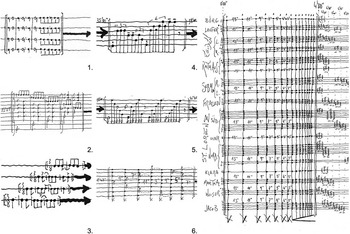
The city concert does not hesitate to include local techniques in cities having their own systems of execution, as shown by the scores for London (1996–97) and York (2000) with respect to the idiosyncratic change ringing.Footnote 14 Throughout the years, Barber has been gathering those local techniques that, due to their versatility and sonic richness, remain in his writing as indispensable devices. It is the case of the refined Slovenian rhythms (see Figure 4.4).Footnote 15
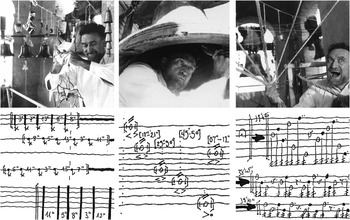
However, Barber’s favourite technique, by far, is the so-called repique: a kind of roll that keeps the bell still while the clapper works. The way he makes use of this traditional Spanish technique requires a mastery of execution: it asks the performer to change in a gradual way tempi as well as dynamics, forcing a brief climax and then going back to silence.Footnote 16 When the performer is not a skilled ringer, the very position of the bell within the tower becomes of primary importance (Figure 3). Due to the large number of performers involved in these concerts, whether professional or not, one should expect more or less elaborate sonorities depending on these spatial factors. Whatever the case may be, over the years the timbre repertoire of the city concert is extended with new devises such as the repique with metal rods. Such strategies illustrate Barber’s continuing search for the very limits of sound phenomenon materiality.
Performance techniques. Photos: David Jiménez with kind permission of Llorenç Barber.
3. THE COMPOSITIONAL STRUCTURES: A SOUND MORPHOLOGY
Relying on the principles of Minimalism, Barber’s writing is articulated by means of structures of repetition within different time-lengths. These loops are fixed according to a time-scale, of minutes and seconds, placed at the top of every page (see Figure 1). Such writing involves different temporal levels: the ‘chronometric time’ concerned with the length of the loop, which is fixed numerically by the composer and obeyed by means of a chronometer by the bell tower conductors; the ‘notation time’ related to the way the structure itself is written, as well as the ‘performance tempo’ engaged with the performer’s interpretation.
Next, we will try to analyse these structural elements according to the following parameters: duration or extension, intensity or weight, and timbre or colour, to express ourselves in audiovisual terms.
3.1. Structures of duration
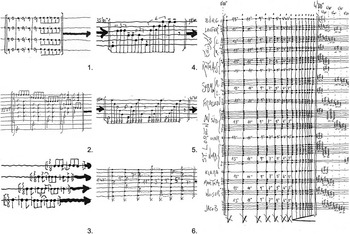
In the earliest scores, Barber employs traditional sol-fa notation to define the structural elements involved in the composition. We find ‘static’ and ‘dynamic’ configurations according to their rhythmic appearance. Static ones show a fixed time-length. They are devised by means of a same rhythmic design or by diverse rhythms overlapping in time. Whereas the former are heard as enclosed blocks (Figure 4.1), the latter create the illusion of a linear entity spatialised around the bell tower (Figure 4.2).Footnote 17 By contrast, the time-length of the dynamic structures is not fixed: they are based on the gradual entry of each bell (Figure 4.3). Thus, their sonic appearance varies throughout time according to the rhythmic design devised for each bell.Footnote 18
Over the years, Barber’s writing turns to a much more flexible notation. The traditional time signatures are replaced with subtle time-length suggestions (Figures 4.4 and 4.5). In addition, we find structures designed by means of numerical patterns, derived from arithmetical series, which are disordered so that they provoke a random effect (Figure 4.6). By means of these and other devices, Barber ends up approaching the sound phenomenon not as a finished measured object, but as an event in temporal progress that always presents itself in fertile and deliberately random disarray.
3.2. Structures of intensity
The structures that manage the parameters of intensity are mainly wide series of chords in accelerando and/or ritardando.Footnote 19 They are devised for each tower or even for the whole city, as chains of solemn and emphatic ‘city clusters’ (Figure 4). The writing of these chords has a traditional aspect: it indicates a synchronised performance. However, due to the spatial dimension involved in the city concerts, this form of execution is utopian in itself.Footnote 20 While these chords may be simple to perform at the tower level, there is the risk of them being unworkable when transferred to the city. Thus, Barber ends up writing in an open way, to be sure that the effect will work in a bipolar way, whether it is performed correctly or it is diluted in an increasingly imprecise manner.
Left: 1. Static structure (Oñati, 1990); 2. Hoquetus. Glocken Konzert (Munich, 1998); 3. ‘Bell tower crescendo’. Alagón (Coria, 1995); 4. Pritkavane structure (Ljubljana, 1997); 5. ‘Open’ rhythm (Ljubljana, 1997); 6. Numerical pattern (Ljubljana, 1997). Right: ‘City clusters’. Introduction of Meister. Glocken. Singer. Stadt (Nuremberg, 2000) 0’00–6’43’’.
3.3. Structures of colour
Barber’s colour work is based on linear configurations that involve all the bells of the tower. Among them, we find slow-moving melodies, particularly detailed with respect to their execution (Figure 5.1), as well as ‘tower arpeggios’ (Figure 5.2). The latter can be ascending or descending,Footnote 21 or even mixed, which we might call ‘of French variety’.Footnote 22
These structures of colour suggest a spatial manipulation of sound. Barber traces spatial trajectories in the shape of enveloping spirals, or still more complex geometries, by using the distribution of bells imposed by each tower. For instance, up to three polygonal forms can be found in each, and one from the other: first, the tower plan designed by the architect; second, the bell distribution; and third, the sound wisp devised by Barber (Figure 5).
1. Bell tower melody; 2. Arpeggios of French type; 3. ‘City glissando’. Magna Mater (Madrid, 1991) 24’38’’–26’30’’.

While the ‘tower arpeggios’ produce these drawing effects to be heard in proximity to the tower, similar procedures of colour cause strikingly different results at the city level (Figure 5.3). The glissandos devised by Barber for the whole city – employing bells from high to low pitch or vice versa – do not create a linear effect, but a sound mass that seems to enlarge and decrease over time, changing its intensity and colour gradually.Footnote 23 In both cases, sound design successfully approaches a carefully articulated dialogue between immobile and mobile elements: between what is seen and what is heard, whether they confirm or contrast with each other.
4. THE COMPOSITIONAL STRATEGIES: A SOUND SYNTAX
After having discussed materials, performance techniques and structural elements, we will address the following creative dimension of Barber’s writing, which we shall call ‘of composition’, and ask: what is the range of possibilities for design offered by a spatial and temporal manipulation of these elements of duration, intensity and colour in the city?
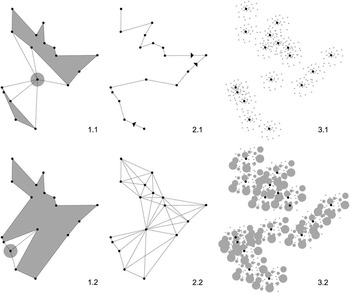
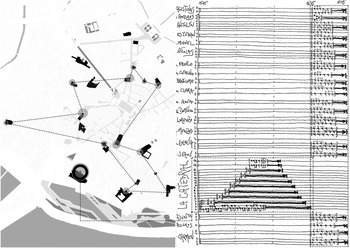
To examine the spectrum of strategies identified, we will use the classification of spatial effects proposed by Francis Bayer (Reference Bayer1981: 13–14): first, the effects of ubiquity related to sound spatialisation; second, the effects of mobility pertaining to sound translation; and third, the textural effects involved in a sonic background with the appearance of a continuum. With regard to the city concerts, these effects are suggested by the city as a space for emission and reception, which offers sound to the listener in one way or another according to its acoustic and urban features (Figure 6).
From left to right: 1. Strategies of ubiquity; 2. Strategies of mobility; 3. Strategies of texture.

4.1. Strategies of ubiquity or ‘points’
The procedures of ubiquity suggest an air map where each tower may exhibit its sound quality and location. To this end, Barber proposes the same structure for all the available towers. It can either be rhythmic or melodic, in any of the forms previously mentioned – ‘static’ or ‘dynamic’, measured or unmeasured. The listener, for his part, focuses on the links, successions and echoes suggested by this contrasted tapestry of unequal sound weights.
Barber’s writing provides different designs depending on the temporal organisation of the sources: from the utopian synchrony of all the sources to different dialogues between them. When there is a singular bell or tower in the city – be it due to either its sound quality or location – the writing focuses on contrasting this voice as a soloist with the rest of the city as a choral block in tutti (Figure 6.1). This responsorial strategy articulates identical rhythmic motives, such as imitations, or similar designs like question-answer dialogues (Figure 7).
Responsorial device. In Altum (Palma de Mallorca, 1989) 15’15’’–17’45’’.
4.2. Strategies of mobility or ‘lines’
The strategies of mobility deal with an illusory displacement of sound in space. Although we have already mentioned some of them – the trajectories in ‘line’ of arpeggios and hoquetus devices – the compositional opportunities increase greatly in the city. Here, Barber devises the same element for all the towers, most often a chord, and connects them linearly – ‘one by one’ we might say. Thus, the whole city seems to perform an enormous arpeggio, composed by the ‘tones’ of each tower, which travels across urban space for several minutes.Footnote 24 As we will show next, the compositional potential of these ‘lines’ relies on how the towers are interconnected (Figure 6.2).
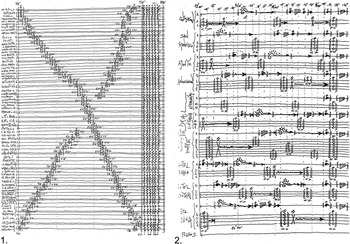
There are ‘lines’ rigorously defined by the composer: the sound goes through the city only in one direction, or even in two or more overlapping directions which share the beginning or the end of their trajectories (Figure 8.1). Here, the listener can sense how these sonic geometries coincide and emphasise the geometries of the physical space (in which the citizen walks) in a ‘homophonic’ way (Figure 9.1). In other cases, he will perceive how these geometries construct other air ‘figures’ unlike those of the streets, that is to say ‘polyphonically’ (Figure 9.2).
Left: ‘Closed line’. O Roma Nobilis (Roma, 1999) 7’20’’–9’40’’. Right: ‘Open line’. Signa (Santander, 2000) 13’00’’–16’36’’.

Left: ‘Homophonic line’. Nit de campanes (Girona, 1993) 12’10’’–14’30’’. Right: ‘Heterophonic line’. Vaniloquio campanero (Cholula, 1993) 17’00’’–18’00’’ / 29’00’’–30’30’’.
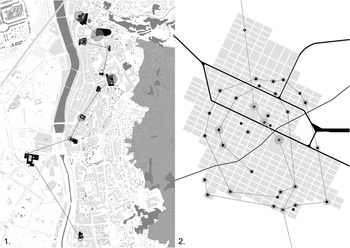
This sound travelling in ‘line’ proves the subtlety of Barber's design. However, in order for its outdoor reception to be optimal, such strategies require homogeneous building heights and flat topographies. To simplify these procedures, Barber’s writing devises another system of ‘lines’ with a higher degree of openness: they are not dictated to the same extent by the composer, but are more in need of a montage by the listener. Here, the same element – ‘tower chords’ mostly – is spatially distributed without a previously determined order (Figure 8.2). According to the weight and location of each source, this procedure invites the listener’s ear to connect different sonic points and, in so doing, to create his own ‘line’ among the infinite possibilities (Figure 6.2). Once again, the ‘close’ writing gives way to an ‘open’ writing which seems more appropriate for the city, for its vague geometries and for its mobile spectators.
4.3. Strategies of texture or ‘clouds’
The strategies of texture are closely related to the inner space of the sound mass. Here, Barber’s work does not offer a particular ‘sound figure’ in the foreground – as we have seen in previous operations – but rather produces a sonic background of variable density and texture (Figure 6.3). As if immersed in a cloud, in that ‘pure medium of sound’ hoped by Phillip Glass,Footnote 25 the listener focuses on the subtle variations of colours and dynamics that take place in the surrounding atmosphere. Depending on how these strategies articulate the structural elements, the sound result may be relatively homogeneous or gradually changing.
4.3.1. Homogeneous ‘clouds’
Homogeneous ‘clouds’ are designed by means of random percussions performed in all the available sources (see Figure 2). Within each tower, the conductor plays the role of a clock, indicating with his arms every minute elapsed. Inside each time-length marked in this way, the performer distributes sounds freely or in concordance with the actions of the rest. Therefore, the result is always unpredictable: ‘a rain devoid of any tension or intentionality, a pure occurrence of variable densities’ (Barber in conversation with the author, 2007).
This characteristic strategy of the city concert, called Lluvia a lo Cage (‘Rain in the Manner of Cage’), certainly explains much of what Barber’s composition means.Footnote 26 An effect that would be conventional in the concert hall turns into an enveloping and infinitely variable spectacle, as soon as it is transferred to the city. The ability of this ‘rain’ to hypnotise transcends the simplicity of its writing up to the point of justifying a whole concert in itself.
4.3.2. Changing ‘clouds’
Other strategies of texture work directly on the intensity level of the sound mass. These employ different structures ordered in time: from scattered percussions ‘in the manner of Cage’ to the final colophon of every single bell ringing simultaneously. This crescendo device creates increasing clouds of overtones that, in certain cases, can even mask the percussive strikes of bells. These clouds remain in the air for several minutes after the end of the concert as if they were an enormous hum (the lowest and longest-lasting partial of the bell) of the whole city. In these cases, the listener – physically penetrated by a sonority expanded in space and time – is unable to distinguish between background and foreground. Sometimes, ‘these crescendos adopt a ghostly shape or timbre’ (Barber Reference Barber2003: 116) perceived in the form of electronic organs, vocal choruses, and even metallic trumpets.Footnote 27 In order to intensify the sound feedback that causes such spectacular acoustic illusions, these continuum devices become more extended in duration over the years.
All in all, these strategies of ubiquity, mobility and texture claim a new space and time for the sonic occurrence. The city concert not only suggests ‘a musical recognition of the necessity of space [and time]’ (Cage Reference Cage1961: 39–40) (as Cage pointed out with respect to the physical distribution of the sound sourcesFootnote 28 ), but also seems to multiply the very dimensions of space and time of sound phenomenon.
As we have tried to show, the ‘city instrument’ devised by Barber involves many different ‘physical spaces’: first, the bell space, related to its tuning features; second, the tower space that defines the bell location and, therefore, how the bell can be performed; third, the nearby space around the tower that allows listening to, or not, the geometric subtleties of ‘sound figures’ such as ‘tower arpeggios’ or crescendos; and finally, the far space between towers made up of ‘points’, ‘lines’ or ‘clouds’. Also, there are different ‘physical times’ which are a feature of the writing for the city: first, a chronometric time that fixes the length of the score and the loop of each structure; second, a measured or unmeasured time of the structure itself that depends on the way it is written; third, a tempo related to the performer’s interpretation; and finally, other ‘open times’ engaged with the listener walking through the city.
And, what is ever more important, these spaces and times end up experiencing what one might term ‘interpenetration’ in a shared medium. During the city concert, they dialogue with each other as if they were of the same nature: the bell space in conversation with the tempo of the performer; the space of the streets with the responsorial ‘points’, fugue ‘lines’ or rain ‘clouds’; or even the dialogue among the space between towers on the one hand, and the chronometric time of the score, on the other. In Barber’s composition, space and time have found a joint dimension, by which they can follow each other in a ‘homophonic’ way, or diverge ‘polyphonically’, to use those old categories of musical imagination. In this new urban relativism, space and time become two homogeneous dimensions that can be assimilated into the same sound discourse.
5. THE FORMAL STRUCTURE: A SOUND NARRATIVE
On the last creative level, we will focus on the ‘great form’ with which the previous dimensions comply. How does the score articulate these during the concert?
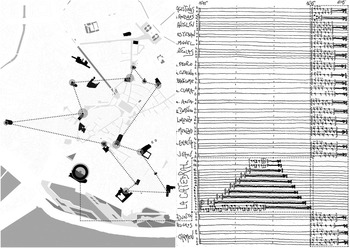
The city concert is usually structured, simply and conventionally, in three differentiated sections: an introduction, a central part and a final one. In the introduction, Barber makes literal use of the bells’ traditional function of calling (to summon the community to pray, to warn of dangerous situations, celebrations, etc.). This section is designed by means of very gradual crescendos (Figure 10), or suddenly by simultaneous entries of all the available sources (Figure 4). To ensure the success of the call, the duration of the introduction is closely related to the city size. Similarly, the final section appears in the form of both a crescendo building up to maximum output and a progressive diminuendo until finally fading-out. Over the years, these sections have been progressively extended, allowing the listening experience to be more relaxed and, therefore, attentive.
Gradual introduction. Pulsante Fragor (Jerez de la Frontera, 1996) 00’00’’–10’00’’.
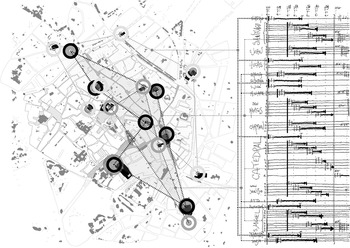
Meanwhile, the central sections do not articulate a discourse commonly understood as musical, that is, linearly composed of tensions and resolutions, or focused on thematic developments. On the contrary, these sections present a tessellated structure of independent units that can confront, overlap or bind with each other, without a discursive progression in their links. These units can be transferred and continuously improved upon from one concert to another. In so doing, the discourse of the city concert provides a grammar so elementary that it cannot escape the characteristics of a collage: a collage at the limits of grammar. Surely, this situation is implied in the very hybrid nature of the city concert – between composition and indeterminacy of urban space.
6. ‘REBELLIOUS’ ASPECTS: THE PRAGMATICS OF SOUND
Within every single creative dimension already mentioned, there is a whole compositional evolution engaged in the difficulty of foreseeing any ‘accident’ that could happen – contradicting the author’s instructions – during the concert. Accordingly, Barber tends to simplify more and more the aspects involved in each of them.
First, concerning materials and performance techniques, given the impossibility of being able to choose the tuning of the bells, the writing becomes more focused on aspects of timbre rather than pitch. Similarly, given the inability to recruit an army of skilled performers, the writing becomes progressively more simple, yet more detailed and expressive; the elementary inflexion ‘of character’, provided by graphic marks and textual calls, seems much more appropriate for the city sound space than the formal one.Footnote 29 This point underlies the evolution itself of the compositional elements. Moreover, within this second dimension we have seen how those sol-fa structures written by traditional time signatures give way to more flexible ones which appear as ‘open’ to the creative collaboration of the performer. These structures qualify the sound mass by means of internal events of shaded intensities and colours (accelerandos and arpeggios, dances or vague melodies). Furthermore, as for compositional strategies, due to the inability to foresee that the designed effects will be heard by the spectator exactly as they are written in the score, Barber turns to a more choral and insistent writing, less fragmented or almost without ‘gaps’, using bells and bell towers as construction materials of broader gestures. In other words, the compositional procedure becomes more concerned with the inner space of a single sonic entity in continuous transformation than with the outer space related to the sources’ distribution in the city. Finally, regarding the final form of the score, we have seen how the concert ends up adopting a basic tripartite structure that leaves no room for uncertainty, clearly showing the formal profile of the sound event to the listener.
The increasing simplification of the writing not only deals with the inability to foresee particular aspects of these four dimensions. Urban space itself may subject the concert to much more unexpected occurrences. The materiality of the city, the urban activity and even the present meteorological conditions at the concert will lead the writing to an even more prudent simplification.Footnote 30 Over the years, Barber’s writing has selected those materials, techniques, structures and strategies that have demonstrated their fertile versatility to any outdoor condition. These compositional devices will remain in progressively briefer scores, more synthetic and analogous to each other.
What is the common aim of this evolution? It is a progressive adaptation to the intrinsic inability to foresee the sound result in the city. In its attempt to achieve its goal despite any accident, to offer sound phenomenon wherever it may be but with every kind of nuance, the city concert language has become more binding, similar and unitary. This aspect is more than a style: it is in itself as consubstantial to urban space as choral writing is to the church. Far from being a creative abdication, this pragmatic dimension is the key to showing Barber’s writing as a foolproof method that can appropriately cope with the rebellious aspects of the urban medium.
7. CODA
This text has shown five inclusive dimensions of Barber’s work for urban space. Within all of them, his particular manner of dealing with the sound outdoors, as any empirical process of trial and error, adumbrates an increasingly accurate sound design of the city. Over the last 25 years, his writing has been outlining a canonical reliability between design procedures – originally musical – and the extraneous urban space for which they were designed – originally ascribed to art sound – to the extent that, as our analysis has tried to demonstrate, his final work becomes full of suggestions for sound design, between music and sound art, of the city.
The quantity, quality and spatial distribution of the sound sources, together with the morphology and materiality of the resounding city circumscribe sound imagination to a restricted scope. These instrumental conditions, imposed beforehand, reduce the designer’s freedom as well as his expectations of an outdoor sound particularly vulnerable to all types of unexpected meteorological and quotidian events. Barber manages to recover all those ‘losses’ in the unique achievement of that great open mass which is a city concert.
We might say that it is not the sound designer who ‘composes’ for the polis. Within this new political context (which requires administrative permits, blocked streets, churches reserved for this secular use, etc.), it is the polis itself that – mobilised or convened by Barber – imbues sound phenomenon with symbolic value, with spaces and times inevitably associated with its bells. Thus, the citizen goes out onto the street not to listen to any composer or sound artist, but to enjoy a sound that always has belonged to him.
Acknowledgements
All the scores are published with kind permission of Llorenç Barber. The drawing plans and diagrams are property of the author.