


1. Introduction
The no-miracle argument is among the most influential arguments for scientific realism in contemporary philosophy of science.Footnote 1 At its core, the argument contends that the remarkable predictive success of mature scientific theories would be miraculous if these theories were not at least approximately true (cf. Putnam Reference Putnam1975; Musgrave Reference Musgrave and Nola1988). This intuitive reasoning has been formalized in various ways, with the probabilistic version receiving particular attention due to its apparent precision and mathematical rigor (cf. Howson Reference Howson2000; Magnus and Callender Reference Magnus and Callender2004).
Let ‘NMA’ stand for the probabilistic no-miracle argument. However, the probabilistic formulation of the no-miracle argument has faced a significant challenge from Colin Howson’s (Reference Howson2000) base-rate fallacy objection. Howson argues that the probabilistic no-miracle argument (NMA) commits a formal logical error by ignoring the prior probability, thereby failing to comply with the principles of Bayesian reasoning. According to this objection, even if true theories are highly likely to be predictively successful and false theories are highly unlikely to be predictively successful, the posterior probability that a successful theory is true can still be low if the prior probability of approximate truth is sufficiently low. This objection has been widely regarded as successful,Footnote 2 leading many philosophers to conclude that NMA is inferentially fallacious and that scientific realists must either abandon this line of reasoning or find alternative formulations (cf. Henderson Reference Henderson2017; Dawid and Hartmann Reference Dawid and Hartmann2018).
This paper argues that such conclusions are premature: despite its mathematical sophistication, the base-rate fallacy objection fails to undermine the no-miracle argument—at least not for scientific theories that attain an extraordinarily high degree of predictive precision. While Howson correctly identifies the conditions under which NMA would violate Bayes’ theorem, these conditions, when applied to theories with exceptionally precise predictions, require assumptions that are far more problematic than anything the no-miracle argument presupposes. I will demonstrate that, for the argument to be inferentially fallacious, opponents must assume that the prior probability of approximate truth is “miraculously low”—an assumption I will argue is implausible, question-begging against realism, and unsupported by anti-realist arguments.
The argument proceeds through several stages. Sections 2 and 3 present NMA and Howson’s base-rate fallacy objection. Sections 4 and 5 establish the validity condition for the no-miracle argument and motivate a shift in focus from validity to fallacy, after which I undertake a systematic analysis of the argument’s fallacy condition. Sections 6 and 7 examine two distinct ways in which the prior probability could be sufficiently low to render the no-miracle argument inferentially fallacious, showing that both require assumptions about “miraculous” or “super-miraculous” prior probabilities. Section 8 identifies NMA’s fallacy condition, while Section 9 argues for the main thesis: for theories with exceptionally high predictive precision, NMA is not inferentially fallacious. Section 10 addresses potential objections. The paper concludes that NMA remains a viable and important argument for scientific realism, at least insofar as it is not undermined by the base-rate fallacy objection.
2. The probabilistic no-miracle argument
Putnam’s well-known defense of scientific realism provides the locus classicus of the no-miracle argument:
The positive argument for realism is that it is the only philosophy that doesn’t make the success of science a miracle. That terms in mature science typically refer […], that the theories in a mature science are typically true, that the same term can refer to the same thing even when it occurs in different theories—these statements are viewed by the scientific realist not as necessary truths but as the only scientific explanation of the success of science and hence as part of any adequate scientific description of science and its relations to its objects. (Putnam Reference Putnam1975, 73)
This passage captures the essential intuition behind the no-miracle argument: the extraordinary predictive success of mature scientific theories cries out for explanation, and the most plausible explanation is that these theories are at least approximately true. The alternative—that fundamentally false theories could achieve such remarkable success—seems to require us to believe in what would amount to a miracle.
Colin Howson (Reference Howson2000) suggests that we can make Putnam’s argument more precise by interpreting his polemical use of the word “miracle” with literal probabilistic force: a miracle can be regarded as an event with exceedingly low probability. This interpretation allows us to construct the no-miracle argument in explicitly probabilistic terms, making its logical structure amenable to rigorous mathematical analysis.
To begin with, note that the term “approximate truth” and its cognates (“verisimilitude,” “truthlikeness,” and “closeness to the truth”) have been defined in numerous ways. On some accounts, a theory is approximately true just in case it is close or similar to the truth in a logical or modal space (cf. Oddie Reference Oddie1986; Niiniluoto Reference Niiniluoto1987); on others, it is true of an idealized model that approximates the real system (cf. Psillos Reference Psillos1999), contains working posits that are true (cf. Vickers Reference Vickers2017), or captures the formal structure of reality (cf. Worrall Reference Worrall1989). I will not attempt to adjudicate among these competing formulations. For present purposes, we may simply treat approximate truth as the disjunction of these prominent proposals.
Let S stand for the proposition that the theory H is predictively successful, and T for the proposition that the theory H is approximately true. Here, “predictive success” should be understood broadly to include not only novel predictions that are subsequently confirmed, but also the theory’s ability to systematically account for a wide range of empirical phenomena with high precision. The probabilistic version of the no-miracle argument can then be formulated as follows (also cf. Psillos Reference Psillos2009, 57; Dyck Reference Dyck2023, 762):
The probabilistic no-miracle argument (NMA)
(P1) Pr(S | T) is high.
(P2) Pr(S | ∼T) is very low.
(C1) So, Pr(T | S) is high.
This formulation captures, in probabilistic terms, the intuitive reasoning that once we observe a theory’s consistent empirical success, the probability that it is at least approximately true should increase to a high level.
(P1) captures the intuitively plausible idea that true theories generally make accurate predictions about observable phenomena. The reasoning behind this premise is that if a theory correctly describes the underlying structure of reality, then the predictions it generates based on that description should typically be borne out by observation.
(P2), by contrast, captures the “no-miracle” intuition that gives the argument its name: it would be an extraordinary coincidence—indeed, a miracle—for a fundamentally false theory to consistently make accurate predictions about the world. The idea here is that if a theory’s central claims about the structure of reality are fundamentally mistaken, then there is no reason to expect its predictions to align systematically with empirical observations. Any such alignment would have to be attributed to remarkable good fortune rather than genuine insight into the nature of reality.
Finally, (C1) follows from (P1) and (P2) by what appears to be straightforward probabilistic reasoning: if true theories are likely to be predictively successful and false theories are very unlikely to be predictively successful, then predictively successful theories are likely to be true.
3. The base-rate fallacy objection
Howson has argued that NMA is formally invalid. Specifically, he contends that the inference from (P1) and (P2) to (C1) is not supported by the fundamental principles of probability calculus. The problem becomes clear when we apply Bayes’ theorem:
 ${\bf Bayes ' \ theorem{:}}\ {\rm{Pr}}(T\mid S) = {{{\rm{Pr}}(S\mid T){\rm{Pr}}(T)} \over {{\rm{Pr}}(S\mid T){\rm{Pr}}(T) + {\rm{Pr}}(S\mid \; \sim{T}){\rm{Pr}}( \sim{T})}}$
At its core, NMA is the inference that from (P1) the high true-positive rate
 ${\rm{Pr}}(S\mid T)$
and (P2) the very low false-positive rate
 ${\rm{Pr}}(S\mid \sim{T})$
to (C1) the high posterior probability
 ${\rm{Pr}}(T\mid S)$
. But Bayes’ theorem reveals that the posterior probability
 ${\rm{Pr}}(T\mid S)$
depends not only on the true-positive rate
 ${\rm{Pr}}(S\mid T)$
and the false-positive rate
 ${\rm{Pr}}(S\mid \sim{T})$
but also on the prior probability Pr(T). Crucially, even when the true-positive rate
 ${\rm{Pr}}(S\mid T)$
is high and the false-positive rate
 ${\rm{Pr}}(S\mid \sim{T})$
is very low, the posterior probability
 ${\rm{Pr}}(T\mid S)$
can still be low if the prior probability Pr(T) is sufficiently low. We can illustrate this point with a numerical example. Suppose
 ${\rm{Pr}}(S\mid T) = 0.9$
(high),
 ${\rm{Pr}}(S\mid \sim{T}) = 0.1$
(low), and Pr(T) = 0.001 (low). Applying Bayes’ theorem, we get
 ${\rm{Pr}}(T\mid S) = {{0.9 \times 0.001} \over {0.9 \times 0.001 + 0.1 \times 0.999}} = {{0.0009} \over {0.1008}} \approx 0.009$
which is very low. So, the inference from (P1) and (P2) to (C1) is not inferentially valid—despite the high true-positive rate and low false-positive rate, the posterior probability remains very low due to the extremely low prior probability.
Howson therefore maintains that NMA commits the base-rate fallacy, since the inference from (P1) and (P2) to (C1) ignores the possibility of a low prior probability (base rate; Howson Reference Howson2000, Reference Howson2013; also cf. Magnus and Callender Reference Magnus and Callender2004). This objection has been widely influential, with many commentators concluding that it demonstrates a fatal flaw of NMA (cf. Menke Reference Menke2014; Henderson Reference Henderson2017; Dawid and Hartmann Reference Dawid and Hartmann2018).
However, it is important to distinguish what cognitive psychologists identify as the base-rate fallacy from the alleged error Howson claims NMA commits. This distinction is crucial for properly evaluating the force of Howson’s objection.
In cognitive psychology, the base-rate fallacy is the tendency to ignore the prior probability (base rate) even when that information is available (cf. Kahneman and Tversky Reference Kahneman and Tversky1973; Bar-Hillel Reference Bar-Hillel1980). In a typical experimental scenario, subjects are told that a medical test has a true-positive rate of 99% (high), a false-positive rate of 5% (low), and that only 1% of the population carries the disease (low base rate). When asked to estimate the probability that a person who tests positive actually has the disease (the posterior probability), most respondents say it is very high. However, Bayes’ theorem shows that the probability is actually only about 16% (low). The base-rate fallacy manifested here involves two elements: first, the reasoning directly violates Bayes’ theorem, and second, the experimental subjects ignore or underweight prior probability information that has been explicitly provided to them.
The reasoning behind NMA differs from the classical base-rate fallacy in two respects. First, unlike the probabilistic reasoning of experimental subjects, NMA does not contradict Bayes’ theorem. NMA is compatible with Bayes’ theorem in the sense that the inference from (P1) and (P2) to (C1) is permitted, though not licensed, by Bayes’ theorem. Second, the prior probability of approximate truth is not readily available in the way that base-rate information is explicitly provided in psychological experiments. Unlike experimental subjects who are given precise numerical values for all relevant probabilities, proponents of NMA are not guilty of disregarding or underweighting information that has been explicitly given to them. Instead, they face a more complex task that includes the determination of what prior probability should be assigned to the approximate truth of mature scientific theories.
This analysis reveals that NMA faces a dilemma rather than a straightforward refutation. The argument might commit the base-rate fallacy, but it might not—the answer depends on the value of the prior probability Pr(T).
4. The validity condition
Howson is aware that NMA is compatible with Bayes’ theorem. Although, as it stands, the argument is not licensed by Bayes’ theorem, Howson points out that NMA can be transformed into a valid inference if Pr(T) is not sufficiently low. It is evident that, although Howson does not say so explicitly, once all the vague terms are adequately specified, the following is both a necessary and sufficient condition for NMA to be inferentially valid:
The validity condition
(P3) Pr(T) is not sufficiently low.
Viewed in this light, Howson’s base-rate fallacy objection actually presents NMA with a choice between two alternatives, each of which faces serious difficulties. The first horn—accepting that NMA commits the base-rate fallacy—is obviously unpalatable. But the second horn—accepting (P3) as an additional premise—faces two significant problems of its own.
First, assuming (P3) risks begging the question against anti-realism. Anti-realists typically deny that mature scientific theories are approximately true, and this denial arguably commits them to reject (P3) as well. If NMA is intended as an argument for scientific realism against anti-realism, then assuming something incompatible with anti-realism would render the argument circular and therefore dialectically ineffective.
Second, a principled rationale for (P3) might not be available to realists—at least not without undermining their claim that NMA is the ultimate argument for scientific realism. Providing a principled, non-circular justification for (P3) would require a method for determining the approximate truth of scientific theories independent of NMA itself. But this would undercut NMA’s status as the primary argument for realism, since it would show that we already have independent grounds for believing in the approximate truth of scientific theories.
5. From validity to fallacy
We will return to the validity condition (P3) and its objections in Section 9. For now, note that the base-rate fallacy objection has been widely regarded as successful, leading many philosophers to conclude that the prospects for NMA are dim. Even some proponents of the no-miracle argument have conceded defeat, responding by either rejecting NMA entirely or developing alternative versions that focus on “global” (scientific theories as a whole) rather than “local” (individual theories) predictive success (cf. Henderson Reference Henderson2017; Dawid and Hartmann Reference Dawid and Hartmann2018).
However, I believe it is premature to capitulate to the base-rate fallacy objection. While the first horn of Howson’s dilemma—accepting that the argument commits a logical fallacy—is clearly untenable, defending the second horn is more feasible than many have realized. The key insight is to shift our perspective from asking what it takes for NMA to be valid to asking what it takes for the argument to be inferentially fallacious.
This strategic shift reveals an important asymmetry that has been overlooked in the literature. While commentators have quickly recognized the problems with accepting (P3), they have tended to overlook that denying (P3) is even more problematic. The denial of (P3) can be formulated as:
(P4) Pr(T) is sufficiently low.
Focusing on (P4) forces us to examine what opponents of NMA must assume in order to sustain their objection. And I will demonstrate that, when properly understood, accepting (P4) is actually a far worse theoretical choice than accepting (P3).
In the existing literature, the term “sufficiently low” typically functions as a placeholder for whatever threshold the prior probability Pr(T) must avoid in order for conclusion (C1) to hold—that is, for the posterior probability
 ${\rm{Pr}}(T\mid S)$
to count as “high.” This vagueness has made it difficult to evaluate the relative plausibility of (P3) and (P4), since we cannot assess the reasonableness of these claims without knowing what they actually require.
However, I contend that closer examination of the mathematical structure of Bayes’ theorem can actually tell us quite a lot about what constitutes a “sufficiently low” probability in this context. While we may not be able to determine a precise numerical threshold, we can still learn enough about this notion to properly evaluate the trade-off between accepting (P3) and accepting (P4).
The key is that Bayes’ theorem yields a posterior probability of the form
 ${\rm{Pr}}(T\mid S) = {a \over {a + b}},$
where
 $a = {\rm{Pr}}(S\mid T){\rm{Pr}}(T)$
and
 $b = {\rm{Pr}}(S\mid \; \sim{T}){\rm{Pr}}( \sim{T})$
. This type of fraction has an important mathematical property that is especially relevant to our discussion:
 ${a \over {a + b}}{\rm{ \gt }}{1 \over 2}\ {\rm{iff}}\ a{\rm{\gt }}b,$
 ${a \over {a + b}} \le {1 \over 2}\ {\rm{iff}}\ a \le b.$
Applying (1) to Bayes’ theorem, we obtain
 ${\rm{Pr}}(T\mid S){\rm{ \gt }}{1 \over 2}\ {\rm{iff\ Pr}}(S\mid T){\rm{Pr}}(T){\rm{\gt Pr}}(S\mid \; \sim{T}){\rm{Pr}}( \sim{T}),$
 ${\rm{Pr}}(T\mid S) \le {1 \over 2}\ {\rm{iff\ Pr}}(S\mid T){\rm{Pr}}(T) \le {\rm{Pr}}(S\mid \; \sim{T}){\rm{Pr}}( \sim{T}).$
(2) reveals that there are two distinct ways for the prior probability Pr(T) to be “sufficiently low” to undermine NMA.
Path 1: The prior probability Pr(T) could be low enough to ensure the right-hand side of (2b)—i.e.,
 ${\rm{Pr}}(S\mid T){\rm{Pr}}(T) \le {\rm{Pr}}(S\mid \; \sim{T}){\rm{Pr}}( \sim{T})$
—which would make the posterior probability
 ${\rm{Pr}}(T\mid S){\rm{\le }}{1 \over 2}$
. Since a posterior probability
 ${\rm{Pr}}(T\mid S)$
of ½ or less cannot be reasonably counted as “high” in the context of the no-miracle argument, this would render conclusion (C1) false.
Path 2: The prior probability Pr(T) could be high enough to ensure the right-hand side of (2a)—i.e.,
 ${\rm{Pr}}(S\mid T){\rm{Pr}}(T){\rm{\gt Pr}}(S\mid \; \sim{T}){\rm{Pr}}( \sim{T})$
—but still low enough to make the posterior probability
 ${\rm{Pr}}(T\mid S)$
closer to ½ than to 1, thereby failing to achieve the “high” probability claim in (C1).
In Sections 6 and 7, I examine these two paths in detail, showing precisely which assumptions opponents of the NMA must commit to. Section 8 then identifies the argument’s fallacy condition.
Before proceeding to examine these two paths in detail, it is worth emphasizing the significance of this analytical approach. By identifying the precise mathematical conditions under which NMA would be fallacious, we can move beyond vague assertions about “low priors” to examine the specific commitments that opponents of the argument must accept. This approach reveals that the base-rate fallacy objection is not simply a matter of pointing out that Bayes’ theorem includes a prior probability term. Rather, it requires substantive assumptions about the magnitude of that prior probability—assumptions that, as we shall see, are themselves highly questionable. The burden of proof thus shifts to opponents of NMA to justify these assumptions, rather than simply pointing to their possibility.
6. First path to fallacy
Let us begin by examining the first path by which the prior probability could be sufficiently low to render NMA fallacious. This path requires that
 ${\rm{Pr}}(S\mid T){\rm{Pr}}(T) \le {\rm{Pr}}(S\mid \; \sim{T}){\rm{Pr}}( \sim{T}).$
As established in the previous section, (3) is sufficient for the fallacy of NMA, since it implies that the posterior probability
 ${\rm{Pr}}(T\mid S) \le {\textstyle{1 \over 2}}$
, which cannot reasonably be counted as “high.”
The crucial question is: how low must the prior probability Pr(T) be for (3) to hold? To answer this question, we can manipulate the inequality algebraically. First, applying a basic theorem of probability theory that
 ${\rm{Pr}}(p){\rm{Pr}}(q) \le {\rm{Pr}}(p)$
, we get
 ${\rm{Pr}}(S\mid \; \sim{T}){\rm{Pr}}( \sim{T}) \le {\rm{Pr}}(S\mid \; \sim{T}).$
Applying (4) to (3), we obtain
 ${\rm{Pr}}(S\mid T){\rm{Pr}}(T) \le {\rm{Pr}}(S\mid \; \sim{T}),$
which is equivalent to
 ${\rm{Pr}}(T) \le {\rm{ }}{{{\rm{Pr}}(S\mid \sim{T})} \over {{\rm{Pr}}(S\mid T)}}.$
(6) tells us that for NMA to be fallacious via the first path, the prior probability Pr(T) must be no greater than the inverse likelihood ratio
 ${\rm{Pr}}(S\mid \sim{T})/{\rm{Pr}}(S\mid T)$
.
Now, by (P1), the true-positive rate
 ${\rm{Pr}}(S\mid T)$
is close to 1. When the denominator of a fraction is close to 1, the value of the entire fraction is approximately equal to its numerator. Therefore, by (P1) and (5), we can derive
 ${\rm{Pr}}(T)\lesssim{\rm{Pr}}(S\mid \sim{T}).$
(7) reveals something remarkable: for NMA to be fallacious via the first path, the prior probability that a mature scientific theory is approximately true must be roughly as low as the probability that a false theory would be predictively successful.
To appreciate the full significance of (7), we need to understand just how low the false-positive rate
 ${\rm{Pr}}(S\mid \sim{T})$
actually is. For present purposes, we may treat the probability that a theory yields a correct prediction despite not being even approximately true as akin to the probability of a lucky guess. This is intuitively plausible: a non-approximately true theory is, as noted, neither close to the truth in logical or modal space (Oddie Reference Oddie1986; Niiniluoto Reference Niiniluoto1987), nor true of any idealized model that adequately approximates the real system (Psillos Reference Psillos2009); it contains no true working posits (Vickers Reference Vickers2017) and fails to capture the formal structure of reality (Worrall Reference Worrall1989).
However, not all guesses—or predictions—are equally demanding: some are far more likely to be correct than others. It is one thing to predict that an experiment will yield a positive effect, and quite another to predict its precise magnitude. What matters for present purposes is the extraordinary degree of predictive success achieved by some mature scientific theories. Modern physics, for instance, has attained an exceptionally high level of precision in its predictions. A striking illustration is the remarkable agreement between theory and experiment in quantum electrodynamics (QED), as noted by Alan Sokal and Jean Bricmont:
Quantum electrodynamics predicts that the magnetic moment of the electron (expressed in a well-defined unit which is unimportant for the present discussion) has the value
1.001159652201 ± 0.000000000030
(where the ‘±’ denotes the uncertainties in the theoretical computation, which involves several approximations), while a recent experiment gives the result
1.001159652188 ± 0.000000000004
(where the ‘±’ denotes the experimental uncertainties).
This 11-decimal-place agreement between theory and experiment—particularly when combined with thousands of other similar though less spectacular ones—would be utterly miraculous if quantum electrodynamics were not saying something at least approximately true about the world. (Sokal and Bricmont Reference Sokal, Bricmont, Carrier, Roggenhofer, Küppers and Blanchard2004, 32–33)
Now, Sokal and Bricmont are certainly correct that this agreement to 11 decimal places—particularly when combined with thousands of similar results—would be nothing short of miraculous if QED were not even approximately true. But we can be more precise about just how miraculous this would be.
Imagine, for the sake of argument, that QED were completely wrong and provided no meaningful information about the electron’s magnetic moment. In that case, its “prediction” would amount to a lucky guess—analogous to a random draw from a reasonably generous interval, say between 1 and 2 (in natural units), a range that arguably includes all plausible empirical values. When you take into account the uncertainty in both the theoretical and experimental values, the overlap of their respective uncertainty bands amounts to only
 $8 \times {10^{ - 12}}$
. This small overlap suggests that, if we assume the true value is uniformly distributed across the interval [1,2], the probability of a random draw falling within this narrow window is approximately
 $8 \times {10^{ - 12}}$
, or about 1 in
 $1.25 \times {10^{11}}$
. The probability that all of these would succeed by mere chance is thus astronomically small. And we haven’t even mentioned the several thousand other similar predictions.
To put this into perspective, events with probability on the order of one in a million (
 ${10^{ - 6}}$
) are commonly regarded as miraculous in everyday discourse. We often describe extraordinarily unlikely events as “one-in-a-million” miracles—for example, winning a typical lottery, where the probability is often on the order of several million to one. But the kind of predictive success achieved by theories like QED would be far more improbable than winning a typical lottery. A single instance of such precision would already be comparable to winning a lottery several times in a row, and the fact that such agreement recurs systematically across thousands of predictions compounds this improbability to an extraordinary degree.Footnote
3
This suggests that we need a stronger term than “miracle” to describe the kind of coincidence that would be required for false theories to achieve the level of predictive success we observe in mature science. Let us call such events super-miracles—events that are not merely improbable, but improbable to a degree that strains credibility beyond any reasonable limit.
To make this notion precise, we can adopt the following definitions:
Definition 1. Miracle: An event is miraculous if its probability is approximately
 ${10^{ - 6}}$
or lower.
Definition 2. Super-miracle: An event is super-miraculous if its probability is at least 10,000 times lower than that of a miracle—that is, approximately
 ${10^{ - 10}}$
or lower.
The exact numerical thresholds chosen here may appear somewhat arbitrary, but they effectively clarify the relevant orders of magnitude. With these definitions in hand, we can see that, at least for scientific theories that attain an exceptionally high level of predictive precision, such as QED, (P2) can be restated as:
(P2*)
 ${\rm{Pr}}(S\mid \; \sim{T})$
is super-miraculously low.
This reformulation captures what is really at stake in the no-miracle argument. The predictive success of mature scientific theories is not merely improbable if these theories are false—it is super-miraculously improbable.
Returning to our earlier analysis, (7) tells us that for NMA to be fallacious via Path 1, we must have
 ${\rm{Pr}}(T) \lesssim {\rm{Pr}}(S\mid \sim{T})$
. Combined with (P2*), this yields
 ${\rm{Pr}}(T)\;{\rm{is}}\;{\rm{super {-} miraculously}}\;{\rm{low}}.$
In other words, in order to sustain the base-rate fallacy objection via Path 1, opponents of NMA must assume that the prior probability of approximate truth is not merely low but super-miraculously low—at least in cases involving theories that achieve an extraordinary degree of predictive success, such as those in modern physics.
7. Second path to fallacy
The first path for showing the inferential fallacy of NMA requires the assumption of super-miraculously low prior probabilities. However, there is a second, more subtle, path that merits careful examination. This path permits the prior probability Pr(T) to be sufficiently high to establish that
 ${\rm{Pr}}(S\mid T){\rm{Pr}}(T){\rm{\gt Pr}}(S\mid \sim{T}){\rm{Pr}}( \sim{T}),$
but it maintains that the prior probability Pr(T) remains sufficiently low to prevent the posterior probability
 ${\rm{Pr}}(T\mid S)$
from being genuinely “high”—that is, substantially greater than ½.
To clearly identify the range for Pr(T) that both satisfies (9) and denies a genuinely high posterior, a useful analytic tool is the concept of order of magnitude. Any positive number x can be written uniquely in scientific notation as
 $x = s \times {10^n}$
, where 1 ≤ s < 10 and
 $n \in \mathbb{Z}$
. We call the exponent n the order of magnitude of x. For instance, the order of magnitude of 540 (= 5.4 × 10²) is 2; similarly, the order of magnitude of 0.0095 (=
 $9.5 \times {10^{ - 3}}$
) is −3. Intuitively, the order of magnitude captures how many “powers of ten” a number is composed of, reflecting its scale.
Suppose that a and b are such that
 $a = {s_a} \times {10^m}$
and
 $b = {s_b} \times {10^n}$
, and that
 $k = m - n$
. We say that a and b are k orders of magnitude apart. For instance, 36,000 (= 3.6 × 10⁴) and 8.1 (= 8.1 × 100) are four orders of magnitude apart, whereas 72,000 (= 7.2 × 10⁴) and 4,500 (= 4.5 × 10³) are one order of magnitude apart. Crucial for the present discussion is that the value of
 $a/(a + b)$
depends on s
a
, s
b
, and k as follows:
 ${a \over {a + b}} = {{{s_a}{{10}^k}} \over {{s_a}{{10}^k} + {s_b}}}$
(see the derivation in Appendix A for the proof).
(10) reveals that the difference in orders of magnitude effectively determines the precise upper and lower bounds for
 $a/(a + b)$
. More precisely, given that a > b, that
 $a = {s_a}{10^m}{\rm{\gt }}b = {s_b}{10^n}$
, and that a and b are k orders of magnitude apart (where k ≥ 0, since a > b), the bounds for
 $a/(a + b)$
are shown in Table 1 (see the derivation in Appendix B for the proof). To illustrate, suppose that
 $a = {s_a} \times {10^5}$
and
 $b = {s_b} \times {10^3}$
, so k = 2. In this case,
 $a/(a + b)$
’s upper bound is
 ${10^{2 + 1}}/({10^{2 + 1}} + 1) = 1000/1001 \approx 0.999$
(exclusive), whereas its lower bound is
 ${10^2}/({10^2} + 10) \approx 0.909$
(inclusive). Likewise, suppose that
 $a = {s_a} \times {10^4}$
and
 $b = {s_b} \times {10^4}$
, so k = 0. In this case,
 $a/(a + b)$
’s upper bound is
 ${10^{0 + 1}}/({10^{0 + 1}} + 1) = 10/11 \approx 0.909$
(exclusive), whereas its lower bound is ½ (exclusive).
The upper and lower bounds for
 $a/(a + b)$
| Order of magnitude difference | Lower bound for
 $a/(a + b)$ |
Upper bound for
 $a/(a + b)$ |
|---|---|---|
| k = 0 |
 $\gt {1 \over 2}$ |
 $\lt {{{{10}^{k + 1}}} \over {{{10}^{k + 1}} + 1}}$ |
| k ≥ 1 |
 $ \ge {{{{10}^k}} \over {{{10}^k} + 10}}$ |
 $\lt {{{{10}^{k + 1}}} \over {{{10}^{k + 1}} + 1}}$ |
Table 1 Long description
A table with two rows and three columns. The columns are labeled 'Order of magnitude difference', 'Lower bound for a/(a + b)', and 'Upper bound for a/(a + b)'. The first row has k=0, greater than 1/2, and less than 10^(k+1)/10^(k+1)+1. The second row has k>=1, greater than or equal to 10^k/10^k+10, and less than 10^(k+1)/10^(k+1)+1.
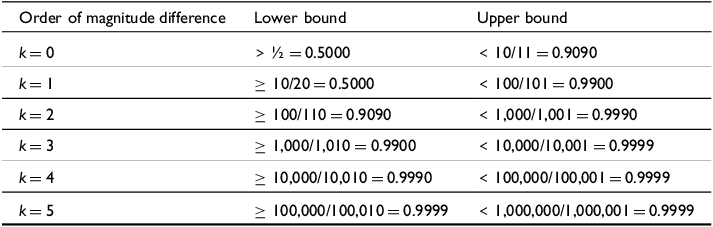
Table 2 illustrates the lower/upper bounds for
 $a/(a + b)$
from k = 0 up to k = 5. Here, we can clearly see, when a and b are k orders of magnitude apart (where 0 ≤ k ≤ 5), how large—or small—
 $a/(a + b)$
can ever be (rounded to the fourth significant digit). Reading down the rows, it is evident that there is a gap between k < 2 and k ≥ 2. When k < 2, the lower bound for
 $a/(a + b)$
can still be as low as just above 0.500. But when k = 2, the lower bound for
 $a/(a + b)$
jumps sharply to 0.909, and from that point on, every additional order of magnitude pushes
 $a/(a + b)$
’s lower bound by another “9.”
The upper/lower bounds for
 $a/(a + b)$
with
 $a = {s_a}{10^m}{\rm{ \gt }}b = {s_b}{10^n}$
and a and b being k orders of magnitude apart (rounded to fourth significant digit)
| Order of magnitude difference | Lower bound | Upper bound |
|---|---|---|
| k = 0 | > ½ = 0.5000 | < 10/11 = 0.9090 |
| k = 1 | ≥ 10/20 = 0.5000 | < 100/101 = 0.9900 |
| k = 2 | ≥ 100/110 = 0.9090 | < 1,000/1,001 = 0.9990 |
| k = 3 | ≥ 1,000/1,010 = 0.9900 | < 10,000/10,001 = 0.9999 |
| k = 4 | ≥ 10,000/10,010 = 0.9990 | < 100,000/100,001 = 0.9999 |
| k = 5 | ≥ 100,000/100,010 = 0.9999 | < 1,000,000/1,000,001 = 0.9999 |
Table 2 Long description
A table comparing the lower and upper bounds for a/(a + b) with a and b k orders of magnitude apart. The table has 6 rows and 3 columns. The columns are labeled Order of magnitude difference, Lower bound, and Upper bound. The rows are labeled with k values from 0 to 5. Each row provides the lower and upper bounds for the corresponding k value. Row 1: k = 0, Lower bound > 1/2 = 0.5000, Upper bound < 10/11 = 0.9090. Row 2: k = 1, Lower bound >= 10/20 = 0.5000, Upper bound < 100/101 = 0.9900. Row 3: k = 2, Lower bound >= 100/110 = 0.9090, Upper bound < 1,000/1,001 = 0.9990. Row 4: k = 3, Lower bound >= 1,000/1,010 = 0.9900, Upper bound < 10,000/10,001 = 0.9999. Row 5: k = 4, Lower bound >= 10,000/10,010 = 0.9990, Upper bound < 100,000/100,001 = 0.9999. Row 6: k = 5, Lower bound >= 100,000/100,010 = 0.9999, Upper bound < 1,000,000/1,000,001 = 0.9999.
This leap at k ≥ 2 is particularly pertinent to the present discussion, as it poses a substantive constraint on the fallacy condition for NMA. Recall that
 ${\rm{Pr}}(T\mid S) = a/(a + b)$
, where
 $a = {\rm{Pr}}(S\mid T){\rm{Pr}}(T)$
and
 $b = {\rm{Pr}}(S\mid \sim{T}){\rm{Pr}}( \sim{T})$
. Table 2 thus reveals that
 ${\rm{Pr}}(S\mid T)$
is high (≥ 0.9090) when
 ${\rm{Pr}}(S\mid T){\rm{Pr}}(T)$
and
 ${\rm{Pr}}(S\mid \sim{T}){\rm{Pr}}( \sim{T})$
are at least two orders of magnitude apart. Conversely,
 ${\rm{Pr}}(T\mid S)$
can be low (≥ 0.5000) only when
 ${\rm{Pr}}(S\mid T){\rm{Pr}}(T)$
and
 ${\rm{Pr}}(S\mid \sim{T}){\rm{Pr}}( \sim{T})$
are within two orders of magnitude. This effectively implies that NMA can only be inferentially fallacious when
 ${\rm{Pr}}(S\mid T){\rm{Pr}}(T)$
and
 ${\rm{Pr}}(S\mid\sim{T}){\rm{Pr}}( \sim{T})$
are within two orders of magnitude—assuming Path 2:
 ${\rm{Pr}}(S\mid T){\rm{Pr}}(T){\rm{\gt Pr}}(S\mid \sim{T}){\rm{Pr}}( \sim{T})$
.
In other words, under Path 2, an opponent who wants to argue for the fallacy of NMA must endorse
 ${\rm{Pr}}(S\mid T){\rm{Pr}}(T)\;{\rm{and}}\;{\rm{Pr}}(S\mid \sim{T}){\rm{Pr}}( \sim{T})\ {\rm{are}}\;{\rm{within}}\;{\rm{two}}\;{\rm{orders}}\;{\rm{of}}\;{\rm{magnitude}}.$
At first glance, (11) might not seem particularly problematic. However, closer analysis reveals that it actually commits us to a very low value for Pr(T).
Specifically, notice that if two numbers a and b are within two orders of magnitude, then neither can be more than 102 = 100 times larger than the other. Hence, (11) entails
 ${\rm{Pr}}(S\mid T){\rm{Pr}}(T)\;{\rm{is}}\;{\rm{at}}\;{\rm{most}}\;{10^2} = 100\;{\rm{times}}\;{\rm{larger}}\;{\rm{than}}\;{\rm{Pr}}(S\mid \sim{T}){\rm{Pr}}( \sim{T}).$
Now, applying the probability theorem Pr(p)Pr(q) ≤ Pr(p), we obtain
 ${\rm{Pr}}(S\mid \sim{T}){\rm{Pr}}( \sim{T}) \le {\rm{Pr}}(S\mid\sim{T}).$
Applying (13), we can simplify (12):
 ${\rm{Pr}}(S\mid T){\rm{Pr}}(T)\ {\rm{is}}\;{\rm{at}}\;{\rm{most}}\;{\rm{100}}\;{\rm{times}}\;{\rm{larger}}\;{\rm{than}}\;{\rm{Pr}}(S\mid \sim{T}).$
By (P1),
 ${\rm{Pr}}(S\mid T)$
is close to 1, which allows us to further simplify (14):
 ${\rm{Pr}}(T)\;{\rm{is}}\;{\rm{approximately}}\;{\rm{at}}\;{\rm{most}}\;{\rm{100}}\;{\rm{times}}\;{\rm{larger}}\;{\rm{than}}\;{\rm{Pr}}(S\mid\sim{T}).$
Now, recall our earlier conclusion that, when it comes to extraordinarily predictively successful scientific theories,
(P2*)
 ${\rm{Pr}}(S\mid\sim{T})$
is super-miraculously low.
From (15) and (P2*), we obtain
 ${\rm{Pr}}(T)\ {\rm{is}}\;{\rm{approximately}}\;{\rm{at\ most}}\;{\rm{100}}\;{\rm{times}}\;{\rm{larger}}\;{\rm{than}}\ {\rm{ the}}\;{\rm{probability}}\;{\rm{of}}\;{\rm{a}}\;{\rm{super}}\;{\rm{miracle}}.$
Given our definition of super-miracles as events with probability
 ${10^{ - 10}}$
or lower, this essentially just means that Pr(T) is at most
 $100 \times {10^{ - 10}} = {10^{ - 8}}$
. According to our definition, events with probability
 ${10^{ - 6}}$
or lower count as miraculous. So, we can conclude that
 ${\rm{Pr}}(T)\ {\rm{is}}\;{\rm{miraculously}}\;{\rm{low}}{\rm{.}}$
In other words, for highly predictively successful theories, such as those in modern physics, opponents of NMA must, in order to sustain the base-rate fallacy objection via Path 2, assume that the prior probability of approximate truth is not merely low but miraculously low—comparable to the probability of winning a lottery.
8. The fallacy condition
Our analysis has revealed the precise conditions under which NMA would be inferentially fallacious. Opponents of the argument must endorse one of the two possibilities:
Path 1:
 ${\rm{Pr}}(S\mid T){\rm{Pr}}(T) \le {\rm{Pr}}(S\mid \sim{T}){\rm{Pr}}( \sim{T})$
, which requires that (8).
Path 2:
 ${\rm{Pr}}(S\mid T){\rm{Pr}}(T){\rm{ \gt Pr}}(S\mid \sim{T}){\rm{Pr}}( \sim{T})$
, but the two terms are within two orders of magnitude, which requires (17).
The fallacy condition was initially stated as
(P4) Pr(T) is sufficiently low.
We can now see, however, that (P4) understates what is really at stake. Our analysis of Paths 1 and 2 shows that Pr(T) would have to be much lower than anything that could plausibly count as “sufficiently low.” More precisely, Paths 1 and 2 jointly yield a general fallacy condition for NMA in the case of highly predictively successful scientific theories:
The fallacy condition
(P4*) Pr(T) is miraculously—indeed, potentially super-miraculously—low.
(P4*) represents what opponents of NMA must assume to sustain their objection. For highly predictively successful scientific theories, NMA is inferentially fallacious if, and only if, the prior probability Pr(T) is miraculously—indeed, even super-miraculously—low. The base-rate fallacy objection is therefore not merely a reminder that Bayes’ theorem includes a prior-probability term; it depends on substantive—and highly demanding—assumptions about the magnitude of that prior probability, at least in case of theories with high predictive precision. This matters for the present discussion, since the debate between realism and anti-realism centrally concerns the ontological status of non-observable entities posited in high-precision scientific domains such as modern physics.
9. From fallacy to validity
With (P4*) now identified as the fallacy condition for NMA, we can assess the argument’s inferential status. I defend two complementary theses. On the one hand, (P4*) is untenable: it is implausible, question-begging, ad hoc, and unsupported by anti-realist arguments. On the other hand, the NMA’s validity condition—essentially the denial of (P4*)—is theoretically innocent and enjoys independent motivation. Taken together, these theses place the burden of proof squarely on the NMA’s critics: anyone who would deny its validity must marshal compelling evidence for their extraordinary claim. I begin with the critique of (P4*).
First, (P4*) is implausible because it is deeply counterintuitive to assume that it would be miraculous for mature scientific theories to be at least approximately true. This implausibility becomes clear when we consider the sophisticated selection processes that scientific theories must survive before achieving the status of mature theories.
As Bas van Fraassen has noted, scientific theories are born into “a life of fierce competition” where predictive success serves as the primary determinant of survival:
[T]he Darwinist says: Do not ask why the mouse runs from its enemy. Species which did not cope with their natural enemies no longer exist. That is why there are only ones who do.
In just the same way, I claim that the success of current scientific theories is no miracle. It is not even surprising to the scientific (Darwinist) mind. For any scientific theory is born into a life of fierce competition, a jungle red in tooth and claw. Only the successful theories survive—the ones which in fact latched on to actual regularities in nature. (van Fraassen Reference Fraassen1980, 39–40; italics omitted)
Van Fraassen’s analogy is illuminating, but it actually supports the opposite conclusion from the one he draws. He treats the selection-process explanation of scientific theories’ predictive success as an alternative to an approximate-truth explanation (also cf. Wray Reference Wray2018). That is a mistake. The two explanations are complementary: the selection-process hypothesis offers a phylogenetic (historical-evolutionary) account—explaining how scientific theories came to possess their predictive power—whereas the approximate-truth hypothesis provides a mechanistic account—explaining why a given theory’s predictions are accurate (Lee Reference Lee2021).
Moreover, the fact that scientific theories have withstood intense scrutiny, demonstrated predictive power across numerous domains, and proven practically useful in technological applications is a reliable indicator of their being at least approximately true (also cf. Henderson Reference Henderson2017). Given these selection pressures, it is counterintuitive to regard the approximate truth of such theories as miraculous. The very fact that they have survived the competitive process of scientific evaluation provides prima facie reason to expect that they have “latched on to actual regularities in nature,” to use van Fraassen’s phrase.
Consider an analogy. Wimbledon is among the most competitive events in professional tennis: stringent qualification rules, a deep field drawn by prestige and prize money, and a single-elimination format that winnows the draw to just two finalists.Footnote 4 The fierce-selection hypothesis supplies a phylogenetic explanation of why Wimbledon finalists are outstanding players—the relentless culling of less-qualified competitors. This explanation complements, rather than conflicts with, a mechanistic one that appeals to their physical conditioning and technical mastery. The tournament’s selection pressure thus functions as a reliable indicator of competence. Given these selection pressures, it is counterintuitive to regard it as miraculous that a Wimbledon finalist is an excellent tennis player. Instead, the very fact that they have survived the competitive process provides prima facie reason to expect exceptional skill.
Second, (P4*) is question-begging because endorsing it is tantamount to assuming the falsity of scientific realism—the very position that NMA is designed to support. Scientific realism, in its most basic form, holds that mature scientific theories are at least approximately true. If we assign a miraculously low prior probability to this claim, we are effectively ruling out scientific realism from the start. This creates a problematic dialectical situation. NMA is typically presented as an argument for scientific realism against anti-realist alternatives. But if the objection to NMA presupposes the falsity of scientific realism, then it cannot serve as a neutral evaluation of the argument’s merits. Indeed, it becomes a circular argument that assumes what it purports to prove.
Consider an epistemological analogy. Suppose that someone argues that we have good reason to believe in the existence of the external world because our sensory experiences are best explained by the hypothesis that they are caused by external objects. A skeptic might object that this argument fails because the prior probability of the external world’s existence is extremely low. But such an objection would be question-begging, since it assumes the very skeptical position that the argument is designed to refute.
The same structure applies to the debate over NMA. Anti-realists who invoke (P4*) to object to the argument are not providing a neutral assessment of its logical merits. Instead, they are importing their anti-realist commitments into their evaluation of the argument, thereby rendering their objection dialectically ineffective.
Third, (P4*) is ad hoc because it emerges only under close mathematical analysis of the conditions required for NMA to be fallacious. The assumption is not part of the original base-rate fallacy objection as initially presented by Howson and others. Instead, it represents a commitment that opponents of NMA must make in order to sustain their objection once the mathematical details are worked out.
This ad hoc character is problematic for several reasons. First, it suggests that the base-rate fallacy objection is not as straightforward as it initially appeared. If the objection were genuinely compelling, we would not expect it to require such strong and controversial auxiliary assumptions. Second, the ad hoc nature of (P4*) raises questions about whether opponents of NMA are willing to accept the full implications of their position. It is one thing to claim that NMA does not comply with Bayes’ theorem; it is quite another to accept that the approximate truth of mature scientific theories is miraculously improbable.
Moreover, the ad hoc character of (P4*) also undermines the dialectical force of the base-rate fallacy objection. Effective philosophical objections typically expose problematic assumptions that are already implicit in the target argument. But in this case, the objection succeeds only by introducing new and highly controversial assumptions that are far more problematic than anything in the original argument.
Finally, (P4*) lacks theoretical groundings. A natural source from which opponents of NMA might seek to justify a low prior probability Pr(T) is the pessimistic meta-induction (PMI; cf. Laudan Reference Laudan1981) and the underdetermination of theory by data (UTD; cf. Stanford Reference Stanford, Edward and Nodelman2023). The historical record of theory change is often taken to show that many once-successful theories were later rejected, thereby motivating skepticism about the approximate truth of current theories. Likewise, for any scientific theory, there arguably exist indefinitely many empirically equivalent but theoretically incompatible alternatives, undermining the claim that the available evidence strongly favors any particular theory and thereby motivating a low Pr(T).
Although anti-realist challenges such as PMI and UTD may rationally motivate lower priors than naïve realist optimism would suggest, they in no way justify (P4*). Granting PMI and UTD, it may be rational for one to assign relatively low values to Pr(T)—say, 0.1 or even 0.05—but it remains a far cry from assigning (super-)miraculously low probabilities to Pr(T).
None of this shows that PMI and UTD are mistaken. Rather, it shows that, even if fully granted, they fail to warrant the (super-)miraculously low prior probabilities required to sustain the base-rate fallacy objection to NMA. That objection therefore cannot be defended merely by appeal to PMI or UTD; it would require an additional argument explaining why Pr(T) should be assigned a (super-)miraculously low value. To date, no such argument has been provided.
Our analysis also puts us in a position to see why it is reasonable to regard NMA as inferentially valid. Recall that Howson points out that the validity condition for NMA is:
(P3) Pr(T) is not sufficiently low.
Howson has raised some worries about (P3), but these worries are mainly misplaced, as it is misleading to formulate the validity condition for NMA as (P3). Given our analysis of the fallacy condition (P4*), the validity condition is more appropriately formulated as
(P3*) Pr(T) is not miraculously low.
This reformulation reveals that the validity condition is far more reasonable than critics have suggested. Unlike the original formulation (P3), which seemed to beg the question against anti-realism, (P3*) represents a minimal requirement for a productive debate between realism and anti-realism—(P3*) does not assume that scientific realism is true. It does not even assume that mature scientific theories are likely to be approximately true. It merely states that the approximate truth of such a theory is not so improbable as to be miraculous. This is a much weaker assumption that should be acceptable to anyone who takes the debate seriously.
Consider what it would mean to reject (P3*). Such a rejection would amount to claiming that the approximate truth of mature scientific theories is comparable in probability to winning the lottery, or to other events that we would regard as miraculous. But this level of skepticism seems to go beyond reasonable doubt and into the realm of philosophical pathology.
Moreover, accepting (P3*) is compatible with a wide range of positions on the realism/anti-realism debate. One could accept (P3*) while still maintaining that mature scientific theories are probably false, or that we lack sufficient evidence to determine their truth value, or that the concept of approximate truth is in need of further specification. (P3*) merely rules out the extreme position that approximate truth is miraculously improbable.
Put another way, opponents of the NMA argue that the argument cannot be rescued by adding (P3) as an additional premise. They worry that assuming that Pr(T) is not sufficiently low begs the question against anti-realism and lacks principled justification for realists. These concerns can be addressed by clarifying that the assumption is not merely that Pr(T) is not sufficiently low, but that it is not miraculously low—i.e., (P3*). (P3*) neither begs the question against anti-realism (if anything, anti-realists beg the question against (P3*)) nor lacks principled support; indeed, it is backed by considerations independent of realism.
The present analysis thus clarifies where the burden of proof lies in the debate between opponents and proponents of NMA. Opponents who claim that the argument is inferentially fallacious bear the burden of establishing (P4*). This is a substantial burden that has not been met by existing anti-realist arguments. By contrast, proponents of NMA need only establish the much weaker claim (P3*). This burden is much easier to meet, since it requires only that we avoid extreme skepticism rather than establish positive grounds for optimism regarding the approximate truth of scientific theories. The asymmetry between defending (P4*) and defending (P3*) indicates that the default position should be to withhold the charge of inferential fallacy—at least in cases of theories with high predictive precision—absent strong reasons to think otherwise. Opponents who wish to overturn this default must provide compelling evidence for their extraordinary claims about prior probabilities.
10. Objections and replies
Objection 1: One might object that the paper’s main argument depends on the stipulative thresholds for what count as “miracles” and “super-miracles.” These labels may be rhetorically powerful but remain, to some extent, arbitrary, and an anti-realist might thereby reject them as question-begging.Footnote 5
Reply: While the distinction between miracles and super-miracles is indeed stipulated, this stipulativeness does not render the distinction either viciously arbitrary or question-begging.
On the one hand, the distinction is not viciously arbitrary because the thresholds do not function as (hidden) premises on which the core inference depends. The mathematical results concern the relative magnitudes of probabilities required for the base-rate fallacy objection to succeed. The labels “miracle” and “super-miracle” are introduced only as illustrative anchors to make vivid the scale of these magnitudes. The argument would go through unchanged if these categories were replaced with neutral labels such as “type-1 improbability” and “type-2 improbability,” albeit at some cost to intuitive clarity.
On the other hand, the distinction does not beg the question against anti-realism. It is independent of the anti-realist’s core commitments: an anti-realist is free to rename the categories or to propose different thresholds, but none of this affects the conclusion, namely, that the base-rate fallacy objection succeeds only when the relevant prior probabilities are taken to be extraordinarily—and sharply—small.
Objection 2: One might argue that the present defense of NMA is dialectically weak because it applies only to a subset of scientific theories—namely, those with extraordinarily precise predictive success. Worse still, the critic may continue, the present defense places undue weight on cases of extreme predictive precision, such as QED. Many mature scientific theories, it might be objected, deliver only moderately accurate quantitative predictions. If so, since (P4*) may be unwarranted outside a narrow class of exceptional theories, the present account has limited force in addressing the broader debate between realism and anti-realism.Footnote 6
Reply: The present defense of NMA has a clear limitation: it applies only to highly predictively successful scientific theories. For theories that do not attain this level of predictive success, the present account does not show that (P4*) applies. Indeed, some of the most mature and well-confirmed theories in science are not highly predictively precise in the way modern physics is. Evolutionary theory, for instance, explains why certain adaptations arise and why certain patterns are expected, but it rarely yields point predictions with tight numerical bounds. In this respect, the present account does not warrant applying NMA to evolutionary theory.
Still, showing that (P4*) applies to highly predictively successful theories such as modern physics is itself a significant contribution. Given that much of the debate between scientific realism and anti-realism centers on the ontological status of unobservable physical entities, showing that NMA holds at least for physics goes a long way toward defending realism.
Moreover, it is also worth pointing out that the present argument does not apply only to scientific theories that achieve the level of precision found in QED. It also applies to theories that are systematically and cumulatively predictively successful, even if they do not attain the same degree of precision in each individual prediction. For instance, general relativity delivers a wide range of quantitatively accurate predictions—such as light bending, gravitational redshift, and orbital precession—typically to within a few percent or better. Although these predictions fall far short of QED-level precision, the probability that such a broad pattern of numerical success would arise by accident is still extraordinarily low. Likewise, in chemistry, quantum statistical mechanics and thermodynamics successfully predict equilibrium constants, reaction yields, and phase-transition points within well-defined numerical ranges across a wide variety of systems. While these predictions are rarely point-precise to many decimal places, their systematic and cumulative numerical accuracy would likewise be extraordinarily unlikely if the underlying theories were not at least approximately true.
Objection 3: The present account relies on the premise that the false-positive rate
 ${\rm{Pr}}(S\mid \; \sim{T})$
is super-miraculously low. One might deny that such low false-positive rates should be assumed in the first place. For instance, in discussing NMA, Jan Sprenger writes that assuming a low false-positive rate “amounts to making the assumption that only the empirical adequacy (or truth) of a scientific theory can explain its success” (Sprenger Reference Sprenger2016, 178). “But this,” Sprenger continues, “is essentially a realist premise which the anti-realist would refuse to accept” (ibid.). From this perspective, assuming a super-miraculously low false-positive rate may simply beg the question against anti-realism by presupposing a realist explanation of predictive success. To avoid question-begging, then, the present argument may be better regarded as establishing a conditional claim—namely, that if false-positive rates are super-miraculously low, then the base-rate fallacy objection to NMA is misguided—rather than the stronger and more general conclusion that the base-rate fallacy objection to NMA fails outright.Footnote
7
Reply: It is true that (P2*)—i.e.,
 ${\rm{Pr}}(S\mid \; \sim{T})$
is super miraculously low—is a crucial premise of the present account. However, this does not mean that the argument begs the question against anti-realism, for this premise is argued for rather than merely assumed. In particular, (P2*) is restricted to scientific theories that achieve an exceptionally high degree of predictive precision. Given that the probability of a theory making a correct prediction when it is not even approximately true is plausibly analogous to the probability of a lucky guess, the probability that such a theory would produce exceptionally precise predictions—whether individually, repeatedly, or cumulatively—by chance alone is indeed super-miraculously low.
Crucially, these considerations do not presuppose the falsity of anti-realism; they remain compatible with anti-realist views that allow for occasional predictive success without approximate truth.
Accordingly, (P2*) does not beg the question against anti-realism. Moreover, while the present defense establishes the relevant conditional claim, it also supports a stronger conclusion that the base-rate fallacy objection fails outright for theories exhibiting exceptionally precise predictive success.
11. Conclusion
The no-miracle argument (NMA) has long been regarded as one of the most powerful arguments for scientific realism, but it has also faced persistent challenges from sophisticated critics. The base-rate fallacy objection, in particular, has been widely viewed as delivering a decisive blow to the argument’s credibility. This paper has argued that such pessimistic assessments are premature.
Through a systematic analysis of the mathematical conditions under which NMA would be inferentially fallacious, I have shown that, for scientific theories with exceptionally precise predictive success, the base-rate fallacy objection succeeds only under assumptions that are far more problematic than anything NMA itself presupposes. This is important since the debate between realism and anti-realism is centrally concerned with the ontological status of non-observable entities that are primarily posited in high-precision scientific theories such as modern physics. Specifically, opponents of NMA must assume that the prior probability of approximate truth is either miraculously low (Path 2) or super-miraculously low (Path 1). These assumptions, I argue, are implausible, question-begging, ad hoc, and unsupported by standard anti-realist arguments.
The analysis reveals an important asymmetry in the dialectical situation. While critics have been quick to point out that NMA’s validity depends on the prior probability not being “sufficiently low,” they have failed to appreciate the extraordinary nature of what “sufficiently low” actually requires. The burden of proof thus shifts to opponents of NMA to justify their extraordinary claims about prior probabilities.
This conclusion does not imply that NMA is immune from all criticism or that scientific realism is thereby established. The argument remains vulnerable to other objections, and the broader debate between realists and anti-realists involves many considerations beyond NMA. However, it does show that one of the most influential objections to NMA—the base-rate fallacy objection—fails to undermine the argument’s logical credentials, at least with respect to scientific theories that attain an exceptionally high degree of predictive precision.
Acknowledgements
An earlier version of this paper was presented at the 2025 Annual Conference of the Taiwan Association for Logic, Methodology and Philosophy of Science and Technology (LMPST), and I thank the audience for their helpful feedback. I am also grateful to Duen-Min Deng and, in particular, Jonathon Hricko, whose invaluable comments greatly improved the manuscript. Lastly, my thanks go to Tsai-Hsia Chang for her invaluable support and assistance throughout this project.
Funding statement
This work was supported by the National Science and Technology Council (Taiwan) (NSTC 113-2628-H-194-002-MY3).
Declarations
None to declare.
Appendix A: Derivation of (10)
Two positive numbers a and b are such that
 $a = {s_a}{10^m}$
and
 $b = {s_b}{10^n}$
(where
 $1 \le {s_a},{s_b}{\rm{\lt }}10$
and
 $m,n \in \mathbb{Z}$
). Let
 $k = m - n$
, so
 $m = k + n$
.
Proof
 ${a \over {a + b}} = {{{s_a}{{10}^m}} \over {{s_a}{{10}^m} + {s_b}{{10}^n}}} = {{{s_a}10^{k + n}} \over {{s_a}{{10}^{k + n}} + {s_b}{{10}^n}}} = {{{s_a}{{10}^k}{{10}^n}} \over {{s_a}{{10}^k}{{10}^n} + {s_b}{{10}^n}}} = {{{s_a}{{10}^k}{{10}^n}} \over {{{10}^n}({s_a}{{10}^k} + {s_b})}} = {{{s_a}{{10}^k}} \over {{s_a}{{10}^k} + {s_b}}}.$
Appendix B: Derivation of the upper and lower bounds for
 ${\bf a/(a + b)}$

Two positive numbers a and b are such that
 $a = {s_a}{10^m}{\rm{ \gt }}b = {s_b}{10^n}$
(where
 $1 \le {s_a},{s_b}{\rm{\lt }}10$
and
 $m,n \in \mathbb{Z}$
). Let
 $k = m - n$
(where k ≥ 0, since a > b). We want to find the upper and lower bounds for
 $a/(a + b)$
.
As proved above,
 $a/(a + b) = {s_a}{10^k}/({s_a}{10^k} + {s_b})$
. To find the upper and lower bounds of
 $a/(a + b)$
, we consider extremal cases of s
a
and s
b
.
To determine the lower bound of
 $a/(a + b)$
is the same as minimizing
 ${s_a}{10^k}/({s_a}{10^k} + {s_b})$
; we need to consider two cases,
 $k = 0$
and
 $k \ge 1$
.
If k = 0, then s
a
> s
b
. To minimize
 ${s_a}{10^k}/({s_a}{10^k} + {s_b})$
, we therefore need s
b
as close to s
a
as possible
 $({s_b} \to s_a^ - )$
. This gives
 ${a \over {a + b}} = {{{s_a}{{10}^0}} \over {{s_a}{{10}^0} + {s_a}}} = {{{s_a}} \over {2{s_a}}} = {1 \over 2}.$
If k ≥ 1, then to minimize
 ${s_a}{10^k}/({s_a}{10^k} + {s_b})$
we need s
a
as small as possible
 $({s_a} \to {1^ + })$
and s
b
as large as possible
 $({s_b} \to {10^ - })$
. This gives
 ${a \over {a + b}} \ge {{1 \times {{10}^k}} \over {1 \times {{10}^k} + 10}} = {{{{10}^k}} \over {{{10}^k} + 10}}.$
Now for the upper bound. To maximize
 $a/(a + b)$
is to maximize
 ${s_a}{10^k}/({s_a}{10^k} + {s_b})$
. We therefore need s
a
as large as possible
 $({s_a} \to {10^ - })$
and s
b
as small as possible
 $({s_b} \to {1^ + })$
. This gives
 ${a \over {a + b}}{\rm{\lt }}{{10 \times {{10}^k}} \over {10 \times {{10}^k} + 1}} = {{{{10}^{k + 1}}} \over {{{10}^{k + 1}} + 1}}$
(a strict inequality since s a < 10 and s b > 1).
The final general formulas are summarized in Table 1.

 a/(a+b)
 a/(a+b)
 a=sa10m>b=sb10n


