The importance of walnuts in California has been increasing in the last decade (USDA 2016). In the Sacramento Valley region, the acreage of walnut orchards increased from about 41,000 ha in 2005 (USDA 2005) to 59,000 ha in 2015 for a total gross dollar value of $800,000,000 (Anonymous 2016). Because the majority of the state’s rice production is also based in the Sacramento Valley (Hill et al. Reference Hill, Williams, Mutters and Greer2006), walnut orchards are often in close proximity to rice fields.
Weeds can have a major negative impact on rice yield, and more than 95% of the rice fields in California are treated with herbicides during the growing season (Fischer et al. Reference Fischer, Strong, Shackel and Mutters2010). Growers typically apply herbicide at planting, which is usually between April and May, and follow up with one or two postemergence applications.
Walnut trees are characterized by a polycyclic growth pattern: each shoot may be formed by one or more cycles of growth (Sabatier et al. Reference Sabatier, Barthélémy and Ducousso2003). Monocyclic shoots are formed in one flush of growth in spring, whereas bicyclic shoots are formed by two flushes of growth separated by a period of rest between May and early June. Leaves and flowers are produced in spring from bud tissues that were predifferentiated between late May and early July in the previous season (Polito Reference Polito1985; Sabatier et al. Reference Sabatier, Barthélémy and Ducousso2003). Walnut is a monecious species with separate male and female flowers borne on the same tree. Male flowers form from axillary buds on year-old growth, and female flowers are typically borne in the terminal position on spring shoots (Sabatier and Barthelemy Reference Sabatier and Barthélémy2001).
In the Sacramento Valley, the majority of rice herbicide applications are made by aircraft between early May and early July (CalPIP 2016). This application timing generally coincides with the period in which nuts have reached their final size, but are just beginning to accumulate fats and other materials in the kernel (Labavitch and Polito Reference Labavitch and Polito1985). During the same time period, walnuts are predifferentiating leaves and flowers for the next year growth (Polito Reference Polito1985; Sabatier et al. Reference Sabatier, Barthélémy and Ducousso2003). Because walnuts and rice are produced in close proximity in the Sacramento Valley, and rice herbicides are often applied by air, there are occasionally complaints related to known or suspected rice herbicide drift onto walnut trees.
Bispyribac-sodium, an acetolactate synthase (ALS) inhibitor herbicide, is commonly used at the early tillering stage of rice (CalPIP 2016). This herbicide was introduced in California (Fischer et al. Reference Fischer, Cheetham, Vidotto and De Prado2004) for the control of grass species such as barnyardgrass [Echinochloa crus-galli (L.) P. Beauv.], early watergrass [Echinochloa oryzoides (Ard.) Fritsch], and late watergrass [Echinochloa oryzicola (Vasinger) Vasinger] and broadleaf species such as California arrowhead (Sagittaria montevidensis Cham. & Schltdl.), ducksalad [Heteranthera limosa (Sw.) Willd.], monochoria [Monochoria vaginalis (Burm. f.) C. Presl ex Kunth], and redstem (Ammannia spp.).
Typical symptoms caused by bispyribac-sodium in walnuts are leaf chlorosis, chlorotic spots, and internode stacking (Al-Khatib Reference Al-Khatib2015). While the effect of low doses of bispyribac-sodium on walnut growth and yield has not been studied, responses to simulated ALS inhibitor drift on other annual or perennial species have been previously reported (Al-Khatib et al. Reference Al-Khatib, Parker and Fuerst1992, Reference Al-Khatib, Parker and Fuerst1993; Al-Khatib and Tamhane Reference Al-Khatib and Tamhane1999; Boutin et al. Reference Boutin, Lee, Peart, Batchelor and Maguire2000; Fletcher at al. Reference Fletcher, Pfleeger, Ratsch and Hayes1996; Rana et al. Reference Rana, Norsworthy and Scott2014). In a study on English hawthorn (Crataegus monogyna Jacq.), Kjaer et al. (Reference Kjaer, Strandberg and Erlandsen2006) found negative effects on growth and reproductive indices the year after ALS inhibitor drift simulation. In addition, Bhatti et al. (Reference Bhatti, Felsot, Al‐Khatib, Kadir and Parker1995) observed reduced yield and a delay in maturity as a result of multiple exposure of simulated drift of chlorsulfuron to sweet cherry [Prunus avium (L.) L.].
Although many rice herbicides are applied in a granular form to minimize drift, bispyribac-sodium is only available in a liquid formulation. In addition, because the majority of rice fields in the Sacramento Valley are sprayed with herbicides within a very short window of time, it is possible that nearby walnut orchards could be exposed to more than one drift event.
Leaf symptoms consistent with ALS inhibitor systems are commonly observed on walnut in the Sacramento Valley; however, the cumulative impact of several sublethal doses of bispyribac-sodium on tree growth, flowers, nut and kernel quality, and yield in the year of the exposure are not known. Similarly, the impacts of ALS-inhibitor herbicides on reproductive structures that contribute to subsequent year yield in walnut have not been studied. Thus, the objectives of this research were 1) to evaluate the symptoms and effects of multiple exposures of simulated bispyribac-sodium drift on walnut growth, 2) to evaluate the effects of simulated bispyribac-sodium drift on walnut yield and nut and kernel quality in the year of exposure, and 3) to evaluate walnut yield in the year after simulated drift of bispyribac-sodium.
Material and Methods
Field experiments were conducted at the University of California, Davis Plant Sciences Field Facility near Davis, CA. Bare root walnut nursery stock (cv ‘Chandler’, rootstock ‘Paradox’) was transplanted in spring 2014 and spring 2015, respectively, in two different orchard blocks. The soil in both blocks was a Sycamore complex, drained (fine-silty, mixed, superactive, nonacid, thermic Mollic Endoaquepts) with an organic matter content of approximately 2.0% and yolo silt loam (fine-silty, mixed, superactive, nonacid, thermic Mollic Xerofluvents) with an organic matter content of approximately 2.2%. Trees were spaced 6 m within and 6 m between rows. In order to replicate commercial orchard conditions, the orchards were managed following standard procedures used by Sacramento Valley growers. Trees were monitored for insects and diseases and were treated according the University of California Cooperative Extension Walnut Pest Management Guidelines (Strand Reference Strand2003). Weeds in the experimental area were managed with a combination of PRE and POST herbicides that were labeled for use in walnut. No in-season ALS inhibitors or glyphosate were used to avoid potential leaf symptoms from other amino acid–inhibiting herbicides. Trees were irrigated and fertilized according to local standards with microsprinklers through the growing season.
Visual Injury and Walnut Growth
In summer 2015, treatments were applied to the orchard planted in 2014, while in summer 2016, the study was repeated in the orchard planted in 2015, so that treatments were evaluated in trees of similar age. Bispyribac-sodium was applied four times, at weekly intervals, at 0.5% and 3% of the high product use rate in rice (45 g ai ha−1) to simulate a drift scenario (Al-Khatib and Peterson Reference Al-Khatib and Peteson1999). Nonionic surfactant (Broadspread®, Custom Ag Formulators, Inc., Fresno, CA) at 117 ml ha−1 was added to all treatments. A nontreated control was also included. Treatments were applied on one side of the canopy with a hand-held, CO2-pressurized boom. The sprayer was equipped with three 8001 flat-fan tips spaced 50 cm apart and calibrated to deliver 93 L ha−1 at 138 kPa. To minimize off-target drift, plots were sprayed when wind speed was calm. Treatments were applied on June 12 and 21 and July 1 and 11 in 2015 and on June 1, 8, 15, and 22 in 2016. In both years, trees were treated at the same growing stage: internode elongation following pistillate flowering. However, due to differences in nursery stock sources, the trees were 2 to 2.5 m tall in 2015 and 1.7 to 2 m tall in 2016.
Visual symptom data and leaf greenness estimates were collected on the days of the second, third, and fourth applications and 7, 14, 21, and 28 d after last application (DALA). For each visual injury estimation, two injured leaflets per tree were collected and scanned using a desktop scanner. Injured areas of the leaf were separated from the green area with picture thresholding software (Abramoff et al. Reference Abramoff, Magalhaes and Ram2004), and the percentage of injured area was calculated. Results are presented as the percentage of similar data from leaves collected from nontreated trees, as described by Ali et al. (Reference Ali, Streibig, Duus and Andreasen2013). Leaf greenness was estimated with a SPAD-502 (Minolta Co. Ltd, Japan) from three randomly selected individual leaflets per tree at each evaluation.
In order to evaluate the growth of young shoots, the number of internodes per shoot was also counted during the growing season. Prior to the first treatment, three actively growing shoots on each tree were marked and the number of internodes on each shoot was counted. Internode number was subsequently recorded on the days of the second and third bispyribac-sodium applications and 7, 14, 21, and 28 DALA.
Walnut Yield
Year of Drift Exposure
The effect of simulated drift on walnut yield and nut quality the year of exposure was evaluated in a separate experiment. In order to reduce variability among single trees, drift simulation treatments were evaluated on trees 2 years after transplanting. Thus, in summer 2016, treatments were applied to trees planted in 2014, while in summer 2017, treatments were applied to trees planted in 2015. Trees were treated on June 6, 13, 20, and 27, 2016, and on May 9, 15, 22, and 29, 2017, with the previously described equipment. At the time of application, trees were approximately 2.5 to 3 m tall. Nuts were harvested on October 13, 2016, and on October 20, 2017. Nuts were shaken from the trees with mallets and poles and picked up by hand and separated from the hulls. Nuts were subsequently dried at 36 C for 36 hours and total in-shell nut weight and number of nuts per tree were recorded. Data are presented as in-shell nut weight per tree and average nut weight.
In addition to gross yield per tree, kernel color, one of the most important walnut nut quality factors (Olson and Coates Reference Olson and Coates1985), was evaluated. A 40-nut subsample was taken from each tree and carefully unshelled by hand. Kernels were visually assessed and subdivided into four color classes as defined by the Dried Fruit Association of California: extra light, light, light amber, and amber (DFA 2016). Because light-colored kernels are considered the best quality and preferred by the market, data are presented as percentage of the two lightest color classes (combining the extra light and light classes).
Year after Drift Exposure
In 2015 and 2016, nut production was relatively low and highly variable among single tree plots; thus, yield was not evaluated. However, walnuts were harvested the year after simulated drift exposure on October 13, 2016, and on October 20, 2017. In order to evaluate the effect of simulated drift on reproductive structures that contribute to subsequent year yield, no additional drift simulation treatments were made the year of harvest. Trees were harvested following the procedure described above.
Statistical Analysis
The studies were established as randomized complete block with four replicates with single trees as experimental units. All data were subjected to ANOVA with the lmerTest package in R (Kuznetsova et al. Reference Kuznetsova, Brockhoff and Christensen2016), with block and year as random effects. Means for each variable were separated according to Tukey’s test at the 5% level of probability with the multcomp package in R (Hothorn et al. Reference Hothorn, Bretz and Westfall2008). Because year by treatment interactions were not significant, two years of data were combined for analysis
Results and Discussion
Visual Injury and Walnut Growth
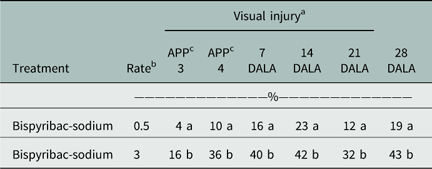
Bispyribac-sodium caused symptoms similar to those previously reported in walnut (Al-Khatib Reference Al-Khatib2015): leaf chlorosis, yellow spotting, stunted growth, and leaf stacking in young shoots. The first visual symptoms became apparent 7d after the initial treatment (data not shown) and peaked approximately 2 weeks after the last simulated drift treatment.
The 3% bispyribac-sodium simulated drift rate caused the greatest visual injury at each assessment. In particular, 7d after the second application and before the third application was conducted, trees treated with 3% bispyribac-sodium were injured 16%. The third treatment increased the severity of the symptoms to 36%. Subsequently, the severity of the symptoms remained nearly constant as visual injury 28 DALA was 43% (Table 1).
Visual injury of walnut trees as affected by four exposures of simulated herbicide drift rates of bispyribac-sodium applied in 2015 and 2016 near Davis, CA. Means are averaged over years.

Abbreviations: APP, application; DALA, day after last application.
a Means followed by same letter within a column are not statistically different according to Tukey’s test (P<0.05).
b Rate expressed as percentage of rice use rate (full rate is 45 g ai ha−1). Each treatment was applied four times at weekly intervals during early summer.
c Evaluation conducted immediately before the third and fourth simulated drift treatments.
Injury from the 0.5% rate did not exceed 5% until after three applications. In general, the response of walnuts to four sequential applications of bispyribac-sodium at 0.5% showed a trend analogous to that caused by the 3% rate: the severity of the symptoms peaked 14 DALA and subsequently remained nearly constant over the duration of the study. Leaf greenness values presented a trend similar to that of the leaf injury at each assessment (data not shown).
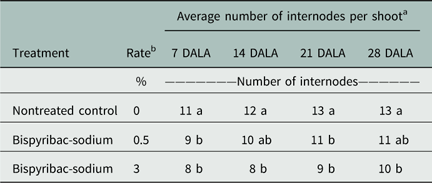
Bispyribac-sodium simulated drift rates generally slowed growth of young actively growing walnut shoots and resulted in leaf stacking. By 7 DALA, the average number of internodes per shoot was lower in trees that received the 0.5% rate than it was in nontreated trees (Table 2). There were no differences between the two bispyribac-sodium rates, although the number of internodes per shoot in trees exposed to the 3% rate was numerically lower than it was in trees exposed to 0.5% bispyribac-sodium. This trend was confirmed 14 and 21 DALA. By 28 DALA, walnut trees exposed to the 0.5% bispyribac-sodium rate had a similar number of internodes per shoot as the nontreated trees, suggesting growth rate recovery even after four simulated drift treatments. On the other hand, trees exposed to the 3% rate had fewer nodes per shoot than did the nontreated trees.
Average number of internodes per walnut shoot as affected by four exposures of simulated herbicide drift rates of bispyribac-sodium applied in 2015 and 2016 near Davis, CA. Means are averaged over years.

Abbreviations: DALA, day after last application
a Means followed by same letter within a column are not statistically different according to Tukey’s test (P<0.05).
b Rate expressed as percentage of rice use rate (full rate is 45 g ai ha−1). Each treatment was applied four times at weekly intervals during early summer.
In this experiment, four simulated drift treatments of bispyribac-sodium reduced or delayed walnut shoot growth. Trees exposed to four applications of 0.5% bispyribac-sodium started recovering approximately 1 month after the final drift simulation treatment, suggesting limited long-term effects on biomass production. Trees exposed to the 3% rate also showed some degree of recovery but still had fewer nodes than nontreated trees at the end of the study.
Walnut Yield
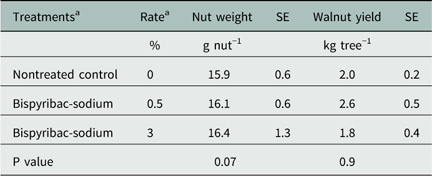
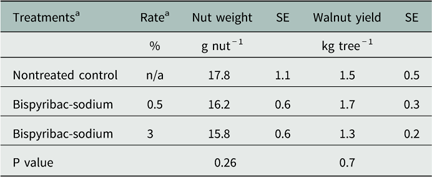
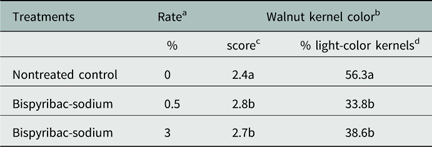
Because of the young age of the trees, gross walnut yield varied greatly between single trees, resulting in high levels of variation and standard errors. No measurable yield reductions were observed in either the year of exposure (Table 3) or the following year (Table 4). In particular, visual symptoms as high as 40%, either the year before harvest (Table 1) or the year of harvest (data not shown), did not result in reduced walnut gross yield. On the other hand, in the year of exposure, kernels from treated trees were generally darker than those harvested from nontreated trees, with respect to both the average color score and the percentage of light kernels (Table 5). No differences in nut kernel color were observed between trees treated with the two simulated drift rates. However, visual symptoms were poorly correlated to average color score (Pearson’s r=0.22, P=0.59) and percentage of light kernels (Pearson’s r=–0.14, P=0.74).
Average nut weight and nut yield per tree as affected by four exposures of simulated drift rates of bispyribac-sodium applied the year of harvest. Treatments were applied in 2016 and 2017 near Davis, CA. Means are averaged over years.

a Rate expressed as percentage of rice use rate (full rate is 45 g ai ha−1). Each treatment was applied four times at weekly intervals during early summer.
Average nut weight and nut yield per tree as affected by four exposures of simulated drift rates of bispyribac-sodium applied one year before harvest. Treatments were applied in 2015 and 2016 near Davis, CA. Means are averaged over years.

a Rate expressed as percentage of rice use rate (full rate is 45 g ai ha−1). Each treatment was applied four times at weekly intervals during early summer.
Walnut kernel color as affected by four exposures to simulated drift rates of bispyribac-sodium applied the year of harvest. Treatments were applied in 2016 and 2017 near Davis, CA. Means are averaged over years.

a Rate expressed as percentage of rice use rate (full rate is 45 g ai ha−1). Each treatment was applied four times at weekly intervals during early summer.
b Means followed by same letter within a column are not statistically different according to Tukey’s test (P<0.05).
c Color score (1 to 4) where 1 is extra-light and 4 is amber.
d Percentage of nuts with extra-light and light kernel color.
Multiple simulated drift events throughout the growing season, while generating visual symptoms, did not appear to negatively affect walnut gross yield in the year of exposure or the following year. Walnuts collected from treated trees, however, were generally darker than nuts from nontreated trees the year of exposure. Walnut color is considered one of the most important quality parameters (Olson and Coates Reference Olson and Coates1985) and growers are awarded a premium for light-colored kernels. Therefore, a negative effect on walnut kernel color can potentially have an impact on Sacramento Valley walnut growers. While 0.5% and 3% of rice use rate are plausible drift rates (Al-Khatib and Peterson Reference Al-Khatib and Peteson1999), this study was designed to simulate a worst-case scenario, considering four consecutive drift events in a short interval of time, an event unlikely to happen in a typical drift situation in a field scenario. Results from related research suggested that, although a positive linear correlation between kernel color and bispyribac-sodium rate was found, the color of nuts harvested from trees exposed to bispyribac-sodium only once during the growing season was not affected (Galla Reference Galla2017).
This study shows that multiple exposure of bispyribac-sodium drift can cause visual injury and slow the growth of young walnut shoots. Although at least three simulated drift exposures were necessary for the 0.5% rate to cause visual symptoms, the effect of the higher 3% rate was clear after only a single simulated drift treatment. Growth of shoots treated with the 0.5% rate was somewhat delayed during the treatment regime but appeared to recover after treatments ended. However, walnut shoots exposed to the high rate had fewer internodes than nontreated trees at the end of the season, 1 month after the last application.
Although bispyribac-sodium simulated drift showed the potential of causing visual symptoms and also reducing or slowing shoot growth, it did not cause measurable reduction in walnut yield or average nut weight in either the year of exposure or in the following season. However, both rates tested negatively affected walnut kernel color, one of the most important quality parameters, in the year of exposure. While the effects of ALS-inhibitor herbicides on tree growth is understood, additional research is needed to confirm and elucidate the mechanisms by which bispyribac-sodium affected walnut kernel color. The level of simulated drift evaluated in this study, with four sequential applications at relatively high drift rates in a short amount of time, should be considered as a worst case scenario. Therefore, although the highest rates tested reduced walnut growth and there were indications of reduced nut quality in this study, walnut exposure to this magnitude of bispyribac-sodium is likely uncommon in field situations.
Acknowledgements
Walnut nursery stock for the test orchards was provided by Emerald Farms and Stuke Nursery. Funding for this research was provided by the Rice Research Board of California.