Introduction
Late-life depression is a leading cause of morbidity and mortality in the older adults (Reifler, Reference Reifler2006; Steffen et al., Reference Steffens2006). Depression is 2–3 times more common than dementia in old age and it remains a largely unrecognized and untreated condition (Anderson, Reference Anderson2001). Late-life depression causes greater disability than diabetes, chronic lungs diseases, hypertension, and back pain (Panzarino, Reference Panzarino1998) The functional disability due to the illness imposes an immense burden on the individual, family, community, and health services (Chen et al., Reference Chen, Wei, Hu, Copeland and Hemingway2005; Gureje et al., Reference Gureje, Kola and Afolabi2007). Additionally low income promotes depression by increasing the burden of medical illnesses secondary to poor healthcare and health related behaviors (Arean and Alexopoulos, Reference Arean and Alexopoulos2007; Arean et al., Reference Arean2010). Prevalence rate of late-life depression in the developed countries of the world ranges from 10–20% (Knauper and Wittchan, Reference Knauper and Wittchan1994; Copeland et al., Reference Copeland1999; Wilson et al., Reference Wilson, Mottram and Sixsmit2006). Reports coming out of low and middle income countries indicate that late-life depression is common, lower in rate compared with Europe and America (Chen et al., Reference Chen, Wei, Hu, Copeland and Hemingway2005). In the sub-Saharan African countries specifically, very few studies on late-life depression had been conducted (Uwakwe, Reference Uwakwe2000; Sokoya and Baiyewu, Reference Sokoya and Baiyewu2003; Baiyewu et al., Reference Baiyewu2007; Gureje et al., Reference Gureje, Kola and Afolabi2007; Peltzer and Phaswana-Mafuya, Reference Peltzer and Phaswana-Mafuya2013), and as such the extent of the problem remains largely understudied. Although some studies in this region included participants from urban and rural areas, only Uwakwe (Reference Uwakwe2000) had specifically reported on a rural population. A large percentage of the elderly in Nigeria live in rural areas; the rural areas are now being depleted of young people because of industrialization and urbanization. These young people who otherwise would have provided support for the elderly are constantly moving to the cities in search of job opportunities. This study attempts to determine the prevalence and correlates of late-life depression in four villages from two culturally diverse areas of Nigeria; the southwest and northwest regions.
Materials and methods
Study area
The study was conducted in four villages in Nigeria, one of the villages, Yakawada, is located in Kaduna state, northwestern part of Nigeria, while the other three Egbeda, Owobale, and Erunmu are located near Ibadan in Oyo state, in the southwest. Based on the Nigerian National Population Commission 2010 population estimate, the population of the village in the northwest was 6,565, while the 3 villages in the southwest were estimated at 9,480. Basic differences in the two regions are that the northwest is close to the Sahara Desert, while the southwest is in the rainforest area. In both regions, subsistence farming is the main occupation, but generally the northwest region has poorer socio-economic indicators especially education and health (National Bureau of Statistics, 2012). In the northwest, Hausa is the commonly spoken local language while it is Yoruba in the southwest. However, English is the language of business in the country.
Population studied
The participants in this study were inhabitants of the two rural areas aged 65 years and older who have been domiciled in the areas for at least 6 months prior to the time of the study. All participants who met the inclusion criteria and agree to participate were recruited.
Age determination
A sizable percentage of the participants did not know their dates of birth. For such, age was determined by use of historical events as previously reported in studies in this area. (Ogunniyi and Osuntokun, Reference Ogunniyi and Osuntokun1993; Hendrie et al., Reference Hendrie1995; Yusuf et al., Reference Yusuf, Baiyewu, Sheikh and Shehu2011). This method of age determination involves drawing a table of popular major historical events both local and international and relating the time of birth to one of them. Such historical events included the World War II, the visit of Queen Elizabeth to Nigeria in 1956, and the Nigerian Independence in 1960. In addition, the age of a participantcould be estimated using documents of others, like baptismal certificate or Army discharge certificate, e.g. the birth of a person close to such events. Also in rural Nigeria, girls get married at about the age of 18 years, so the year of marriage or age of the first child if documented could be used to estimate a woman's age. Usually for each estimate multiple methods above are used and must be convergent. The estimates were found correct within a margin of one to two years in a previous study (Yusuf et al., Reference Yusuf, Baiyewu, Sheikh and Shehu2011).
Questionnaires
The following questionnaires were used for the study:
Modified Mini-Mental State Examination (MMSE)
The MMSE was developed by Folstein et al. (Reference Folstein, Folstein and McHugh1975) is the most widely used instrument for screening cognitive functions in the older adults. The use of the instrument requires some level of training and takes about 10 minutes to administer. However, its major drawback is that, it is affected by educational status of the respondent; and because of this, it has been modified to suit various environments. In Nigeria, the MMSE has been modified by the Indianapolis-Ibadan Dementia project. Normative values have been published for MMSE and other items in the Consortium to Establish a Registry for Alzheimer's Disease (Gureje et al., Reference Gureje1995). That modified version was used in this study.
Geriatric depression scale (GDS-30)
This is a self-administered instrument designed to screen depressive symptoms in the elderly. It consists of 30 questions answered in yes or no pattern (Yesavage et al., Reference Yesavage, Brink and Rose1983). The instrument has been validated in Nigeria and has been used in both primary healthcare setting and in the community (Sokoya and Baiyewu, Reference Sokoya and Baiyewu2003, Baiyewu et al., Reference Baiyewu2007). A κ of 0.645 was recorded between GDS at cut-off point 10/11 and ICD-10 diagnosis of depression (Sokoya and Baiyewu, Reference Sokoya and Baiyewu2003). Although a self-administered questionnaire, because of the high level of illiteracy in the study population, it was administered by trained interviewers.
Geriatric mental state schedule (GMSS)
This instrument was developed to assess psychopathology in the elderly by Copeland et al. (Reference Copeland, Kelleher and Kellet1976). It has been translated into many languages for use in both clinical settings and epidemiological research (Burns et al., Reference Burns, Lowlor and Craig2002). There is a computerized algorithm of proven validity, Automated Geriatric Examination for Computer Assisted Taxonomy (AGECAT) which provides standardized diagnosis (Copeland et al., Reference Copeland, Prince, Wilson, Dewey, Payne and Gurland2002). Administration of this instrument requires some training. The GMSS had been used in Nigeria to assess psychopathology in the elderly (Uwakwe, Reference Uwakwe2000; Sokoya and Baiyewu, Reference Sokoya and Baiyewu2003). A good level of agreement between diagnoses of depression based on ICD-10 criteria and AGECAT had been recorded in the previous studies (Copeland et al., Reference Copeland1999; Sokoya and Baiyewu, Reference Sokoya and Baiyewu2003). A sensitivity of over 90% and an internal consistency of 0.93 had been reported for this instrument (Prince et al., Reference Prince, Beekman, Deeg, Fuhrer and KIvela1999).
Socio-demograhphic data collecting sheet
This was designed to obtain socio-demographic information such as age, education, gender, and perceived health status. Others include social networking which was determined by ability to participate in community activities like, attendance at places of worship, village meetings, marriages, naming ceremonies, funerals, and clan or family meetings. Ability to participate in three or more events in one month was regarded as good social networking.
: “Bereavement” in our study is defined as the loss of a close relative such as a child, grandchild or spouse. “Financial difficulty” in our study was based on self-reported difficulties in having sufficient money for paying bills, or purchasing medication and basic necessities like food. “Poverty” in our study is defined as earning less than one dollar per day. The “perceived health status” in our study was based on self-report. The elderly person was required to rate his or her present health status based on a Likert scale as good, average or poor.
Translation of the questionnaires
The instruments were translated into Hausa and Yoruba languages respectively by bilingual translators including a psychiatrist using the back translation method. A panel of experts consisting of the two translators and two other physicians met at each site to harmonize each of the two versions.
Training on the use of the instruments
All Hausa language versions were administered by A.J.Y. or trained interviewers, while Yoruba versions were administered by A.O. or trained interviewers. Both A.J.Y. and A.O. were previously trained on the use of the instruments by O.B.
Ethical consideration
Ethical approval for the study was obtained from the Institutional Review Boards of the Ahmadu Bello University Teaching Hospital, Zaria, and the University of Ibadan/University College Hospital, Ibadan. An informed consent was obtained from each of the participants. They were made to sign or right thumb print the consent form after the content had been explained to them.
Procedure
The study began with listing and numbering of all the housing units in the villages in each site by A.J.Y. and A.O. assisted by trained research assistants. Thereafter, a house to house census of elderly persons was conducted during which the age of each participant was either recorded or estimated. The study had a two phase design; in the first stage, trained research assistants interviewed eligible participants using the socio-demographic data sheet and MMSE. Only participants who scored 13 or higher on MMSE were administered the GDS.
In all 556 elderly participants were identified from the screening phase, 485 (87.2%) successfully completed the study. Contact could not be established with 8 residents (1.43%). Twelve persons (2.1%) refused to participate and 51 (9.2%) were excluded. Out of those excluded, 4(0.7%) had severe mental illness and could not give informed consent, while 47 participants (8.4%) had severe cognitive impairment as demonstrated by MMSE of 13 or below.
The participants who scored 11 points and above on the GDS and randomly selected 10% of those with scores less than 11 were re-interviewed within a week of the first interview using GMSS by A.J.Y. and A.O. at their respective sites. An ICD-10 diagnosis was made for each of the participants based on the symptoms generated using GMSS. Later AGECAT diagnosis was generated.
Data management
The data obtained from the study was analyzed using the Statistical Package for Social Sciences 15th edition for windows. Descriptive statistics was calculated for all variables. Frequency distribution and cross-tabulation were generated. Tests of association were carried out using χ 2test, and Student t-test. Confidence intervals for prevalence rates were determined. Socio-demographic variables which were found to be significant were further analyzed using multiple logistic regression.
Level of agreement between AGECAT diagnosis and ICD-10 was determined using κ statistics. Statistical significance was set at 5% level of probability.
Result
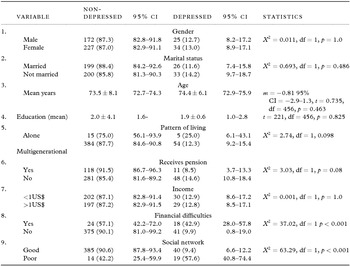
A total of 458 older persons participated in the study consisting of 261(57%) females. Mean age of participants was 73.65 (±7.89) years (95% CI 72.93–74.37). Mean age of the male participants was 73.61(± 7.39) years while that of the females was 73.68(± 8.25) years. There was no significant age difference between the males and females (t = −0.087, df = 456, p = 0.93, 95% CI = 1.51–1.37). The overall mean GDS and MMSE scores were 4.15(±4.80) and 21.73 (±.4.67), respectively. The mean MMSE scores for depressed and non-depressed participants were 19.4±5.6 (CI = 18.02–0.8) and 22.1±4.4 (CI = 21.7–22.5) (t = 4.26, df = 456, p < 0.001). The relationship between socio-demographic characteristics and ICD-10 diagnosis of depression is shown in Table 1. In summary, those depressed reported significantly higher levels of financial difficulties and poorer social network (p < 0.001 in each case), In addition, they had poorer – perceived self-health 50 (84.7%) versus 104 (26.1%) X 2 = 79.3,df = 1, p < 0.001; and had experienced more bereavement in the past year 22(37%) versus 69 (17. 3% X 2 = 12.91 df = 1, p < 0.001. A total of 59 (12.9%, CI = 9.8–16.0%) had depression based on ICD-10 criteria; while a total of 58 (12.7%, CI = 9.7–15.7) participants had depression based on GMSS-AGECAT diagnosis. There was an excellent agreement between diagnosis based on ICD 10 criteria and GMSS-AGECAT (κ = 0.931, p < 0.001).
Relationship between socio-demographic characteristic to prevalence of depression based on ICD-10 criteria

By logistic multiple regression the significant predictors of late-life depression in this cohort are financial difficulties (Odds ratio 4.52 and bereavement Odds ratio 2.70); however social network and perceived health were related to depression in the model, but with much lower odds ratio (Table 2).
Unadjusted summary of multiple logistic regression

Discussion
Participants
The preponderance of female participants in this study is in keeping with the trends reported by community based studies involving the elderly in Africa (Baiyewu et al., Reference Baiyewu2007; Gureje et al., Reference Gureje, Kola and Afolabi2007), however there was no significant gender difference in rate of depression.
Prevalence of late-life depression
There is a variation in the prevalence of late-life depression all over the world, this probably has to do with methodological differences or indeed there may be true regional or racial differences. With respect to studies using the GMSS, in the depression among older people in Europe (EURODEP) studies the prevalence rates of depression ranged from 8% in Iceland to 23% in Munich (Copeland et al., Reference Copeland, Beekman, Braam, Dewey and Delespaul2004). A study of 16 villages in Anhui Province of China gave a standardized prevalence of 6.0% (Chen et al., Reference Chen, Wei, Hu, Copeland and Hemingway2005), while another Chinese study from Hefei city gave a standardized prevalence of 2.2% (Chen et al., Reference Chen, Hu, Qin, Xu and Copeland2004) indicating a higher prevalence in rural China; however in a study in rural Nigeria a prevalence rate of 23.1% was obtained (Uwakwe, Reference Uwakwe2000). Generally, studies measuring depressive symptoms using the GDS and other screening scales in the elderly tend to report higher prevalence rates (Baiyewu et al., Reference Baiyewu2007). By ICD-10 criteria, prevalence rate of depression in the present study is 12.9% (95% CI = 9.8–16.0%). This is at the lower end of rates for the EURODEP studies (Copeland et al., Reference Copeland, Beekman, Braam, Dewey and Delespaul2004), but higher than the two Chinese studies using similar methodology (Chen et al., Reference Chen, Hu, Qin, Xu and Copeland2004; Reference Chen, Wei, Hu, Copeland and Hemingway2005).
Correlates of depression
There was no difference in the prevalence of depression in this study between male and females participants. This is contrary to the finding of most studies (Copeland et al., Reference Copeland1999; Cole and Dandekuri, Reference Cole and Dendukuri2003). However, this result is consistent with the finding of Baiyewu et al. (Reference Baiyewu2007). Our study also found that cognitive functioning as measured by MMSE was poorer in depressed compared to non-depressed participants (p ≤ 0.01). Financial difficulties, poor social network and poor perceived self-health are also significantly related to depression. However, on logistic regression, financial difficulties, and bereavement had high odd ratios. Poor income was not directly related to depression, what is important here is the perception of financial difficulties, both concepts are related, but it is unclear why only financial difficulty is the important variable in this study which indicates that those who expressed financial difficulties were four times more likely to be depressed than those who did not.
Poverty is rife in this population, since by our assessment 50.65% live below poverty line measured by earning less than one dollar a day. This is in agreement with the estimate of Nigeria Bureau of Statistics (2012) which puts poverty rate at between 31% and 84% in the 36 states of the nation. According to that report, poverty levels are highest in the North and lowest in the southwest. Stewart (Reference Stewart2006) had argued that poverty and other social factors are more relevant to depression in the elderly than biological factors.
Financial difficulties or poverty in the elderly had been identified in earlier studies as risk factors for depression (Cole and Dendukuri, Reference Cole and Dendukuri2003; Chen et al., Reference Chen, Wei, Hu, Copeland and Hemingway2005). Information from the US census of 2004 indicated that 10% of people over the age of 65 years live below poverty line and they had higher rates of major depression compared with other community dwelling older adults (Gum et al., Reference Gum, Arean and Bostrom2007).
Poverty, depression and burden of medical illnesses are interrelated as poverty contributes to depression which in turn promotes poor health related behaviors (Arean and Alexopoulos, Reference Arean and Alexopoulos2007). Poor health status increases disability as well as difficulty in accessing both formal and informal care ultimately leading to depression in the older adult.
Poor social network in the older adult can either lead to depression or arise as a result of depressive illness (Cole and Dendukuri, Reference Cole and Dendukuri2003; Chen et al., Reference Chen, Wei, Hu, Copeland and Hemingway2005). In this study poor social networking is likely to lead to depression even though most of the participants live in multigenerational settings and living alone was not significantly associated with depression. Moreover, majority of the people in this study enjoy good support and help whenever the need arose not only from family members but also from other members of the community, but despite all these, poor social network as measured by us was still associated with depression. Bereavement is an undisputable risk factor for depression in the older persons, going by the report of earlier studies (Schoevers et al., Reference Schoevers, Boekman, Deeg, Gerling, Jonker and vanTilberg2000; Sokoya and Baiyewu, Reference Sokoya and Baiyewu2003). Loss of a close relative or an associate constantly reminds the older adult of the inevitable end. It is more distressing if the deceased is a younger family member especially a child. Then the older adult has lost someone who could take care of him/her in old age. There is also a cultural belief which borders on ageism that the older individual should die rather than the younger and occasionally there is the insinuation that the death of the younger person took place because the older adult is a “witch” who had substituted the younger for himself/herself by diabolical means. All the above, make bereavement particularly distressing to the older person; those who were bereaved in the past year were more likely to be three times more depressed than those not bereaved.
The prevalence of late-life depression among community dwelling older adults in Nigeria was higher compared with some previous studies from other developing countries. The interactions between social network, poverty, and physical health factors are probably responsible for the high prevalence of depression being witnessed in the developing countries of the world. There are unmet needs for diagnosis and treatment of depression in Nigeria, and very few of those with the illness had ever been seen by a health practitioner on account of their illness. In addition health seeking behavior may impact on treatment because of some cultural factors. In a study on knowledge and perception of stroke amongst hospital workers in Nigeria, Akinyemi et al. (Reference Akinyemi2009) reported that 14% of their cohort attributed the cause of stroke to witchcraft and evil spirit and would rather seek spiritual help. The import of this is that hospital workers are expected to be opinion leaders on health matters in the society. Diagnosis and adequate treatment of depression is a phenomenon that presents difficulty not only in developing countries but in the technologically developed ones as well as observed by Reifler (Reference Reifler2006). This is an issue which hopefully will be addressed by the new emphasis on treatment at primary healthcare facilities through the implementation of the Mental Health Gap Action Program(mhGAP) being advocated by the World Health Organization (Abdulmalik et al., Reference Abdulmalik, Kola, Fadahunsi, Adebayo, Musa and Gureje2013).
Limitations
One limitation of this study is that it is a cross-sectional descriptive study and we can only deduce associations not causality. In the elderly, depression, and cognitive impairment exists side by side. Participants in this study had to recall events from memory and for those with cognitive impairment that could be problematic. To reduce the impact of that, we had screened out those likely to have disabling cognitive impairment at the beginning of the study. An important strength of the study is that it was conducted in two locations in the country with substantial cultural and regional differences and assessment was by standard protocol.
Conflict of interest
None.
Description of authors’ roles
O.B.: Conceptualized and participated in study design, data analysis and writing of the paper.
A.J.Y.: Conceptualized and participated in the study design, data collection, analysis, and writing of the paper.
A.O.: Conceptualized and participated in the study design, data collection, analysis, and writing of the paper.
Acknowledgments
We are grateful to the members of the Ibadan-Indianapolis Dementia Research Project, Ibadan site for their support.