§1. WHY WE NEED TEXTUAL CRITICISM—AND THE SUBLITERAL ASTERISK
In his magisterial work Persephone,Footnote 1 Zuntz drew a basic distinction between two sets of OrphicFootnote 2 gold leaves—those known from the elaborate tumuli at Thurii, which he called Group A, and a more widely scattered series, Group B, then represented by two longer texts from Petelia in southern Italy and Pharsalus in Thessaly, and, in a shortened form, by a series of six (now seven)Footnote 3 short texts from the environs of Eleutherna in Crete (his Group C). Three further finds have reinforced Zuntz's distinctions: first, a tablet from Hipponium, the colony of Epizephyrian Locri in southern Italy, published by Foti and Pugliese Carratelli,Footnote 4 then a lamella said to be from Thessaly but now in Malibu and published by Breslin,Footnote 5 and finally a tablet said to be from Entella in Sicily and recently in Geneva, which was published in a bad transcription by FrelFootnote 6 and much clarified by Riedweg.Footnote 7 The first and third belong to Zuntz's Group B, while the second is close to his Group C. Pugliese Carratelli has published an exceptionally fine set of photographs of all the texts except those from Petelia and Entella.Footnote 8 My restudy of the leaf from Petelia has led to some improved readings.Footnote 9 Not even a drawing exists of the Entellan leaf, which no scholar except its first editor has ever seen. This fact prompted a reviewer of this article to wonder about its authenticity. In the absence of the object itself, such doubts can only be allayed if its text consistently contributes to improving our understanding of the archetype from which it is derived. One of the aims of this article is to show that it does indeed do so.
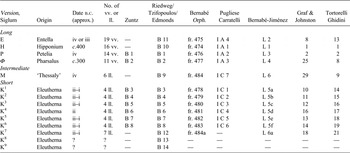
We now have many editions of all the relevant materials, including a highly scholarly and dependable set of texts by Bernabé, an equally splendid but more accessible monograph by Bernabé and Jiménez San Cristóbal,Footnote 10 since translated into English with many changes,Footnote 11 and a revised edition in French of the Italian edition of Pugliese Carratelli,Footnote 12 not to mention the careful rereading of the Hipponium text by SaccoFootnote 13 or the popularizing editions and translations by Tortorelli Ghidini,Footnote 14 Graf and Iles Johnston (now in two editions),Footnote 15 and Edmonds,Footnote 16 as well as a monograph by Tzifopoulos devoted to the Cretan finds.Footnote 17 The texts with which we are concerned are listed in Table 1. These editions present each of the gold leaves separately, as is appropriate to their purpose. Unfortunately, however, the extraordinary proliferation of texts, numbering-systems and editorial conventions has made matters far more confusing than they need be, in a truly Orphic ὅμαδοϲ βίβλων.
Concordance of editions of the ‘Orphic’ gold leaves.

Above all, these editions are all ‘multitexts’ which reproduce, with variable degrees of accuracy, each version of what are essentially the same archetypes or hyparchetypes; we will see below that we need to advance beyond the notion of a fluid ‘multitext’, in which every minor variant or indeed error of transmission is important, if we are to establish what the author of the underlying text meant to say. But four subsidiary causes, which I will discuss first, augment the confusion:
-
(i) The inscriptions use different epichoric alphabets and divergent orthographic conventions; some editors retain ε̄ for η, ō for ου or ω and h for the spiritus asper, whereas most normalize.
-
(ii) Editors report interpretations of spelling conventions, for example πιεῖν μοι for πιεῖμ μοι, as if these are variant readings, or silently normalize such sandhi phenomena.
-
(iii) Some editors pile up lists of which scholars support particular readings or supplements without stating who first originated them; the muddle is then passed on to subsequent editions, some of which are full of errors in the attribution of conjectures.
-
(iv) Editors' conventions diverge in various ways from the standard Leiden convention, which was established precisely in order to forestall this kind of chaos. Some, claiming that such conventions are too intimidating for modern readers, have even abandoned the use of letters with subliteral dots, for example α̣, to indicate a letter that can be read as another,Footnote 18 but print such letters undotted as if they are securely read. There is a major problem with letters that have been deliberately altered by an editor, as often happens in these very corrupt texts. To indicate such cases, some editors employ dotted letters, which is highly inappropriate, while others use letters between angle-brackets, for example ⟨α⟩, which should denote a letter supplied by an editor where there is nothing in the original.Footnote 19 Others again employ underlining, for example α, which is normally used to indicate which parts of an inscription are preserved only in a potentially unreliable apograph. Still others print altered letters with no warning at all, unless perhaps in the apparatus criticus. If such a warning is given, this practice conforms to the Leiden convention, and is indeed standard practice. However, it too is deficient, since the reader deserves to be alerted by some sign within the word itself that what is printed has been altered relative to its source. Some such signal is especially important in very garbled texts when, as in this case or in that of the Herculaneum papyri, the apparatus criticus necessarily becomes very large.
The variety of solutions to the problem of altered letters at least proves that some convention for indicating altered letters is indispensable in editing such texts. Here the subliteral asterisk, for example α͙, will be used for this purpose; this is to adapt a convention that was introduced by Reinhold Merkelbach for editing texts such as the Herculaneum papyri, where it warns the reader that an editor has corrected the reading of a potentially inaccurate drawing in a passage where the papyrus itself is now lacunose. The subliteral asterisk is aptly used to signal alterations to Frel's apograph of the tablet from Entella, which can be proved to be highly inaccurate. But it needs to be extended to ancient exemplars too, where editors deliberately change, or, as one hopes, correct the paradosis. This important innovation has already been introduced in Bernabé's edition, but he provided no explicit justification for it.Footnote 20
The paramount problem, however, is that none of the recent editions has investigated the essence of these texts, i.e. their archetype and hyparchetypes. This failure is owed to their authors' refusal, unconscious or conscious, to go beyond multitexts. Even such early editors as Zuntz,Footnote 21 MarcovichFootnote 22 and Pugliese CarratelliFootnote 23 explicitly rejected any attempt to reconstruct an archetype. In his new edition the latter has repeated his view that the texts are too different from each other to justify any attempt to reconstruct one:
… les variations que l'on relève … remontent, mais pas directement, à un archétype unique; celui-ci a vraisemblablement été rédigé (comme le suggère la présence des formes ioniennes) en grec ionien d'Asie. A ce propos, il ne faut pas négliger le témoignage de Ion de Chios (DK 36 B 2) selon lequel certains des Ὀρφικά auraient été composés par Pythagore et attribués par lui à Orphée. Chercher à reconstituer le texte original paraît, cependant, étant donné les divergences de leçons et la diversité des modes possibles de transmission, une entreprise d'efficacité douteuse; il convient donc de tenir séparés les cinq textes, tout en ayant conscience de leur origine commune.Footnote 24
Similarly Bernabé, while accepting that the intermediate and short versions are based on the long ones, believes that the latter reflect a much freer state of affairs than do the shorter texts, which is presumably why he does not reconstruct an archetype for them:
En nuestra opinión las laminillas cretenses y la tesalia del museo de Malibu son el resultado de plasmar en un modelo más esquemático y formalizado la antigua libertad de las laminillas más largas.Footnote 25
However, if we wish to understand these texts, the reconstruction of an archetype is a heuristic procedure that is both legitimate and essential; nor is it hard to apply philological and linguistic methods to the task. The homogeneity of the verses, in both their wording and their sequence, precludes coincidence, especially now that we have four different witnesses to the long text. We shall see that the resulting archetype is not merely a random collection of verses that were gathered together at different times and places; rather, Richard Bentley's ratio et res ipsa will make clear which, among what may initially seem a bewildering set of variants, actually offers the superior and in fact the original reading.
The notion of a ‘multitext’ has value in editing texts that are orally derived. However, once a text has been written down and thereby transmitted in writing, it ineluctably becomes subject to the principles of textual criticism that scholars have developed from long experience.Footnote 26 The study of ‘multitexts’ is no substitute for these principles; indeed, textual criticism was developed in order to spare ourselves from having to read through ‘multitexts’, which may, in a case like Homer's Iliad, amount to thousands of verses in thousands of sources. Homeric studies have for years been bedevilled by some scholars' rejection of the idea of an authoritative archetype, even for this oral dictated text, in favour of a multitextual chimera.Footnote 27
Here, too, it has impeded progress. The texts on the gold leaves were certainly subject to oral transmission, since, being a secret that was transmitted during rites of initiation, they were meant to be memorized and put back into writing from memory; this is the direct implication of the preamble (verses 1–3) that will be reconstructed in §2. The initiates would not willingly have written them down except for the ritual purpose of providing the dead with instructions about what to do in Hades, in order to attain the blessed status of hero that they had been promised. However, these texts certainly were written down as well, just as we all have to write down the endlessly proliferating digital passwords that we are supposed to memorize. The diminutive lamellae are an eloquent testimony to the difficulty of writing accurately on tiny surfaces of very expensive material. This article aims to show that the principles of textual criticism can and indeed must be applied to these texts too.
It is surprising, if not, frankly, astonishing, that this argument needs to be made, since it seems obvious and has been made before. Zuntz's claim that the longer texts were elaborations of the very short texts from Crete was rebutted long ago; his theory was a priori implausible, given their wording and the fact that the Cretan texts are later than the others.Footnote 28 Meanwhile, Lloyd-JonesFootnote 29 and WestFootnote 30 argued that an archetype for the longer texts could be reconstructed. Also, it was already suggested that many divergences among the texts depend upon memorized transmission by initiates who were not allowed to divulge the texts.Footnote 31 Given the new text from Entella and the advances in deciphering these tiny and hardly legible texts, it is high time to re-examine this question. In fact, with the progress in reading these texts and the increase in their number, their archetype can now rest on a much firmer basis.
In reconstructing an archetype, some preliminary questions must always be answered. Is an archetype really necessary? In this instance it is, because the extent of the agreement between the sources precludes coincidence. Indeed, in this case positing an archetype is invaluable as a heuristic device for determining the best reading;Footnote 32 but the evident hermeneutic value of this procedure also implies that an archetype did once exist. What form did it take? By definition it had a fixed form, but it does not necessarily follow from this that the archetype was in writing. Such a short piece could conceivably have been composed and memorized in the mind of its author, and taught by him orally to his disciples and successors. However, whatever form it took, the text was fixed, and once it was fixed it became subject to the principles of textual criticism as well as to the divagations of memorized transmission. Scholars have disagreed as to how corrupt the copies are. Many do not hesitate to posit corruption to account for irregular scansion or impossible semantics, but others will alter nothing. They may well be right to do so, when the copies are in question; but in reconstructing the archetype we will assume that it made sense and was in the best possible Greek. Examining the copies will confirm these assumptions, in a familiar hermeneutic circle.
Was the original in hexameters? Although Gallavotti denied this, suggesting that H is in a strange variety of metres,Footnote 33 the unanimity of the versions of the long text confirms it. If so, was it composed in the Doric which appears in the Hipponium text, or in Homeric dialect? Apart from H, all the long texts are in Homeric diction; this is powerfully confirmed by the new text said to be from Entella, itself in Dorian Sicily. Even H, despite its Doric veneer, contains many Ionic forms. We should not assume that it was in an arbitrarily mixed dialect when other witnesses oppose such an assumption. Such was the position of Gallavotti, who deemed it a deliberate mixture of Doric and Attic;Footnote 34 but all his alleged Atticisms have disappeared with our progress in reading the text. West was right to assume that any archetype should have been in Homeric diction.Footnote 35
The new text from Entella is decisive for these questions. Even though half of each line is lost, and for the rest we depend on an unreliable transcription, Riedweg was able to use the evidence of the other long texts to restore most of the verses, and even to confirm Ebert's conjecture Ἄϊδοϲ ϲκότοϲ ὀρφνήεντοϲ in the text from Hipponium.Footnote 36 The lamella from Entella was, so far as we know, entirely in Homeric dialect, and its verses are undoubtedly hexametric. Unfortunately it is hard to establish, without a photograph or even a drawing, how many letters are lost at the start of each line, but one must at least impose on oneself the discipline of making approximately consistent restorations, since these texts were usually folded vertically and then tended to break along those folds. Doing so will lead to useful results, as will shortly appear.
As is at once evident from the fourth column of Table 1, we are dealing with texts of very different length. The Thessalian and especially the Cretan versions are much shorter; they are no longer in proper hexameters, and in fact it is hard to say exactly into how many lines these texts are meant to be divided. However, the shorter versions will not be my topic here.Footnote 37 The long texts vary in different ways:
-
(i) The version from Hipponium (H), which has attracted much attention because of its greater length and antiquity (c.400 b.c.), will not turn out to be the most accurate version, even though it seems to be the oldest copy. First, it has modified the originally Ionic diction of the epic archetype in favour of an inconsistently applied Doric; secondly, it has often corrupted the sense of the archetype, and even includes nonsense in places, like εὐε̄ρέαϲ instead of εὑρήϲειϲ.
-
(ii) Although more than half of the version from Entella (E) is broken away, it seems to have been very accurate indeed. So similar is it to the archetype I first attempted to reconstruct in 1984 that an anonymous reviewer of this article even suggested that it might be a forgery based on that reconstruction. However, as we have seen, Riedweg used E to confirm Ebert's conjecture in H, which I had not adopted; this surely proves its authenticity. Its transcriber, Frel, made too many elementary errors to have been capable of divining such a difficult reading. Its dating is quite possibly incorrect; it could well be earlier than the third century b.c., or else be based on a very early copy. Until we see it, there is no way to be sure.
-
(iii) The version from Petelia (P) is accurate, but is rather abridged and has put the initial three-line preamble at the end, as if adding it only when it was clear that there was enough room. The fact that it uses the four-bar sigma Σ alongside epigraphic Ω suggests a date within the fourth century b.c.
-
(iv) The version from Pharsalus (Φ) is the most divergent; it has recomposed one and a half verses, omits the three-line preamble entirely and lapses into prose at the end. Its use of lunate sigmas (but of Σ for a double sigma!) alongside epigraphic Ε and a form transitioning away from epigraphic Ω to Ω in πρόϲϲω dates it to c.300 b.c. The degree to which the text from Pharsalus differs from the rest can be explained by the fact that, unlike the other three texts, it is from Thessaly rather than from Sicily or Magna Graecia.
-
(v) The text in Malibu (M) is the ‘missing link’ between the long texts and the short ones. It is allegedly from the same region, but its script, so similar to that of the Derveni papyrus, belongs to the fourth century b.c. Like the short versions from Crete (K1–7), it has largely corrupted or abandoned the excellent hexameters in which the archetype was composed.
§2. ON RECONSTRUCTING THE ARCHETYPE
In the discussion that follows, the text of each apograph of the long version (followed by derivative verses in the shorter hyparchetypes) is given in the order of the verses in the archetype, so that the different versions of each line can readily be compared. In the separate texts, verse-numbers and not line-numbers are used, since parts of two verses sometimes appear in the same line. There follows in each case a discussion of the variants; a reconstruction of the whole archetype is given in §3.Footnote 38 For the different sources for the text, and the sigla for them, see Table 1. The following conventions are used (for the use of the subliteral asterisk see above, §1):
α̣ a doubtful letter that can be read as another
`α΄ a letter added by the scribe above the line
⟦α⟧ a letter deleted by the scribe
(α) a letter written by the scribe in a full spelling, i.e. an elided vowel
[α] a letter supplied by an editor in a gap
⌊α⌋ a letter supplied from a parallel source by an editor in a gap
{α} a letter deleted by an editor
⟨α⟩ a letter inserted by an editor
α͙ a letter altered by an editor
The beginning of the text presents the most severe problems for the reconstruction of the archetype. These verses are numbered 1–3, since their location in H and E suggests that they originally formed a preamble to the rest of the text, which could be included if space permitted but sometimes seemed dispensable, as in Φ, or was transposed to the end, as in P. We shall see that this conclusion is confirmed by their content, once it has been reconstructed.
1 Μναμοϲύναϲ τόδε ἔργ͙ον· ἐπεὶ ἂμ μέλλε̄ιϲι θανε̄͂ϲθαι {ι̣} (H 1)
⌊Μνημοϲύ⌋νηϲ τόδ⟨ε⟩ ἔρ̣⌊γον· ἐπεὶ ἂν μέλληιϲι⌋ θανεῖϲ̣θα⌊ι⌋ (P 12)
⌊Μνημοϲύνηϲ τόδε ἔργον· ἐπεὶ ἂν μέλ⌋λ͙η͙ιϲ͙ι{ν} θαν{ι}ε̄̃ϲθαι (E 1)
Riedweg proposed Μνημοϲύνηϲ τόδε in E. Following him, Bernabé suggested Doric Μναμοϲύναϲ τόδε, as in H; however, nothing else is Doric in E. Αn anonymous author supplied ⌊Μνημοϲύ⌋νηϲ in P.Footnote 39 The corrupt word in H is clearly legible in the photographs as ΕΡΙΟΝ. In P only the upright of ρ̣ survives before the break (with no trace of the loop of ρ or of the horizontals of a second ε). However, more was read in the past; a tiny piece of gold must have fallen off at the edge, perhaps when the object was encased in the perspex block inside which it is now conserved. It has been felt that we need a word for the object itself (‘leaf’, ‘tablet’) or for the verses that are engraved upon it (‘charm’, ‘incantation’, ‘song’, ‘oracle’, ‘inscription’, ‘secret’). But no such word exists.Footnote 40 The late leaf from Rome, which is related to our series only in its opening phrase, has Μνημοϲύνηϲ τόδε δῶρον ἀοίδιμον ἀνθρώποιϲι.Footnote 41 But it is hard to see how such a straightforward word could have been corrupted or misremembered; δῶρον has replaced something else, and this fact indicates at least that the word was difficult and subject to replacement. Palaeographically the most plausible restoration is ἔργον, which in H involves adding only a horizontal stroke; the word seemed difficult in the sense that, once the digamma was forgotten, it appeared to be preceded by an illegitimate hiatus. This solution was suggested by Burkert,Footnote 42 followed by GilFootnote 43 and Ebert,Footnote 44 and Guarducci subsequently made the same proposal in P.Footnote 45 We must accept ἔργον, and translate it ‘task’. The same phrase occurs at the verse-end six times in Homer; compare τόδε ϝέργον at the verse-end in CEG 1.380,5.
The restoration of E implies that this lamella has lost 30.5 letter-widths at the left, which is far more than in subsequent lines, where c.21 letters are lost; since no image of E has been published, we cannot state that this width is incorrect. ἐπεὶ ἂν was restored there by Bernabé after Riedweg and Frel's ἐπεὶ ἂμ. In H ἐπεὶ ἄν is not contracted to ἐπήν, as West and Marcovich proposed that it should be. Contracted ἐπήν is almost universal in the manuscripts of Homer but can often be resolved into ἐπεὶ ἄν, which is attested at Il. 6.412 (ἔϲται θαλπωρή, ἐπεὶ ἂν ϲύ γε πότμον ἐπίϲπηιϲ). P and E are lacunose, and Merkelbach restored ἐπεὶ ἂν μέλληιϲι in P.
Riedweg restored μέλ⌋λ͙η̣ι͙ϲ͙ι{ν} in E from Frel's transcript μελ]ηνίοιν [sic]. The metre indicates that we should accept θανεῖϲθαι from P, even though, as Gallavotti observed,Footnote 46 H may have θανεϲθαν̣ (pace Pugliese Carratelli), either by a dittography of the first θαν or because the gold leaf has been reused and traces of the palimpsest remain.Footnote 47 Frel reported that E has θανιε̃ϲθαι [sic], which Pleket interpreted as a mere misprint for θανεῖϲθαι; P reads θανειϲθα[ with the final α.Footnote 48 θανεῖϲθαι is a post-Homeric form; Homer always has (ὀιόμενοϲ) θανέεϲθαι (3×). For the verb in the same locus, compare μέλλουϲιν ὀπάζειν at Od. 18.19.
2 - - - ] τόδε γραψ[ - - - (P 13)
- - - μ]εμνημέ⟨ν⟩οϲ ἥρωϲ (E 2)
The first part of verse 2 is known only from P (where I saw the Τ, though it is small, and Smith also read it in his drawing of 1882),Footnote 49 and its end is only in E. West had proposed exempli gratia [ἐν πίνακι χρυϲέωι] τόδε γραψ[άτω ἠδὲ φορείτω],Footnote 50 but the line-ending in E disproves γραψάτω. Hence we need a different trisyllabic form of the verb: I suggest [ - - - ] τόδε γραψ[άϲθω μ]εμνημέ⟨ν⟩οϲ ἥρωϲ.Footnote 51 The complete verse might run [ἀτρεκέωϲ] τόδε γραψ[άϲθω μ]εμνημέ⟨ν⟩οϲ ἥρωϲ, ‘let the hero get this written down accurately from memory’, or, with Guarducci's suggestion for the start of the line,Footnote 52 [ἐν χρυϲίωι] τόδε γρα[ψάϲθω μ]εμνημέ⟨ν⟩οϲ ἥρωϲ ‘let the hero get this written down on a gold leaf from memory’. Both restorations demand a main caesura in the fourth foot, which is not a problem, and both imply the loss of c.21 letter-widths at the left in E. The almost adverbial use of μεμνημένοϲ to mean ‘mindful’ appears in Hesiod at Op. 728. ἥρωϲ is often placed at the end of the hexameter.
3 - - - ]ΠΟ̣ΓΛΩΣΥ̣ΠΑ[.]Ω̣ ϲκότοϲ ἀμφικαλύ̣ψαϲ (P 14)
- - - ] ϲκότοϲ ἀμφικαλύψαι (E 3)
Verse 3 must somewhere have contained a conjunction indicating that the inscription must be made ‘before’ the darkness of death surrounds the hero, presumably annihilating him if he does not follow its instructions. P's readings in the first part of the verse, which is written in the right margin, have remained totally obscure. Pugliese Carratelli prints ]Τ̣Ο̣Γ̣Λ̣Ω̣Σ̣Ε̣Ι̣Π̣Α̣. However, since 1882 the leaf has lost a tiny sliver of gold from the right edge; according to Smith's drawing,Footnote 53 this bore the letters μοι from the main part of line 6 overwritten with the letters Ω̣Σ̣ΣΚΟΤ from line 14, which is engraved sideways over the end of line 6. Smith's drawing supports ]Κ̣ΟΓΛΩΣΣ̣Ι̣ΠΑ Ω̣, and on the original I read ]ΠΟ̣ΓΛΩΣΥΠΑ[; Smith's final ]Ω̣ has disappeared with the damage to the right edge. This suggests that the first half of the verse contained the good epic adverb ἐκπάγλωϲ ‘terribly’, which is common enough in this locus in Homer; no other Greek word ends in -γλωϲ, and the only other place where this series of letters occurs is in the word γλῶϲϲα, which will not fit here. A verb ought to follow, for example [μὴ τόν γ’ ἐκ]πά͙γλωϲ ὑπά[γ]ο̣[ι].Footnote 54 If this was also the reading in E, it implies the loss of 22 letter-widths, which is comparable to the loss of 21.5 in verse 4. Unfortunately, given that Frel transcribed ἀμφικαλύψαι at the verse-end in E, it is not certain that we should accept Riedweg's emendation ἀμφικαλύψαϲ͙,Footnote 55 since πρὶν could have preceded or E could have read ἀμφικαλύψαν͙, but Frel's transcript is profoundly unreliable. The verse-ending is a modification of τὸν δὲ ϲκότοϲ ὄϲϲε κάλυψεν (12× Il.).
Hence the preamble should be reconstructed as follows:
1 Μνημοϲύνηϲ τόδε ἔργ̣ον· ἐπεὶ ἂν μέλληιϲι θανεῖϲθαι,
[ἐν χρυϲίωι] τόδε γραψ[άϲθω μ]εμνημέ⟨ν⟩οϲ ἥρωϲ,
3 [μὴ τόν γ’ ἐκ]πά͙γλωϲ ὑ̣πά[γ]ο̣[ι] ϲκότοϲ ἀμφικαλύψαϲ.
These verses are clearly instructions to the initiates on what they must do to prepare to overcome death, explaining how to deploy the mystery-text which the practitioners of the cult had taught them. These instructions have been postponed in P, as being less important than the directions in Hades, and are omitted entirely in Φ and the short texts. An anonymous reviewer suggests that they could have been composed separately from the main text and added later. However, this is not a necessary hypothesis and therefore contravenes Occam's razor. In addition, the fact that the initiate is called a hero shows that this preamble is fully in accord with the theology of the main text, where the promise is made that he will rule among ‘the other heroes’ (verse 20). We may contrast Zuntz's A series, where the deceased becomes a θεόϲ, which sounds like a much higher status. The phrase [μ]εμνημέ⟨ν⟩οϲ ἥρωϲ supports the view that the text was meant to be transmitted by being memorized by the initiate.Footnote 56
The rest of the text is much less problematic. The readings of E confirm most of the archetype as it was first reconstructed.Footnote 57 The new evidence further supports the theory that the variations are owed to transmission via both memorization and miscopying, together with the reconstruction of an intermediate hyparchetype from which M is taken and on which the further hyparchetype of the short Cretan version is based. A detailed analysis of the diction in terms of formulaic composition will make all this clear.
4 εἶϲ Ἀίδαο δόμōϲ εὐε̄ρέαϲ· ἔϲτ’ ἐπὶ δ⟨ε⟩ξιὰ κρε̄́να {τν} (H 2)
εὑρήϲ{ϲ}ειϲ δ’ Ἀίδαο δόμων ἐπ’ ἀριϲτερὰ κρήνην (P 1)
εὑρήϲ{ϲ}ειϲ Ἀίδαο δόμοιϲ ἐνδέξια κρήνην (Φ 1)
⌊εὑρήϲειϲ Ἀίδαο δόμων ἐπὶ⌋ δεξιὰ λίμνην (E 4)
κράναϲ αἰειρόω ἐπὶ δεξιά (K1, K2, M 2)
κράναϲ αἰε͙ιρ͙όω ἐπὶ δεξιά (K4)
κράνα⟨ϲ α⟩ἰε͙ιρ⟨ό⟩ω ἐπ⟨ὶ⟩ δεξιά (K5)
κρ̣άναϲ αἰ̣⟨ε⟩ι̣ρ⟨ό⟩ου ἐπ’ {α} ἀρι⟨ϲ⟩τερὰ (K7)
κ͙ράναϲ α͙ἰενάω ἐπὶ δε⌊ξ⌋ιά (K3)
`κ΄ράναϲ αἰενάω ἐπὶ δ⟨ε⟩ξιά (K6)
E was restored by Riedweg, save that Frel already suggested ἐπὶ (c.21.5 letter-widths would be lost); Bernabé proposed δόμοιϲ instead. P has δ’ in the first line of the text when nothing has preceded, whereas Φ and H have an asyndeton, even though H has part of the preamble; this confirms that P has suppressed the preamble, but the asyndeton is surely superior.Footnote 58 Unfortunately, for lack of any photograph or drawing, the exact number of letters lost in E cannot be verified, since this would clarify whether the asyndeton is original here.
The only form of the future of εὑρίϲκω in the early epos, εὑρήϲω at Hymn. Hom. Merc. 302, appears in the same locus here. As WestFootnote 59 and Lloyd-JonesFootnote 60 saw, H has garbled εὑρήϲειϲ at the beginning of the verse, adapting the familiar epic formula εἰϲ Ἀίδαο δόμουϲ (4× Od., always at the start of the verse), and adding the epithet εὐήρεαϲ.Footnote 61 This epithet, a compound of εὖ and ἀραρίϲκω meaning ‘well-fitted, suitable’, is completely inept: in Homer it is applied only to oars, in the formulae εὐῆρεϲ ἐρετμόν and εὐήρε’ ἐρετμά (6× Od.),Footnote 62 while it is used to mean ‘appropriate’ in Hippocrates and Nicander. Perhaps the composer of H was influenced by formulae like δόμουϲ εὖ ναιετάονταϲ. The recomposition has entailed an asyndeton after ἔϲτ’ and the change of the spring from accusative to nominative; this is shown to be an innovation by the fact that it made the next verse unmetrical, as we shall see.
It has not been noted that Φ replicates P's error εὑρήϲ{ϲ}ειϲ, since, as Bernabé saw,Footnote 63 Φ reads ΕΥΡΗΣΕΙϹ with a four-bar rather than a lunate sigma in this position; as in the Cretan lamellae (see below on verse 5), Σ is being used for geminate -ϲϲ-. The only other place in Φ where this form of sigma is used is in ΤΗΣ in Φ 10, where it again indicates gemination (see below on verse 15).
The phrase Ἀίδαο δόμοιϲ occurs in this locus at Od. 24.204; otherwise, it appears as Ἀίδαο δόμοιϲιν at the verse-end (4× Il., 4× Od.). Ἀίδαο δόμων is therefore a formulaic modification by declension,Footnote 64 but is not clearly inferior in sense to the dative-locative; rather, the dative would have replaced the genitive after the introduction of ἐνδέξια.Footnote 65 As in εἰϲ Ἀίδεω ἰέναι δόμον εὐρώεντα (Od. 10.512), the accusative δόμουϲ in H ensued from the initial εἰϲ. E has wrongly replaced the ‘spring’ with a ‘pool’, but its text does support the view that the first water-source is on the right rather than on the left, where all the other sources except P and K7 locate it. In Φ ἐνδέξια means ‘rightwards’ and is therefore an error; the short texts M and K1–6 confirm ἐπὶ δεξιὰ. We may assume that E, which was evidently a carefully written text in general, is correct. Accordingly, the archetype should have been εὑρήϲειϲ δ’ Ἀίδαο δόμων ἐπὶ δεξιὰ κρήνην. The unintelligible letters at the end of this verse and the next in H are the remnants of a previous inscription on the lamella, which must have been flattened and reused. Lastly, instead of αἰειρόω, which is shown to be earlier by its presence in M, a later hyparchetype of some of the Cretan lamellae had αἰενάω; however, ΑΙΓΙΔΔΩ in K4 is a mangled version of the former, with Γ for Ε and ΡΟ miscopied as ΔΔ.Footnote 66 On the other hand, K7, read by TzifopoulosFootnote 67 as ⟨Ϲ⟩αύρου after the name of a local spring, has V rather than the normal Υ as its second letter, and so should probably be read αἰ̣⟨ε⟩ι̣ρ⟨ό⟩ου; hence it is a version of the older text αἰειρόω.
5 πὰρ δ’ αὐτὰν ἑϲτακυ⟨ῖ⟩α λευκὰ κυπάριϲ⟨ϲ⟩οϲ {αο} (H 3)
πὰρ δ’ αὐτῆι λευκὴν ἑϲτηκυῖαν κυπάριϲϲον (P 2)
πὰρ δ’ αὐτῆι λευκὴν ἑϲτηκυῖαν κυπάριϲϲον (Φ 2)
⌊πὰρ δ’ αὐτῆι λευκὴν ἑϲτη⌋κυ⟨ῖ⟩αν͙ κυπάριϲϲον (E 5)
λευκὴ κυπάριϲϲοϲ (M 3)
τε̄ κυπά͙ριϲϲοϲ (K4)
τῆ κυφάριϲϲοϲ (K1–2, K5–6)
τῆ κυφάρι{ϲ}ϲϲοϲ (K3)
τᾶϲ κυφ̣α{ϲ}ρίϲϲω (K7)
In verse 5 H is garbled again, by both putting the cypress into the nominative case to the detriment of the metre, and transposing the final nu to πὰρ δ’ αὐτὰν, where a dative is essential to the sense. The other three sources consistently support πὰρ δ’ αὐτῆι λευκὴν ἑϲτηκυῖαν κυπάριϲϲον. E is restored by Riedweg, with 18.5 letter-widths lost;Footnote 68 Frel read ἑϲτη]κῦαι. The Cretan sources (K1–K7) write ΚΥΦΑΡΙΣΟϹ or ΚΥΦΑΡΙΖΟϹ and ΕΣΙ or ΕΖΙ in line 10b, but these are merely the local spellings of κυπάριϲϲοϲ and ἐϲϲί. For these texts distinguish sigma, written as Ϲ, from zeta, written with its early form ɪ in K4, as Ζ in K5–7, and as Σ in the remaining apographs, and they consistently use the latter form in place of -ϲϲ-, just as the Pharsalian lamella does.Footnote 69 Hence I transcribe Ζ and Σ as ϲϲ in these texts.
6 ἔνθα κατερχόμεναι ψ⟦χκ⟧`υχ΄αὶ νεκύōν ψύχονται (H 4)
⌊ἔνθα κατερχόμεναι ψυ⌋χ̣αὶ νεκύων ψύχονται (E 6)
E is restored by Frel (18.5 letter-widths would be lost). There is no disagreement over the archetype of verse 6. Its closest formulaic parallel is Od. 10.529–30, ἔνθα δὲ πολλαὶ | ψυχαὶ ἐλεύϲονται νεκύων κατατεθνειώτων,Footnote 70 together with ψυχαὶ νεκύων κατατεθνειώτων at Od. 11.541; the same formula is found separated at Od. 11.37, ψυχαὶ ὑπὲξ ἐρέβευϲ νεκύων κατατεθνειώτων. The verb κατέρχομαι appears at the verse-end in the formula ψυχὴ δ’ Ἀίδοϲδε κατῆλθε (2× Od.), which is modified into the plural at Il. 7.330. Thus this verse uses the resources of the epic diction in an accomplished manner.Footnote 71
7 ταύταϲ τᾶϲ͙ κράναϲ με̄δὲ ϲχεδὸν ἐνγύθεν ἔλθε̄ιϲ (H 5)
ταύτηϲ τῆϲ κρήνηϲ μηδὲ ϲχεδὸν ἐμπελάϲειαϲ (P 3)
ταύτηϲ τῆϲ κρήνηϲ μηδὲ ϲχεδόθεν πελάϲηιϲθα (Φ 3)
⌊ταύτηϲ τῆϲ κρήνηϲ μη⌋δὲ ϲχεδὸν ἐ⟨μ⟩πελάϲ⟨αϲ⟩θαι (E 7)
Frel restored E (18 letter-widths would be lost),Footnote 72 save that Riedweg repaired the infinitive. The phrase ταύτηϲ τῆϲ κρήνηϲ is of late origin, since the only place in the epos where the definite article stands between any case of οὗτοϲ and its noun is at Od. 18.114, τοῦτον τὸν ἄναλτον. The collocation μηδὲ ϲχεδὸν is unparalleled. At the end of the verse either E or P could be right; the less attractive variant ϲχεδόθεν in Φ reflects the sound while redividing the words. The redundant phrasing ϲχεδὸν ἐνγύθεν shows that H again has an inferior and misremembered variant, even though it tends to preserve the same sounds.Footnote 73 West evidently understood the inferiority of the forms in -θεν when he conjectured that the archetype had ϲχεδὸν ἐμπελάϲηιϲθα. P's optative ἐμπελάϲειαϲ is impossible.Footnote 74 The use of the infinitive for imperative in 12 supports E's infinitive ἐ⟨μ⟩πελάϲ⟨αϲ⟩θαι here rather than ἐμπελάϲηιϲθα.Footnote 75 Thus the archetype had ταύτηϲ τῆϲ κρήνηϲ μηδὲ ϲχεδὸν ἐμπελάϲαϲθαι. The verb is paralleled in the epos only at [Hes.] Sc. 109. H substitutes the more familiar verb ἔλθε̄ιϲ, which even so preserves the -θ- of the archetype.
8 πρόϲθεν δ’ hευρε̄́ϲειϲ τᾶϲ Μναμοϲύναϲ ἀπὸ λίμναϲ (H 6)
εὑρήϲειϲ δ’ ἑτέραν τῆϲ Μνημοϲύνηϲ ἀπὸ λίμνηϲ (P 4)
πρόϲϲω δ’ εὑρήϲειϲ τὸ Μνημοϲύνηϲ ἀπὸ λίμνηϲ (Φ 4)
⌊πρόϲθεν δ’ εὑρήϲειϲ τῆϲ⌋ Μνημοϲύνηϲ ἀπὸ λίμνηϲ (E 8)
E is restored by Frel, but with scriptio plena of δέ. Ιt is better to assume that δέ was elided, because in the latter case 18.5 letter-widths would be lost. Since H and Φ have πρόϲθεν or πρόϲϲω at the start of the verse, one of these forms must be original. Bernabé suggested πρόϲϲω, but πρόϲθεν is far more frequent than πρόϲϲω in Homeric diction, and we have seen that Φ is less reliable than other sources. Hence πρόϲθεν is preferable.Footnote 76 P has neither adverb, wrongly replacing it with the Attic or local DoricFootnote 77 form ἑτέραν;Footnote 78 this vocalism is out of place in P and results from a misremembering. πρόϲθεν is supported by the fact that P replaces ἐπύπερθεν with ἐπίπροϲθεν in the next verse,Footnote 79 influenced by a recollection of the correct text of the previous line. P has substituted τό for τῆϲ, introducing an utterly unepic separation of a definite article from its noun ὕδωρ in the next verse; even the article τῆϲ in agreement with Μνημοϲύνηϲ is a recent combination.
9 ψυχρὸν ὕδōρ προρέον· φύλακεϲ δ(ὲ) ἐπύπερθεν ἔαϲι (H 7)
ψυχρὸν ὕδωρ προρέον· φύλακεϲ δ’ ἐπίπροϲθ`έν ἔαϲιν (P 5)
ψυχρὸν ὕδωρ προ⟨ρέον⟩· φύλακ⟦ο⟧{ι}εϲ δ’⟦ε̣⟧ ἐπύπερθεν ἔαϲιν (Φ 5)
⌊ψυχρὸν ὕδωρ προρέον⌋, φυλακοὶ θ’ ἐ͙πύ͙πε⟨ρ⟩θ⟨εν ἔ⟩αϲιν (E 9)
The start of E is restored by Frel (18 letter-widths are lost), the rest by Cassio and Riedweg:Footnote 80 Frel had read θυποπεθαϲιν. Φ is supplied by Zuntz, since Verdelis had printed προ⟨ρρέον⟩. ψυχρὸν ὕδωρ is a common noun-epithet combination in the epos, but never occurs there without formulaic modification. At Od. 9.374 it is reversed and declined into the dative case (εἰν ὕδατι ψυχρῶι). At Od. 19.387–8 the epithet is separated from the noun over the line-end (ὕδωρ ἐνεχεύατο πολλόν, | ψυχρόν); so too at Theog. 985–6 (ὕδωρ | ψυχρόν). At Od. 17.209 the formula is separated by a verb (κατὰ δὲ ψυχρὸν ῥέεν ὕδωρ). Here the composer seems to have preserved a genuine epic formula which he knew from poetry now lost to us. Similarly, προρέω is common in various forms in the epos; for the word in this locus, compare Il. 11.365–6, ζέε δ’ ὕδωρ | οὐδ’ ἔθελε προρέειν, and Hesiod, fr. inc. 339, ὣϲ ἀκαλὰ προρέων (of a river).
One novel result of the accession of E is that φυλακοί now emerges as the original reading rather than the lectio facilior φύλακεϲ. Pugliese Carratelli's drawing of Φ suggests that the previously puzzling reading φυλακεϲι is actually φύλακεϲ written over φυλακοί.Footnote 81 The unnoticed existence of this variant in Φ confirms the bona fides of E. A ‘correction’ need not necessarily be the better reading, but in this case is a lectio facilior. Τhis Ionic word for ‘guard’ should be ascribed to the archetype; it occurs once in the epos (Il. 24.566), more rarely than φύλαξ, as well as in CEG 1.415,2 (an epigram from Thasos, c.500 b.c.), and often in Herodotus. There is, however, no reason to accept E's θ’ instead of δ’, since the other three sources oppose it.Footnote 82
According to Frel, E has υποπεθαϲιν, which Riedweg and Cassio emended to ἐ͙πύ ͙πε⟨ρ⟩-θ⟨εν ἔ⟩αϲιν. ἐπύπερθεν has a notable Ionic psilosis for ἐφύπερθεν, which is frequent in the epos. Parallels for this psilosis exist in some papyri containing early epic poetry, for example [κα]τύπερθεν in P.Oxy. 2510,18 (probably from the epic cycle).Footnote 83 This form suggests that the verses were composed in an East Ionic milieu that was, unlike the texts of Homer, Hesiod and the Homeric Hymns, free of the Euboean or Attic influence that led to the restoration of most aspirates. As we saw, P has replaced ἐπύπερθεν with ἐπίπροϲθεν derived from πρόϲθεν in the preceding verse 8, where this version had omitted it in error (a mistake highly suggestive of memorization); it is surely not by chance that this adverb, never found in the epos, is not attested until Euripides. Thus the sources other than P confirm that the archetype was ψυχρὸν ὕδωρ προρέον· φυλακοὶ δ’ ἐπύπερθεν ἔαϲιν. H, in accord with its Doric veneer, drops the νῦ ἐφελκυϲτικόν that is normal at the end of the line in epic verse; it is right to restore it in the archetype, with West and Marcovich, but not in H itself.
10 οἳ δε̄́ ϲ(ε) εἰρε̄́ϲονται ἐν⟨ὶ⟩ φραϲὶ πευκαλίμαιϲι (H 8)
⌊οἳ δή ϲ(ε) εἰρήϲονται ἐνὶ⌋ φραϲὶ πευκαλίμη⟨ι⟩ϲιν (E 10)
10a οἳ δε̄́ ϲ’ εἰρήϲονται ὅ τι χρέοϲ εἰϲαφικάνειϲ (Φ 6)
11a τοῖϲ δὲ ϲὺ εὖ μάλα πᾶϲαν ἀληθείην καταλέξαι {`ϲ´ι} (Φ 7)
10b τίϲ δ’ ἐϲί; πῶ δ’ ἐϲί; (M 4)
τίϲ δ’ ἐϲϲί; πῶ δ’ ἐϲϲί; (K1–4)
τίϲ {δε} δ’ ἐϲϲ⟨ί⟩; πῶ δ’ ἐϲϲί; (K5)
τίϲ δ’ ἐϲϲί; πῶ δ’ ⟨ἐ⟩ϲϲί; (K6)
τί͙ϲ δ’ εἶ; {η} πῶ δ’ εἶ; (K7)
At the start of verse 10 neither hοι nor Doric τοὶ should be read in either H or E.Footnote 84 GallavottiFootnote 85 was the first to read οἱ in H with no initial letter and ὅττι rather than hὅττι in verse 11, noting that these lines, like H 12–16, are written ἐν εἰϲθέϲει. The image shows that, because of what must have been a pre-existing indentation on the left edge of the leaf, the scribe of H has indented by the width of one letter both this verse and all those that follow (this excludes Luppe's restorations [τ]οὶ at the start of line 10 and [π]ὸτ ⟨τ⟩ί at the start of line 11). However, E was restored by Riedweg and Pleket with initial τοὶ δὲ ϲε.Footnote 86 My proposal οἳ δή ϲ(ε) yields 17 letter-widths lost, which is one fewer than in E 9 and E 12. Perhaps some other additional letter was inserted in E by a scribal error. The archetype is likely to have had οἱ, as Φ does, since in our manuscripts of the early epos οἱ and αἱ are always preferred to τοί and ταί at the line-beginning except in [Hes.] Sc., which was composed by a pro-Theban poet who was probably from a place in central Greece, where these forms were in his vernacular dialect.Footnote 87
Merkelbach correctly interpreted οιδεϲε in H 8 as οἱ δε̄́ ϲ’, i.e. οἱ δή ϲ’, not οἵδε ϲε or οἳ δέ ϲε;Footnote 88 the latter interpretations cause an unwanted hiatus, since εἰρήϲονται never had an initial digamma.Footnote 89 It does not belong to the paradigm of the verb εἴρω ‘say’, which did originally have an initial digamma (it is from *ϝείρω, with future *ϝερέω). Rather, εἰρήϲονται is the future of ἐρέω ~ εἴρομαι ‘ask’, which is cognate with ἐρωτάω and never had an initial digamma; for ἐρέω was originally ἐρέϝω—ἔρϝομαι, which explains why its future appears in Ionic as εἰρήϲομαι but in Attic as ἐρήϲομαι.Footnote 90 Accordingly, it is incorrect to introduce the effect of a lost digamma by reading δέ ϲ⟨ε⟩ εἰρήϲονται in verse 10a, as editors of Φ have done,Footnote 91 rather than Merkelbach's δε̄́ ϲ(ε) εἰρήϲονται, with a scriptio plena of elided ϲε.Footnote 92 The writing of δή as δε in Φ, which uses η everywhere else, must be ascribed to the influence of a hyparchetype, like the Hipponium text, in which the letter η was not used for ē. Perhaps the copyist took δε̄́ ϲ(ε) as δέ ϲε with an illicit hiatus.
The metrical correction ἐν⟨ὶ⟩ is owed to Zuntz,Footnote 93 MerkelbachFootnote 94 and Lloyd-Jones.Footnote 95 φραϲί is the correct archaic form of the dative plural of φρήν, but is not attested in what we have of Ionic epic, where the standardized φρεϲί is preferred. φραϲί is common in Doric, for example in Pindar. But φραϲί is more widespread than one expects, for example in Attic epigrams (CEG 1.28,1) and Halicarnassian inscriptions.Footnote 96 Since it is alien to standard epic diction, one might suspect that H has introduced this archaism from his own Doric speech, but the testimony of E shows that the archetype had φραϲί. The formula ἐνὶ φρεϲὶ πευκαλίμηιϲιν is found at Il. 8.366. West claimed that it ‘hat keinen Sinn’,Footnote 97 but Gallavotti rightly replied that it means that the guardians know the answer to their question even without asking it.Footnote 98
Verses 10a–11a in Φ comprise the only case in the long archetype of a genuine variant with proficient recomposition of the verse. However, 10a lacks good parallels in the early epos. Φ has suppressed the redundant formula ἐνὶ φρεϲὶ πευκαλίμηιϲι in favour of a familiar epic tag that replaces the sense of the archetype's verse 11. However, Φ then undoes this economical move by adding the redundant verse 11a.Footnote 99 Verse 11a is not entirely competent, since τοῖϲ δὲ ϲὺ εὖ μάλα πᾶϲαν contains an unwelcome hiatus after ϲύ. The phrase εὖ μάλα πᾶϲαν is paralleled at Od. 24.123 and Hymn. Hom. Del. Ap. 171, while πᾶϲαν ἀληθείην καταλέξαι is paralleled at Il. 24.407 and Od. 17.122. No doubt its composer had in mind the (correct) etymology of ἀλήθεια, which evokes the spring of Mnemosyne and water of Lethe.Footnote 100 Lloyd-Jones believed Φ's variant 10a–11a to be secondary. His view is supported by the fact that the even shorter recensions M and K1–7 replace the entire couplet with verse 10b, i.e. the questions τίϲ δ’ ἐϲϲί; πῶ δ’ ἐϲϲί; or a variant thereof (Κ7 has τηϲ for τί͙ϲ). In the Cretan lamellae (K1–7) that use Σ for -ϲϲ-, Σ is transcribed ϲϲ, as above in verse 5.
11 ⟨h⟩ότ⟨τ⟩ι δε̄̀ ἐξερέειϲ Ἄϊδοϲ ϲκότοϲ ὀρφ̣⟨ν⟩ε̄́εντοϲ (H 9)
⌊ὅτ⟨τ⟩ι δὴ ἐξερέ⟨ε⟩ιϲ Ἄϊδοϲ ⟨ϲ⟩κότο⌋ν͙ ὀρ͙φ{ο}νήεντα (E 11)
Frel transcribed E as [ - - - ϲκότοϲ] μου φονηεντά [sic]. By comparing H, Riedweg restored ὅττι δὴ ἐξερέειϲ ᾌδοϲ ϲκότοϲ. Since his restoration entails the loss of 21 letter-widths, where only 18 are expected, I have posited that three geminate letters were lost by separate haplographies. ὅττι δὴ is not paralleled anywhere in the epos, although ἐξερέω falls in this locus in its two occurrences in Homer (Od. 4.337 = 17.128, κνημοὺϲ ἐξερέηιϲι καὶ ἄγκεα ποιήεντα).
E has seemed to confirm Ebert's palmary restoration of H as ὀρφ̣⟨ν⟩ε̄́εντοϲ.Footnote 101 But Frel's transcription of E as ]μουφονηεντα is more readily explained if the verse did not end in the same way as H, but instead as ⌊ϲκότο⌋ν͙ ὀρ͙φ{ο}νήεντα, with the masculine rather than the neuter declension of ϲκότοϲ. This reconstruction entails less alteration to the transcript and uses the same masculine declension of ϲκότοϲ as in verse 3 above, which there is no reason to ascribe to a different composer; also, it is easier to suppose that Μ is a misreading of Ν than of Σ or C. Early epic uses only the epithet ὀρφναῖοϲ to describe night;Footnote 102 ὀρφνήειϲ next appears in Manetho 4.57, the astrologer probably of the fourth century a.d., and his contemporary Quintus of Smyrna, again as an epithet of darkness (νὺξ … ὀρφνήεϲϲα, 3.657). Thus E emerges as not just a reliable witness, but indeed a more reliable one than H, which has been influenced by the normal Homeric formula for the darkness of Hades in this locus, namely Ἄϊδοϲ ϲκότοϲ εὐρώεντοϲ, and so attributes to Hades an epithet that properly belongs to darkness.
12 εἶπον· Γ̣ε̃ϲ παῖ⟨ϲ⟩ ε̄̓μι καὶ ˉ̓Ορανō̃ ἀϲτερόεντοϲ (H 10)
εἰπεῖν· Γῆϲ παῖϲ εἰμι καὶ Οὐρανοῦ ἀϲτερόεντο`ϲ´ (P 6)
εἰπεῖν̣· Γῆϲ παῖϲ εἰμι καὶ Οὐρανοῦ ἀϲτ⟨ερόεντοϲ⟩ (Φ 8)
⌊εἰπεῖν· Γῆϲ παῖϲ εἰμι καὶ⌋ Οὐρανοῦ ἀϲτερόεντοϲ (E 12)
Γᾶϲ υἱόϲ εἰμι καὶ Οὐρανοῦ ἀϲτερόεντοϲ (M 4–5)
Γᾶϲ υἱόϲ ἠμι καὶ Ὠρανῶ ἀϲτερόεντοϲ (K1)
Γᾶϲ υἱόϲ ἠμι καὶ Ὠρανῶ ἀϲτερόε͙ντοϲ (K2)
Γᾶϲ υἱόϲ ἠμι κα⟨ὶ Ὠ⟩ρανῶ ἀϲ͙τερόεντοϲ͙ (K5)
Γᾶϲ υἱόϲ ἠμ⟨ι⟩ καὶ Ὠρα̣νῶ ἀϲτερόεντ[ο]ϲ (K3)
Γᾶϲ υἱόϲ ἠ͙μι καὶ Ὠρανῶ ἀϲτερόεντοϲ{ϲ} (K6)
Γᾶϲ ἠμι γ̣υα̣τηρ καὶ Ὠρα̣νῶ ἀϲτερόεντοϲ (K4)
Γᾶϲ ἠμ{ο}ι ματηρ {πωτιαετ} ⌊κ⌋α̣ὶ ⟨Ο⟩ὐρανῶ ⟨ἀ⟩ϲτε⟨ρόεν⟩το͙ϲ (K7)
εἰπεῖν is common in initial position in the epos, quite often followed by punctuation, but its use to introduce direct speech which does not begin with the verse is unparalleled there.Footnote 103 The imperative εἶπον, only in H, is less well attested in the paradosis, and should not therefore be restored in E as Riedweg proposes.Footnote 104 Sacco's reading Γ̣ε̃ϲ παῖ⟨ϲ⟩ ε̄̓μι in H at last yields an intelligible text,Footnote 105 getting rid of the repellent original transcription ιοϲ Β̣αρ̣έ̣α̣ϲ ⟨τε⟩, and improving on Russo's ὑὸϲ Γᾶϲ ε̄̓μι. This reading of course reinforces the case for reconstructing an archetype. ε̄̓μι may also be the true reading of P; the iota, if it is there, is lost in a crease in the gold, but Smith thought he read ειμι. In E Bernabé, following Pugliese Carratelli, rightly restores Γῆϲ παῖϲ εἰμι (this entails that 18 letters are lost).Footnote 106 παῖϲ εἰμι is in Homer (Od. 9.519); the rest of the verse goes back to the template γαίηϲ τε καὶ οὐρανοῦ ἀϲτερόεντοϲ in Homer and Hesiod. The essential information contained in this verse is preserved even in the shorter versions M and K1–7, though they omit εἰπεῖν and replace the conveniently unisex form παῖϲ with either υἱόϲ or (in K4) ⟨θ⟩υγ̣ά̣τηρ (written Γ̣ΥΑ̣ΤΗΡ). ματηρ in K7, if taken as μάτηρ, is theologically nonsensical,Footnote 107 and Guarducci, followed by most editors, rightly saw it as another corruption of θυγάτηρ.Footnote 108 Again the substitution of a gendered but unmetrical subject is surely secondary, and παῖϲ was the original reading. Verdelis restored Φ's ἀϲτ~ as ἀϲτ⟨ερόεντοϲ⟩; he rightly regarded the squiggle, which resembles the engraver's cursive omega, as a mark of abbreviation. The copyist must have shortened the word because he was running out of space. For ἀϲτερόεντοϲ K5 actually wrote αετεροεντοε, as Tzifopoulos' drawings reveal.Footnote 109 K7 garbles the second half of the line as well. Although Tzifopoulos reads the ending as ⟨Ο⟩ὐρανό̣ϲ τετιϲ, his drawing suggests that the Ο̣ is an Ω which runs over the final upright of the preceding Ν; so this represents ᾿Ωρανῶ ⟨ἀ⟩ϲτε⟨ρόεν⟩το͙ϲ, with the final Ο wrongly written Ι. This is not part of the following verse 13, since the latter is lost completely in all the other Cretan copies.
13 αὐτὰρ ἐμοὶ γένοϲ οὐράνιον· τὸ δὲ {δ} ἴϲτε καὶ αὐτο`ί´ (P 7)
⟨αὐτὰρ ἐ⌊μοὶ γένοϲ οὐράνιον· τὸ δὲ {δ} ἴϲτε καὶ αὐτοί⌋⟩ (E 15)
αὐτὰρ ἐμοὶ γένοϲ οὐράνιον. (M 6)
Ἀϲτέριοϲ ὄνομα (Φ 9)
This is the first line that comes from the second column of E, where the number of lost letter-widths is no help as a control on restoration, since the right margin would not have been justified. For its transposition in E to follow 15, see the discussion of that verse. The existence of verse 13 in P (where West rightly read τὸ δὲ {δ}),Footnote 110 as well as further down in E, confirms that H omitted this verse for some reason. Presumably he was anxious to arrive at verse 14 about thirst, which was so essential that even the shortest hyparchetype had it. For the beginning, which Frel restored in E, compare αὐτὰρ ἐμοὶ γενεή at Il. 21.157, and with γένοϲ οὐράνιον compare γένοϲ οὐρανίωνεϲ at Hes. fr. 43.53.
In the second hemistich Riedweg supplied τόδε δ’ ἴϲτε καὶ αὐτοί in E: compare καὶ δ’ αὐτοὶ τόδε ἴϲτε in the first hemistich of Hom. Od. 21.110. However, the archetype surely had τὸ δὲ rather than τόδε δ’, as West suggested; the reading τόδε δ’, which goes back to Franz's editio princeps of P, is contrary to epic usage.Footnote 111 For the observance of initial digamma in *ϝίϲτε, compare that in τόδε ἔργον in verse 1.
ZuntzFootnote 112 deemed verse 13 incompatible with verse 12. But it is methodologically better to reconstruct the text first, and to attempt to interpret it only once it is properly reconstructed. As Guthrie saw,Footnote 113 αὐτὰρ can be strongly adversative, so that the initiate is saying that he is of mixed descent, but that the heavenly element in his make-up predominates. The intermediate recension in M preserves only the first hemistich, which disappears entirely in the short Cretan version. Φ has Ἀϲτέριοϲ ὄνομα instead. This is presumably based on ἀϲτερόεντοϲ at the end of verse 12. In the light of Φ's divergent version, Griffiths proposed to emend αὐτὰρ ἐμοὶ γένοϲ to αὐτὰρ ἐμοὶ γ’ ὄνομ’;Footnote 114 one may compare CEG 1.18,5, αὐτὰρ ἔμοιγ’ ὄνυμ’ ἐϲτί (Egypt, v b.c.). However, we have repeatedly seen that Φ is, with H, the least reliable of our four sources for the reconstruction of the long archetype.
14 δίψαι δ’ ε̄̓μ’ αὖοϲ καὶ ἀπόλλυμαι· ἀλ⟨λ⟩ὰ δότ’ ō῏κ̣α̣ (H 11)
δίψηι δ’ εἰμ(ι) αὔη καὶ ἀπόλλυμαι· ἀλλὰ δότ’ αἶψα (P 8)
⌊δίψηι δ’ εἰμ’ αὔη καὶ ἀπόλ⟨λ⟩⌋υμαι· ἀλλὰ δότε μμοι (E 13)
δίψηι δ’ εἰμ’ αὖοϲ ⟦κ̣⟧⟨αὶ ἀπόλλυμαι⟩· ἀλλὰ δότε μοι (Φ 10)
δίψα⟨ι⟩ δ’ ἠμ’ αὖοϲ καὶ ἀπόλ⟨λ⟩ομαι· ἀλ⟨λ⟩ὰ πιε̄́ν μοι (K4)
δίψα⟨ι⟩ {α}αὖοϲ ἐγὼ καὶ ἀπόλ⟨λ⟩υμαι· ἀλλὰ π⟨ι⟩ε̄́μ μο⟨ι⟩ (K6)
δίψαι αὖοϲ ἐγὼ καὶ ἀπόλλυμαι· ἀλλὰ πιε̄́⟨μ⟩ μοι (K1)
δίψαι αὖοϲ ἐγὼ καὶ ἀπόλλυ{μα}μαι· ἀλλὰ πιε̄́⟨μ⟩ μοι (K2)
δίψαι αὖοϲ ἐγὼ καὶ ἀπόλλυμαι· ἀλ⟨λ⟩ὰ πιε̄́μ {ε}μοι (K5)
δίψαι αὖοϲ ἐγὼ κ⟨αὶ⟩ ἀπόλλυμαι· ἀλλὰ πιε̄́⟨μ⟩ μου (M 1)
δίψαι αὖοϲ {α̣αυ̣ο̣ϲ} ἐγὼ καὶ ἀπόλλυμαι· ἀλλὰ πιε̄́μ μου (K3)
δίψαι {τοι} ⟨α⟩ὖοϲ παρα̣π⟨ό⟩λλυται· {α} ἀλλ⟨ὰ⟩ π{α}ιε̄́ν μοι (K7, a)
δίψαι τοια̣τοιιω̣τοοπαϲ̣ρ̣ατο̣νηο (K7, b)
H 11 was restored by Pugliese Carratelli (with ō῏κ̣α̣ confirmed by Sacco), and E 13 by Riedweg, with αὖοϲ. However, his restoration of E implies the loss of 20 letter-widths, which is too long by two; hence I have supplied αὔη, as Bernabé proposed, rather than αὖοϲ, and posited the haplography of a geminate letter. Riedweg also restored the Doric form δίψαι,Footnote 115 which must be replaced by the Ionic form δίψηι, since E has no other Doric vocalisms. The opening phrase δίψηι δ’ εἰμ’ αὖοϲ is not paralleled in the early epos; ἀπόλλυται appears there twice, each time in the same locus. The intermediate and short versions (M and K1–7, except for K4) lack the connective particle δ’, as one would expect, because they have transposed this verse to the beginning of their text; hence we should not expect to find it in K6, where Graf and Johnston read it, and indeed it is not there.Footnote 116 Φ's omission of καὶ ἀπόλλυμαι was deliberate, because the scribe realized that he was running out of space; as the drawing in Pugliese CarratelliFootnote 117 reveals, he wrote the α of ἀλλὰ over the κ of κ⟨αὶ ἀπόλλυμαι⟩.
The end of 14 is a problem, since the scansion δότε̄ (μ)μοι in E and Φ is very unwelcome before this enclitic. μοι is surely a later replacement for an adverb like ὦκα or αἶψα as seen in H and P, since it is natural for the initiate to focus on his or her own desperate need for water rather than on the mere necessity that he be given the water quickly. Hence μοι is a replacement; the fact that it prevails in all the shorter versions supports this assumption.Footnote 118 But it is not certain whether the archetype had ὦκα (H) or αἶψα (P); P seems generally more reliable, even though it is less complete. K7 inserts τοι but is otherwise again fairly close to K4, since both have πιε̄́ν rather than πιε̄́μ (but with παρα̣πόλλυται ousting original καὶ ἀπόλλυμαι), repeats this verse at the end of the tablet (K7, b), but mostly as nonsense; the scribe seems to have been concerned to fill up the space on the leaf.Footnote 119
15 ψυχρὸν ὕδōρ π[ ]ιέναι τε̃ϲ Μνε̄μοϲύνε̄ϲ ἀπὸ λίμ⟨ν⟩ε̣̄ϲ (H 12)
ψυχρὸν ὕδωρ προρέον τῆϲ Μνημοϲύνηϲ ἀπὸ λίμνηϲ (P 9)
⌊ψυχρὸν ὕδωρ πιέναι τῆϲ⌋ Μνημοϲύνηϲ ἀπὸ λίμνηϲ (E 14)
πιέν’ ἀπὸ τῆϲ{ϲ} κρήνηϲ (Φ 11)
For ψυχρὸν ὕδωρ, see above on verse 9. The palmary reading πιέναι τε̃ϲ in H, which divides πιέναι either side of a gap around what must have been a pre-existing hole in the leaf, replacing the earlier reading πιὲν αὐτε̃ϲ, is owed to Pugliese Carratelli.Footnote 120 E probably had the same, since προρέον is two letters too long for the space; Riedweg restored πιέναι τῆϲ (with 19 letter-widths posited), Frel the rest. Φ's πιὲν may reflect elided πιέναι.Footnote 121 P replaces this peculiar infinitive, which will be discussed in §4 below, with the more familiar word προρέον from verse 9, where ψυχρὸν ὕδωρ preceded; again this suggests the misremembering of a memorized text. The end of Η 12 was read by Sacco.
E transposes verse 13, ‘but my race is of heaven, as you know yourselves’, to follow 15, but it certainly belongs earlier, as we saw on 13. The initiate or the scribe (if they are not the same person) remembered it just in time, so that he could at least include it within the speech of the hero. Again, presumably, it was displaced because the writer had been anxious to get to the crucial line about thirst.
The use of the different sigmas in Φ's text ΤΗΣΚΡΗΝΗϹ has not been understood. As we saw on verse 4 above, Φ employs the form Σ to denote the double sibilant -ϲϲ-, as in the Cretan lamellae. Hence its scribe intended τηϲϲ κρηνηϲ. This graph is not a mistake, except in our eyes, but a reflection of the two possible divisions of syllables ending in sigma: since these could be articulated as either τηϲ | κρη | νηϲ or τη | ϲκρη | νηϲ, ancient texts often double the sigma in this phonetic environment.Footnote 122
16 καὶ δε̄̀ τοὶ ἐρέōϲιν h͙υποχθονίōι βαϲιλε̄͂ϊ (H 13)
καὶ τοὶ δ͙ὴ͙ ⌊ἐρέουϲιν ὑποχθόνιωι βαϲιλῆϊ⌋ (E 16)
In E Bernabé conjectured καί τοι δ͙ὴ͙ (or, too drastically, καὶ τότ͙⟨ε⟩ δ͙ὴ͙)Footnote
123
to replace Frel's original transcription καὶ τοὶ ἂν. However, in both sources τοὶ is better taken as the third person pronoun ‘they’ rather than the enclitic particle τοι. Τhe nexus δε̄̀ τοὶ in H is superior to E's reading τοὶ δ͙ὴ͙, because the sequence τοὶ δὴ never occurs in the early epic. The correct restoration ἐρέουϲιν, replacing the earlier misreading ἐλεō̃ϲιν which has the wrong tense, is owed to Lazzarini.Footnote
124
The hiatus before ἐρέουϲιν is caused by the trace of an initial digamma, which is well attested in the verb ἐρέω.Footnote
125
The epithet ὑποχθόνιοϲ occurs only once in the extant early epos, in Hesiod, Op. 141, in the verse τοὶ μὲν ὑποχθόνιοι μάκαρεϲ θνητοὶ καλέονται, but this shows that it is a perfectly acceptable word. The upright before it is presumably a half-written aspirate  . The restoration of ἐρέουϲιν implies that a dative is needed in the second hemistich; we can interpret this as either h͙υποχθονίωι βαϲιλῆϊ with Merkelbach,Footnote
126
or h͙υποχθονίωι βαϲιλεί⟨αι⟩ with West.Footnote
127
However, although Bernabé prefers the latter, since it means that Persephone rather than Hades is in charge of the decision regarding the initiate, West's suggestion involves inserting two letters and is therefore less likely, whereas it is easy to interpret the letters that are actually present in H as ὑποχθονίωι βαϲιλῆϊ, particularly since a blank space follows.Footnote
128
The restoration of E is by Pugliese Carratelli (but with ὑπὸ χθονίωι for some reason).
17 καὶ δε̄́ τοι δṓϲōϲι πιε̄͂ν τᾶϲ Μναμοϲύναϲ ἀπὸ λίμ`ναϲ´ (H 14)
καὐτ[οί ϲ]οι δ`ώ´ϲουϲι πιεῖν θείηϲ ἀπ[ὸ λίμ]ν̣ηϲ (P 10)
καὶ τότε τ ⌊οι δώϲουϲι πιεῖν θείηϲ ἀπὸ λίμνηϲ⌋ (E 17)
The start of 17 in H, καὶ δε̄́ τοι, is a mistaken reprise of the previous verse.Footnote 129 The repetition in H of τᾶϲ Μναμοϲύναϲ ἀπὸ λίμναϲ derives from verses 8 (Doricized) and 15 (Ionic); it resembles P's reprise at 15 of προρέον from 7.Footnote 130 The result is monstrously hypermetric, unless we were to follow Gallavotti in deleting δε̄́ τοι as a repetition of the previous verse. It is surely another error, which should not be imported into E, since P likewise has three syllables before δώϲουϲι.Footnote 131 Accordingly, E's version καὶ τότε τ[οι] is preferable; compare Hom. Od. 4.480, καὶ τότε τοι δώϲουϲι. Alternatively, Bernabé conjectured καὶ͙ ⟨δή⟩ τ[ο]ι, believing that P has fewer letters lost;Footnote 132 but since a rounded letter, lunate sigma or omicron, is also present, he could have proposed καὶ͙ ⟨δή⟩ τοι. In the latter case the archetype would have been καὶ δή τοι. The enclitic τοι should be taken as ‘to you’. Since it was not readily understood to mean ϲοι, and is easily open to misinterpretation as the pronoun τοί ‘they’, P may have remodelled the opening phrase to introduce, at the price of the crasis καὐτ[οί] (restored by Kaibel and found 3× in Homer), the more familiar form [ϲ]οι (restored by Kaibel); if P had [τ]οι rather than [ϲ]οι, the repetition entailed by the phrase καὐτ[οί τ]οι would be even more inept.
As for the rest of 17, the restoration of E is mine; from H, Riedweg had supplied δώϲουϲι πιεῖν τῆϲ Μνημοϲύνηϲ ἀπὸ λίμνηϲ, which is hypermetric just as in H, and Frel δώϲωϲιν τῆϲ Μνημοϲύνηϲ ἀπὸ λίμνηϲ, which is ungrammatical. As we saw, the hypermetric insertion of Mnemosyne in H surely derives from 15 above. It is better to follow Franz's restoration of P, θείηϲ ἀπ̣[ὸ λίμ]ν̣ηϲ, and a supplement of this kind is supported by Φ, which is lapsing into prose, as its use of the article shows. The spelling πιειν in P for πιεν in H shows that the latter should be taken as πιεῖν rather than as elided πιέν(αι) or πιὲν. Goettling's supplement in P, θείηϲ ἀπŏ κρήνηϲ, would reflect the syllabification of the composer's vernacular: in the early epic the group κρ- in the word κρήνη always makes position (21×). Hence θείηϲ ἀπὸ λίμνηϲ is preferable.Footnote 133
18 καὶ δε̄̀ καὶ ϲὺ πιṑν hοδὸν ἔρχεα⟨ι⟩ hάν τε καὶ ἄλλοι (H 15)
19 μύ[ ]ϲται καὶ βάχχοι hιερὰν ϲτείχōϲι κλεε̣[ι]`ν̣οί´ (H 16)
The palmary reading ϲὺ πιṑν in H instead of the original transcription ϲυχνον was achieved independently by Gil,Footnote 134 LuppeFootnote 135 and Gallavotti,Footnote 136 and confirmed on the original. The phrase ὁδὸν ἔρχεαι is paralleled only in the third person at Hymn. Hom. Pyth. Ap. 233, and the collocation ὁδὸν … ϲτείχειν at CEG 1.28,1 (Attic epigram, vi b.c.), but the line-ending ἥν τε καὶ ἄλλοι is often paralleled in other cases in Homer. The enjambement ὁδὸν … ἱερὰν runs beyond verse 18 deep into verse 19, and is paralleled rarely, if at all, in the early epos.
The rest of 19 is paralleled only in general terms; note the hiatus after βάχχοι at the main caesura. Sacco's photograph shows that her reading κλε⟨ε⟩ιν̣οί is not the sole one possible, since there is a creased and broken area in the gold between the ε and the ν̣, with enough room even for κλεε̣[ν]ν̣οί to be read.Footnote 137 However, the latter form would be unwelcome here, since κλεεννόϲ is Aeolic and lyric. Neither form occurs in the early epic, but κλεεινόϲ is a variant of κλεινόϲ correctly formed according to the rules of Ionic dialect from *κλεϝεϲνόϲ. The paean in hexameters (and therefore evidently in the epic Kunstsprache)Footnote 138 that was supposedly composed by Socrates while he waited in prison for the Salaminia to return from its sacred voyage to Delos contains κλεεινόϲ. Diogenes Laertius quotes the start of this poem:
παιᾶνα κατά τιναϲ ἐποίηϲεν, οὗ ἡ ἀρχή
Δήλι’ Ἄπολλον χαῖρε, καὶ Ἄρτεμι, παῖδε κλεεινώ.Footnote 139
This is therefore a parallel contemporary with H.
20 καὶ `τ´ότ’ ἔπειτ’ ἄ[λλοιϲι μεθ’] ἡρώεϲϲιν ἀνάξει[ϲ (P 11)
καὶ τότε δ[ὴ πάντεϲϲι μεθ’ ἡρώεϲϲιν ἀνάξειϲ (E 18)
The composition of 20 is perfectly acceptable as restored in P. καὶ τότ’ ἔπειτ(α) occurs 6× in Homer, and ἀνάϲϲω is common there in the sense ‘rule’. Edmonds proposed [τέλη ϲύ θ]’ ἡρώεϲϲιν ἀνάξει[ϲ, taking the verb as the future of ἀνάγω ‘celebrate (a ritual)’.Footnote 140 This is implausible, since it is not an epic usage. He objects to the traditional translation on the ground that there is no parallel for heroes ruling in Hades. However, three heroes judge in Hades, namely Minos, Rhadamanthys and Aeacus; presumably they were thought to judge the other heroes, as well as the ordinary dead, and judging was in antiquity a major aspect of ruling. It is not clear whether E had a version of 18–19 or of 20. Riedweg restored δ[ὴ and proposed supplements based on each, but the start of the verse seems more likely to correspond to 20; hence my supplement above.
West argued that the ending offered a choice between H's distich 18–19 and P's one-verse conclusion 20. The version of H seems earlier and more interesting, and is followed by enough empty space to add at least one more line, although this would have had to be copied around two holes in the leaf. But it seems perfectly possible that 20 reflects the final state of the hero after he has travelled along the road that other initiates and bacchoi have previously trodden; in these texts, the general tendency is to abbreviate rather than to lengthen. If so, all three verses were in the archetype; abbreviation at the end is only to be expected—gold is an expensive material.
i ϲύμβολα φ[ (E 17)
ii καὶ φε[ (E 18)
iii ϲεν[ (E 19)
There follow at the end of E three lines that were quite possibly in prose, and do not form part of the versified directions to the initiate. Instead, they begin with ϲύμβολα and were presumably a list of magical passwords,Footnote 141 perhaps including a form of Persephone's name that was particular to the rites.Footnote 142 They were probably not in the archetype.
§3. THE ARCHETYPE AS RECONSTRUCTED
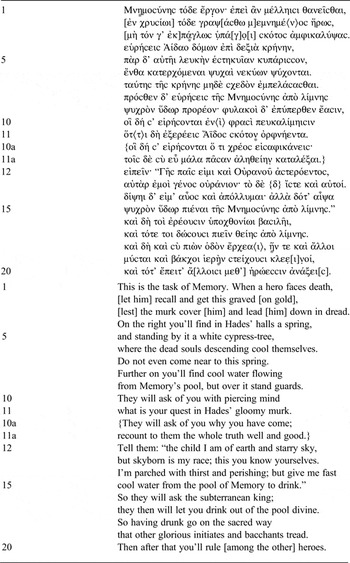
The analysis in §2 above results in the normalized archetype that is offered in Table 2, to which a verse translation is appended. In applying the subliteral asterisk to letters changed by an editor, I have not marked letters where the orthography has simply been adjusted to that of the Ionic alphabet or phenomena of sandhi have been removed: thus I print βάκχοι for βάχχοι, πιὼν for πιṑν, ϲτείχουϲι for ϲτείχōϲι, and ἂν μ- for ἂμ μ-. The apparatus always gives the original orthography.
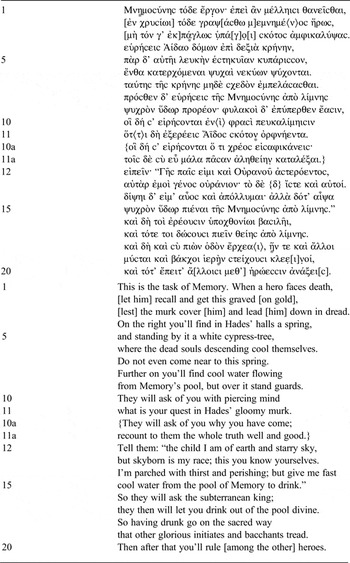
fontes: lamellae E(ntellae), H(ipponii), P(eteliae), Φ (Pharsali): 1 E 1, H 1, P 12; 2 E 2, P 13; 3 E 3, P 14; 4 E 4, H 2, P 1, Φ 1; 5 E 5, H 3, P 2, Φ 2; 6 E 6, H 4; 7 E 7, H 5, P 3, Φ 3; 8 E 8, H 6, P 4, Φ 4; 9 E 9, H 7, P 5, Φ 5; 10 E 10, H 8; 11 E 11, H 9; 10a–11a Φ 6–7; 12 E 12, H 10, P 6, Φ 8; 13 E 15, P 7, Φ 9 (rescriptum); 14 E 13, H 11, P 8, Φ 10; 15 E 14, H 12, P 9; 16 E 16, H 13; 17 E 17, H 14, P 10, Φ 11; 18 H 15; 19 H 16; 20 E 18, P 11
* = haec editio; [E] vel [P] = deest E vel P
1 ⌊Μνημοϲύ⌋νηϲ anon. in Brit. Mus. cat. ap. P: Μναμοϲύναϲ H: [E] τόδε ἔργ͙ον Burkert ap. H: τοδεεριον H: τόδ⟨ε⟩ ἔργ⌊ον⌋ Guarducci ap. P (τοδεν[ leg. Kaibel, τοδερ̣γ̣[ vel τοδει̣ρ̣[ Smith, sed nunc τοδει̣[ tantum legi): [E] ἐπεὶ ἂν Merkelbach: ἐπεὶ ἂμ H: ἐπὴν West: [EP] μέλλε̄ιϲι H: μέλ⌋λ͙η͙ιϲ͙ι{ν} Riedweg ap. E (]ηνιοιν leg. Frel): [P] θανεῖϲθαι Riedweg et Pleket ap. E (θαν{ι}ε̄͂ϲθαι Frel): θανε̄͂ϲθαι H: θανεῖϲ̣θα⌊ι⌋ Smith ap. P 2 ἐν χρυϲίωι Guarducci in lac. x litt. ap. P: ἐν δέλτωι Gallavotti: [E] γραψ[άϲθω *: γραψ[ P: γράψ[αι Gallavotti: [E] μ]εμνημέ⟨ν⟩οϲ Riedweg ap. E: [P] 3 in initio desunt haud minores iv litt. ap. P, sed plures veri simillimum est hic deesse: [E] μὴ τόν γ’ ἐκ]πά͙γλωϲ̣ ὑ̣πά[γ]ο̣[ι * e P: ]πο̣γλωσυπα[ legi (ο̣ potius quam α̣): ]τ̣ογλωσσ̣ι̣πα ω̣ legit Smith a. 1882 (τ̣ vel π̣; Σ̣Ι̣ potius quam Ε̣Ι̣; ω̣ vel ο̣, ubi spat. litt. ii nunc periit): [E] ἀμφικαλύψαϲ H: ἀμφικαλύψαι ap. E leg. Frel: ἀμφικαλύψαϲ͙ Riedweg ap. E 4 εὑρήϲ{ϲ}ειϲ δ’ Franz ap. P: εὑρήϲ{ϲ}ειϲ * ap. Φ (sc. ΕΥΡΗΣΕΙϹ): ειϲ H (εἶϲ ‘ibis' intellexit Merkelbach, εἰϲ Pugliese Carratelli): [E] δόμων P: δόμοιϲ Φ: δόμōϲ εὐε̄ρέαϲ H: [E] ἐπὶ δεξιὰ *: ἔϲτ’ ἐπὶ δ⟨ε⟩ξιὰ Pugliese Carratelli ap. H: ἐνδέξια Φ: ἐπ’ ἀριϲτερὰ P: ]δεξια E κρήνην PΦ: κρε̄́να H: λίμνην E 5 αὐτῆι λευκὴν ἑϲτηκυῖαν PΦ: ἑϲτη⌋κυ⟨ῖ⟩αν͙ Riedweg ap. E (ἑϲτη]κῦαι Frel): αὐτὰν ἑϲτακυ⟨ῖ⟩α λευκὰ Marcovich ap. H κυπάριϲϲον EPΦ: κυπάριϲ⟨ϲ⟩οϲ Pugliese Carratelli ap. H 6 ψκχαι Hac νεκύōν H 7 ταύτηϲ τῆϲ κρήνηϲ PΦ: ταύταϲ τᾶϲ͙ κράναϲ Sacco ap. H (-ρκρ- lamella): [E] μηδὲ PΦ: με̄δὲ H: ]δε E ϲχεδὸν ἐ⟨μ⟩πελάϲ⟨αϲ⟩θαι Riedweg ap. E: ϲχεδὸν ἐμπελάϲειαϲ P: ϲχεδόθεν πελάϲηιϲθα Φ: ϲχεδὸν ἐνγύθεν ἔλθε̄ιϲ H 8 πρόϲθεν δ’ hευρε̄́ϲειϲ H: πρόϲϲω δ’ εὑρήϲειϲ Φ: εὑρήϲειϲ δ’ ἑτέραν P: [E] τῆϲ P: τᾶϲ H: τὸ Φ: [E] Μνημοϲύνηϲ ἀπὸ λίμνηϲ EPΦ: Μναμοϲύναϲ ἀπὸ λίμναϲ H 9 προρέον HP: προ⟨ρέον⟩ Zuntz post Verdelis in Φ: [E] φυλακοὶ EΦ ac: φύλακεϲ HPΦ pc δ’ vel δ(ὲ)
HPΦ: θ’ E ἐπύπερθεν HΦ: ἐ͙πύ͙πε⟨ρ⟩θ⟨εν⟩ Riedweg et Cassio ap. E (υποπεθ leg. Frel): ἐπίπροϲθ`έν P ἔαϲιν PΦ: ⟨ἔ⟩αϲιν Riedweg et Cassio ap. E: ἔαϲι H 10 οἳ Zuntz ap. H (οἱ Merkelbach et Marcovich): [E] δή ϲ’ Merkelbach et Marcovich (cf. 10a): δε ϲε H, sc. δε̄́ ϲ(ε): δέ ϲε Pugliese Carratelli: [E] ἐν⟨ὶ⟩ Merkelbach et Lloyd-Jones: ἐν H: [E] πευκαλίμη⟨ι⟩ϲιν Frel ap. E: πευκαλίμαιϲι H 11 ὅτ⟨τ⟩ι Guarducci post Pugliese Carratelli ap. H: [E] δε̄̀ Zuntz ap. H (δὲ Pugliese Carratelli): [E] ϲκότο]ν͙ * ap. E: ]μ leg. Frel ap. E: ϲκότοϲ H: ϲκότο]ϲ͙ Riedweg ap. E ὀρ͙φ{ο}νήεντα * ap. E (ουφονηεντα leg. Frel): ὀρ͙φ{ο}νήεντο͙⟨ϲ⟩ Riedweg ap. E: ὀρφ⟨ν⟩ε̄́εντοϲ Ebert ap. H 10a–11a vv. quos pro 10–11 finxit Φ ex archetypo omisi 10a οἳ δε̄́ ϲ’ * (cf. 10): οἱ δε̄́ ϲ’ Merkelbach: οἱ δέ ϲ’ Zuntz: οἱ δέ ϲ⟨ε⟩ West: οἳ δέ ϲ⟨ε⟩ Bernabé: οἵδε ϲ’ Verdelis 11a τοῖϲ δὲ Zuntz: τοῖϲδε Verdelis 12 εἰπεῖν PΦ: εἶπον H: [E] Γῆϲ παῖϲ εἰμι PΦ (πάιϲ Gallavotti, fort. recte): Γ̣ε̃ϲ παῖ⟨ϲ⟩ ε̄̓μι Sacco ap. H: [E] Οὐρανοῦ EPΦ: ˉ̓Ορανō̃ H ἀϲτερόεντοϲ EHP: αϲτ~ Φ 13 versum hic praebet P: post 15 collocat E: om. H αὐτὰρ ἐμοὶ γένοϲ οὐράνιον P: αὐτὰρ ε[ E: Ἀϲτέριοϲ ὄνομα Φ τὸ δὲ {δ} ἴϲτε καὶ αὐτο`ί´ P: om. Φ: [E] τὸ δὲ {δ} West: τόδε δ’ Franz 14 δίψηι PΦ: δίψαι H: [E] εἰμ’ Φ: ε̄̓μ’ H: εἰμ(ι) P: [E] αὖοϲ HΦ: αὔη P, ut fort. E propter spatium: [E] καὶ ἀπόλλυμαι HP: ⟦κ̣⟧ Φ: ]μαι E ἀλλὰ EPΦ: ἀλ⟨λ⟩ὰ Pugliese Carratelli ap. H δότ’ αἶψα P: δότ’ ō῏κ̣α̣ Pugliese Carratelli ap. H: δότε μμοι E: δότε μοι Φ 15 πιέναι H, ut fort. E propter spatium: προρέον P: [E] τῆϲ P: τε̄͂ϲ H: [E] λίμνηϲ EP: λίμ⟨ν⟩ε̣̄ϲ Pugliese Carratelli ap. H 16 δὴ τοὶ *: δε̄́ τοι Pugliese Carratelli ap. H: τοὶ δ͙ὴ͙ Riedweg post τοι δ͙ὴ͙ Bernabé ap. E (τοι ἂν leg. Frel) ἐρέōϲιν Lazzarini ap. H: [E] h͙υποχθονίōι * ap. H (ιυπο-): [E] βαϲιλε̄͂ϊ Merkelbach ap. H: βαϲιλεί⟨αι⟩ West: [E] 17 καὶ τότε τ[οι Bernabé ap. E (cf. Hom. Od. 4.480): καὶ δε̄́ τοι H (δε̄́ τοι deleverit Gallavotti): καὐτ[οί ϲ]οι Kaibel ap. P (litt. ]ο primus legi, sed ut ]ϲ[ intellexit Bernabé, post quem καὶ͙ ⟨δή⟩ τοι coniecerim): om. Φ δ`ώ´ϲουϲι πιεῖν P: δṓϲōϲι πιε̄͂ν H: πιεν Φ (πιε̄͂ν Verdelis, πιέν’ Cassio collato H 12): [E] θείηϲ P: τᾶϲ Μναμοϲύναϲ H contra metrum: om. Φ: [E] ἀπὸ H: ἀπ⌊ὸ Franz ap. P: ἀπὸ τῆϲ{ϲ} * ap. Φ (sc. ΤΗΣ) contra metrum λίμ⌋ν̣ηϲ Franz ap. P: λίμ`ναϲ´ H: κρήνηϲ Φ: κρή⌋ν̣ηϲ Goettling ap. P 18–19 versum om. E 18 δε̄̀ ϲὺ πιṑν H ἔρχεα⟨ι⟩ Pugliese Carratelli ἥ͙ν *: hάν H 19 βάχχοι H ἱερὴ͙ν *: hιερὰν H ϲτείχōϲι H κλεε̣[ι]ν̣οι * ap. H: κλε⟨ε⟩ιν̣οί Burkert et Merkelbach 20 versum om. H τότ’ ἔπειτ’ P: τότε δ[ὴ Riedweg ap. E ἄ[λλοιϲι Kaibel ap. P (τέλη Edmonds): [E] μεθ’ suppl. Franz ap. P: [E] ἀνάξει[ϲ Franz ap. P: [E] post 20 E 19–21 ex archetypo om. *
§4. CONCLUSION
What can we learn about the author of the archetype of this poem, which is carefully composed and unified in outlook and diction? The original dialect is clearly that of Ionic epic, but it has certain distinctive forms. The most significant is the psilosis in ἐπύπερθεν, which shows that there is no Attic or Euboean influence; the dialect is psilotic Ionic. The use of νῦ ἐφελκυϲτικόν at the verse-end, even before verses beginning with consonants, is consistent with an Ionic composer. The form φραϲίν for φρεϲίν is an archaism rather than a specifically Doric form.Footnote 143
Alongside the standard East Ionic aorist infinitive πιεῖν before a consonant in verse 17 stands a unique infinitive of πίνω, namely πιέναι in verse 15. It is not clear whether this is an artificial formation or an inherited archaism. The only literary parallel for πιέναι is πελέναι, which occurs twice in Parmenides, who was from the Phocaean colony of Elea: B 8.11 DK, οὕτωϲ ἢ πάμπαν πελέναι χρεών (read χρεόν?) ἐϲτιν ἢ οὐκί, and B 8.45 DK, οὔτε τι βαιότερον πελέναι χρεόν (read χρεών?) ἐϲτι τῆι ἢ τῆι. Until recently everyone had regarded πελέναι as an artificial form, based perhaps on ἔμμεναι. Cassio has now adduced a new inscription on a skyphos from the district of Leontini in Sicily, published by Manganaro.Footnote 144 This dates from c.500–475, and contains the present infinitive κλεπτέναι. It is thus exactly parallel to πελέναι, since this too is a thematic verb. Cassio suggested that it was created by analogy with the pair τιθέναι — τιθεῖν, which, as he noted, occurs only in West Ionic (Euboean). He argues that Parmenides took this form from his vernacular, and explained it as a feature of a dialect where a West Ionic dialect has been mixed with East Ionic. If πιέναι was an artificial creation, it is open to the same explanation, and points towards Southern Italy and Sicily as the place where the archetype was created, even though it was in East Ionic dialect.Footnote 145
However, πιέναι may in fact be an old East Greek form, since the infinitive of athematic verbs in -ναι is actually the outcome of -εναι. Compare Cypriot δοϝέναι for δοῦναι and the presence of -ε- in ἰέναι. Thus εἶναι is contracted from an original form *esenai.Footnote 146 πίνω was originally a -μι verb ending with the Indo-European o-coloured laryngeal *H3 , seen in Vedic píbati with root-aorist ápāt. It can be reconstructed as original *peyH3-mi, which was then metathesized to *peH3y-mi,Footnote 147 which would in turn have developed into †πῷμι, had not analogical pressures led to its replacement by πίνω with a nasal suffix. Traces of the athematic verb survive in two imperative forms, πῖθιFootnote 148 and Lesbian πῶθι. The infinitive πιέναι, originally *piH3-enai, probably derives from the original aorist *epieH3-m, which, without the operation of analogy, would have become *ἐπίων (cf. πῶθι and ἐβίων). However, with Cassio one may ask why, if it is an archaism, it is not attested in Homer alongside the metrically similar Aeolism πιέμεν.Footnote 149
In Φ's truncated version of verse 15 πιέναι seems to turn into πιεν, which I interpret as its elided form, i.e. πιέν’ ἀπὸ τῆϲ{ϲ} κρήνηϲ. The hyparchetype of the intermediate and short texts further condenses this into πιέν μοι to form the end of verse 14; since πιέν precedes a consonant, it can no longer be elided πιέναι. However, πιέν is a form familiar from inscriptions in Arcadian, a number of Doric dialects, including Heraclean, Argolic, Cretan, Theraean, Cyrenean and Coan, and possibly Cypriot. The fact that all the apographs of the shortest version come from Crete might seem to suggest that πιέν is originally a Cretan form, but this does not explain why the Thessalian text M has it. Also, Parmenides too uses μιγέν for the present infinitive of μείγνυμι.Footnote 150 Although Stein emended this to μιγῆν, and everyone accepts his emendation, this does not explain why Simplicius has μιγέν; indeed, the form μιγῆν is linguistically unacceptable.
Cassio may well be right that, despite its East Ionic dialect, the archetype derived from the West. This is plausible simply on the grounds that three of the four long texts come from there, whether or not πιέναι is an inherited archaism. Other linguistic arguments for the origin of the archetype are hard to find. The poet's readiness to maintain the metrical effects of initial prevocalic digamma is perhaps another indication that he was familiar with some kind of West Greek.
As for the date of composition, the author's use of the article, for example in ταύτηϲ τῆϲ κρήνηϲ (6) or τῆϲ Μνημοϲύνηϲ ἀπὸ λίμνηϲ (8), is fully compatible with a date in the late sixth or fifth century, but helps us little. All we can say about his diction is that this use of the article seems later than that in most of the Homeric Hymns, but less innovative than that of Parmenides.
In conclusion, the archetype of this poem was the work of a skilful poet well versed in the epic tradition. There is little sign of the formulae and phrasing of post-Hesiodic composers like those of most of the Homeric Hymns, although we have seen a couple of parallels with the Hymn to Apollo, the Pythian part of which dates from the 580s b.c., whereas the composite poem was created by Cynaethus of Chios in 522/521 b.c. (Cynaethus later migrated to Sicily, where he died).Footnote 151 However, our poet is largely drawing on the texts of the eighth-century poems of Homer and Hesiod, which had a large diffusion in Magna Graecia by this time (rhapsodic contests were instituted at Syracuse in 504 b.c.).Footnote 152 However, he applied a large measure of his own creative use of the tradition. He was probably an East Ionian who migrated to southern Italy and promulgated his doctrine there, very probably in Orphic-Pythagorean circles. If we must put a name to him, one wonders whether he was actually Pythagoras of Samos. If such a proposal seems surprising in an article which has eschewed flights of fancy, we should recall that Pythagoras is a figure for whose existence the historical evidence is no weaker than it is for that of Socrates, since Pythagoras' contemporary Xenophanes refers to him.Footnote 153 As Pugliese Carratelli noted, whoever the author was, he may well have passed his verses off as the work of a legendary predecessor like Orpheus, to whom, according to Ion of Chios, Pythagoras attributed some of his own writings.Footnote 154