Recruitment, or the addition of young individuals to a population, is one of the major components of population dynamics (Underwood & Keough, Reference Underwood, Keough and Bertness2001). In intertidal barnacle populations from the St Lawrence Estuary, in eastern Canada, adult organisms are restricted to crevices (Bergeron & Bourget, Reference Bergeron and Bourget1986). Such a characteristic spatial pattern is related to ice scour, which results from the widespread formation of sea ice across the entire Gulf of St Lawrence system every winter (Saucier et al., Reference Saucier, Roy, Gilbert, Pellerin and Ritchie2003). Crevices act as refuges for barnacles against the physical effects of moving ice. The recruitment period for this barnacle species, Semibalanus balanoides (Linnaeus, 1766), is limited to a few months on the north-western Atlantic coast, usually earlier in the year in southern locations (Bousfield, Reference Bousfield1954; Minchinton & Scheibling, Reference Minchinton and Scheibling1991; Pineda et al., Reference Pineda, Starczak and Stueckle2006). In the St Lawrence Estuary, barnacle larvae settle almost exclusively in crevices (Bergeron & Bourget, Reference Bergeron and Bourget1986), in contrast with the open Atlantic coast (which does not undergo ice scour), where larvae settle extensively across rocky intertidal surfaces (Bourget et al., Reference Bourget, Martel, Lapointe, Bussières, Garbary and South1990). It was suggested that selective pressures (intense ice scour outside of crevices) may have determined the larval preference for settlement in crevices in the St Lawrence Estuary (Chabot & Bourget, Reference Chabot and Bourget1988). To test the generality of this pattern, we investigated barnacle recruitment on other ice-scoured shores within the Gulf of St Lawrence system. In particular, we surveyed topographically complex sections of the coast where areas subjected to intense winter ice scour are interspersed with areas subjected to mild ice scour. We asked the question whether this complex structural pattern on the coast would be associated with a different recruitment pattern than the one described for the St Lawrence Estuary.
We surveyed Sea Spray Shore (45° 46′ N 62° 9′ W), near Arisaig, on the southern coast of the Gulf of St Lawrence, Nova Scotia, Canada. The substrate of this subarctic coast is primarily volcanic bedrock with high rugosity. Surface seawater temperature ranges between monthly averages of -1.4 °C and 18.2 °C in this region, while surface seawater salinity ranges between monthly averages of 28.4‰ and 30.6‰ (Fisheries and Oceans Canada, 2007). Sea ice forms in early winter and melts between late winter and early spring (Saucier et al., Reference Saucier, Roy, Gilbert, Pellerin and Ritchie2003), normally late March or April at Sea Spray Shore. On this coast, Semibalanus balanoides is the only species of intertidal barnacle. At Sea Spray Shore, habitats directly facing open waters (exposed habitats) are subjected to strong ice scour in winter (see values in Scrosati & Heaven, Reference Scrosati and Heaven2006) and strong wave action during the ice-free period (see values in Scrosati & Heaven, Reference Scrosati and Heaven2007). Habitats protected by outer rocky formations (sheltered habitats) are subjected to significantly lower values of ice scour and wave action (Scrosati & Heaven, Reference Scrosati and Heaven2006, Reference Scrosati and Heaven2007). Barnacle recruits appear on this shore normally in May. On 7–8 June 2005 and 7–10 June 2006, after all sea ice from the preceding winter seasons had completely melted, we measured the density of barnacle adults and recruits in one exposed habitat and one sheltered habitat that were visually representative of the entire coast. Recruits were much smaller than adults at the time of sampling (Figure 1), so both life-history stages could easily be differentiated. In each habitat, we laid a 20 m transect line across the mid–high intertidal zone and counted the number of barnacle adults and recruits in 30, 100 cm2 random quadrats.
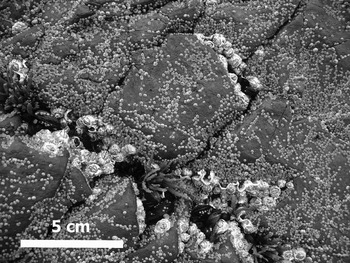
Intertidal zone of an exposed habitat at Sea Spray Shore viewed in the spring (June), showing adult barnacles restricted to crevices and barnacle recruits occurring extensively across the rocky substrate, both inside and outside of crevices. Note the pronounced size difference between adults and recruits. Photograph by R. Scrosati.

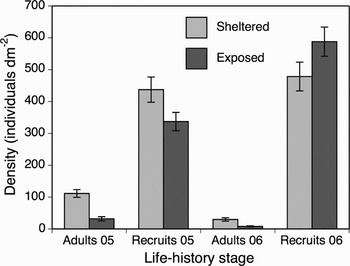
We found that barnacle recruits occurred abundantly throughout the rocky substrate, both inside and outside of crevices (Figure 1). Recruits were significantly more abundant than adults in sheltered and exposed habitats in both years (Student's t-tests, P < 0.05; Figure 2). In each year, the density of recruits was similar between exposed and sheltered habitats (Student's t-tests, P > 0.05; Figure 2). Barnacle adults were restricted to crevices in the exposed habitat, whereas they occurred both inside and outside of crevices in the sheltered habitat, apparently as a result of the milder ice scour that occurs in winter there.
Density (individuals dm−2; means ± SE) of barnacle adults and recruits in exposed and sheltered habitats at Sea Spray Shore in the spring (June) of 2005 and 2006 (N = 30 quadrats for each case).

The massive barnacle recruitment occurring everywhere on rocky surfaces on the outer Gulf of St Lawrence stands in sharp contrast with the spatially selective recruitment in crevices in the St Lawrence Estuary. What might explain this regional difference along the same ice-scoured coastline? A long-term history of strong ice scour might indeed determine microhabitat selectivity in larvae through natural selection, as suggested by Chabot & Bourget (Reference Chabot and Bourget1988) to explain their findings in the St Lawrence Estuary. However, in habitats where ice scour is relatively mild, settlement inside crevices is less critical for population persistence, as several organisms settling outside of crevices will also reach adult size. Thus, on topographically complex shores where sheltered habitats are interspersed with exposed habitats, the coastal larval pool (a mixture from various shore areas) would include many larvae without a particular spatial preference for settlement. Sea Spray Shore includes alternating areas subjected to strong and mild ice scour (Scrosati & Heaven, Reference Scrosati and Heaven2006), and larvae indeed settle both inside and outside of crevices everywhere on the shore, as we found. The selective potential of environmental factors on larval settlement behaviour in marine invertebrates has been investigated by a number of researchers (Todd, 1998; Morgan, Reference Morgan and Bertness2001). Our study suggests that ice scour, a rarely considered factor in terms of larval ecology (Barnes & Conlan, Reference Barnes and Conlan2007), might also affect the evolution of settlement behaviour in barnacles. Experimental studies on this topic should therefore improve our understanding of barnacle population dynamics in polar and subpolar shores.
ACKNOWLEDGEMENTS
This study resulted from the BSc Honours thesis of E.A. MacPherson. Funding was provided by grants from the Canada Research Chair (CRC) programme, the Canada Foundation for Innovation (CFI), the Natural Sciences and Engineering Research Council of Canada (NSERC), and the St Francis Xavier University Council for Research (UCR) to R. Scrosati and by an Undergraduate Student Research Award (USRA) to E.A. MacPherson. We thank Lindsay Eckersley, Heather MacDonald, and Martha MacPherson, for field assistance, and two anonymous referees, for their constructive comments.