Introduction
It is estimated that around 10–15% of new mothers experience postpartum depression (PPD) with most cases developing depressive symptoms in the first 3 months after giving birth (O'Hara & Swain, Reference O'Hara and Swain1996; Evans et al. Reference Evans, Heron, Francomb, Oke and Golding2001; Josefsson et al. Reference Josefsson, Berg, Nordin and Sydsjo2001; Bennett et al. Reference Bennett, Einarson, Taddio, Koren and Einarson2004; Gavin et al. Reference Gavin, Gaynes, Lohr, Meltzer-Brody, Gartlehner and Swinson2005; Halbreich & Karkun, Reference Halbreich and Karkun2006; Norhayati et al. Reference Norhayati, Hazlina, Asrenee and Emilin2015). Depressive symptoms can vary from mild complaints and ‘maternity blues’ to clinically diagnosed PPD. Depression at the postpartum period is often not diagnosed early enough, resulting in women being depressed for longer periods of time before they are given effective treatment. The prevalence of PPD in Greece (Gonidakis et al. Reference Gonidakis, Rabavilas, Varsou, Kreatsas and Christodoulou2008; Leonardou et al. Reference Leonardou, Zervas, Papageorgiou, Marks, Tsartsara, Antsaklis, Christodoulou and Soldatos2009) is similar to that reported in other countries (Cox et al. Reference Cox, Murray and Chapman1993; Nonacs & Cohen, Reference Nonacs and Cohen2002).
PPD is considered to be a systemic illness affecting the new mother's mental health and functioning, as well as her relationship with her infant and family (O'Hara, Reference O'Hara, Murray and Cooper1997; Grace et al. Reference Grace, Evindar and Stewart2003; Howard et al. Reference Howard, Molyneaux, Dennis, Rochat, Stein and Milgrom2014). Furthermore, PPD has significant adverse impact on infant and child development (Cornish et al. Reference Cornish, McMahon, Ungerer, Barnett, Kowalenko and Tennant2005; Koutra et al. Reference Koutra, Chatzi, Bagkeris, Vassilaki, Bitsios and Kogevinas2013). A range of biological and psychosocial risk factors have been identified as important determinants of PPD (Beck, Reference Beck1996, Reference Beck2001; O'Hara & Swain, Reference O'Hara and Swain1996). Previous research suggests that socio-demographic characteristics, such as mother's young age (Rubertsson et al. Reference Rubertsson, Waldenstrom and Wickberg2003), low educational level (Davis et al. Reference Davis, Edwards, Mohay and Wollin2003) and low socio-economic background (Beck, Reference Beck2001), as well as psychosocial factors, such as antenatal depression and anxiety (Koutra et al. Reference Koutra, Vassilaki, Georgiou, Koutis, Bitsios, Chatzi and Kogevinas2014; Tebeka et al. Reference Tebeka, Le Strat and Dubertret2016), are associated with increased levels of PPD.
While there is an extensive literature on the socio-demographic and the psychosocial determinants of PPD, there are only few epidemiological studies with inconsistent findings that have examined the effects of perinatal complications on PPD (Warner et al. Reference Warner, Appleby, Whitton and Faragher1996; Nielsen Forman et al. Reference Nielsen Forman, Videbech, Hedegaard, Dalby Salvig and Secher2000; Johnstone et al. Reference Johnstone, Boyce, Hickey, Morris-Yatees and Harris2001; Blom et al. Reference Blom, Jansen, Verhulst, Hofman, Raat, Jaddoe, Coolman, Steegers and Tiemeier2010). Some studies found no association between pregnancy or delivery complications and increased risk for developing PPD (Nielsen Forman et al. Reference Nielsen Forman, Videbech, Hedegaard, Dalby Salvig and Secher2000; Johnstone et al. Reference Johnstone, Boyce, Hickey, Morris-Yatees and Harris2001), while others revealed a number of obstetric risk factors strongly associated with PPD (Warner et al. Reference Warner, Appleby, Whitton and Faragher1996; Blom et al. Reference Blom, Jansen, Verhulst, Hofman, Raat, Jaddoe, Coolman, Steegers and Tiemeier2010). More specifically, Blom et al. (Reference Blom, Jansen, Verhulst, Hofman, Raat, Jaddoe, Coolman, Steegers and Tiemeier2010) showed that several pregnancy complications including preeclampsia, hospitalisation during pregnancy, emergency caesarean section, concern about fetal distress and newborn's admission to special care were associated with PPD at 2 months postpartum, and the risk of developing PPD increased with the number of complications women experienced. In a similar vein, Warner et al. (Reference Warner, Appleby, Whitton and Faragher1996) suggested that unplanned pregnancy, formula feeding instead of breastfeeding, and unemployment in either the mother or the head of household were significant risk factors for PPD at 6–8 weeks postpartum. Two meta-analyses (O'Hara & Swain, Reference O'Hara and Swain1996; Robertson et al. Reference Robertson, Grace, Wallington and Steward2004) found that obstetric factors had a significant but small effect on the prevalence of PPD.
From a public health point of view, identifying perinatal risk factors for PPD is of major importance, due to the disorder's high prevalence and its consequences for the new mother and her family. To our knowledge, there are studies which examined a composite score of obstetric complications (O'Hara & Swain, Reference O'Hara and Swain1996), thus making it difficult to determine which specific complications predict PPD. In addition, some studies reported associations between obstetric complications and PPD that were only minimally adjusted (Warner et al. Reference Warner, Appleby, Whitton and Faragher1996), and thus may have been confounded by unmeasured factors. Moreover, the majority of the studies examining specific perinatal complications as risk factors for PPD is mainly focused at pregnancy and delivery complications without concurrent consideration of sleep patterns during pregnancy (i.e. sleep deprivation, snoring, daytime sleepiness) and possible complications women experiencing at the early postpartum period (i.e. breastfeeding difficulties and discontinuation). Prior research suggests a possible relationship between sleep patterns during pregnancy and maternal mood during the postpartum period (Lee et al. Reference Lee, McEnany and Zaffke2000; Wolfson et al. Reference Wolfson, Crowley, Anwer and Bassett2003; Goyal et al. Reference Goyal, Gay and Lee2007; Chang et al. Reference Chang, Pien, Duntley and Macones2010; Tomfohr et al. Reference Tomfohr, Buliga, Letourneau, Campbell and Giesbrecht2015). Furthermore, short duration of breastfeeding or not breastfeeding (Dennis & McQueen, Reference Dennis and McQueen2007; Watkins et al. Reference Watkins, Meltzer-Brody, Zolnoun and Stuebe2011) and breastfeeding difficulties (Mezzacappa & Katlin, Reference Mezzacappa and Katlin2002; Ystrom, Reference Ystrom2012; Figueiredo et al. Reference Figueiredo, Canario and Field2014; Dias & Figueiredo, Reference Dias and Figueiredo2015) have been associated with PPD symptoms.
Within the context of a population-based mother–child cohort study in Crete, Greece (Rhea Study), our study aimed at investigating a wide range of complications during pregnancy, at delivery, or at the early postpartum period as determinants of PPD at 8 weeks postpartum.
Methods
The mother–child cohort in Crete (Rhea Study)
The present study is part of the Rhea Study, a prospective mother–child cohort examining a population sample of pregnant women and their children at the prefecture of Heraklion, Crete, Greece (Chatzi et al. Reference Chatzi, Plana, Daraki, Karakosta, Alegkakis, Tsatsanis, Kafatos, Koutis and Kogevinas2009a). Female residents (Greek and immigrants) who had become pregnant during the 12-month period starting in February 2007 have been contacted at four maternity clinics in Heraklion and asked to participate in the study. To be eligible for inclusion in the study, women had to have a good understanding of the Greek language and be older than 16 years of age. The first contact was made at the time of the first major ultrasound examination, before week 15 of gestation. Women were informed about the study protocol by trained nurses and midwives and asked to participate in the study. Women were then contacted again at the third trimester of pregnancy, at birth, and at 8 weeks postpartum. Face-to-face structured interviews, together with self-administered questionnaires and medical records, were used to obtain information on several psychosocial, dietary and environmental exposures during pregnancy and postpartum. The study was approved by the Ethical Committee of the University Hospital in Heraklion, Crete, Greece. Written informed consent was obtained from all participants.
Detailed characteristics of the study population have been described elsewhere (Chatzi et al. Reference Chatzi, Plana, Daraki, Karakosta, Alegkakis, Tsatsanis, Kafatos, Koutis and Kogevinas2009a). During the study recruitment period 1765 eligible women were approached, 1610 (91%) agreed to participate and 1388 (86%) were followed up until delivery. A total of 1079 women completed the depression scale at 8 weeks postpartum and 1072 women had full data on basic exposure information (gestational age, preterm birth and type of delivery) and PPD. Seven women with a previous diagnosis of severe psychiatric disorders (i.e. schizophrenia, bipolar disorder, etc.) and 28 multiple pregnancies were excluded from the sample, resulting in a cohort of 1037 women available for analyses.
Measures
Pregnancy, perinatal and postpartum complications
The present study examined a wide range of pregnancy, perinatal and postpartum complications as risk factors for PPD. Information on the following complications was obtained through questionnaires administered to pregnant women by trained interviewers during the first or third trimester of pregnancy. Upon enrolment, women reported whether or not the pregnancy was planned, and about how women were trying to get pregnant (i.e. immediately v. with effort, subjective assessment of women). At 30 weeks of gestation, women answered a question about whether they had symptoms like vomit, nausea, etc. during the first two trimesters of pregnancy and a question about whether they had been admitted to hospital for more than 24 h during the first two trimesters of pregnancy. Furthermore, women were asked if they were smoking during pregnancy and if they were drinking alcohol during pregnancy.
Women were screened for gestational diabetes at 24–28 weeks of gestation and were classified as having gestational diabetes in the index pregnancy if two or more of the four plasma glucose values obtained during the 100-g 3-h oral glucose tolerance test (OGTT) were abnormal, as per the criteria proposed by Carpenter & Coustan (Reference Carpenter and Coustan1982): fasting blood glucose ≥95 mg/dl; 1-h ≥ 180 mg/dl; 2-h values ≥ 155 mg/dl; and 3-h values ≥ 140 mg/dl (Chatzi et al. Reference Chatzi, Plana, Daraki, Karakosta, Alegkakis, Tsatsanis, Kafatos, Koutis and Kogevinas2009a). All participants were classified as having metabolic syndrome or not, according to the criteria proposed by the US National Heart, Lung and Blood Institute/American Heart Association (NHLBI/AHA) (Grundy et al. Reference Grundy, Cleeman, Daniels, Donato, Eckel, Franklin, Gordon, Krauss, Savage, Smith, Spertus, Costa, American Heart, National Heart and Blood2005), with some considerations taken into account to adapt to our study population of pregnant women, as described in previous studies form the same cohort (Chatzi et al. Reference Chatzi, Plana, Daraki, Karakosta, Alegkakis, Tsatsanis, Kafatos, Koutis and Kogevinas2009a, Reference Chatzi, Plana, Pappas, Alegkakis, Karakosta, Daraki, Vassilaki, Tsatsanis, Kafatos, Koutis and Kogevinasb). In particular, the metabolic syndrome was diagnosed if three or more of the following risk factors were present: a pre-pregnancy BMI of >30 kg/m2; a triglyceride level of ≥150 mg/dl; a high-density lipoprotein (HDL)-cholesterol level of <50 mg/dl; a fasting glucose level of ≥100 mg/dl, and a blood pressure level of ≥130/≥85 mm Hg. In this study, we tested metabolic syndrome as both number of symptoms and its components specifically. Information on gestational hypertension and/or preeclampsia and thyroid dysfunction during pregnancy was obtained through computer-assisted interviews and medical records at the first and third trimesters. Maternal pre-pregnancy BMI was calculated by height, measured at the first prenatal visit, and pre-pregnancy weight, as reported at the time of the first major ultrasound visit (BMI; weight [kg]/height[m]2). Maternal gestational weight gain was calculated by body weight at delivery (objective) – pre-pregnancy weight (self-reported). Information on sleep patterns, including sleep duration, sleep-disordered breathing (i.e. non-snorers v. snorers) and daytime sleepiness was collected through a computer-assisted interview at the third trimester of pregnancy and was based on the following questions: ‘During the past month, how many hours do you sleep per day? How often do you snore during your sleep? How fresh do you feel when you wake up in the morning, independently of the hours you have slept?’ The answers were classified on 5-point Likert scales (Micheli et al. Reference Micheli, Komninos, Bagkeris, Roumeliotaki, Koutis, Kogevinas and Chatzi2011). Sleep deprivation was defined as five or fewer hours of sleep (Sabanayagam & Shankar, Reference Sabanayagam and Shankar2010). Snoring symptoms were also recoded into two categories: non-snorers v. snorers. The Epworth Sleepiness Scale was used to determine the level of daytime sleepiness; excessive daytime sleepiness was defined as a total score ≥10 (Johns, Reference Johns1991).
Gestational age, type of delivery and anthropometric measures at birth were collected from clinical records. Gestational age was based on the interval between the last menstrual period and the date of delivery. When the menstrual estimate of gestational age was inconsistent by seven or more days with the ultrasound measurement taken in the first trimester of pregnancy, a quadratic regression formula describing the relation between crown rump length and gestational age was used instead (Chatzi et al. Reference Chatzi, Plana, Daraki, Karakosta, Alegkakis, Tsatsanis, Kafatos, Koutis and Kogevinas2009a). Preterm birth was defined as a birth at less than 37 weeks. Type of delivery was divided into vaginal and caesarean section. Birth weight of the child was also obtained from routine midwife and hospital registry records and low birth weight was defined as birth weight below 2500 g.
Information on breastfeeding initiation, duration, and difficulties was collected at 9 months postpartum, but for this analysis only information up to 8 weeks postpartum was used. Mothers were asked if they had ever breastfed their child (or placed the child on their breast to feed). If they never breastfed their child, the reason was recorded. If women initiated breastfeeding, further information on breastfeeding duration was asked, as well as information regarding the first time they breastfed their infant and the duration of breastfeeding. Finally, at 9 months postpartum, the women reported retrospectively whether or not their newborn was admitted to Intensive Care Unit (ICU) immediately after delivery.
Psychological assessment at the postpartum period
Maternal depressive symptoms were assessed at 8 weeks postpartum using the Edinburgh Postnatal Depression Scale (EPDS; Cox et al. Reference Cox, Holden and Sagovsky1987). The EPDS is a widely used 10-item self-reported questionnaire providing an indication of the severity of mother's mood during the past 7 days. Items are rated on a 4-point Likert scale ranging from 0 (not at all) to 3 (most of the time) and refers to depressed mood, anhedonia, guilt, anxiety and suicidal ideation (possible range 0–30). A cut-off score of 13 or greater on the EPDS has been found to identify probable clinical postnatal depression with a sensitivity of 86% and a specificity of 78% (Cox et al. Reference Cox, Holden and Sagovsky1987; Matthey et al. Reference Matthey, Henshaw, Elliot and Barnett2006). This cut-off is also consistent with previous work in our cohort (Koutra et al. Reference Koutra, Chatzi, Bagkeris, Vassilaki, Bitsios and Kogevinas2013, Reference Koutra, Vassilaki, Georgiou, Koutis, Bitsios, Chatzi and Kogevinas2014). The EPDS has been translated and validated for the Greek population by two research groups (Leonardou et al. Reference Leonardou, Zervas, Papageorgiou, Marks, Tsartsara, Antsaklis, Christodoulou and Soldatos2009; Vivilaki et al. Reference Vivilaki, Dafermos, Kogevinas, Bitsios and Lionis2009), and showed a very high overall internal consistency.
Potential confounders
Based on the existing literature, we considered the following non-obstetric factors as possible confounders in the association between pregnancy, perinatal and postpartum complications and PPD: maternal age at delivery; education (low level: ≤6 years of school, medium level: 7–12 years of school, and high level: some years in university or university degree, ref: low level); marital status (single/married-engaged); Greek origin (yes/no); parity (primiparous/multiparous); and working during pregnancy (yes/no). Information on the aforementioned characteristics was obtained by questionnaires upon enrolment.
Statistical analysis
Descriptive statistics were used to summarise the baseline characteristics of participants. The primary outcome variable of interest was the PPD score at 8 weeks postpartum. The primary exposures of interest were pregnancy, perinatal and postpartum complications. EPDS was used as both a continuous and dichotomous variable with a cut-off score of 13 or greater recommended by Cox et al. (Reference Cox, Holden and Sagovsky1987) which appeared to be an effective screening for probable clinical depression.
Bivariate associations between dependent and independent variables were studied using Pearson's χ2 test or Fisher exact test for categorical variables. The EPDS score failed the normality test; hence, non-parametric tests were applied (Spearman's correlation, Kruskal–Wallis and Mann–Whitney tests). Missing values have been excluded pair-wise. Multivariable linear and logistic regression models were fit to estimate the association between pregnancy, perinatal and postpartum complications with maternal depressive symptoms at 8 weeks postpartum. Potential confounders related with either the outcome or the exposure of interest in the bivariate associations with a p-value < 0.2 (i.e. maternal age, education, marital status and working during pregnancy), as well as a priori selected potential confounders (i.e. maternal origin and parity) were included in the multivariable models. To account for the possibility of confounding by antenatal depressive symptoms, we performed additional sensitivity analyses excluding 77 women with high levels of depression during pregnancy (antenatal EPDS ≥ 13) Maternal antenatal depressive symptoms were assessed at 28–32 weeks of gestation using the EPDS (Cox et al. Reference Cox, Holden and Sagovsky1987). Finally, heterogeneity in associations related to parity (primiparous v. multiparous) was evaluated by including interaction terms in the multivariable models (statistically significant effect modification if p-value < 0.10) and by stratifying the sample, accordingly.
Estimated associations are described in terms of β coefficients (linear regression models) with 95% confidence intervals (CIs) or odds ratios (OR) with 95% CIs (logistic regression models). All hypothesis testing was conducted assuming a 0.05 significance level and a two-sided alternative hypothesis. All statistical analyses were performed using SPSS Statistics 20.0 software (IBM, Armonk, NY, USA).
Results
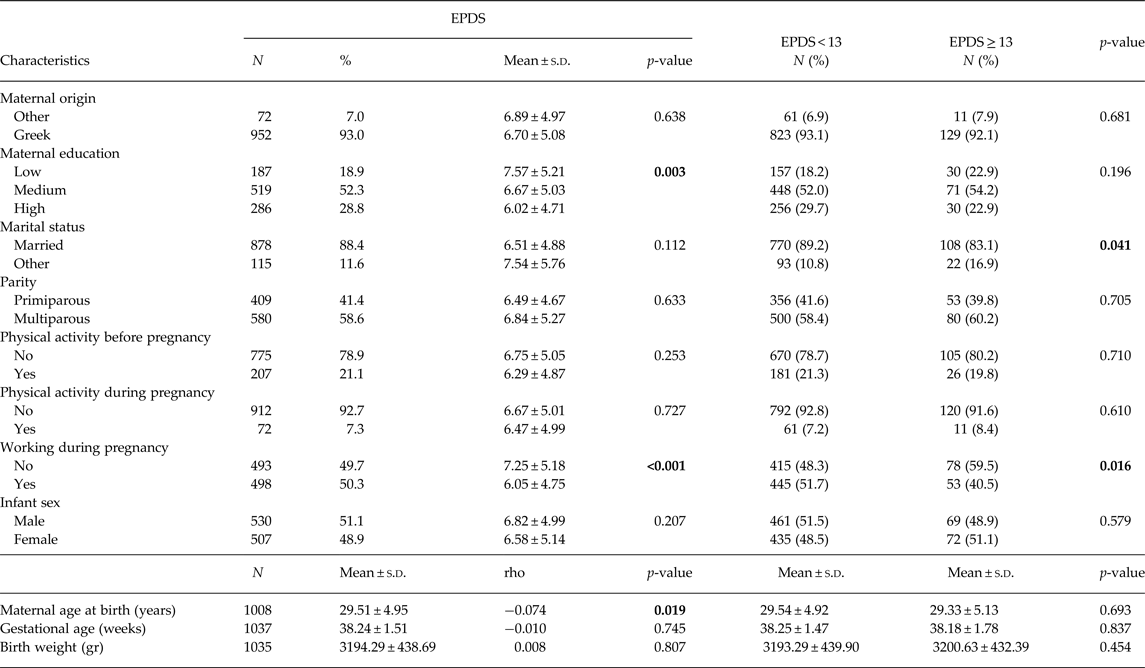
The socio-demographic characteristics of the study population are presented in Table 1. Participating mothers were predominantly of Greek origin (93.0%), married (88.4%) and had a mean age at delivery of 29.51 (s.d. = 4.95) years. More than half of the mothers had medium level of education (52.3%) and were multiparous (58.6%). About half of the infants were boys (51.1%) with a mean gestational age of 38.24 (s.d. = 1.51) weeks. Women of younger age, with low levels of education, who were not married, and those who did not work during pregnancy had significantly higher mean EPDS scores. The comparison between the 1037 participants and the 402 non-participants (final sample n = 1439 including only women with live singleton births from the initial sample of eligible women) revealed significant differences between the two groups in terms of age, education, origin, and marital status. Mothers who participated in this study were more likely to be older, to have high levels of education, to be married and of Greek origin as compared with non-participants.
Socio-demographic characteristics of participants (Rhea Study, Crete, Greece)

EPDS, Edinburgh Postnatal Depression Symptoms; rho, Spearman's correlation coefficient.
Statistical significant differences at p < 0.05, based on Mann–Whitney U-test for two independent samples, Kruskal–Wallis one-way analysis of variance by ranks, Spearman's rho correlation coefficient and χ 2 analysis for categorical variables. Missing values have been excluded pair-wise.
Bold font indicates statistically significant differences (p < 0.05).
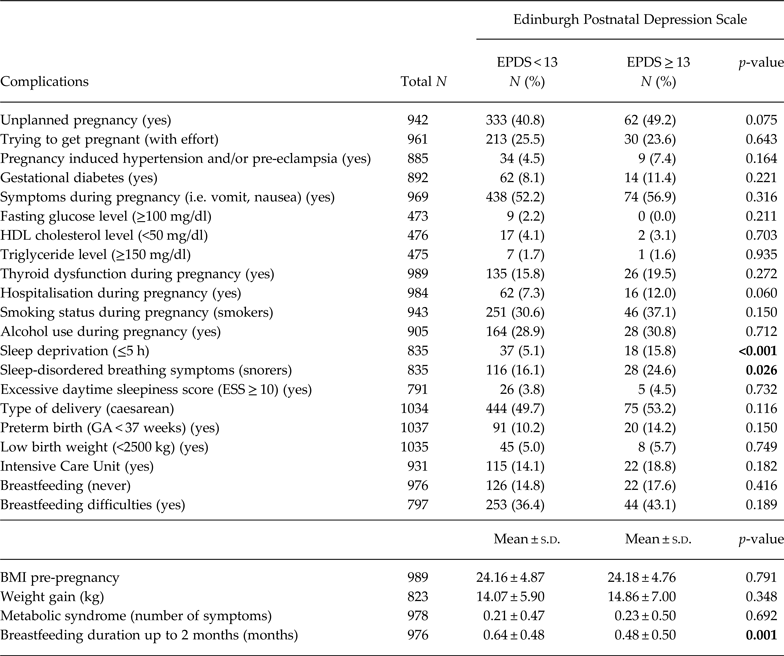
In the present study population, the prevalence of women with probable PPD (EPDS score ≥ 13) was 13.6%, indicating that 141 out of 1037 new mothers presented high levels of PPD at 8 weeks postpartum. The frequencies of pregnancy, perinatal and postpartum complications between depressed and non-depressed women are presented in Table 2. Women with PPD were more likely to report sleep deprivation, to be snorers and to breastfeed their children for a shorter period than women without PPD.
Descriptive of pregnancy, perinatal and postpartum complications by score on the Edinburgh Postnatal Depression Scale (Rhea Study, Crete, Greece)
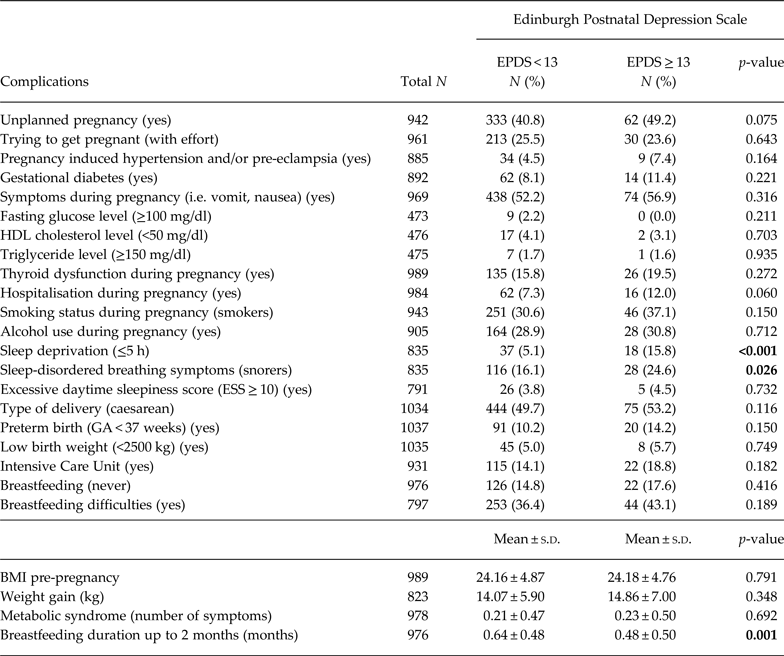
EPDS, Edinburgh Postnatal Depression Symptoms; HDL, High-Density Lipoprotein.
Statistical significant differences at p < 0.05, based on Mann–Whitney U-test for two independent samples for continuous variables and χ 2 test or Fisher exact test for categorical variables.
Bold font indicates statistically significant differences (p < 0.05).
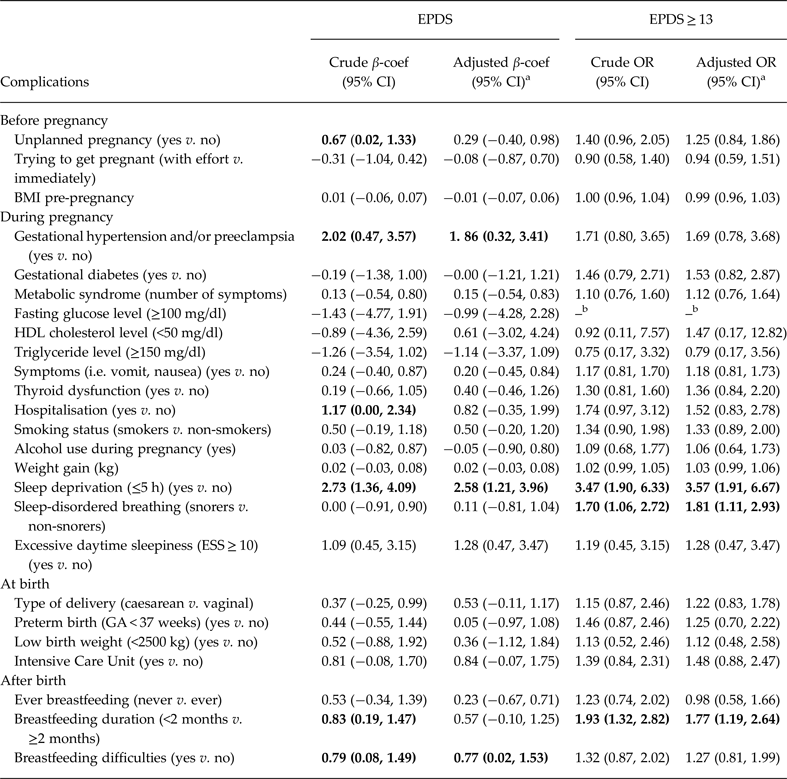
Table 3 presents the crude and adjusted associations between pregnancy, perinatal and postpartum complications and postpartum EPDS score as continuous variable at 8 weeks postpartum. In the crude models, several complications were associated with postnatal EPDS score, i.e. unplanned pregnancy, gestational hypertension and/or preeclampsia, sleep deprivation, hospitalisation during pregnancy, sleep deprivation during pregnancy, breastfeeding duration less than 2 months, and breastfeeding difficulties. Further adjustment for maternal characteristics, such as maternal age, origin, education, marital status, working during pregnancy, and parity, showed that only gestational hypertension and/or preeclampsia (β coefficient 1.86, 95% CI: 0.32, 3.41), sleep deprivation during pregnancy (β coefficient 2.58, 95% CI: 1.21, 3.96) and breastfeeding difficulties (β coefficient 0.77, 95% CI: 0.02, 1.53) were significantly associated with higher EPDS score. The relationships between postpartum EPDS score and gestational hypertension and/or preeclampsia (β coefficient 2.60, 95% CI 1.07, 4.12), as well as sleep deprivation (β coefficient 2.49, 95% CI 1.10, 3.88), proved remarkably robust when sensitivity analysis was conducted following the exclusion of 77 women with antenatal EPDS ≥ 13 to explore the possible impact of antenatal depression. Although this sensitivity analysis attenuated the observed association between breastfeeding difficulties and postpartum EPDS score, the direction of the association did not change (β coefficient 0.66, 95% CI: −0.09, 1.41).
Associations of PPD with pregnancy, perinatal and postpartum complications in the mother–child cohort (‘Rhea’ study) in Crete, Greece

β-coef., beta coefficient; 95% CI, 95% confidence interval; OR, odds ratio; HDL, High-Density Lipoprotein; ESS, Epworth Sleepiness Scale.
Bold font indicates statistically significant differences (p < 0.05).
a All models are adjusted for maternal age, education, origin, marital status, working during pregnancy and parity.
b There were no events of high EPDS scores (EPDS ≥ 13) in mothers with Fasting glucose level ≥100 mg/dl.
Associations of pregnancy, perinatal and postpartum complications with high levels of postpartum depressive symptoms (EPDS ≥ 13) are also presented in Table 3. Multivariable analysis revealed that sleep patterns during pregnancy, such as sleep deprivation (OR = 3.57, 95% CI: 1.91, 6.67) and snoring (OR = 1.81, 95% CI 1.11, 2.93), were associated with almost fourfold and twofold increase in the odds for PPD, respectively. Furthermore, breastfeeding duration less than 2 months was related to a 77% increase in the odds for PPD (OR = 1.77, 95% CI: 1.19, 2.64). These associations were supported by sensitivity analyses as well, after exclusion of 77 women with antenatal EPDS ≥ 13 (sleep deprivation OR = 3.79, 95% CI 1.89, 7.62, snoring OR = 1.98, 95% CI 1.14, 3.42, and breastfeeding duration less than 2 months OR = 1.59, 95% CI 1.01, 2.49).
Finally, we did not find any significant interactions between pregnancy, perinatal and postpartum complications and parity (p for interaction >0.10) (data not shown in tables).
Discussion
In the present study, we investigated the association of various pregnancy, perinatal and postpartum risk factors with maternal mood in the early postpartum period in a population-based mother–child cohort in Crete, Greece. To our knowledge, this is the first study evaluating the effect of specific pregnancy and delivery complications along with sleep patterns in late pregnancy and complications women are experiencing at the early postpartum period (i.e. breastfeeding) on PPD. The results suggest that gestational hypertension and/or preeclampsia and negative early breastfeeding experiences were adversely associated with PPD symptoms at 8 weeks postpartum. Furthermore, sleep deprivation and snoring during pregnancy, as well as breastfeeding duration less than 2 months appeared to increase the odds for the development of PPD. These findings apply equally to primiparous and multiparous women. Our results also indicate that these effects on PPD are not likely to be due to confounding by high levels of antenatal depressive symptoms, even though replication of such analyses in other population samples would be desirable.
According to our findings, higher PPD symptoms were reported by mothers who experienced gestational hypertension and/or preeclampsia. This finding is comparable with a previous study which found an association between preeclampsia and PPD (Blom et al. Reference Blom, Jansen, Verhulst, Hofman, Raat, Jaddoe, Coolman, Steegers and Tiemeier2010) and suggested that this association might be explained by hormonal (i.e. serotonin levels) and physical (i.e. morbidity) changes (Blom et al. Reference Blom, Jansen, Verhulst, Hofman, Raat, Jaddoe, Coolman, Steegers and Tiemeier2010). More specifically, increased blood serotonin levels in pregnant women with preeclampsia (Bolte et al. Reference Bolte, van Geijn and Dekker2001) could be linked with decreased serotonin levels in the brain, thus leading to the development of PPD symptoms. In addition, women who experience complications during pregnancy, including hypertension, are more likely to experience physical morbidity in the postpartum period, which can lead to higher rates of PPD.
Our findings, also, indicated that women with negative early breastfeeding experiences were more likely to have higher depressive symptoms at 8 weeks postpartum. This finding is consistent with the study of Watkins et al. (Reference Watkins, Meltzer-Brody, Zolnoun and Stuebe2011), who found that women who disliked breastfeeding in the first week and those who reported severe breastfeeding pain in the first day, the first and the second week, were more likely to experience PPD at 2 months postpartum. These results are also in consistence with the study of Dennis & McQueen (Reference Dennis and McQueen2007) suggesting that mothers who perceived their breastfeeding as terribly progressing at 1 week postpartum were at higher risk to develop PPD at 4 and 8 weeks. Psychological mechanisms, such as women's particular expectations, about breastfeeding might underlie the association between breastfeeding difficulties and PPD. Negative early breastfeeding experiences lead to worries and feelings of disappointment and failure, which may affect a woman's ability to adapt in this situation and thus experience depressive symptoms. When depressive symptomatology at 1 week was controlled for in this latter study (Dennis & McQueen, Reference Dennis and McQueen2007), the negative impact of perceived breastfeeding difficulties was diminished, thus giving rise to the hypothesis that depressive mood negatively influences cognitions and leading new mothers to have more negative attitudes about breastfeeding and report decreased satisfaction with their breastfeeding experiences. The underlying neuroendocrine mechanism linking breastfeeding difficulties with maternal mental health at the postpartum period is largely unknown. However, neurochemical imbalances in key neurotransmitters, such as serotonin, have been thought to contribute to both feelings of pain and depression (Bair et al. Reference Bair, Robinson, Katon and Kroenke2003).
In our study, shorter duration of breastfeeding up to 2 months postpartum was found to be a risk factor for the development of PPD. Therefore, women who discontinued breastfeeding their infants at 2 months postpartum were at higher risk for developing PPD. This finding is comparable with previous research, which demonstrated an association between longer breastfeeding duration and a lower prevalence of PPD (Mezzacappa & Katlin, Reference Mezzacappa and Katlin2002; Ystrom, Reference Ystrom2012; Figueiredo et al. Reference Figueiredo, Canario and Field2014). This relationship has been suggested to be influenced by biological factors, such as differences in hormone levels between breastfeeding and non-breastfeeding mothers (Groer, Reference Groer2005), as well as by the mother's intention to breastfeed her baby (Borra et al. Reference Borra, Iacovou and Sevilla2015). Breastfeeding is suggested to attenuate neuroendocrine responses to stress and may act to enhance maternal mood. In addition, breastfeeding may enhance the mother–infant interaction, which could lead to improved maternal mental health.
Finally, our study provides some new evidence that specific sleep patterns during late pregnancy, such as sleep deprivation and snoring, were associated with PPD. Sleep disturbances are prevalent among pregnant women, due to the changes in physiology that occur with pregnancy (Sahota et al. Reference Sahota, Jain and Dhand2003). Our findings concur with previous epidemiological studies showing associations between sleep deprivation (Lee et al. Reference Lee, McEnany and Zaffke2000; Wolfson et al. Reference Wolfson, Crowley, Anwer and Bassett2003; Goyal et al. Reference Goyal, Gay and Lee2007; Chang et al. Reference Chang, Pien, Duntley and Macones2010) and snoring (Bat-Pitault et al. Reference Bat-Pitault, Deruelle, Flori, Porcher-Guinet, Stagnara, Guyon, Plancoulaine, Adrien, Da Fonseca, Patural and Franco2015) during pregnancy with PPD symptomatology. It has been suggested that sleep disturbances may increase the risk for PPD with inflammation as the underlying mechanism. Specifically, prior research has indicated that sleep deprivation is associated with higher levels of pro-inflammatory serum cytokines (Okun et al. Reference Okun, Hall and Coussons-Read2007), which have been observed in women with PPD symptoms (Irwin et al. Reference Irwin, Wang, Campomayor, Collado-Hidalgo and Cole2006). However, the proposed pathophysiological explanations (i.e. the neuroendocrine one or the inflammation one) are now only hypotheses.
Finally, some other complications, such as unplanned pregnancy and hospitalisation during pregnancy were positively associated with EPDS score in unadjusted models, but these associations were explained by socio-demographic characteristics of the mother, such as maternal age, origin, education, marital status, working during pregnancy and parity. The following complications were non-significantly associated with PPD symptoms in both unadjusted and adjusted models: trying to get pregnant, metabolic syndrome (defined as number of symptoms) and its components specifically (i.e. BMI pre-pregnancy, triglyceride level, HDL-cholesterol level and fasting glucose level), thyroid dysfunction, gestational diabetes, symptoms during pregnancy (i.e. vomit, nausea, etc.), smoking and alcohol use during pregnancy, weight gain, excessive daytime sleepiness during pregnancy, type of delivery, preterm birth, low birth weight and newborn's admission at ICU. These findings are inconsistent with previous research, which has shown that unintended pregnancy (Mercier et al. Reference Mercier, Garrett, Thorp and Siega-Riz2013; Gaillard et al. Reference Gaillard, Le Strat, Mandelbrot, Keita and Dubertret2014), hospitalisation during pregnancy and emergency caesarean section (Blom et al. Reference Blom, Jansen, Verhulst, Hofman, Raat, Jaddoe, Coolman, Steegers and Tiemeier2010), preterm birth or low birth weight (Blom et al. Reference Blom, Jansen, Verhulst, Hofman, Raat, Jaddoe, Coolman, Steegers and Tiemeier2010; Gulamani et al. Reference Gulamani, Premji, Kanhi and Azam2013, Sundaram et al. Reference Sundaram, Harman and Cook2014) could be contributing factors for the development of PPD.
Strengths and limitations
The strengths of the present study include the population-based, prospective follow-up design, the large number of women participating, and the availability of detailed information on various pregnancy, perinatal and postpartum complications. The study population included women followed-up since early pregnancy, providing us the opportunity to account prospectively for the effect of exposures during pregnancy. Furthermore, the exclusion of women who gave birth to twins and women with a previous history of psychiatric disorder, as well as adjustment for several socio-demographic variables, reduced the likelihood of confounding. Finally, to evaluate the possibility of confounding by antenatal psychosocial stressors, a sensitivity analysis excluding women with high levels of antenatal depressive symptoms (antenatal EPDS ≥ 13) was carried out and the results remained essentially the same as those from the original analysis, although the possibility of residual confounding cannot be completely eliminated.
There are also some limitations to this study. Despite our large study population, the prevalence of some pregnancy, perinatal and postpartum complications was rather low, and this may have limited the power of our study. Another possible limitation would be the differences found between participants and non-participants. Although we consider that these differences observed at baseline are not likely to have affected appreciably the present results, this limitation should be taken into account when considering study findings. Furthermore, we assessed PPD symptoms with the self-reported EPDS scale rather than definite cases of depression based on clinician-administered structured diagnostic interview. However, this is an epidemiological study assessing the prevalence of PPD and EPDS is an established and widely used screening tool with high specificity and sensitivity. Moreover, although we incorporated extensive information on potential social and environmental factors that are associated with the risk of PPD, we acknowledge that there may be other factors linked with both perinatal complications and PPD that could explain this association. Another possible limitation would be that we did not use a questionnaire to evaluate stressful life events, history of abuse, family functioning and perceived social support, which have been have been shown to contribute to the development of PPD. Moreover, our results should be interpreted with caution since maternal depression was assessed only once postpartum (at 8 weeks); there is no information about the development of PPD during the 2 months' period after delivery. More specifically, the study missed cases of depression that had been successfully treated or else the cases of depression developed soon after delivery that after 2 months were at their natural point of attenuation, and this might have affected our findings and possibly underestimated the associations (i.e. based on the positive associations the study has observed). A longitudinal analysis of perinatal risk factors across different stages of the postpartum period is of great value for examining how the effect of various risk factors changes across the postpartum period. Finally, it is difficult to fully decipher the direction of the association between PPD, breastfeeding difficulties and sleep deprivation, since the two latter variables could be risk factors for PPD or else symptoms of the depression itself; thus, we cannot rule out the possibility of a bi-directional interpretation of these two associations in the light of the possible interventions to prevent or treat PPD.
Conclusion
In a large sample of Greek women, we found that specific pregnancy, perinatal and postpartum complications, such as gestational hypertension and/or preeclampsia, sleep deprivation and snoring during pregnancy, negative early breastfeeding experiences and discontinuation of breastfeeding were associated with PPD symptomatology at 8 weeks postpartum. Our findings have considerable implications for developing effective prevention and early psychoeducational intervention strategies for women at risk of developing PPD. Given that women who experience an episode of PPD are more likely to have experienced depression during pregnancy (Koutra et al. Reference Koutra, Vassilaki, Georgiou, Koutis, Bitsios, Chatzi and Kogevinas2014), and are at increased risk of future episodes (Giallo et al. Reference Giallo, Cooklin and Nicholson2014; Woolhouse et al. Reference Woolhouse, Gartland, Mensah and Brown2015), PPD acts as a marker of risk of depression at other times which in turn might have a significant adverse impact not just on the new mother's sense of well-being, but also on her family as a whole. The causal pathway between these pregnancy, perinatal and postpartum complications and PPD is far from being elucidated. Future longitudinal studies are needed to confirm the findings of our study and better understand the complex underlying processes.
Acknowledgements
We are grateful to all those who participated in the study especially the mothers and their infants, and the whole Rhea team for their contribution and understanding.
Financial Support
The Rhea project was financially supported by European projects (EU FP6-003-Food-3-NewGeneris – Contract no. 16320, EU FP6 STREP Hiwate – Contract no. 36224, EU FP7 ENV.2007.1.2.2.2. – Project no. 211250 Escape, EU FP7-2008-ENV-1.2.1.4 Envirogenomarkers – Contract no. 226756, EU FP7-HEALTH-2009-single stage CHICOS – Contract no. 241604, EU FP7 ENV.2008.1.2.1.6. – Proposal no. 226285 ENRIECO, EU-FP7 – Proposal no. 264357 MeDALL, EU-FP7-HEALTH-2012 – Proposal no. 308333 HELIX) and the Greek Ministry of Health (Program of Prevention of obesity and neurodevelopmental disorders in preschool children, in Heraklion district, Crete, Greece: 2011–2014; ‘Rhea Plus’: Prevention Program of Environmental Risk Factors for Reproductive Health, and Child Health: 2012–2015).
Conflict of Interest
None.
Ethical Standard
The authors assert that all procedures contributing to this work comply with the ethical standards of the relevant national and institutional committees on human experimentation and with the Helsinki Declaration of 1975, as revised in 2008.
Availability of Data and Materials
Ethical restrictions prevent public sharing of data from the Rhea pregnancy cohort study, as imposed by the Research Ethics Committee of the Rhea Cohort Study. Data can be made available to all interested researchers upon request by contacting the Research Committee at rhea@med.uoc.gr or the Principal Investigators of the study (Professor Manolis Kogevinas, kogevinas@creal.cat; Dr Leda Chatzi, lchatzi@med.uoc.gr).