


Do members of stigmatized groups derive substantive benefits from access to political representation? Over the last decade, a distinguished body of literature focusing on gender and ethnic quotas in India has answered this question with a resounding yes. One prominent study showed that the provision of public goods may better reflect the needs of members of these groups when “one of their own” is in public office (Chattopadhyay and Duflo Reference Chattopadhyay and Duflo2004). Others highlighted the fact that members of these groups are more likely to receive private benefits when representation becomes more descriptive (Besley et al. Reference Besley, Pande and Rao2004; Reference Besley, Pande and Rao2005; Pande Reference Pande2003).
More recent findings, however, cast doubt on these conclusions. A flurry of additional studies have suggested that these redistributive effects may not exist (Dunning and Nilekani Reference Dunning and Nilekani2013; Jansenius Reference Jansenius2013), that they may only concern a subset of the groups that they target (Bardhan, Mookherjee, and Parra Torrado Reference Bardhan, Mookherjee and Parra Torrado2010; Chauchard N.d.; Chin and Prakash Reference Chin and Prakash2011), or that they may not be consistent across outcomes (Chauchard N.d.). Given these contradictory findings, it remains unclear whether members of disadvantaged groups benefit materially from descriptive representation.
Given this uncertainty, it is important to investigate how, if at all, members of stigmatized groups benefit from descriptive representation. Research on descriptive representation in the United States and in India points to the existence of a variety of nonmaterial effects. When members of disadvantaged groups are represented by a co-ethnic, it may boost political participation (Gay Reference Gay2001), increase trust in political institutions (Gay Reference Gay2002; Marschall and Shah Reference Marschall and Shah2007), enhance pride and self-respect (Fenno Reference Fenno2003; Marschall and Ruhil Reference Marschall and Ruhil2007), increase solidarity among members of the newly represented category (Dunning Reference Dunham and J2010), lessen discrimination against future cohorts of political candidates from that group (Beaman et al. Reference Beaman, Chattopadhyay, Duflo, Pande and Topalova2009; Bhavnani Reference Bhavnani2009; Hajnal Reference Hajnal2005), and increase the reporting of crimes against members of the newly represented group (Iyer et al. Reference Iyer, Mani, Mishra and Topalova2011).
Expanding on this line of research, this study explores the impact of descriptive representation on a crucial—yet so far unexplored—outcome: the psychology of intergroup relations. It is often believed that when members of groups that have long been dominated, stigmatized, and excluded finally gain access to political power, members of dominant groups will change their perceptions of them. Moreover, these psychological changes are sometimes thought to have far-reaching behavioral consequences. Yet, these presumed effects have so far remained unspecified and untested. How, if at all, does the access of a few members of a stigmatized group to public office change the psychology of intergroup relations? What are the potential repercussions of these psychological changes on everyday interpersonal relations?
In this study of the effect of descriptive representation on intergroup relations, my focus is on psychological mechanisms. Discriminatory, hostile, or unequal social relations between members of a disadvantaged group and members of dominant groups can derive from a variety of group-related beliefs. As a result, there are different psychological mechanisms through which descriptive representation may affect intergroup relations. Mansbridge (Reference Mansbridge1999) and various empirical studies of descriptive representation (Beaman et al. Reference Beaman, Chattopadhyay, Duflo, Pande and Topalova2009; Bhavnani Reference Bhavnani2009; Hajnal Reference Hajnal2001; Reference Hajnal2005) have pointed to the potential effect of descriptive representation on stereotypes. If descriptive representation did change stereotypes, we might logically expect to see improvements in intergroup relations. Insofar as descriptive representation may also affect less obvious group-related beliefs that contribute to the persistence of discriminatory behaviors, other mechanisms exist beyond this stereotype-based mechanism. As the insights presented in this article demonstrate, descriptive representation may influence perceived social and legal norms of interactions (i.e., beliefs about how other members of dominant groups interact or ought to interact with members of disadvantaged groups). To the degree that individuals look for cues in their social and legal environment when interacting with others, these strategic beliefs play a major role in the reproduction of discriminatory behaviors. Regardless of what stereotypes they hold, individuals are more likely to discriminate when most people in their environment discriminate or when laws that forbid discrimination are not enforced. If descriptive representation had an impact on these perceived norms, we might thus expect to observe tangible changes in behaviors deriving from descriptive representation.
Relying on qualitative data and on an innovative audio self-administered survey, this article sets to explore these various mechanisms. It describes and measures the effect of descriptive representation on two series of outcomes: (1) the various beliefs (both stereotypes and perceived norms) that underpin routinized discriminatory practices and (2) the readiness of members of dominant groups to actually engage in discriminatory practices (i.e., their behavioral intentions).
Building on an already rich literature on quotas in India, this study focuses on recent efforts to enhance the political representation of members of the scheduled castes (the former “untouchables”) through the use of political quotas at the local level. This empirical focus allows me to explore the psychological consequences of access to political representation for a group that remains severely discriminated against and stigmatized. Even though untouchability has been constitutionally banned since independence and the scheduled castes have been granted numerous government benefits through reservation policies and various targeted schemes, significant discrimination persists (Deliege Reference Deliege1999; Hoff and Pandey 2006; Kapur et al. Reference Kapur, Prasad, Pritchett and Babu2010; Narula Reference Narula1999; Shah et al. Reference Shah, Mander, Thorat, Deshpande and Baviskar2006). As suggested by a recent representative national-level study (Shah et al. Reference Shah, Mander, Thorat, Deshpande and Baviskar2006), members of the scheduled castes (SCsFootnote 1 ) experience discrimination in most of their interactions with others.Footnote 2 In an effort to counter this dismal reality in rural areas, the 73rd constitutional amendment, passed in 1993, mandated that Indian states reserve seats for members of the SCs in all local-level political institutions.Footnote 3 In spite of initial opposition from traditionally “dominant” caste groups (Mathew Reference Mathew2000; Purohit, Chaturvedi, and Lodha Reference Purohit, Chaturvedi, Lodha and Palanithurai2002), these political quotas have now been implemented during several electoral cycles in most Indian states. By restricting (for a fraction of the seats) the right to be a candidate to members of the SCs, “reservations” have guaranteed the election of thousands of SC candidates who would almost certainly never have been elected otherwise.
Although these bold reservations for members of the SCs exist for various positions throughout rural India, this study focuses on reservations for the position of sarpanch, the head of the village council, the gram panchayat (GP), in the Indian state of Rajasthan.Footnote 4 Focusing on Rajasthan allows me to measure the impact of access to political power for castes that have until recently been almost entirely deprived of political representation, in addition to being discriminated against and targeted by collective violence.Footnote 5 Focusing on the local position of sarpanch provides me with an important methodological and theoretical edge. Methodologically, focusing on sarpanchs allows me to derive credible estimates of the causal impact of reservation in the quantitative section of this article. In Rajasthan, as in other Indian states (Dunning and Nilekani Reference Dunning and Nilekani2013), local authorities reserve a fixed number of sarpanch positions before each election. To ensure a rotation across GPs in the implementation of reservations, electoral officers have used a simple list ranking GPs according to the size of their SC population. Since 1995 (the date of the first election), they have progressed down that list, reserving GPs with increasingly small SC populations during each successive electoral period. Because assignment to reservation depends on this simple demographic principle, this system enables me to generate a natural experiment on a subset of the data. Because “reserved GPs” with the smallest relative SC population are similar to “unreserved GPs” with the largest SC population, sampling GPs directly around this discontinuity allows for a credible cross-sectional comparison.
In each village council selected around this discontinuity, I interviewed a probability sample of members of “dominant groups.” To isolate respondents, decrease misreporting, and measure a large range of beliefs and behavioral intentions (Chauchard Reference Chauchard2013), I used an innovative MP3-player-based self-administered survey for these interviews.
The results of this survey suggest that the experience of political power by a member of a disadvantaged group, such as the SCs, bears positive consequences for intergroup relations. The psychological effect of descriptive representation is, however, specific and limited. Stereotypes remain as negative among villagers who experienced reservation as among those who did not. Yet, members of dominant groups of who live in a reserved village perceive that other members of dominant groups are more accepting and that hostile behaviors against members of the SCs are more likely to be sanctioned. These strategic changes in perceived social norms of interaction and perceived legal norms of interactions—however limited they might be—matter for everyday interpersonal behaviors, because upper caste villagers also appear less willing to engage in several types of untouchability-related behaviors in reserved locations. Taken together, these findings suggest that a disadvantaged group's access to political representation matters for intergroup relations not because it changes what members of dominant groups think about members of that disadvantaged group, but rather because it changes their perceptions of how members of disadvantaged groups are treated by others (perceived social norms of interaction) and of the legal risks faced by potential discriminators (perceived legal norms of interaction).
These findings have important implications for the aforementioned literature on descriptive representation and quotas, as well as for strategies to ensure prejudice reduction and citizen compliance. I return to the discussion of these findings in the last section of the article. Drawing on interviews and observations, the next section theorizes about the changes that may and may not result from reservations for the position of sarpanch. In the third section, I present both the natural experiment on which this study is based and the innovative survey methodology used to measure beliefs and behavioral intentions. The fourth and fifth sections analyze the impact of reservation on beliefs and behavioral intentions.
THE PSYCHOLOGICAL IMPACT OF SC SARPANCHS
What does change in the minds of members of dominant groups as a result of reservation for a SC villager? To understand the sociopolitical context in which reservations take place and hypothesize about this question, I first engaged in ethnographic work, described in Online Appendix A, in eight villages of Jaipur district, Rajasthan. This section draws from this data and proceeds in three steps. I first describe the position of sarpanch. I then present the tangible changes that occur when a member of the SCs assumes office. Third, I hypothesize about the psychological changes that may result from that new leadership.
Sarpanchs and the Politics of Gram Panchayats
Gram panchayats are the elected village councils that constitute the most local form of elected government in rural India. They are headed by a village council head (the sarpanch) and administered by an unelected civil servant (the secretary). The 73rd constitutional amendment, which reorganized the architecture of rural local institutions in 1993, mandated political reservation in favor of scheduled castes (SCs) for all elected positions in gram panchayats, including the position of sarpanch on which this study focuses. In addition, this amendment required that no position of sarpanch be reserved for the same group for two consecutive elections, hence combining the principle of reservation with a principle of rotation. Local authorities thus determine before each election the number of positions of sarpanchs to be reserved for each disadvantaged category, including the SCs.Footnote 6
In Rajasthan, villagers directly elect their sarpanchs, picking among several candidates after short but usually heated campaigns (Vij Reference Vij2010). Sophisticated political maneuvering takes place in the run-up to these elections, and competing candidates have recourse to a variety of licit and illicit campaign strategies to assemble a winning coalition (Vij Reference Vij2010). Given the heterogeneous caste make-up of most Rajasthani villages, these coalitions by definition reach across group boundaries. As a result, the winning candidate is usually elected by the votes of villagers not from his or her own community. Wherever the position of sarpanch is reserved for members of the SCs, only SC individuals can stand for election. Campaigns, however, remain just as competitive, with several SC candidates vying to obtain the votes of villagers from all groups. Thus, although reservation necessarily results in the election of a member of the SCs, SC sarpanchs owe their victory to votes received from other groups.
These local elections are hotly contested in Rajasthan for a simple reason: Substantial advantages come attached to the position of sarpanch. In Rajasthan, gram panchayats perform two important tasks. They select beneficiaries for a number of welfare schemes and decide on the construction and the maintenance of village public goods, such as streetlights, roads, and drains. Members of the gram panchayat, especially the sarpanch, also play an informal role within the village, mediating private conflicts between villagers and serving as brokers between villagers and local authorities.
Although decisions are theoretically the product of deliberations of the village council, the balance of power among the different actors within the gram panchayat—the council members, the sarpanch, and the unelected secretary—varies according to these actors’ respective backgrounds. Wherever the sarpanch is perceived as weak, inexperienced, or uneducated, both the council members and the unelected secretary exert their full influence. As a result, decisions tend to be taken collectively. On the contrary, in many villages in which the sarpanch is perceived as legitimate—because of age, education, and/or caste—he or she exerts greater authority in decision making.
With these nuances in mind, it remains the case that all sarpanchs—even those whose decision-making power tends to be eroded by other actors within the gram panchayat—play a central role in the village. Their signature and their stamp are required on all official documents produced by the gram panchayat, thereby rendering them indispensable to the functioning of the village council and to villagers trying to obtain official documentation.Footnote 7 In addition, sarpanchs are the only village-level officials authorized to disburse funds to buy materials for construction, and they are personally in charge of ensuring that public works are implemented.Footnote 8 Given this responsibility, sarpanchs are frequently in contact with government officers at the block and at the district level to ensure that funds sanctioned for the village are released. As village council head, they also represent the village in various institutions and assemblies at the block and district level and maintain relations with a host of locally powerful actors (including the police). Last but not least, sarpanchs play an important ceremonial role when they preside over the fortnightly meetings of the gram panchayat or the participative village assemblies (gram sabhasFootnote 9 ).
The social status acquired by becoming the top official of the village is not, however, the main reason why these elections are so hotly contested. The direct or indirect monetary returns that sarpanchs derive from their function constitute a more influential factor. Sarpanchs receive a relatively meager monthly salary (INR 3000 as of 2012). A vast majority of them, however, are able to increase their net wealth during their tenure in proportions that appear unrelated to their previous income or to their official income. Sarpanchs’ new connections, as well as their central role in assisting with local development works, almost invariably provide them with the ability to launch a profitable contracting or land acquisition business. The role of sarpanch may also enable them to embezzle public funds,Footnote 10 especially when they run their own contracting businesses. Regardless of whether their activities are licit or illicit, sarpanchs’ new connections provide them with new opportunities to amass wealth, which ultimately pave a path to social mobility for the official and his or her immediate family (Baviskar and Matthew Reference Baviskar, Baviskar and Mathew2009; Kumar and Rai Reference Kumar and Rai2005).
My observations provide anecdotal evidence supporting this widespread presumption among the villagers I interviewed. The major acquisitions made by sarpanchs and their families during their tenure suggest that they, in most cases, become conspicuously richer. Six of the eight sarpanchs whom I observed had recently acquired their first sport utility vehicle, thus proving correct the popular nickname of “Bolero sarpanchs.”Footnote 11 An overlapping sample of six of the eight sarpanchs had also undertaken major renovation works at their residence.
Changes in Village Life under an SC Sarpanch
Given the role played by sarpanchs in village life, what does change, and what does not change, when a member of the SCs is elected sarpanch?
As suggested by several recent studies (Chauchard N.d.; Dunning and Nilekani Reference Dunning and Nilekani2013), it is first important to note that sarpanchs from traditionally disadvantaged groups, such as the SCs, do not fundamentally overturn the traditional social order. The material gains made by villagers from the SCs, if any, remain minimal, and traditionally dominant groups remain dominant. This is because the sarpanch's ability to aid SC villagers is limited by the local political context. To gain office, SC sarpanchs depend on a multigroup coalition and thus may not wish to make decisions viewed as favorable to their own group. Indeed, SC sarpanchs may even behave as proxies for influential local strongmen.Footnote 12 The most significant constraint faced by SC sarpanchs may, however, be the institutional structure of the gram panchayat system itself, in which council members may play an outsized role, especially in the face of a sarpanch perceived as weak or “illegitimate,” which is often the case with SC sarpanchs.
In spite of this notably weak impact on the redistribution of resources, the arrival of an SC villager in office nonetheless entails a series of tangible changes in village life. Reservation for a member of the SCs may lead to a major reversal of traditional caste-based roles in the village. Simply put, the election to a position of power of a member of a stigmatized group exposes villagers to sights that would have been unlikely before reservation was implemented. Villagers may observe a member of the SCs seating ceremoniously on a dais, providing his or her opinion or signing off on the council's decisions. As the sarpanchs and their entourage walk through village streets to assess various public works, villagers see members of the SCs on streets on which they otherwise dared not venture. The conjunction of each of these apparently minor changes represents a significant change to the social environment in which villagers live.
The second visible consequence of reservation for a member of the SCs derives from the ability of sarpanchs to accumulate wealth during their tenure. Given this reality, reservation of the office of sarpanch for a member of the SCs often ensures that at least one household within that category will display—often in the most ostentatious manner—ownership of a number of goods that members of these castes typically do not possess.
Third, the ascension of an SC villager to the position of sarpanch increases several forms of contact between some SC and some non-SC villagers. Given the social role played by the sarpanch in the village, reservation first appears to increase the frequency with which non-SC villagers enter the SC hamlet. Villagers from all castes visit the sarpanch in his or her courtyard and in some cases even inside his or her home.Footnote 13 Interestingly, reaching the sarpanch's courtyard requires villagers to take roads that they do not usually take and to pass by homes they would usually not go by. In that sense, the relatively frequent visits that elders and household leaders from all castes pay to the sarpanch may subtly redefine the geography of the village: They now routinely visit areas that were previously considered unworthy of a visit. In reverse, the visits made by the sarpanch and his or her entourage in the course of their work across the village give several members of the SCs access to areas of the villages in which they are otherwise rarely seen.
Finally, reservation for an SC sarpanch appears to create a new channel of communication between the village's SC community and formal and informal institutions. Sarpanchs attend numerous meetings at higher levels of government and are typically engaged in a multitude of deals (lawful or not) with various institutional actors. As implied by Dunning and Nilekani (Reference Dunning and Nilekani2013), sarpanchs also frequently develop ties to powerful party officials, who rely on them for grassroots mobilization. In sum, reservation offers the SC community access to a network of relatively powerful individuals—local functionaries, local police commanders, and in some cases even members of state legislatures—who were previously out of reach. In addition to the personal benefits that an SC sarpanch may derive from these important connections, another byproduct of reservation may come in the form of an extra measure of linkage for the SC community (Krishna Reference Krishna2004). Given the crucial importance of these links in the event of a conflict between an SC villager and another person,Footnote 14 this undeniably constitutes an important change in village life.
The Psychological Impact of SC Sarpanchs: Hypotheses
Given the changes in village life just described, how should we expect reservation for a member of the SCs to influence the psychology of intergroup relations? Whereas an important literature has suggested that a group's access to representation may drive short-term, emotion-driven psychological reactions in majority populations (Coser Reference Coser1956; Horowitz Reference Horowitz1985; Olzak Reference Olzak1990; Petersen Reference Petersen2002), this study focuses on the cognitive effects of descriptive representation. What new group-related information is revealed as a result of reservation for a member of the SCs? Which group-related beliefs may, in turn, be expected to change?
Researchers who have explored the effect of a group's access to political representation on the psychology of members of dominant groups (Beaman et al. Reference Beaman, Chattopadhyay, Duflo, Pande and Topalova2009; Hajnal Reference Hajnal2001; Reference Hajnal2005) have emphasized its potential impact on stereotypes. Access to political representation, these authors argue, provides citizens with updated information regarding the characteristics of politicians from that group. Because this information may be more positive than previously held information, representation may lead citizens to update their negative stereotypes about members of disadvantaged groups, replacing them with more positive ones. In that sense, descriptive representation may reduce statistical discrimination. These intuitions about the ability of descriptive representation to reduce statistical discrimination have relied on two interrelated assumptions: that updated group-related information leads individuals to develop more positive beliefs about members of a disadvantaged group and that this updated information may arise from exposure to an atypical member of that group (i.e., an elected politician).
Decades of studies in social psychology, insisting on the stickiness of stereotypes and their ability to resist new disconfirming information, however, suggest that such assumptions may be very optimistic. Ethnic stereotypes are learned early in life (Dunham and Degner Reference Dunham and J2010). They are deeply ingrained (Allport Reference Allport1954; Devine Reference Devine1989; Fazio et al. Reference Fazio, Jackson, Dunton and Williams1995) and too stable (Fiske Reference Fiske, Fiske, Gilbert and Lindzey1998) to be influenced by new information acquired through exposure to a single member of a disadvantaged group in a stereotype-inconsistent position. A variety of tactics allow members of dominant groups to maintain their stereotypes and to create cognitive consistency (Macrae, Hewstone, and Griffiths Reference Macrae, Hewstone and Griffiths1993). They may overlook individuals who disconfirm their current views or discount inconsistent evidence as an exception to the rule (Macrae, Hewstone, and Griffiths Reference Macrae, Hewstone and Griffiths1993; Weber and Crocker Reference Weber and Crocker1983). Attributional and other interpretative biases (Hewstone Reference Hewstone1994; Maass and Arcuri Reference Maass, Arcuri, Semin and Fiedler1992) may allow them to see the counter-stereotypical individual “in ways that render his or her behavior more in line with expectations, or as being due to temporary, external, situational constraints” (Moreno and Bodenhausen Reference Moreno and Bodenhausen1999, p. 7). Perceivers may also see the counter-stereotypical individual as not reflective of the group as a whole (Allport Reference Allport1954; Kunda and Oleson Reference Kunda and Oleson1997; Weber and Crocker Reference Weber and Crocker1983) – that is, they may “subtype” him or her. Given the intractability of stereotypes and the enduring nature of prejudice described in these works, it is less clear why one should expect a single local official to change the way people think about outgroups. Accordingly, the type of rational belief update—new information automatically leading to a decrease in statistical discrimination—described in Beaman et al. (Reference Beaman, Chattopadhyay, Duflo, Pande and Topalova2009) and hinted at in Mansbridge (Reference Mansbridge1999) remains an unlikely consequence of descriptive representation, especially in the short time span covered by a single political mandate.Footnote 15
The fact that descriptive representation may not alter stereotypes does not mean, however, that we should expect it to have no impact on the psychology of intergroup relations. Descriptive representation may affect at least two other group-related beliefs that contribute to the persistence of discriminatory behaviors. It could first affect perceived social norms of interaction with members of the SCs. Villagers may, in other words, perceive that other members of dominant groups are more tolerant and less discriminatory in their interactions with members of the SCs under reservation. Reservation entails de facto shifts in social norms of interaction with at least one member of the SCs: When a village is reserved, the SC sarpanch enters a variety of homes within the village, receives the visit of villagers, and builds relationships with non-SC villagers. In a context in which segregation and hostility otherwise prevail, these changes represent a major breakthrough. As villagers living in reserved villages are faced with a number of norm-breaking situations, their overall perception of social norms of interaction may be evolving toward more tolerance and less segregation. Consider how a young upper caste villager critical of reservations sardonically described the new social status of the sarpanch's extended family: “Since he [a SC villager] became sarpanch, people salute them and even invite them [home].”Footnote 16
These changing perceptions of social norms of interactions should, in turn, matter for interpersonal relations. A rich tradition of scholarship on conformity and social consensus has suggested that, while engaging in social behaviors, individuals often rely more on perceived social norms than on their own personal beliefs (Allport, Reference Allport1954; Asch, Reference Asch and Macoby1958; Cialdini, Kallgren, and Reno Reference Cialdini, Kallgren, Reno and Zanna1991; Crandall and Stangor Reference Crandall, Stangor, Dovidio, Glick and Rudman2005; Kuran, Reference Kuran1995; Stangor, Sechrist, and Jost, Reference Stangor, Sechrist and Jost2001). Building on these intuitions, research has suggested that perceived social norms of interaction with members of disliked groups are more powerful predictors of intergroup behavior than individual attitudes toward that group (e.g., Blanchard et al. Reference Blanchard, Crandall, Brigham and Vaughn1994; Paluck Reference Paluck2009; Paluck and Green 2010; Paluck and Shepherd Reference Paluck and Shepherd2012). If reservation did affect these perceived social norms of interactions, we should thus expect upper caste villagers’ behaviors to evolve as well. As upper caste villagers perceive that social norms relating to interactions with SCs are changing around them, they may adjust their own behaviors.
Second, I argue that reservation could affect villagers’ perceived legal norms of interaction toward members of the SCs. Changes in these beliefs are more political in nature. The legal arsenal criminalizing untouchability-related practices has, over the years, become extensive (Shah et al. Reference Shah, Mander, Thorat, Deshpande and Baviskar2006). This legislation is rarely implemented, either because local authorities do not cooperate or because wronged members of SC communities lack the capacity to take their claim through a fragmented and biased system of local courts. As a result, flagrant untouchability-related behaviors are frequently left unpunished in spite of the existence of extremely repressive laws. When an SC sarpanch assumes office, the possibility that local authorities will use and implement these laws may be perceived as more likely. Because of the sociopolitical context in which they serve, it is unlikely that SC sarpanchs would personally come forward as strong advocates for victims of these practices, and they do not have direct authority over the police. Yet, given the political connections and linkages that SC sarpanchs build through their functions, villagers may perceive that other powerful local actors with whom SC sarpanchs now interact on a regular basis (party leaders, members of state assemblies, etc.) could pressure the police on their behalf. As a consequence, they may be more likely to perceive that otherwise relatively common humiliations could now be considered atrocities under Indian law and that local authorities would be more likely to pay attention to caste-related incidents. Echoing many other upper caste men who explicitly made this connection in reserved villages, one of my interlocutors summarized the issue: “SCs are now protected, so we make sure not to do anything wrong; otherwise a complaint might be very easily recorded against us.”Footnote 17 As hinted by this statement, these changes should in turn be expected to have an effect on the practice of untouchability. Because the probability of legal sanctions by the authorities in part predicts the behaviors of members of dominant groups, changes in these beliefs should constitute a major predictor of untouchability-related behaviors.
The rest of this article evaluates the impact of reservation on the various beliefs considered in this section and on the readiness of non-SC villagers to engage in untouchability-related practices.
RESEARCH DESIGN
Assessing the psychological effect of reservation presents at least two challenges: (1) Reservations are based on the proportion of SCs in the population and hence are not random, and (2) asking questions about social relations between members of SCs and non-SCs in village India is not a trivial challenge. I dealt with the first problem by exploiting the discontinuity around the local thresholds for reservation. Namely, I drew a sample of matched pairs just above and just below the cutoff proportion of SCs in the population above which reservations are imposed. I dealt with the second problem by designing an innovative methodology by which respondents self-administer the survey instrument using MP3 players. The rest of this section details this research design.
Sampling Villages: Exploiting A Discontinuity
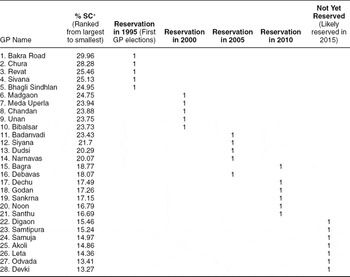
In Rajasthan, electoral officers of each district bureaucracy reserve a fixed number of sarpanch positions before each election according to a rule based on the share of SC population at the panchayat samiti level.Footnote 18 Namely, the total number of gram panchayats (GPs) reserved within each panchayat samiti at each electoral period is proportional to the share of the SC population in the panchayat samiti area. To ensure rotation across GPs in the implementation of reservation, electoral officers have in addition been instructed to rank GPs according to their proportion of SCs and to go down that list, reserving GPs with increasingly small SC populations at each successive electoral period. Following this rule, illustrated in Table 1, the set of reserved GPs systematically differs from each other across electoral periods in terms of their SC population. Online Appendix B provides additional details on the implementation of this rule in each of the panchayat samitis in which the survey took place.
Reservations for the Scheduled Castes in Jalore Panchayat Samiti (Jalore District)

*Based on 2001 Census of India Data
Note: Since members of the SCs constitute less than 20% of the population in Jalore Panchayat Samiti, 5.5 (that is, either 5 or 6) GPs are supposed to be reserved at each electoral period, as is the case here. Assignment to reservation then unfolds in decreasing order, starting with the GPs with the largest SC population share and ending with the GPs with the smallest SC population share.
Given the rules presiding over this rotation, if I randomly sampled GPs within Rajasthan, I would not be able to determine whether the variation in my outcome variables was due to reservation for members of the SCs or to a higher share of SC population within reserved GPs. However, because assignment to reservation depends on this demographic principle, this system enables me to generate a natural experiment on a subset of the data. Namely, I exploited the discontinuity in the implementation of reservation. I selected GPs whose SC population was around—some slightly above, some slightly below—the local threshold for reservation in 2005 (as seen in Table 1, in Jalore this “threshold” was 18.07%). I thus focused on comparisons between two sets of GPs: GPs that were reserved in 2005 (and, given the rules detailed earlier, had never been reserved before) and GPs that were not reserved in 2005 and had never been reserved before.
Practically, to sample the villages, I proceeded in four steps.
-
1. I first selected four districts.Footnote 19 They were purposefully chosen to ensure that different parts of the state would be represented in the sample.
-
2. I then randomly selected four panchayat samitis within each of these four districts.
-
3. Within each of the 16 targeted panchayat samitis, I listed GPs that had been reserved for SCs in 2005 as well as the 5 “never reserved” GPs with the largest share of SC population.
-
4. Selecting from this group of GPs, I formed 8 matched pairs of GPs in each district, for a total of 32 pairs and 64 GPs. In each case the survey team targeted the largest village under the authority of the GP. Footnote 20
Each of these pairs contained one reserved GP and one unreserved GP that were geographically proximate.Footnote 21 Given limited resources, the pair matching was designed to ensure that the targeted GPs were matched on a number of key observables that could potentially affect my outcome variables.Footnote 22 In addition to being matched on SC population at the GP level, selected pairs were thus also matched on the population of their head villages, which the survey targeted, on their relative distance to a city, on caste make-up (a dichotomous variable indicating whether the majority of the non-SC population of the GP belonged to a single subcaste), and the identity of the dominant (i.e, the most numerous) SC subcaste in the GP.Footnote 23
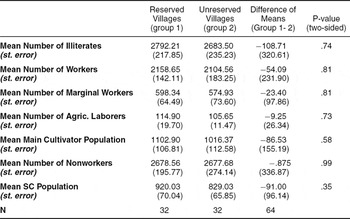
Although this pair matching —detailed in Online Appendix C— allowed me to ensure that selected reserved and unreserved GPs were comparable on a number of key variables, my sampling strategy also guaranteed a more general form of balance. Namely, because these pairs were selected around the local thresholds for reservation, my sample was balanced on a large set of covariates drawn from the census of India. Table 2 and Online Appendix D (Table D.1) show that selected reserved and unreserved GPs are statistically indistinguishable on a large number of village characteristics (including their population of SCs), a necessary condition for a valid natural experiment (Dunning Reference Dunning2008).
Difference of Means between Reserved and Unreserved Villages, with Standard Errors

Note: All analyses at the GP level and based on data from the 2001 census of India.
Sampling Villagers
In each of the 64 villages visited, 12 respondents were interviewed, for a total N of 768 respondents. The surveys were administered in November 2009 to a sample of 12 non-SC individuals within each village. Respondent sampling followed an “as-random-as-possible” procedure within each of the caste-homogeneous units into which Indian villages are divided. Based on information on patterns of settlement in each village,Footnote 24 each interviewer was assigned to survey members of a specific caste group. After being assigned to a specific group, interviewers were “placed” by supervisors in front of a house at one end of their sections and began by attempting to survey that household. They were instructed to subsequently walk toward the other end of their zone and to interview a member of every nth house (the n number depended on caste settlement size) along the way. Within each house, interviewers surveyed the “first available male” (in the absence of female interviewers, no female was interviewed). If no male was available, interviewers were instructed to come back to each house twice before they were allowed to target another household. Proceeding in this fashion, the overall response rate was 67.8%.Footnote 25
Eliciting More Honest Responses: The Interview Process
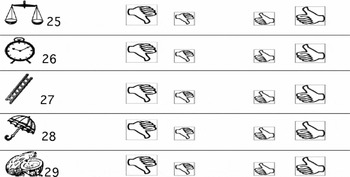
To generate self-reports of untouchability-related beliefs, this study relied on an original MP3-player-based “audio self-administered questionnaire.” In this methodology, respondents reacted to statements made by “villagers like [them] in earlier conversations with the research team” that they heard through the MP3-player's earphones. To note their reactions to those statements, they marked an answer sheet using simple shapes and logos,Footnote 26 a portion of which is reproduced in Figure 1. The answer sheet had as many lines as there were questions in the audio survey, and each line presented respondents with various response choices represented by thumbs. Instructions contained in the instrument detailed what each thumb meant, and a “voice” provided instructions on how and where to react to each statement. Respondents ticked one of the shapes on each line; if they did not know what to answer or refused to respond, they did not tick anything and moved on to the next line. To enable illiterate respondents to identify the line associated with each statement, a logo (in Figure 1, a chair, a tea glass, or a hanger) was mentioned after each statement. Interviewers played a minimal role: After training respondents, they simply pushed the “play” button and sat aside until the audio survey ended. After their return, if respondents requested that a question to be repeated, interviewers used the “skip forward” function. After they completed the audio survey, respondents folded their answer sheets and placed them in a locked box.
The Answer Sheet

This methodology, whose design and implementation are detailed in Online Appendices E and F, was chosen over several alternatives. It was chosen over audio computer interviewing (ACASI), which would likely have attracted unwanted attention and limited our ability to convince older villagers to participate, as determined in a small pretest. This methodology was also chosen over face-to-face interviewing and techniques known to reduce misreporting such as list, survey, and endorsement experiments. The use of recordings had several advantages. First it ensured a perfectly uniform delivery of the survey. It also provided respondents with culturally grounded questions, presented in their local dialect through the reflections of “fellow villagers.” Third, whereas only a limited number of survey or list experiments can be included in an instrument, this methodology allowed me to generate individual-level responses to an extensive series of items, and thus to disentangle various psychological mechanisms. Last but not least, as with other self-administered survey methodologies (Harmon et al. Reference Harmon, Turner, Rogers, Eggleston and Li2009; Tourangeau and Smith Reference Tourangeau and Smith1996), the isolation and the privacy implied by this methodology significantly reduced misreporting.Footnote 27
ANALYSES AND RESULTS
To estimate the impact of reservation on beliefs, I used items from the audio survey featuring a “villager” making a statement related to the SCs. After they heard these statements, respondents were asked, “How much do you agree or disagree with what this villager said?” and were provided with four possible response choices graphically represented by a total of four different “thumbs ups” or “thumbs down”: clearly disagree, somewhat disagree, somewhat agree, clearly agree.Footnote 28
To test for the effect of reservation on stereotypes, I used reactions to two series of statements. I was first interested in measuring whether beliefs about the ability of SCs to play a role in politics had changed. Accordingly, the first series of statements I used directly tap into these beliefs:
-
• “SCs are usually unable to do a good job as sarpanch. They do not have the skills for that.”
-
• “SCs are able to serve as politicians such as MLAs or MPs.”
-
• “SCs do not have ideas on how the village should be run.”
Second, to determine whether reservation had affected more general stereotypes about SCs, I gauged reactions to four additional statements:
-
1. “SCs cannot think for themselves; they usually prefer being dominated by members of higher castes.”
-
2. “SCs usually have low confidence.”
-
3. “Members of the scheduled castes are just as intelligent as other villagers.”
-
4. “Members of the scheduled castes are just as hard-working as other villagers.”
To test whether reservation had affected perceived social norms of interaction with members of the SCs, I used reactions to the following two statements:
-
1. “In this village, if a member of the upper castes says positive things about SCs, then other men from the upper castes would speak about him badly.”
-
2. “In this village, if a member of the upper castes invites SCs to his wedding, then other members of the upper caste would be mad at him.”Footnote 29
Finally, to test whether perceived legal norms of interaction had evolved, I used reactions to the following two statementsFootnote 30 :
-
1 “If an upper caste villager gets into a dispute with an SC villager, then he will be in trouble with the police.”
-
2 “If an upper caste villager opposes SCs during the village meeting, then he will be in trouble with the police.”
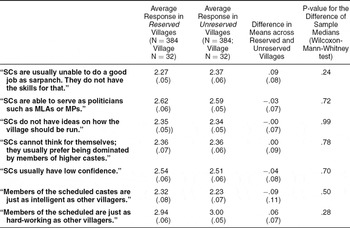
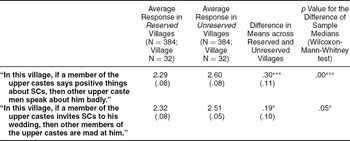
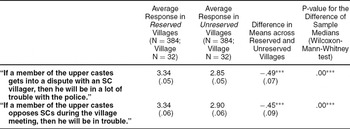
How did reservation affect these beliefs? Because the conditions for a natural experiment were met, I simply compared average responses in reserved and unreserved villages, taking into account the clustered (village-level) nature of the data.Footnote 31 Results from these analyses are presented in the first three columns of Tables 3 to 5. In each case, the first column provides the mean response to each item in reserved villages, along with a standard error; the second column indicates the mean response to each item in unreserved villages; the third column indicates the difference in means between the two groups of villages and indicates the significance level of this difference.
Effect of Exposure to a SC Sarpanch on Stereotypes (1 = Strongly Disagree, . . ., 4 = Strongly Agree)

Effect of Exposure to a SC Sarpanch on Perceived Social Norms of Interaction (1 = Strongly Disagree, . . . ., 4 = Strongly Agree)

*** significant at the .01 level, * significant at the .1 level in a two-sample t-test of cluster means.
Effect of Exposure to a SC Sarpanch on Perceived Legal Norms of Interaction (1 = Strongly Disagree, 4 = Strongly Agree)

*** significant at the .01 level in a two-sample t-test of cluster means.
These differences in means suggest that the experience of reservation does not improve villagers’ stereotypes about members of the SCs. Of the seven items included in Table 3, none of the differences in means are close to usual significance levels, which implies that villagers’ views remain as stereotypical in reserved villages as in unreserved villages. Interestingly, exposure to an SC sarpanch does not even appear to change stereotypical views about the role SCs should or can play in politics. By contrast, Tables 4 and 5 indicate that reservation affects the two other group-related beliefs considered in the previous section. Table 4 suggests that reservation during the period 2005–9 significantly shifted perceived social norms of interaction. Respondents living in reserved villages are significantly more likely to believe that their fellow caste members will not blame them for inviting a member of the SCs into their homes or for talking about a member of the SCs in a positive way. The results presented in Table 5 in turn imply that reservation increased beliefs that hostile behaviors toward members of the SCs would be punished. Respondents living in reserved villages are significantly more likely to perceive that a verbal altercation with a member of the SCs could have problematic legal repercussions.
These results pass a variety of robustness tests. The fourth column of Tables 3 to 5 reports the probability that the difference in medians between the two groups of villagers is not different from zero, as calculated by a nonparametric, two-sample Wilcoxon-Mann-Whitney test taking village clustering into account. These results confirm the parametric analysis: Although stereotypes do not change under reservation, perceived social norms of interaction and perceived legal norms of interaction do evolve. Second, these effects also hold across a wide range of multivariate specifications, which are presented in Online Appendix H.Footnote 32 Third, as can be seen from figures included in the Online Appendix, the effects of reservation detected on the beliefs presented in Tables 4 and 5 hold across subgroups based on age, education, socioeconomic status, or subcaste. In reverse, there exists no subgroup within which stereotypes appear to improve as an effect of reservation.
These results cannot be explained by the fact that reservation may have increased the sensitivity of some survey items. If this were the case, one would expect to observe an effect of reservation on the most sensitive items among those included in the instrument; that is, arguably, on stereotypes about members of the SCs. Instead, that the exact same proportion of villagers agreed that SCs “usually prefer being dominated by members of higher castes” seems to rule out this explanation. In addition, as shown in Online Appendix I, the responses provided by SC villagers of the same villages to comparable items corroborate these findings. As a result, the most credible explanation for these results appears to be that reservation did not change stereotypes, but did change these other group-related beliefs.
If stereotypes were not altered, can it be said that reservation has a positive impact on intergroup relations? To the degree that stereotypes affect the well-being of those they target, their stickiness is bad news. Yet, if behavioral change is the metric according to which we evaluate positive evolution of intergroup relations, the persistence of these beliefs alone cannot lead us to conclude that SC villagers do not benefit from reservation. Because behavioral change may also stem from changes in beliefs about social norms of interactions or about the likelihood of legal sanctions, whether or not reservation improves intergroup relations remains an empirical question. Even though stereotypes did not change, did changes in these other group-related beliefs translate into behavioral changes?
RESERVATION AND UNTOUCHABILITY-RELATED BEHAVIORS
To address this question, this section explores the effect of reservation on the willingness of villagers to engage in several behaviors characteristic of untouchability, the array of hostile practices faced by members of the scheduled castes in rural India. Given the ethical and practical challenges posed by collecting individual-level data on hostile behaviors, I focus in what follows on behavioral intentions—the class of attitudes viewed as the most direct causal antecedent of behaviors (Ajzen and Fishbein Reference Ajzen, Fishbein, Albarracín, Johnson and Zanna2005).Footnote 33 To measure these behavioral intentions, I rely on the audio methodology described in the third section.
As theorized by the literature on untouchability in contemporary India (Deliege Reference Deliege1999; Macwan et al. Reference Macwan, Davenport and Stam2010; Shah et al. Reference Shah, Mander, Thorat, Deshpande and Baviskar2006), there are several important behavioral dimensions of untouchability. In addition to the most well-known aspect of untouchability (segregation in most aspects of village life), it entails the performance of publicly visible acts of intimidation or humiliation, such as the imposition of gestures of deference on SCs or abuse against members of the SCs whose behavior is perceived as excessively assertive. Moreover, untouchability is almost always associated with exclusion or noncooperation in socioeconomic activities.
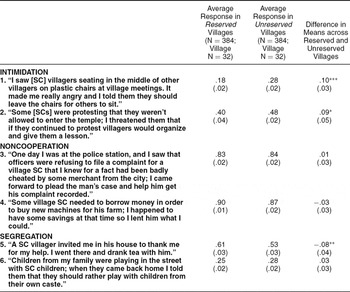
To make inferences on which of these dimension(s) of untouchability are affected by reservation, the MP3/ASAP survey measures the propensity of villagers to engage in behaviors associated with each of these three dimensions: intimidation, noncooperation, and segregation. To measure whether reservation affected upper caste villagers’ readiness to intimidate SC villagers, the first two statements of Table 6 measure the propensity of respondents to publicly threaten members of the SCs. Because SC villagers often remain excluded from village-level solidarity networks, statements 3 and 4 measure the propensity of respondents to cooperate with a fellow SC villager looking for help. Finally, statements 5 and 6 of Table 6 measure the propensity of villagers to enforce physical segregation between SCs and non-SCs. Although these three dimensions do not cover all untouchability-related situations in daily village life,Footnote 34 they encompass a variety of common behaviors in which the target population of this study may engage.
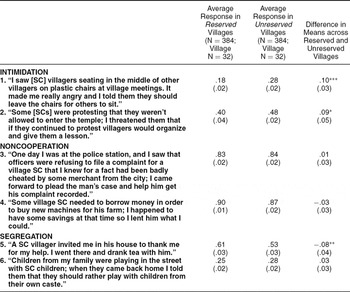
Effect of Exposure to a SC Sarpanch on Untouchability-Related “Behavioral Intentions” (1 = Yes, 0 = No)
*** significant at the .01 level, ** significant at the .05 level, * significant at the .1 level in a two-sample t-test of cluster means.
After they heard each statement, respondents were asked, “If you were in a similar situation today, would you behave like that villager?”, a question to which they could answer either yes (by marking a thumb-up symbol) or no (by marking a thumb-down symbol). I then compared the proportion of yes responses in reserved and unreserved villages, taking into account the clustered (village-level) nature of the data. Results from these analyses are presented in the first three columns of Table 6. In each case, the first column provides the mean response (that is, given the binary nature of the data, the proportion of yes responses) in reserved villages, along with a clustered standard error; the second column indicates the mean responses to each item in unreserved villages; the third column indicates the difference in proportion between the two groups of villages and the significance level of this difference. As earlier, to account for the clustering of the data, t-tests were on the basis of cluster means in reserved versus unreserved groups.Footnote 35
These analyses suggest that reservation may affect villagers’ willingness to verbally abuse members of the SCs and to enforce physical exclusion against them. Although the variation in the prevalence of each reported behavior corresponds to levels measured in other works on untouchability (Shah et al. Reference Shah, Mander, Thorat, Deshpande and Baviskar2006),Footnote 36 these data also highlight the specific effect of reservation: Respondents in reserved villages are much less likely to report that they would engage in verbal violence or threats against members of the SCs who transgress traditional norms of interaction; responses to the “village meeting” item and to the “temple entry” item suggest that respondents are significantly less likely (at the .01 and at the .1 level, respectively) to ask that SC villagers not sit among other villagers at village meetings and to say that they would abuse an SC villager who transgressed traditional norms of interaction and entered the village temple. They are also more likely to report that they would accept tea from a member of the SCs (significant at the .05 level). Although only three of the difference in means are significant after taking village clustering into account, the signs on other differences in means point in the same direction. Altogether, these results imply that reservation may ease caste relations.
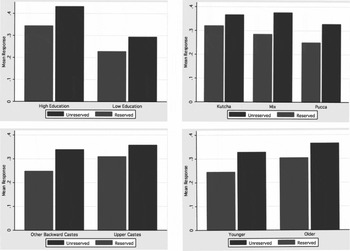
As may be seen from the full models reported in Online Appendix K, the effects I detect hold in multivariate probit specifications, including a diversity of village- and individual-level characteristics, as well as various clustering options.Footnote 37 As can be seen from Figure 2, these effects also exist across most theoretically important demographic groups within the non-SC population: Although the magnitude of the effect differs, there are differences in response between young and old respondents, educated and uneducated respondents, and respondents with a high and low socioeconomic status. Finally, among non-SC villagers, these effects exist both among members of middle castesFootnote 38 and upper castes. Although these results do not imply that reservation overturned the nature of intercaste relations, they nonetheless suggest less open hostility in a number of everyday situations.
Mean Proportion of Respondents Who Provided a Hostile, Discriminatory, or Uncooperative Response across the Six “Behavioral Intention”
Note: Items Included in Table 3, by Subgroups (by Education, Type of house, Subcaste, and Age), across Reserved and Unreserved Targeted Villages (based on a scale composed of the six behavioral intentions items included in Table 6)Footnote 40

DISCUSSION
How do these striking results on behavioral intentions relate to the other results presented in this article? Taken together, these results suggest that exposure to an SC sarpanch could improve interpersonal relations even if stereotypes about members of the SCs remain unchanged. Although mechanisms that this study could not test may also be at work, the results presented in this article thus suggest that less obvious psychological mechanisms explain why villagers update their behavioral intentions under reservation. Behaviors may first improve because upper caste villagers sense that social norms of interactions with SC villagers are evolving around them.Footnote 39 Perceptions that social norms of interactions are changing may derive from the nature of reservation itself, because it brings about actual changes in patterns of interaction with at least one member of the SCs. Once non-SC villagers engage in new forms of interactions with at least one member of the SCs, they may also practice less discrimination against other members of the SCs, especially if those members belong to the family or the subcaste of the sarpanch. In other words, reservation may decrease the social cost of engaging in contra-normative behavior with members of the SCs precisely because it requires additional intercaste interaction.
Most importantly in light of the strong results detected on the intimidation items in Table 6, reservation may change behaviors by spreading the perception that discriminators cannot expect the same impunity as before. As mentioned earlier, SC sarpanchs’ only have a limited ability to intervene or pressure the police to defend members of their community when a caste-related incident occurs. They are, however, likely to be seen as having the ability to reach out to powerful political actors who could bring discriminators to justice. This is a potentially important consequence of ethnic quotas: By creating new political linkage—or patronage—between an otherwise isolated community and local elites, quotas ensure that this community will receive better protection from the state and, almost as importantly, that it will be perceived as having protection.
My design does not allow me to determine which of these perceived norms of interactions (social or legal) drives the effect on behavioral intentions. An explanation based on changes in these beliefs, however, does appear more credible than a number of alternatives. These results cannot be explained by the fact that upper-caste villagers may have felt more pressured to provide less discriminatory responses in reserved villages. Acts of discrimination continue to happen on a regular basis in both sets of villages, and SC sarpanchs generally have little power or incentives to act against instances of mundane verbal hostility. Upper caste villagers with whom I interacted in reserved villages never appeared to feel strongly pressured to refrain from making discriminatory statements compared to villagers living in unreserved villages. They regularly made extremely prejudiced comments about SCs, about their own beliefs about intercaste relations, or about the way they had behaved with SC villagers. Among those few villagers who refrained from making such negative comments, nothing suggested that their more moderate outlook owed to reservation. In addition, assuming that respondents in reserved villages felt pressured not to discriminate, the survey methodology used in this study would have limited this pressure. Because it increased the confidentiality and the privacy of responses, the MP3 self-administered methodology ensured that interviews were taking place in a relatively similar social context across reserved and unreserved villages. As shown in Chauchard (Reference Chauchard2013), the use of earphones isolated respondents from their social environment and limited the chance that respondents would feel strongly pressured by their interviewer or by a third party or that this pressure would have been consistently different across reserved and unreserved villages. Finally, for my results to be caused by increased sensitivity in reserved villages, respondents in reserved villages would have had to consider that some items were more sensitive than others. Namely, that purported behaviors were more sensitive than stereotypes, a hypothesis that can be opposed on several counts. First, the fact that overall levels of untouchability remained high—including in reserved villages—seems to disprove the idea that villagers could feel strongly pressured when responding to any kind of question. Second, it is unclear why we should theoretically expect stereotypes to be less rather than more sensitive than behavioral intentions under reservation. This may especially be the case of stereotypical statements directly related to the presence of a SC as sarpanch, which we may instead expect to be more sensitive than those behavioral intentions items less directly related to reservation. The fact that the same proportion of villagers in reserved and unreserved villages agreed with the statement that SCs “usually prefer being dominated by members of higher castes” undermines the idea that reservation would add any pressure at all. Third and finally, even if social desirability were the cause of the effects detected on behavioral intentions, this would not explain the effects on beliefs about norms, which are presumably not subject to social desirability.Footnote 41
A second explanation may also be dismissed. I have until now assumed that the attitudes of villagers from unreserved GPs corresponded to a “baseline” level. This, however, remains an assumption, and in the absence of a baseline level of prejudice known before polling villagers, these results may be turned around and interpreted to mean that the attitudes of villagers who did not experience a SC sarpanch worsened, and not that the attitudes of villagers who did experience it improved. This could especially be the case if villagers who anticipated that their village would be reserved for an SC became more hostile toward SCs in the run-up to this transition. This possibility, however, seems equally unlikely; even if the rotation principle that accompanies the reservation process meant that all surveyed villages that were not reserved at the time of the survey would become reserved a few months after its completion (for the 2010 elections), villagers were almost universally unaware of that information. Villagers have little idea of the complicated rules that govern the reservation process—and usually have no access to the demographic data used to determine which GPs are reserved at each electoral round. Hence they could not have confidently assumed that their village was about to be reserved.
Finally, and most importantly, these results cannot be explained by the fact that members of the SCs might have self-selected into reserved villages. As shown in Online Appendix L, this hypothesis is implausible for several reasons. First, Tables L.1 and L.2 show that the correlation implied by this alternative explanation—that the proportion of SCs would be correlated with more positive attitudes—does not hold in my sample. Second, migratory patterns make this scenario relatively unlikely: Migration rates to the rural areas of Rajasthan are very low, especially among members of the SCs. In addition, my data allow me to show that this scenario is implausible in my sample. Using village-level data from the 1961 census of India, Table L.3 shows that the proportion of members of the SCs in reserved villages was already higher than the proportion of members of the SCs in unreserved villages in 1961, and hence, that no major migrations toward reserved GPs had taken place in my sample since then. Although these points do not entirely eliminate the possibility that SCs may have historically self-selected into reserved GPs, they at least undermine the basis for such arguments.
Given their robustness with respect to these alternative explanations, these results suggest that descriptive representation can play a promising role in improving interpersonal relations. However, because respondents were drawn from a relatively restricted population (male villagers from 64 villages of one Indian state), it is important to delineate in precise terms the external validity of these findings.
There is no obvious reason to think that these results derive from specific characteristics of the sample of gram panchayats in the study. The 64 selected GPs encompassed a variety of types of caste make-up and intercaste dynamics. Yet they also resembled many other potential sets of GPs—within and outside of Rajasthan—in the way reservation has been implemented, in their hierarchical caste-based social structure, and in their level of development. Because the research team only targeted “head villages” within these gram panchayats, it is likely that these results overestimate the effect of reservation in smaller villages in which sarpanchs are rarely seen and play a less important role. Although the fact that effects do exist in “head villages”—in which a plurality of villagers live—remains a striking finding, it is important to note that these effects could be attenuated by the much criticized structure of GPs.Footnote 42 In addition, because of practical reasons the survey team only interviewed male respondentsFootnote 43 and hence focused on discriminatory behaviors associated with male villagers, it remains to be proven whether reservation would have a comparable effect on female respondents and on discriminatory behaviors associated with female villagers. Because women are traditionally more distant from political processes, we may expect that reservation would have had less of an impact on them, at least in the short term. Further research will need to determine whether this is the case.
Several characteristics of local-level political institutions in the state of Rajasthan also affect the external validity of these findings. It is likely that reservation would not have the same effect on perceived social norms in those Indian states in which sarpanchs are given a less central and executive role. In thinking beyond the Indian context of this study, several characteristics of sarpanchs are worth emphasizing. Their visibility and their accessibility, for instance, likely play a role in determining these effects on perceived norms. In that sense, descriptive representation should be expected to have a larger effect on interpersonal relations when implemented at the local level. Similarly, it likely matters that sarpanchs have de facto veto powers. One may thus hypothesize that descriptive representation would remain inconsequential unless it is accompanied by substantial executive powers. Finally, these results suggest that the inexperience of these officials—which often makes them the object of ridicule—may not prevent them from changing the nature of interpersonal relations.
Although further research is needed to confirm these intuitions, the results presented in this article constitute an important addition to the empirical literature on the impact of descriptive representation. This literature, which has so far largely focused on India and the United States, has mostly focused on the redistributive (Chattophadhyay and Duflo Reference Chattopadhyay and Duflo2004; Dunning and Nilekani Reference Dunning and Nilekani2013) and political (Bhavnani Reference Bhavnani2009; Gay Reference Gay2001; Hajnal Reference Hajnal2001) consequences of descriptive representation. This study, by contrast, shows that there are more unexpected consequences of a disadvantaged ethnic group's access to political office; namely, that this group's access to political representation can have important psychological and behavioral repercussions among members of dominant groups. Building on the intuitions of India scholars that the lower castes’ access to political power triggered “symbolic social change” in intercaste relations (Jaffrelot Reference Jaffrelot2003; Jeffrey et al. Reference Jeffrey, Jeffery and Jeffery2008, pp. 1372; Krishna Reference Krishna2003; Pai Reference Pai2002; Weiner Reference Weiner2001), and in line with recent contributions about the transformative impact of gender quotas in the country (Bhavnani Reference Bhavnani2009; Beaman et al. Reference Beaman, Chattopadhyay, Duflo, Pande and Topalova2009; Iyer et al. Reference Iyer, Mani, Mishra and Topalova2011), this article provides innovative quantitative evidence suggesting that ethnic quotas matter for intergroup relations.
Although the concrete empirical applications of these results may be limited (reservation-type quotas after all exist in relatively few countries), these results more generally inform the theoretical debate on the rationale for descriptive representation in politics (Mansbridge Reference Mansbridge1999; Phillips Reference Phillips1995; Williams Reference Williams1998). To the extent that changes in discriminatory patterns affect both the short- and long-term well-being of members of disadvantaged groups, these results open the door to a different justification for institutional efforts to enhance descriptive representation. If a stigmatized group's access to political representation can trigger such changes in interpersonal relations, descriptive representation may be beneficial to members of that group regardless of its redistributive or political impact.
Beyond the literature on descriptive representation, these results contribute to several debates across the social sciences. First, they inform the debate on strategies to reduce stereotypes, prejudice, and discrimination. In line with Allport's intuition (Allport Reference Allport1954) and with most recent studies (meta-analyzed in Talaska, Fiske, and Chaiken Reference Talaska, Fiske and Chaiken2008), these results confirm that evaluative stereotypes of stigmatized groups do not often correlate with indices of discriminatory behaviors toward members of these groups. In line with a host of other works (Blanchard et al. Reference Blanchard, Crandall, Brigham and Vaughn1994; Paluck Reference Paluck2009; Paluck and Shepherd Reference Paluck and Shepherd2012), these results by contrast suggest that changes in perceived social norms may constitute a major avenue through which attitudes and behaviors may change. Thus, public policies that incentivize new norms of intergroup contact and interaction—in political institutions and elsewhere—may be seen as particularly valuable.
Insofar as they imply that ethnic quotas increase the likelihood that individuals comply with existing laws, these results also provide an interesting counterpoint to the literature on citizen compliance. Scholars in this tradition have emphasized the need for legitimacy-based voluntary compliance (Levi Reference Levi1988; Levi and Sacks Reference Levi and Sacks2007; Levi, Sacks, and Tyler Reference Levi, Tyler, Sacks, Goodman, Jenks and Woods2009). Focusing on a context in which both the legitimacy of government and the legitimacy of antidiscrimination laws are low, this study, by contrast, implies that compliance may derive from changes in the perceived likelihood of punishment rather than in changes in the perceived legitimacy of government. The role played by the perceived response of local authorities in this argument suggests that deterrence—rather than perceived legitimacy—remains an important motivation of compliance. Political quotas may thus play an underappreciated role: Because they provide a disadvantaged group with institutional and/or political linkage, they ensure that members of that group benefit from the basic protections to which they are entitled by law, and hence that the most hostile behaviors toward them are deterred.
Supplementary materials
To view supplementary material for this article, please visit http://dx.doi.org/10.1017/S0003055414000033




Comments
No Comments have been published for this article.