Photo archives can be dusty and difficult to access but they can also be the stuff of time travel. Thanks to the art historical photo archives in the international consortium of 14 European and North American institutions that constitute PHAROS, it is possible to assess the various states of physical integrity of a sculpture captured at different points in time, for example. The evidence born by these black and white photographs can provide much needed support to advance a hypothesis on the conservation treatment of a work of art, or answer questions about an object's provenance by documenting its presence at an exhibition. These archives are also a valuable snapshot of the canon of art history in the early part of the 20th century as they encapsulate the taste and connoisseurship of their time. In short, they are an invaluable resource for researchers, and PHAROS aims to leverage digital technology to make them available to today's audiences.
The nature of the PHAROS initiative, however, is different from that of the individual research institutions where the physical photo archives are still housed. PHAROS is a consortium that is developing a single digital research platform allowing for comprehensive consolidated access to photo archive images and their associated scholarly documentationFootnote 1. This collaborative approach means that the focus is on supporting search and discoverability across all 14 partners from a single access point. The other guiding principle of the collaboration is that the solution adopted must work well for all its members, no matter how much data or how many photo archives each of these partners can contribute to the consortium's platform. Given these two requirements, it makes sense that interoperability be at the heart of the project. And in fact, PHAROS’ adoption of open standards, such as the Linked Art data modelFootnote 2 and the International Image Interoperability Framework (IIIF), speaks volumes to the role of interoperability in the projectFootnote 3.
These open standards are the products of collaborations themselves and are based on existing standards and established community practices. As such, Linked ArtFootnote 4 is a profile of the CIDOC Conceptual Reference Model (CIDOC CRM)Footnote 5, which is itself the product of many years of analysis of museums’ practices moderated by the International Committee for Documentation (CIDOC)Footnote 6. CIDOC CRM introduces an event-based paradigm to describe the world, which is different from most traditional cultural descriptive practices that focus closely on the object or the intellectual work that it carries. This approach creates a network of activities related to the object that can be used for meaningful connection with other objects, people, places and content. But where the CIDOC CRM is a rich and vast ontology that ‘provides definitions and a formal structure for describing the implicit and explicit concepts and relationships used in cultural heritage documentation’, the scope of Linked Art is more focused. It is a data model or application profile that uses only a few of the available classes and properties that constitute the CIDOC CRM semantic framework with the aim to describe museums’ art collections. It combines these with recommendations about terminology, modelling patterns, and distribution formats to create a comprehensible, implementable and usable framework. Linked Art is also based on the experience of previous collaborative Linked Open Data (LOD) initiatives, such as the American Art CollaborativeFootnote 7 and others. One such learned lesson is that the lack of entry-level technology and ontology resources have prevented museums from engaging more deeply with Linked Open Data to leverage their collections descriptions. This finding led, in part, to the creation of the Linked Art community.
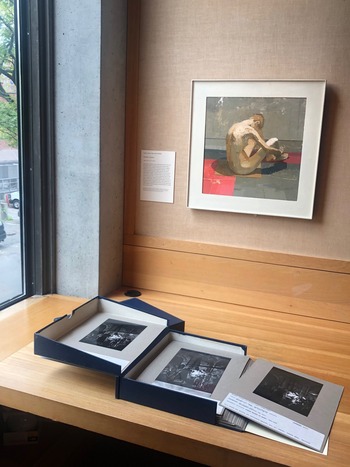
Yale Center for British Art's photo archives box containing works by Joseph Wright of Derby below Double Square, 1999 to 2000, Euan Uglow, oil on canvas, Yale Center for British Art, Gift of Dorothy C. Weicker in honor and memory of her parents, Beatrice Trostel and Frederick E. Weicker, Yale, Sheffield Scientific School, Class of 1931. Image courtesy of Emmanuelle Delmas-Glass.

Indeed, the notion of community is critical to Linked ArtFootnote 8. The Linked Art community wants to encourage and educate museum professionals to engage with the CIDOC CRM, Resource Description Framework, and Linked Open Data. To support this goal, Linked Art is developing an international network of scholars, collection managers, technologists, curators, ontologists, systems architects, provenance researchers, and metadata experts to document best practices and provide museum professionals with the opportunity to develop their knowledge of the CIDOC CRM and the Semantic Web in general. The specific intention is to lower the barrier of participation in LOD initiatives for museums. Linked Art recognises the tension between mission and resources currently affecting cultural institutions. Namely, while not all museums can have a data scientist or an ontologist on staff, it is hugely important that museums become more agile with Linked Open Data techniques because it is the vehicle that will best make available the richness of their knowledge. The mission of cultural heritage institutions is to share knowledge effectively to further scholarship and it is important that they participate in the development of the framework that disseminates their knowledge in the Semantic Web. The networked ecosystem is an opportunity that can contribute to museums’ relevance to future audiences, especially as more art historians are becoming well versed in Digital Humanities techniques. Further, cultural heritage institutions want to go beyond publishing their knowledge as siloed webpages. They want to be a part of the Web, rather than just on the Web. They want to link across institutions through deep semantic connections, they want to enable shared cataloguing, reuse and leverage the knowledge developed by peer institutions. They want to be able to tell richer stories about their objects, afforded by the larger context of the lives of other collections. Linked Art aims to provide museums with the semantic framework and Web technology expertise to fulfil their ambition, without needing specific experts as part of their permanent staffing. The solution, however, must be a highly collaborative one between museums and technologists because cultural knowledge is complex, rich and unique. It constitutes a corpus that is highly dependent on the context of the collections that cannot be programmatically transmitted to technologists without critical semantic loss. Additionally, because Linked Art is a collaborative effort to find shared solutions, it needs to be sustained by real world use cases that are backed by existing data, rather than academic musings. Today, Linked Art continues to evolve and mature as a data standard thanks to the feedback of early adopters such as Linked Conservation DataFootnote 9, and of course PHAROS, and will continue to grow with the complexity of the use cases submitted.
One of the driving design principles of the Linked Art data model centres around a notion well known to data managers: data that is not reused is not delivering on its return on investment promise. For example, if a piece of data from a Collections Management System is not used several times – in an internal report or a public facing application, such as an online collections catalogue or programmatic data endpoint – then the value of that data is questionable. Similarly, the Linked Art data model is designed to make sure that the resulting datasets encoded with its framework can be easily reused by developers. This principle means that Linked Art favours data usability over absolute data completeness. Data accuracy is of critical importance to museums and it is to the Linked Art data model as well, however, the latter is also cognizant of the danger of trying to account for all and every scenario that may happen in the life of an object. Instead, Linked Art is gathering consensus around a shared data model that provides a solution for 90 percent of real-world use cases. In other words, Linked Art provides shared data modelling solutions for most traditional scenarios that cataloguers encounter when describing an object and the events it is part of, such as its production, publication, provenance, exhibition, publication, and representation in digital objects. It then allows for local extensions to complete the remaining 10 percent of use cases that may be institution-specific, or very complicated to describe. The use of consistent patterns applied in consistent ways to describe these activities, backed up with good documentation packed with examples able to be cut-and-paste into systems, makes for ‘developer happiness’. The predictability of the data model ensures that this important audience of the data model can build practical and interoperable solutions using it. Linked Art is, thus, a Linked Open Usable Data model that achieves the balance between the requirements of the domain knowledge experts and the technologists that need to implement it.Footnote 10
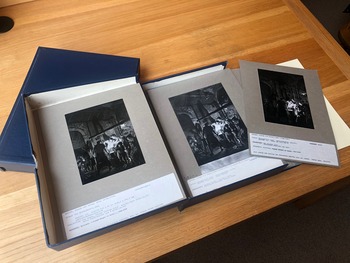
Yale Center for British Art's photo archives box containing works by Joseph Wright of Derby. Image courtesy of Emmanuelle Delmas-Glass.

Generally speaking, there are a limited number of types of entity:
• Physical Objects (such as statues or buildings)
• Information Objects (such as digital files or conceptual works)
• Actors (such as people or organizations)
• Places (such as museum locations or countries)
• Times
• Types (such as concepts, languages or currencies)
• Activities (such as Production or Acquisition of an object)
These core entity types are then linked together via relationships, following some core patterns for consistency and comprehensibility.
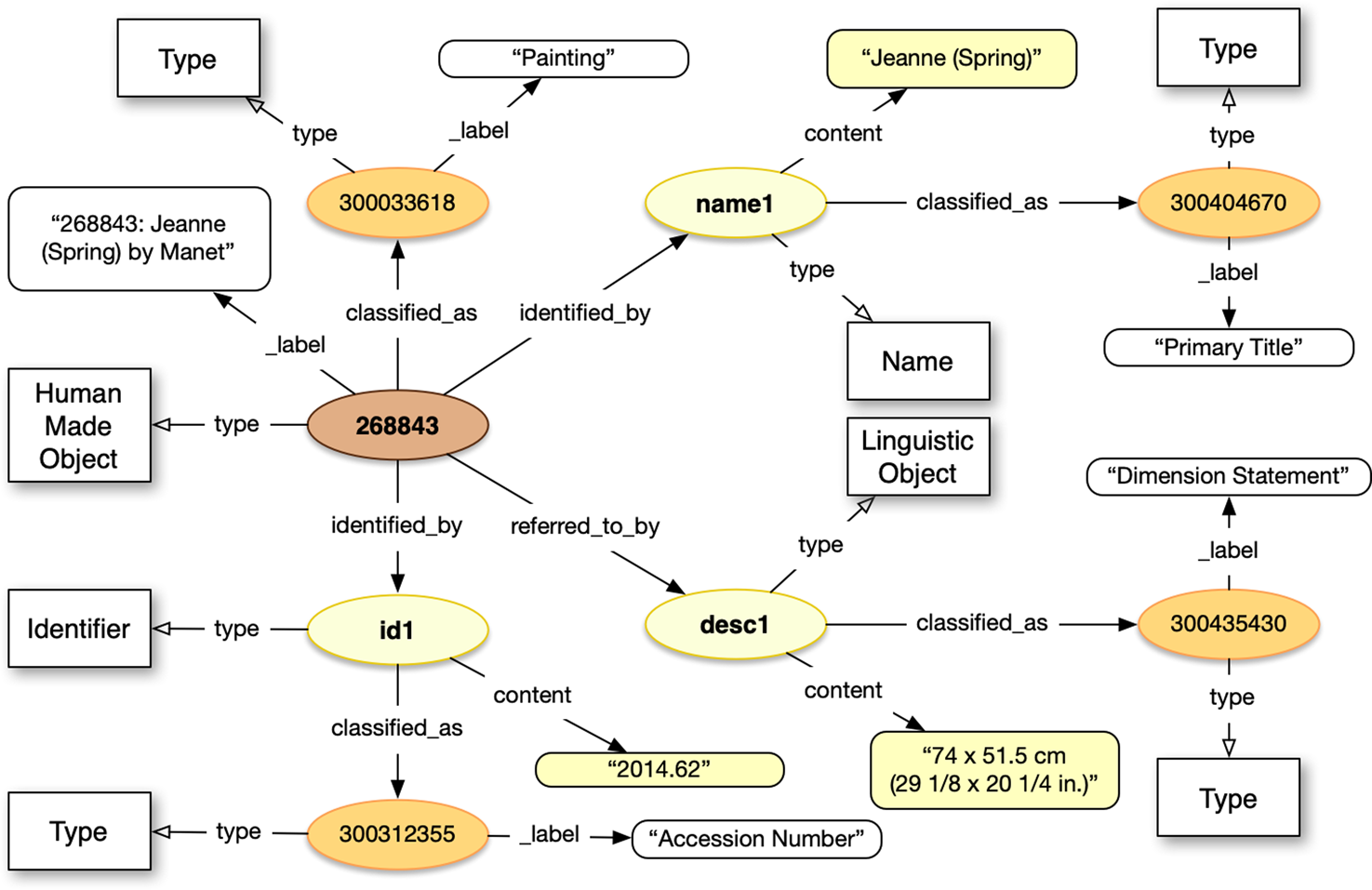
There are four, inter-related core patternsFootnote 11 that form the baseline of the Linked Art model: specific classification of higher level types, naming and identifying things, statements about things, and partitioning resources into more specific components. The first pattern involves assigning a vocabulary term to clarify the type of an entity from a general class down to a museum-domain level of specificity. For example, a painting in CIDOC-CRM is an instance of the Human-Made Object class, which we then add a classification of aat:300033618, labelled ‘paintings (visual works)’, to add the information that it is a painting, not just any object. The same pattern is used throughout the model.
Secondly, every entity should have a name data structure associated with it. The name is not just a string, but can have properties and relationships, such as a language or where the name was discovered in primary or secondary source literature. Names are thus specific to the entity, meaning that different names must be able to have the same string content. The same applies for identifiers such as accession numbers. Expanding from naming, there is also a requirement to describe entities and their relationships in human readable prose. These notes, descriptions and statements follow the same pattern as names, however are related via the ‘referred to by’ property rather than ‘identified by’. These two patterns allow us to comprehensively include all the information held in collection management systems as strings intended to be read by humans, but with domain-specific classifications associated with them for clarity for machines.
The fourth common pattern is the beginning of the transformation from human-oriented text, to machine- and research-oriented data. In order to describe details of an object or activity, we need to have specific entities for different parts to associate those details with. For example, the material statement ‘Oil on Canvas’ assumes that there is at least a part of the painting made with ‘Oil’ and another part, classified as the support, which is made of ‘Canvas’. Similarly, if there are multiple people contributing to the production of the object, such as a sculptor and a painter for a painted statue, then the activity of producing the object is split into two parts, the sculpting followed by the painting.
The following diagram exemplifies the first three patterns, with a name and identifier for a black figure neck amphora, a description of its dimensions, and classifications on all of the resources. This object could then be depicted in a photograph in a photo study archive in one or more of the PHAROS consortium partners’ collections. The use of Linked Open Data allows the description of the depicted object to be managed and maintained by a separate organization from the catalogues of the photographs of it.
The existence of the Linked Art data model opens the door to many opportunities for PHAROS, especially as the group of research institutions wishes to offer more than any one of its single institutions can. For example, the harmonised knowledge graph resulting from the adoption of Linked Art will allow scholars to ask research questions that could only be hypothesis before, such as what images were reproduced multiple times and are now held in multiple PHAROS photo archives, and what negatives they were produced from. Because the Linked Art data model is currently developing a strategy to help with the LOD expression around provenance scenarios, PHAROS hopes to become a hub for research on the study of ownership history.
Linked Art design principles. Diagram courtesy of Robert Sanderson.

The Linked Art data model is particularly well suited for cultural heritage initiatives that aim to leverage Linked Open Data in the most efficient way. It allows individual institutions to focus on producing the best knowledge and data that they can while using a data model collaboratively agreed on by museums based on the most common real-world use cases. The Linked Art data model is also designed with developers in mind. The model offers documentation with many examples to disambiguate its semantic framework and its use of consistent patterns reduces the complexity of the model and ensures the performance of applications built on it.