Introduction
Alzheimer's disease (AD) is the most common cause of dementia in people over 65, affecting around 30 million people worldwide, a number that is anticipated to increase fourfold in the next 40 years (Jalbert et al., Reference Jalbert, Daiello and Lapane2008; Holtzman et al., Reference Holtzman, Morris and Goate2011). The assessment of cognitive decline in AD has been the focus of a great deal of research in recent years (Holtzman et al., Reference Holtzman, Morris and Goate2011).
Assessment of severe cognitive impairment is very important in geriatrics, especially in the context of administrating interventions. Neuropsychological assessment, along with clinical examination, provides a reliable and valid evaluation of the degree of cognitive decline in dementia. There are four approved treatments for AD, three cholinesterase inhibitors (donepezil, rivastigmine, and galanthamine) and memantine, an NMDA receptor antagonist (Ballard et al., Reference Ballard2001). Clinical trials for memantine and donepezil have used the Severe Impairment Battery (SIB) in conjunction with other tests to distinguish mild from more severe dementia (Tariot et al., Reference Tariot2004; Wilkinson and Andersen, Reference Wilkinson and Andersen2007; Riordan et al., Reference Riordan2011).
The aim of this study was to develop and validate a Greek version of the SIB (Panisset et al., Reference Panisset, Roudier, Saxton and Boller1992) in patients with mild, moderate or severe AD, compared to the Mini-Mental State Examination (MMSE; Folstein et al., Reference Folstein, Folstein and McHugh1975), the most widely used bedside cognitive measure.
Methods
A convenience sample of patients and controls from was recruited from: (1) the Psychogeriatric Outpatient Unit of the 3rd Department of Psychiatry of A.H.E.P.A. University Hospital, (2) the Psychogeriatric Outpatient Unit of the 1st Department of Psychiatry University Clinic in Papageorgiou General Hospital, and (3) several elderly care homes. The University's bioethics review board oversaw the research. Patients participated in the study based on written informed consent from their immediate family. Control participants personally provided written informed consent for participation.
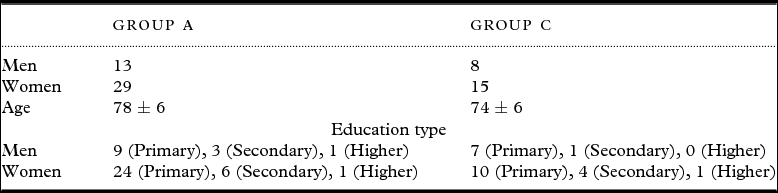
Criteria for the inclusion were the ability to read and write Greek before the onset of dementia. Also, participants had to have adequate vision and hearing and no prior treatment for dementia. A total of 73 elderly patients were assessed for inclusion. They underwent a full assessment with clinical history, physical and neurological examination, and recent neuroimaging (CT or MRI) to exclude non-AD types of Central Nervous System (CNS) pathology. Additional investigations were carried out when necessary (e.g. complete blood count, serum B12 or folic acid, thyroid hormone levels, routine biochemical tests). Patients were also assessed on the Clinical Dementia Rating (CDR) a measure of dementia severity and global CDR score of five levels of impairment (0 = no dementia, 0.5 = questionable, 1 = mild, 2 = moderate, 3 = severe) (Morris, Reference Morris1993; Marin et al., Reference Marin2001), and the Hachinski Ischemia-Scale (Hachinski et al., Reference Hachinski1975; Fischer et al., Reference Fischer, Jellinger, Gatterer and Danielczyk1991) to assess vascular burden. Only patients meeting criteria for dementia by Diagnostic and Statistical Manual of Mental Disorders, 4th edition text revision (DSM-IV-TR; American Psychiatric Association, 2000) and AD by the NINCDS-ADRDA criteria (McKhann et al., Reference McKhann1984), with a score <4 on Hachinski scale were included. The final group of 42 AD patients (A) comprised 13 men and 29 women with a mean age of 78 ± SD 6, mostly with primary education (mean duration of education was 6.4 ± SD 3.2 years).
Twenty-three individuals, who after similar assessment had no dementia according to the DSM-IV-TR criteria, were the control group (C). Controls (8 male 15 female) were free of neurological or psychiatric symptoms and of comparable age (74 ± SD 6 years with an average education of 7.2 ± SD 2.9 (Table 1).
Demographic information for both groups

SIB (Panisset et al., Reference Panisset, Roudier, Saxton and Boller1992) contains nine subscales assessing the following cognitive functions: memory, attention, language, orientation, praxis, visuospatial perception, constructional ability, attention, and social interaction. Language proficiency assessment includes naming, fluency, reading, repetition, and writing. SIB comprises 57 questions that maybe accompanied by non-verbal signs to promote automatic responses and has total score between 0 and 133. SIB is administered in a manner that facilitates the patient and makes him/her feel s/he is not under an examination.
SIB was translated into Greek, from the original French under permission (Panisset et al., Reference Panisset, Roudier, Saxton and Boller1992), in collaboration with a professional French translator. Both the features and structure of the test were maintained in the original format, paying careful attention to the chosen vocabulary so as to be easily understood by patients, regardless of educational background.
An important parameter in the clinical use of tests is their duration. Neuropsychological tests that exceed thirty minutes are hard for dementia patients to complete as they frequently develop from fatigue or poor concentration. The average duration of the Greek SIB was 21 ± SD 4 minutes, similar to the original French (Panisset et al., Reference Panisset, Roudier, Saxton and Boller1992), Italian (Pippi et al., Reference Pippi1999), or American versions (Swainson et al., Reference Swainson2001).
Patients were first assessed on the Greek MMSE (Fountoulakis et al., Reference Fountoulakis, Tsolaki, Chantzi and Kazis2000) and then on the Greek SIB. Both tests were repeated after an interval of about one week, and an average score was calculated. The SIB questions were repeated as necessary. Answers that were partially correct and correct non-verbal responses were taken into account.
Patients were tested at a specific time of day, after breakfast or lunch, provided they were in good health. For inpatients and patients in primary care testing took place at the site of their daily activity. The controls were tested during a scheduled appointment at the clinic.
Statistical analysis was performed with GraphPad PRISM (Ver. 5), while graphs were prepared with Microsoft EXCEL 2010. The Mann-Whitney U test and Spearman correlation were used to test for significant differences in the total SIB and Greek MMSE scores. The validity of the SIB was determined by calculating the Spearman correlation coefficients between the SIB and the Greek MMSE, as grouped by CDR scores. Cronbach's coefficient α and item-total correlation coefficients were generated to examine the internal consistency of the SIB. Spearman correlation coefficients were generated to evaluate test-retest reliability. The Mann-Whitney U test was used to assess the differences in the mean SIB total score for the various CDR stages. Statistical significance cut-off was set at p < 0.05.
Results
Patients and controls did not differ significantly in age or education (Table 1). For validity purposes SIB scores were compared to MMSE scores across CDR score groups. The validity of the Greek SIB was examined by comparing the total SIB score with the total Greek MMSE, and CDR scores (Table 1). Spearman's ρ between the SIB and the Greek-MMSE was 0.802 between the SIB and the CDR was –0.957 and between the Greek MMSE and the CDR was –0.801 all with a p < 0.000 (two-tailed).
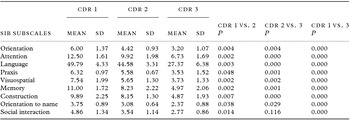
Mann-Whitney U tests between the three CDR groups of the SIB scores show the statistical significance difference between the three groups in each of the Sib subscales with the exception of Social interaction between moderate (2) and severe (3) CDR (Table 2).
Mann-U tests for SIB by CDR

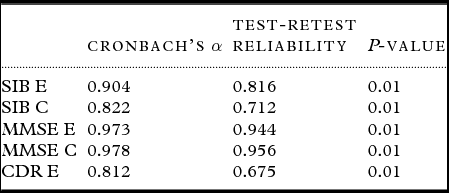
The Cronbach's coefficient α was used as a reliability measure. The Cronbach's coefficient α and item-total correlation coefficients were generated to examine the internal consistency of all the tests used. Test-retest reliability was also tested for all given tests. The test-retest correlations for the total SIB, MMSE and CDR scores were statistically significant (Table 3).
Validity and reliability measures for all given tests

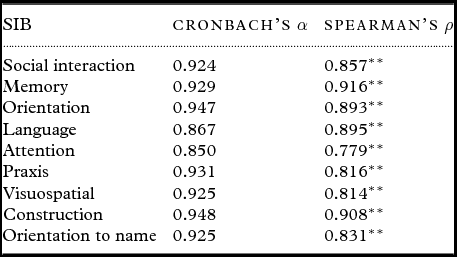
The Cronbach's coefficient α of the total SIB score was 0.904, and the internal consistency of the SIB subscales ranged from 0.850 (Attention) to 0.948 (Construction). The item-total Spearman's ρ correlations for the SIB subscales were also very good (p < 0.01; Table 4).
Internal consistencies

**Correlation significant at the 0.01 level (two-tailed).
SIB and MMSE score according to dementia severity.
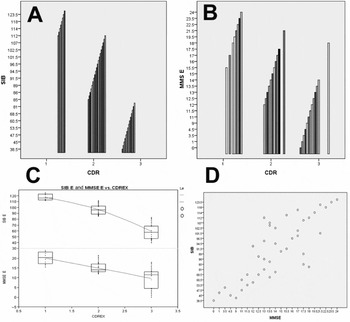
The participants were separated into three groups according to their dementia severity using the CDR with the aim of measuring the total SIB and MMSE scores and the SIB subscale scores (Figure 1(a) and Figure 1(b)). The SIB and MMSE scores do have a linear relationship as shown in Figure 1(d).
(a) SIB E group scores by CDR. (b) MMSE E group scores by CDR. (c) Box plot of SIB and MMSE scores grouped by CDR. (d) SIB and MMSE correlation of experimental groups scores.

SIB scores differ in an ordinal and significant fashion from mild, to moderate to severe (CDR groups 1–3). This is evident from the Box plot in Figure 1(c). Possible floor and ceiling effects for each disease stage were analyzed based on the respective test's total score distribution of the CDR groups (as seen in Figure 1(a) and (b)). The SIB results demonstrated that very few of the patients in any of the stages had scores close to the minimum and maximum SIB total score, indicating no substantial floor/ceiling effects for this population. The MMSE results as evident in Figure 1(c) shows a linear connection between the groups and the large spread of MMSE scores of each CDR group is indicative of possible floor and ceiling effects (Franco-Marina et al., Reference Franco-Marina2010).
Conclusion
The reliability and validity of the Greek version of SIB were examined in this study. The results of this study indicate that like the original SIB the Greek version is a reliable, valid, and useful instrument for evaluating severely impaired dementia patients.
The significant correlation that was obtained between the SIB and the Greek-MMSE, suggests that the SIB has appropriate construct validity, and evaluates global cognitive functioning in patients with severe dementia as has been previously observed. Similar results were reported by Pippi et al. (Reference Pippi1999) from Italy, whose study included a larger sample of patients with Alzheimer's dementia or other types of dementia and of similar demographic characteristics. Although we did not have a long term assessment of the Greek version of the SIB, Schmitt et al. (Reference Schmitt1997) reports that the SIB is highly reliable and valid in the long term assessment of patients with AD.
Its internal consistency as measured by Cronbach's coefficient α for the total SIB score and each subscale score and the item-total correlation for the SIB subscales showed high significance, indicating that the SIB has excellent internal consistency. The test-retest correlation for the total SIB score and each subscale scores was highly significant as well. This result suggests that the performance on this instrument has acceptable stability over time. However, the test-retest correlation although high has to be interpreted cautiously due to the necessary short period between the retests.
The total SIB score and the SIB subscale scores were compared according to the dementia severity using the CDR to group the patients into three severity groups. It was found that the difference in the total SIB score and its subscale scores between all three CDR severity groups was significant but the social interaction in the moderate (2) and severe (3) groups was not statistical significant at p < 0.116. Social interaction seems to be influenced by other complex functions, such as direction of attention and is an important factor in the patient's communication with the environment, since severe AD patients also maintained acceptable levels of social interactions, albeit reduced. Pelissier et al. (Reference Pélissier, Roudier and Boller2002) in a pilot study analyzed the factors that the SIB estimates and found that social interaction probably does not depend on cognitive decline and can be used in therapeutic interventions
In conclusion, according to this study, the SIB (Panisset et al., Reference Panisset, Roudier, Saxton and Boller1992) can distinguish between dementia patients with or without probable AD. The Greek SIB has high test-retest reliability and distinguishes preserved remaining functions in more severe dementia.
Because the SIB is brief and simple to implement, has high reliability, and can distinguish remaining mental abilities of patients with probable AD, we believe it is a useful test for both the assessment of therapeutic interventions and the evaluation of the course of the dementia in AD. The Greek SIB shows similar results to the other translations and the results of our study are in agreement with similar research in other languages. We believe that SIB is an appropriate tool for use with Greek patients.
Strengths and limitations
The one-week interval between retests may have been too short, possibly allowing for practice effects but unavoidable as the patients needed to start medication and to delay them would not have been ethical. The fact that the Greek version of SIB presents similar results to the other versions demonstrates the minimal effect of systematic or random errors on the results.
It is important to emphasize that no single neuropsychological test, including the SIB, can provide a diagnosis, but rather the SIB can be used as one piece of data among many other pieces of clinical information to come to an informed decision about a diagnosis.
Conflict of interest
None.
Description of authors’ roles
A. Konsta designed the study, supervised the data collection, performed the interviews, and wrote the paper; E. Bonti collected data and assisted with writing of the paper; E. Parlapani collected data and assisted with writing of the paper; L. Athanasiadis was responsible for the statistical design of the study and for carrying out the statistical analysis; P. Kechayas analyzed data and assisted with the writing of the paper; M. Karagiannidou assisted with the writing of the paper; and K. Fokas assisted with writing of the paper and reviewed its final version.