Introduction
Mentoring is a developmentally oriented relationship of formal or informal help between a senior individual (the mentor) and a relatively junior individual (the protégé) in an organization. The literature has acknowledged mentoring to be beneficial for both employees and organizations (Allen & Eby, Reference Allen and Eby2003; Allen, Smith, Mael, Gavan O'Shea, & Eby, Reference Allen, Smith, Mael, Gavan O'Shea and Eby2009; Eby, Butts, Hoffman, & Sauer, Reference Eby, Butts, Hoffman and Sauer2015; Ghosh & Reio, Reference Ghosh and Reio2013; Huang & Weng, Reference Huang and Weng2012; Núñez-Cacho Utrilla & Grande Torraleja, Reference Núñez-Cacho Utrilla and Grande Torraleja2013). Social exchange theory suggests that individuals enter relationships in which they evaluate the expected benefits as greater than the costs (Blau, Reference Blau1964; Homans, Reference Homans1958; Thibaut & Kelley, Reference Thibaut and Kelley1959). Most mentoring research utilize this cost–benefit analysis in social exchange theory as a main framework to assum the mentors' mentoring provision (e.g., Allen, Reference Allen, Ragins and Kram2007; Ragins & Scandura, Reference Ragins and Scandura1999). For example, mentoring provision are more likely for mentors who gain benefits from high-performing protégés, a loyal base of support, and great recognition (Green & Bauer, Reference Green and Bauer1995; Olian, Carroll, & Giannantonio, Reference Olian, Carroll and Giannantonio1993; Ragins & Scandura, Reference Ragins and Scandura1999), yet less likely for mentors who perceived the costs incurred by, for example, dysfunctional relationships and energy drain (Ragins & Scandura, Reference Ragins and Scandura1999).
While the social exchange theory has been heavily relied on to explain why mentors engage in mentoring provision, one exception may lie in the relation between different types of psychological contracts (PC) perceived by mentors and their mentoring provision. PC is an implicit contract reflecting an employee's belief about reciprocal and promissory obligations with his or her employer (Robinson, Kraatz, & Rousseau, Reference Robinson, Kraatz and Rousseau1994; Rousseau, Reference Rousseau1995). Rousseau (Reference Rousseau2000) uses two key dimensions of duration (short-term vs. open-ended) and performance–reward contingencies (high vs. low or non-contingent) to develop three types of PCs to describe three different employment relationships: balanced PC, relational PC and transactional PC. To our knowledge, mentoring research regarding this relation are two studies. Consistent with social exchange theory, Bordia, Restubog, Bordia, and Tang (Reference Bordia, Restubog, Bordia and Tang2010) found that psychological contract breach as a whole leads to a withdrawal of mentoring provision to subordinates. However, Walker and Yip (Reference Walker and Yip2018) surveyed senior executives and found that transactional organizational inducement (e.g. compensation) and relational organizational inducement (e.g. career development) have opposite effects to mentoring. Mixing result suggests that different types of PC might influence mentoring behaviors differently, however, suggested that there exist variances in mentoring that could not be explained by the norm of reciprocity (Gouldner, Reference Gouldner1960) in the social exchange theory.
We suggest that the answer to this question can be deduced through a different conceptualization of mentoring provision. Mentoring can be conceived as a social dilemma because mentoring has been long recognized as a specific form of organizational citizenship behavior (OCB; Allen, Reference Allen2003; Bordia et al., Reference Bordia, Restubog, Bordia and Tang2010; Scandura & Schriesheim, Reference Scandura and Schriesheim1994; Tepper & Taylor, Reference Tepper and Taylor2003), a discretionary yet not formally rewarded behavior (Organ, Reference Organ1988). OCB recently has been identified as a social dilemma (Bergeron, Reference Bergeron2007; Joireman, Kamdar, Daniels, & Duell, Reference Joireman, Kamdar, Daniels and Duell2006; Van Lange, Joireman, Parks, & Van Dijk, Reference Van Lange, Joireman, Parks and Van Dijk2013), wherein efforts made by individuals may be costly to them in the short term but beneficial to collective goal in the long term (Dawes, Reference Dawes1980; Joireman et al., Reference Joireman, Kamdar, Daniels and Duell2006; Messick & Brewer, Reference Messick, Brewer, Wheeler and Shaver1983). In other words, mentoring provision could be understood as a mentors' paradoxical situation: mentors may be costly if they involve into mentorship but beneficial to protégé and the organization.
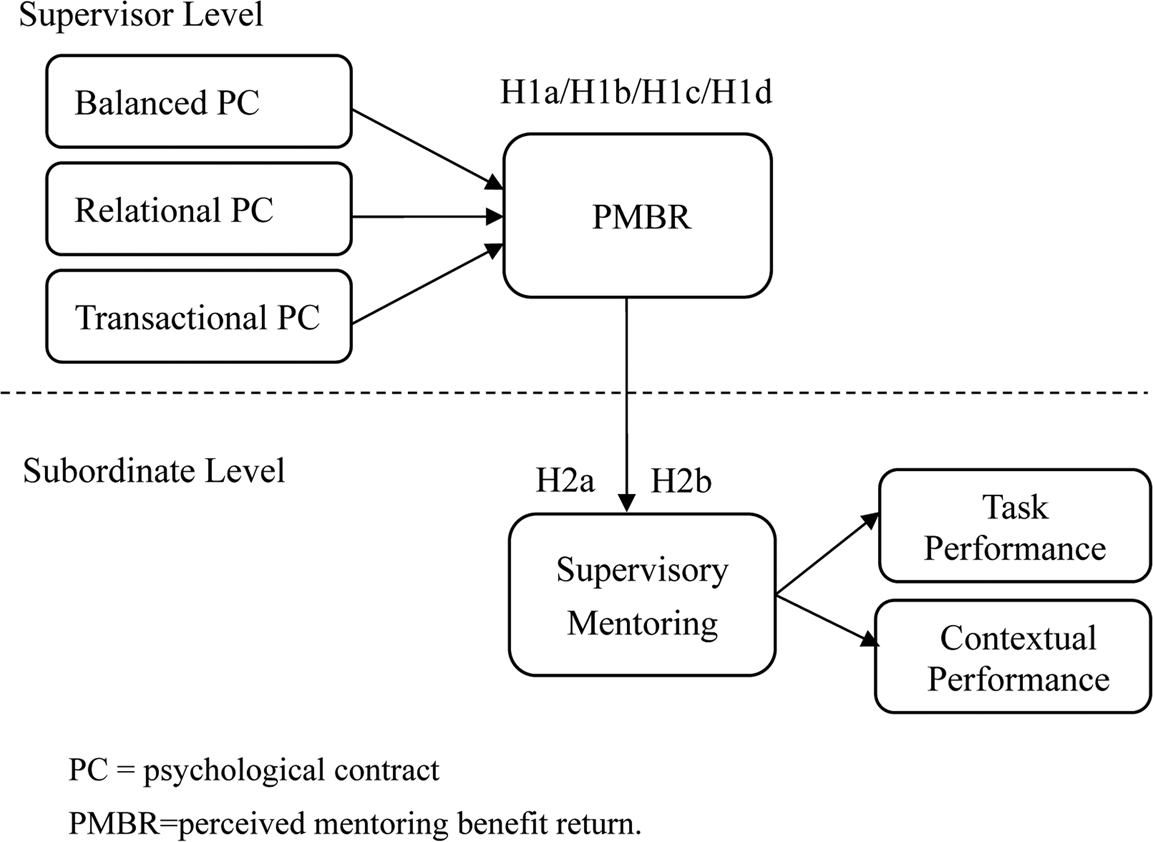
Drawing on the social dilemma perspective, we hypothesized that whether or not supervisors can be understood by how supervisors evaluate their mentoring provision by whether they could benefit from mentoring provision in a timely manner. This perspective suggests that different types of PCs varied by the duration of employment and the performance–reward system lead to differences in the perceived extent of the social dilemma in supervisory mentoring provision through cost–benefit evaluation. Overall, this study develops a cross-level framework to examine the mentoring cost–benefit evaluation as the mechanism to explain why different types of PCs lead to varied supervisory mentoring, which in turn influences subordinate job performance. Figure 1 shows the research framework.
The conceptual research framework.

The present study makes several contributions to the mentoring literature. First, most mentoring studies have adopted a protégé-centric framework at the individual level. This study responds to the call for mentor-centric research on mentoring (Allen, Reference Allen, Ragins and Kram2007; Haggard, Dougherty, Turban, & Wilbanks, Reference Haggard, Dougherty, Turban and Wilbanks2011), examine three types of PCs as the contextual antecedent to mentoring provision. Second, by verifying the influence of mentoring on protégé performance, this study develops a cross-level model not only to best capture the mentor–protégé relationship nested by nature (Allen, Reference Allen, Ragins and Kram2007; Haggard et al., Reference Haggard, Dougherty, Turban and Wilbanks2011), but also expand the limited range of criterion variables examined beyond protégé career outcomes (Scandura & Pellegrini, Reference Scandura, Pellegrini, Allen and Eby2007). Last, and perhaps the most important, this study adopts a social dilemma perspective to contribute new insights beyond social exchange theory into why different supervisors have varied mentoring provisions. A social dilemma perspective on mentoring from mentors' view can be informative about what features of the person and situation may affect behavior (Kelley, Holmes, Kerr, Reis, Rusbult, & Van Lange, Reference Kelley, Holmes, Kerr, Reis, Rusbult and Van Lange2003; Rusbult & Van Lange, Reference Rusbult, Van Lange, Higgins and Kruglanski1996). Specifically, when individuals must make a trade-off between a small immediate cost and larger long-term benefit, features of the person or situations that induce concern for the future may affect behavior (Joireman et al., Reference Joireman, Kamdar, Daniels and Duell2006; Kelley et al., Reference Kelley, Holmes, Kerr, Reis, Rusbult and Van Lange2003). Thus, conceptualizing mentoring as a social dilemma implies temporal orientation plays an important role in explaining why mentors varied in mentoring provision in different types of PCs.
Theoretical background and hypotheses
Social dilemma: delayed social fences
Many real-world problems constitute social dilemmas from a theoretical standpoint. Since Dawes (Reference Dawes1980) formally coined the term, interest in social dilemmas has grown over decades across disciplines, including anthropology, biology, economics, mathematics, psychology, political science, and sociology (see a review by Van Lange et al., Reference Van Lange, Joireman, Parks and Van Dijk2013). Social dilemmas exist in various types within dyads, small groups, and society at large (Van Lange et al., Reference Van Lange, Joireman, Parks and Van Dijk2013). Management research particularly focuses on social dilemmas that deal with situations in which short-term self-interest is at odds with longer-term collective interests termed delayed social fences (Messick & Brewer, Reference Messick, Brewer, Wheeler and Shaver1983; Van Lange & Joireman, Reference Van Lange and Joireman2008). Delayed social fences, also called give-some dilemmas, are situations in which the individual's action brings negative consequences to the individual (usually in terms of cost in money, time, or effort) but long-term positive consequences for the collective (e.g., subordinate job performance, team success, and organization effectiveness). Social dilemmas are detrimental to the collective interests because ‘a non-cooperative course of action is (at times) tempting for each individual in that it yields superior (often short-term) outcomes for self, and if all pursue this non-cooperative course of action, all are (often in the longer-term) worse off than if all had cooperated (Van Lange et al., Reference Van Lange, Joireman, Parks and Van Dijk2013: 126).’ Thus, cooperation in the social dilemmas, the maximization long-term collective interest, has long been the focus of research.
A classic example of the delayed social fence in the management field is OCB, which is well known to be ‘discretionary, not explicitly recognized, and not formally rewarded, but to promote organizational effectiveness’ (Organ, Reference Organ1988: 4). When employees choose to not engage in OCB (i.e. non-cooperative actions), the effectiveness and culture of their organization eventually deteriorates (i.e. worse collective interests) (Messick & Brewer, Reference Messick, Brewer, Wheeler and Shaver1983). Indeed, studies have recognized and verified the delayed social fence aspect of OCB (e.g., Balliet & Ferris, Reference Balliet and Ferris2013; Joireman et al., Reference Joireman, Kamdar, Daniels and Duell2006; Shih & Chen, Reference Shih and Chen2011). A review of OCB in the view of social dilemma has suggested that whether or not employees increase prosocial behaviors can be understood by how employees manage the conflict between the immediate self-interest and the long-term benefits of not giving into such self-interest. For examples, Joireman et al. (Reference Joireman, Kamdar, Daniels and Duell2006) found that engaging in OCBs was higher among those who adopted a long-term horizon within an organization and those high in empathy (i.e. individuals' tendency toward other's interest). Balliet and Ferris (Reference Balliet and Ferris2013) further found that individuals who are less (versus more) oriented toward future outcomes engage in less prosocial behaviors with others who have ostracized them (i.e. a situation that hinder cooperation in social dilemmas); Shih and Chen (Reference Shih and Chen2011) reveal that employees perceived more balanced psychological contract (i.e. maximization of long-term interest) has more tendency to employee OCB than other types of psychological contract.
Supervisory mentoring as supervisor's social dilemma
Mentoring is a form of mentors' OCB. According to Mullen (Reference Mullen1994), ‘by acting as a mentor, one is performing prosocial behaviors’ (p. 276). Scandura and Schriesheim (Reference Scandura and Schriesheim1994) considered mentoring ‘a personal, extra-organizational investment in the protégé by the mentor’ (p. 1589). Indeed, in theory, mentoring evokes prosocial individual traits, such as other-oriented empathy and instrumental motives (Allen, Reference Allen2003; Ghosh & Reio, Reference Ghosh and Reio2013; Tepper & Taylor, Reference Tepper and Taylor2003). It also develops organizational predictors analogous to those of other OCB types, such as PC breach and procedural justice perceptions (Bordia et al., Reference Bordia, Restubog, Bordia and Tang2010; Tepper & Taylor, Reference Tepper and Taylor2003).
Although little research empirically examines mentoring as a social dilemma, theoretically, mentoring provides coherent support for this perspective in two main ways. First, mentoring describes a social exchange relationship wherein ‘the mentor gives, the protégé gets, and the organisation benefits’ (Scandura, Tejeda, Werther, & Lankau, Reference Scandura, Tejeda, Werther and Lankau1996: 53). Mentoring offers the opportunity for protégés and organizations to free ride on the contributions of mentors, characterizing a classic case of social dilemma (Olson, Reference Olson1965; Yamagishi & Cook, Reference Yamagishi and Cook1993). Second, the concept of time has long been recognized as an important component of mentoring theory (Kram, Reference Kram1985; Scandura & Pellegrini, Reference Scandura, Pellegrini, Allen and Eby2007). Longer mentorship duration tends to ensure mentorship effectiveness (Allen & Eby, Reference Allen and Eby2003; Kram, Reference Kram1985; Tonidandel, Avery, & Phillips, Reference Tonidandel, Avery and Phillips2007). This implies that mentors might not benefit until mentorship has developed over a long period of time, yet in the short term, mentors pay a cost, for example, as energy drain, scheduling difficulties, and mentor–protégé conflicts (Eby, Durley, Evans, & Ragins, Reference Eby, Durley, Evans and Ragins2008b; Eby & Lockwood, Reference Eby and Lockwood2005).
We choose supervisory mentoring because the social dilemma may be more salient for supervisors in supervisory mentorship than for formal mentors. This is because supervisors may devote themselves as much as mentors in formal mentorship not typically mandated within organizations as OCB (i.e., incur similar costs), yet their anticipated benefits are more likely to be uncertain and thus, lead to asymmetrical benefits for the protégé and organization (for a review, see Van Lange et al., Reference Van Lange, Joireman, Parks and Van Dijk2013). We defined supervisors' social dilemma toward supervisory mentoring as the situation in which supervisors' engagement in mentorship costs them in the short term yet they eventually gain benefits in the long term.
Supervisors' PC and supervisory mentoring: a social dilemma analysis
A social dilemma perspective on mentoring can be informative about what features of the person and situation may affect mentoring behavior from the view of mentors. Specifically, the underlying features characterizing the structure of social situations that has important implications for behavior involves both temporal dimension and benefits dimension. These two features of mentoring behavior are key for understanding the effects of different type of PCs on mentoring behavior. This study analyzes supervisors' PC as an important social situation that affects their mentoring provision. We believe PC provide highly relevant situations to mentoring behaviors for social dilemma analysis. That is, Rousseau (Reference Rousseau2000) uses two key dimensions of duration (short-term vs. open-ended) and performance–reward contingencies (high vs. low or non-contingent) to develop three types of PCs to describe different employment relationships. These types are: transactional PC, a short-term timeframe and the exchange of economic resources; relational contractual PC, an open-ended timeframe and exchange of socioemotional resources; and balanced PC, a combination of the previous two types. Using Rousseau (Reference Rousseau2000) typology allows us to examine the contextual features that create both temporal dimension and benefits dimension in situations affecting mentors' perceptions of the expected costs and benefits of mentoring provision. Furthermore, the three types of PCs (i.e., situations) that feature differential combinations of benefits and time period, then would involve supervisors in a cognitive process of evaluation of pros and cons that would determine three levels of supervisors' social dilemmas toward mentoring, thus eventually differentiating engagement in mentoring behavior. The higher level of engagement in mentoring behavior that mentors intend to provide indicates the greater giving or contributing to the protégé and organization. This is a desirable solution to social dilemmas, so-called cooperation (i.e. giving or contributing to the collective) (Van Lange et al., Reference Van Lange, Joireman, Parks and Van Dijk2013). Below, we utilize this rationale of social dilemma analysis as the bases to develop our hypotheses.
Supervisors' cooperation in mentoring: long-term benefit maximization
Studies on social dilemmas suggest that sustained cooperation depends on whether situations promote long-term benefit maximization (e.g., Insko, Schopler, Pemberton, Wieselquist, McIlraith, & Currey, Reference Insko, Schopler, Pemberton, Wieselquist, McIlraith and Currey1998; Joireman, Balliet, Sprott, Spangenberg, & Schultz, Reference Joireman, Balliet, Sprott, Spangenberg and Schultz2008; Van Lange, Klapwijk, & Van Munster, Reference Van Lange, Klapwijk and Van Munster2011). This is ‘because it [situations promoting long-term benefit maximization] shifts people's focus to long-term outcomes, and it provides opportunities for people to reciprocate and to build their reputations’ (Chen, Dang, & Keng, Reference Chen, Dang, Keng, van Lange, Rokenbach and Yamagishi2014: 128). Supporting this argument, Siegrist (Reference Siegrist1996) effort–reward imbalance model suggests that in a social exchange relationship, individuals' evaluation of imbalance between effort and reward, particularly in high effort/low reward conditions, leads to unfavorable work outcomes. In addition, the perspective of time in a social dilemma is important, because the time horizon considered by employees provides different latitudes for attitude and work behaviors (Joireman et al., Reference Joireman, Kamdar, Daniels and Duell2006; Kooij, Tims, & Akkermans, Reference Kooij, Tims and Akkermans2017).
Accordingly, the social dilemma perspective suggests that supervisory mentoring is determined by whether supervisors perceive they could benefit from mentoring in a timely manner. Supervisory mentoring is more likely to occur when organizations provide an employment relationship that allows mentors to have higher perceived mentoring benefit return (PMBR). We define PMBR as the extent to which mentors perceive that their mentoring input could pay off.
Balanced PC and supervisory mentoring: low social dilemma
Balanced PC describes an employment relationship in which employees perceive an open-ended (long-term relationship) and high-reward employment relationship (Rousseau, Reference Rousseau2000). A concern with future consequences is critical determinant to collective benefits (e.g., Insko et al., Reference Insko, Schopler, Pemberton, Wieselquist, McIlraith and Currey1998; Joireman et al., Reference Joireman, Balliet, Sprott, Spangenberg and Schultz2008; Van Lange, Klapwijk, & Van Munster, Reference Van Lange, Klapwijk and Van Munster2011; Van Lange et al., Reference Van Lange, Joireman, Parks and Van Dijk2013). When supervisors perceive balanced PC, they regard the employment relationship to be long term and with features of a formal incentive system. This employment relationship lays the groundwork for a complete mentoring relationship and allows the supervisor sufficient time to receive an eventual payoff on his or her investment in mentoring. In this regard, we expect that supervisors who perceive balanced PC are more likely to have a high level of PMBR, which in turn facilitates supervisory mentoring.
Hypothesis 1a: Balanced PC positively affects supervisory mentoring through higher PMBR.
Relational PC and supervisory mentoring
Relational PC characterizes long-term employment relationships in which rewards are only loosely contingent on performance and are directly derived from membership and employee participation (Rousseau, Reference Rousseau2000). Given the lack of a formal performance-based reward system, supervisors under relational PC regard the employment relationship to be supportive yet face an uncertain return on investment in mentoring. Without a guaranteed payoff for effort and investment in mentoring from a formal reward system, those supervisors concerned with other interests (Singh, Bains, & Vinnicombe, Reference Singh, Bains and Vinnicombe2002) may shift their focus from intrinsic rewards (e.g., fulfilling the need to give and passion for helping younger colleagues; Aryee, Chay, and Chew, Reference Aryee, Chay and Chew1996). Parise and Forret (Reference Parise and Forret2008) suggested that supervisory mentoring seems to carry more perceived rewarding experiences and less perceived mentoring trouble than other types of mentoring. Thus, supervisors embedded in relational PC are more likely to have a positive evaluation of mentoring benefit return, which facilitates supervisory mentoring.
Hypothesis 1b: Relational PC positively affects supervisory mentoring through higher PMBR.
Transactional PC and supervisory mentoring
Transactional PC is a short-term employment relationship with a specific set of duties that are highly focused on a specified reward system (Rousseau, Reference Rousseau2000). Despite a clear reward system that may ensure benefit returns for supervisory mentoring, the limited timeframe expected in this type of employment relationship not only impedes the initiation of mentorship and its effectiveness (Kram, Reference Kram1985; Scandura & Pellegrini, Reference Scandura, Pellegrini, Allen and Eby2007) but also inhibits the receipt of eventual payoff on investment in mentoring in a timely manner. In this regard, supervisors under transactional PC are more likely to pay higher mentoring costs and to gain less benefit in return, leading to a low level of PMBR, which then decreases supervisory mentoring.
Hypothesis 1c: Transactional PC negatively affects supervisory mentoring through less PMBR.
Relative strength of the mediation effect among the three types of PCs
Our second and central goal is to determine whether different types of PCs predict supervisors' varied tendency to engage in mentoring. Whether a situation promotes long-term benefit maximization is critical for sustaining individuals' cooperation in a social dilemma (e.g., Insko et al., Reference Insko, Schopler, Pemberton, Wieselquist, McIlraith and Currey1998; Joireman et al., Reference Joireman, Balliet, Sprott, Spangenberg and Schultz2008; Van Lange, Klapwijk, & Van Munster, Reference Van Lange, Klapwijk and Van Munster2011). Based on this assumption, supervisory mentoring should be highest in situations that attach greater importance to a long-term rather than a short-term employment relationship and to advancing mentor interests rather than protégé/organization interests.
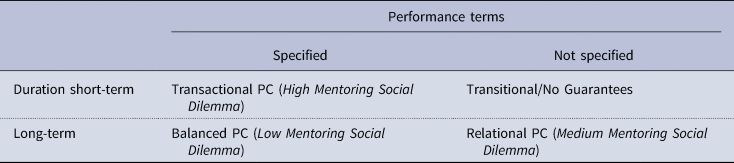
Accordingly, this study further proposes that there should be an ascending level of social dilemma for mentors in balanced PC, followed by relational PC, and then transactional PC (see Table 1). The rationale for this assumption is three-fold. First, balanced PC is most desirable for long-term benefit maximization for supervisors, because, as a hybrid of relational and transactional PC, it is characterized by both mentor interest and a steady employment relationship. Second, relational PC lacks a formal reward system to ensure desirable mentoring payoff, whereas balanced PC has such a system, yet the long-term employment relationship under relational PC probably still causes supervisors to perceive intrinsic benefits. Finally, given that mentoring is prosocially (Mullen, Reference Mullen1994; Tepper & Taylor, Reference Tepper and Taylor2003) and long-term (Kram, Reference Kram1985) oriented, we expect that relational PC is more likely than transactional PC to encourage supervisory mentoring. Therefore, we expect that the indirect effect of PC on supervisory mentoring via PMBR is strongest for supervisors under balanced PC, then relational PC, and last, transactional PC.
Hypothesis 1d: The indirect relationship between PC and supervisory mentoring via PMBR strengthens from transactional PC to relational PC and to balanced PC.
Social dilemmas about supervisory mentoring in psychological contract typology

Note. Adapted from Rousseau (Reference Rousseau2000) and Shih and Chen (Reference Shih and Chen2011).
Supervisors' PMBR, mentoring, and subordinate job performance
Following the logic that supervisors who perceive a benefit–cost balance in mentorship are more likely to provide mentoring, we expect supervisory mentoring to facilitate subordinate job performance. Drawn on social exchange theory, we predict that subordinates reciprocate job performance for receiving mentoring support from supervisors, as supervisors are viewed as key agents of the organization (Tekleab & Taylor, Reference Tekleab and Taylor2003). There is evidence in the literature in support of this argument, with a positive effect of mentoring on employee performance (Donaldson, Ensher, & Grant-Vallone, Reference Donaldson, Ensher and Grant-Vallone2000; Eby, Allen, Evans, Ng, & DuBois, Reference Eby, Allen, Evans, Ng and DuBois2008a; Eby et al., Reference Eby, Butts, Hoffman and Sauer2015; Kwan, Liu, & Yim, Reference Kwan, Liu and Yim2011; Tonidandel, Avery, & Phillips, Reference Tonidandel, Avery and Phillips2007).
Hypothesis 2a: Supervisors' PMBR positively affects subordinate task performance through higher supervisory mentoring.
Hypothesis 2b: Supervisors' PMBR positively affects subordinate contextual performance through higher supervisory mentoring.
Methods
Sample and procedure
We conducted a questionnaire survey among sales agents in Taiwan. Taiwan presents one of the promising labor market context with its rapid globalization in Asian economy due to its important role of world's leading provider of chip foundry services, notebook PCs, and LCD monitors holding over 50% of the world's market share (Einhorn, Kovac, Engardio, Roberts, Balfour, & Edwards, Reference Einhorn, Kovac, Engardio, Roberts, Balfour and Edwards2005). Sale agents in insurance industry provide a highly relevant setting to our research. Insurance salespersons are expected to develop professional competencies including self-confidence, resilience, customer orientation, achievement motivation, identity, teamwork, and learning motivation to achieve performance standards. Supervisors play a critical role in achieving the high standard of sales performance through a variety of leadership behaviors (Arnold, Palmatier, Grewal, & Sharma, Reference Arnold, Palmatier, Grewal and Sharma2009; Ingram, LaForge, Locander, MacKenzie, & Podsakoff, Reference Ingram, LaForge, Locander, MacKenzie and Podsakoff2005). Supervisors not only focus on developing employees' sales skills, but also focus on developing a strong sales workgroup that requires substantial mentoring, including guiding new recruits, supporting them to foster their assimilation into the organizational culture, professional knowledge training, allowing them to come along on client visits, and encouraging group morale. Therefore, supervisors and their subordinates in insurance industry are relevant for testing the relationships among supervisor’ psychological contract, mentoring behavior and employee performance.
The participants in this study consisted of 330 sales agent teams from seven leading insurance companies in northern, central, and southern Taiwan. We collected supervisor–subordinate matched data to control common method variance (Podsakoff, MacKenzie, Lee, & Podsakoff, Reference Podsakoff, MacKenzie, Lee and Podsakoff2003). To ensure a large sample and the response rate, we invited sales agent teams of acquaintances and personal connections. We first obtained permission from the leaders of the sale agent teams and subsequently contacted the supervisors at each of the teams. Second, to ensure sample representativeness, we confirmed with the sales supervisors whether they were informal mentors and gain the agreements to participate prior to the survey. Last, researchers in person delivered supervisors a package of survey questionnaires (separate ones for supervisors and subordinates with different paper colors), along with a letter containing instructions. In the supervisor questionnaire, we asked sales leaders to evaluate perceived PC, perceived mentoring benefit, perceived mentoring cost, and job performance of their team members. In the subordinate questionnaire, we asked team members to evaluate mentoring support provided by their team leaders. To ensure confidentiality, subordinates were given a small envelope to seal the finished questionnaires before returning them to the supervisors. Finally, supervisors returned all matched questionnaires to researchers with a postage-paid envelope provided. To remind participants and increase response rate, follow-up phone calls were made after two weeks.
Of the 800 self-reported questionnaires sent, 204 subordinates did not respond to the survey. Ultimately, the final sample consisted of 596 supervisor–subordinate data matched from 225 sales agent teams (74.5% response rate). On average, each supervisor rated 2.64 subordinates (SD = 1.02). Of the subordinates, 71% were female, 51.9% were married, and 59.5% possessed college education or higher. Their average age was 37.6 years (SD = 10.8), average job tenure was 6.7 years (SD = 6.9), and average years of co-working with a supervisor was 4.38 years (SD = 4.72). Of the supervisors, 63% were female, 72% were married, and 59.4% possessed college education or higher. Average age was 41 years (SD = 9.5), and average tenure was 11.3 years (SD = 7.0).
Measures
The questionnaires were originally constructed in English but were administered in Chinese. All measures followed a back-translation procedure to ensure item equivalence (Brislin, Reference Brislin, Triandis and Berry1980). Given the tendency of Chinese respondents to gravitate toward neutral ratings, all ratings used a 6-point scale (1 = strongly disagree; 6 = strongly agree), unless otherwise indicated, to avoid a neutral option.
Supervisor PC
Rousseau (Reference Rousseau2000) Psychological Contract Inventory (PCI) was used. This scale is later widely used and showed high stability (e.g. Dabos & Rousseau, Reference Dabos and Rousseau2013; Uen, Chien, & Yen, Reference Uen, Chien and Yen2009). Hui, Lee, and Rousseau (Reference Hui, Lee and Rousseau2004) validated this measure in China. Since this study emphasized the fulfillment of obligations that employees perceive in their current employment relationship, unlike the original version of PCI, which evaluates the extent to which employers make certain obligations to employees, we asked supervisors to consider their relationship with their current employers and to identify the extent to which their employers had fulfilled their obligations to supervisors based on a 6-point Likert-type scale (1 = completely unfulfilled; 6 = completely fulfilled). Balanced PC included 14 obligations (α = .94) with such sample items as ‘skill development increases my value to the firm’ and ‘supports me to attain the highest possible levels of performance.’ Relational PC included eight obligations (α = .92) with such sample items as ‘steady employment’ and ‘concern for my long-term well-being.’ Transactional PC included seven obligations (α = .87) with such sample items as ‘makes no commitment to retain me in the future’ and ‘pays me only for specific duties I perform.’ We combined items within each contract form to assess the fulfillment for the three PC forms. The higher the scores, the higher the extent to which the specific PC form was perceived as fulfilled.
Perceived mentoring benefit return
Ragins and Scandura (Reference Ragins and Scandura1999) developed a five-dimension mentoring benefit measure and a five-dimension mentoring cost measure. To fit the research setting, we invited 14 senior insurance executives to help evaluate and identify the practical relative importance of each dimension alluded to above for the insurance industry, resulting in ‘improved job performance’ and ‘more trouble than worth’ as the most important among the dimensions of mentoring benefits and mentoring costs, respectively. Accordingly, we asked supervisor participants to rate the degree to which they experienced costs and benefits in mentoring relationships on these two sub-scales identified. Sample items from the four-item scale of improved job performance (i.e., mentoring benefit) included ‘Mentoring has a positive impact on the mentor's job’ and ‘My job performance is likely to improve when I become a mentor’ (α = .87). Sample items from the four-item scale of more trouble than worth (i.e., mentoring cost) included ‘Being a mentor is more trouble than it's worth’ and ‘There are more drawbacks to being a mentor than advantages’ (α = .78). Following an established procedure (Siegrist et al., Reference Siegrist, Starke, Chandola, Godin, Marmot, Niedhammer and Peter2004), we calculated the ratio of ‘mentoring benefit’ to ‘mentoring cost’ score to compare rewards and costs. When the ratio was higher than 1, mentoring rewards were higher than mentoring costs. When the ratio was lower than 1, mentoring rewards were lower than mentoring costs.
Supervisory mentoring
To obtain actual supervisory mentoring provided, we asked subordinates to report the extent to which their supervisors performed 15 types of mentoring behaviors included in Scandura and Ragins (Reference Scandura and Ragins1993) Mentoring Functions Questionnaire (MFQ). This is the most established and used mentoring scale, which Hu, Pellegrini, and Scandura (Reference Hu, Pellegrini and Scandura2011) has shown measurement equivalence across cultures (i.e. Taiwan and U.S.). This scale captures six items for career development (α = .95, sample items include ‘My supervisor takes a personal interest in my career’ and ‘My supervisor has placed me in important assignments’), four items for role-modeling (α = .95, sample items include ‘I try to model my behavior after my supervisor’ and ‘I respect my supervisor's knowledge of the insurance profession’), and five items for psychosocial support (α = .94, sample items include ‘I socialize with my supervisor after work’ and ‘I consider my supervisor a friend’).
Job performance
We employed the scale developed by Borman and Motowidlo (Reference Borman, Motowidlo, Schmitt and Borman1993) and made revisions that fit the sample context. This scale also provides a broad-band definition of employee performance and has been widely recognized its criterion validity with human resource practices such as mentoring (Hanson & Borman, Reference Hanson, Borman, Bennett, Lance and Woehr2006; Werner, Reference Werner2000). Supervisors were asked to evaluate the level of job performance of their subordinates. The measure includes five items each for task (α = .92) and contextual performance (α = .74). Higher scores suggested that subordinates exhibited better performance.
Control variables
Given the multilevel nature of the study, we used controls at both the supervisor and subordinate levels. At the supervisor level, we controlled tenure (number of years), gender, age, and education (years). The selection of control variables was guided by previous studies (Allen, Reference Allen2003; Eby, Lockwood, & Butts, Reference Eby, Lockwood and Butts2006). At the subordinate level, we controlled for years of co-working with the supervisor (number of years) and education. To address possible factors related to mentorship, we also controlled for gender similarity (1 = different gender, 0 = same gender), age similarity (higher scores represent greater discrepancy), and education similarity (higher scores represent greater discrepancy; Avery, Tonidandel, & Phillips, Reference Avery, Tonidandel and Phillips2008; Olian, Carroll, & Giannantonio, Reference Olian, Carroll and Giannantonio1993).
Confirmatory factor analysis
To assure construct validity, confirmatory factor analyses were conducted for measures rated by supervisors and subordinates. The model was specified by loading indicators on their respective latent variables, and the correlations among latent variables were freely estimated. For supervisor-rated measures, the results of the five-factor model (three types of PCs, mentoring benefit, and mentoring cost) showed that each indicator had significant and substantive loadings (p < .001) and fit the data well (χ2 = 966.672, CFI = .93, TLI = .92, RMSEA = .053, SRMSR = .070). The five-factor model also fit significantly better than either the two-factor model (the model in which the three types of PCs were combined and mentor benefit and cost were combined: Δχ2 = 801.48, Δdf = 9, p < .001; ΔCFI = .16) or the one-factor model (which combined all constructs: Δχ2 = 1,249.58, Δdf = 10, p < .001; ΔCFI = .25; Cheung & Rensvold, Reference Cheung and Rensvold2002). For subordinate-rated measures, the results of the three-factor model (including second-order supervisory mentoring, task performance, and contextual performance) showed that each indicator had significant and substantive loadings (p < .001) and fit the data well (χ2 = 820.652, CFI = .95, TLI = .94, RMSEA = .0059, SRMSR = .051). The three-factor model also fit the data significantly better than either the two-factor model, which combined task and contextual performance (Δχ2 = 459.35, Δdf = 5, p < .001; ΔCFI = .13) or the one-factor model, which combined all constructs: (Δχ2 = 3,978.99, Δdf = 6, p < .001; ΔCFI = .38).
Analytical strategy
To account for the effects of the supervisor's PC on subordinate-level outcomes, we adopted a multilevel approach to deal with the hierarchical structure in which responses of subordinate variables were nested within supervisors' workgroup. As both task and contextual performance were rated by supervisors, it is necessary for examining the existence of variances at the level of cluster. Variance explained by cluster membership is determined with intraclass correlation coefficients (ICC1 and ICC2; Bliese, Reference Bliese, Klein and Kozlowski2000). Results indicated that the ICC1 and ICC2 for task performance was .36 (F = 2.48, p < .001) and .60, and for contextual performance was .31 (F = 2.20, p < .001) and .54, respectively. Based on the high between-cluster variability, this data structure was a good candidate for MLM procedures. We utilized the Mplus 5.0 software package (Muthén & Muthén, Reference Muthén and Muthén2007) to estimate the multilevel structural equation model (MSEM). Rather than using latent variables, we used multilevel path analysis, which has gained extensive psychometric support (Bollen, Bauer, Christ, & Edwards, Reference Bollen, Bauer, Christ, Edwards, Kolenikov, Steinley and Thombs2010). A full information maximum likelihood estimator was used for all analyses, and the weighted least squares means and variance-adjusted estimator were also used to test model fit based on chi-squared measures. The MLR estimator is asymptotically equivalent to the estimator proposed by Yuan and Bentler (Reference Yuan and Bentler2000). The Monte Carlo method was also used to estimate confidence intervals for the hypothesized multilevel mediated relationships to determine their significance (Preacher, Zyphur, & Zhang, Reference Preacher, Zyphur and Zhang2010).
Results
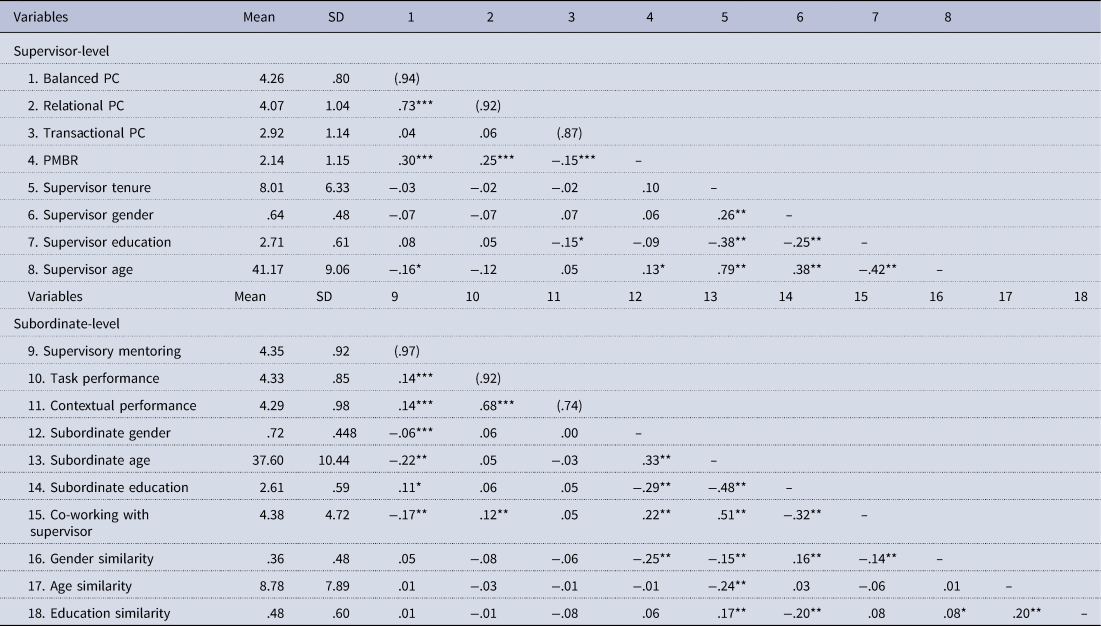
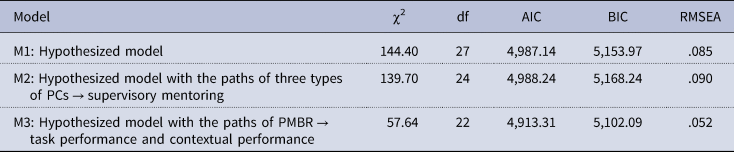
The means, standard deviations, and correlations for the study variables are presented in Table 2. We first conducted a series of comparisons of nested structural models to determine the final model for testing the hypotheses. Model 3 adds the path of the PMBR with task performance and the path of the PMBR with contextual performance to model 1. Model 3 adds three paths of PC with supervisory mentoring to model 1. Table 3 shows that model 3 has significantly better fit than either model 1 (Δχ2 = 86.76, Δdf = 5, p < .001; ΔRMSEA = .33; ΔAIC = 73.83; ΔBIC = 51.88) or model 2 (Δχ2 = 82.06, Δdf = 2, p < .001; ΔRMSEA = .038; ΔAIC = 74.93; ΔBIC = 66.15). Therefore, the following hypothesis testing is based on the estimation for model 3.
Mean, Standard Deviations, and Correlations

PC, psychological contract; PMBR, perceived mentoring benefit return; SD, standard deviation.
Note. N = 596 for subordinate-level variables. N = 225 for supervisor-level variables. *p < .05; **p < .01; ***p < .001. Cronbach's α are reported in parentheses.
Comparisons of nested structural models

PC, psychological contract; PMBR, perceived mentoring benefit return; AIC, Akaike information criterion; BIC, Bayesian information criterion; RMSEA, root–mean–square error of approximation. Model 3 is the final model.
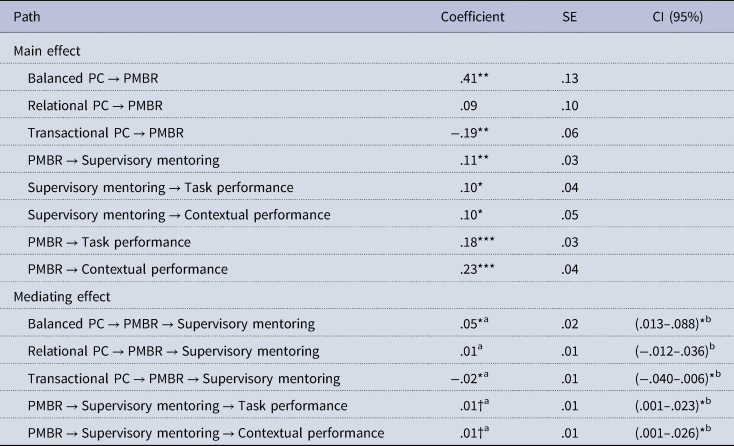
Hypotheses 1a, 1b, and 1c predict that PMBR mediates the relationship between each of the three types of PCs and supervisory mentoring. Table 4 shows the estimation of the main effects and mediating effects for model 4. The results suggest that the PMBR is positively related to the provision of mentoring (γ = .11, p < .01). To estimate the hypothesized cross-level indirect relationship, we used a parametric bootstrap procedure (Preacher, Zyphur, & Zhang, Reference Preacher, Zyphur and Zhang2010). With 20,000 Monte Carlo replications, the results show that there is a positive indirect relationship between supervisors' balanced PC and supervisors' provision of mentoring via PMBR (indirect effect = .05, 95% bias-corrected bootstrap CI [.013–.088]). Therefore, Hypothesis 1a is supported. In addition, the results indicate that there is a negative indirect relationship between supervisors' transactional PC and supervisory mentoring via PMBR (indirect effect = −.02, 95% bias-corrected bootstrap CI [−.040, −.006]), thereby supporting Hypothesis 1c. In contrast to our prediction, supervisors' relational PC is not related to supervisory mentoring via PMBR (indirect effect = .01, 95% bias-corrected bootstrap CI [−.012–.036]). Therefore, Hypothesis 1b is not supported.
Multilevel path analysis results

PC, psychological contract; PMBR, perceived mentoring benefit return.
a Mediating effects are reported based on the results of the Sobel test.
b Mediating effects are reported based on the results of bootstrapping.
* p < .05; **p < .01.
Hypothesis 1d predicts that the indirect relationship with supervisory mentoring via PMBR is stronger for supervisors who perceive balanced PC than relational PC, and is weakest for transactional PC. We compare the indirect effects of the three types of PCs on supervisory mentoring via PMBR, and the results indicate that of the three comparisons among relationships, only the balanced PC–mentoring relationship is significantly different from the transactional PC–mentoring relationship (indirect effect difference, γ = .05, p < .05). Specifically, supervisors' engagement of mentoring in balanced PC is significantly higher than that in transactional PC. Overall, the findings are fairly consistent with Hypothesis 1d.
Hypotheses 2a and 2b predict that mentoring support mediates the relationship between PMBR on the one hand and task and contextual performance on the other. The results show that PMBR had an indirect effect on task performance via supervisors' provision of mentoring (indirect effect = .01, 95% bias-corrected bootstrap CI [.001–.023]) and on contextual performance via supervisors' mentoring provided (indirect effect = .01, 95% bias-corrected bootstrap CI [.001–.026]). Therefore, Hypotheses 2a and 2b are supported.
Discussion
This study adopted a social dilemma perspective to explore why supervisors under different employment relationships vary their mentoring provision. We tested our model using supervisor–subordinate matched sample from the insurance industry in Taiwan. Overall, the findings support our proposition: different experiences of PC by supervisors drive their varying levels of social dilemmas, which lead them to provide different inputs in their mentoring. The results showed that the more the supervisors perceive balanced PC, the more supervisory mentoring they engage in; conversely, the more the supervisors perceive transactional PC, the less supervisory mentoring they engage in. However, perceived transactional PC is not related to supervisory mentoring. Furthermore, supervisory mentoring predicts both subordinate task performance and contextual performance. By broadly viewing mentoring as supervisors' OCB, a reciprocal return of supervisors on favorable treatment by their employers (Bordia et al., Reference Bordia, Restubog, Bordia and Tang2010; Tepper & Taylor, Reference Tepper and Taylor2003), our social dilemma perspective of the PC–mentoring relationship can be viewed as a subtle reframing of the social exchange theory. Nonetheless, as Joireman et al., (Reference Joireman, Kamdar, Daniels and Duell2006: 1,316) noted, it is important to recognize ‘the real value in a social dilemma analysis to make meaningful predictions that are supported by the data.’ We believe that this study boosts the theoretical and practical understanding of the predictions on mentoring supported by data.
Theoretical implications
Extant literature has paid little attention to the relationship between supervisors' PC and their mentoring with two exceptions (Bordia et al., Reference Bordia, Restubog, Bordia and Tang2010; Walker & Yip, Reference Walker and Yip2018). The present study advances their findings by demonstrating that mentoring is a complex decision embedded within different employment relationships. This subsection compares our results with theirs. First, while Walker and Yip (Reference Walker and Yip2018) found that relational PC is positively related to supervisory mentoring, we find that balanced PC (i.e., long-term and contingent incentives) more strongly predicts supervisory mentoring than does relational PC (i.e., long-term but non-contingent incentives). Our finding implies that supervisory mentoring is developed more firmly on the joint basis of long-term duration and favorable incentives from employers (i.e., balanced PC) than on a single long-term element alone (i.e., relational PC). Our findings are derived from the social dilemma perspective, which considers both time and incentive aspects that drive supervisory mentoring.
Second, transactional PC (i.e., short-term but contingent incentives) impedes supervisory mentoring, yet relational PC (i.e., long-term but non-contingent incentives) is not related to supervisory mentoring. It seems that insufficient time acts as a necessary deterrent to the impetus for supervisory mentoring. The findings might not be surprising; they reflect the theoretical definition of mentoring, that is, it is inherently discretionary and mostly motivated by other interests. Based on this account, it is possible for transactional PC to trigger a motivational crowding-out effect (Frey & Oberholzer-Gee, Reference Frey and Oberholzer-Gee1997). In other words, by reinforcing and shifting the focus toward instrumental gains, transactional PC ‘crowds out’ intrinsic motivation and, ultimately, the value of an activity (Walker & Yip, Reference Walker and Yip2018: 6).
The study contributes to the broad stream of mentoring literature. First, responding to the call for research on mentor-centric studies, the present study expands the body of work on mentors' input, such as mentor's altruism, accountability, psychological empowerment, transformational leadership, and perceived organizational support (Allen, Reference Allen2003; Eby, Lockwood, & Butts, Reference Eby, Lockwood and Butts2006; Hu, Wang, Yang, & Wu, Reference Hu, Wang, Yang and Wu2014; Sun, Pan, & Chow, Reference Sun, Pan and Chow2013; Wang, Noe, Wang, & Greenberger, Reference Wang, Noe, Wang and Greenberger2009). Focusing on mentors' existing employment relationships, this study drawn on social dilemma perspective to explain why supervisors make different supervisory mentoring efforts. Prior research dominantly has used social exchange theory's emphasis on mentor perceptions of reciprocal relations to understand mentoring behaviors at work. A social exchange perspective would forward the hypothesis that mentors under all types of PCs should indifferently engage mentoring behaviors. As Haggard et al. (Reference Haggard, Dougherty, Turban and Wilbanks2011) suggested that ‘conceptualizing the mentor role as extra-role behavior might provide considerable insight into reasons for forming a mentoring relationship’ (p. 298), the present study provides an initial illustration of how the social dilemma perspective may represent a meaningful advance in our understanding of mentoring.
Second, this study shows that mentoring success is not just career related (Eby et al., Reference Eby, Butts, Hoffman and Sauer2015; Lapointe & Vandenberghe, Reference Lapointe and Vandenberghe2017; Scandura & Pellegrini, Reference Scandura, Pellegrini, Allen and Eby2007) by linking supervisor mentoring with subordinate job performance. We show a generalized reciprocity in triadic social exchange relationships through a ‘pay it forward’ effect of indirect reciprocity (Baker & Bulkley, Reference Baker and Bulkley2014). In other words, the benefits of an organization's investment in a longer and rewarding employment relationship extend beyond the focal supervisors and have a positive and indirect benefit on subordinate performance, through supervisory mentoring.
The present study also shows the social dilemma perspective in the effects of types of PCs on prosocial behaviors, as first highlighted in the PC–OCB relationship in the research of Shih and Chen (Reference Shih and Chen2011). Our results demonstrate patterns among supervisors consistent with those reported by Shih and Chen (Reference Shih and Chen2011) for rank-and-file employees; we further contribute to the literature by examining the mechanism mediating the types of PCs and prosocial behaviors. In the case of supervisory mentoring, we verify the perception of benefit return as the cognitive mechanism. These findings are consistent with those showing that benefit uncertainty and benefit asymmetries hinder people from choosing cooperation under social dilemmas (i.e., they choose not to sacrifice short-term for long-term interest; e.g., Budescu, Rapoport, & Suleiman, Reference Budescu, Rapoport and Suleiman1990; De Kwaadsteniet, Van Dijk, Wit, & De Cremer, Reference De Kwaadsteniet, Van Dijk, Wit and De Cremer2006). However, given that our study and that of Shih and Chen (Reference Shih and Chen2011) are conducted in the Chinese context, we need to be cautious about cross-cultural generalizability. The Chinese context tends to be more collectivistic than the Western context and workers in the former context consider OCB more a part of the in-role job than do those in the latter context (Jiao, Richards, & Hackett, Reference Jiao, Richards and Hackett2013). Therefore, further investigation is needed to determine whether our findings are generalizable to the Western context.
Finally, this study has methodological strengths that advance mentoring research. We adopted multilevel analysis and multiple-source data from both the mentor and protégé in a relationship (Allen, Eby, O'Brien, & Lentz, Reference Allen, Eby, O'Brien and Lentz2008) to adequately capture the inherently nested supervisor mentor–subordinate protégé relationship, thereby yielding insights into mentor characteristics associated with beneficial protégé outcomes.
Practical implications
Mentoring is acknowledged as beneficial for both employees and organizations in the management literature (Allen & Eby, Reference Allen and Eby2003; Eby et al., Reference Eby, Butts, Hoffman and Sauer2015; Ghosh & Reio, Reference Ghosh and Reio2013; Scandura & Ragins, Reference Scandura and Ragins1993). Supervisors are important assets for initiating supervisory mentorship in organizations. A better understanding of the paradoxical nature underlying supervisory mentoring behavior would help employers establish a sustained employment relationship with mutual interests that fosters such mentoring behavior. Our findings confirm that supervisory mentoring may be related to subordinate job performance. Therefore, managers who commit to promoting supervisory mentoring functions should hope to benefit from it. Importantly, our study highlights that supervisory mentoring is a favorable but conflicted type of behavior for supervisors. We suggest that the joint effects of anticipated mentoring benefits and long-term employment for supervisors are highly relevant for fostering supervisory mentorship. Recognizing this, organizations should supply supervisors with both short- and long-term incentives to increase the likelihood of mentor–organization cooperation. Meanwhile, we recommend that management seek to build an encouraging organizational climate for long-term mentorship and include the setting of long-term goals for both the organization and supervisors. Obviously, supervisors embedded in companies that emphasize a short-term and performance-based reward system would not consider supervisory mentoring as pay-off behaviors. In this case, the organization should implement a formal program as a solution to enhance mentoring functions, if necessary.
Limitations and future directions
This study has the following limitations. First, although we adopted procedural remedies (i.e. different sources from supervisors and subordinates, respondent anonymity, and reversed items) to reduce CMV, concerns with potential effect of CMV on our findings still remain without statistical remedies (e.g., controlling social desirability or negative affectivity) (Podsakoff et al., Reference Podsakoff, MacKenzie, Lee and Podsakoff2003). Thus, this may cause that some coefficients (involving relationships between the three types of PCs and PMBR, as well as the relationship between supervisory mentoring and job performance) are examined based on data from the same source. Therefore, these relationships need to be interpreted carefully, as they may be inflated by CMV. Future research should strive to collect data that are multisource, longitudinal in design, and in different formats (e.g., experimental and archival data), so as to provide a more robust test of the causal relationships.
Second, to reduce the possibility of selection bias, supervisors were instructed to distribute surveys randomly to subordinates. However, possible causes of selection bias remain, such as supervisors selecting their favorite subordinates, which would result in higher levels of reported supervisory mentoring. In addition, we gave subordinates small self-adhesive envelopes to seal the finished surveys in order to assure confidentiality. However, subordinates needed to return the envelopes to their supervisors, limiting subordinates' provision of their true thoughts in the survey.
Future studies could examine the roles of supervisors' PC types on supervisory mentoring in other industries in which mentorship is vital to organizational success. In this study, we focused on sales mentorship, aimed at enhancing sales team performance in the insurance industry. An important challenge arising from delayed social fences (i.e., supervisory mentoring) is to foster the willingness and ability to choose to maximize the long-term (vs. short-term) consequences of one's actions (Joireman et al., Reference Joireman, Balliet, Sprott, Spangenberg and Schultz2008). Future studies may extend our framework to professions in which supervisory mentoring is critical, such as banking, law, and nursing.
Another promising avenue for future research is to focus on the moderating role of individual disposition, which past research has suggested encourages cooperation in social dilemmas (Van Lange et al., Reference Van Lange, Joireman, Parks and Van Dijk2013). Researchers should consider individual differences related to self-control traits, such as consideration of future consequences/future orientation (Joireman et al., Reference Joireman, Balliet, Sprott, Spangenberg and Schultz2008; Van Lange, Klapwijk, & Van Munster, Reference Van Lange, Klapwijk and Van Munster2011) and salience of future work selves (Strauss, Griffin, & Parker, Reference Strauss, Griffin and Parker2011), or promoting positive responses to non-cooperation, such as forgiveness (Balliet, Li, & Joireman, Reference Balliet, Li and Joireman2011). This is especially important for organizations characterized by transactional employment relationships with supervisors, in which supervisory mentoring is particularly needed.
Finally, supervisory mentoring and leader–member exchange (LMX) is highly inter-correlated. For example, the level of quality of LMX with supervisor is determined in the early stage of supervisor–subordinate relationships whereas mentoring relationships may take more time to develop (Liden, Wayne, & Stilwell, Reference Liden, Wayne and Stilwell1993). Researchers suggest that high quality of LMX may be a prerequisite for subordinates to receive mentoring from their supervisors (Graen & Scandura, Reference Graen and Scandura1987; McManus & Russell, Reference McManus and Russell1997). Therefore, we encourage future studies to consider LMX and its related constructs (e.g., perceived supervisor support) as potential antecedents of mentoring.
Data
The datasets generated during and/or analyzed during the current study are available from the corresponding author on reasonable request.
Conflict of interest
There are no conflicts of interest to declare.
Ethical standards
This study is supported by funding from the National Ministry of Science and Technology, Taiwan (NSC 102-2410-H-251 -002 -SS3) and gains assurance of research ethics by reviewee committee. All the subjects have provided appropriate informed consent and details on how this was obtained are detailed in the manuscript.