Introduction
Self-neglect is a complex multidimensional concept, first identified in the 1950s (Day et al., Reference Day, Leahy-Warren and McCarthy2016). The National Center on Elder Abuse (NCEA) (2006) defined elder self-neglect (ESN) as follows: Self-neglect generally manifests itself in an older person as a refusal or failure to provide himself/herself with adequate food, water, clothing, shelter, personal hygiene, medication (when indicated), and safety precautions. ESN is also described as an older person's inability or unwillingness to provide for themselves the goods or services to meet their basic needs (Day, Reference Day2010), or defined as a behavior of a person that consequently threatens his or her health and safety (Dong et al., Reference Dong2009).
Theories of ESN generally come from sociocultural and psychomedical frameworks (Iris et al., Reference Iris, Ridings and Conrad2010). From the sociocultural perspective, judgments of self-neglect are rooted in contemporary values regarding hygiene and cleanliness (Lauder et al., Reference Lauder, Anderson and Barclay2002). However, the psychomedical approach posits that the condition is grounded in “mental, physical, and social disturbances” (Abrams et al., Reference Abrams, Lachs, McAvay, Keohane and Bruce2002) and is associated with depression, cognitive impairment, or other risk factors (Iris et al., Reference Iris, Ridings and Conrad2010). Furthermore, behavioral theory addresses self-neglect by attempting to understand the determinants of the behavior (Gibbons et al., Reference Gibbons, Lauder and Ludwick2006). In addition, in terms of Orem's self-care theory, self-neglect is described as having a self-care deficit (Lauder, Reference Lauder2001).
ESN is an important and serious public health issue, and is one of the most commonly reported allegations to Adult Protective Services (APS) in the USA (National Center on Elder Abuse, 2006). Data from the Health Service Executive (HSE) in the Republic of Ireland (ROI) has suggested that self-neglect cases account for 20%–25% of the referrals cases to elder abuse services (Health Service Executive (HSE), 2014). Self-neglect can result in devastating consequences for the elderly people, potentially exacerbating diseases (Braye et al., Reference Braye, Orr and Preston-Shoot2011), leading to higher healthcare utilization (Franzini and Dyer, Reference Franzini and Dyer2008), and even causing premature death (Dong et al., Reference Dong2009). However, the etiology of self-neglect is still unclear (Reyes-Ortiz et al., Reference Reyes-Ortiz, Burnett, Flores, Halphen and Dyer2014). The well-known biopsychosocial path model, proposing links between health conditions and ESN development, was developed by Dyer and colleagues (Reference Dyer, Goodwin, Pickens-Pace, Bumett and Kelly2007). Recent epidemiological researches have led to significant improved understanding of the self-neglect. Risk factors for the development of ESN include, for example, chronic disease (Dong et al., Reference Dong, Simon and Evans2010), physical function impairment (Dong and Simon, Reference Dong and Simon2015), living alone (Lee and Kim, Reference Lee and Kim2014), advanced age (Papaioannou et al., Reference Papaioannou, Räihä and Kivelä2012), poverty (Papaioannou et al., Reference Papaioannou, Räihä and Kivelä2012), lower levels of social network and social engagement (Spensley, Reference Spensley2008), depression (Papaioannou et al., Reference Papaioannou, Räihä and Kivelä2012), and reduced cognitive capability (Dong and Simon, Reference Dong and Simon2015). However, there remain gaps in our standing in the health outcome among those elderly who self-neglect, which is attributable to varied definition, assessment instruments, and social cultures of ESN.
According to Patrick and Erickson (Reference Patrick and Erickson1993), life has two dimensions: quantity and quality. Quantity of life is expressed in terms of “hard” biomedical data, such as mortality and morbidity rates or life expectancy. Quality of life (QoL) is defined by the WHO (1993) as “individuals' perceptions of their position in life in the context of the culture and value systems in which they live and in relation to their goals, expectations, standards and concerns.” It is a broad ranging concept incorporating a person's physical health, psychological state, level of independence, social relationships, personal beliefs, and their relationships with salient features of the environment (WHO, 1993). Some researchers conclude that poor QoL in older adults is associated with, for example living alone, depression, anxiety, limited social support, decreased activities of daily living (ADLs), chronic conditions, and limited financial circumstances (Netuveli et al., Reference Netuveli, Wiggins, Hildon, Montgomery and Blane2006; Wang, Reference Wang2007; Webb et al., Reference Webb, Blane, McMunn and Netuveli2011; Buckley et al., Reference Buckley2012; Garin et al., Reference Garin2014; Chang et al., Reference Chang, Yao, Hu and Wang2015; Shrestha et al., Reference Shrestha2015). The public sectors in developing countries have mainly focused on communicable diseases and non-communicable diseases, such as diabetes, coronary heart disease, and cancers. However, QoL in older populations remains as a neglected topic in these settings. The existing literature suggests that QoL in rural Chinese older people, a more vulnerable group, is a cause for concern (Zhou et al., Reference Zhou, Chen, Wang, Wang, Zhang and Zheng2011; Liang and Wu, Reference Liang and Wu2014).
Previous studies have shown that ESN had a great impact on health and social well-being in the elderly (Lauder, Reference Lauder1999; Dong et al., Reference Dong, Simon and Evans2010). QoL is one of the essential aspects of human health, which is embedded in a physical, mental, and social context (Orley et al., Reference Orley, Saxena and Herrman1998). It is reasonable to hypothesize that higher levels of overall self-neglect severity are independently associated with lower levels of QoL among the elderly, when adjusting for confounding factors. However, there are few research reported the association between ESN and QoL. To fill this knowledge void, this study aims to explore the relationship between ESN and QoL among elderly people in a rural area of China.
Methods
Participants and study design
This study was conducted in Dangtu, a county located in eastern Anhui province, China. According to data from the Sixth National Census conducted in China, this county has a population of 655,534, of which 55% live in the rural areas. Residents aged 65 years or older of the county accounted for 11.7% of the total population in 2010.
The participants were recruited using a cluster-sampling method. One district (of 15 in Dangtu) was selected, which has 14 rural villages. The inclusion criteria comprised being aged 60 years or older and having resided in that rural district for at least one year. People with speech impediments, hearing impairments, and other communication disorders, and those who were unavailable for the interview, was excluded. A total of 3,190 older adults were recruited to participate; 3,182 were successfully interviewed, while eight did not complete the interview, either because of confusion, or due to inconsistent answers to questions. To maximize the response rate, each participant received a gift worth 10 Yuan RMB (about 1.5 US D). Furthermore, support was obtained from the village doctors, who accompanied researchers into participants’ homes for the interviews. Administering the questionnaire took, on average, approximately 1 hour.
Data collection and ethics statement
Data were collected between January 1 and February 28, in 2015, after completion of a pilot study, in which 46 elderly people aged 60 years or older from five rural districts of five counties in Anhui province validated the questionnaire items. The interviewer team comprised six postgraduate and eight undergraduate students from the School of Public Health in Anhui Medical University. All interviewers were given a one-day training session on the investigation and interview protocols. The study was performed through face-to-face structured interviews for the household survey. Participants were provided with an explanation of the study to acquire their informed consent before proceeding with the questionnaire. Because most of the elderly people were illiterate, oral informed consent for the interview was obtained from each participant. For consent to be obtained, the participants had to understand that they were free to accept or reject the invitation to participate in the study. The Human Ethics Research Committee of the Anhui Medical University approved the study protocol. Each participant's verbal consent was recorded in the questionnaire. Only aggregated data were analyzed and no personal information was disclosed.
Measurements
Quality of life evaluation
The World Health Organization's abbreviated QoL questionnaire (WHOQOL-BREF), as adapted into a widely used Chinese version (Hao, Reference Hao and Fang2000), was employed in this study. The WHOQOL-BREF is a 26-items version of the WHOQOL-100 and it is based on a four-domain structure (physical health, psychological health, social relationship, and environment) (WHO, 1998). Each domain includes three to eight items (e.g. How satisfied are you with your sleep? (physical health); How satisfied are you with yourself? (psychological health); How satisfied are you with the support you get from your friends? (social relationship); How satisfied are you with the conditions of your living place? (environment)). Moreover, two questions yield general information: question 1 asks about an individual's overall perception of QoL; question 2 asks about an individual's overall perception of his or her health. Each item is based upon self-rated physical criteria and scored on a five-point Likert scale. The scores of each domain are transformed to a 0 to 100 scale (a higher score indicates better QoL) according to the guidelines.
Elder self-neglect assessment
ESN was measured using the Scale of the Elderly Self-Neglect (SESN) (see Table S1, available as supplementary material attached to the electronic version of this paper at https://doi.org/10.1017/S1041610217000229), which is administered to older people. A draft SESN was developed by our research team based on theories of psycho-medicine, socio-culture, behavior and self-care, literature reviews (Iris et al., Reference Iris, Ridings and Conrad2010), and the results from in-depth interviews with 28 elderly people in rural areas of three counties in Anhui province. After two-rounds of Delphi expert consultations and item selection, a 14-item instrument that is a short and easy-to-administer tool was developed. The SESN includes five domains: medical health and care (MHC) (three items: utilization of medical resources, taking medicines, and nutrition); environmental sanitation and personal hygiene (ESPH) (three items: environmental sanitation, personal hygiene, and house cleaning); mental health (MH) (three items: negative feelings, actively maintained mental health, and concerns about emotional needs); safety (three items: falling down, fire safety, and maintenance of their house/apartment/yard); and social communication (SC) (two items: communication with others, and accepting care and help from others). The SESN was assessed by interviews with the elderly administered in their home. The respondents were asked to recall their lives in the past year. Elderly participants who were unable to complete the SESN independently were provided necessary assistance by their caregivers. Each of the items was scored on a scale of 0 to 3 (not occurring or no effect, mild effect, moderate effect, severe effect). A higher total score indicated greater ESN severity.
The Cronbach's α coefficient of the total score was 0.78, and for the five domains ranged from 0.62 (for SC domain) to 0.72 (for MHC domain). The test–retest reliability of total score was 0.747, and for the five domains ranged from 0.69 (for ESPH domain) to 0.82 (for safety domain).
Control variables
Socio-demographic, physical, psychological, and social support variables that were associated with QoL and ESN in previous studies, were the control variables in this study. Sociodemographic variables, including sex, age, education level, marital status, living situation, financial situation, and religious belief, were measured. Education level, marital status, and religious belief were grouped into two categories: illiterate (did not know and any Chinese characters) or not illiterate; married or not; living alone or not, respectively. The participant's financial situation was assessed by their self-rated economic level, categorized as high, medium, and low. Their physical health situation was assessed by self-reporting, with the categories good, medium, and poor. Executive function was assessed using the Lawton–Brody ADL Scale, which consists of the Physical Self-Maintenance Scale (PSMS) and Instrumental Activities of Daily Living Scale (IADL) (Lawton and Brody, Reference Lawton and Brody1969). The scores are on a 0 to 54 scale (higher score indicates lower physical function). Cronbach's coefficient of the scale was 0.84 to 0.94 (Reijneveld et al., Reference Reijneveld, Spijker and Dijkshoom2007). Depressive symptoms were assessed using the 15-item Geriatric Depression Scale-15 (GDS-15, range: 0–15) (Sheikh and Yesavage, Reference Sheikh and Yesavage1986; Chan, Reference Chan1996); a higher GDS score suggests more severe depression. Anxiety symptoms were assessed using the Self-rating Anxiety Scale (SAS) (Zung, Reference Zung1971), the standardized score of which is equal to the raw score times 1.25 (range: 0–100); a higher score indicates more severe anxiety. Social support was assessed using the Social Support Rating Scale (SSRS, range: 10–65) (Xiao, Reference Xiao1994), which consists of ten items within three aspects: objective support (three items), subjective support (four items), and utilization degree of support (three items). This instrument had an internal consistency of α = 0.89 to 0.94, and the correlation coefficient for the test–retest = 0.92 (Liu et al., Reference Liu, Li and Lian2008). The scores are on a 0 to 62 scale (a higher score indicates better social support). Cognitive function was assessed using the Mini-Mental State Examination (MMSE), which is a widely used 30-item measure for dementia (Folstein et al., Reference Folstein, Folstein and McHugh1975). A Higher MMSE score is consistent with better cognitive function.
Statistical analysis
Categorical variables are presented as frequency (percentage) and continuous variables are presented as means and standard deviation (SD). If the scale scores followed a non-normal distribution, the median and the 25th and 75th percentiles were applied to describe data. The independent sample t-test or one-way analysis of variance (ANOVA) was performed to compare four QoL domains scores across categorical covariates. If the omnibus test detected a significant difference, the Bonferroni post hoc test was applied for correction of multiple comparisons. The Mann–Whitney U test or Kruska–Wallis H test with a Bonferroni post hoc test were then performed to compare the ESN scores (total scores and five domains) across categorical covariates. Person's correlation test was performed to estimate the correlation coefficient between the QoL scores and continuous variables, and Spearman's correlation coefficients were used to describe the association of the ESN scores with continuous control variables. Finally, hierarchical linear regression models were used to analyze the associations between overall ESN scores and scores of four QoL domains, after adjusting for potential confounders (entering the sociodemographic variables in the first step; self-report physical health, social support, ADL, depression, anxiety, and MMSE in the second step; and ESN total scores in the third step). Multicollinearity was examined using the variance inflation factor (VIF).
EpiData 3.1 was used to set up the quantitative database after checking and coding questionnaires. The database was analyzed using SPSS 16.0 (SPSS Inc. Released 2007. SPSS for Windows, Version 16.0, Chicago, SPSS Inc.). In all tests, the level of significance was set at p < 0.05. The effect size (SE) was estimated by G *Power 3 (Faul et al., Reference Faul, Erdfelder, Lang and Buchner2007).
Results
Characteristics of participants
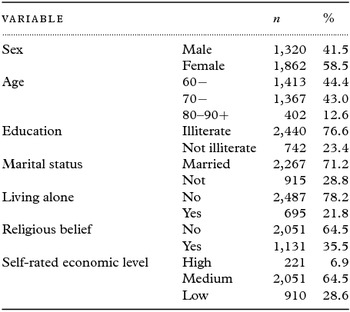
Of the 3,182 elderly adults analyzed for our study, 1,862 (58.5%) were female, and 1,320 (41.5%) were male. Their age ranged from 60 to 95 years, and the average was 70.70 (SD = 6.97) years old. In terms of education level, 76.6% (n = 2,440) were illiterate, while 23.4% (n = 742) were literate. Regarding marital status, 71.2% (n = 2,267) were married, while 28.8% were not (covering those who were widowers/ widows/ divorced/ unmarried). In this study sample, 1,131 (35.5%) believed in a religion. The majority of the respondents (78.2%) did not live alone, while the rest did. Financially, 28.6% (n = 910) self-rated their economic level as low, 64.5% (n = 2,051) self-rated it as medium, and only 6.9% (n = 221) self-rated it as high. Table 1 presents detailed information on the demographic characteristics of the elderly.
Demographic characteristics among the Subjects (n = 3,182)

Potential characteristics associated with QoL
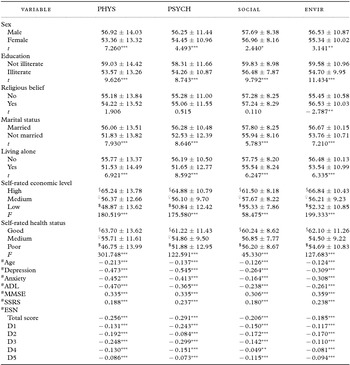
Table 2 shows the differences between four QoL domains scores and sociodemographic, social support, physical, and psychological characteristics. The results demonstrated that lower scores of QoL four domains were significantly associated with being female, illiterate, living alone, not being married, and having a low economic level and poor physical health. However, there was no association of religious belief with the scores of physical, psychological, and social relations domains of QoL. The Cohen's d (for t-test, followed: 0.2 small, 0.5 moderate, 0.8 large) of categorical covariates ranged from 0.11 to 0.56, indicating small or moderate ES values, and the Eta squared (η 2) (for ANOVA, followed: 0.01 small, 0.06 medium, 0.14 large) of self-rated economic and physical health ranged from 0.03 to 0.16, indicating medium or large ES values (Cohen, Reference Cohen1988). Age, depression, anxiety, and ADL were negatively correlated with the four QoL domains scores, while MMSE and SSRS results were positively correlated with QoL four domains scores, separately. Furthermore, the scores of overall ESN and its five domains were negatively correlated with QoL four domains scores, respectively.
Characteristics of the participants and four QoL domains scores ( X ± S)

Note: *p < 0.05.
**p < 0.01.
***p < 0.001.
# Continuous variable.
PHYS: physical health; PSYCH: psychological health; SOCIAL: social relationships; ENVIR: environment.
D1: Medical health and care self-neglect; D2: Environmental sanitation and personal hygiene self-neglect; D3: Mental health self-neglect; D4: Safety self-neglect; D5: Social communication self-neglect.
The Person correlation was used for continuous variables and WHOQOL-BREF total and domain scores.
§ Statistically significant difference in variable between High (Good) and Medium.
♀ Statistically significant difference in variable between Medium and Low (Poor).
$ Statistically significant difference in variable between High (Good) and Low (Poor), as determined by Bonferroni post hoc test.
Potential characteristics associated with ESN
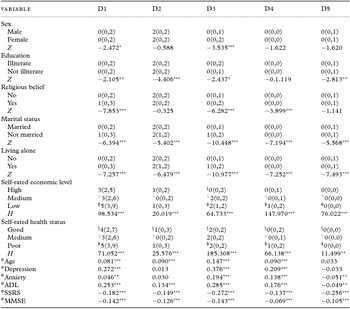
As shown in Table 3, participants who were single, or living alone reported higher ESN total scores and scores on the five domains than their counterparts (p < 0.001). Female participants had higher scores on MHC, and MH domains than males (p < 0.05). Illiterate participants reported higher ESN scores, except for safety self-neglect, than literate participants, and religious participants had higher ESN scores than non-religious subjects, expect in the SC domain. Additionally, individuals with a low economic level had higher ESN scores than those who self-rated a medium and high economic level (p < 0.001) expect for ESPH domain, and those who self-reported poor physical health scored higher on ESN scores than those who self-reported medium and good physical health (p < 0.01). Finally, ADL was positively correlated with ESN scores (including overall and for each of the five domains) (p < 0.01). However, both anxiety and depression were not correlated with the scores in ESPH domain, and age and depression were not correlated with the scores in SC domain (p > 0.05). Conversely, SSRS and MMSE were negatively correlated with ESN scores (p < 0.001).
Characteristics of the participants and scores of ESN (M (P 25, P 75))

Note: *p < 0.05.
**p < 0.01.
***p < 0.001.
# Continuous variable.
M: median; P 25: 25th percentiles; P 75: 75th percentiles.
D1: Medical health and care self-neglect; D2: Environmental sanitation and personal hygiene self-neglect; D3: Mental health self-neglect; D4: Safety self-neglect; D5: Social communication self-neglect.
The spearman correlation was used for continuous variables and ESN total scores and its’ five domains.
§ Statistically significant difference in variable between High (Good) and Medium.
♀ Statistically significant difference in variable between Medium and Low (Poor).
$ Statistically significant difference in variable between High (Good) and Low (Poor), as determined by Bonferroni post hoc test.
Associations of ESN with QoL
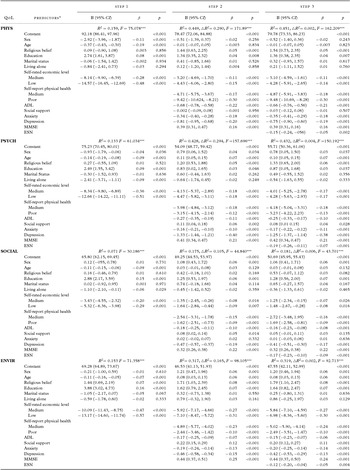
The results from the hierarchical linear regression models, with QoL as a dependent variable to testing the associations between ESN and QoL, are summarized in Table 4. Tested in step one, the sociodemographic variables explained 15.9%, 13.3%, 7.1%, and 15.3% of the variance in the scores of physical health, psychological health, social relationships, and environment domains, respectively. Tested in step two, the social support and physical and psychological variables explained an additional 29.0%, 29.4%, 10.5%, and 16.5% of the variance in each of these four scores, respectively, beyond the effects of the sociodemographic variables. Tested in step three, ESN explained an additional 0.2%, 0.4%, 0.6%, and 0.2% of the variance in each of these four scores, respectively. A higher ESN total score was associated lower scores for each of the four QoL domains when adjusting for confounding variables (p < 0.001). The final model explained 45.1%, 43.2%, 18.1%, and 31.9% of variance in the scores of the physical health, psychological health, social relationships, and environment domains, respectively.
The covariates for scores of WHOQOL-BREF under hierarchical linear regression models

Note: ***p<0.001; a reference group: self-rated economic level (high), self-report physical health (good).
△R 2: R square change; B: Partial regression coefficient; β: Standard partial regression coefficient; 95% CI: 95% confidence interval.
PHYS: physical health; PSYCH: psychological health; SOCIAL: social relationships; ENVIR: environment.
Sex = 0 male, 1 female; Religious belief = 0 no, 1 yes; Education = 0 illiterate, 1 literate; Marital Status = 0 married, 1 not; Living alone = 0 no, 1 yes.
In the models of QoL, VIF values (range: 1.097–2.545) did not indicate a multicollinearity problem.
Discussion
We found that the participants reporting more severe overall ESN reported lower scores in terms of four QoL domain while adjusting for confounding factor, respectively. Education, economic level, physical health, ADL, depression, and cognitive function were found to be consistent predictors across all QoL domains.
Our findings were based on the results of prior studies, and contribute to the field of ESN and QoL. First, our findings extend evidence of the association of the ESN and QoL which was previously documented (Dong, Reference Dong2014), although the cause and effect relationship between ESN and QoL has been unclear. QoL is the general well-being of individuals and societies, outlining negative and positive features of life, including life satisfaction with physical health, family, education, employment, wealth, religious beliefs, finances, and the environment (WHO, 1993). The QoL of older people has been an important public health issue with the aging of populations (lv et al., Reference Lv2013). However, the self-neglected elderly confers an unknown influence on their well-being, yet few researchers have attempted to describe this association. On the one hand, internationally, there is an agreement on a definition of QoL that emphasizes subjective dimensions, i.e. the perception of the individual regarding the different domains of his/her life (Orley et al., Reference Orley, Saxena and Herrman1998). To the extent that, in elderly people with self-neglect, the mind may be “sick,” it is expected that perception and/or the processing of perceptions (cognition) may be altered. Self-neglecting elderly people are more likely to be dissatisfied with their present living situations or well-being and report their QoL with moderate to lower scores. On the other hand, older adults with lower scores of QoL may have lower self-consciousness and self-esteem or be in worse socioeconomic, physical, and psychological situations that may lead to ESN. They may still strive to maintain customary everyday lives, because they do not see their behaviors as self-neglecting, or feel threatened and distrustful when people interfere (Bozinovski, Reference Bozinovski2000). Thus, low scores reported by the elderly on QoL instruments should warn clinicians or healthcare managers about possible ESN. Meanwhile, public health practitioners should implement measures to improve QoL through prevention of and/or interventing in ESN. It is noteworthy that ESN only explained a little of the variance in the four QoL domains. ESN not only affected QoL directly but may also have affected it through some intermediate factors (e.g. physical and psychological variables and social support).
Second, our study systematically examined the associations between overall ESN and four QoL domains scores in Chinese rural areas. ESN should be studied in the context of the different cultural and value systems in which the elderly live in (Lauder et al., Reference Lauder, Anderson and Barclay2002). The participants were from rural community with poor sociodemographic and socioeconomic status. With the rapid development of China's economy over the past 30 years, the income gap between rural and urban areas is increasing. Rural societal conditions obtain for more than half of China's population, and this can have varied impacts on standards of living and life patterns. In many regions, rural society has lower standards of living, with primitive conditions. Basic needs, such as running water and accessible transportation, are still especially problematic in these areas. Older adults in rural areas are a more vulnerable population compared with urban dwellers, because of more limited economic resources. The unsecured social welfare system, poor living conditions, and gaps in public health services leave the elderly in rural areas more susceptible to self-neglect.
Third, our study considered the wide range of sociodemographic, physical, and psychological health and psychosocial factors in the relationship between ESN and QoL. However, in our study, we did not examine whether these potential confounders modify the relationship between ESN and QoL, and how they modify the relationship. Furthermore, there are additional potential confounders (e.g. medical comorbidities, elder abuse, substance abuse, and nutritional deficiency) not included in our study.
As the first population-based study to systematically examine the association of ESN with QoL in China's rural elderly, the findings have important practical implications for social work policy-makers, healthcare providers, and public health officials in guiding their strategies and programs in rural areas. On the one hand, clinicians and healthcare professionals should pay special attention to the elderly who are found to have lower QoL scores because they may be at an increased risk of ESN and poor medical outcomes. Thus, increased measures for injury prevention and disease intervention should be considered. For instance, the establishment of a special service unit to provide necessary support, assistance, and intervention for elderly adults at risk, as is provided by APS in the USA, is needed. Furthermore, adequate training and education of healthcare professionals is vital to help them recognize and diagnose patients suffering from self-neglect, so as to quickly and efficiently intervene and treat this condition, in addition to educating the elderly people who have this problem to deal with self-neglect. Additionally, it would be useful to increase public awareness of ESN via various media, such as TV shows, newspaper articles, or educational leaflets. On the other hand, appropriate and effective measures to help improve the QoL of elderly in rural areas, especially women, those of advanced age, the illiterate, those living alone, or those of low economic status, are needed. These measures could include reinforcing traditional Chinese family arrangements, providing basic social security benefits, establishing rural community care systems, etc. (Liang and Wu, Reference Liang and Wu2014).
Limitations in this study should be acknowledged. Primarily, there is a lack of agreement regarding “evidence-based” risk factors and a sound psychometric screening tool for professionals (Iris et al., Reference Iris, Conrad and Ridings2014). We employed screening techniques for ESN developed by our research team. The validity and reliability of this approach should be further examined in the context of different culture and value systems in which the elderly live. Second, as this was a cross-sectional study, causal pathways between ESN and QoL cannot be established. Hence, the data presented in this study represents merely a snapshot of information on ESN and QoL in elderly people. Future longitudinal studies are needed to explore temporal associations between ESN and QoL. Third, the sample from one rural district was not representative of diverse ethnic and racial populations. Fourth, elderly people with extreme self-neglect often remain isolated and refuse any social and medical services; thus, they were less likely to be recruited to participate in the survey. Finally, information regarding ESN was obtained through participant self-rating. The validity of elderly adults’ answers might be distorted by recall bias.
Conclusion
This study showed ESN to be inversely associated with QoL in older people. ESN is important to consider when examining QoL in older people. Understanding the role of ESN and its implications for QoL is an important consideration in managing the health and well-being of the older population in rural China. Future longitudinal research is needed to examine the potential causal inferences between specific ESN and QoL.
Conflict of interest
None.
Description of authors’ roles
Y.Y. Zhao was responsible for the study conception and design, data analysis, and supervision of data collection; C.Y. Hu, F. Feng, F.F. Gong, S.S. Lu, and Z.Z. Qian performed the data collection; Y.H. Sun assisted in critical revisions of the paper.
Acknowledgments
This research was supported by grants from the Talent Program of the Higher Education Revitalization Plan of Anhui Province, China, 2013 and the Major Program of the Social Science Foundation of Anhui Province, China, 2014 (SK2014ZD037). We would like to thank all the elderly who took part in the study. We also thank all the village doctors for their kind assistance with data collection. Finally, we thank Dr ZhengQiang Wu and ZhiHua Zhang for providing help with the statistical analyses.
Supplementary material
To view supplementary material for this article, please visit https://doi.org/10.1017/S1041610217000229