Introduction
The first case of severe acute respiratory syndrome coronavirus 2 (SARS-CoV-2) was recorded in December 2019 in Wuhan, China. It rapidly became a global pandemic with a major impact on physical and mental health. The first case of SARS-CoV-2 was diagnosed in Ireland on 26 February 2020 (Perumal et al. Reference Perumal, Curran and Hunter2020). Since then, there have been three stay-at-home orders issued in the Republic of Ireland, the third lockdown lasting from 22 December 2020 to 12 April 2021. This accompanied the third wave of the pandemic with the highest numbers of daily cases and deaths that Ireland had suffered.
Being pregnant in the COVID-19 era carries significant concerns for women, in addition to the normal anxieties of pregnancy. There may be a fear of contracting the illness, risks to the foetus and missing out on social support both antenatally and postnatally due to restrictions on social contact. Women may be signed off work earlier to reduce the risk of infection, leading to increased isolation. Family living overseas was unable to make trips to spend time together at this important bonding time due to travel restrictions. There may also be financial insecurity within families due to job losses.
In order to reduce the transmission of SARS-CoV-2 amongst pregnant women and their babies, maternity hospitals across Ireland adopted strict infection control measures. Initially, there were no visitors allowed in hospitals for antenatal consultations and scans. Partners were given limited access during delivery, and only allowed to attend the active part of labour and a short time after the baby was born. Shortly before this survey was administered, pregnant women faced the additional perceived threat of stillbirth due to COVID-19. There were four cases of intrauterine death due to COVID-19 placentitis in Ireland, reported by NPHET in early March 2021 (Department of Health, 2021).
In a multinational study carried out before COVID-19, it was shown that 4–8% of women suffer from moderate-to-severe depression during pregnancy and the postnatal period (Lupattelli et al. Reference Lupattelli, Twigg, Zagorodnikova, Moretti, Drozd, Panchaud, Rieutord, Juraski, Odalovic, Kennedy, Rudolf, Juch and Nordeng2018). A large multinational study carried out between June and July 2020 showed higher levels of anxiety and depression in perinatal women once the pandemic was established (Ceulemans et al. Reference Ceulemans, Foulon, Ngo, Panchaud, Winterfield, Pomar, Lambelet, Cleary, O’Shaughnessy, Passier, Richardson, Hompes and Nordeng2021).
Pregnant and post-partum women are more likely to experience obsessive-compulsive disorder (OCD) compared to the general population (Russell et al. Reference Russell, Fawcett and Mazmanian2013). In antenatal OCD, obsessive thoughts are often related to fears of foetal death or contamination (Brockington et al. Reference Brockington, Macdonald and Wainscott2006). Compulsive behaviours may include the mothers’ repeated requests for ultrasounds to check foetal well-being prior to birth, excessive washing and cleaning.
At our hospital, pregnant women at CWUIH have reported increased anxiety during the pandemic (Corbett et al. Reference Corbett, Milne, Hehir, Lindow and O’Connell2020). In our clinical experience at the Specialist Perinatal Mental Health Service at CWUIH, there appeared to be a decline in mental health amongst pregnant women during the pandemic, particularly in terms of anxiety, depression and OC symptoms. The fear of contamination and public health around handwashing due the pandemic appeared to be exacerbating OCD. We hypothesised there would be high rates of depression and anxiety amongst pregnant women, as suggested in the international literature, and also high rates of OCD.
Methods
A cross-sectional survey was administered to pregnant women receiving antenatal care at CWUIH. All pregnant women who had booked their pregnancy at CWIUH were eligible to participate. An anonymous paper questionnaire was offered to 500 consecutive women attending the antenatal clinic. Women were surveyed between February and March 2021 during the ‘third wave’ of the pandemic in a period of level 5 (maximum) lockdown. Self-reported generalized anxiety disorder-7 (GAD-7), patient health questionnaire-9 (PHQ-9), and the Yale–Brown obsessive-compulsive scale symptom checklist (Y-BOCS) scores were collected to assess the prevalence and severity of depression, anxiety and OCD in the maternity population. Additional data on self-reported changes in mental health due to COVID-19, quality of the relationship with the baby’s father and history of mental illness were collected.
The PHQ-9 may be used to screen for depression, as it directly relates to the nine Diagnostic and Statistical Manual of Mental Health Disorders (DSM-5) criteria for diagnosis of Major Depressive Disorder (APA, 2013). It has been validated for antenatal depression screening: A PHQ-9 score of above 9 yields sensitivity and specificity rates of 85 and 84%, respectively, for a diagnosis of depression (Sidebottom et al. Reference Sidebottom, Harrison, Godecker and Kim2012).
The GAD-7 is a self-report scale that asks respondents to report how frequently they experienced specific problems during the preceding 2 weeks, such as worrying too much, having trouble relaxing. The range of scores is between 0 and 21. It is recognised as a clinically useful scale for the detection of generalised anxiety disorder in pregnant women (Simpson et al. Reference Simpson, Glazer, Michalski, Steiner and Frey2014)
The Y-BOCS is a clinician-administered scoring tool for OCD. Though not initially designed as a diagnostic or screening tool, it reflects the DSM-IV criteria for the diagnosis of OCD in providing an indicator of how obsessive and compulsive symptoms impact a woman’s life (APA, 2013). It has been validated as a computer-based, self-administered test with Pearson correlations ranging from 0.73 to 0.88 (Rosenfeld et al. Reference Rosenfeld, Dar, Anderson, Kobak and Greist1992; Baer et al. Reference Baer, Brown-Beasley and Sorce1993). A score of 14 and above is defined as clinically significant obsessive-compulsive (OC) symptoms, indicating a possible OCD diagnosis.
Questionnaires were collected in a sealed box in the antenatal clinic waiting room. The patient information leaflet and questionnaire itself provided participants with ways of accessing specialist mental health support at the hospital, as well as links to publicly available mental health support information.
The results were transferred to a Microsoft Excel file and then analysed on SPSS (IBM Armonk, New York, USA).
Results
Overall, 392 pregnant women completed the questionnaire, although not all women answered every question. This represents a 78.4% response rate. The results were calculated on the completed items only. Numbers of each completed item are included in all tables.
Figure 1 demonstrates the scoring at each level for the three scores. The majority of respondents had low scores for the GAD-7, PHQ-9 and Y-BOCS. For the GAD-7, 80/338 (23.7%) were in the moderate-to-severe range (>9). For the PHQ-9, 70/343 (20.4%) were in the moderate-to-severe range (>9). For the Y-BOCS scale, 29/283 (10.3%) were in the moderate-to-severe range (>13). The obsessive component of the Y-BOCS ranged from 0 to 14 with a median score of 1 (n = 360) and the compulsive score ranged from 0 to 17 with a median of 0 (n = 295). Test for normality indicated that the results in all three scales were not normally distributed (Shapiro–Wilk statistic 0.899, p < 0.0001; 0.869, p < 0.0001 and 0.786, p < 0.0001, respectively). Therefore, non-parametric testing with either the Mann–Whitney U or Kruskal–Wallis tests were used.
The number of women scoring at each level in the GAD-7 (0–21), PHQ-9 (0–24) and the Y-BOCS (0–26) scores.

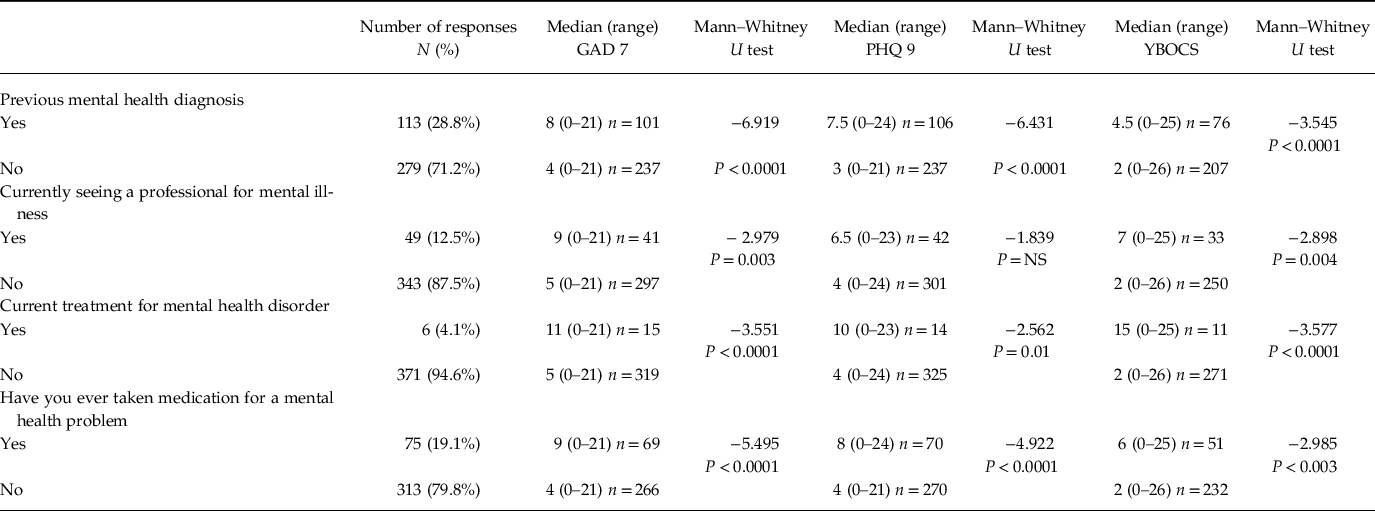
Table 1 outlines the relationship between previous and current mental health and treatment and the scores obtained on the GAD-7, PHQ-9 and Y-BOCS scales. Notably, there were significantly worse GAD-7, PHQ-9 and Y-BOCS scores in women with previous mental health diagnoses and those with either a past or current treatment for mental health issues.
The relationship to current and past mental health issues and scores from the GAD-7, PHQ-9 and Y-BOCS scales. The questionnaire was administered to 392 pregnant women

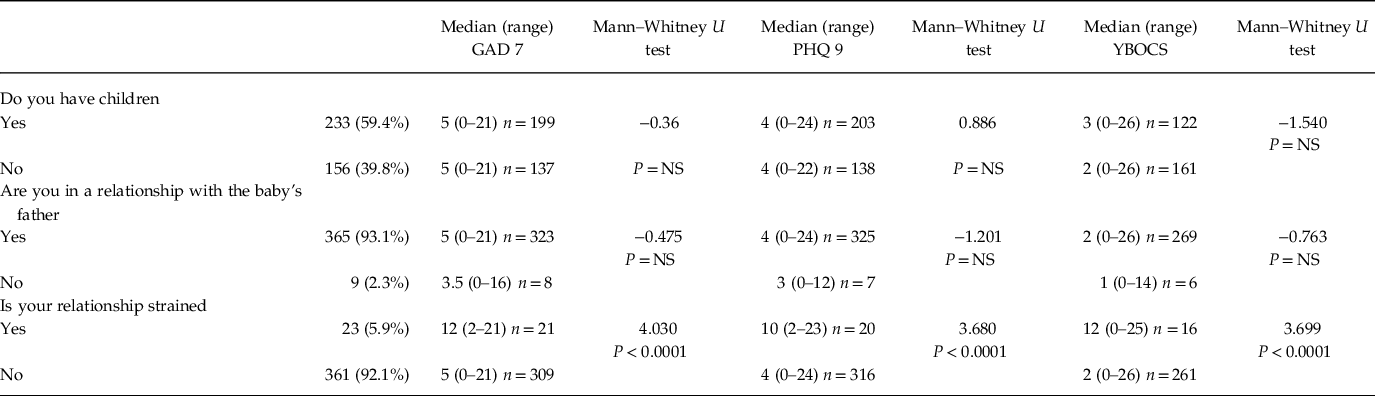
For those currently seeing a mental health professional, there were significantly poorer GAD-7 and Y-BOCS scores but no difference in PHQ-9 scores. For women with children at home and those in a relationship with the baby’s father, there was no difference in any mental health score. Women who reported that their relationship was under strain demonstrated significantly poorer scores on all scales (Table 2).
The relationship between relationship factors and children and the scores from the GAD-7, PHQ-9 and Y-BOCS scales

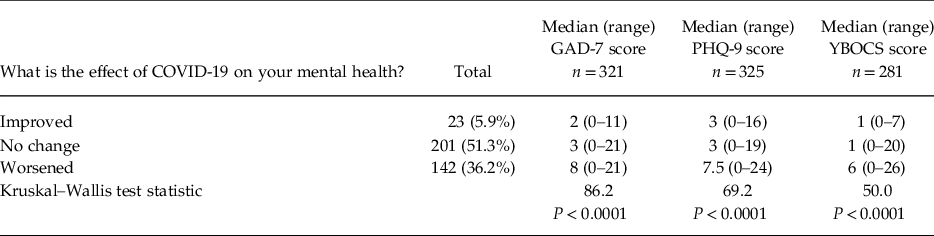
Self-reported mental health issues related to COVID-19 are outlined in Table 3. There were 132 women (36.2%) who described their mental health to be worse in the COVID-19 era. Anxiety and sleep disturbance were the commonest complaints with 123 and 98 women reporting a problem respectively.
The relationship between self-reported mental health changes with COVID-19 and scoring on the GAD-7, PHQ-9 and Y-BOCS scales

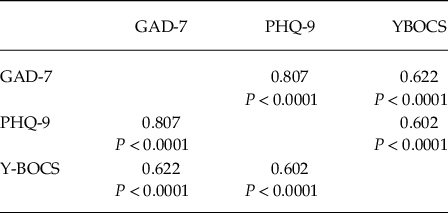
When analysed against the test scores, self-reported worsening of mental health in the COVID-19 era was significantly associated with worse scores on the GAD-7, PHQ-9 and Y-BOCS scales (Table 4). The GAD-7, PHQ-9 and Y-BOCS scores were positively correlated with each other (Table 4).
Pearson’s correlation coefficient for correlations between the GAD-7, PHQ-9 and Y-BOCS scores from questionnaires given to 392 women

In summary, self-reported mental health was found to be worse in women with a current or previous history of mental health diagnoses or treatment and those with relationship strain. There was a measured deterioration in self-reported mental health parameters during the COVID-19 era.
Discussion
This study of an unselected group of pregnant women attending an antenatal clinic during the COVID-19 era demonstrated significant findings regarding pregnant women’s mental health. Pregnant women at CWIUH experienced subjectively poor mental health during the COVID-19 pandemic, characterised by increased anxiety, depression and OC symptoms.
For anxiety, 23.7% of women screened positive on the GAD-7. In a multinational study conducted earlier in the pandemic, 11.1% screened positive (moderate-to-severe), with living in Ireland being a risk factor for worse anxiety (in Ireland 14.7% screened positive). The current study showed higher anxiety rates. This may be due to the study being carried out later in the pandemic during the worst and deadliest wave. At the time, there was extensive media commentary about the effects of visitor restrictions for maternity patients and the negative impact it was having on mental health (e.g. Kenny, Reference Kenny2021).
For depression, 20.4% of women screened positive. This level is broadly in line with international findings during COVID-19, using different a different scale to assess depression: 15% average, 26.3% for Ireland (Ceulemans et al. Reference Ceulemans, Foulon, Ngo, Panchaud, Winterfield, Pomar, Lambelet, Cleary, O’Shaughnessy, Passier, Richardson, Hompes and Nordeng2021).
Women who screened positive for OCD represented 10.3% of the sample. This suggests OC symptoms are common in the antenatal population. There appears to be a preponderance of obsessive symptoms rather than compulsive symptoms. Although a pathognomic feature of OCD, they may be a feature of depression and anxiety as well. Intrusive, unwanted thoughts are also a well-recognised normal phenomenon amongst new mothers, with over half reporting intrusive thoughts of wanting to harm their baby (Fairbrother and Woody Reference Fairbrother and Woody2008). This study shows that intrusive thoughts may be a more common symptom amongst pregnant women during COVID-19 than previously thought. Obsessions could include intrusive thoughts about the baby’s well-being, or harm coming to the baby. Such thoughts are understandable as in pregnancy there is a heightened level of responsibility and meaning regarding the baby’s health. COVID-19 as an infectious threat could trigger obsessions about contamination and trigger cleaning behaviours.
Limitations of this study include various sampling biases. Women who fail to attend antenatal care may have higher rates of mental illness, and they would not have been offered the questionnaire (sampling bias). Women may not be motivated to engage with the survey due to active mental illness (non-response bias). There may be a tendency to under-report OC symptoms (response bias) because women without a prior diagnosis of OCD may not have the language or insight to describe their experiences in the Y-BOCS terms. In addition, compulsive behaviours such as handwashing might not be recognised as compulsive as it is a recommended public health safety measure. Similarly, checking behaviours, reassurance-seeking and avoidance behaviours that can be associated with OCD, may be seen as a normal response to pregnancy-related to concerns, particularly in COVID-19. These biases might tend towards an under-reporting of mental health difficulties, especially OCD.
This study builds on the existing literature regarding OC symptoms in post-partum women. The findings suggest the commonality of such symptoms during pregnancy, particularly in the COVID-19 era. Perinatal Mental Health assessment in both Primary Care and Specialist settings should ensure thorough screening for obsessional and compulsive symptoms, as well as offering targeted therapeutic interventions, such as cognitive behavioural therapy. Treating pregnant women with OC symptoms should include the obstetric team as the woman’s health-seeking behaviour may be affected. This could not only improve women’s experience of pregnancy, but also give them tools for a potential exacerbation of OC symptoms postnatally.
Conclusion
This study found high levels of depression, anxiety and OC symptoms amongst pregnant women during COVID-19. This highlights the vulnerability of this group to mental illness and the importance of enhanced screening and support during pandemics. Identifying these patients, particularly taking account of their mental health history and relationship status, would allow clinicians to help women access appropriate support. As well as anxiety and depression in pregnancy, OC symptoms may represent significant morbidity. There are a number of established approaches for managing perinatal OCD, and more effort may be needed to identify these patients in order to offer them an appropriate, individualised care plan.
Ethical standards
The authors assert that all procedures contributing to this work comply with the ethical standards of the relevant national and institutional committee on human experimentation with the Helsinki Declaration of 1975, as revised in 2008. The study protocol was approved by the Research Ethics Committee of Coombe Women and Infants University Hospital.
Financial support
This research received no specific grant from any funding agency, commercial or not-for-profit sectors.
Conflicts of interests
None.