Implications
Our study indicates that farmers’ preferences for cattle production objectives, traits and breeds are heterogeneous. Crossbreeding has to be considered a suitable breeding strategy with the potential to improve farmers’ livelihoods and conserve locally adapted breeds. Monitoring crossbreeding, supporting farmers with appropriate breeding information and implementing a national within-breed improvement program will reduce the risk of genetic erosion of local breeds through indiscriminate crossbreeding.
Introduction
In recent decades, there has been a rapid shift in livestock breeds used in developing countries due to global drivers, such as an increasing demand for livestock products and market-oriented production. Local breeds have been replaced by exotic breeds, leading to a loss of genetic resources (Rege et al., Reference Rege, Marshall, Notenbaert, Ojango and Okeyo2011). Changes in economic, social and environmental factors affecting the population of local livestock breeds might offer opportunities, but also pose threats to the livelihoods of poor farmers (Rege et al., Reference Rege, Marshall, Notenbaert, Ojango and Okeyo2011). The trypanotolerant N’Dama cattle breed (Bos taurus) is endemic to the southern region of Mali. It is productive in tsetse-infested areas, tolerant to heat, and resistant or resilient to helminthes and tick-borne diseases (Murray et al., Reference Murray, Stear, Trail, d’Ieteren, Agyemang and Dwinger1991). The breed also has relatively low nutritional and husbandry requirements, which, along with the previous features, can be considered as advantageous for poor livestock keepers with limited capital to invest in better feeding and health care. However, trypanotolerant taurines are often perceived as inferior in terms of meat and milk output as well as draught power, and thus fetch lower prices on the market compared with Fulani Zebu (Bos indicus) breeds (Kamuanga et al., Reference Kamuanga, d’Ieteren, Tano, Jabbar, Swallow and Pokou1999; Agyemang, Reference Agyemang2005). Where Fulani Zebu can be raised, trypanotolerant cattle have been continuously replaced, suggesting that farmers regard the advantages of trypanotolerant breeds to be less important than their disadvantages (Jabbar and Diedhiou, Reference Jabbar and Diedhiou2003).
In the past 30 years, more and more transhumant pastoralists have settled with their Fulani Zebu in the south of Mali due to repeated droughts in the north since the 1970s (Ayantunde et al., Reference Ayantunde, Asse, Said and Fall2014). Along with this sedentarization, bush clearing for agriculture, implementation of tsetse control programs, and a widespread use of trypanocides have been observed. These changes have favored crossbreeding between the N’Dama and the Fulani Zebu breeds (Agyemang, Reference Agyemang2005). In 1985, the N’Dama breed was estimated to represent 6% of the total cattle population in Mali, with an estimated 409 000 heads (Shaw and Host, Reference Shaw and Hoste1987). The number of purebred N’Dama was reported to have declined in inland Sahelian countries like Mali (Agyemang, Reference Agyemang2005); however, the extent to which the current N’Dama population is affected by crossbreeding in Mali is not known. The future role of trypanotolerant breeds as a unique animal genetic resource depends on the changes occurring in the production systems in which they are kept, the availability of other options for tsetse and trypanosomiasis control, and the farmers’ perceived value of these breeds relative to other breeds (Agyemang, Reference Agyemang2005).
A number of studies have been carried out on production objectives, and trait and breed preferences of farmers for cattle in West Africa. Most of these studies were conducted within the scope of conservation and improvement of trypanotolerant cattle breeds. Tano et al. (Reference Tano, Kamuanga, Faminow and Swallow2003) investigated trait preferences of farmers in Burkina Faso using conjoint analysis. Jabbar and Diedhiou (Reference Jabbar and Diedhiou2003) examined breed preferences in Nigeria based on the rating of breed traits and market data using hedonic pricing. Ejlertsen et al. (Reference Ejlertsen, Poole and Marshall2013) and Benison et al. (Reference Bennison, Barton and Jaitner1997) assessed the production objectives and selection criteria of livestock owners in The Gambia, also using a rating matrix. Few studies have taken into account the heterogeneity of farmers and the factors that influence their production objectives and trait preferences for cattle (Benison et al., Reference Bennison, Barton and Jaitner1997; Tano et al., Reference Tano, Kamuanga, Faminow and Swallow2003; Ouma et al., Reference Ouma, Abdullai and Drucker2007; Ndumu et al., Reference Ndumu, Baumung, Wurzinger, Drucker, Okeyo, Semambo and Sölkner2008).
A long-term international project for pure breeding N’Dama cattle, the ‘Regional Project for Sustainable Management of Endemic Ruminant Livestock in West Africa’ (United Nations Development Program (UNDP), 2007), was set up to prevent genetic dilution and improve the productivity of N’Dama cattle. Breed improvement programs should take into account production aims, breeding interests, and selection criteria of livestock keepers to reduce the risk of being unsustainable (Ouma et al., Reference Ouma, Abdullai and Drucker2007; Ndumu et al., Reference Ndumu, Baumung, Wurzinger, Drucker, Okeyo, Semambo and Sölkner2008). Understanding the production objectives of farmers and how they value different livestock traits is regarded as a prerequisite for enabling them to make best use of the animal genetic resources available (Anderson, Reference Anderson2003). This paper evaluates farmers’ production objectives as well as trait and breed preferences, and their relationship to household and farm characteristics using a ranking approach. The aim of the present study was to better understand farmers’ breeding preferences in order to consider them in breeding programs and to comparatively assess the suitability of N’Dama and Fulani Zebu cattle breeds and their crosses for different production objectives in southern Mali.
Material and methods
Study area
The study was conducted in the communes of Sibirila and Garalo in the Bougouni district, within the Sikasso region of southern Mali and covered an area of 363 700 km2 (UNDP, 2007). Within the study area, two farmer groups were differentiated: (a) local farmers, who have lived in their villages for many generations, and (b) settled transhumants, who had previously been migrating and then settled in a particular village. Local farmers in the study area are mainly from the Bambara ethnic group, they rely mainly on crop farming, while livestock production remains a secondary activity. The settled transhumants are all from the Fulani ethnic group, they mainly raise cattle and crop farming is less important to them.
Sampling
The communes Sibirila and Garalo and four villages within each commune were purposively selected based on the presence of the three breed groups N’Dama, Fulani Zebu and their crossbreds. A stratified random sampling scheme based on cattle breed ownership was applied for the selection of the households. In total, 160 households out of an estimated 2200 households owning a cattle herd in both communes were selected. Household herds were grouped into four categories based on breed composition: The first three categories were comprised of herds with more than 75% of N’Dama, Fulani Zebu or crossbred cattle, respectively. Herds with <75% cattle from a single breed were designated as mixed herds, hence forming the fourth category. From the 160 sampled households, 34 N’Dama, 31 crossbreds, 34 Fulani Zebu and 61 mixed herds were identified. A focus group discussion with eight to 10 farmers, who had previously participated in the household survey, was carried out in each of the eight villages.
Data collection
Interviews comprised sets of semi-structured and structured questionnaires and were conducted to collect data on household characteristics, herd composition, history of the cattle breeds kept, reasons for changing breeds, and intended breed choice for the next 5 to 10 years. The following four ranking procedures were applied to assess farmers’ production objectives, trait and breed preferences: (1) the household heads were asked to rank reasons for keeping cattle from a list of the following nine predetermined production objectives: draught power, savings, use for ceremony and dowry, manure, sale of animals, milk for home consumption, milk for selling, meat for home consumption, and prestige associated with the owning of cattle; (2) household heads were asked to state and rank the three most important traits they considered when selecting breeding animals; (3) respondents were asked to rank the following six predetermined traits with respect to the suitability of each of the three breed groups (Fulani Zebu, N’Dama and crosses of Fulani Zebu and N’Dama): body size, milk yield, fertility, draught ability, drought tolerance and disease resistance; (4) they were then asked to rank the three breed groups from most preferred to least preferred. In addition, the main reason for ranking a certain breed first as well as the main disadvantage of each breed group were requested. The focus group discussions aimed at obtaining information on the time of the introduction of Fulani Zebu and the onset of crossbreeding in the villages.
Data analysis
Descriptive statistics were used to present information on household characteristics, stated reasons for preferences, and reported disadvantages of N’Dama, Fulani Zebu and their crossbreds. Ranked data for the production objectives, trait and breed preferences were analyzed using an exploded logit model (Allison and Christakis, Reference Allison and Christakis1994). The exploded logit model can be conveniently implemented using proportional hazards regression as implemented, for example in the PHREG procedure in SAS, Version 9.3 (SAS Institute Inc., 2012). This is described in detail by Allison and Christakis (Reference Allison and Christakis1994). In this model, a respondent i derives a certain utility U ij from each item (cattle production objective, trait or breed) j, which is modeled as the sum of a systematic component μ ij and a random component e ij , that is, U ij =μ ij +e ij . The error term e ij is assumed to be independently and identically distributed with an extreme value distribution. The systematic component can be modeled as: μ ij =β j x i , where β j is a row vector of coefficients, the values of which vary over the cattle production objectives, traits or breeds j, and x i is a column vector of predictor variables that describe the ith respondent. As utility is modeled on a latent scale, corresponding to the log-odds scale, one of the β j must be set equal to 0 for an arbitrary chosen item (reference production objectives, traits or breeds) to achieve identification of all parameters. Each of the β j vectors then describes how characteristics of the respondent affect the log-odds of choosing item j rather than the reference item. The exponential difference between coefficients of two items provides the odds of preference of one item over the other item. As predictor variables, several household characteristics were investigated, that is, farmer group, age and education of the household head, farm size (area for crop production), cattle herd size, and herd category.
Several exploded logit models were estimated. First, the ranks for the production objectives, traits and breeds were examined for significant differences. For this purpose, a model that allowed for differences among the production objectives, traits and cattle breeds, but not for differences among respondents, was used. This can be written as:
 $$\mu _{{ij}} {\equals}\beta _{j} ,{\rm for}\,{\rm all}\,i\,{\rm and}\,j$$
where β j is a scalar.
Second, heterogeneity across respondents was taken into account using the following model for production objectives, traits and cattle breed preferences:
 $$\mu _{{i\left( {klmno} \right)j}} {\equals}\beta _{{0j}} {\plus}G_{{jk}} {\plus}\beta _{j} a_{i} {\plus}E_{{jl}} {\plus}F_{{jm}} {\plus}S_{{jn}} {\plus}H_{{jo}} $$
where G jk is the effect of kth farmer group (k=1, 2; local farmer, settled transhumant), β j the coefficients of regression on age, a i the age of the ith household head in years, E jl the effect of lth category of education of the household head (l=1, 2; no formal education, primary school), F jm the effect of mth farm size category in hectare (m=1, 2, 3;<6.5, 6.5 to 13.5, >13.5), S jn the effect of nth herd size category in head (n=1, 2, 3;<22, 22 to 50, >50), and H jo the effect of oth herd category (o=1, 2, 3, 4; N’Dama, crossbreds, Fulani Zebu, mixed).
The model for production objectives, trait and breed preferences was selected using a backward elimination procedure, and explanatory variables retained by the models were significant at α=0.1. The interaction terms farmer group×herd category were not significant in the models for production objectives, traits and cattle breed preferences and based on small group sizes n<7. Therefore these interaction terms were not included in the final model and partial confounding between farmer group and herd category was accepted. The Wald χ 2 statistic was computed to test the significance of model terms. The SAS macro %MULT was used to display significant mean differences by a letter display (Piepho, Reference Piepho2012), with a common letter indicating non-significance of a difference between means at the 5% level by a Wald-test.
Results
Household characteristics
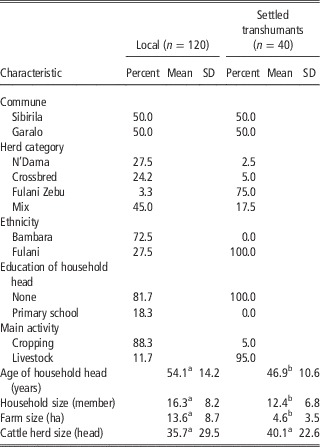
From the sampled households, 30% of the total cattle were N’Dama, 38% were crossbreds, and 32% were Fulani Zebu. The breed distribution of adult breeding bulls was 11% for N’Dama, 24% for crossbreds, and 65% for Fulani Zebu, indicating a wider use of Fulani Zebu bulls in the breeding herds. In the Fulani Zebu herd category, only Fulani Zebu bulls were used for breeding. Fulani Zebu bulls were further used in 29%, 52% and 72% of the N’Dama, crossbred and mixed herd categories, respectively. Table 1 summarizes household and farmer characteristics for the two farmer groups. No female household head was encountered. For the settled transhumants, none of the household heads attended primary school, and 95% reported livestock husbandry as their main activity. Only a few local farmer household heads (18.3%) attended primary school, and 88.3% reported cropping to be their main activity. The age of the household heads, the household sizes, and the farm sizes were significantly lower for settled transhumants than for local farmers. The breed composition of the herds was also different between the two farmer groups: of the local farmers, 45% had a mixed herd, 27.5% had N’Dama and 24.2% had a crossbred herd, while only 3.3% had a Fulani Zebu herd, compared with 75% of the settled transhumants.
Characteristics of surveyed households for local farmers and settled transhumants

a,bMeans within a row with different superscripts differ significantly at P<0.05.
Production objectives
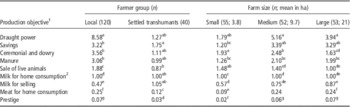
In general, farmers have different preferences for production objectives. The provision of draught power was the most important reason for keeping cattle, with cattle being four times more likely to be kept for draught power than for home consumption of milk. The odds of keeping cattle as a saving, for manure and sale, were 2.60, 2.21 and 1.51 times, respectively, the odds of keeping cattle for home consumption of milk. Milk for selling, meat for home consumption, and prestige were of less importance with 0.60, 0.23 and 0.07 times, respectively, the odds of keeping cattle for home consumption of milk. Considering farmer characteristics, farmer group (P<0.0001) and farm size (P=0.02) had a significant effect on the ranking of the production objectives (Table 2). Local farmers had a clear hierarchy for their production objectives, with high importance of livestock functions linked to crop production, such as draught power, savings and manure. The same was observed for medium to large farms. In contrast, the six first production objectives of settled transhumants did not differ significantly, indicating the multifunctional role of cattle for this group. Keeping cattle for sale was more important for small farms compared with large farms, while savings were less important.
Odds ratios of estimated production objective preferences by farmer group and farm size

1 Production objectives with different superscripts in a column differ significantly at P<0.05, while alphabetical order of superscripts indicates the relative importance of production objectives.
2 Milk for home consumption was used as the reference.
Trait preferences
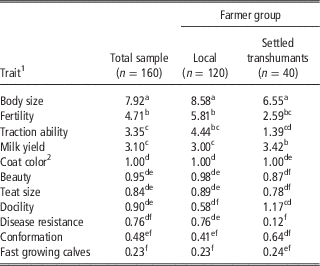
The left-hand column of Table 3 shows that in general, the trait most preferred by farmers was body size, followed by fertility, traction ability and milk yield. The odds of preferring body size were 7.92 times the odds of preferring coat color (reference) when selecting a breeding animal. Regarding coat color, red was the most preferred. According to farmers, cattle with red coats are less affected by insect bites.
Odds ratios of estimated trait preferences by total sample and farmer group

1 Traits with different superscripts in a column differ significantly at P<0.05, while alphabetical order of superscripts indicates the relative importance of traits.
2 Coat color was used as the reference.
Considering farmer heterogeneity, only farmer group (P=0.0126) had a significant effect on the ranking of the trait preferences. Both local farmers and settled transhumants ranked body size first. Milk yield was ranked second by settled transhumants and only fourth by local farmers, who gave more importance to fertility and traction ability. Disease resistance was ranked least important by settled transhumants (Table 3).
Breed preferences, aptitude and trends
Based on the total sample, crossbreds were ranked significantly higher than N’Dama and Fulani Zebu cattle (Table 4). When heterogeneity across respondents was considered, farmer group (P=0.0017) and herd category (P=0.0001) had a significant effect on the ranking of the breed preferences. Local farmers had a higher preference for crossbreds and N’Dama over Fulani Zebu, while settled transhumants preferred Fulani Zebu and crossbreds over N’Dama. Farmers with crossbred and mixed herds had a higher preference for crossbreds compared with N’Dama and Fulani Zebu breeds. Farmers with N’Dama and Fulani Zebu herds preferred the main breed they kept as well as crossbreds (Table 4).
Odds ratios of estimated breed preferences by total sample, farmer group and herd category

1 Breeds with different superscripts in a column differ significantly at P<0.05, while alphabetical order of superscripts indicates the relative preference for breeds.
2 Zebu was used as the reference.
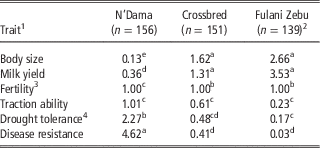
Table 5 shows that the ranking of the selected traits significantly differs for each breed group. Differences in trait valuation were more pronounced for Fulani Zebu cattle compared with crossbreds. Fulani Zebu cattle were more appreciated for milk yield and body size and much less valued for traction ability, drought tolerance and disease resistance than crossbreds. In contrast, N’Dama cattle were valued for disease and drought tolerance, while body size and milk yield were the least valued traits. The ranking of the selected traits for each breed group was not affected by any of the farmer characteristics.
Odds ratios of estimated selected trait preferences according to cattle breed group

1 Traits with different superscripts in a column differ significantly at P<0.05, while alphabetical order of superscripts indicates the relative importance of traits.
2 n: number of farmers who completed the ranking of the six predetermined traits for the respective breed group.
3 Fertility was used as the reference.
4 Refers to breed ability to cope with reduced quantity and quality of forage during the dry season.
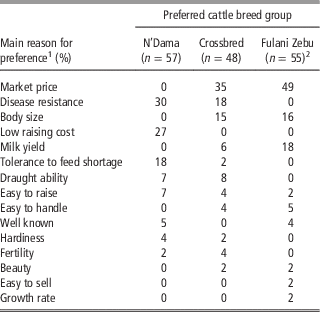
As presented in Table 6, preferences for the N’Dama breed were explained mainly by their resistance to diseases, low raising costs, and tolerance to feed shortages. The main reasons for preferring crossbreds were their high market price, followed by their disease resistance. High market price was also the most frequent reason for preferring Fulani Zebu, followed by milk yield. To a lesser extent, draught ability was also stated as a reason for preferring N’Dama and crossbreds. Regarding undesirable features for each breed group, the most mentioned disadvantages of N’Dama cattle was their handling difficulty followed by their small size and low selling price. The lack of tolerance to feed shortages and disease susceptibility were the most cited disadvantages of crossbreds and Fulani Zebu, respectively.
Reported main reason for preferring a cattle breed group

1 Farmers were only asked to give the main reason for the breed group they ranked first.
2 n: number of farmers reporting N’Dama, crossbred or Zebu as their top preferred breed.
During the group discussions, farmers additionally reported that, when starting to raise cattle, a farmer without experience in cattle husbandry usually preferred to start with the N’Dama breed because of lower input costs and risks. Many farmers mentioned that N’Dama cattle were the animal of the poor, as they can afford to keep them. Of the total respondents, 70% had introduced a new breed into their herd in the past. Among the 115 households, who had changed the breed composition of their herd, 95% included crossbreds or Fulani Zebu, while only 5% introduced N’Dama. The most common change occurred through the purchase of Fulani Zebu bulls for mating with N’Dama cows. It was reported during the group discussions that the practice of crossbreeding started ~13 years ago (range: 5 to 30 years).
Discussion
Farmers’ production objectives and trait preferences
The production objectives and trait preferences for cattle found in this study reflect the multiple objectives of the farmers in southern Mali, and are comparable with the findings of similar studies conducted previously in Kenya (Bebe et al., Reference Bebe, Udo, Rowlands and Thorpe2003; Mwacharo and Drucker, Reference Mwacharo and Drucker2005). The importance of draught power, saving and manure functions, underline the strong integration of crop and cattle production in the study area, especially among local farmers. As noted by Bosma et al. (Reference Bosma, Bengaly and Defoer1993), these functions became more important with the development of cotton cultivation in Mali, while the traditional prestige function of cattle has lost its significance.
In our study, farmers ranked productive traits such as large body size, high fertility and milk yield (Table 3) higher than adaptive traits such as disease resistance for the selection of breeding animals. These results are in line with Wurzinger et al. (Reference Wurzinger, Ndumu, Baumung, Drucker, Okeyo, Semambo, Byamungu and Sölkner2006) who found that milk yield, fertility and body size were ranked highest by Ankole cattle breeders in different production systems in Burundi, Rwanda, Tanzania and Uganda. These traits were also scored higher by goat, sheep and cattle keepers as selection criterion in recent findings of Ejlertsen et al. (Reference Ejlertsen, Poole and Marshall2013) in The Gambia. Contrary to our results, Tano et al. (Reference Tano, Kamuanga, Faminow and Swallow2003) found that disease resistance was among the most important traits, while body size was among the traits ranked lowest in West Africa. More research is needed to know if differences between our results and Tano et al. (Reference Tano, Kamuanga, Faminow and Swallow2003) findings are due to changes of farmer traits preferences over time. The preference for a large body size in both farmer groups in our study was mainly driven by a higher market price for larger cattle. Duguna et al. (Reference Duguma, Mirkena, Haile, Okeyo, Tibbo, Rischkowsky and Wurzinger2011) also found large body size to be an important trait across different sheep production systems in Ethiopia. Milk yield was of less importance for local farmers than for settled transhumants, probably because the milk offtake was usually kept by the herders hired by the local farmers as in-kind payment in addition to their salary. In contrast, settled transhumants, who rely mostly on their own family members as herders, benefited directly from the milk for home consumption or sale.
The low rank given to disease resistance (Table 3) might be explained by the lower prevalence of tsetse flies in the study area (Bocoum et al., Reference Bocoum, Diarra, Maiga, Sanogo and Traoré2012), or the widespread use of subsidized trypanocidal drugs (Grace et al., Reference Grace, Randolph, Affognon, Dramane, Diall and Clausen2009). This is a concern, knowing that farmers in West Africa are confronted with the development of widespread resistance of trypanosomes against trypanocidal drugs (Grace et al., Reference Grace, Randolph, Affognon, Dramane, Diall and Clausen2009).
Farmers’ breed preferences
Similar to previous studies across several sites in West Africa (Kamuanga et al., Reference Kamuanga, d’Ieteren, Tano, Jabbar, Swallow and Pokou1999), our study shows a higher overall preference for crossbreds. The most important reason for preferring crossbreds was high market price followed by disease resistance (Table 6). The latter result is inconsistent with the result in Table 5, which indicates low importance of disease resistance for crossbreds. This contradiction might be partly explained by productive traits such as body size and milk yield being valued through high market price (Table 6). A further explanation is that farmers probably tend to prefer N’Dama when disease tolerance is important to them. However, when they chose crossbreds, they take it for granted that they lose disease tolerance, but this loss is outweighed by higher market value. Also it is important to note that the results for the most important reason for preferring a certain breed group (Table 6) were only based on the farmer who ranked that breed first, unlike the ranking of breed aptitude done by each farmer. The less pronounced differences in trait valuation for crossbred compared with N’Dama and Fulani Zebu (Table 5) suggest that the combination of adaptive and productive traits is more relevant for the farmer than any particular trait in this breed group.
Similar to findings of Jabbar and Diedhiou (Reference Jabbar and Diedhiou2003), the lack of disease resistance and the disability to cope with dry season stress were clearly perceived as disadvantages for Fulani Zebu, but this was out-weighted by a high recognition of their size and milk yield (Table 5). Next to market price, milk yield as the second most important reason for preferring Fulani Zebu (Table 6) indicates its suitability for farmers for whom milk production is an important production objective.
No farmer reported draught ability as a reason for preferring Fulani Zebu, compared with 7% and 8% of the farmers preferring N’Dama and crossbreds, respectively (Table 6). Though Agyemang (Reference Agyemang2005) and Kamuanga et al. (Reference Kamuanga, d’Ieteren, Tano, Jabbar, Swallow and Pokou1999) reported a low draught power for N’Dama, the fairly good traction ability reported by farmers as a reason for preferring N’Dama cattle in this study might not be determined by draught power, which is linked to animal size, but by endurance, as suggested formerly by Steglich (Reference Steglich2006). During group discussions, farmers reported that Fulani Zebu was not able to plow fields as long as N’Dama cattle. This suggests the adequacy of N’Dama cattle for local farmers for whom draught power was the most important production objective.
In accordance with Steglich (Reference Steglich2006), ~10 years ago for the Gambia, disease resistance and drought tolerance were the most preferred traits for the N’Dama in our study (Table 5). Low raising costs were the main reason for preferring N’Dama (Table 6), making it the breed of choice for poorer farmers. Similar to results of Jabbar and Diedhiou (Reference Jabbar and Diedhiou2003), difficulty in handling, small size, and low market price were identified as the main disadvantages of the N’Dama breed. In this study, however, more farmers were concerned about the difficulty in handling this breed than about its small size, which might explain the preference for crossbred and Fulani Zebu in this respect. Interestingly, ranking of the relative aptitudes of the different breed groups (Table 5) was not influenced by the farmer group, suggesting that local and settled transhumants had a common perception of the breed aptitudes.
In the context of climate change and pro-poor development, the comparative advantages of the N’Dama breed in terms of adaptive traits such as coping with feed shortages and disease resistance are expected to become more relevant for the prospects of its conservation and for ensuring a sustainable contribution of livestock breeds to farmer livelihoods (Hoffmann, Reference Hoffmann2013). As stressed by Zander and Drucker (Reference Zander and Drucker2008), local breeds are an important genetic resource that may be used to develop new breeds that will be able to adapt to unforeseen future changes. This may also apply to the situation in our study.
Implications for breeding strategies
Farmers are well aware of the aptitudes (Tables 5 and 6) and weaknesses of the different breeds, and therefore, crossbreeding is a decision made by the farmer, rather than just taking place randomly. Steglich (Reference Steglich2006) noted in the case of The Gambia that a considerable number of cattle owners were very knowledgeable about crossbreeding strategies and their prerequisites. Following socio-economic and parasitological studies attesting the productivity of the N’Dama cattle, policy has been in favor of its use in the whole sub-humid zone of West Africa and genetic improvement programs for the N’Dama cattle were initiated in The Gambia and Mali (Agyemang, Reference Agyemang2005). The clear preference for crossbreds in our study shows the need to design a breeding program, which does not only focus on N’Dama pure breeding, but includes crossbreeding as a breeding strategy (Leroy et al., Reference Leroy, Baumung, Boettcher, Scherf and Hoffmann2016). This would additionally contribute to the conservation and further promotion of pure breeding N’Dama, as it would require a continuous supply of purebred females (FAO, 2015; Scholtz and Theunissen, Reference Scholtz and Theunissen2010). Under favorable conditions and when properly implemented, crossbreeding can result in better animal performance and a higher income for the farmer (Roschinsky et al., Reference Roschinsky, Kluszczynska, Sölkner, Puskur and Wurzinger2015). Crossbreds combine advantages of both breeds, but in order to assess and maximize the potential benefits, an organized crossbreeding scheme would be required (Herold et al., Reference Herold, Roessler, William, Momm and Valle Zarate2010). So far, no organized crossbreeding between the N’Dama and Zebu cattle has been implemented at village level, which would require a thorough planning and long-term organization (Leroy et al., Reference Leroy, Baumung, Boettcher, Scherf and Hoffmann2016) to sustainably contribute to farmers’ livelihoods. Farmers need to be better informed about the effects of crossbreeding, especially in terms of the possible loss of adaptive traits, and researchers should consider farmers’ experience in crossbreeding. Only crossbreeding between European breeds and the Fulani Zebu or N’Dama cattle was done in peri-urban areas and on-station to test the performance of the different crossbreds (Tamboura et al., Reference Tamboura, Bibe, Babile and Petit1982).
As advised by Mapiye et al. (Reference Mapiye, Chimonyo, Dzama, Raats and Mapekula2009) for the Nguni breed in South Africa, the government should create multiplication farms and formulate policies to ensure the conservation and future supply of N’Dama breeding stock. The low appreciation of productive traits of N’Dama cattle in our study highlights the need for their improvement. An open nucleus breeding scheme could be considered (Bosso et al., Reference Bosso, Van der Waaij, Kahi and Van Arendonk2009) in order to achieve this and prevent genetic erosion of the N’Dama breed. Multiplier herds managed by individuals or farmer groups specialized in the breeding of pure N’Dama cattle could also allow for a sustainable production of heifers that could partly be mated to Fulani Zebu bulls to produce crossbred cattle for the market. A rotational crossbreeding scheme could then be applied to avoid animal with more than 1/2 Fulani Zebu blood. Crossbred dams would alternatively be mated to improved N’Dama bulls and Fulani Zebu bulls.
Regarding breed improvement, a three-tier breeding program, with the breeding objective defined as ‘improvement of milk and meat without loss of disease resistance and other adaptive traits,’ was implemented for N’Dama cattle in The Gambia by the International Trypanotolerance Centre (Dempfle and Jaitner, Reference Dempfle and Jaitner2000). A similar selection strategy could be implemented for the N’Dama in Mali; however, large body size should receive the highest weight. An additional trait that could be considered is the reddish coat color, which is preferred by farmers (Table 3). Using a uniform coat color will help in the branding of the breed.
Conclusion
This study emphasizes the multiple production objectives, traits and breed preferences of livestock keepers in southern Mali. N’Dama cattle remain a valuable breed due to their favorable adaptive traits and also their relatively good traction ability, thereby fulfilling the diverse objectives of local farmers. However, with increasing demand for livestock products and a decrease in the tsetse fly population, it is expected that more Fulani Zebu cattle will be kept and the trend in crossbreeding will probably continue, putting the N’Dama breed under high risk of genetic dilution. Crossbreeding should be seen as an opportunity for farmers to improve their livelihoods, and can be considered as a way to maintain locally adapted breeds. There is a need to monitor crossbreeding and to develop appropriate policies that aim to minimize the risk of genetic erosion of the N’Dama breed, such as sensitizing and supporting farmers with appropriate breeding information and implementing a national or regional within-breed improvement program.
Acknowledgments
Field work for this study was made possible through the collaboration of the Regional Project for Sustainable Management of Endemic Ruminant Livestock in West Africa, and the International Livestock Research Institute (Nairobi). We extend our sincere gratitude to the German Academic Exchange Service (DAAD) and the Foundation Fiat Panis (Ulm) for providing funding.