Introduction
The third United Nations World Conference on Disaster Risk Reduction, 2015 in Sendai, Miyagi (Japan), adopted the Sendai Framework for disaster risk reduction over a period of 15 years (between 2015 and 2030). 1 As a fundamental objective, this framework seeks to reduce the loss of human life and economic, cultural, and environmental assets through disaster risk reduction, as well as to reduce the social impacts of disasters. Additionally, increasing resilience is essential for the sustainable development of affected communities. Colombia welcomes the guidelines provided by this framework and is 1 of the first Latin American countries to comply with this process. 2
The Colombian government has been working for more than 20 years to implement policies, strategies, guidelines, and regulations that allow the comprehensive development of risk management in the country. While significant advances have been made, there have been difficulties implementing these actions in some areas. With the establishment of the National Unit for Disaster Risk Management (UNGRD), the country has managed to consolidate a technical reference that coordinates activities focused on risk management throughout the country.
Over the years, Colombia has faced disaster situations that have generated changes in risk management models. These situations have not only brought suffering, destruction, and loss of human life, but have also served as lessons to develop procedures aimed at minimizing the risks caused by the presence of hazards. Most disasters that result in large numbers of deaths and economic losses in Colombia are related to natural hazards. However, other events such as anthropogenic, biological, and complex (derived from a sequence of 2 or more phenomena in which 1 triggers the others) threats can affect communities and have a significant social, physical, and economic impact on the society.
The significance of public policies for mitigating risk and educating the population and governing bodies regarding disaster preparation, illustrates how vulnerable communities can be in the absence of comprehensive actions to reduce the social and economic impacts of disasters. Reference Sarmiento Prieto, Fritis Estay and Castro Correa3
The objective of this article is to provide general evidence-based guidelines for formulating disaster risk management plans in Colombia for each action process (risk awareness, risk reduction, and disaster management). These guidelines focus on specific disaster management activities and preparedness for an effective response to emergencies, which are the materialization of threats in each possible scenario that alter the normal functioning of entities and communities.
The lack of preparedness for an adverse event affects the ability of individuals or communities to counter a threat, which in turn has severe and irreparable consequences for the population. In order to respond to an emergency, it is necessary to educate and raise awareness in the community, and the government should ensure that such responses develop effectively. Knowing and understanding the risk is the first step in the development of disaster risk management plans. Intervention includes reducing the risk and determining the actions to be taken in the event of a disaster.
Discussion
Disasters and the Main Threats in Colombia
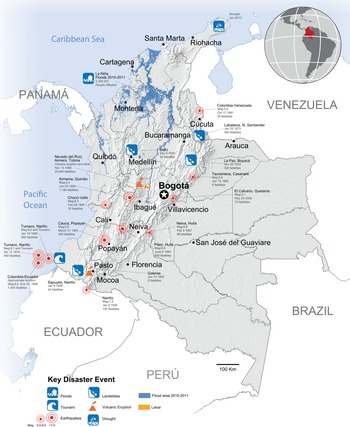
Several natural disasters have hit areas across the Colombian territory in the last few decades, which has led to substantial changes in risk management strategies in the country. The 10 events that have cost the most human lives and that are still remembered by current generations are, in chronological order: the explosion of military cars with dynamite in Cali (Valle del Cauca, 1956); the El Playón landslide (Santander, 1979); the Tumaco earthquake (Nariño, 1979); the Popayán earthquake (Cauca, 1983); the Nevado del Ruiz volcanic eruption (Tolima, 1985) which holds the record for the highest number of fatalities in the last century; the Villatina landslide (Antioquia, 1987); the Páez earthquake (Cauca, 1994); the Eje Cafetero (coffee axis) earthquake (Caldas, Tolima, Quindío Risaralda and Valle del Cauca, 1999); the rainy season of 2010–2011 in the entire country; and the Mocoa landslide (Putumayo, 2017). 4 Floods are the most frequent disasters in Colombia, affected the greatest percentage of the population. The most lethal disaster event in Colombia was associated with the eruption of the Nevado del Ruiz volcano in 1985, which led to a lahar that covered the town of Armero, Tolima, killing more than 25000 people. Figure 1 illustrates the historical natural disasters in Colombia.
Historical natural disasters in Colombia.
Source: Modified from United Nations Office for the Coordination of Humanitarian Affairs, website https://www.humanitarianresponse.info/sites/www.humanitarianresponse.info/files/snapshot_colombia_EN_sep_2013_desastre%20modif2.pdf

Colombia is located in the extreme northwest of South America and covers an area of 2070408 km2. Approximately 55% of this area comprises the continental territory, whereas the remaining 45% comprises the maritime territory. Its great hydrological, geological, climatic, and geomorphological diversity makes it susceptible to natural phenomena. 5 The Colombian territory is susceptible to geological events (earthquakes, volcanic eruptions, tsunamis, mass movements), hydro-meteorological phenomena (floods, droughts, and tropical cyclones), wildfires, technological threats, complex threats, and biological threats produced by uncontrolled exposure to biological agents or microorganisms, such as pandemics. Reference Repository6
It is important to emphasize that disasters are not natural; they are the product of the social construction of risk. In other words, they are the product of a natural phenomenon (e.g., an earthquake, or a flood) and the vulnerability of the human element: socioeconomic conditions, policies, and infrastructure (for example, housing built on unstable land, buildings with structural deficiencies, precarious economic situations, housing built in risk areas, etc.). The combination of these elements creates disaster. Reference Hernández Vázquez7 Disasters are interpreted as situations that arise from the relationship between a natural phenomenon and society’s organisation and structure; natural phenomena would not cause damage themselves if they did not interact with the human environment and its development.
Risk Management as a Continuously Improving Process
The risk management of disasters in Colombia is part of a national policy oriented towards the formulation, execution, monitoring, and evaluation of the actions that both the state and the public must follow to reduce the risk of disasters and their negative effects. These effects are detrimental to the sustainability, wellness, territorial security, and quality of life of local populations and communities at risk. 8 The risk management plans in Colombia are developed by stages based on 3 fundamental processes, risk awareness, risk reduction, and disaster management. Each of these processes involves specific activities within the framework of its competences, roles, and jurisdiction as a part of the National System for Disaster Prevention and Response. Reference Álvarez-Ríos, Aristizábal-Vélez and Torres-Pavas9
Risk Awareness
This process entails identifying, analyzing, evaluating, monitoring risk scenarios, and establishing communication processes to promote awareness, thereby generating a prevention culture. Knowing the risk complements the processes of disaster reduction and management. 10 Identifying risk scenarios and the sequence of events that have generated emergencies or disasters in the past will serve as a starting point for developing a risk management plan. The characterization of the population, the socio-economical and socio-cultural context, and having databases of vulnerable populations, can help determine threats and levels of vulnerability.
The following steps are necessary to characterize such context: (1) determine the natural characteristics of the geographic location of a community or entity, including the presence of mountains, rivers, lagoons, wetlands, beaches, volcanoes, geological faults, etc., and identify whether they are potential threats, (2) determine cultural and social conditions in order to guide participatory and organizational strategies for the community, (3) identify the conditions of the physical infrastructure of buildings and public services that are in place, and identify police stations, fire departments, and hospital centers that will support emergency care. Additionally, policies, objectives, and strategies that support the development and execution of risk management plans should be established, as should organizational models that allow the creation of positions responsible for leading this process. An inventory and analysis of the exposed elements, the potential areas of impact, causes of vulnerability, and risk sources should be conducted. These actions ensure an efficient risk analysis.
Risk analysis and assessment should adopt a methodology that determines people’s exposure to different phenomena and their ability to respond to them. This process should determine the risk level based on the general threat and vulnerability, and prioritize scenarios with the highest risk for intervention. Reference Campos, Holm-Nielsen and Díaz11
The analysis and zoning of threats and risks, the assessment and zoning of vulnerability, the assessment and categorization of risk, the modeling of damage scenarios, and the study of infrastructure should be carried out by qualified personnel. Appropriate disciplines based on the type of threat must also be involved in risk assessment. In the case of earthquakes, historical and instrumental information on regional seismicity must be collected, and seismic micro zoning must be performed.
Monitoring natural phenomena is the responsibility of technical-scientific entities that provide information on threats and risk conditions in the territory so that other institutions and the population, in general, can activate response procedures as needed. 5 Risk communication aims to emphasize the prevention and perception of risk and is a cross-sectorial process of obtaining and sharing information and engaging public and private entities and the community in disaster risk management through continuing education and awareness programs.
Risk Reduction
This process includes risk intervention measures aimed at modifying, decreasing, or eliminating the conditions or factors that generate risk; the current risk is reduced through mitigation (corrective intervention), and future risk is reduced through prevention (prospective intervention). Risk reduction also includes financial protection actions. 10 Risk mitigation or corrective intervention seeks to reduce the population’s level of risk through mitigating actions that reduce the conditions of threat and vulnerability.
Interventions on the physical structure of buildings and the application of engineering techniques that produce safe infrastructure and protect people and systems from threatening events are crucial in order to reduce the magnitude and intensity of the threat and decrease the population’s vulnerability. Examples of these measures are: constructing earthquake-resistant buildings, structural reinforcement of buildings, construction of dikes in coastal areas, securing of equipment and office furniture, among others. Mitigation efforts should be established for each type of phenomenon to which the community or public and private entity is exposed. Non-structural intervention measures include access to knowledge and practices that reduce the risk and impacts of different threats, mitigate probable losses, and avoid new risks. Reference Pérez, Rodríguez and Ramírez12 These actions are normative, informative, and educational; they increase the population’s awareness and provide people with training. To implement such measures, it is essential to determine the technical and financial feasibility of the intervention, the resources available for its implementation, the timeline for its execution, and the entities responsible for their management.
In risk prevention or prospective interventions, it is necessary to ensure that no new risk events emerge, and avoid the need for corrective interventions through preventive actions that contribute to safe physical conditions for the population. These actions include performing pre-feasibility studies, applying adequate designs, identifying regulations that do not allow the occupation of areas prone to threatening events, and developing sustainable environmental planning programs. Control measures are used to monitor the processes mentioned above. Reference Calderon and Frey13
Regarding financial protection, mechanisms must be established to provide advance economic resources in the case of risk events to cover the costs of damage, emergency care, and recovery. These resources should be easily accessible and available for prompt use. Financial coverage through policies, insurance, hedge funds, deposit insurance, social investment funds, and environmental funds will allow the impacts of disasters to be addressed. Reference Rivas, Aparicio and Páez14
Disaster Management
Once the risk is known and reduction measures are taken in disaster management, emergency preparedness actions and responses should be implemented by creating an emergency and contingency plan. This step is key for managing the disaster response and preparing and executing a recovery plan (rehabilitation and reconstruction), taking into account the impact of the event and the affected population’s ability to execute the necessary actions. 10
The coming together of the companies with local or regional entities belonging to the National System for Disaster Risk Management (SNGRD) (within the framework of Law 1523 of 2012). 15 will allow efficient response to an emergency and reduce its impacts on the population. The structure of the plan ensures the development of a logical sequence of actions in case of an emergency and establishes mechanisms to guarantee functionality and maintain a constant culture of safety. These points allow the development of methods and mechanisms for carrying out the intervention strategies necessary to implement the plan in each possible scenario.
Resources for effective emergency response are those elements that the entity relies on for emergency response. The quantity and location of these resources (for example, fire extinguishers, first-aid kits, and stretchers) must be known in advance to establish their availability. Signage is a useful tool for the identification, location, and placement of the elements necessary for emergency care and evacuation. These signs should draw attention to the existence of risks, indicate procedures to follow, and be easily visible from any point along the evacuation route. Entities must adopt alarm systems (ringers, bells, or sirens) to warn of an emergency event in progress and activate mobilization if evacuation is necessary. Reference Correa, Ríos and Acevedo16
It is essential to have alternative systems that guarantee the supply of basic needs affected when emergency or disaster events occur, such as emergency lighting, power, and water reserves. Communication systems are essential elements that guarantee the exchange of correct information when a call chain is activated. Such systems include portable radios, cell phones, and communication media that speed up the transmission of messages, and the quantity and location of such devices should be detailed in the risk management plans. Additionally, each piece of equipment must undergo a scheduled inspection and preventive maintenance. Likewise, the entity must establish an annual budget for risk management to execute necessary actions for mitigating risks and preparing the population for an emergency event or disaster.
An emergency management committee should be formed to ensure that emergency operations are adequately organized. The committee will be responsible for the coordination of response actions before, during, and after an emergency or disaster. The committee will administer the plan and make decisions at the time of an emergency. Brigades, and specific groups trained to respond to the event and comply with preventive actions must be formed. It is important to implement an annual training plan focused on prevention and emergency response for all staff, promoting a better emergency response.
Entities must detail the specific roles of those involved in preparing, assessing, and implementing emergency plans before, during, and after the emergency. It is also essential to establish a crisis plan that focuses on communication protocols and outlines how emergency information will be scaled and who will be responsible for official communications to the press if necessary. 10 On the other hand, there are support groups for emergency response comprising public or private entities; organized and trained in risk management, and emergency and disaster response.
The evacuation plan is 1 of the most critical aspects of the management plan; it establishes the actions and procedures to follow in the event of incidents that threaten a population’s integrity. The evacuation plan is the rapid displacement through safe routes to an external location that meets safety conditions. For evacuation, it is necessary to practice drills that facilitate and guide people’s mobilization to safe areas in cases of an emergency. This response action is key to the safety of personnel in these situations. Evacuation strategies should be developed based on the risks to which the entity is exposed, the vulnerability analysis, and the characteristics of the population. Additionally, the methods through which emergency services and the emergency call chains will be notified to activate the administrative structure for emergency response must be established. Reference Díaz-Tamayo, Gil and Arboleda17
Evacuation routes are routes designed to allow people to evacuate to safe areas in the shortest possible time. These routes are plotted considering threats, the level of risk, and vulnerability. Meeting points or withdrawal points are areas that have been previously designated for locating people who evacuate in case of emergency. These places must have open, clear fields of view and be relatively risk-free. Additionally, alert and alarm systems are acoustic or visual devices that warn a potentially affected community or intervention team of a future emergency.
Entities must provide an architectural drawing with evacuation routes that allow people to recognize where the evacuation routes and safe areas for refuge are located. Communities must plot topographic maps locating potential threats to the area and safety zones or meeting points where people must remain until it is safe for them to return to their homes.
Contingency plans are developed to address each specific threat identified in the risk analysis and establish specific guidelines. These plans are organized according to the type of risk and present aspects such as those responsible for the execution of the activities, the equipment that will be used, and the personal protection elements necessary according to the event. Reference Da Silva, Da Fonseca and Pinheiro18
Simulation exercises are classroom activities that allow scenarios to be played out through virtual reality. The goal of these exercises is to develop skills in coordination, management, and decision-making in the presence of adverse events. They are based on hypothetical events that occur at a specific place and time and allow the response team to be assessed in all aspects without assuming the risks of field exercises. When developing these exercises, it is essential to create a script, which will be the fundamental basis of the activity. The script should thoroughly describe the entire development of the event and include detailed facts, including the sequence and chronology of the strategic, tactical, and operational actions expected during the exercise, the available resources, and those responsible for each role.
An emergency drill is a practical teamwork exercise that is carried out in the field. It presents an emergency that will involve the mobilization of resources and personnel. In such exercises, the knowledge and techniques detailed in the emergency and contingency plan are applied. The patients and the event are simulated, but the response is measured in real time, and the actions performed and the resources used are evaluated. While the simulation is a virtual exercise based on a scenario, it does require careful planning and organisation to avoid setbacks. Reference Díaz-Tamayo, Gil and Arboleda17
Mutual aid plans are joint strategies carried out by 2 or more entities in the same geographical area to complement the emergency and contingency plan. These plans are formal agreements between entities to provide technical and human assistance if an emergency exceeds the entities capacity. The mutual aid plan strengthens the entity and nearby entities, improving the response capacity through mutual aid mechanisms and providing immediate support before relief agencies arrive.
A business continuity plan that focuses on the recovery of critical processes should be established to minimize an event’s financial impact that disrupts operations. Such a plan requires the entity to determine how activities will continue uninterrupted in the event of a disaster or emergency. This means that work must continue either from another location or from a place that has been pre-determined in the protocol so that the entity can continue to operate and the population that benefits from its activities is not affected. For workers, alternatives include teleworking, having computer media stored outside the entity, and working on virtual platforms, among others. Reference Correa, Ríos and Acevedo16
A mechanism for evaluating, monitoring, and updating the emergency and contingency plan should be established annually and should allow the plan to be updated in response to changes in the entity, thus ensuring its functionality. The effectiveness and efficiency of an emergency and contingency plan are tested through simulation exercises and drills to identify opportunities for improvement and establish new response strategies. The plan should be disseminated and disclosed to everyone so that they are aware of and understand its scope and applications.
The mechanisms for disseminating the emergency and contingency plan should be creative, clear, concise, and easily assimilated since people receive better knowledge through didactic tools. These tools can be printed or distributed in an audiovisual way, electronically, or through training.
Disaster recovery plans are activated after the emergency phase; they should be geared towards the rehabilitation and reconstruction of activities after the disaster and should mitigate the negative consequences of the disaster. During the rehabilitation phase, the priority areas and processes necessary for short-term recovery are identified, as are the necessary essential services. Rapid assessment of damage and losses is recommended during the emergency phase to plan for rehabilitation needs. The reconstruction phase establishes the actions needed to restore the infrastructure affected by the disaster and reduce its vulnerability, thus making the population safer and more resilient. This is done by identifying, proposing, and developing medium- and long-term projects to improve infrastructure and operation in a sustainable manner. Reference Gaviria and Zambrano19
Conclusions
Risk knowledge is a fundamental aspect of decision-making, and is also important for allocating the resources needed for reducing risk. Those who lead both private and public entities in Colombia must establish budgets that support disaster risk management in each of their domains. Risk assessments should take into account the interrelationships and the evolving nature of a threat and the cascading events that can be triggered and can impact an entire system; in this sense, systemic risk management should be viewed as adaptive and anticipated planning that identifies complex risks and allows actions to be executed quickly.
Plans must be multidisciplinary and interdisciplinary; their development must involve multiple disciplines, and all processes must be coordinated. Likewise, the response must be multi-sectoral. Also, risk management plans should be incorporated into land-use plans to identify areas that present potential risks due to natural phenomena and the location of human settlements to improve safety and provide management strategies for exposed areas.
The regulatory entities in charge of disaster risk management must continuously verify that territorial, public, and private entities comply with national risk management guidelines to anticipate and avoid the catastrophic consequences and impacts of any phenomenon. The plans must be flexible, allowing them to be adjusted and changed in unexpected situations. Plans should be as dynamic as the events they are designed to respond to. Implementing strategies for disaster risk management allows communities to respond effectively to disasters and recover quickly in the face of adversity.
Abbreviations
SNGRD, National System for Disaster Risk Management (Spanish: Sistema Nacional para la Gestión del Riesgo de Desastres); UNGRD: National Unit for Disaster Risk Management (Spanish: Unidad Nacional para la Gestión del Riesgo de Desastres).