


Introduction
Ever since Aedes albopictus was confirmed in Albania in 1979 and later in Italy in 1990 concerns have been raised over the incursion and possible establishment in Europe of invasive Aedes mosquitoes, and their potential role in transmission of previously tropical arboviruses. In fact it is surprising that it took 17 years before an invasive Aedes species became involved in the transmission of pathogens to humans in Europe.
The first human disease outbreak attributed to invasive Aedes mosquitoes in Europe occurred in 2007 in Ravenna, Italy, where more than 200 chikungunya virus (CHIKV) cases were reported between July and September (Angelini et al., Reference Angelini, Finarelli, Angelini, Po, Petropulacos, Macini, Fiorentini, Fortuna, Venturi, Romi, Majori, Nicoletti, Rezza and Cassone2007a , Reference Angelini, Finarelli, Angelini, Po, Petropulacos, Silvi, Macini, Fortuna, Venturi, Magurano, Fiorentini, Marchi, Benedetti, Bucci, Boros, Romi, Majori, Ciufolini, Nicoletti, Rezza and Cassone2007b ; Rezza et al., Reference Rezza, Nicoletti, Angelini, Romi, Finarelli, Panning, Cordiolo, Fortuna, Boros, Magurano, Silvi, Angelini, Dottori, Ciufolini, Majori and Cassone2007). The second autochthonous transmission (i.e. transmission initiated locally rather than imported) of CHIKV in Europe occurred in Southern France (Fréjus, department of Var) in 2010 (Grandadam et al., Reference Grandadam, Caro, Plumet, Thiberge, Souares, Failloux, Tolou, Budelot, Cosserat, Leparc-Goffart and Desprès2011). In the same year, two cases of autochthonous dengue fever were diagnosed in Nice, France. This was the first local transmission of dengue virus (DENV) in Europe, since the major DENV epidemic in Greece and Turkey in the late 1920s (Rosen, Reference Rosen1986; Schaffner & Mathis, Reference Schaffner and Mathis2014). Subsequently, Croatia was the second country in Europe to report autochthonous DENV transmission in 2010 (Gjenero-Margan et al., Reference Gjenero-Margan, Aleraj, Krajcar, Lesnikar, Klobučar, Pem-Novosel, Kurečić-Filipović, Komparak, Martić, Duričić, Betica-Radić, Okmadžić, Vilibić-Čavlek, Babić-Erceg, Turković, Avsić-Županc, Radić, Ljubić, Sarac, Benić and Mlinarić-Galinović2011). In 2013, France reported one autochthonous DENV case in the area of Aix-en-Provence, Bouches-du-Rhone department (Marchand et al., Reference Marchand, Prat, Jeannin, Lafont, Bergmann, Flusin, Rizzi, Roux, Busso, Deniau, Noel, Vaillant, Leparc-Goffart, Six and Paty2013), and very recently (August/September 2014) three separate cases have been reported from Var department and Bouches-d-Rhôȏne in Provence-Alpes-Côȏte d'Azur (Schaffner et al., in press; ARS, 2014; ECDC, 2014a ). In October 2014, four cases of locally-acquired CHIKV were reported in Montpelier (WHO, 2014). All these recent events of CHIKV and DENV autochthonous transmissions occurred in areas where Ae. albopictus had become established.
From the end of September 2012–March 2013, the autonomous province of Madeira (a Portuguese archipelago), reported its first DENV outbreak with 2168 probable cases reported of which 1080 were confirmed. No severe clinical forms were reported, and there were no fatalities. A further 78 cases were imported from Madeira into Europe (ECDC, 2013b ). Aedes aegypti, known to occur in Madeira since 2005, was incriminated as the vector.
The presence and continuous spread of invasive Aedes species is a concern for public health in Europe. The vulnerability of Europe for the transmission of arboviruses such as DENV and CHIKV was recognized prior to 2007 (Depoortere & Coulombier, Reference Depoortere and Coulombier2006; ECDC, 2006; ECDC, 2007) and confirmed the first CHIKV outbreak in Italy in 2007. For onward transmission to occur, the introduction of a virus through a viremic patient into Europe would need to coincide with vector presence and activity, and permissive climatic conditions for outbreaks. Temporal clusters of imported cases of e.g. CHIKV in the EU are largely synchronous with large outbreaks in endemic countries as reported for Germany (Frank et al., Reference Frank, Schoneberg and Stark2011). With this in mind, the current CHIKV outbreak in the Caribbean is of concern as it adds an additional possible source of introduction of CHIKV into the Northern hemisphere overlapping with the distribution of the competent mosquito vectors, Ae. albopictus and Aedes aegypti in Europe (ECDC, 2014b ; Van Bortel et al., Reference Van Bortel, Dorleans, Rosine, Blateau, Rousset, Matheus, Leparc-Goffart, Flusin, Prat, Cesaire, Najioullah, Ardillon, Balleydier, Carvalho, Lemaître, Noel, Servas, Six, Zurbaran, Leon, Guinard, van den Kerkhof, Henry, Fanoy, Braks, Reimerink, Swaan, Georges, Brooks, Freedman, Sudre and Zeller2014). Further, the Caribbean and Central America are popular travel destinations for EU residents and increased travel can be expected. Indeed, large numbers of imported CHIKV cases are already reported in mainland France (Paty et al., Reference Paty, Six, Charlet, Heuzé, Cochet, Wiegandt, Chappert, Dejour-Salamanca, Guinard, Soler, Servas, Vivier-Darrigol, Ledrans, Debruyne, Schaal, Jeannin, Helynck, Leparc-Goffart and Coignard2014).
During the first 15 years of the 21st century, Europe has witnessed continued incursions of invasive Aedes mosquitoes, their establishment as native fauna, the development of bespoke guidelines for their surveillance (Schaffner et al., Reference Schaffner, Bellini, Petrić, Scholte, Zeller and Marrama Rakotoarivony2013a ) and now faces the prospect of continued outbreaks of CHIKV and DENV. To keep pace with the changing status of these mosquitoes and the rapid changing of public health risks, numerous papers have attempted to summarize the status of these mosquitoes (Medlock et al., Reference Medlock, Hansford, Schaffner, Versteirt, Hendrickx, Zeller and Van Bortel2012; Schaffner et al., Reference Schaffner, Medlock and Van Bortel2013b ), and the climate suitability for the mosquito vector (Medlock et al., Reference Medlock, Avenell, Barrass and Leach2006; Benedict et al., Reference Benedict, Levine, Hawley and Philip2007; ECDC, 2009; Fischer et al., Reference Fischer, Thomas, Niemitz, Reineking and Beierkuhnlein2011; Caminade et al., Reference Caminade, Medlock, Ducheyne, McIntyre, Leach, Baylis and Morse2012) and the virus (ECDC, 2012; Fischer et al., Reference Fischer, Thomas, Suk, Sudre, Hess, Tjaden, Beierkuhnlein and Semenza2013). However for many of these papers, the focus is on surveillance, biological constraints of the mosquito or virus, or a summary of the public health risk. This review paper aims to focus primarily on the entomological aspects of these invasive Aedes species, with a particular focus given to those species that have established: Ae. albopictus, Ae. aegypti, Aedes japonicus, Aedes koreicus and Aedes atropalpus. An additional species, Aedes triseriatus, has been found introduced once in France (Medlock et al., Reference Medlock, Hansford, Schaffner, Versteirt, Hendrickx, Zeller and Van Bortel2012) and has most probably the ability to establish in Europe; however, its invasiveness is not yet confirmed and thus, the species is not treated in detail here. The review also brings together a wealth of information gathered during the European Centre for Disease Prevention and Control (ECDC) VBORNET project. In addition, it looks at Europe in a global context incorporating information on the invasive species across the many overseas and dependent European territories distributed across the globe.
Entomological characteristics of the invasive Aedes mosquito species of Continental Europe
Aedes albopictus
Aedes albopictus (Skuse, 1894) has undergone a dramatic global expansion facilitated by human activities, in particular the movement of used tyres and ‘lucky bamboo’ (Paupy et al., Reference Paupy, Delatte, Bagny, Corbel and Fontenille2009). This, coupled with passive transportation via public and private transport, has resulted in a widespread global distribution. It is now listed as one of the top 100 invasive species by the Invasive Species Specialist Group (ISSG, 2009), and is considered as the most invasive mosquito species. The success of its invasion is due to a number of factors including: its high ecological plasticity, strong competitive aptitude, globalization, lack of surveillance and lack of efficient control. Climate change predictions suggest that Ae. albopictus will continue to be a successful invasive species, spreading beyond its current geographical boundaries (ECDC, 2009, 2012). This mosquito is already showing signs of adaptation to colder climates (Paupy et al., Reference Paupy, Delatte, Bagny, Corbel and Fontenille2009) which may result in disease transmission in new areas.
Geographic distribution
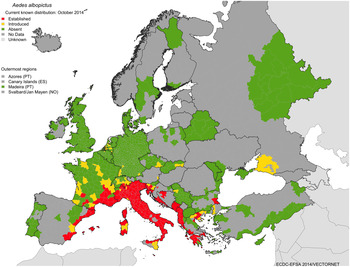
Although originated in tropical forests of Southeast Asia, Ae. albopictus has spread globally. Beyond its initial range Ae. albopictus has so far been reported in 25 different countries in Europe (fig. 1): Albania, Austria (not established), Belgium (not established), Bosnia & Herzegovina, Bulgaria, Croatia, Czech Republic (not established), France (including. Corsica), Germany (not established), Greece, Italy (including Sardinia and Sicily), Malta, Monaco, Montenegro, the Netherlands (not established), Romania, Russia, San Marino, Serbia (not established), Slovakia, Slovenia, Spain, Switzerland, Turkey, Vatican City. Elsewhere it has been reported in the Middle East in Lebanon, Israel and Syria; in the Arabic peninsula (Saudi Arabia, Yemen); in seven countries in South America (Argentina, Bolivia (not established), Brazil, Colombia, Paraguay, Uruguay, Venezuela); in the Far East and Australasia (Australia, Japan, New Zealand (not established)); on numerous Pacific Ocean and Indian Ocean islands; in North America (Mexico, USA), Central America (Costa Rica, El Salvador, Guatemala, Honduras, Nicaragua, Panama), the Caribbean (Barbados (not established), Cayman Islands, Cuba, Dominican Republic, Haiti, Trinidad (not established)) and in Africa (Algeria, Cameroon, Central African Republic, Equatorial Guinea, Gabon, Madagascar, Nigeria, South Africa (not established)) (Schaffner & Karch, Reference Schaffner and Karch2000; Madon et al., Reference Madon, Mulla, Shaw, Kluh and Hazelrigg2002; Schaffner et al., Reference Schaffner, Van Bortel and Cooseman2004; Eritja et al., Reference Eritja, Escosa, Lucientes, Marques, Roiz and Ruiz2005; Benedict et al., Reference Benedict, Levine, Hawley and Philip2007; Contini et al., Reference Contini2007; Haddad et al., Reference Haddad, Harbach, Chamat and Bouharoun-Tayoun2007, Reference Haddad, Mousson, Vazeille, Chamat, Tayeh, Osta and Failloux2012; Scholte & Schaffner, Reference Scholte, Schaffner, Takken and Knols2007; Buhagiar, Reference Buhagiar2009; ECDC, 2009, 2014c ; Gatt et al., Reference Gatt, Deeming and Schaffner2009; Paupy et al., Reference Paupy, Delatte, Bagny, Corbel and Fontenille2009; Diallo et al., Reference Diallo, Laganier and Nangouma2010; Carrieri et al., Reference Carrieri, Albieri, Angelini, Baldacchini, Venturelli, Zeo and Bellini2011; Izri et al., Reference Izri, Bitam and Charrel2011; Fernández Mdel et al., Reference Fernández Mdel, Jean, Callaba and López2012; Laird et al., 1994; Šebesta et al., Reference Šebesta, Rudolf, Betášová, Peško and Hubálek2012; Seidel et al., Reference Seidel, Duh, Nowotny and Allerberger2012; Becker et al., Reference Becker, Geier, Balczun, Bradersen, Huber, Kiel, Krüger, Lühken, Orendt, Plenge-Bönig, Rose, Schaub and Tannich2013; Bocková et al., Reference Bocková, Kočišová and Letková2013; Bonizzoni et al., Reference Bonizzoni, Gasperi, Chen and James2013; Oter et al., Reference Oter, Gunay, Tuzer, Linton, Bellini and Alten2013).
Current distribution of Aedes albopictus in Europe (ECDC 2014/VBORNET/VECTORNET).

Brief history of spread and potential for future expansion
Although it was first reported in Europe in Albania in 1979 (Adhami & Reiter, Reference Adhami and Reiter1998), the geographical spread of this species has mostly occurred during the past 25 years (Medlock et al., Reference Medlock, Hansford, Schaffner, Versteirt, Hendrickx, Zeller and Van Bortel2012) via passive transport of cold- and drought-resistant eggs in used tyres or lucky bamboo; the latter being the route of importation into the Netherlands (Scholte et al., Reference Scholte, Dijkstra, Blok, de Vries, Takken, Hofhuis, Koopmans, de Boer and Reusken2008) and Belgium (Demeulemeester et al., Reference Demeulemeester, Deblauwe, De Witte, Jansen, Hendy and Madder2014). Commercial or private transport from heavily infested areas has also resulted in the inadvertent passive transportation of Ae. albopictus into new areas (Scholte et al., Reference Scholte, Dijkstra, Blok, de Vries, Takken, Hofhuis, Koopmans, de Boer and Reusken2008), and this is believed to be the route for its introduction into Austria, the Balkans, the Czech Republic, Southern France, Germany, Spain and Switzerland (Aranda et al., Reference Aranda, Eritja and Roiz2006; Scholte & Schaffner, Reference Scholte, Schaffner, Takken and Knols2007; Šebesta et al., Reference Šebesta, Rudolf, Betášová, Peško and Hubálek2012; Kampen et al., Reference Kampen, Kronefeld, Zielke and Werner2013).
In 1985, Ae. albopictus was reported in Texas, USA and has since spread northward and eastward, having now been reported in at least 32 US states (Bonizzoni et al., Reference Bonizzoni, Gasperi, Chen and James2013; Morens & Fauci, Reference Morens and Fauci2014). This expansion was facilitated by the movement of used tyres along the interstate highways (Moore & Mitchell, Reference Moore and Mitchell1997). In Latin America it was first reported in Brazil in 1986 and later in Mexico in 1988 (Aranda et al., Reference Aranda, Eritja and Roiz2006). Reports of importation were recorded in Bolivia, Cayman Islands, Costa Rica, Cuba, Honduras, Dominican Republic, El Salvador, Guatemala and Panama in 1995, in Columbia in 1997, in Argentina and Paraguay in 1998, and in Nicaragua in 2003 (Benedict et al., Reference Benedict, Levine, Hawley and Philip2007; Bonizzoni et al., Reference Bonizzoni, Gasperi, Chen and James2013) and in New Zealand in 1994 (Derraik, Reference Derraik2004).
Following its establishment in Albania, Ae. albopictus was not reported in any other European country until 1990, when it was found in Italy, having been imported through the port of Genoa (Sabatini et al., Reference Sabatini, Raineri, Trovato and Coluzzi1990). It is now established in most areas of the country <600 m above sea level and is highly abundant in many urban areas (ECDC, 2009; Valerio et al., Reference Valerio, Marini, Bongiorno, Facchinelli, Pombi, Caputo, Maroli and Della Torre2009). During the first 10 years of its colonization, it spread throughout 22 provinces, mainly in the Northeast of the country (Romi et al., Reference Romi, Di Luca and Majori1999). Italy is now the most heavily infested country in Europe with the most abundant populations in Veneto and Friuli-Venezia-Giulia Regions, large parts of Lombardia and Emilia-Romagna Regions and coastal areas of central Italy, including San Marino and the Vatican City (Scholte & Schaffner, Reference Scholte, Schaffner, Takken and Knols2007; ECDC, 2009).
Aedes albopictus was reported in France in 1999 and Belgium in 2000, however these initial importations via imports of used tyres either were eradicated or died out, respectively, but spread has occurred to a number of countries in Europe since 2000 via ground transport from Italy, including Southern France. Aedes albopictus is now known to be spreading in Eastern Spain, Southern France and Monaco, the Balkan countries and Greece (Scholte & Schaffner, Reference Scholte, Schaffner, Takken and Knols2007). Besides, populations have established in Ticino, Switzerland, thanks to recurrent introductions from the bordering Italian region since 2003 (Wymann et al., Reference Wymann, Flacio, Radczuweit, Patocchi and Luthy2008) and in Malta (Gatt et al., Reference Gatt, Deeming and Schaffner2009, Reference Gatt, Schaffner and Cassai2010; Buhagiar, Reference Buhagiar2009). It has been repeatedly found in the Netherlands since 2005 at lucky bamboo and used tyres importing companies (Scholte et al., Reference Scholte, Dijkstra, Ruijs, Jacobs, Takken, Hofhuis, Reusken, Koopmans and de Boer2007, Reference Scholte, Dijkstra, Blok, de Vries, Takken, Hofhuis, Koopmans, de Boer and Reusken2008), and on a number of occasions in Southern Germany, but so far has not established (Pluskota et al., Reference Pluskota, Storch, Braunbeck, Beck and Becker2008; Werner et al., Reference Werner, Kronefeld, Schaffner and Kampen2012; Becker et al., Reference Becker, Geier, Balczun, Bradersen, Huber, Kiel, Krüger, Lühken, Orendt, Plenge-Bönig, Rose, Schaub and Tannich2013; Kampen et al., Reference Kampen, Kronefeld, Zielke and Werner2013). The Dutch populations imported on lucky bamboo have not established outside greenhouses, suggesting that they are tropical strains not adapted to temperate climates, whereas populations imported from the USA via the used tyres have been supressed, so far successfully, to avoid their establishment. Specimens have also been collected at parking lots along highways and at some other places in Austria (Seidel et al., Reference Seidel, Duh, Nowotny and Allerberger2012), Czech Republic (Šebesta et al., Reference Šebesta, Rudolf, Betášová, Peško and Hubálek2012) and Slovakia (Bocková et al., Reference Bocková, Kočišová and Letková2013), but they seem to have so far not established as subsequent surveys remained negative. Finally, populations have recently been found in Bulgaria in 2011 (Mikov et al., Reference Mikov, Nikolov, Schaffner and Mathis2013), Russia in 2011 (Ganushkina et al., Reference Ganushkina, Tanygina, Bezzhonova and Sergiev2012, Reference Ganushkina, Bezzhonova, Patraman, Tanygina and Sergiev2013), Turkey in 2011 (Oter et al., Reference Oter, Gunay, Tuzer, Linton, Bellini and Alten2013) and Romania (Bucarest) in 2012 (Prioteasa et al., Reference Prioteasa, Sorin Dinu, Fălcută and Ceianu2013), and populations have successfully established in these countries.
The ability for imported populations to establish is currently dependent on the origin of the mosquito and its strain and it is not always clear if the introductions into Europe will result in established populations. Populations are already established in a number of countries around the Mediterranean. It was suggested that Ae. albopictus can also establish in Portugal, eastern Turkey and along the Caspian Sea coast of Russia (Benedict et al., Reference Benedict, Levine, Hawley and Philip2007). Risk mapping projections (ECDC, 2009; Fischer et al., Reference Fischer, Thomas, Niemitz, Reineking and Beierkuhnlein2011, Reference Fischer, Thomas, Neteler, Tjaden and Beierkuhnlein2014; Caminade et al., Reference Caminade, Medlock, Ducheyne, McIntyre, Leach, Baylis and Morse2012) suggest that further expansion of this species will occur in the Mediterranean basin toward the east and the west, as well as in coastal parts of Greece, Turkey and the Balkan countries. Incorporation of climate change projections suggests that most of Europe will become more suitable for Ae. albopictus establishment (ECDC, 2009; Caminade et al., Reference Caminade, Medlock, Ducheyne, McIntyre, Leach, Baylis and Morse2012). It is predicted that future climate will increase the risk of establishment in Northern Europe, due to wet and warmer conditions, and slightly decrease risk over Southern Europe because of hot and dry summers (Fischer et al., Reference Fischer, Thomas, Niemitz, Reineking and Beierkuhnlein2011, Reference Fischer, Thomas, Neteler, Tjaden and Beierkuhnlein2014; Caminade et al., Reference Caminade, Medlock, Ducheyne, McIntyre, Leach, Baylis and Morse2012). Land-use changes, particularly urbanization, may continue to increase the competitive advantage of Ae. albopictus over resident mosquitoes in exploiting artificial container habitats, further aiding establishment in new areas (Leisnham & Juliano, Reference Leisnham and Juliano2012).
Entomological perspective
Taxonomy and identification
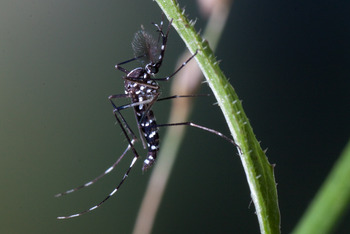
Aedes albopictus (Skuse) is also referred to as Stegomyia albopicta (Reinert et al., Reference Reinert, Harbach and Kitching2004) and is commonly known as the Asian tiger or Forest day mosquito. Adults are relatively small and show a black and white pattern due to the presence of white/silver scale patches on a black background on the legs and other parts of the body (fig. 2). Some indigenous mosquitoes to Europe such as Aedes cretinus and Culiseta annulata show similar characteristics; the first being almost indistinguishable, but the second being more brown and yellow in colour. There are also some similarities with other invasive species (Ae. aegypti, Ae. japonicus, Ae. koreicus). The main diagnostic character is the presence of a median silver-scale line on a black background on the scutum (dorsal part of the thorax).
Male Aedes albopictus (Photograph: F. Schaffner).

Biological aspects of acclimation to Europe
Tropical and subtropical Ae. albopictus populations are active throughout the year with no overwintering (Knudsen et al., Reference Knudsen, Romi and Majori1996). In contrast, temperate populations are affected by seasonal temperature and photoperiodicity and in response to these factors can overwinter by producing eggs that undergo a winter diapause (Hawley, Reference Hawley1988). The extent of the establishment of Ae. albopictus in new geographic locations is thought to correspond to various climatic thresholds: a mean winter temperature of >0°C permitting egg overwintering, a mean annual temperature of >11°C required for adult survival and activity, and at least 500 mm of annual rainfall; a pre-requisite for the maintenance of aquatic habitats (Mitchell, Reference Mitchell1995; Kobayashi et al., Reference Kobayashi, Nihei and Kurihara2002; Medlock et al., Reference Medlock, Avenell, Barrass and Leach2006; Roiz et al., Reference Roiz, Neteler, Castellani, Arnoldi and Rizzoli2011). Rainfall however needs to be sufficient during summer months in order to maintain such sites. Conversely, periods of high precipitation reduce short-term abundance of host-seeking females (Roiz et al., Reference Roiz, Rosa, Arnoldi and Rizzoli2010). A summer temperature of 25–30°C is suggested for optimum development (Straetemans, Reference Straetemans2008). However, there are reports of populations establishing in areas with lower mean temperatures (5–28.5°C) and lower rainfall (290 mm annually) than previously suspected (Benedict et al., Reference Benedict, Levine, Hawley and Philip2007; Severini et al., Reference Severini, Di Luca, Toma and Romi2008). Furthermore, water can accumulate or be stored, so there may be suitable aquatic habitats even in the absence of rainfall.
The length of the reproductive season is regulated by the increasing temperatures in spring and the onset of egg diapause in autumn. The critical photoperiodic threshold for diapause varies between geographical locations. In general the production of diapausing eggs occurs below 13–14 h of daylight, however in some locations this threshold occurs at 11–12 h (Wang, Reference Wang1966; Mori et al., Reference Mori, Oda and Wada1981; Pumpuni et al., Reference Pumpuni, Knepler and Craig1992; Kobayashi et al., Reference Kobayashi, Nihei and Kurihara2002; Toma et al., Reference Toma, Severini, Di Luca, Bella and Romi2003). Egg production occurs during late summer/early autumn when daylight hours are reducing. Eggs laid during this time enter facultative diapause and hatching suppression occurs which is usually sufficient to outlast winter (Estrada-Franco & Craig, Reference Estrada-Franco and Craig1995). The mosquito's ability to induce photoperiodic egg diapause allows it to overwinter in temperate regions, which assists its establishment in more northern latitudes in Asia, North America and Europe. Diapausing eggs of European Ae. albopictus have been shown to be able to survive a cold spell of −10°C, whereas eggs of tropical Ae. albopictus could only survive −2°C (Thomas et al., Reference Thomas, Obermayr, Fischer, Kreyling and Beierkuhnlein2012). In addition, the hatching success and cold tolerance of European Ae. albopictus eggs have been shown to increase in diapausing compared with non-diapausing eggs (Thomas et al., Reference Thomas, Obermayr, Fischer, Kreyling and Beierkuhnlein2012).
There is generally little adult activity below 9°C, but adults do seek warmer microclimates indoors (Roiz et al., Reference Roiz, Rosa, Arnoldi and Rizzoli2010). In parts of Italy, there are signs of cold-acclimation as adults are remaining active throughout winter (Romi et al., Reference Romi, Severini and Toma2006). Hatching of diapausing eggs in spring is related to changes in photoperiod, food availability, temperature and water availability. Furthermore, this mosquito may not survive through winter if environmental temperatures and humidity are not maintained above set thresholds, or the period of diapause exceeds six months (Medlock et al., Reference Medlock, Avenell, Barrass and Leach2006).
Seasonal dynamics and habitat preferences
In temperate strains, the drought-resistant eggs are laid singly, above the water line. Larval development takes 3–8 weeks, and adults can survive more than 3 weeks (Gatt et al., Reference Gatt, Deeming and Schaffner2009). Adult generally do not overwinter in temperate regions, but females have been reported to remain active during winter months in Rome (Romi et al., Reference Romi, Severini and Toma2006). Aedes albopictus is a multivoltine species (5–17 generations per year Gatt et al., Reference Gatt, Deeming and Schaffner2009), with seasonal abundance dependent on temperature and the availability of food and water in a particular geographical area. Higher temperatures speed up larval development, increase the number of adult generations, increase autumnal development of immatures and consequently increase rates of egg overwintering. A study in Northern Italy showed an increased abundance of adult females during the period May–September, peaking late July (Roiz et al., Reference Roiz, Rosa, Arnoldi and Rizzoli2010). In Greece, Ae. albopictus is continuously active for more than 8 months a year with oviposition taking place from mid-April–December, numbers of eggs highest from mid-July to the end of autumn (and significantly increased during mild and rainy weather) and highest adult abundance in October (Giatropoulos et al., Reference Giatropoulos, Emmanouel, Koliopoulos and Michaelakis2012).
Aedes albopictus has the ability to breed in natural and artificial container habitats, including tyres, barrels, rainwater gulley catch basins and drinking troughs (Gatt et al., Reference Gatt, Deeming and Schaffner2009). It is not known to breed in brackish or salt water (Buhagiar, Reference Buhagiar2009). It has a preference for urban and suburban habitats (Juliano & Lounibos, Reference Juliano and Lounibos2005), and where it occurs sympatrically with Ae. triseriatus and Ae. japonicus, it is reported to be superior in competing for food resources (Leisnham & Juliano, Reference Leisnham and Juliano2012). Adult flight range and hence dispersal on the wing is limited to ~200 m (Turell et al., Reference Turell, Dohm, Sardelis, O'Guinn, Andreadis and Blow2005). The main route of dispersal of this mosquito occurs via transport and movement of container habitat goods at intercontinental scale mainly, or as inadvertent passenger in ground vehicles at continental scale.
Host preferences and biting/resting habits
Aedes albopictus is an opportunistic feeder (Turell et al., Reference Turell, Dohm, Sardelis, O'Guinn, Andreadis and Blow2005). Blood hosts include humans, domestic and wild animals, reptiles, birds and amphibians (Eritja et al., Reference Eritja, Escosa, Lucientes, Marques, Roiz and Ruiz2005). Laboratory studies and blood meal analysis have shown a preference for human blood (Paupy et al., Reference Paupy, Delatte, Bagny, Corbel and Fontenille2009). A study in Italy found a preference for mammals as opposed to birds and found human blood meals were more frequent in urban areas compared with rural sites, suggesting that host availability and abundance directly impact feeding activities of Ae. albopictus (Valerio et al., Reference Valerio, Marini, Bongiorno, Facchinelli, Pombi, Caputo, Maroli and Della Torre2009).
Aedes albopictus is currently a serious biting nuisance for humans in Italy (Scholte et al., Reference Scholte, Dijkstra, Ruijs, Jacobs, Takken, Hofhuis, Reusken, Koopmans and de Boer2007; Genchi et al., Reference Genchi, Rinaldi, Mortarino, Genchi and Giuseppe2009), Southern France (Vazeille et al., Reference Vazeille, Jeannin, Martin, Schaffner and Failloux2008) and Spain where they significantly reduce the quality of life in infested areas (Aranda et al., Reference Aranda, Eritja and Roiz2006). Adult females bite aggressively, usually during the day and preferably outdoors. However, there are reports that Ae. albopictus is becoming partially endophilic (Drago, Reference Drago2003; Genchi et al., Reference Genchi, Rinaldi, Mortarino, Genchi and Giuseppe2009). During a study in Rome, blood-fed females were mainly found indoors, indicating that local populations could spend time resting indoors after a blood meal (Valerio et al., Reference Valerio, Marini, Bongiorno, Facchinelli, Pombi, Caputo, Maroli and Della Torre2009). Another study on Penang Island in Malaysia reported observations of Ae. albopictus females developing indoors within containers, such as flower vases, empty paint cans, under floors and in sinks, with most larval stages found during a five month period, suggesting that this species may have acclimatized to indoor environments (Dieng et al., Reference Dieng, Saifur, Hassan, Salmah, Boots, Satho, Jaal and AbuBakar2010). A laboratory study found that Ae. albopictus could survive for long periods indoors by obtaining sugars from lucky bamboo and other ornamental plants. The mosquito's survival time was long enough to complete a gonotrophic cycle, and to allow development of transmissible arboviruses within the vector (Qualls et al., Reference Qualls, Xue, Beier and Müller2013).
Public health importance
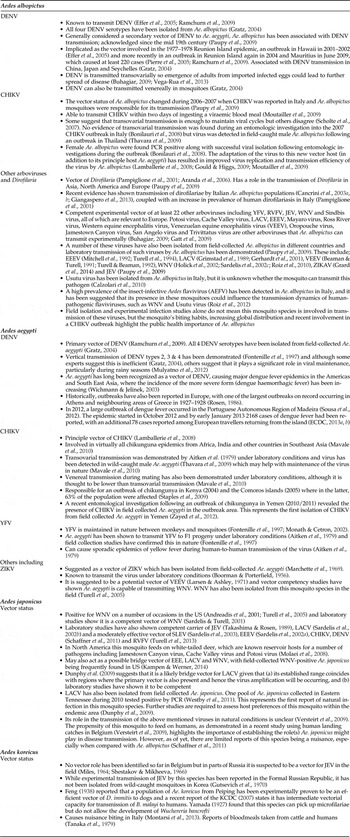
Aedes albopictus is known to be a significant biting nuisance with the potential to become a serious health threat as a bridge vector of zoonotic pathogens to humans (Benedict et al., Reference Benedict, Levine, Hawley and Philip2007). This mosquito species is a known field vector of CHIKV, DENV, Zika virus (ZIKV) and dirofilarial worms (Gratz, Reference Gratz2004; Grard et al., Reference Grard, Caron, Mombo, Nkoghe, Ondo, Jiolle, Fontenille, Paupy and Leroy2014). A number of other viruses important to human health have been isolated from field-collected Ae. albopictus females in different countries or have been succesfully tested for experimental infection in the laboratory. Its recent involvement in the localized transmission of CHIKV in Italy (Bonilauri et al., Reference Bonilauri, Bellini, Calzolari, Angelini, Venturi, Fallacara, Cordioli, Angelini, Venturelli, Merialdi and Dottori2008) and France (Gould et al., Reference Gould, Gallian, De Lamballerie and Charrel2010) and DENV in France in 2010, 2013 and 2014 (La Ruche et al., Reference La Ruche, Souares, Armengaud, Peloux-Petiot, Despres, Lenglet, Jourdain, Leparc-Goffart, Charlet, Ollier, Mantey, Mollet, Fournier, Torrents, Leitmyer, Hilairet, Zeller, Van Bortel, Dejour-Salamanca, Grandadam and Gastellu-Etchegorry2010; Cotteaux-Lautard et al., Reference Cotteaux-Lautard, Berenger, Fusca, Chardon, Simon and Pagès2013; Marchand et al., Reference Marchand, Prat, Jeannin, Lafont, Bergmann, Flusin, Rizzi, Roux, Busso, Deniau, Noel, Vaillant, Leparc-Goffart, Six and Paty2013) and Croatia (Gjenero-Margan et al., Reference Gjenero-Margan, Aleraj, Krajcar, Lesnikar, Klobučar, Pem-Novosel, Kurečić-Filipović, Komparak, Martić, Duričić, Betica-Radić, Okmadžić, Vilibić-Čavlek, Babić-Erceg, Turković, Avsić-Županc, Radić, Ljubić, Sarac, Benić and Mlinarić-Galinović2011) highlights the importance of surveying this invasive species. (Tables 1 and 2)
Aedes aegypti
Aedes aegypti aegypti (Linnaeus, 1762) (subsequently referred to as Aedes aegypti) was previously long-established in Southern Europe from late 18th–mid-20th centuries, with some sporadic more recent records in Italy and Turkey, but it disappeared from the Mediterranean region for unclear reasons (Schaffner & Mathis, Reference Schaffner and Mathis2014). It has since re-colonized parts of Southern Russia and Georgia (Yunicheva et al., Reference Yunicheva, Ryabova, Markovich, Bezzhonova, Ganushkina, Semenov, Tarkhov, Vasilenko, Guzeeva, Shevereva and Sergiev2008; Schaffner & Mathis, Reference Schaffner and Mathis2014) has colonized Madeira (Almeida et al., Reference Almeida, Goncalves, Novo, Sousa, Melim and Gracio2007) and, has been recently reported in the Netherlands (Scholte et al., Reference Scholte, Den Hartog, Dik, Schoelitsz, Brooks, Schaffner, Foussadier, Braks and Beeuwkes2010). It is now one of the most widespread mosquito species globally. There are no climatic reasons why Ae. aegypti, if introduced into Europe, could not survive across Southern Europe. If this were to happen, it may increase the risk of disease transmission of yellow fever virus (YFV) and DENV (Reiter, Reference Reiter2010; Rogers et al., Reference Rogers, Suk and Semenza2014). Although its global establishment is currently restricted due to its intolerance to temperate winters (Gould & Higgs, Reference Gould and Higgs2009), over the past 25 years there has been an increase in its distribution worldwide in tropical and subtropical regions (Jansen & Beebe, Reference Jansen and Beebe2010).
The success of this invasive species has largely been due to globalization. It thrives in densely populated areas, which lack reliable water supplies, waste management and sanitation (Honorio et al., Reference Honorio, Codeco, Alves, Magalhaes and Lourenco-de-Oliveira2009). Historically, Ae. aegypti has moved from continent to continent via ships, and this method of dispersal is thought to present the highest risk of introducing this mosquito into continental Europe from Madeira. It is suggested that Ae. aegypti evolved its domestic behaviour in West Africa, and its widespread distribution and colonization in the tropics led to the highly efficient interhuman transmission of viruses such as DENV (Weaver & Reisen, Reference Weaver and Reisen2009). This domestic behaviour can provide protection against adverse environmental conditions (as it rests indoors) and numerous habitats suitable as oviposition sites, but can also result in increased sensitivity to control measures used to eliminate the species (Jansen & Beebe, Reference Jansen and Beebe2010).
Geographic distribution
Prior to its disappearance from Europe, Ae. aegypti had been reported from Azerbaijan, Cyprus, France (including. Corsica), Georgia, Greece (including Crete and other islands), Israel, Italy, Malta, Portugal (including. Azores), Southern Russia, Sardinia, Spain (including Balearic Islands and Canaries), Syria, Turkey and former Yugoslavia in Europe and the Middle East and Algeria, Egypt, Libya, Morocco and Tunisia in North Africa (Holstein, Reference Holstein1967; Schaffner & Mathis, Reference Schaffner and Mathis2014).
It has since re-colonized parts of Southern Russia and Georgia (Krasnodar Krai and Abkhazia (Yunicheva et al., Reference Yunicheva, Ryabova, Markovich, Bezzhonova, Ganushkina, Semenov, Tarkhov, Vasilenko, Guzeeva, Shevereva and Sergiev2008)) and has colonized Madeira (Almeida et al., Reference Almeida, Goncalves, Novo, Sousa, Melim and Gracio2007) (fig. 3). On Madeira island, Ae. aegypti is active throughout the year, with a peak in abundance from August–October (Gonçalves et al., Reference Gonçalves, Silva and Biscotto2008). It is currently distributed in Africa, the surrounding tropics and subtropics, Southeastern USA, the Middle East, Southeast Asia, Pacific and Indian Islands and Northern Australia (Soumahoro et al., Reference Soumahoro, Fontenille, Turbelin, Pelat, Boyd, Flahault and Hanslik2010).
Current distribution of Ae. aegypti in Europe (ECDC 2014/VBORNET/VECTORNET).

Brief history of spread and potential for future expansion
Aedes aegypti was most likely transported into the Americas and the Mediterranean on sailing ships from Africa (Gubler, Reference Gubler, Gubler and Kuno1997; Eritja et al., Reference Eritja, Escosa, Lucientes, Marques, Roiz and Ruiz2005; Weaver & Reisen, Reference Weaver and Reisen2009; Reiter, Reference Reiter2010). Historically, it was established in Southern Europe from late 18th–mid-20th centuries, but never established north of latitude 44°30′N. More northerly records from port cities (e.g. Saint-Nazaire, France, 1861, and Swansea, UK, 1865) relate to mosquito introductions via sailing ships and maintenance during summer months only, sometimes triggering yellow fever (YFV) and/or DENV outbreaks (Surtees et al., Reference Surtees, Hill and Broadfoot1971, Schaffner & Mathis, Reference Schaffner and Mathis2014). Historically the mosquito was reported in Spain until 1953, Portugal until 1956, with more recent reports in Italy (1972) and Turkey (1961, 1984, 1992, 1993, 2001; fig. 3), although none of these records are indicative of well established populations. The reduction in their numbers and their ultimate disappearance was possibly due to improvement of sanitation with expansion of piped water systems, local vector control programmes towards the species, and malaria vector eradication programmes (Schaffner & Mathis, Reference Schaffner and Mathis2014). Since these historical reports in Europe, it is only more recently that reports of (re-)colonization have come to light. Colonization was reported from the island of Madeira in 2004 and 2005. Aedes aegypti is now established on the island and there are concerns that it could be transported to western continental Europe via air or sea traffic (Almeida et al., Reference Almeida, Goncalves, Novo, Sousa, Melim and Gracio2007). Also for Eastern Europe there are concerns that it could be introduced from Russia and Georgia (Abkhazia) to other countries bordering the Black Sea via road or sea traffic. It was more recently reported in the Netherlands at tyre yards, having been imported via the shipment of tyres from Florida, USA, and then eliminated by immediate application of control measures (Scholte et al., Reference Scholte, Den Hartog, Dik, Schoelitsz, Brooks, Schaffner, Foussadier, Braks and Beeuwkes2010; Brown et al., Reference Brown, Scholte, Dik, Den Hartog, Beeuwkes and Powell2011).
Unlike Ae. albopictus, the ability for Ae. aegypti to establish in more temperate regions is currently restricted due to its intolerance to temperate winters (Gould & Higgs, Reference Gould and Higgs2009). It could become widely established again in the Mediterranean and this could change in the future with global climate change resulting in northern and southern expansion of Ae. aegypti (Weaver & Reisen, Reference Weaver and Reisen2009).
Entomological perspective
Taxonomy and identification
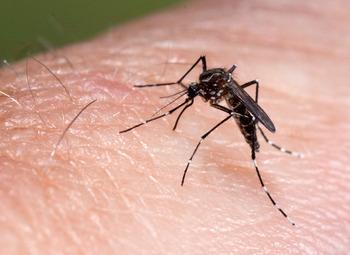
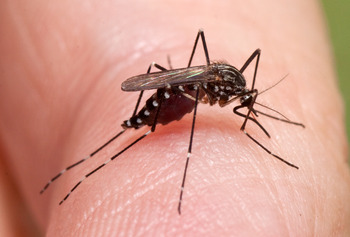
Ae. aegypti aegypti (Linnaeus) is also referred to as Stegomyia aegypti (Reinert et al., Reference Reinert, Harbach and Kitching2004) and commonly known as the yellow fever mosquito. Adults are relatively small and show a black and white pattern due to the presence of white/silver scale patches on a black background on the legs and other parts of the body. The diagnostic character is the presence of silver scales in a shape of a lyre on a black background on the scutum (fig. 4). The domestic form (Ae. aegypti aegypti) is paler than its ancestor (Ae. aegypti formosus) and has white scales on the first abdominal tergite. The latter is confined to Africa south of the Sahara and has been recorded from the forest or bush away from places of human settlement breeding in more natural habitats (Fontenille et al., Reference Fontenille, Diallo, Mondo, Ndiaye and Thonnon1997).
Female Ae. aegypti (Photograph: F. Schaffner).

Biological aspects of acclimation to Europe
Unlike Ae. albopictus, Ae. aegypti is not able to undergo winter diapause as eggs, and this therefore limits its ability, to some extent, to exploit more northerly temperate regions, but it may establish in regions of Europe showing a humid subtropical climate (e.g. parts of Mediterranean and Black Sea countries) such as around Sochi where it has established since 2001 (Ryabova et al., Reference Ryabova, Yunicheva, Markovich, Ganushkina, Orabei and Sergiev2005). Some survival is also possible during the summer following an importation prior to winter die-off.
Aedes aegypti has limited dispersal capability as adults (Jansen & Beebe, Reference Jansen and Beebe2010) with a flight range estimate of only 200 m (Turell et al., Reference Turell, Dohm, Sardelis, O'Guinn, Andreadis and Blow2005). Species competition has also been shown to affect distribution and abundance in Southwestern USA, where a decrease in Ae. aegypti distribution has in some locations been associated with the invasion of Ae. albopictus (Jansen & Beebe, Reference Jansen and Beebe2010). Rainfall may affect abundance and productivity of breeding sites but this species’ preference for artificial water containers means it does not always have to rely on rainfall for larval development sites, particularly in localities where water is stored or captured (Jansen & Beebe, Reference Jansen and Beebe2010).
Seasonal dynamics and habitat preferences
Aedes aegypti is multivoltine. Previous studies have shown populations of Ae. aegypti to remain active in Egypt throughout winter, in Morocco in October and December and in Algeria up to the end of the summer and early winter (Holstein, Reference Holstein1967).
Historically, Ae. aegypti was found in forested areas, using tree holes as aquatic habitats (Weaver & Reisen, Reference Weaver and Reisen2009). As it has adapted to more urban domestic habitats, it has exploited a wide range of artificial containers such as vases, water tanks and tyres that are often associated with human habitations (Jansen & Beebe, Reference Jansen and Beebe2010). It has also been found utilizing underground aquatic habitats such as septic tanks (Barrera et al., Reference Barrera, Amador, Diaz, Smith, Munoz-Jordan and Rosario2008) and adapting to use both indoor and outdoor aquatic habitats in the same area. Adaptation to breeding outdoors may allow for increased population numbers and difficulty in implementation of control methods (Saifur et al., Reference Saifur, Dieng, Hassan, Salmah, Satho, Miake and Hamdan2012). A study in Brazil found higher numbers of eggs in oviposition sites as the sites got closer to human populations (Medeiros et al., Reference Medeiros, Marcondes, De Azevedo, Jeronimo, e Silva and Ximenes2009). Eggs are laid on or near the water surface (Jansen & Beebe, Reference Jansen and Beebe2010) with the ability to survive desiccation (Juliano & Lounibos, Reference Juliano and Lounibos2005).
Host preferences and biting/resting habits
Aedes aegypti prefers mammalian hosts (Turell et al., Reference Turell, Dohm, Sardelis, O'Guinn, Andreadis and Blow2005) and will preferentially feed on humans, even in the presence of alternative hosts (Saifur et al., Reference Saifur, Dieng, Hassan, Salmah, Satho, Miake and Hamdan2012). It also feeds on multiple hosts during one gonotrophic cycle (Weaver & Reisen, Reference Weaver and Reisen2009; Jansen & Beebe, Reference Jansen and Beebe2010) which has implications for disease transmission. The domestic form is often not found further than 100 m from human habitations (Reiter, Reference Reiter2010) although some studies have shown that breeding habitats can also be found away from human dwellings (Saifur et al., Reference Saifur, Dieng, Hassan, Salmah, Satho, Miake and Hamdan2012). Ae. aegypti prefers human habitations as they provide resting and host seeking possibilities (Weaver & Reisen, Reference Weaver and Reisen2009). The species will readily enter buildings (Jansen & Beebe, Reference Jansen and Beebe2010; Reiter, Reference Reiter2010), and its activity is both diurnal and crepuscular (Turell et al., Reference Turell, Dohm, Sardelis, O'Guinn, Andreadis and Blow2005; Jansen & Beebe, Reference Jansen and Beebe2010).
Public health importance
Aedes aegypti is a known vector of several viruses, including DENV, CHIKV, YFV and Zika virus (ZIKV). Hundreds of imported DENV and CHIKV cases are reported in Europe every year, including fatal DENV cases (Wichmann & Jelinek, Reference Wichmann and Jelinek2003; Paty et al., Reference Paty, Six, Charlet, Heuzé, Cochet, Wiegandt, Chappert, Dejour-Salamanca, Guinard, Soler, Servas, Vivier-Darrigol, Ledrans, Debruyne, Schaal, Jeannin, Helynck, Leparc-Goffart and Coignard2014). The possible establishment of Ae. aegypti in Europe raises concerns about autochthonous arbovirus transmission (Almeida et al., Reference Almeida, Goncalves, Novo, Sousa, Melim and Gracio2007), particularly in Southern Europe where climatic conditions are more suitable for the re-establishment of this species and for virus transmission. In 2012, a large outbreak of dengue fever occurred in the Portuguese Autonomous Region of Madeira (Sousa et al., Reference Sousa, Clairouin, Seixas, Viveiros, Novo, Silva, Escoval and Economopoulou2012) associated with Ae. aegypti. The epidemic started in October 2012 and by early January 2013 more than 2000 cases of dengue fever had been reported, with an additional 78 cases reported among European travellers returning from the island (ECDC, 2013b ). (Tables 1 and 2)
Aedes japonicus
Aedes japonicus japonicus (Theobald, 1901) (subsequently referred to as Aedes japonicus) has become the third invasive mosquito species to be reported in Europe. Its geographical expansion has been facilitated by human activities such as the international trade in used tyres. It is now listed as one of the top 100 invasive species by the Invasive Species Specialist Group (ISSG, 2009). Its distribution in Central Europe is also expanding. The success of the invasion of Ae. japonicus, particularly in the USA, has been due to a number of factors including its ability to withstand long distance dispersal and winter temperatures in temperate regions, and its tolerance to high organic matter content in water in a number of natural and artificial containers (Versteirt et al., Reference Versteirt, Schaffner, Garros, Dekoninck, Coosemans and Van Bortel2009). Another key to its invasion success is that it emerges before other competing species and is active for a longer period (Kaufman & Fonseca, Reference Kaufman and Fonseca2014). Aedes japonicus has less specialized requirements for aquatic habitats, compared with Ae. albopictus, and this could facilitate further spread of this species (Schaffner et al., Reference Schaffner, Chouin and Guilloteau2003).
Brief history of spread and European distribution
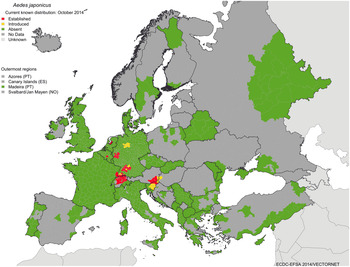
Aedes japonicus is endemic to Korea, Japan, Taiwan, Southern China and Russia (Southeastern Siberia) (Tanaka et al., Reference Tanaka, Mizusawa and Saugstad1979) and has since spread to a number of other countries: Austria, Belgium, Canada, Croatia, France, Germany, Hungary, New Zealand (not established), the Netherlands (not established), Switzerland, Slovenia and the USA (fig. 5). This spread has occurred since the 1990s and like other invasive mosquito species, Ae. japonicus has relocated to new geographical areas via the movement of infested tyres. Once introduced to the USA, it rapidly spread throughout eastern and northern states and Southern Canada (Kampen & Werner, Reference Kampen and Werner2014; Kaufman & Fonseca, Reference Kaufman and Fonseca2014). It was reported in New York State, New Jersey and Connecticut in 1998, Ohio and Pennsylvania in 1999, Maryland, Massachusetts and Virginia in 2000, and Quebec and Ontario, Canada in 2000 and 2001. It has since spread to 33 states including Hawaii, Iowa, Wisconsin and Minnesota. Its spread in the US is thought to be due to multiple introductions (Falco et al., Reference Falco, Daniels and Slameck2002; Fonseca et al., Reference Fonseca, Widdel, Hutchinson, Spichiger and Kramer2010). This species was intercepted on several occasions in ports of New Zealand (1993, 1998 and 1999) through the importation of used tyres from Japan (Derraik, Reference Derraik2004).
Current distribution of Aedes japonicus in Europe (ECDC 2014/VBORNET/VECTORNET).

It was first reported in Europe in 2000 in Normandy (Orne), Northern France (Schaffner et al., Reference Schaffner, Chouin and Guilloteau2003), where it was promptly eliminated (Schaffner et al., Reference Schaffner, Kaufmann, Hegglin and Mathis2009). In 2002, it was reported at a tyre depot in Belgium, with adults and larvae later confirmed at a second site close-by in 2007 and 2008; there it remained locally established, with no evidence of spreading (Versteirt et al., Reference Versteirt, Schaffner, Garros, Dekoninck, Coosemans and Van Bortel2009; Damiens et al., Reference Damiens, Ayrinhac, Van Bortel, Versteirt, Dekoninck and Hance2014). It was detected in Switzerland in 2008 following reports of nuisance biting and was later revealed to have colonized 1400 km2 of Northern Switzerland, and across the border into Germany (Schaffner et al., Reference Schaffner, Kaufmann, Hegglin and Mathis2009). No obvious route of introduction was identified in this instance but the species may have been present for some time. Adults were then found in other parts of the federal state of Baden Württemberg (Southern Germany) in 2011 (Becker et al., Reference Becker, Huber, Pluskota and Kaiser2011). In the same year, a population was detected in Austria and in Slovenia (Seidel et al., Reference Seidel, Duh, Nowotny and Allerberger2012). The following year a large, newly infested area was also reported from the city of Stuttgart to the Swabian Mountains (Schneider, Reference Schneider2011; Huber et al., Reference Huber, Pluskota, Jöst, Hoffmann and Becker2012). Similarly in 2012, surveys in North Rhine-Westphalia revealed the presence of an established population in the west of the country (Kampen et al., Reference Kampen, Zielke and Werner2012). In 2013, reports came from further north in southern Lower Saxony and northeastern North Rhine-Westphalia (Werner & Kampen, Reference Werner and Kampen2013). The mosquito was also detected in 2012 and 2013 in Lelystad, the Netherlands (Ibaňez-Justicia et al., Reference Ibaňez-Justicia, Kampen, Braks, Schaffner, Steeghs, Werner, Zielke, Den Hartog, Brooks, Dik, van de Vossenberg and Scholte2014). Also in 2012, specimens were detected in Hungary (Indra, Reference Indra2013), and in 2013 in Alsace (France) (Schaffner, personal communication) and Croatia (Merdić, personal communication), suggesting a spread of the south German/Swiss and the Austrian/Slovenian populations, respectively. This evidence confirms earlier suppositions that Ae. japonicus may continue to expand further (Schaffner et al., Reference Schaffner, Kaufmann, Hegglin and Mathis2009).
Except for France (Normandy) and Belgium, where the species was found exclusively at two tyre depots, it is not known how, when and where the various European populations were introduced and whether they are related to each other. It appears that there are at least two genetically differentiated populations in Europe, with the West German population basically representing one of them (although the second is admixed) and the other European populations representing the other (Zielke et al., Reference Zielke, Werner, Kampen, Schaffner and Fonseca2014). In Southern Germany, microsatellite analysis has shown that the populations in Baden-Württemberg and North Rhine-Westphalia represented two distinct populations suggesting that they originated from two independent introduction events.
Entomological perspective
Taxonomy and identification
Aedes japonicus japonicus is also referred to as Ochlerotatus japonicus japonicus (Reinert, Reference Reinert2000) and Hulecoeteomyia japonica japonica (Reinert et al., Reference Reinert, Harbach and Kitching2006), and is commonly known as the East Asian bush or rock pool mosquito (Schaffner et al., Reference Schaffner, Kaufmann, Hegglin and Mathis2009). It is one of a number of subspecies of Ae. japonicus (Tanaka et al., Reference Tanaka, Mizusawa and Saugstad1979; Kampen & Werner, Reference Kampen and Werner2014). Adults are relatively large and show a black and white pattern due to the presence of white scale patches on a black background on the legs and other parts of the body. Aedes japonicus could be confused with other invasive (Ae. aegypti, Ae. albopictus, Ae. koreicus) or indigenous species (Ae. cretinus, restricted to Greece and Turkey), and the main diagnostic character is the presence of several lines of yellowish scales on a black background on the scutum (fig. 6). The three other described subspecies differ in tibia ornamentation and are restricted to parts of South-eastern Asia (Tanaka et al., Reference Tanaka, Mizusawa and Saugstad1979). A DNA-based RAPD assay has been developed in order to distinguish this species from other similar invasive species (Cameron et al., Reference Cameron, Wilkerson, Mogi, Miyagi, Toma, Kim and Fonseca2010). Larvae of Ae. japonicus appear brownish-yellow or darker than other similar species, with a slender appearance and long siphon. The head capsule is also dark brown and has no bright areas on the dorsal side (Kampen et al., Reference Kampen, Zielke and Werner2012).
Female Aedes japonicus (Photograph: F. Schaffner).

Biological aspects of acclimation to Europe
Similar to Ae. albopictus, Ae. japonicus can also produce freeze and desiccation resistant eggs (Andreadis & Wolfe, Reference Andreadis and Wolfe2010) that can remain dormant over winter and hatch once environmental conditions become favourable. This is not surprising as Ae. japonicus occurs in Northern Japan where temperatures go down to −20°C in winter. In Europe, diapausing eggs are known to overwinter in Belgium and Germany (Versteirt et al., Reference Versteirt, Schaffner, Garros, Dekoninck, Coosemans and Van Bortel2009; Werner & Kampen, unpublished), thus suggesting a climate suitability for Northern Europe. In Northeastern Japan this species overwinters as eggs, but in Southwestern Japan it may overwinter also in the larval stage (Kamimura, Reference Kamimura, Sasa, Kurihara and Kamimura1976). Larval overwintering has also been reported in New Jersey and North Carolina (Armistead et al., Reference Armistead, Nishimura, Arias and Lounibos2012). No larvae have so far been found during winter sampling in Belgium or in Germany (Versteirt et al., Reference Versteirt, Schaffner, Garros, Dekoninck, Coosemans and Van Bortel2009; Werner & Kampen, unpublished), but some have been in tree holes in Switzerland (Schaffner, unpublished).
There is limited information on environmental thresholds constraining the distribution of Ae. japonicus, except that it does not tolerate aquatic habitats >30°C in the USA (Andreadis & Wolfe, Reference Andreadis and Wolfe2010). This may be a limiting factor in its establishment and spread in Southern Europe. Although Ae. albopictus has been shown to be superior to Ae. japonicus in competing for food resources in larval habitats in the USA (particularly in artificial container habitats), higher overwintering survival and earlier hatching means Ae. japonicus is able to exploit larval habitats before Ae. albopictus (Armistead et al., Reference Armistead, Nishimura, Arias and Lounibos2012; Leisnham & Juliano, Reference Leisnham and Juliano2012). Competition with larvae of other Aedes species may affect Ae. japonicus adult longevity, but exploitation of multiple aquatic habitats lessens the impact this may have on the success of Ae. japonicus in new habitats (Alto, Reference Alto2011). This species is also suggested to reduce populations of several native species occupying these habitats through interspecific competition for limited resources (Andreadis & Wolfe, Reference Andreadis and Wolfe2010), and in particular outcompete Ae. atropalpus in some areas of the USA due to shorter larval development periods (Kaufman et al., Reference Kaufman, Stanuszek, Brouhard, Knepper and Walker2012). There is also evidence that Ae. japonicus can outcompete Ae. triseriatus and Culex pipiens in some breeding environments (Damiens et al., Reference Damiens, Ayrinhac, Van Bortel, Versteirt, Dekoninck and Hance2014; Kampen & Werner, Reference Kampen and Werner2014). Little is known about adult active dispersal although they are assumed to have a relatively short flight range (Kampen & Werner, Reference Kampen and Werner2014).
Seasonal dynamics and habitat preferences
Aedes japonicus is multivoltine (Andreadis et al., 2001). In North America, larvae and host-seeking adults have been collected from May to November in Connecticut (Andreadis et al., 2001) and May to October in New York State (Falco et al., Reference Falco, Daniels and Slameck2002). Larvae of Ae. japonicus have also been shown to be the dominant species within rock pools during the early to mid-summer months when temperatures are lower (Gaspar et al., Reference Gaspar, McKay and Huss2012; Kaufman et al., Reference Kaufman, Stanuszek, Brouhard, Knepper and Walker2012). Field studies in North America suggest that adults remain active into early autumn in northern temperate zones (Dunphy et al., Reference Dunphy, Tucker, Petersen, Blitvich and Bartholomay2009). At milder temperatures, activity may extend into early December (Kampen & Werner, Reference Kampen and Werner2014). In Belgium, during 2009, Ae. japonicus larvae could be collected from May and adults were first recorded in mid-June, with the population increasing until August and then decreasing until October (Damiens et al., Reference Damiens, Ayrinhac, Van Bortel, Versteirt, Dekoninck and Hance2014).
Aedes japonicus prefers bushy and forested areas in agricultural, rural, suburban or urban settings, and can develop in a large range of both natural and artificial aquatic container habitats, including rock pools, tyres, bird baths, milk cartons, buckets and tree holes (Andreadis et al., 2001; Kampen & Werner, Reference Kampen and Werner2014). Breeding habitats often contain decaying organic matter and algae, and larvae are tolerant to environmental pollutants, having been collected from dirty artificial containers, such as ashtrays (Kampen & Werner, Reference Kampen and Werner2014). In some areas in North America they preferentially select rock pools (Juliano & Lounibos, Reference Juliano and Lounibos2005) particularly in areas with low summer temperatures (Andreadis & Wolfe, Reference Andreadis and Wolfe2010) or high degrees of shade (Armistead et al., Reference Armistead, Nishimura, Arias and Lounibos2012). Elsewhere in the USA and Japan, larvae have been found in various aquatic habitats with varying sunlight, elevation and detrital content, and within both urban and rural settings (Lorenz et al., Reference Lorenz, Walker and Kaufman2013). Its distribution and aquatic habitats in North America overlap with Ae. triseriatus (Alto, Reference Alto2011; Gaspar et al., Reference Gaspar, McKay and Huss2012) and Ae. atropalpus (Armistead et al., Reference Armistead, Nishimura, Escher and Lounibos2008). The latter may actually be outcompeted by Ae. japonicus in the USA, particularly in tyre sites (Hardstone & Andreadis, Reference Hardstone and Andreadis2012). In Belgium, Ae. japonicus larvae were frequently found together with Culex pipiens/torrentium larvae, and the peak of Ae. japonicus abundance was associated with a decline in Cx. pipiens numbers, an effect not seen at sites without Ae. japonicus (Damiens et al., Reference Damiens, Ayrinhac, Van Bortel, Versteirt, Dekoninck and Hance2014). Aedes geniculatus numbers were also lower in habitats shared with Ae. japonicus (Damiens et al., Reference Damiens, Ayrinhac, Van Bortel, Versteirt, Dekoninck and Hance2014).
Utilization of the same aquatic habitats as Ae. albopictus has been reported, although their peak abundances differ seasonally (Armistead et al., Reference Armistead, Nishimura, Arias and Lounibos2012). Where both species are sympatric, Ae. albopictus appears to predominate in urban environments while Ae. japonicus is more abundant in rural habitats and where water temperatures are below 14°C (Bartlett-Healy et al., Reference Bartlett-Healy, Unlu, Obenauer, Hughes, Healy, Crepeau, Farajollahi, Kesavaraju, Fonseca, Schoeler, Gaugler and Strickman2012; Kampen & Werner, Reference Kampen and Werner2014). Sampling in Northern Switzerland showed a preference for plastic vases in cemeteries, but fountains, rain water casks and catch basins were also colonized (Schaffner et al., Reference Schaffner, Kaufmann, Hegglin and Mathis2009). In Germany larvae are found in a variety of containers, including flower vases, flower-pot saucers, watering cans and paddling pools (Kampen et al., Reference Kampen, Zielke and Werner2012). In Belgium, the majority of larvae were found in tyres and other artificial breeding sites. On one occasion larvae were found in a tree hole close to an infested tyre company (Damiens et al., Reference Damiens, Ayrinhac, Van Bortel, Versteirt, Dekoninck and Hance2014).
Host preferences and biting/resting habits
Aedes japonicus preferentially feeds on mammals (Turell et al., Reference Turell, Dohm, Sardelis, O'Guinn, Andreadis and Blow2005), with studies in New York reporting females solely feeding on humans and mammals (Apperson et al., Reference Apperson, Hassan, Harrison, Savage, Aspen, Farajollahi, Crans, Daniels, Falco, Benedicts, Anderson, McMillen and Unnasch2004). Blood meal analysis from specimens collected in Connecticut showed human, deer and eastern chipmunks as hosts (Molaei et al., Reference Molaei, Andreadis, Armstrong and Diuk-Wasser2008). In similar studies in New Jersey 52% of females had fed on White tailed deer and 36% on humans, with no evidence of avian or reptilian blood meals (Molaei et al., Reference Molaei, Farajollahi, Scott, Gaugler and Andreadis2009). In contrast however, bird biting has been reported under laboratory conditions (Sardelis et al., Reference Sardelis, Turell and Andre2003). In North America, adults are often found in forested areas (Andreadis et al., 2001), active during the daytime and crepuscular hours (Turell et al., Reference Turell, Dohm, Sardelis, O'Guinn, Andreadis and Blow2005). This species is an aggressive biter and will readily bite humans outside and occasionally inside houses (Schaffner et al., Reference Schaffner, Chouin and Guilloteau2003; Kampen et al., Reference Kampen, Zielke and Werner2012). In Belgium, analysis of the blood-meal sources identified humans as the most frequent mammalian host, followed by cows (Damiens et al., Reference Damiens, Ayrinhac, Van Bortel, Versteirt, Dekoninck and Hance2014).
Public health importance
In Japan and Korea, its normal native range, Ae. japonicus is not considered an important disease vector (Schaffner et al., Reference Schaffner, Chouin and Guilloteau2003). There is a concern in the invaded countries however that this species may become a pest problem or be involved in the transmission of arboviruses such as West Nile virus (WNV) (Sardelis & Turell, Reference Sardelis and Turell2001). Aedes japonicus colonizes urbanized environments (Schaffner et al., Reference Schaffner, Kaufmann, Hegglin and Mathis2009) and females are active during the day (Turell et al., Reference Turell, Dohm, Sardelis, O'Guinn, Andreadis and Blow2005), increasing the contact potential this species could have with humans which in turn may result in disease transmission. More recently, this species has shown vector competence for the transmission of CHIKV and DENV, both of which have been recently reported in Europe (Schaffner et al., Reference Schaffner, Vazeille, Kaufmann, Failloux and Mathis2011). Tables 1 and 2
Aedes koreicus
Brief history of spread and European distribution
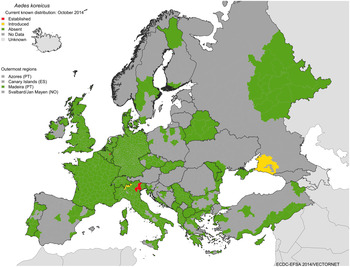
Aedes koreicus (Edwards, Reference Edwards1917), also known as Ochlerotatus koreicus (Reinert, Reference Reinert2000) and Hulecoeteomyia koreica (Reinert et al., Reference Reinert, Harbach and Kitching2006), was encountered for the first time in Europe in 2008 and in subsequent years in the same area in Belgium within a 6 km2 area of an industrial zone in Maasmechelen (Versteirt et al., Reference Versteirt, De Clercq, Fonseca, Pecor, Schaffner, Coosemans and Van Bortel2012). It was later found in Belluno, Veneto province, Italy during 2011 (Capelli et al., Reference Capelli, Drago, Martini, Montarsi, Soppelsa, Delai, Ravagnan, Mazzon, Schaffner, Mathis, Di Luca, Romi and Russo2011) and in neighbouring provinces Treviso and Vicenza in 2012 (Montarsi et al., Reference Montarsi, Martini, Dal Pont, Delai, Ferro Milone, Mazzucato, Soppelsa, Cazzola, Cazzin, Ravagnan, Ciocchetta, Russo and Capelli2013) (fig. 7). Nothing is known on the initial introduction of the species into Belgium or Italy, although international trade has been suggested as a possible route (Versteirt et al., Reference Versteirt, De Clercq, Fonseca, Pecor, Schaffner, Coosemans and Van Bortel2012).
Current distribution of Aedes koreicus in Europe (ECDC 2014/VBORNET/VECTORNET).

Entomological perspective
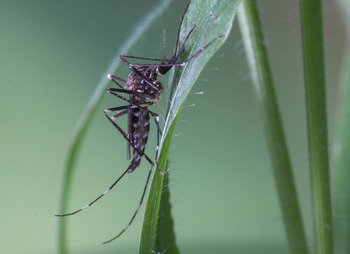
Aedes koreicus is relatively large and strongly resembles Ae. japonicus also bearing several clear longitudinal lines on the scutum. The main diagnostic character between the two species is the presence of a complete basal band on hind tarsomere 4 (fig. 8). Individuals of Ae. koreicus from Jeju-do Island, southwest of the Korean mainland, have an incomplete pale basal band on the fifth hind tarsomere which is not the case for the specimens from the mainland. This characteristic is however also present in all individuals of the Belgian population and those from Italy. Furthermore, mosquitoes from Belgium, Italy and Jeju-do share 99–100% sequence identity (Montarsi et al., Reference Montarsi, Martini, Dal Pont, Delai, Ferro Milone, Mazzucato, Soppelsa, Cazzola, Cazzin, Ravagnan, Ciocchetta, Russo and Capelli2013).
Female Aedes koreicus (Photograph: F. Schaffner).

In Belgium, adults are present from May to October with a peak activity during the summer months; larvae of the species can be observed earlier from March/April till September (Versteirt et al., Reference Versteirt, De Clercq, Fonseca, Pecor, Schaffner, Coosemans and Van Bortel2012). Larvae were collected during May and July 2011 in Veneto, Italy (Capelli et al., Reference Capelli, Drago, Martini, Montarsi, Soppelsa, Delai, Ravagnan, Mazzon, Schaffner, Mathis, Di Luca, Romi and Russo2011). Surveillance in the same region in 2012 first detected larvae in late March, eggs were found in ovitraps in May, adults were active until mid/late September, and living larvae could be observed until the end of October (Montarsi et al., Reference Montarsi, Martini, Dal Pont, Delai, Ferro Milone, Mazzucato, Soppelsa, Cazzola, Cazzin, Ravagnan, Ciocchetta, Russo and Capelli2013). Nothing is known on the number of generations the species has per season. Larvae of the species have been found breeding in a number of artificial sites such as garden ponds, water drums and other water-containing vessels (Ho, Reference Ho1931), and in natural sites such as tree holes and stone cavities containing rain water and decaying tree leaves (Feng, Reference Feng1938). Tanaka et al. (Reference Tanaka, Mizusawa and Saugstad1979) stated that the larvae of Ae. koreicus can be found more easily in human inhabited areas than the larvae of Ae. j. japonicus. In Belgium, immatures of Ae. koreicus were found in artificial sites such as discarded tyres and old rusted construction equipment as well as in more natural sites such as road tracks and ditches (Versteirt et al., Reference Versteirt, De Clercq, Fonseca, Pecor, Schaffner, Coosemans and Van Bortel2012). In Italy, larvae were found in manholes, garden buckets and cemetery flower pots (Capelli et al., Reference Capelli, Drago, Martini, Montarsi, Soppelsa, Delai, Ravagnan, Mazzon, Schaffner, Mathis, Di Luca, Romi and Russo2011). During surveillance in Northeastern Italy during 2011 and 2012, larvae were most often found in catch basins and artificial water containers, commonly located at garden centres, streets/squares, private gardens and cemeteries (Montarsi et al., Reference Montarsi, Martini, Dal Pont, Delai, Ferro Milone, Mazzucato, Soppelsa, Cazzola, Cazzin, Ravagnan, Ciocchetta, Russo and Capelli2013). There is little information on possible thresholds constraining the distribution of Ae. koreicus. Based on a comparison between Korea and Belgium, climate seems not to be a limiting factor for the establishment of the species in the country (Versteirt et al., Reference Versteirt, De Clercq, Fonseca, Pecor, Schaffner, Coosemans and Van Bortel2012) or other countries with similar climate in Europe. In Italy, Ae. koreicus was found at altitudes ranging from 173 to 1250 m a.s.l., but was most commonly found at 400–600 m a.s.l. (Montarsi et al., Reference Montarsi, Martini, Dal Pont, Delai, Ferro Milone, Mazzucato, Soppelsa, Cazzola, Cazzin, Ravagnan, Ciocchetta, Russo and Capelli2013). The mean and minimum temperature trends during the Ae. koreicus period of activity (April–October) in Northeastern Italy are similar to those in the mosquito's native range in South Korea (Montarsi et al., Reference Montarsi, Martini, Dal Pont, Delai, Ferro Milone, Mazzucato, Soppelsa, Cazzola, Cazzin, Ravagnan, Ciocchetta, Russo and Capelli2013).
Public health importance
In parts of Russia, Ae. koreicus has been suggested a possible vector for Japanese encephalitis virus (JEV) (Miles, Reference Miles1964; Shestakov & Mikheeva, Reference Shestakov and Mikheeva1966) but this was never confirmed from the field in Korea (Kim et al., Reference Kim, Chong, Collier and Klein2009). There are indications that the species could be able to transmit Dirofilaria immitis to dogs (Feng, Reference Feng1938) and Brugia malayi to humans (KCDC, 2007). In Italy the species seems to be a suitable intermediate host for D. immitis (Montarsi et al., Reference Montarsi, Ciocchetta, Ravagnan, Simonato, Mutinelli, Camuffo, Frangipane di Regalbono and Capelli2014). Aedes koreicus can be found more easily in human inhabited areas than Ae. j. japonicus, and the species is known to bite humans (Tanaka et al., Reference Tanaka, Mizusawa and Saugstad1979) during daytime (Kim et al., Reference Kim, Lee, Richards, Schleich, Herman and Klein2003) increasing the potential contact with humans. Nuisance biting has been reported in regions of Italy where Ae. koreicus is the exclusive diurnal biting species (Montarsi et al., Reference Montarsi, Martini, Dal Pont, Delai, Ferro Milone, Mazzucato, Soppelsa, Cazzola, Cazzin, Ravagnan, Ciocchetta, Russo and Capelli2013) Tables 1 and 2.
Aedes atropalpus
Brief history of spread and European distribution
Aedes atropalpus (Coquillett, 1902), also referred to as Ochlerotatus atropalpus (Reinert, Reference Reinert2000) and Georgecraigius atropalpus (Reinert et al., Reference Reinert, Harbach and Kitching2006), is known as the American rock pool mosquito. It is now native to Eastern North America (Carpenter & LaCasse, Reference Carpenter and LaCasse1955) and although originally limited to rock pool areas (Nawrocki & Craig, Reference Nawrocki and Craig1989), its utilization of scrap tyres during the 1980s (Freier & Beier, Reference Freier and Beier1984) as an alternative larval development site resulted in its spread in North America. Subsequently non-desiccating eggs were mainly imported into Veneto Province in Italy via used tyres, with both adults and larvae found at a tyre depot in 1996 and 1997, and initial use of insecticides achieved the elimination of the populations (Romi et al. 1997; Romi et al., Reference Romi, Di Luca and Majori1999). In France, some larvae were found at a used tyre yard in Poitou-Charentes (Vienne) in 2003 with evidence of reproduction but did not spread. A second introduction was observed in Normandy (Orne) in 2005, and immediate control measures (insecticiding) aiming also at Ae. albopictus achieved eradication (S. Chouin & F. Schaffner, unpublished data). Aedes atropalpus has since been imported into the Netherlands through the tyre trade, but these populations remained localized (Scholte et al., Reference Scholte, Hartog, Braks, Reusken, Dik and Hessels2009) and have subsequently been eliminated (Ibañez-Justicia, personal communication). Consequently, there is currently no population known to persist in Europe.
Entomological perspective
Adults of Ae. atropalpus show a dark and clear pattern due to the presence of clear scale patches on a black background on the legs and other parts of the body, but this looks much less obvious than for the other invasive mosquitoes. The presence of two lateral broad lines of clear scales on a black background on the scutum (dorsal part of the thorax) is diagnostic compared with Ae. aegypti (lyre shape), Ae. albopictus (one median line) and Ae. japonicus (median and lateral lines). The pale rings on the legs are inter-articular whereas they are only basal for the above mentioned invasive species. Other indigenous Aedes species resemble, but they usually do not breed in tyres and other human-made containers.
Adults tend to occur early in the season due to their ability to produce eggs without taking a blood meal (Juliano & Lounibos, Reference Juliano and Lounibos2005; Yee, Reference Yee2008). A study in Illinois found high abundance of Ae. atropalpus in tyres in open-field areas and in ecotones with neighbouring habitat, being most abundant here in June (Lampman et al., Reference Lampman, Hanson and Novak1997). They have a preference for riparian/riverine habitats such as rock pools but also use human-made containers including used tyres (Juliano & Lounibos, Reference Juliano and Lounibos2005). They typically inhabit warm, sunlit areas with larvae being found in habitats with up to 30°C (Andreadis & Wolfe, Reference Andreadis and Wolfe2010) but are also occasionally found in shaded areas (Lampman et al., Reference Lampman, Hanson and Novak1997). Their preference for tyres that are in direct sunlight as opposed to those in the shade has also been reported (Freier & Beier, Reference Freier and Beier1984). Larvae are known to congregate at the bottom of rock pools under organic matter (Armistead et al., Reference Armistead, Nishimura, Escher and Lounibos2008). Gravid females have been found laying eggs on the water surface (Yee, Reference Yee2008).
Aedes atropalpus is a multivoltine species, has a preference for mammalian hosts and will readily bite humans (Turell et al., Reference Turell, Dohm, Sardelis, O'Guinn, Andreadis and Blow2005). Previous studies have found deer and canaries as blood meal hosts (Freier & Beier, Reference Freier and Beier1984). Females are known to be a pest to humans near aquatic habitats, with biting activity reported during the day and night (Turell et al., Reference Turell, Dohm, Sardelis, O'Guinn, Andreadis and Blow2005). The species has a limited flight range (Turell et al., Reference Turell, Dohm, Sardelis, O'Guinn, Andreadis and Blow2005). There is currently a lack of understanding of the habitat tolerances of Ae. atropalpus (Yee, Reference Yee2008), however their northern distribution in North America suggests their potential for survival in Northern Europe, as documented by populations in the Netherlands. There is some evidence to suggest that populations of Ae. atropalpus have declined in some areas of North America and that this may be due to interactions with Ae. japonicus in aquatic breeding sites (Armistead et al., Reference Armistead, Nishimura, Arias and Lounibos2012).
Public health importance
This species is not considered as an important vector of pathogens in the field. However, WNV has been isolated from field collected Ae. atropalpus (Turell et al., Reference Turell, Dohm, Sardelis, O'Guinn, Andreadis and Blow2005) and laboratory competency studies have shown it to be a competent vector for WNV, La Crosse virus (LACV), JEV, St. Louis encephalitis virus (SLEV), and Eastern equine encephalitis virus (EEEV) (Scholte et al., Reference Scholte, Hartog, Braks, Reusken, Dik and Hessels2009). Studies have found that Ae. atropalpus is susceptible to oral infection with LACV, capable of transmitting the virus through blood meals and transovarial transmission (Freier & Beier, Reference Freier and Beier1984). The latter has also been demonstrated with SLEV under laboratory conditions (Hardy et al., Reference Hardy, Rosen, Reeves, Scrivani and Preser1984) Tables 1 and 2.
Invasive mosquitoes in the European associated continental and overseas territories (OTs)
The geo-political extent of Europe ranges far beyond that of the geographical one, to include a number of OTs. The OTs are important to the European parent states and ECDC. Therefore a discussion of invasive mosquitoes in Europe is not complete without some consideration of their status on the OTs; particularly given the recent emergence of mosquito-borne disease in the Caribbean OTs. Many European countries have special territories which often have a certain degree of autonomy represented by a local government, but they do not possess full political independence or sovereignty as a state. There are seven European outermost regions which are members of the EU: the two groups of Portuguese islands Azores and Madeira, the group of Spanish Canary Islands, and the five French overseas departments French Guiana, Guadeloupe, Martinique, Reunion and Mayotte. Beside these, there are 34 territories that have a special relationship with one European country: 16 with the UK, eight with France, three with Norway, two with the Netherlands, two with Denmark, one with Greece, one with Finland and one territory is administrated by the United Nations. Most of them are located overseas but a few are on the European mainland; they may have different status and some are still disputed. Here, a geographical approach more suited to the current purpose, will be adopted, with territories being ranked from north to south within each geographical region.
Europe
North (>60°N)
Only one mosquito species, Aedes nigripes, is recorded so far from the Svalbard and Jan Mayen islands (Kingdom of Norway) (Coulson, Reference Coulson2007). The species is not known as a potential vector but it could be locally responsible for nuisance biting. Several species have been reported from Åland islands (autonomous province of Finland) although none are invasive species (Utrio, Reference Utrio1979; Huldén, personal communication), and there is no information available on the mosquito fauna from the Faroe Islands (Kingdom of Denmark).
North-West (50–60°N, 0–15°W)
Although there are mosquitoes in the Northern European British Crown dependencies, there are no reports of invasive species on the Channel Islands (comprising Alderney, Jersey, Herm, Guernsey and Sark), or on the Isle of Man.
South (25–40°N)
Mosquito control does take place in the British sovereign bases (Akrotiri and Dhekelia) on Cyprus, but there are no confirmed reports of invasive species, and no information exists on the mosquito fauna of the UN buffer zone in Cyprus, from Gibraltar (British OT) or from Mount Athos (under Greek sovereignty). Three groups of islands are located in the Atlantic Ocean: the Portuguese autonomous regions Azores and Madeira and the Spanish autonomous community Canaries. Mosquito fauna is diverse, including some endemic species or subspecies: Culiseta atlantica on Azores (Da Cunha Ramos & Ribeiro, Reference Da Cunha Ramos and Ribeiro1980), Ae. eatoni on Madeira and Canaries (Capela, Reference Capela1981), Cx. hortensis maderensis on Madeira (Capela, Reference Capela1981). The introduction of Ae. aegypti in Madeira since 2004/2005 has proven to be significant, and has been responsible for DENV transmission as previously discussed.
Atlantic Ocean
High northern latitudes (>45°N)
Considering the local climate, there is very little possibility that any mosquito-borne transmission will occur under these latitudes. However, even if the diversity is generally low for the biting insect fauna, the abundance of these can be very high at certain periods. Four aedine mosquito species are reported from Greenland (Kingdom of Denmark), the larger associate territory (Darsie, R.F. & Ward R.A. (Reference Darsie and Ward1989)). Among them is Ae. triseriatus, found once nearby an airbase in 1967 and suspected to have been introduced (Messersmith, Reference Messersmith1971). This is the northernmost location of the species, but studies are scarce and this single record needs to be confirmed. No recent information on invasive species is available. Mosquitoes are also numerous on Saint Pierre and Miquelon (French community), but no precise information is available.
Medium northern latitudes (10–45°N)
The associated territories in this area are, from north to south: the British OT Bermuda, Turks and Caicos Islands, and in the Caribbean the Cayman Islands, Anguilla, British Virgin Islands, the French communities Saint Martin and Saint Barthélemy, Sint Maarten, Saba and Sint Eustatius as a part of the Dutch OT Netherlands Antilles, the British OT Montserrat, the French departments Guadeloupe (including Marie-Galante, La Désirade and Les Saintes) and Martinique, and the Dutch OT Aruba, Curaçao and Bonaire another part of the Netherlands Antilles. In these territories, the mosquito story is somewhat different. All have had or currently have populations of Ae. aegypti, with Ae. albopictus confirmed only on Bermuda and the Cayman Islands (Wheeler & Petrie, Reference Wheeler and Petrie2007; Kaplan et al., Reference Kaplan, Kendell, Robertson, Livdahl and Khatchikian2010). In the Cayman Islands, Ae. aegypti was eliminated but was re-introduced in 2002. However, in 1997, Ae. albopictus was introduced during the Ae. aegypti-free period, but since the return of Ae. aegypti the Ae. albopictus population has plummeted and is now only found rarely on the island (Wheeler & Petrie, Reference Wheeler and Petrie2007). On Bermuda also, Ae. aegypti was considered eliminated by the 1960s but was rediscovered in 1997, and in 2000 Ae. albopictus was found. Subsequently, and inversely to the Cayman Islands, the population of Ae. aegypti has rapidly declined (Kaplan et al., Reference Kaplan, Kendell, Robertson, Livdahl and Khatchikian2010).
Across all the territories various activities are in place for surveillance and control of these invasive species. According to the Pan American Health Organization, examples of control include fogging in areas of high mosquito abundance and dengue cases in Anguilla, integrated vector control through community engagement in the Turks and Caicos, port disinfection, ovitrap surveillance and chemical control of adults and larvae in the Cayman Islands, also larval biocontrol (e.g. Bacillus thuringiensis israelensis) on the French Islands, as well as surveillance of introduction pathways (used tyres) (Corriveau et al., Reference Corriveau, Philippon and Yébakima2003; Wheeler & Petrie, Reference Wheeler and Petrie2007). Dengue cases (albeit at low levels) have been reported in all of the six British territories, although it is questionable how much of this is due to local transmission and hence true endemicity, as most cases appear to be due to importations from elsewhere in the region. DENV is also endemic on the French islands and epidemics of several serotypes occur regularly. Imported malaria and CHIKV cases are surveyed, with application of preventive focal insecticiding in the surrounding. Also the Dutch islands have regular outbreaks of dengue fever during the rainy seasons, despite control programmes of its vector Ae. aegypti. The ongoing outbreak of CHIKV is affecting many Caribbean territories and American OTs (all French lesser Antilles territories, Anguilla, British Virgin Islands, Turks and Caicos, Cayman Islands, Curaçao, Sint Maarten), with control measures being in general reinforced. Further work is ongoing to ascertain the status of invasive species and transmission of DENV and CHIKV in these territories, and VECTORNET (formerly VBORNET) would welcome further communication with individuals involved in mosquito surveillance and control in the British and Dutch OTs and dependencies.
Low northern latitudes (0–10°N)
The second larger associate territory is French Guiana, located on the South American continent. The mosquito fauna is various and abundant, and comprises many vector species. Malaria is still endemic mainly on inland territories along rivers in the Amazon forest where it has decreased during recent years while owing to migratory movements, transmission is becoming more frequent in coastal municipalities and close to the capital Cayenne. The main vector is Anopheles darlingi but several secondary vectors are involved in the transmission (Dusfour et al., Reference Dusfour, Carinci, Issaly, Gaborit and Girod2013). Dengue is now considered as hyperendemic, while outbreaks of all four serotypes occur regularly. The vector is Ae. aegypti. Other mosquito-borne arboviruses, including recently CHIKV, have also been recorded. Aedes albopictus importation is regularly assessed. One unpublished observation in 2013 mentioned the presence of the species, but it is not established locally so far.
Low and Medium southern latitude (0–45°S)
The British OT St. Helena and dependencies (Ascension Island and Tristan da Cunha -see below-) are located more southerly in the Atlantic Ocean. Ae. aegypti was reported on St Helena, along with Culex quinquefasciatus, however, according to local sources, there have been no recent reports of Ae. aegypti on the island.
High southern latitude (>45°S)
For the more Southern British OT in the South Atlantic, the human population is small or not always fully resident and therefore there is no or little information on invasive mosquito species. The Falkland Islands and Tristan da Cunha are reportedly free of mosquitoes, including invasive species. This absence and the small human populations inhabiting these isolated territories also means there is no significant surveillance or control of mosquitoes. In the case of South Georgia, South Sandwich Islands and British Antarctic Territory, the climate is also likely to be inimical to the survival of these species. Similar assumptions could be made for Bouvet Island (Norway-dependent territory), uninhabited and covered by glaciers, as well as for Queen Maud Land (Norwegian Antarctic territory).
Indian Ocean
Low southern latitudes (0–10°S)
From British Indian Ocean Territory (Chagos Archipelago, the largest island being Diego Garcia) there is no available information.
Medium southern latitudes (10–30°S)
Some islands of the French Southern and Antarctic Lands (French OT) are located in or close to the Mozambique Channel (Eparse Islands): Banc du Geyser, Glorioso Islands, Tromelin Island, Juan de Nova, Bassas da India and Europa. If inhabited, they are generally only by researchers in scientific stations. Little information on the mosquito fauna is available but a very recent survey made in the Eparse Islands has reported Ae. albopictus introduced in Grande Glorieuse and Juan de Nova (Bagny et al., Reference Bagny, Freulon and Delatte2009), the species having not been observed during a preceding survey from 2000 to 2003 (Girod & Le Goff, Reference Girod and Le Goff2005). The French community Mayotte, part of the Comoros Archipelago, has several vectors among the mosquito fauna (45 species recorded to date), including Cx. quinquefasciatus, Anopheles gambiae, An. funestus, Ae. aegypti, Ae. albopictus and Ae. circumluteolus (Le Goff et al., Reference Le Goff, Goodman, Elguero and Robert2014). Aedes albopictus, observed for the first time on the island in 2001, has since almost completely replaced Ae. aegypti (Bagny et al., Reference Bagny, Arnoux, Delatte, Lajoie and Fontenille2012). Besides, a new mosquito species, Aedes pia, has recently been described (Le Goff et al., Reference Le Goff, Brengues and Robert2013; as Stegomyia pia). The vector role of this mosquito species, which appears to be quite common on Mayotte Island is unknown. Although malaria transmission is endemic, it is has been decreasing dramatically in recent years. CHIKV outbreaks in 2006 and 2007 have affected about 40% of the human population (Lernout et al., Reference Lernout, Giry, Binder, Zumbo, Durquety, Lajoinie, D'Ortenzio and Filleul2011). DENV is also circulating. Recent local transmission of Rift Valley fever virus (RVFV) has been observed from 2004 to 2008 in ruminants, and human cases were reported in 2007 (Balenghien et al., Reference Balenghien, Cardinale, Chevalier, Elissa, Failloux, Nipomichene, Nicolas, Rakotoharinome, Roger and Zumbo2013). Aedes albopictus is reported to have been present in the French department Reunion since at least 1913 and Ae. aegypti since 1902. Twelve mosquito species have been recorded in all (Boussès et al., Reference Boussès, Dehecq, Brengues and Fontenille2013). Aedes aegypti is now restricted to small wild populations. Mosquito surveillance and control has been effective for decades, but until 2004, these programmes were aimed almost exclusively at malaria vectors in order to prevent local transmission. A small DENV outbreak then occurred (the first since the 1970s), followed by a huge CHIKV outbreak with 266,000 estimated cases and an incidence of 38% (Renault et al., Reference Renault, Balleydier, D'Ortenzio, Bâville and Filleul2012). Since then, an integrated vector control programme is implemented for limiting CHIKV and DENV transmission.
High southern latitudes (>30°S)
The rest of the French Southern and Antarctic Lands (French OT) are Saint-Paul Island, Amsterdam Island, Crozet Island, Kergelen Islands and Adélie Land in Antarctica, also generally uninhabited, except by researchers in scientific stations, and probably support no mosquito fauna.
Pacific Ocean
Low northern latitude (0–20°N)
The French state private property Clipperton has no permanent inhabitants, and no information on the mosquito fauna is available.
Medium southern latitudes (0–60°S)
The French Wallis and Futuna (OT), French Polynesia (overseas country) and New Caledonia (OT) have regular DENV outbreaks, with Ae. aegypti as main vector (Roth et al., Reference Roth, Mercier, Lepers, Hoy, Duituturaga, Benyon, Guillaumot and Souarès2014). The first documented outbreak of ZIKAV infection in French Polynesia and New Caledonia occurred in 2013/2014 (ECDC, 2014d ). Other species that contribute to transmission include Ae. polynesiensis in Wallis and Futuna and French Polynesia, and Ae. albopictus has not been reported (Guillaumot et al., Reference Guillaumot, Ofanoa, Swillen, Singh, Bossin and Schaffner2012). Integrated dengue vector control programmes are implemented. Lymphatic filariasis, suggested to be transmitted by Ae. vigilax in New Caledonia and Ae. polynesiensis in the other islands, has been reported in the general population, but current levels are unclear (Mou et al., Reference Mou, Plichart, Legrand, Mallet, Cerf and Nguyen2009; Bossin H., personal communication). Malaria does not occur. Two other arboviruses which are active in the Pacific region require attention, Ross River virus which affected New Caledonia, Wallis and Futuna in 1979 and 1980, and JEV which is currently expanding its distribution range (LaPointe, Reference LaPointe2007). Finally, CHIKV appeared in New Caledonia for the first time in 2011 (Dupont-Rouzeyrol et al., Reference Dupont-Rouzeyrol, Caro, Guillaumot, Vazeille, D'Ortenzio, Thiberge, Baroux, Gourinat, Grandadam and Failloux2012), and French Polynesia in 2014. The British OT Pitcairn Islands is an isolated island with a population of 50. Local sources report that the island has a mosquito biting problem, suggesting that both malaria and dengue vectors may occur on the island but there are no reports of mosquito-borne disease cases. However its closest neighbour, Mangareva (in French Polynesia), does have a problem with mosquito-borne infections, and there is concern of possible spread and a recognized need for mosquito control on Pitcairn. There are a number of historical references to Ae. polynesiensis, Culex quinquefasciatus and Ae. aegypti on Pitcairn (Belkin, Reference Belkin1962).
High southern latitudes (>60°S)
The last territory is Peter I Island, Norwegian Antarctic territory, an uninhabited volcanic island, with unfavourable conditions for mosquitoes and mosquito-borne transmission.
Conclusion
Over the last 30 years continental Europe has faced invasion by exotic aedine mosquito species. These container-breeding mosquitoes find suitable conditions to spread and proliferate, and will probably further spread as suggested by several statistical or biological models (Schaffner & Mathis, Reference Schaffner and Mathis2014). Ae. aegypti has returned to an area of the Black Sea region and there is concern for its introduction and spread into the Mediterranean region. Aedes albopictus is better adapted to temperate climate and has already invaded a large part of Southern Europe, and is now spreading northwards. Aedes japonicus is even more able to colonize temperate/cold areas and is currently spreading rapidly thoughout Central Europe. Little is known about Ae. koreicus and Ae. atropalpus in terms of invasiveness, but the first seems to spread in Northern Italy whereas the second has been eliminated from introduction sites. The situation is diverse in the OTs, with Ae. aegypti having been present for long time in most of the territories in tropical climes, whereas Ae. albopictus has so far invaded only few of them. There is a moderate risk of colonization of temperate OTs by these mosquito species, and little or no risk for the other OTs localities in the far northern or southern regions. No other invasive mosquito species have so far been reported from OTs.
Competition might occur between invasive mosquitoes and native container-breeding mosquitoes. Competition outcomes will differ according to species and environmental conditions. Unfortunately invasive mosquito species represent a significant risk to public health (primarily by transmission of DENV and CHIKV) and animal health (primarily by possible transmission of diverse equine encephalitis viruses) (tables 1 and 2). Most detrimental would be Ae. aegypti and Ae. albopictus, as demonstrated by past and recent transmission of DENV and CHIKV in Europe. These species can show high vectorial capacity under favourable environmental/climatic conditions, in particular because they are well adapted to modern human environments and readily feed on humans. Native mosquitoes have no or low vector competence for these two viruses, but are or can be actively involved in the transmission of other pathogens, e.g. WNV. Little is known about the risk to public and animal health posed by Ae. koreicus and Ae. atropalpus.
Status of invasive mosquitoes of Europe as disease vectors.

Public health significance of pathogens transmitted by invasive mosquitoes.

For these reasons, invasive mosquitoes should be surveyed (Schaffner et al., Reference Schaffner, Bellini, Petrić, Scholte, Zeller and Marrama Rakotoarivony2013a ) and their control is the sole response to suppress pathogen transmission. Surveillance might primarily focus on Ae. aegypti and Ae. albopictus, but other invasive speices must not be neglected. Control of these mosquito species is particularly difficult, as they develop in a variety of human-made and natural containers that are difficult to access. Thus, there is a crucial need for research and development of efficient and sustainable vector control tools taking into account possible occurence of insecticide resistance and the restricted use of biocides in the EU. The dispersal of invasive mosquitoes and exotic arboviruses is a consequence of the increase of travel and trade. In this context, international collaboration is essential for prevention and preparedness for the spread of vectors and vector-borne pathogens. A European network for sharing data on the geographic distribution of arthropod vectors, transmitting human and animal disease agents, named VECTORNET (formerly VBORNET; www.vbornet.eu) has been established by the ECDC and the European Food Safety Authority (EFSA). This network gathers together medical and veterinary entomologists and public and animal heath experts, to assist ECDC and EFSA in their activities involving arthropod vector surveillance within the EU, and consequently to improve preparedness for vector-borne diseases, in line with other ‘One Health’ initiatives. Experts are invited to join that network to share data on the distribution of important vectors and provide scientific input on vector-borne diseases. A major outcome of this continental-scale collaboration will be the improvement of preparedness of European countries for vector-borne diseases in both pre-disease stage and outbreak response.
Acknowledgements
We thank the following people for their assistance provided for the section on invasive mosquitoes on the overseas territories: Hervé Bossin (Institut Louis Malardé, Papeete, French Polynesia) Carel van der Merwe (Medical Director, Tristan da Cunha), Michele Christian (Government of the Pitcairn Islands), Roger Diggle (Chief Medical Officer, Falklands Islands), Alan Wheeler (Government of the Cayman Islands), Joan Moinnodeen (Ministry of Health Montserrat), Sarel Bloem (Senior Medical Officer, St. Helena), Lena Huldén (University of Helsinki, Finland), Laurent Guillaumot (Institut Pasteur de Noumea, New Caledonia) and Joel Gustave (Agence Régionale de Santé, Guadeloupe).