Surgical site infections (SSIs) are a substantial cause of morbidity, mortality, and cost.Reference Horan, Andrus and Dudeck 1 SSI rates decrease with measures such as perioperative antibiotic administration, oxygen administration, and meticulous skin preparation.Reference Anderson, Podgorny and Berrios-Torres 2 For these reasons, the rate of SSI is an excellent composite end point of good surgical practice and widely used as a quality measurement.
The National Healthcare Safety Network defines 3 types of SSI: superficial, deep incisional, and organ-space; deep incisional and organ-space are collectively referred to as “complex SSI.” 3 The Centers for Medicaid and Medicare Services elected to base hospital reimbursement in part on complex colon SSI rates beginning in January 2016. 4 Colon SSI rates are also used by state health departments for publicly reported quality comparisons between local hospitals. A recent Web-based search revealed that 28 states require SSI rates to be reported; only 3 of these states exclude superficial SSI from their mandatory reporting requirements. 5 In order for public image and financial reimbursement to be fairly distributed, all hospitals must make a good-faith effort to detect all SSI after colon surgery.
SSI may be detected before hospital discharge, upon hospital readmission, or solely in the outpatient setting. Previous publications state that 6% to 88% of SSI occur after hospital discharge, when superficial SSI are most common and surveillance techniques of infection preventionists (IP) are most variable.Reference Mannien, van den Hof, Brandt, Behnke, Wille and Gastmeier 6 – Reference Anderson, Chen, Sexton and Kaye 10 When IP perform minimal postdischarge surveillance, the reported rates of superficial SSI falsely decrease. This misinforms consumers who compare hospitals on these factors and limits opportunities to implement SSI prevention practices.Reference Anderson, Podgorny and Berrios-Torres 2
The objective of this study was to evaluate the relationship between SSI surveillance techniques for colon surgery and the rates of superficial and complex SSI per 100 procedures.
METHODS
The study population was local hospitals that performed at least 20 colon surgeries from August 1, 2012, through July 31, 2013. Data were obtained from 2 distinct sources: (1) a survey of IP who performed SSI surveillance during these periods; and (2) hospital-specific information that was reported to the state health department.
A 15-question online survey was developed to determine how IP detect SSI (Online Appendix).Reference Reese, Price, Knepper and Young 11 Particular attention was given to the use of microbiology and laboratory tests, communication with healthcare personnel, and postoperative healthcare utilization. The survey link was emailed to IP at local hospitals, and a reminder email was sent 2 weeks after the initial mailing.
Through a data share agreement, the state health department linked the number of superficial SSI, complex SSI, and colon surgeries performed at participating hospitals to their survey responses.
Responses from the survey questions were analyzed. IP who used at least 2 distinct microbiology and laboratory tests were considered to use that SSI surveillance technique; those who used only 1 microbiology or laboratory test were not considered to use that technique. Similarly, IP who communicated with at least 2 healthcare personnel or who evaluated for at least 3 types of postoperative visit were considered to use those SSI surveillance techniques; IP who used less than those numbers were not considered to use those techniques.
Descriptive statistics were used to characterize the SSI surveillance techniques used by IP. Hospitals were stratified according to the number of SSI surveillance techniques that IP performed. The Kruskal-Wallis test was used to compare median superficial and complex SSI rates.
Crude mean superficial SSI rates per 100 procedures were calculated. Adjusted mean superficial SSI rates were calculated controlling for the volume of procedures at participating hospitals via indirect standardization. Crude and adjusted mean complex SSI rates were calculated by the same methods. The Cochran-Armitage test was used to evaluate for trends in the adjusted mean superficial and complex SSI rates stratified by the number of SSI surveillance techniques.
In order to have 80% power to detect a trend in the adjusted mean superficial SSI rate over 4 stratified surveillance groups, 230 procedures were needed in each group. The Colorado Multiple Institutions Review Board approved this study.
RESULTS
Of 37 hospitals that performed at least 20 colon surgeries during the study period, completed surveys were received from 26 (70%). Thirteen IP (50%) reported using at least 2 microbiology or laboratory tests as an indicator for detailed chart review. Communication with at least 2 healthcare personnel was used by 12 IP (46%), and 17 IP (65%) reported using at least 3 types of postoperative visits.
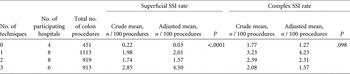
None of the individual techniques for SSI surveillance was associated with increased superficial or complex SSI rates, but the combination of using at least 2 laboratory results and communicating regularly with at least 2 types of healthcare personnel was associated with higher median superficial SSI rates (3.31 vs 1.01 per 100 procedures; P=.048). There was a significant trend toward higher adjusted mean superficial SSI rates when more SSI surveillance techniques were used (P<.0001). The adjusted mean complex SSI rate did not rise with increasing numbers of SSI surveillance techniques (P=.098) (Table 1).
Relationship Between the No. of Surgical Site Infection (SSI) Surveillance Techniques and Reported SSI Incidence

NOTE. Surveillance techniques included ≥2 laboratory or microbiology results, communication with ≥2 types of healthcare providers, and surveillance for ≥3 types of postoperative visits.
DISCUSSION
In this study, we demonstrated that IP who used more surveillance techniques reported a higher rate of superficial but not complex SSI than that reported by IP who used few surveillance techniques.
It was surprising that the use of 1 surveillance technique detected higher superficial and complex SSI rates than the use of 2 surveillance techniques, although this finding was not statistically significant. Upon inspection of the data, we found that 1 facility performed 1 surveillance technique and had higher superficial and complex SSI rates than all of the other facilities in this group. We suspect that the inclusion of this facility’s data skewed the results; a larger sample size would likely mitigate this unexpected finding.
There are a number of ways that the accuracy of publicly reported SSI rates could improve. IP could undergo standardized training and ongoing modules similar to those of National Surgical Quality Improvement Program site reviewers.Reference Shiloach, Frencher and Steeger 12 This is likely unfeasible at most institutions owing to competing time demands on IP. A second option would be for national organizations to endorse a minimum standard of at least 2 surveillance techniques for IP to perform SSI surveillance. Full standardization of SSI surveillance techniques is unrealistic because IP have varying degrees of electronic medical record capabilities and access to outpatient encounters. Another option is for states to publish complex SSI rates only, aligning with the Centers for Medicaid and Medicare Services reimbursement plan. Finally, audit mechanisms will continue to be essential to ensuring accuracy of data. The Centers for Medicaid and Medicare Services has plans to audit facilities, and many state health departments regularly perform audits at local hospitals.
To our knowledge, this is the first study to correlate IP surveillance techniques for publicly reported surgeries to reported rates of SSI. Although the study did exceed the number of procedures required to have sufficient statistical power, it was limited by its small geographic scope. Future nationwide evaluations of the association between SSI surveillance techniques and SSI rates should be undertaken. A national survey could characterize practice patterns and influence recommendations for best IP surveillance practices.
In conclusion, colon SSI rates are used for both public hospital comparison and financial reimbursement. The intensity of SSI surveillance by IP can impact the superficial SSI rate. Care must be taken to ensure that facilities that capture all SSI, both superficial and complex, are not unjustly punished for utilizing more rigorous surveillance techniques.
Acknowledgments
We thank the IP who participated in the study and shared details of their SSI surveillance techniques.
Financial support: None reported.
Potential conflicts of interest: All authors report no conflicts of interest relevant to this article.
Supplementary material
To view supplementary material for this article, please visit http://dx.doi.org/10.1017/ice.2015.21