Imperialist nostalgia revolves around a paradox: A person kills somebody, and then mourns the victim. . . . At one more remove, people destroy their environment, and then they worship nature.
—Renato Rosaldo, Culture and Truth: The Remaking of Social AnalysisWidespread fascination with ruin porn offers evidence that it is easier to imagine the end of the world than the end of capitalism. From the massive Dandora Landfill in Nairobi, Kenya, to the tsunami-ravaged, radioactive landscape of Fukushima, Japan, ecological wastelands have become a ubiquitous visual expression of the Anthropocene, an epoch in which humankind has achieved a disastrous level of geologic agency. We are increasingly confronted not with visual inducements to shock and horror but with the sublimity of human-altered landscapes marked by extraction, extinction, and toxic waste. As Siobhan Lyons puts it, “Ruin porn is the new sublime” (1). As she explains, “since the sublime was always acquainted with the threat of death, its alliance with the notion of ruin porn is unsurprising and essential” (2). It is pornographic because it taps into the amoral, representing an ungovernable libidinal reaction that overwhelms the rational fear of death. We should recognize the future orientation of ruin porn, a vision of humanity's impending collapse. The reason it titillates, Lyons suggests, is that “it offers an image of our own death while we are still alive” (2).
But skepticism over anthropogenic discourse about climate change and visual culture revolves around the question, Whose death? As the Métis scholar Zoe Todd elucidates, Euro-Western conceptions of the Anthropocene erase “Indigenous peoples and their knowledge systems and legal-political realities” (“An Indigenous Feminist's Take” 6). In other words, anthropogenic discourse displaces urgent historical and political questions about power and knowledge in favor of metaphysical speculations on human nature and the abstract threat of death. Therefore, departing from this mode of speculative discourse and following Robert Nichols's examination of colonial dispossession and capitalist accumulation, I explore the way the violence of colonial land expropriation plays out primarily “on the terrain of history, not ontology” (131). It is in this spirit that I consider the relation of colonial history to visions of the Anthropocene while also considering the Anthropocene's posthumanist alter ego. I conclude by proposing that the visual culture of the Anthropocene bears the antipolitical and dissociative trace of racial capitalism, which represses the economies of environmental violence experienced by racialized and colonized peoples.
The Anthropocene and Poststructuralist Deferrals
As spillover from the natural sciences, Anthropocene discourse in the humanities has become ubiquitous. Indigenous, Black, and critical ethnic studies scholars have expressed concern that this “charismatic mega category” displaces the history and violent continuity of empire (Reddy). Part of this displacement can be attributed to the scientific desire to mark the precise onset of the Anthropocene, whether it was the invention of the steam engine in the nineteenth century or the so-called Great Acceleration, the rise of global commodity chains that followed World War II. These origin stories fetishize newness while failing to engage the histories of racialized and colonized peoples throughout the world. As Elizabeth M. DeLoughrey clarifies, Anthropocene discourse claims “the novelty of crises rather than being attentive to the historical continuity of dispossession and disaster caused by empire” (2). The positivist search for origins takes for granted the Eurocentric authority of the natural sciences as a universal explanatory framework, one that is grossly inadequate for identifying highly uneven global processes. The invention of steam power, one of the most common “allegories of the Anthropocene” (DeLoughrey), is not reducible to a universal human demand for energy. Rather, as Andreas Malm and Alf Hornborg have elucidated, the investment in steam power was made possible by the genocidal decimation of Indigenous peoples in the Americas, the abduction and enslavement of Africans, the exploitation of British workers in factories and mines, and the global demand for cotton (63). By extension, Indigenous histories, experiences, and knowledge production are not reducible to the universalized climate science of the Anthropocene. As DeLoughrey puts it succinctly, “Anthropocene scholarship produces a globalization discourse that misses the globe” (2). While critics of the Anthropocene have offered corrective terms such as Capitalocene (Moore, ch. 7), Racial Capitalocene (Vergès), Necrocene (McBrien), Manthropocene (Raworth), and a Billion Black Anthropocenes (Yusoff), they nevertheless reinforce a Western investment in geologic framing that displaces the social, cultural, and political relations that exceed it.
The preoccupation with the human in anthropogenic discourse risks deflecting attention away from histories of imperial conquest that have contributed to what Karl Marx conceived of as the “metabolic rift” in the social relation to nature (Capital 949). Here I am referring not only to the currency of universalizing the term anthropos to refer to an undifferentiated “humankind” but also to theories that attempt to decenter the human, such as new materialism, posthumanism, and multispecies theory. Instead of being diametrically opposed, human-centered and human-decentered ontologies represent two sides of the same coin. In either overemphasizing or minimizing the human, these discourses attempt to redraw a Cartesian division between nature and society that obscures rather than clarifies their relation. In anthropocentric accounts of the death of nature (or of nature as a social construction), society is collapsed into nature. Alternatively, in new materialist accounts of the agency of matter, nature is collapsed into society. Nature is either socially constructed or exhibits social characteristics.
But is it possible that nature and society do not constitute a false opposition that needs to be critically dismantled? From a historical materialist perspective, the deep, mutually constituting, and increasingly destructive interaction between nature and society does not mean the distinction between them is obsolete; rather, it renders that distinction more crucial than ever. As Malm puts it, “environmental destruction, including climate change, does not happen at the boundary between droplet and cloud, or between petal and flower, or stone and slope. . . . It happens right at the interface between society and nature” (71). Far from being subsumed into human society, the category of nature precedes and exceeds us; it was here before us and will remain after we are gone. From a dialectical rather than binary perspective, we can approach nature as both nonidentical with the humanity that confronts and transforms it and at the same time an all-encompassing totality that includes humanity (Nichols 26).
Theory that acknowledges forms of agency in the more-than-human world may appear aligned with Indigenous philosophies. But as Todd explains in her account of a disappointing lecture by Bruno Latour, despite the similarity of his conceptualization of cosmopolitics and Inuit cosmological thought, a proprietary, Eurocentric claim to this knowledge is an apolitical given. “I waited,” she explains, “through the whole talk, to hear the Great Latour credit Indigenous thinkers for their millennia of engagement with sentient environments, with cosmologies that enmesh people into complex relationships between themselves and all relations, and with climates and atmospheres as important points of organization and action” (“An Indigenous Feminist's Take” 7). The displacement of Indigenous knowledge can again be rooted in Eurocentric assumptions. Much of the hybridism that defines anthropogenic theory is the result of trying to overcome a Cartesian opposition, in this case nature and culture. This of course presumes that such an ontological split between nature and culture is itself a universal conception, yet many Indigenous epistemologies have never accepted a Western nature-culture binary. As Todd observes, such assumptions remind us of the need to “decentre the Eurocentric, heteropatriarchal focus that posthumanist studies ironically perpetuates within the ‘order of rationality’ that shapes Euro-Western institutions” (“Indigenizing the Anthropocene” 245).
Moreover, in calls to move beyond the human, we must also question the very notion of a shared humanity that can be deconstructed. As Zakiyyah Iman Jackson cautions, “appeals to move ‘beyond the human’ may actually reintroduce the Eurocentric transcendentalism this movement purports to disrupt, particularly with regard to the historical and ongoing distributive ordering of race” (215). As she points out, Black people have been thought of as both animalistic and agents of animal cruelty. The gendered racialization of the field of metaphysics thus constitutes and shapes the nonhuman or inhuman terrain of Blackness. It was on this terrain of Blackness that the Five Civilized Tribes (Cherokee, Chickasaw, Creek, Choctaw, and Seminole) could establish their humanity by enslaving Black people. The human is made intelligible through the racialized figuration of the nonhuman or inhuman.
Attempts to tear down all dualities exaggerate the boundedness of nature and society, which becomes the false ground on which dialectical materialist critique is rejected. For example, Latour discredits historical materialism because “the dialectical interpretation changes nothing, for it maintains the two poles, contenting itself with setting them in motion through the dynamics of contradiction” (258). Instead of engaging with entangled relations, Latour's rejection holds together only under the presumption that nature and society are discrete entities. As Hornborg clarifies, “If the categories of Nature and Society are obsolete, as it is currently fashionable to propose, this only applies to images of Nature and Society as bounded, distinct realms of reality” (qtd. in Malm 62). But if we view nature as both a realm that is nonidentical with a humanity that confronts and transforms it and a totality that includes humanity, we can appreciate how society too represents disordered and often contradictory relations. Stressing “the differences which express the social relation,” Marx writes in the Grundrisse that “society does not consist of individuals, but expresses the sum of interrelations, the relations within which these individuals stand” (265). From a dialectical standpoint, nature and society confront each other as contradictory unities that exist in a complex, moving relation. This view of nature and society does not discount Indigenous epistemologies that foreground the sentience and agency of more-than-human environments and species. But posthumanism has nothing to do with the systems that cause environmental degradation. Matter's sentience or agency cannot compensate for colonial systems of violence or a capitalist ordering of nature that congeals social relations of profound racial and gendered inequality. Nor should it; nonhuman sentience or agency is not a prerequisite for political action. For Indigenous peoples struggling for clean water, for land free of toxic waste, or for legal protection over their more-than-human relations, these questions do not play out in the realm of metaphysics but on the precipice of life and death.
An underlying political quietism is perhaps what is most troubling about anthropogenic and posthumanist theories. If the most prominent allegory of the Anthropocene is an apocalyptic fall caused by some innate human propensity for sin—one that has put us on a course that will destroy humanity itself—it seems pointless to imagine anything except the end of the world, leaving little space for imagining, say, the dismantling of the fossil fuel industry. Similarly, posthumanism's diffuse network of actors and actants both deflects attention away from racial capitalism as the primary driver of environmental devastation and deemphasizes the role of decolonial political action. Worse, antihumanisms and posthumanisms often project a white liberal protectionist narrative that, as Jinthana Haritaworn observes, “ignores, . . . [or] actively paves the way for, the dehumanization of improperly environmental actors who are profiled through their lack of proper appreciation of and respect for nature” (211). Survival and sustenance—rather than recreation and companionship—are seen as the improper ways that Black, Indigenous, and other people of color relate to nature and animals. As Haritaworn reflects on the inhuman pathologies assigned to racialized and colonized peoples alongside the embrace of proper nonhuman species, “the turn to animal studies at times reflects a desire for an ‘Other that doesn't talk back’” (212). From the human-centered anthropos to posthumanism's proper environmental objects, the inhuman figuration of racialized and colonized peoples pivots on being either too close to nature or too destructive of it. Therefore, these discourses risk further entrenching racist and colonial attitudes while remaining apolitical with regard to decolonial, anticapitalist struggle.
To illustrate the fraught intersection of racial capitalism, settler colonialism, and ecological degradation, I turn briefly to the political economy that held southern slavery together, particularly the matrix of terror rooted in monocultural plantation agriculture. This mode of production, defined by the use of slave labor to intensively cultivate one crop, rapidly exhausted the soil and seriously undermined the plantation economy. Monocultural plantation agriculture thus generated the imperative to expand slavery into new territories. As John Bellamy Foster and his coauthors lay out, soil depletion “led to a violent westward (and southward) movement driven principally by the slave power's need to expand slaveowner capitalism, encompassing the Trail of Tears, the three Seminole Wars, the seizure of Texas, and the Mexican-American War” (109). In this case it was not the human propensity for greed or even industrial expansion that produced the metabolic rift in the soil's nutrient cycle. Nor was it the agency of cotton that gave rise to the brutal aggression of the South in its attempts to seize new lands. Rather, racial capitalism required for its survival a radically delimited form of world-making premised on a one-dimensional mode of social relation to nature. As Walter Johnson makes clear, “The hegemony of a single plant over the landscape of the Cotton Kingdom produced both a radical simplification of nature and a radical simplification of human being” (qtd. in Foster et al. 110). This destructive simplification has left its mark on modern monocultural agriculture; the ecological crisis it represents remains shaped by white supremacist settler colonialism made possible by racial capitalism.
Ruin Porn and the Aesthetics of Dissociation
I return where I began on the subject of ruin porn. As the primary visual representation of the Anthropocene, ruin porn obscures the fact that some people are more vulnerable to ecological devastation than others. As a revision of the colonial sublime, ruin porn replicates the Anthropocene's racial and colonial deferrals of meaning. In addition, as a twenty-first-century reprisal of the nineteenth-century pictorial landscape, ruin porn commingles the themes of manifest destiny and imperialist nostalgia in the paradoxical sense conveyed in this essay's epigraph: “A person kills somebody, and then mourns the victim. . . . [P]eople destroy their environment, and then they worship nature.” Finally, ruin porn aestheticizes the loss of historical reference as a form of “colonial unknowing” (Vimalassery et al.).
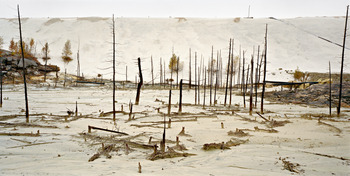
Topographical photographs of extractive wastelands, whose purpose is to document the ravages of the Anthropocene, offer a prominent example of ruin porn. Conjuring what Fredric Jameson calls an “aesthetic of cognitive mapping,” these photographs potentially offer a visualization of our relation to a capitalist totality in the midst of ecological crisis (347). But I'm interested in Alberto Toscano's observation that these photographs rarely include people. Evaluating the surfeit of images of human-altered and human-absented landscapes, Toscano asks, “Why are photographs of manufactured landscapes so often depopulated?” (111). We can observe this absence acutely in the Canadian photographer Edward Burtynsky's large-scale photographs of a wide array of manufactured landscapes, from bleached panoramas of uranium tailings in Ontario (fig. 1) to airplane graveyards in Arizona. Shaped by Anthropocene discourse, Burtynsky's ecoliberal vision reflects a homogenized view of humanity, a positivist construction of knowledge that is reducible to the natural sciences, and a historical framework that evacuates imperial conquest. Indeed, Burtynsky readily emphasizes the inevitability of climate change as a side effect of history's linear unfolding, reinforcing the antipolitical dimensions of Anthropocene discourse. Questions of power are swept aside as elements of the human condition: “This extreme polarization (poverty/wealth) has perhaps always been inevitable in the course of human evolution, the result of our species’ innate social predisposition to greed” (5). This is a vision of undifferentiated “man” as universal agent of history, a vision that is indifferent to the vast asymmetries of power that render Black, Indigenous, and people of color, and people of the Global South, most vulnerable to the harmful effects of climate change while being the least responsible for it.
Uranium Tailings #12, Elliot Lake, Ontario, 1995. Photo © Edward Burtynsky, courtesy Weinstein Hammons Gallery, Minneapolis / Nicholas Metivier Gallery, Toronto.

What we must reckon with in Burtynsky's photographs, however, is their overwhelming beauty—the vibrant colors, the geometric shapes and symmetry. In particular, Burtynsky's manipulations of scale and symmetry reflect an ambivalent stance toward the aims of documentary realism and painterly abstraction. His photographs tilt toward the latter, such that the aesthetic effect is less to reorient us toward a perception of social totality than to spiritualize the abstracted landscapes of settler-colonial capital. In harmonizing the ecological manifestations of global capitalism with the photographic gaze, his works attest to W. J. T. Mitchell's insights about the ideological function of landscape art, that “the ‘harmony’ sought in landscape [can be] read as a compensation for and screening off of the actual violence perpetrated there” (7). Therefore, if the rise of landscape art in North America was the aesthetic corollary to the rise of imperialism, symptomatic of the rise of racial capitalism's “utopian fantasies of the perfected imperial prospect” (10), we might view the twenty-first-century rise of ruin porn as a secular vision of manifest destiny, the naturalization of capitalism and the end of history. What the landscapes of imperial expansion and the landscapes of ruin hold in common is the absence of agency. Inhabiting this ideological void of agency is the spiritual inevitability of conquest on the one hand, the secular inevitability of collapse on the other. As Toscano and Jeff Kinkle reflect, Burtynsky “presents us with beautiful monuments to alienation without any inquiry into the processes of their production” (205).
Envisioning capital as a spatialized form devoid of either spiritual or social relations, ruin porn of this kind helps reinforce the idea that geologic rather than historical time is what really matters. According to Toscano, our abiding attraction to human-altered, human-absented landscapes, similar to the aestheticized landscapes of war photography, reflects a “closure of the space of politics and historical experience by capital, nation, and the state” (113). By erasing all traces of human labor, such representations of space make visible the effects of the past but not as the past, not as history. In the visual culture of the Anthropocene, representations of ecological disaster promote nostalgia for a lost future rather than a political reckoning with the historical conditions of our racial and colonial present.