Distinct domains of adaptive functioning are believed to relate to one another in a meaningful way through the course of development (Burt, Obradović, Long, & Masten, 2008; Masten, Burt, & Coatsworth, Reference Masten, Burt, Coatsworth, Cicchetti and Cohen2006; Masten et al., Reference Masten, Roisman, Long, Burt, Obradović, Riley and Tellegen2005; Mesman, Bongers, & Koot, Reference Mesman, Bongers and Koot2001; Rutter, Kim-Cohen, & Maughan, Reference Rutter, Kim-Cohen and Maughan2006). However, few studies have tested models of “spreading effects” with appropriately informative and conservative designs. The prospective longitudinal multimethod multiinformant study we report here focused principally on antecedent pathways to social competence and externalizing and internalizing behavioral adjustment in early adolescence from social competence and externalizing and internalizing behavioral adjustment in early childhood. The study also assessed the covariation and stability of individual variation in social competence and the two measures of behavioral adjustment in three waves across the same age range. There were three key research questions addressed in this study. What are the interconnections among social competence and behavioral adjustments across early childhood to early adolescence? With which forms of behavioral adjustment is social competence associated? What are the adolescent behavioral adjustment outcomes for young children with different levels of social competence? To address these questions, we modeled developmental cascades in children.
We define a developmental cascade as a cross-domain, uniquely intrapersonal, longitudinal relation. Cross-domain means that one psychological characteristic (construct, structure, function, or process) affects a different psychological characteristic, uniquely intrapersonal means that the two characteristics coexist in the individual and influence one another separate from other intrapersonal or extrapersonal factors, and longitudinal relation means that one characteristic affects another over time separately and apart from any concurrent temporal covariation between them and over and above temporal stability in each. Developmental cascades therefore imply that functioning in one domain influences functioning in another domain in some lasting way. These cascades minimally involve two characteristics at two time points but ideally model three (or more) characteristics at three (or more) time points, as we do here. Developmental studies of longitudinal effects do not normally control for stability as well as concurrent associations among characteristics so that models of influence from one domain to another can be properly and conservatively evaluated. We distinguish intrapersonal developmental cascades from other temporal associations that involve interpersonal interactions through time such as transactions (Bornstein, Reference Bornstein and Sameroff2009; Sameroff, Reference Sameroff2009).
Social Competence and Behavioral Adjustment in Childhood and Adolescence
We studied developmental cascades among social competence and two sorts of behavioral adjustment, externalizing and internalizing, from early childhood to early adolescence. Social competence is a broadly adaptive individual-differences characteristic that encompasses many related interpersonal skills. Social competence in children manifests in emotional self-regulation, social cognition, positive communication, and prosocial relationships with family members, peers, and teachers. Information about children's social competence comes from several sources, including self-perceptions, peer report, parent report, teacher report, and observer or interviewer ratings (Ladd, Reference Ladd2005, Reference Ladd, Saracho and Spodek2007; Raver & Zigler, Reference Raver and Zigler1997). Social competence occupies a central position in developmental task theory and guided the present study (Havighurst, 1948/Reference Havighurst1972; Masten & Coatsworth, Reference Masten and Coatsworth1998; Masten et al., Reference Masten, Burt, Coatsworth, Cicchetti and Cohen2006; Pulkkinen & Caspi, Reference Pulkkinen and Caspi2002; Roisman, Masten, Coatsworth, & Tellegen, Reference Roisman, Masten, Coatsworth and Tellegen2004); therefore, our operationalizations of social competence reflected age-appropriate developmental changes in children. From early dyadic relationships with caregivers, to play and social interaction with peers and the formation of friendship networks in the preschool years, to close friends and romantic relationships in adolescence, social competence is viewed as a primary component of healthy functioning and wholesome development (Ladd, Reference Ladd1999; Parker, Rubin, Erath, Wojslawowicz, & Buskirk, Reference Parker, Rubin, Erath, Wojslawowicz, Buskirk, Cicchetti and Cohen2006; Rubin, Bukowski, & Parker, Reference Rubin, Bukowski, Parker, Damon, Lerner and Eisenberg2006; Sroufe, Egeland, & Carlson, Reference Sroufe, Egeland, Carlson, Collins and Laursen1999; Volling, MacKinnon-Lewis, Rabiner, & Baradaran, Reference Volling, MacKinnon-Lewis, Rabiner and Baradaran1993). The specific indexes of social competence we drew upon varied with age because expectations for social competence change as children grow. Social competence is central to children's success with others in school and in life (see Blair, Reference Blair2002; Eisenberg et al., Reference Eisenberg, Fabes, Murphy, Maszk, Smith and Karbon1995; Hart, Olsen, Robinson, & Mandleco, Reference Hart, Olsen, Robinson and Mandleco1997; Luster & McAdoo, Reference Luster and McAdoo1996; Mendez, Fantuzzo, & Cicchetti, Reference Mendez, Fantuzzo and Cicchetti2002; Mendez, McDermott, & Fantuzzo, Reference Mendez, McDermott and Fantuzzo2002), and the promotion of social competence figures prominently in both clinical practice and policy recommendations (e.g., Gershoff, Reference Gershoff2003; Huffman, Mehlinger, & Kerivan, Reference Huffman, Mehlinger and Kerivan2000; Knoll & Patti, Reference Knoll, Patti, Elias, Arnold and Hussey2003).
Behavioral adjustment in young children is generally associated with two broadband factors. Externalizing behaviors include problems with attention, self-regulation, and noncompliance, as well as antisocial, aggressive, and other undercontrolled behaviors; internalizing behaviors include depression, withdrawal, and anxiety, as well as feelings of inferiority, self-consciousness, shyness, hypersensitivity, and somatic complaints (Achenbach, Howell, Quay, & Conners, Reference Achenbach, Howell, Quay and Conners1991; Allen & Prior, Reference Allen and Prior1995; Bates, Reference Bates1990; Bates & Bayles Reference Bates and Bayles1984; Boyle & Jones, Reference Boyle and Jones1985; Buss, Reference Buss1981; Buss & Plomin, Reference Buss and Plomin1984; Campbell, Reference Campbell1995; Campbell, Pierce, March, & Ewing, Reference Campbell, Pierce, March and Ewing1991; Campbell, Pierce, March, Ewing, & Szumowski, Reference Campbell, Pierce, March, Ewing and Szumowski1994; Caspi, Henry, McGee, Moffitt, & Silva, Reference Caspi, Henry, McGee, Moffitt and Silva1995; Coddington, Reference Coddington1972; Cowan, Cowan, Schulz, & Heming, Reference Cowan, Cowan, Schulz, Heming, Parke and Kellam1993).
Social competence has been a frequent target of research on connections between children's competence and their behavioral adjustment. Experiences of rewards or rejection that are bound up with children's social competence are asserted to evoke emotional, cognitive, and behavioral responses that in turn influence the emergence and course of psychopathology. Studies from developmental science and child psychiatry point to associations between social competence and behavioral adjustment in preschool- and school-age children. Unfortunately, the literature to date (if consistent and convergent) has failed to disentangle the direction of effects, specificity of effects, and covarying effects. It has not instituted proper or meaningful controls to isolate the effects of stability and thus is more suggestive than determinative. The goal of a developmental cascades approach is to take a step in the direction of disambiguating these several mutually confounding considerations.
What longitudinal relations likely prevail between social competence and behavioral adjustment? There are three (plus one) possibilities for why social competence and externalizing and internalizing behaviors might articulate over time (Hinshaw, Reference Hinshaw1992; Masten & Curtis, Reference Masten and Curtis2000). Perhaps social competence influences behavioral adjustment. Social competence might have a central part to play in the emergence and development of externalizing and internalizing psychosocial and emotional disorders insofar as social competence regulates both self-control and achievement across domains and, out of frustration with their limited social competence skills, children become aggressive and disruptive or depressed and withdrawn. Children who lack skills commonly associated with social competence do not send clear social messages and may be difficult to read and respond to appropriately. Such children likely have fewer positive interactions with others, and they are probably deemed socially incompetent by others. Thus, it is expected that psychosocial and emotional adjustment problems ensue in children who have difficulty expressing themselves and understanding others. Failures in adaptive functioning contribute to symptomatology.
The achievement of salient social developmental tasks constitutes key criteria by which children are judged in society, by others, and by themselves. Failure in these tasks could portend negative consequences for children's perceptions or judgments of themselves or others that lead to increased externalizing or internalizing symptoms over time. Cicchetti and Schneider-Rosen (Reference Cicchetti, Schneider-Rosen, Rutter, Izard and Read1986) theorized that failure to master social and emotional (and cognitive) tasks creates vulnerabilities for future failures and depression. In addition, Cole's (1990, 1991) competency-based model of depression proposed that feedback from others (parents, peers, and teachers) across different domains of performance (including social competence) affects self-image and subsequently depressive symptoms. Cross-sectional and longitudinal connections between social competence and internalizing behaviors from childhood to adolescence abound in the literature (Masten et al., Reference Masten, Burt, Coatsworth, Cicchetti and Cohen2006; Parker et al., Reference Parker, Rubin, Erath, Wojslawowicz, Buskirk, Cicchetti and Cohen2006; Rubin et al., Reference Rubin, Bukowski, Parker, Damon, Lerner and Eisenberg2006). Cole, Martin, Powers, and Truglio (Reference Cole, Martin, Powers and Truglio1996), for example, documented short-term effects for social competence predict changes in depressive symptoms among middle school-aged children but not the reverse; initial depressive symptoms did not predict changes in social competence, controlling for within-time covariation of competence and symptoms and the stability of each domain.
Social competence also predicts internalizing symptoms empirically across longer periods in childhood and adolescence with lower social competence forecasting more symptoms later (Chen, Li, Li, Li, & Liu, Reference Chen, Li, Li, Li and Liu2000; Kiesner, Reference Kiesner2002; Mesman et al., Reference Mesman, Bongers and Koot2001). For example, social isolation and incompetence in second grade are linked to internalizing behaviors 3 years later (Hymel, Rubin, Rowden, & LeMare, Reference Hymel, Rubin, Rowden and LeMare1990). Peer rejection and anxious solitude in kindergarten predict teacher-reported depressive symptoms across a 4-year interval (Gazelle & Ladd, Reference Gazelle and Ladd2003), and increased social isolation is associated with depressed mood in boys aged 12 to 15 years (Larson, Raffaelli, Richards, Ham, & Jewell, Reference Larson, Raffaelli, Richards, Ham and Jewell1990). Masten and colleagues (2005; see Burt et al., Reference Burt, Obradović, Long and Masten2008) reported that social competence skills in childhood predict fewer internalizing behaviors in adolescence. In turn, longitudinal declines in social competence are associated with higher levels of internalizing symptoms (Chen, Rubin, & Li, Reference Chen, Rubin and Li1995; Cole, Martin, & Powers, Reference Cole, Martin and Powers1997; Kellam, Rebok, Mayer, Ialongo, & Kalodner, Reference Kellam, Rebok, Mayer, Ialongo and Kalodner1994). Thus, prior successes or failures in social competence appear to have spillover effects with respect to current and subsequent internalizing symptoms. Childhood social competence with peers predicts adolescent internalizing behaviors over and above initial covariation of these domains in childhood and the stability of each domain across this developmental time span (Obradović, Burt, & Masten, Reference Obradović, Burt and Masten2010). In addition, childhood peer rejection predicts externalizing behaviors longitudinally in the school-age years (Hymel et al., Reference Hymel, Rubin, Rowden and LeMare1990) and into adolescence (Coie, Terry, Lenox, & Lochman, Reference Coie, Terry, Lenox and Lochman1995). Socially isolated youth may self-select into antisocial peer networks, which then encourage further antisocial behavior or set the stage for friendships with deviant peers (Dishion, French, & Patterson, Reference Dishion, French, Patterson, Cicchetti and Cohen1995; Dishion & Patterson, Reference Dishion, Patterson, Cicchetti and Cohen2006; Patterson, Reid, & Dishion, Reference Patterson, Reid and Dishion1992). In short, failure to develop social skills and successful interpersonal relationships could promote mental health symptoms.
Alternatively, symptoms of mental health problems could undermine social competence (Hinshaw, Reference Hinshaw1992; Masten et al., Reference Masten, Roisman, Long, Burt, Obradović, Riley and Tellegen2005, Reference Masten, Burt, Coatsworth, Cicchetti and Cohen2006; Patterson et al., Reference Patterson, Reid and Dishion1992). The emergence and development of social competence might reflect antecedent disrupted and disruptive behavioral adjustment because children who act out or are self-consumed are unlikely to acquire competent social skills. Exhibiting aggression (externalizing) or anxiety (internalizing) during social interactions undermines social competence. Anxiety, depression, and other internalizing symptoms have predictive significance for a spectrum of emotional disorders and problems and also show signs of reciprocal linkages over time with poor peer social adjustment (Harrington & Clark, Reference Harrington and Clark1998; Lewinsohn, Rohde, Klein, & Seeley, Reference Lewinsohn, Rohde, Klein and Seeley1999; Masten & Coatsworth, Reference Masten, Coatsworth, Cicchetti and Cohen1995; Pine, Cohen, Gurley, Brook, & Ma, Reference Pine, Cohen, Gurley, Brook and Ma1998; Rubin, Bukowski, & Parker, Reference Rubin, Bukowski, Parker and Eisenberg1998; Rubin, Chen, McDougall, Bowker, & McKinnon, Reference Rubin, Chen, McDougall, Bowker and McKinnon1995). Although internalizing symptoms may erode social competence, in the literature effects seem to be inconsistent across age, gender, and indexes of social competence (Capaldi, Reference Capaldi1992; Capaldi & Stoolmiller, Reference Capaldi and Stoolmiller1999; Cole et al., Reference Cole, Martin and Powers1997; Mesman et al., Reference Mesman, Bongers and Koot2001). Nonetheless, mental health symptoms could upset the development of social skills and successful interpersonal relationships.
Guided by past theorizing (Cicchetti & Schneider-Rosen, Reference Cicchetti, Schneider-Rosen, Rutter, Izard and Read1986; Cole, Reference Cole1990) and the extant literature, we expected that the first formulation (social competence → externalizing/internalizing) would be more likely than the second (externalizing/internalizing → social competence). Few studies differentiate competing explanations as we do here.
Logic dictates other possible developmental cascades among these characteristics. For example, there is evidence for social competence serving as an intervening link between externalizing and internalizing, both short term in elementary school-aged children (Panak & Garber, Reference Panak and Garber1992) and over the longer term from preschool through early adolescence (Mesman et al., Reference Mesman, Bongers and Koot2001). Specifically, Mesman et al. (Reference Mesman, Bongers and Koot2001) reported a link from aggression in preschool through social competence in middle childhood to internalizing behaviors in early adolescence. Although social competence could mediate links between externalizing and internalizing, relevant data are limited and inconsistent (Kiesner, Reference Kiesner2002; Panak & Garber, Reference Panak and Garber1992; Rubin, Hymel, Mills, & Rose-Krasnor, Reference Rubin, Hymel, Mills, Rose-Krasnor, Cicchetti and Toth1991; Rubin et al., Reference Rubin, Bukowski, Parker and Eisenberg1998).
Only a prospective multiwave longitudinal study of developmental cascades can adequately untangle these developmental possibilities. This study must include assessments of social competence and different kinds of behavioral adjustment problems (externalizing and internalizing) and must institute controls (e.g., for child intelligence and maternal education) with adequate numbers of girls and boys in an analytic design that takes into consideration the covariation between social competence and each behavioral adjustment problem as well as the longitudinal stability of each.
Covariation and Stability of Social Competence and Behavior Adjustment in Childhood and Adolescence
A developmental cascade is a conservative design that overcomes covariation among characteristics at each time point as well as stability in each over time. A body of literature has developed that identifies concurrent relations between social competence in children and their behavioral adjustment. Social competence is consistently related to psychosocial and emotional disorders from preschool to adolescence (Campbell, Reference Campbell1994; Olson & Hoza, Reference Olson and Hoza1993). In early childhood, externalizing and internalizing behaviors are positively correlated with one another and both negatively correlated with social competence (Burt et al., Reference Burt, Obradović, Long and Masten2008). It is naturally difficult to separate psychosocial and emotional problems from social competence. We might expect that young children who have psychosocial and emotional disorders suffer problems in the social sphere.
Investigations of connections between social competence and the two common forms of behavioral adjustment, externalizing and internalizing, must address the covariation widely observed between externalizing and internalizing behaviors, both within and across time. Extensive data give evidence of the co-occurrence of problems across these two broad symptom dimensions (Angold, Costello, & Erkanli, Reference Angold, Costello and Erkanli1999; Bates, Reference Bates1990; Caron & Rutter, Reference Caron and Rutter1991; Caspi et al., Reference Caspi, Henry, McGee, Moffitt and Silva1995; Kagan, Snidman, & Arcus, Reference Kagan, Snidman and Arcus1995). Rose, Rose, and Feldman (Reference Rose, Rose and Feldman1989) examined behavior problems in children age 2 to 5 years using preschool and standard versions of the Child Behavior Checklist/4–18 (CBCL; Achenbach, Reference Achenbach1991a). Externalizing and internalizing scores consistently correlated highly with one another. Externalizing and internalizing behaviors also influence each other over time. Some data implicate externalizing symptoms as predictors of change in internalizing symptoms (Capaldi, Reference Capaldi1992; Garber, Quiggle, Panak, & Dodge, Reference Garber, Quiggle, Panak, Dodge, Ciccheti and Toth1991; Kiesner, Reference Kiesner2002; Lahey, Loeber, Burke, Rathouz, & McBurnett, Reference Lahey, Loeber, Burke, Rathouz and McBurnett2002; Loeber & Keenan, Reference Loeber and Keenan1994; McGee, Feehan, Williams, & Anderson, Reference McGee, Feehan, Williams and Anderson1992; Panak & Garber, Reference Panak and Garber1992; Robins, Reference Robins, Olweus, Block and Radke-Yarrow1986). However, there is also evidence that, once controls for concurrent externalizing behaviors are in place, internalizing behaviors predict later externalizing behaviors, perhaps because of influences of behavioral inhibition on risk-taking behavior or involvement with deviant peers (Farrington, Reference Farrington1995; Kellam, Reference Kellam and Patterson1990; Kerr, Tremblay, Pagani, & Vitaro, Reference Kerr, Tremblay, Pagani and Vitaro1997; Masten et al., Reference Masten, Roisman, Long, Burt, Obradović, Riley and Tellegen2005; Moffitt, Caspi, Harrington, & Milne, Reference Moffitt, Caspi, Harrington and Milne2002; Pine, Cohen, Cohen, & Brook, Reference Pine, Cohen, Cohen and Brook2000; Verhulst, Eussen, Berden, Sanders-Woudstra, & Van Der Ende, Reference Verhulst, Eussen, Berden, Sanders-Woudstra and van der Ende1993).
Covariation aside, stability is a central construct in developmental science. It describes consistency in the relative ranks of individuals in a group with respect to some characteristic through time (Bornstein, Brown, & Slater, Reference Bornstein, Brown and Slater1996; Hartmann, Pelzel, & Abbott, Reference Hartmann, Pelzel, Abbott, Bornstein and Lambin press; McCall, Reference McCall1981; Wohlwill, Reference Wohlwill1973). For example, developmental stability in social competence prevails when some children display a relatively high level of social competence at one point compared to their peers and continue to display a high level at a later point, whereas other children display lower levels at both times; developmental instability in social competence prevails if children do not maintain their rank order through time. Findings of stability tell us about the overall developmental course of a given psychological characteristic. Despite changes in measurement, moderate to strong zero-order stability estimates in social competence have been reported from childhood to young adulthood (Burt et al., Reference Burt, Obradović, Long and Masten2008; Masten et al., Reference Masten, Roisman, Long, Burt, Obradović, Riley and Tellegen2005; Obradović, van Dulmen, Yates, Carlson, & Egeland, Reference Obradović, van Dulmen, Yates, Carlson and Egeland2006; Ollendick, Greene, Francis, & Baum, Reference Ollendick, Greene, Francis and Baum1991; Roisman et al., Reference Roisman, Masten, Coatsworth and Tellegen2004; Shaffer, Burt, Obradović, Herbers, & Masten, Reference Shaffer, Burt, Obradović, Herbers and Masten2009).
Problem behaviors also tend to be stable over time. Relatively high stability has been reported for both externalizing and internalizing in samples from the general population (Achenbach, Howell, McConaughy, & Stanger, Reference Achenbach, Howell, McConaughy and Stanger1995; Campbell, Reference Campbell1995; Costello, Angold, & Keeler, Reference Costello, Angold and Keeler1999; Ferdinand & Verhulst, Reference Ferdinand and Verhulst1995; Hofstra, van der Ende, & Verhulst, Reference Hofstra, van der Ende and Verhulst2000; McConaughy, Stanger, & Achenbach, Reference McConaughy, Stanger and Achenbach1992; Moffitt & Caspi, Reference Moffitt and Caspi2001; Rose et al., Reference Rose, Rose and Feldman1989; Sanson, Pedlow, Cann, Prior, & Oberklaid, Reference Sanson, Pedlow, Cann, Prior and Oberklaid1996; Stanger, Achenbach, & Verhulst, Reference Stanger, Achenbach and Verhulst1997; Verhulst & Koot, Reference Verhulst, Koot, Remschmidt and Schmidt1992; Webster-Stratton & Taylor, Reference Webster-Stratton and Taylor2001). In his review of longitudinal studies, Koot (Reference Koot, Verhulst and Koot1995) concluded that one-third to one-half of children with deviant behaviors remained deviant after 2 to 6 years. Lavigne et al.'s (Reference Lavigne, Arend, Rosenbaum, Binns, Christoffel and Gibbons1998) population-based study of preschool behavior problems showed strong intraclass 48-month stability for disruptive disorders. Mesman and Koot (Reference Mesman and Koot2001) reported significant stability of both externalizing and internalizing from age 2–3 to age 10–11 (see also Caspi, Moffitt, Newman, & Silva, Reference Caspi, Moffitt, Newman and Silva1996; Hofstra, van der Ende, & Verhulst, Reference Hofstra, van der Ende and Verhulst2002). Van der Valk, van den Oord, Verhulst, and Boomsma (Reference van der Valk, van den Oord, Verhulst and Boomsma2003) obtained maternal CBCL ratings for 1,575 twin pairs at ages 3 and 7 years. They reported strong stability between problems assessed at the two ages.
In general, results suggest somewhat higher stability of externalizing than internalizing. As young children's ability to express anxiety and depression is limited, and parents and others have difficulties recognizing these emotions, externalizing behaviors might show larger stability coefficients compared with internalizing (Burt et al., Reference Burt, Obradović, Long and Masten2008; Koot & Verhulst, Reference Koot and Verhulst1992). Nonetheless, internalizing behaviors are stable over a 2-year follow-up of 2- to 5-year-old children (Lavigne et al., 1998) and in the case of internalizing symptoms spanning a 10-year interval (Masten et al., Reference Masten, Roisman, Long, Burt, Obradović, Riley and Tellegen2005); internalizing symptoms are stable between childhood and emerging adulthood (Obradović et al., Reference Obradović, Burt and Masten2010).
On the basis of these rather consistent literatures, we hypothesized stability of social competence and behavioral adjustment symptoms from childhood to adolescence as well as covariation among the three domains.
“Common Cause” Alternative Accounts
Social competence and behavioral adjustment could be developmental functions reflective of a common underlying biological or exogenous experiential influence and thus may emerge simultaneously and develop in tandem. It is possible that social competence and behavioral adjustment become linked when some common cause contributes to both, creating a spurious effect and the illusion of a causal link in either direction that is actually related to unmeasured variables and the causal processes or continuity they represent (Masten & Curtis, Reference Masten and Curtis2000). In brief, social competence–behavioral adjustment associations could result from third variables (e.g., child cognitive skills or maternal education, each of which has a well-established history of predictive significance for multiple aspects of social competence and psychopathology; Masten et al., Reference Masten, Burt, Coatsworth, Cicchetti and Cohen2006). This possibility is methodological, not substantive, and stems from overlapping constructs, items, or informants that may produce spurious associations.
Children's social skills relate to their cognitive skills (Bornstein, Haynes, O'Reilly, & Painter, Reference Bornstein, Haynes, O'Reilly and Painter1996; Bornstein, Haynes, & Painter, Reference Bornstein, Haynes and Painter1998), and children with behavioral adjustment problems have been consistently shown to suffer deficits in cognitive skills. Intelligence has proven to be positively related to a wide array of social competencies and negatively related to externalizing and internalizing behaviors across childhood (Garner, Jones, & Palmer, Reference Garner, Jones and Palmer1994; Nelson, Martin, Hodge, Havill, & Kamphaus, Reference Nelson, Martin, Hodge, Havill and Kamphaus1999; Owens, Shaw, Giovannelli, Garcia, & Yaggi, Reference Owens, Shaw, Giovannelli, Garcia and Yaggi1999). For example, rates of language impairment reach 24% to 65% in samples of children identified as exhibiting disruptive behaviors (Benasich, Curtiss, & Tallal, Reference Benasich, Curtiss and Tallal1993), and 59% to 80% of preschool- and school-age children identified as exhibiting disruptive behaviors also exhibit language delays (Beitchman, Nair, Clegg, Ferguson, & Patel, 1996; Brinton & Fujiki, Reference Brinton and Fujiki1993; Stevenson, Richman, & Graham, Reference Stevenson, Richman and Graham1985). Adjustment-disordered children and adolescents have notoriously poor performance on standardized tests of IQ (Moffitt & Lynam, Reference Moffitt, Lynam, Fowles, Sutker and Goodman1994), associations that prevail after controlling for ethnicity and socioeconomic status (Evans, Reference Evans1996; Lynam, Moffitt, & Stouthamer-Loeber, Reference Lynam, Moffitt and Stouthamer-Loeber1993). Therefore, in addition to child age, we controlled children's general intelligence. We also controlled maternal education in assessing developmental cascades among children's social competence and their behavioral adjustment. Because we used parents' reports, which may be influenced by parents' own ability or by their social desirability (Bornstein, Reference Bornstein, Ben-Arieh, Cashmore, Goodman, Kampmann and Melton2010), we also controlled maternal social desirability of responding. We examined whether these leading candidates for third-variable common causes accounted for any observed developmental cascade effects. We expected that meaningful developmental cascades would prove robust to the inclusion of control variables.
This Study
One major step in the direction of addressing unique longitudinal relations between social competence and externalizing and internalizing behavioral adjustment is to untangle direction, specificity, and source of effects between them over and above their covariation and stability. We took this step in a developmental design that spanned the interval between ages 4 and 14. We chose to begin at 4 years because it is well before the start of formal schooling, and it is almost the earliest age at which social competence can be measured and behavioral adjustment problems make themselves known. Adolescence marks a time of increasing salience and interpersonal sensitivity as in peer relationships. Altogether this period includes many physical, cognitive, emotional, and social developmental transformations. For example, this interval encompasses the transition to school, during which time children learn to cope with academic demands, adjust to new daily routines, and develop new relationships with classmates.
We used path analysis to conduct long-term, longitudinal, and robust tests of cascade effects. The methodology allowed for examination of longitudinal cross-domain paths while controlling for both cross-domain within-time associations and within-domain cross-time stabilities. We included all three domains of focus at each time point not only to test for cascade effects but also to avoid potentially misleading results of any domain considered in isolation because the most informative research on predictive significance controls for the other domain at each time point. We first examined the cross-time stability of each domain and within-time covariation among the three domains. Next, we modeled plausible developmental cascades. Once the most plausible model among alternatives was identified, we examined the effects of key control variables and third-variable causes. Our assessments included principal stakeholders in a child's development, including the children themselves, their parents, and their teachers. Constructs were assessed by multiple measures. Few studies include measures of at least three constructs across at least three time intervals, arguably optimal conditions for testing mediation (Cole & Maxwell, Reference Cole and Maxwell2003). Based on previous research we expected stability of social competence and behavioral adjustment from childhood to adolescence as well as their covariation at each time point. We also expected that social competence (uniquely) predicts externalizing and internalizing behaviors.
Methods
Participants
The data reported here are derived from a 10-year longitudinal study. Families were originally recruited through mass mailings and newspaper advertisements from a US East coast metropolitan area. A total of 118 European American families had complete data when the children were 4 years old, and they participated in the second and third waves of data collection at 10 and 14 years. All children were healthy at birth and at both follow-ups. Almost all were term (n = 115, one mother did not provide information) and of normal weight (n = 114) at birth. (None of the preterm or low birth weight children emerged as outliers or influential cases, so all were retained in the analyses.) All children were firstborns in their families, and 50 (42%) were girls. On average, children were 4.04 (SD = 0.07, range = 3.87–4.34), 10.22 (SD = 0.14, range = 9.99–10.81), and 13.82 (SD = 0.25, range = 13.50–14.82) years of age at the first, second, and third assessment waves, respectively. Mothers averaged 35.32 years of age (SD = 5.45, range = 20.59–49.63) at the first assessment. Two mothers had not completed high school, 6 had completed high school, 20 had partial college, and 90 had completed college (M = 6.10, SD = 0.97, on the Hollingshead Index [1975] 7-point education scale). Families were of middle to upper socioeconomic status (Hollingshead, Reference Hollingshead1975) with a mean of 56.03 (SD = 9.49, range = 29–66). This community sample was sociodemographically heterogeneous in terms of education and socioeconomic status, but we recruited an ethnically homogenous sample as a first step in understanding the matrix of associations surrounding social competence and behavioral adjustment in children before embarking on more complex studies and analyses with ethnically diverse samples. Approximately 75% of the population of the United States self-identifies as European American descent (Tilton-Weaver & Kakihara, Reference Tilton-Weaver, Kakihara and Arnett2008; US Census Bureau, 2004). By including only European Americans, we intentionally avoided an ethnicity confound that might cloud our findings.
Procedures
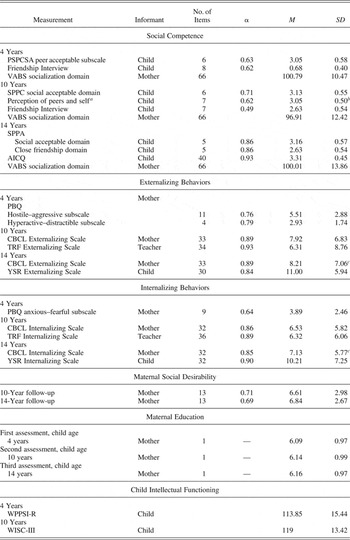
Children and their mothers provided data at all three waves; at age 10 years, children's teachers also provided data. Table 1 summarizes the standardized instruments and questionnaires that we used. We describe the measures in more detail below.
Measurements of social competence, externalizing behaviors, internalizing behaviors, and potential covariates (N = 117)

Note: The reliability is represented by the Cronbach alpha values. In the mean and standard deviation columns, all scale scores were coded so that higher scores represent greater social competence or more externalizing or internalizing behavioral problems. PSPCSA, Pictorial Scale of Perceived Competence and Social Acceptance Preschool/Kindergarten Form (Harter & Pike, Reference Harter and Pike1984); Friendship Interview (Furman & Bierman, Reference Furman and Bierman1984); VABS, Vineland Adaptive Behavior Scales, Interview Edition, Survey Form (Sparrow, Balla, & Cicchetti, Reference Sparrow, Balla and Cicchetti1984); SPPC, Self-Perception Profile for Children (Harter, Reference Harter1985); SPPA, Self-Perception Profile for Adolescents (Harter, Reference Harter1988); AICQ, Adolescent Interpersonal Competence Questionnaire (Buhrmester, Reference Buhrmester1990); PBQ, Preschool Behavior Questionnaire (Behar & Stringfield, Reference Behar and Stringfield1974); CBCL, Child Behavior Checklist/4–18 (Achenbach, Reference Achenbach1991a); TRF, Teacher Report Form (Achenbach, Reference Achenbach1991a); YSR, Youth Self-Report (Achenbach, Reference Achenbach1991b); WPPSI-R, Wechsler Preschool and Primary Scale of Intelligence—Revised (Wechsler, Reference Wechsler1989); WISC-III, Wechsler Intelligence Scale for Children—Third Edition (Wechsler, Reference Wechsler1991).
aPerception of peers and self is the children's self-perceptions in the context of peer relationships.
bItems were reverse coded so that higher scale scores represent greater competence.
cAdjusted scores controlling for mothers' social desirability.
A laboratory visit was scheduled for the mothers and children at all three waves; two home visits were also scheduled at 10 years. For families living at significant distances from the laboratory, all visits were conducted in the home. At 4 years the child completed a variety of activities with an administrator; the child's mother in the same or a different room was instructed not to interact with the child. Prior to the age 10- and 14-year visits with the child and mother, separate packets of questionnaires were mailed to the family with the request that they be completed for the visit. During each of these visits, children and mothers completed additional questionnaires and were interviewed and children were tested. About 1.5 months after each of the three visits, children's mothers were interviewed over the telephone. At 10 years the mothers were also asked to recruit their children's teachers into the study and were given a packet of questionnaires to give to the teachers. The packet contained a letter explaining the study, a consent form, and a self-addressed stamped envelope to mail the completed packet directly to the administrator. Informed consent or assent was obtained from mothers, teachers, and adolescents. Participants were compensated for their time, and the study was approved and monitored by our institutional review board.
Social competence
The measurement of social competence at each time point was guided by developmental task theory and was designed to capture social competence as a broad adaptive construct. Thus, the instruments we chose incorporated multiple dimensions of social competence, including peer acceptance, popularity, and the quality of close friendships. Based on the path analytic approach of the present study, we created composite variables at each time point relative to salient social competence indicators for that developmental period. At age 4 years, social competence was assessed using the peer acceptance subscale of the Pictorial Scale of Perceived Competence and Social Acceptance Preschool/Kindergarten Form (Harter & Pike, Reference Harter and Pike1984), the Friendship Interview (Furman & Bierman, Reference Furman and Bierman1984), and the socialization domain of the Vineland Adaptive Behavior Scales (VABS; Sparrow, Balla, & Cicchetti, Reference Sparrow, Balla and Cicchetti1984) Survey Form, Interview Edition. At age 10 years, social competence was assessed using the social acceptance domain of the Self-Perception Profile for Children (SPPC; Harter, Reference Harter1985), the cognitive dimension of children's self-perceptions in the context of peer relationships on the Perception of Peers and Self (Rudolph, Hammen, & Burge, Reference Rudolph, Hammen and Burge1995), the Friendship Interview, and the socialization domain of the VABS Interview Edition, Survey Form. At age 14 years, social competence was assessed using the social acceptance and close friendship domains of the Self-Perception Profile for Adolescents (SPPA; Harter, Reference Harter1988), the Adolescent Interpersonal Competence Questionnaire (Buhrmester, Reference Buhrmester1990), and the socialization domain of the VABS.
The Pictorial Scale of Perceived Competence and Social Acceptance Preschool/Kindergarten Form (Harter & Pike, Reference Harter and Pike1984) is a 24-item, individually administered measure of children's perceptions of cognitive competence, physical competence, peer acceptance, and maternal acceptance. Each of the four subscales includes six items that are scored on a 4-point scale. The procedures involve children making two basic distinctions. First, children distinguish between pictured activities and relate them to their self-description. Second, children distinguish the degree to which the pictured child represents their self-description. Versions with pictures of girls or boys are used to correspond to the child's gender. The child was shown two pictures that represent the opposite ends of the continuum for each item; then the administrator read a statement about each picture (e.g., “This girl has lots of friends to play with” vs. “This girl doesn't have very many friends to play with”), followed by a question that asked the child to indicate which of the two children she was more like. After making the decision, the child was asked to think only about the picture on that side and indicate whether she was a lot like that girl (the big circle) or just a little bit like that girl (the smaller circle). Item scores were averaged across the six items for a given subscale that provides the child's profile of perceived competence and social acceptance. The mean score of the peer acceptance subscale was used.
The Friendship Interview (Furman & Bierman, Reference Furman and Bierman1984) was set in the context of a pretend play date with the fiction being that the child could invite some friends to come over and play. This setting provided the opportunity to probe the child's knowledge of friendship concepts within the context of the child's own friends. Once the context was established, the interviewer then followed a structured interview. Children were asked 48 open-ended questions about their best friends and friendships in general. The questions and the coding system were developed based on research by Selman (Reference Selman1980) and Serafica (Reference Serafica and Serafica1982). A single a priori scale of eight items was created to reflect the child's concept of friendship (e.g., “Why do we have friends?” “What do you do with your friends?”). Each of the eight items was rated on the following 6-point scale: no friendship concept (0), physical interaction friendship (1), one-way friendship (2), fair-weather friendship (3), mutual relationship (4), and autonomous interdependence friendship (5). The eight items were averaged to produce a score with a possible range of 0 to 5.
The VABS (Sparrow et al., Reference Sparrow, Balla and Cicchetti1984) was used to gain mothers' estimates of their children's competence in four areas: communication skills, daily living skills, social skills, and motor skills. The interview assesses the child's performance, not ability, as reported and evaluated by the child's mother. The approximate 1-hr semistructured interview was carried out by an independent trained staff member who did not see the child at the visit. Only the VABS socialization domain was used; it consists of three subdomains: interpersonal relationships, play skills, and coping skills. The 28 items comprising the interpersonal relationships subdomain assess skills in social interaction, communication, friendship, and empathy. Play skills are assessed by 20 items tapping areas such as sharing and cooperating. The coping skills subdomain includes 18 items concerned with manners, adherence to rules, impulse control, and responsibility. For the VABS survey form, item scores reflect whether the individual performs the activity described. A score of 2 indicates yes, usually, 1 sometimes or partially, and 0 no, never. On the survey form, scores indicating that the individual has no opportunity to perform the activity (N) or that the parent does not know whether the individual performs the activity (DK) may also be used. The score for the socialization domain is the sum of raw scores for the interpersonal relationships, play skills, and coping skills subdomains converted to a standard score (M = 100, SD = 15). The standard score of the socialization domain was used.
The SPPC (Harter, Reference Harter1985) is a self-report questionnaire assessing children's self-esteem. The scale consists of 36 items that can be allocated to five specific domains of self-esteem (scholastic competence, social acceptance, athletic competence, physical appearance, and behavioral conduct) as well as a separate global self-worth score. Each SPPC item consists of two opposite descriptions (e.g., “Some kids find it hard to make friends” but “Other kids find it's pretty easy to make friends”). Children have to choose the description that better fits them and then indicate whether the description is somewhat true or very true for them. Accordingly, each item is scored on a 4-point scale with a higher score reflecting a more positive view of self. The mean score of the social acceptance domain was used.
The Perception of Peers and Self (Rudolph et al., Reference Rudolph, Hammen and Burge1995) assesses children's impressions about the extent to which different social attributes describe their peers and themselves. Items are rated on a scale of 1 = not at all true to 4 = very much true. The first 12-item scale examines children's perceptions of their peers and of friendships. The second 15-item scale measures children's cognitive and affective dimensions of self-representations in the context of peer relationships. The cognitive dimension of self-representations in the context of peer relationships reflects children's perceptions of their specific social competencies (e.g., “I am not very good at getting other kids to let me join in their games”). Items were reverse coded so that higher scores represent greater perceived social competence. The mean score of the cognitive dimension of children's perception of their social competence was used.
The SPPA (Harter, Reference Harter1988) is a 45-item self-report questionnaire assessing children's self-esteem in multiple domains: self-esteem, scholastic competence, social acceptance, athletic competence, physical appearance, behavioral conduct, job competence, romantic appeal, close friendship, as well as a global self-worth. Each domain is measured by five items. Each SPPA item consists of two opposite descriptions (e.g., “Some teenagers are able to make really close friends” but “Some teenagers are unable to make really close friends”). Children choose the description that better fits them and then indicate whether the description is somewhat true or very true for them. Accordingly, each item is scored on a 4-point scale with a higher score reflecting a more positive view of self. The mean scores of the social acceptance and close friendships domains were used.
The 40-item Adolescent Interpersonal Competence Questionnaire (Buhrmester, Reference Buhrmester1990) was devised to assess five domains of competence that are important in close social relationships: self-disclosure, providing emotional support to friends, management of conflicts, negative assertion, and initiation of friendships. Items were rated on a 5-point scale to indicate the level of competence and comfort that each child would have in handling each type of situation (1 = poor at this; would be so uncomfortable and unable to handle this situation that it would be avoided if possible to 5 = extremely good at this; would feel very comfortable and could handle this situation very well). The average score of all 40 items was used.
Externalizing behaviors
Externalizing behaviors were assessed by parent and teacher reports on symptom checklists. At age 4 years, externalizing behaviors were assessed using the hostile–aggressive and hyperactive–distractible subscales on the Preschool Behavior Questionnaire (PBQ; Behar & Stringfield, Reference Behar and Stringfield1974). At age 10 years, externalizing behaviors were assessed using Aggressive Behavior and Delinquent Behavior scales of the CBCL (Achenbach, Reference Achenbach1991a) and Teacher Report Form (TRF; Achenbach, Reference Achenbach1991a). At age 14 years, externalizing behaviors were assessed using aggressive behavior and delinquent behavior scales of the CBCL (Achenbach, Reference Achenbach1991a) and Youth Self-Report (YSR; Achenbach, Reference Achenbach1991b).
Internalizing behaviors
Parallel to externalizing, we focused on broad internalizing behaviors, such as symptoms of depressed mood, anxiety, social withdrawal, and somatic complaints. At age 4 years, internalizing behaviors were assessed using the anxious–fearful subscale on the PBQ. At age 10 years, internalizing behaviors were assessed using anxious–depressed, somatic complaints, and withdrawal scales of the CBCL and TRF. At age 14 years, internalizing behaviors were assessed using anxious–depressed, somatic complaints, and withdrawal scales of the CBCL and YSR.
The PBQ (Behar & Stringfield, Reference Behar and Stringfield1974) is a standardized screening instrument for detection of emotional problems in children aged 3 to 6 years. The questionnaire consists of three subscales: hostile–aggressive (11 items), anxious–fearful (9 items), and hyperactive–distractible (4 items). Each item on the PBQ was scored by counting does not apply (0), sometimes applies (1), and frequently applies (2). Total scores of each subscale were computed.
The CBCL/4–18 (Achenbach, Reference Achenbach1991a) consists of two major sections: a social competence section and a behavior/emotional problems section. The focus of this study is on the 118 items that make up the behavioral and emotional problems section of the checklist. For each item, mothers circle not true (0), somewhat or sometimes true (1), or very true or often true (2). The behavioral/emotional problems section yields eight cross-information syndromes (aggressive behavior, anxious/depressed, attention problems, delinquent behavior, social problems, somatic complaints, thought problems, and withdrawn) and three summary scores (externalizing, internalizing, and total). Externalizing problems scores were computed as the sum of the aggressive and delinquent behavior scores. Internalizing problems scores were the sum of the anxious–depressed, somatic complaints, and withdrawal scores. The raw summary scores of externalizing and internalizing scale scores were used in the study.
The TRF (Achenbach, Reference Achenbach1991a), the teacher version of the CBCL, includes 118 items of which 93 are in common with the CBCL. Items that are irrelevant to the school situation were replaced by more appropriate items (such as disrupts class discipline). Teachers' ratings were based on their observation of the children in the previous 2 months.
The YSR (Achenbach, Reference Achenbach1991b) includes 103 items describing a broad range of problem behaviors. The items are similar to those of the CBCL, except that they are worded in the first person. Seven items were slightly altered from the CBCL to be more suitable for adolescents. The YSR reports problem behaviors based on the previous 6 months. There are 89 problem items having counterparts on the CBCL, YSR, and TRF.
Covariates
A final goal of the analysis was to determine whether the significant cascade paths of the most plausible model would persist when child age and intellectual functioning and maternal education and social desirability of responding were introduced into the model. That is, we wanted to test whether significant developmental cascade paths could be explained by their common dependency on the control variables. Potential covariates included child age and intellectual functioning as well as mothers' education and social desirability of responding. We examined concurrent correlations of child age at each wave with social competence and behavioral adjustment to determine if any scale scores warranted age adjustment, and we assessed the possibility that mothers' tendency to respond to questions in a socially desirable fashion might compromise their reports of children. In addition, in path analysis models, we evaluated if child intellectual functioning and maternal education underlie covariation and stability in, or carry associations between, children's social competence and their behavioral adjustment. To qualify as a covariate, a candidate variable had to correlate significantly (p < .05) with scale scores in the expected direction.
Child intellectual functioning
Child intellectual functioning was measured by the Wechsler Preschool and Primary Scale of Intelligence—Revised (Wechsler, Reference Wechsler1989) at age 4 years and by Wechsler Intelligence Scale for Children (Wechsler, Reference Wechsler1991) at age 10 years.
Maternal education
Maternal education was measured on the Hollingshead Index (1975) 7-point education scale at all three ages.
Maternal social desirability
The short form of the Social Desirability Scale (SDS-SF; Reynolds, Reference Reynolds1982) uses 13 items in Crowne and Marlowe's (Reference Crowne and Marlowe1960) Social Desirability Scale to assess a respondent's tendency to reply to questions in a socially desirable fashion. Statements like, “I'm always willing to admit when I make a mistake” are rated as true or false. Reliability of the SDS-SF was reported to be 0.76, and the correlation with the full SDS was .93 (Reynolds, Reference Reynolds1982). The SDS-SF was assessed on mothers at child ages 10 and 14 years, and it was explored as a potential covariate for maternal reports of children's social competence and behavior problems.
Preliminary analyses and analytic plan
Prior to data analysis, all variables of child social competence and behavior adjustment and potential covariates were evaluated for missing data. In the sample of 118 children, 6.59% of the total data points were missing completely at random, Little's Missing Completely at Random Test, χ2 (759) = 809.43, p = .10; missing data points were imputed using the expectation–maximization algorithm (Dempster, Laird, & Rubin, Reference Dempster, Laird and Rubin1977).
Child age did not correlate with any of the concurrent outcome measures; it was therefore excluded as a covariate. Maternal social desirability was not related to any child outcome measures reported by mothers with two exceptions: maternal social desirability at 14 years was related to mothers' reports of child externalizing, r (116) = −.21, p < .05, and internalizing, r (116) = −.20, p < .05. To remove the effect of maternal social desirability bias on reports of child behavioral adjustment at age 14 years, adjusted scores were calculated by adding the mean scores to the residuals from linear regression of externalizing and internalizing behaviors on the SDS-SF and were used in all analyses.
Correlations among scale scores for social competence, externalizing, and internalizing behaviors at each of the three ages were all positive and in most cases significant. Correlations between the two indicators of externalizing behavior at ages 4, 10, and 14 years were rs (115) = .45, .44, and .25, ps < .001, .001, and .01, respectively. Correlations between the two indicators of internalizing behavior at age 10 and 14 years were rs (115) = .40 and .41, respectively, ps < .001. Ten out of the 15 pairwise correlations among indicators of social competence at the three ages were significant, with the range of rs (115) among the significant correlations at .21, p < .05, to .52, p < .001, and for the nonsignificant correlations at .03 to .18. Measurement models were evaluated for social competence at each of the three time points. At all three ages, excellent model fits were achieved: at age 4, the robust Satorra–Bentler (S-B; Satorra & Bentler, Reference Satorra and Bentler1988, Reference Satorra, Bentler, Von Eye and Clogg1994) χ2 (1) = 0.03, p = .87, robust comparative fit index (CFI) = 1.00, standardized root mean squared residual (SRMR) = 0.01; at age 10, S-B χ2 (2) = 4.09, p = .13, robust CFI = 0.96, SRMR = 0.05; at age 14, S-B χ2 (2) = 1.60, p = .45, robust CFI = 1.00, SRMR = 0.03. Factor loadings for social competence at all three ages were significant at the .05 level or better.Footnote 1 Summary scores representing age 4-, 10-, and 14-year social competence, externalizing, and internalizing were each computed as the mean standard scores of all relevant scale scores obtained at each respective age and were used in path analysis models. The anxious–fearful subscale of the PBQ was the sole indicator of age 4-year internalizing behaviors; it was used as an observed variable in the path analysis models, and no mean standard score was computed for age 4-year internalizing behaviors.
Prior to fitting any path analysis models, we inspected bivariate plots to confirm that variables in the models were linearly related and that no curvilinear effects obtained between pairs of variables. In the course of fitting path analysis models, we evaluated the Mardia (Reference Mardia1970) coefficients of multivariate kurtosis and the cases that contributed most to those estimates, as well as the stability of parameter estimates and the cases that contributed disproportionately to parameter estimates. One case was identified as a multivariate outlier, and it contributed disproportionately to parameter estimates. This case was removed from the final analyses. After this case was deleted, no more cases contributed disproportionately to parameter estimates, and the univariate measures of kurtosis and normalized estimates of Mardia's multivariate coefficients indicated no significant problems of nonnormality.
We fit path analysis models using maximum likelihood functions and followed the mathematical models of Bentler and Weeks (Reference Bentler and Weeks1980) as implemented in EQS 6.1 (Bentler, Reference Bentler1995; Bentler & Wu, Reference Bentler and Wu1995). To evaluate the significance of parameter estimates in the final models, we report the standardized coefficients and evaluated their probabilities using the robust standard errors for the unstandardized coefficients. Given that the main focus of this study was on longitudinal links from 4 to 14 years, of all cross-domain indirect effects that were significant, we report the standardized regression coefficients and their significance levels.
We assessed model fit using multiple convergent indexes, including the robust S-B (Satorra & Bentler, Reference Satorra and Bentler1988, Reference Satorra, Bentler, Von Eye and Clogg1994) scaled chi-square statistic and robust CFI (Bentler, Reference Bentler1990); the SRMR (Browne & Cudeck, Reference Browne, Cudeck, Bollen and Long1993) is reported because of the relatively small sample size (N ≤ 250; Hu & Bentler, Reference Hu and Bentler1999). Cutoff values close to 0.95 for the CFI and close to 0.09 for the SRMR are indicative of a relatively good fit between the hypothesized model and the observed data (Hu & Bentler, Reference Hu and Bentler1999). To enhance the cross-validation adequacy of models, the Akaike information criterion (Akaike, Reference Akaike1987; Kaplan, Reference Kaplan2000) was monitored for its decreasing value in all nested models.
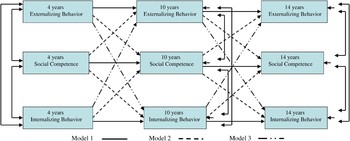
A series of path analysis models was tested to establish the direction and timing of developmental cascades. Figure 1 composites three hypothesized cascade models that we tested. Model 1 included within-time correlations among outcomes as well as stability estimates for each outcome between adjacent time points. Because developmental cascades were assessed controlling for within-time covariances as well as longitudinal stability of the outcome measures involved, all within-time covariances and longitudinal stability estimates in Model 1 were retained in successive models irrespective of their significance levels. Model 2 tested eight paths between social competence and externalizing behaviors and between social competence and internalizing behaviors from 4 to 10 years and from 10 to 14 years. Model 3 added four more paths between externalizing behaviors and internalizing behaviors from 4 to 10 years and from 10 to 14 years.
The hypothesized cascade models that were sequentially tested. [A color version of this figure can be viewed online at journals.cambridge.org/dpp]

Models 2 and 3 were respecified using the following planned strategy: first, all nonsignificant paths in Model 2 were dropped sequentially based on multivariate Wald statistics. Second, when all remaining estimated parameters in Model 2 were significant, Model 3 was tested and nonsignificant paths were dropped sequentially based on the multivariate Wald statistics. Third, we evaluated the final cascade model controlling for child intellectual functioning and maternal education. Models that are constructed by sequential addition and removal of paths, even when selection of paths is guided by theoretical relevance and plausibility, tend to exploit ungeneralizable relations in the data. For this reason, the final developmental cascade model is treated as having tentative explanatory value, suggesting relations for testing in future research.
Results
Descriptive statistics
Table 1 presents means and standard deviations of outcome measures and potential covariates for all participants. All mean scores fell within 1 SD or just above 1 SD (10-year Wechsler Intelligence Scale for Children) of the means reported in normal or standardized samples of children of similar ages (Behar & Stringfield, Reference Behar and Stringfield1974; Buhrmester, Reference Buhrmester1990; Granleese & Joseph, Reference Granleese and Joseph1994; Harter & Pike, Reference Harter and Pike1984; Sparrow et al., Reference Sparrow, Balla and Cicchetti1984, 1985; Stanger & Lewis, Reference Stanger and Lewis1993; Wechsler, Reference Wechsler1989, Reference Wechsler1991; Wichstraum, Reference Wichstraum1995). As expected, our sample was normal in these respects and defines the population to which developmental cascades can generalize.
Cascade analyses
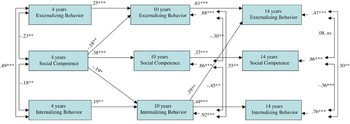
Figure 2 presents the standardized solution to the final, sequentially constructed developmental cascade model, S-B χ2 (18) = 44.90, p < .001, robust CFI = 0.91, SRMR = 0.08. The model reproduced observed correlations with an average absolute standardized error of 0.06. Appendix A presents the pairwise covariance matrix of all variables in the final model.
The standardized solution for the final model in the total sample (N = 117). Single-headed arrows indicate the standardized path coefficients, and double-headed arrows indicate standardized covariance estimates. Arrows associated with dependent variables are error variances and represent the amount of variance not accounted for by paths in the model. *p < .05. **p < .01. ***p < .001. [A color version of this figure can be viewed online at journals.cambridge.org/dpp]

Covariation and stability
At age 4 years the externalizing and internalizing behaviors were positively correlated as expected, and both were negatively correlated with social competence. At age 10 years the error variances of externalizing and internalizing behaviors were positively correlated, and both were negatively correlated with the error variance of social competence. At age 14 years the error variance of internalizing behaviors was correlated with the error variances of externalizing behaviors (positive) and social competence (negative). Not related at 14 years were the error variances of externalizing behaviors and social competence that were not attributable to the cascade path (from 10-year internalizing behaviors to 14-year externalizing behaviors) or the longitudinal stability paths in the model. The zero-order correlation between 14-year social competence and externalizing behaviors was not significant, r (115) = −.06, p = .50. In general, externalizing and internalizing behaviors related positively to one another and the two related negatively to social competence. It was not surprising that all longitudinal stability paths for social competence and externalizing and internalizing behaviors were positive and significant, as found in past research.
Of primary interest in this model were developmental cascades, cross-domain uniquely intrapersonal longitudinal relations, here operationalized as unique links among social competence, externalizing, and internalizing across developmental periods from early childhood to late childhood to early adolescence.
Two-wave cascades
Three significant two-characteristic two-wave cascades emerged from the model. First, 4-year social competence predicted 10-year externalizing and internalizing behaviors: children with lower social competence at age 4 years exhibited more externalizing and internalizing behaviors at age 10 years. Second, age 10-year internalizing behaviors predicted age 14-year externalizing behaviors: children with more internalizing behaviors at age 10 years exhibited more externalizing behaviors at age 14 years.
Three-wave cascades
One significant three-characteristic three-wave cascade and three significant two-characteristic three-wave cascades also emerged. Age 14-year externalizing behaviors were predicted by age 4-year social competence (standardized indirect effect = −0.14, p < .05) with the effect mediated by age 10-year internalizing behaviors and age 10-year externalizing behaviors: children who were of lower social competence at age 4 years exhibited more internalizing and externalizing behaviors at age 10 years, and at age 14 years they exhibited more externalizing behaviors. Age 14-year externalizing behaviors were also predicted by age 4-year internalizing behaviors (standardized indirect effect = 0.04, p < .05) with the effect mediated by age 10-year internalizing behaviors: children who exhibited more internalizing behaviors at age 4 years exhibited more internalizing behaviors at age 10 years, and at age 14 years they exhibited more externalizing behaviors. Age 14-year internalizing behaviors were predicted by age 4-year social competence (standardized indirect effect = −0.09, p < .05) with the effect mediated by age 10-year internalizing behaviors: children who were of lower social competence at age 4 years exhibited more internalizing behaviors at age 10 years, and at age 14 years exhibited more internalizing behaviors.
Direct effects of 4-year social competence
Two plausible paths were added to the final cascade model after examining the standardized residual covariance matrix and the significant parameters suggested by the Lagrange multiplier test: direct paths from 4-year social competence to 14-year internalizing behaviors (standardized regression coefficient = −0.17, p < .05) and from 4-year social competence to 14-year social competence (standardized regression coefficient = 0.24, p < .05). The model fit indexes of this alternative model were slightly better than those of the final model reported earlier: S-B χ2 (16) = 35.48, p < .01, robust CFI = 0.93, SRMR = 0.07. The model reproduced observed correlations with an average absolute standardized error of 0.05. The three significant cascade paths and the significant longitudinal cross-domain links among social competence, externalizing behaviors, and internalizing behaviors across three age periods reported earlier remained significant, and the magnitudes of the indirect effects of 4-year social competence and internalizing problems on 14-year externalizing problems, and the indirect effect of 4-year social competence on 14-year internalizing problems remained virtually unchanged in this alternative final model. The significant direct path from 4-year social competence to 14-year internalizing behaviors suggested that early childhood social competence had both direct and indirect effects (mediated by late childhood internalizing behaviors) on early adolescent internalizing behaviors.
Covariate analyses
Potential common cause covariates considered in this analysis included child intellectual functioning at ages 4 and 10 years and maternal education at all 3 ages. We postulated within-time correlations between covariates and child outcomes (e.g., 4-year covariates with 4-year outcomes) and direct paths from covariates at an earlier time to child outcomes at a later time (i.e., from age 4-year covariates to age 10- and 14-year outcomes or from age 10-year covariates to age 14-year outcomes) in the path analysis models. Covariates were allowed to correlate within and between ages.
At the zero-order level, neither child intellectual functioning (at 4 and 10 years) nor maternal education (at 4, 10, and 14 years) was correlated with any of the child outcomes with 3 exceptions: child intellectual functioning at age 4 years was correlated with 4-year social competence, r (115) = .31, p = .001, and externalizing behaviors, r (115) = −.35, p < .001. Child intellectual functioning at 4 years also predicted 10-year externalizing behaviors, r (115) = −.21, p < .05.
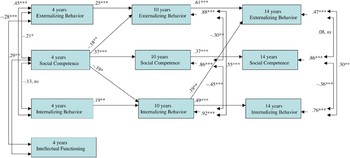
We therefore added age 4-year child intellectual functioning as an exogenous variable to the final cascade model (Figure 2) and reevaluated the developmental cascade effects. Age 4-year child intellectual functioning was allowed a direct path to 10-year externalizing behaviors and covariances with 4-year social competence and externalizing behaviors. However, age 4-year child intellectual functioning did not predict 10-year externalizing behaviors over and above 4-year social competence and the stability of externalizing behaviors, and this path was removed from the model. Figure 3 presents the standardized solution to the final, sequentially constructed developmental cascade model, S-B χ2 (25) = 49.75, p < .01, robust CFI = 0.92, SRMR = 0.08. The model reproduced observed correlations with an average absolute standardized error of .06. The three significant cascade paths and the significant longitudinal links among social competence, externalizing behaviors, and internalizing behaviors across three age periods reported for the final cascade model remained significant and the magnitudes of the indirect effect of 4-year social competence and internalizing problems on 14-year externalizing problems and the indirect effect of 4-year social competence on 14-year internalizing problems remained unchanged controlling for child intellectual functioning in the model.
The standardized solution for the final model with covariate analyses on the total sample (N = 117). Single-headed arrows indicate the standardized path coefficients, and double-headed arrows indicate standardized covariance estimates. Arrows associated with dependent variables are error variances and represent the amount of variance not accounted for by paths in the model. *p < .05. **p < .01. ***p < .001. [A color version of this figure can be viewed online at journals.cambridge.org/dpp]

Discussion
We defined developmental cascades as cross-domain uniquely intrapersonal longitudinal relations. Across the ages of 4 to 10 to 14 years, we found that children with lower social competence at age 4 years exhibited more externalizing and internalizing behaviors at age 10 years and more externalizing and internalizing behaviors at age 14 years. Children who exhibited more internalizing behaviors at age 4 years exhibited more internalizing behaviors at age 10 years and more externalizing behaviors at age 14 years. These developmental cascades obtained over and above covariation among social competence and behavioral adjustment at each age and the temporal stability of each characteristic and separate and apart from child intellectual functioning as well as maternal education and social desirability of responding. Results of this study are consistent with a broad cascade model by which functioning in one domain of behavior spreads to other domains, both directly and indirectly from early childhood going forward.
Social competence in early childhood showed negative longitudinal links to externalizing and internalizing behaviors in late childhood and early adolescence. Young children who are equipped with social skills experience fewer psychopathological symptoms later, separate and apart from their contemporary levels of symptoms (see also Burt et al., Reference Burt, Obradović, Long and Masten2008; Masten et al., Reference Masten, Burt, Coatsworth, Cicchetti and Cohen2006). Reciprocally, as suggested by competency-based models of depression and internalizing behaviors, social problems in early childhood appear to contribute to later internalizing behaviors (Cole, Reference Cole1990, Reference Cole1991). We do not know what about possessing social skills in early childhood keeps poor behavioral adjustment problems at bay. It could be that social competence tempers risky behavior, or social skills separate children from deviant peers who otherwise would promote externalizing behavior during adolescence. The general cascading pattern observed in this study indicates that social competence in evidence at the outset in early childhood affected behavioral adjustment in late childhood, which in turn contributed to behavioral adjustment in early adolescence. Over and above whatever cascades and bidirectional influences may have already occurred by the start of this study, social competence evident in early childhood forecasts behavioral adjustment in adolescence. This pattern held with potential common cause variables (child intelligence, maternal education) controlled (Masten et al., Reference Masten, Roisman, Long, Burt, Obradović, Riley and Tellegen2005).
Between the two main theoretical alternatives we found that social competence cascades to behavioral adjustment, and not that symptoms of behavioral adjustment predict social competence. The significance of early childhood social competence for adolescent behavioral adjustment is consistent with the few other longitudinal studies that control for within-time correlations and longitudinal stability of competence and symptoms. For example, Cole et al. (Reference Cole, Martin, Powers and Truglio1996) reported that social competence predicted symptomatology and not the opposite.
Consistent with one of the main principles of developmental task theory (Sroufe, Reference Sroufe1979), the results of this study demonstrate (heterotypic) stability within domains of adaptive functioning as assessed by developmentally appropriate indexes across time. For example, the longitudinal stability of social competence supports the notion that social skills, broadly construed, exhibit developmental consistency independently of measurement variability of the latent construct across the study time points.
This study has some notable strengths. The operationalization and assessment of developmental cascades per se are both stringent and conservative. Moreover, shared source and method variance, and potential biases because of single reporters and single instruments, were obviated in our multi-informant, multimethod design. We also instituted a number of key controls, including child intelligence; and because some data were derived from maternal reports, we also controlled maternal education and social desirability of responding. Cascades (like transactions) can be exposed only in longitudinal studies (Hinshaw, Reference Hinshaw2002a, Reference Hinshaw2002b; Masten & Curtis, Reference Masten and Curtis2000; Rutter & Sroufe, Reference Rutter and Sroufe2000). The first assessment for this study took place in early childhood, before children began school, which allowed us to test early cascade effects. The path analysis modeling approach we took made it possible to reduce the influence of key confounds and initial covariances between relevant domains; it allowed us to control for spurious effects related to covariance with child IQ and maternal education, important markers of general psychosocial advantages; and it afforded tests of alternative theoretical models. By using models that account for the longitudinal stability over time and concurrent correlations at each time, we tested and rejected as unlikely the alternative explanations that developmental cascades are artifacts of intercorrelations that were present early in the study and carried forward.
However, the study also suffers a number of limitations. Sample size was modest for the complex set of analyses we undertook, and a larger sample size would have allowed closer examination of associations among all study variables. The normative composition and modest sample size may have affected our ability to detect nonzero cascade paths, and so replication with a larger sample size might reveal additional significant paths. Although the sample was sociodemographically diverse, it was not representative; thus, caution is in order when generalizing from this study. The normative nature of the sample (restricting the ranges of social competence and problem severity alike) places limits on understanding how social competence affects the development of behavioral adjustment in clinical or at-risk populations. It could be social competence affects externalizing and internalizing behaviors only in the normal range of functioning and not at the extremely high end or for samples suffering psychiatric disorders. To focus this article, we limited the scope of our study to only one major developmental task domain and two major symptom domains. Other major domains of developmental task competence (like adaptive behavior in age-salient developmental tasks) have been implicated in the cascade literature linking to symptoms (Dodge & Pettit, Reference Dodge and Pettit2003; Masten, Reference Masten2005; Masten & Curtis, Reference Masten and Curtis2000). Another limitation of the present study design is the focus on widely spaced longitudinal relations among broad constructs. The unequal and relatively wide spans between assessment waves did not allow us to draw firm conclusions about precisely when or how observed cross-domain links developed. Because of concerns of model complexity, a number of additional common cause third variables and interacting constructs, such as academic competence, were not included. In addition, examination of additional child characteristics (e.g., temperament) would have made for a more definitive study.
Social competence and behavioral adjustment in children may be generated and influenced by the same (genetic or environmental) factors and emerge at the same time and develop together. Alternatively, children's social competence may be jeopardized because they are aggressive or withdrawn. Perhaps instead, social competence protects behavioral adjustment. Applying a developmental cascade approach, we found that early childhood social competence predicts later externalizing and internalizing behaviors. Externalizing and internalizing behaviors never predicted social competence. Although we cannot refute alternative explanations concerning the direction of cause and effect, the temporal design of the study and the findings suggest that social competence antecedes behavioral adjustment. One implication of our results is that attention to social competence much earlier in development is warranted. What gives rise to individual variation in social competence? It is perhaps not surprising that secure attachment in infancy has been consistently shown to predict social competence in childhood (Booth, Rose-Krasnor, & Rubin, Reference Booth, Rose-Krasnor and Rubin1991; Freitag, Belsky, Grossmann, Grossmann, & Scheuerer-Englisch, Reference Freitag, Belsky, Grossmann, Grossmann and Scheuerer-Englisch1996; Sroufe, Egeland, & Kreutzer, Reference Sroufe, Egeland and Kreutzer1990). Thus, social competence in the child has some origins in relationships in the family (Barth & Parke, Reference Barth and Parke1993; Parke & Ladd, Reference Parke and Ladd1992), and parent–child interaction is a significant factor in the child's development of socioemotional competence and acceptance in peer groups (Boyum & Parke, Reference Boyum and Parke1995; Elicker, Englund, & Sroufe, Reference Elicker, Englund, Sroufe, Parke and Ladd1992).
The linkages between internalizing and externalizing behaviors are complex. These symptom domains were concurrently and positively associated with one another from the outset of this study, and consistently from early childhood to early adolescence. However, our results showed that, over and above stability in each of these domains of behavioral adjustment through time, as well as their intercorrelation at each time, internalizing behaviors at ages 4 and 10 years had implications for externalizing behaviors at 14 years; the reverse was never true. Internalizing behaviors may index a personality trait or process, such as inhibition, that augments the risk for externalizing behaviors (Kerr et al., Reference Kerr, Tremblay, Pagani and Vitaro1997).
Our common cause analyses explored how inclusion of childhood IQ and maternal education in the models would affect observed cross-domain paths. Overall, inclusion of broad individual and family resource variables did not have appreciable effect on links between externalizing and internalizing behaviors or between social competence and externalizing and internalizing behaviors in the child.
The findings suggest a number of implications. For parents, the promotion of early positive development in terms of social competence promises to repay. Promoting young children's social competence may protect against the outbreak of externalizing and internalizing behaviors (e.g., Eisenberg, Cumberland, & Spinrad, Reference Eisenberg, Cumberland and Spinrad1998). For practitioners, the positive focus on social competence not only offers a valuable guideline but also, because behavior problems in the early years are not usually temporary (that is, the stability of behavior problems is high from 4 years on and may increase in frequency with age; Hemphill, Reference Hemphill1996; McConaughy et al., Reference McConaughy, Stanger and Achenbach1992; Verhulst & Koot, Reference Verhulst, Koot, Remschmidt and Schmidt1992; Verhulst & van der Ende, Reference Verhulst and van der Ende1995), the identification of early formative potent vaccinations or countermeasures is vital to children's healthy psychological development.
From the perspectives of intervention and particularly prevention, the possibility of developmental cascades and progressive adaptation spreading across domains of functioning has profound implications. By identifying the processes, timing, and conditions of spreading effects it is possible to learn when to do what to interrupt negative progressions. Our research suggests that one way to prevent problems in two domains is to intervene earlier in a third domain. Knowing when and how cascades occur among which characteristics will inform more strategic (and presumably successful) interventions. The study of directional effects over and above the covariance of multiple domains within time and interindividual stability of multiple domains across time helps to specify unique processes underlying developmental adaptation as well as the most promising targets and timing for intervention (Masten et al., Reference Masten, Burt, Coatsworth, Cicchetti and Cohen2006).
Although this study was conducted with a community sample, the findings reveal some important information regarding key target domains and windows of opportunity for prevention and potential intervention efforts. Social competence in early childhood emerged as a key domain because of the cascading effects that spread to other domains of behavioral adjustment over time, suggesting that programs aimed at improving the quality of social competencies may promote psychological well-being. On account of developmental cascades, an early focus on social skills may result in a high return on investment in early or strategically timed and targeted interventions designed to reduce behavioral problems (Heckman, Reference Heckman2006; Masten et al., Reference Masten, Burt, Coatsworth, Cicchetti and Cohen2006).
Conclusion
Cross-domain effects appear to reflect processes with significance not only for understanding the etiology and consequences of mental health problems but also for intervening to promote competence and prevent or ameliorate symptoms (Masten et al., Reference Masten, Burt, Coatsworth, Cicchetti and Cohen2006; Rutter et al., Reference Rutter, Kim-Cohen and Maughan2006). Social competence in early childhood, as indexed by peer acceptance and ability to maintain close friendships and the like, has implications for positive behavioral adjustment across future periods of development. The delineation of the directions, timing, and processes involved in developmental cascades has implications for intervention as well as developmental theory. Results of this study extend the evidence for developmental cascades from successes (or failures) in one domain of behavior during one period of development to successes (or failures) in other domains across subsequent developmental periods, often through indirect paths. Cross-domain effects may reflect processes with significance for understanding the etiology and consequences of mental health problems and for intervening to promote competence and prevent or ameliorate symptoms of psychopathology.
Appendix A
Pairwise covariance matrix of variables in the final model (N = 117)

Note: All variables were scaled by constants so that their variances were all approximately equal (=1).