Introduction
On 3 June 1947, the leaders of the All India Muslim League and the Indian National Congress met with Viceroy Mountbatten to announce the partition of the British Raj into the two dominions of Pakistan and India. Eight days later, Mir Osman Ali Khan, the seventh and last Nizam of Hyderabad, issued a firman declaring that India's premier princely state would not accede to either of the newly announced dominions. This was an ambitious though by no means unexpected announcement from the Nizam, whose landlocked state in the heart of peninsular India was entirely surrounded by what, after 15 August, became the Indian Union. The Nizam gave four reasons for his decision: first, the ‘basis of the division of British India is communal’; second, ‘[t]he subjects of my State have affinities and common interest with both the contemplated new Unions’; third, ‘[t]he result in law of the departure of the Paramount Power in the near future will be that I shall become entitled to resume the status of an independent sovereign’; and, fourth, ‘[t]he political and constitutional picture in India has in the past few years been changing rapidly and who can say whether the two Units now contemplated for British India represent the final solution or whether there will be still further divisions or whether after all unity may eventually be achieved’.Footnote 1
Of these four reasons, only the third was open to contestation. The Nizam's attempt to ‘resume’ an ‘independent’ sovereignty his ancestors had ceded to the British East India Company nearly two centuries earlier had a reasonably strong basis in law, history, and convention—that is, within the established bounds of imperial constitutionalism. It was no coincidence that Hyderabad's appeal to the United Nations in September 1948 precipitated the violent annexation of the state by the Indian army in an event known as the Police Action.Footnote 2 Faced with this fait accompli, the Nizam offered the unconditional accession of Hyderabad to the Indian Union and, in doing so, brought the millennia-long career of kingship in India to an end.
Although at the time a major event, the Nizam's quest for independence has since been footnoted as a quixotic last gasp of a feudal order fighting against the inevitable tide of democracy. The Hyderabad episode of 1947–48 offers an alternative angle on some of the major questions of decolonization by encouraging us to revisit the alternative futures that competed for supremacy in the decades before the partition. The period between 1919 and 1948 was, in India as elsewhere, marked by a proliferation of wildly divergent political imaginaries, and there was often a fine line between the fantastic and the realistic. The advent of Pakistan as a territorial entity—and an anomalous one at that—within seven years of the 1940 Lahore Resolution is in itself evidence of the open-ended nature of late-colonial Indian politics and the novel imaginings of the future that the tumult of this period produced.Footnote 3 Recapturing the contingency of late-colonial competitions over sovereignty allows us not simply to lament paths not taken, but also to have a fuller understanding of why and how 1947 took the form it did.
The Nizam's firman raises questions worth exploring. Why, after nearly three decades of constitutional negotiations and reforms, did the status of the princely states, and Hyderabad in particular, remain ambiguous and open to contestation? What role did the princely states play in the ‘communal’ division of colonial India along the lines of religious demography? What space did Hyderabad occupy in competing visions of the future? Did the partition signify the culmination of or a break from a longer history of constitutional reform?
This article seeks to answer these questions primarily through a history of the idea of federation in late-colonial India. Of all the futures past of South Asian history, none has been invested with as much hope and potential as federation. An un-partitioned India, if it were ever to exist, could only have taken the form of a federation. Indeed, the rise of ‘communalism’ and, ultimately, antagonistic nationalisms from 1919 took place within a context in which federation provided the dominant framework for India's constitutional development. The last major constitutional reform undertaken by the British, the 1935 Government of India Act, sought (and failed) to establish a Federation of India that would have maintained India's unity by bringing the princely states and British Indian provinces under a single written constitution. As is well known, the 1935 Act and the subsequent 1937 provincial elections were key turning points in the pathway to partition, giving birth to both Congress's demand for a sovereign constituent assembly and the League's Pakistan demand. Yet, by seeking to evolve and codify an imperial regime of sovereignty, federation also established the princely states as key players in late-colonial contestations over sovereignty in the subcontinent. India's unity via federation, in other words, was premised on the maintenance of the Raj's territorial fragmentation, legal plurality, and layered sovereignty. Partition in this respect was not only a process of division, but was equally, if not more so, a process of integration and centralization. ‘I felt convinced,’ the Indian National Congress leader Vallabhbhai Patel explained in an 11 August 1947 speech, ‘that in order to keep India united it must be divided now.’Footnote 4
Hyderabad is central to our narrative not only because it was the ‘premier’ Indian state, but also because the Nizam was seen by some to be a symbol of India's long-standing tradition of Muslim kingship.Footnote 5 Yet, Muslims comprised only 12.8 per cent of Hyderabad's population. Hyderabad thus occupied an important yet ambiguous space in Indian political imaginaries in the decades leading up to 1947, offering a way of exploring how the Hindu–Muslim majority–minority question overlapped and came into conflict with the question of the sovereignty of the princely states. The Nizam's quest for independence also reminds us that monarchs protected or created under colonial rule in Asia, Africa, and the Middle East were able to survive and, in certain cases, expand their authority after their colonial patrons departed. Democracy, or republicanism, was not the inevitable outcome of decolonization.
Projects of federation were attempted—with varying levels of success—in West, East, and Central Africa, Southern Arabia, Southeast Asia, and the Caribbean, among other places. India's interwar federal experiments were, in this respect, the first among many throughout the colonial world. Seeking to disrupt the teleology of the universalization of the nation state, historians have recently turned their attention to these projects of federation of the crucial decades of the mid-twentieth century.Footnote 6 They provocatively interrogate the contingency of the nation state by excavating the solidarities and cosmopolitanisms that were opened up by imperial arrangements that brought diverse peoples into shared political relationships. Gary Wilder, for example, has explored how Aimé Césaire ‘identified imperialism as federation in alienated form’; federation was ‘immanent to the existing empire’.Footnote 7 Empire made futures beyond the nation state possible and, perhaps more importantly, provided a framework for overcoming the majority–minority problem that had been the catastrophic undoing of the nation in the twentieth century.Footnote 8 In India, too, evolving the structures of the Raj into a federation was seen as the most plausible means of both overcoming the majority–minority problem and maintaining India's unity.
Could federation invest an imperial regime of sovereignty with new meaning and function? Or was federation a chimera? In seeking to solve both the ‘communal’ and princely problems simultaneously, federation sought to reconcile and codify into a permanent constitution the two divergent, and ultimately incommensurate, theories of colonial rule that had, since at least 1857, constructed India as both a timeless feudal order and an aggregate of demarcated communities.Footnote 9 Ultimately, the logic of community, or demos, worked to undo and overwhelm that of ‘traditional’ India. That it would do so, however, was a contingent and, in many respects, unexpected outcome. For most of the interwar period, it appeared that not only would the princely states survive efforts of constitutional reform, but that they would secure and even expand their sovereignty. This was especially true for Hyderabad—India's ‘premier state’—and the Nizam's Asaf Jah dynasty.
The article begins by mapping out the complex and fragmented sovereign landscape of the Raj, what I call the imperial regime of sovereignty. Efforts to evolve this imperial regime of sovereignty into a federation gave the princely states a new and influential role in Indian political life. Processes of constitutional reform worked at once to shore up princely sovereignty and made them vulnerable to direct challenges by the nationalists of British India. I argue that Hyderabad came to occupy a curious position in competing visions of the future, pointing to divergent ways in which kingship was sought to be elaborated or eliminated. Ultimately, the princely states were decisive, particularly for the Indian National Congress, in the turn to partition.Footnote 10 This article also seeks to contribute to a growing body of scholarship on the global history of federation and the alternatives to the nation state that were contemplated and attempted in the middle decades of the twentieth century as European empires underwent efforts of reform and decolonization. I hope, further, to participate in a revitalized scholarly conversation centred on the history of sovereignty, the increased importance and potential of the law in the wake of the First World War, and the way in which European empires provided a context for reimagining international legal and constitutional regimes.Footnote 11 And, lastly, I wish to enrich the conceptual history of federation, which remains largely Western in orientation.Footnote 12
The imperial regime of sovereignty
The British united all of India under one imperial system, but the Raj was not a coherent or codified entity. It was marked instead by territorial fragmentation, legal plurality, and layered and dispersed forms of sovereignty. It was a complex institutional matrix—a messy aggregate of legal and administrative jurisdictions. This arrangement was an outcome of the contingencies of colonial conquest between 1757 and 1857, and further elaborated in the decades after the insurrection.Footnote 13 The British conquest was piecemeal, taking place over the course of 100 years, during which time the East India Company signed treaties with or otherwise subordinated hundreds of Indian sovereigns and magnates, who would later form the bulk of the Indian ‘princes’. Following the British re-conquest in the wake of 1857–58, these contingent arrangements of conquest were moulded into a permanent institutional structure and considerably indeterminate constitutional order.
The trial and exile of the last Mughal emperor marked, as Bernard Cohn has argued, a ‘desanctifying of the previous political order’ and ‘the beginning of a new order’.Footnote 14 The Government of India Act of 1858 abolished the East India Company and transferred its sovereign rights to the Crown. Queen Victoria, moving to occupy the symbolic space vacated by the Mughals, issued a proclamation assuring ‘the Native Princes of India that all Treaties and Engagements made with them’ by the Company would be ‘scrupulously maintained’ and promised to ‘respect the Rights, Dignity and Honour of Native Princes as our Own’.Footnote 15 In their attempts to systematize and justify this new regime of sovereignty, imperial jurists and administrators in the latter half of the nineteenth century argued that the distribution of powers between the British and the ‘native states’ was in keeping with indigenous arrangements of political authority.Footnote 16 From this perspective, when Queen Victoria declared herself Kaisar-e-Hind in 1877, she was simply carrying on the Mughal emperor's claim to universal dominion as Shah-en-Shah, or ‘king of kings’. Although substantially transformed under colonial rule, kingship was integral to the imperial regime of sovereignty.Footnote 17 Sudipta Sen calls this ‘conquest without assimilation’, whereby Indian rulers still possessed an ‘attenuated’ or ‘residual’ sovereignty.Footnote 18
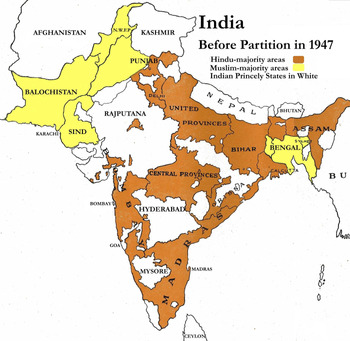
The post-1857 imperial constitution consisted, broadly, of ‘two Indias’, each internally differentiated: the directly ruled British Indian provinces and the indirectly ruled Indian states. Coexisting and co-dependent, these two Indias were juxtaposed across the subcontinent, giving the sovereign landscape of the Raj an extraordinary spatial character—one marked by the proliferation of territorial anomalies (see Figure 1). The Indian states collectively occupied approximately two-fifths of the total area of the subcontinent. There was a staggering diversity among the states themselves, ranging from small units no larger than a few villages to large polities replete with the trappings of modern administration. All were autocracies. They exercised varying degrees of internal autonomy; the vast majority were petty ‘semi-jurisdictional’ or ‘non-jurisdictional’ rather than ‘full-powered’ states.Footnote 19 All states ceded rights of external affairs and of the ability to wage war to the British.
India before partition in 1947, adapted from B. R. Ambedkar, Pakistan, or the Partition of India. Bombay: Thacker and Company, 1945.

Despite their enormous differences, the states were lumped together into the single category of ‘princely’, ‘native’, or ‘Indian’ states—a ‘uniformity of terminology’ that posed significant challenges to late-colonial constitution-making efforts.Footnote 20 Indeed, their legal, constitutional, and institutional qualities differed wildly. Only around 40 major states had formal treaty relations with the British. The Government of India did, however, issue sanads (certificates of protection and recognition) and letters of understanding to many states lacking formal treaty rights.Footnote 21 The constitutional standing of such documents was brought under intense scrutiny after 1919. The British, moreover, refused to systematize their relations with the princes, preferring instead to deal with each state or groups of smaller states separately through the Political Department under direct control of the Viceroy as the Crown Representative.
The underlying principle of this system was the concept of ‘paramountcy’. Although treaties, sanads, and other legal documents suggest that paramountcy was a contractual and consensual relationship, ultimately it was founded on ‘de facto’ British military supremacy. ‘The paramount supremacy of the British Government,’ the Government of India proclaimed in 1877, ‘is a thing of gradual growth; it has been established partly by conquest; partly by treaty; partly by usage.’Footnote 22 The right of the Government of India to intervene in the internal affairs of states (regardless of treaty status) in the event of perceived misrule or disorder was an essential, if infrequently exercised, dimension of paramountcy. Despite the routinization of paramountcy after 1857, the Raj was never codified into a unified legal architecture. This ‘indefinite suzerainty’ left ‘largely unresolved certain fundamental questions of conquest, sovereignty and subjecthood’.Footnote 23 This contingent system developed more out of circumstance than design. It enabled the colonial power to exercise flexibility in managing the constituent units of the Raj, allowing imperial interests to be furthered via legal indeterminacy.Footnote 24
The imperial constitution of the Raj, then, relied on administrative practice and convention—what imperial administrators referred to as ‘usage’ or ‘political practice’. Henry Maine observed that ‘no general rules’ could apply to the division of sovereign powers between the British and the Indian states. These would be deduced instead ‘from de facto relations’ between the paramount power and individual states.Footnote 25 Political authority functioned through complex and contingent processes of management rather than a codified legal-institutional apparatus. Projects of federation faced the challenge of systematizing into a single written constitution an extant arrangement defined precisely by the absence of any ‘general rules’.
Benton is correct to point to the ‘limits of law’ in understanding this imperial regime of sovereignty. At the same time, however, treaties between the princes and the British Crown were more than mere fictions. Although adhered to inconsistently, treaties, in theory and often in practice, guided the relationships between the states and Crown representatives. The very ability to engage in treaties assumed that the figure of the prince was endowed with sovereign capacities and, within his territories, sovereignty flowed directly from his personage. Imperial administrators and the princes alike invoked paramountcy as a historical partnership of sovereignty. The ‘Native Chief’, for Lord Curzon, was a ‘colleague and partner’, not simply ‘appendages of Empire, but its participators and instruments’.Footnote 26 The Treaty of Perpetual and General Defensive Alliance signed by Hyderabad and the East India Company in 1800 held that the Nizam was an ‘equal partner with the Company’.Footnote 27 Hyderabad's support for the British against Tipu Sultan and the Marathas assured British dominance in peninsular India by the early nineteenth century, and the outcome of 1857 could have been radically different had the Nizam joined the insurrectionists. When Hyderabad's prime minister, Sir Salar Jung, visited England after the mutiny, he was hailed as the ‘saviour of Indian empire’.Footnote 28 Mir Osman Ali Khan considered Hyderabad's contributions to both world wars as iterations of his state's historical centrality to the foundation and reproduction of British imperial sovereignty.Footnote 29
In order to explain such a system, Maine elaborated a concept of divisible sovereignty. He argued for a spectrum of sovereignty; an ‘independent sovereign’ possessed a complete assemblage of powers and privileges, whereas lesser sovereigns were equipped with a limited number of powers and ceded others to a paramount entity. ‘There may be found in India,’ wrote Maine, ‘every shade and variety of sovereignty, but there is only one independent sovereign, the British Government.’Footnote 30 When the Nizam of Hyderabad declared independence in 1947, he was doing nothing less than insisting on the resumption of a historically ‘independent’ sovereignty that was temporarily curtailed on account of British paramountcy.
The ‘two Indias’ were distinct and parallel constitutional orders linked together under the British Crown and exhibiting intimate, heterogeneous geographies. British India was governed according to the statutes of parliament. Parliament could not legislate for the Indian states and neither could the Government of India. Indian states were outside of the jurisdiction of British and British Indian courts. Subjects of the Indian states were generally not considered British subjects, instead coming under the category of British protected persons.Footnote 31 The Indian states maintained distinct political personalities; they were, as Charles Lewis Tupper observed, ‘autonomous states, enjoying various degrees of sovereignty, levying their own taxes, administering their own laws, and possessing territory which is, for purposes of internal administration, foreign territory, and has not been annexed to the dominions of the British Crown’.Footnote 32
A federation would need to transform the fragmented jurisdictional landscape of the two Indias into a single written constitution. Crucially, parliament could not legislate for the states and thus such a federation into existence: it required the consent of individual states. The Indian states had, then, decisive influence over the fate of federation and imperial constitutionalism more generally after 1919.
Despite being recognized as sovereign entities, the Indian states had no international standing independently of the Indian empire. Curiously, India—including both British India and the Indian states—became recognized as a single international entity following the First World War and was represented in international forums by Indian princes. The Maharaja of Bikaner signed the Treaty of Versailles on behalf of India, paving the way for India becoming the only non-self-governing state among the founding members of the League of Nations. India's representatives to the League throughout the 1920s were princes.Footnote 33 The vast majority of the Indian states had few reasons to believe they could exist independently of the British empire. It was for this reason that many of them supported, at times, efforts to secure their sovereignty within an all-India federation. Some of the major states, most notably Hyderabad, contemplated independence and made efforts to establish themselves as internationally recognized sovereign states. Both of these potential outcomes—an entrenchment of princely power within an Indian federation or the independence of major states—were possible outcomes of contestations over sovereignty in the subcontinent after 1919.
Federating the Raj, 1919–35
For many Indian nationalists, federation became after 1919 a capacious means for imagining a wide array of possible futures. When Mohamed Ali, the Khilafat leader, invoked a ‘federation of faiths’ in his 1923 presidential address to the Indian National Congress, he pointed to the way in which federation came to signify not simply a particular constitutional arrangement, but a more normative solution in which the ‘Hindu–Muslim’ problem could be solved amicably and justly. The Hyderabadi native Sarojini Naidu often referred to India's ‘federated culture’ and a ‘federated national life’ defined by an irreducible plurality and unity.Footnote 34 In her 1925 presidential address, she made a direct appeal to the Indian states:
[L]et not the princes believe for a moment that we want to crush them by any subtlety or device, hidden or covert …. And let them feel that some day when we have the great federation of free India, the Indian states will come in as an integral unit of Greater India working on the same basis of democratic freedom with the people of [British] India.Footnote 35
Up to 1937, Congress under Gandhi pursued a policy of non-interference in states’ affairs. The older, liberal nationalist leadership was in many respects sympathetic to the princes. However, the 1935 Act and its proposed federation forced the political parties of British India into open engagement and confrontation with the states. A new generation of leadership, most crucially Jawaharlal Nehru and the socialist caucus within Congress, were less amenable than their predecessors to what they considered feudal anachronisms. This conflict was anticipated by the 1928 Nehru Report, which proposed an Indian Dominion consisting of a federation of both British and princely India, but warned that ‘an attempt is being made to convert the Indian States into an Indian Ulster by pressing constitutional theories into service’.Footnote 36 It was in response to the Federation of India envisioned by the 1935 Act that Congress demanded a sovereign constituent assembly and sought a break with imperial constitutionalism altogether.
The idea of federation in India dates back to late Victorian visions of transforming the British empire into a global federation or world state.Footnote 37 Discussion of India's membership in a global British federation peaked during the 1899–1902 Boer War, during which India and Indian princes—most notably the Nizam of Hyderabad—committed considerable resources to the British effort.Footnote 38 The return to the idea of imperial federation in the aftermath of the First World War saw the empire's white settler colonies rearranged into the British Commonwealth of Nations.Footnote 39 In the late 1930s, a mania for federation saw Anglo-American jurists propose transatlantic and western European federations as means of maintaining their hegemony in the face of fascist and communist challenges to ‘Western Civilization’.Footnote 40 The exclusion of India and other non-white colonies from the British Commonwealth made extending ‘dominion status’ and equal membership a central question of interwar constitutional debates. Ultimately, however, international equality required national independence.
While the Commonwealth initially proceeded without India, the idea of an all-India federation provided the dominant framework for, and gave a common language to, contesting visions of India's political future after the First World War. While perhaps more modest than Victorian visions of imperial federation, an all-India federation was in scale, scope, and complexity a tremendously ambitious idea. As elsewhere, the project of federation in India was premised on evolving an imperial regime of sovereignty into an arrangement that resembled its predecessor in form and structure, but which could also absorb India's democratic aspirations. In 1917, the British committed to the ‘gradual development of self-governing institutions with a view to the progressive realization of responsible government in India as an integral part of the British Empire’.Footnote 41 This inaugurated a sustained phase of constitutional contestation that developed dialectically with a new phase of political unrest in the subcontinent marked by the rise of mass politics, Gandhian and otherwise.
In their Report to Parliament, which formed the basis of the 1919 Government of India Act, Secretary of State Edwin Montagu and Viceroy Chelmsford argued that India must eventually become ‘some sort of “federation”’. They envisioned a ‘sisterhood of states’ in which democratized, self-governing British Indian provinces and the autocratic princely states coexisted within a shared constitutional framework. They further assured the princes that ‘no constitutional changes which may take place will impair the rights, dignities and privileges secured to them by treaties, sanads, and engagements or by established practice’.Footnote 42 Alluding to the indeterminate character of paramountcy and the imperial regime of sovereignty, they recommended efforts to ‘simplify, standardize and codify existing practice for the future’.Footnote 43
Federation would ultimately end the constitutional isolation of the two Indias and, by doing so, helped transform debates about representation and minority rights into a full-blown contestation over sovereignty. In a break from earlier practice of discouraging coordination between Indian states, the Chamber of Princes was established by Royal Proclamation in 1921 to serve as a consultative body to the viceroy. The king-emperor assured the chamber of his ‘determination ever to maintain unimpaired the privileges, rights and dignities of the Princes of India’. This pledge was to remain ‘inviolate and inviolable’.Footnote 44 For the British, federation became a means of upholding this pledge while simultaneously introducing ‘responsible government’ in British India.Footnote 45 The codification and institutionalization of paramountcy and princely sovereignty were seen as means to temper the excesses of democratic politics and ensure continued British dominance in the subcontinent. As a consensus developed over the course of the 1920s around federation as a framework for India's constitutional advance, the princely states had a new and significant role to play. Some officials, such as the secretary of the Political Department, the Indian Civil Service officer J. P. Thompson, suggested federation schemes in which all the territories of India, including those of British India, would be placed under princely rule and indirectly administered by a small coterie of British officials in New Delhi.Footnote 46
The Indian States Committee, appointed in 1928 to evaluate the constitutional standing of the princely states, concluded that the states had a direct relationship with the British Crown rather than the Government of India. As a result, paramountcy could not be transferred to a future federal government without the consent of each individual state, thus giving the states veto power over the formation of an all-India polity.Footnote 47 The committee also determined that in the event of ‘widespread popular demand for change, the Paramount Power would be bound to maintain the rights, privileges and dignity of the Prince’.Footnote 48 In their 1930 Report to Parliament, the Simon Commission insisted that the ‘ultimate constitution of India must be federal, for it is only in a federal constitution that units differing so widely in constitution as the provinces and the States can be brought together while retaining internal autonomy’.Footnote 49 They too maintained the princely veto and suggested that a future federal constitution should provide an ‘open door’ that would permit, ‘when it seems good to them’, the princes to ‘enter on just and reasonable terms’.Footnote 50
Although the Simon Report argued that federation ‘must remain a distant ideal’, only months later, at the opening of the first Round Table Conference in November 1930, princely delegates and British Indian leaders announced their mutual support for federation. As Ian Copland notes, it was the support of Hyderabad's delegate, Sir Akbar Hydari, that transformed an all-India federation from a theoretical proposition into ‘practical politics’.Footnote 51 Over the course of the 1920s, federation became increasingly accepted among the princes as the most viable means of securing their sovereignty in any future constitutional settlement. By 1930, the chamber's leadership and major non-chamber states like Hyderabad, Mysore, and Travancore were supporters of federation.Footnote 52 K. N. Haksar and K. M. Panikkar, princely delegates to the conference, argued in their Federal India (1930) that the ‘governing factor’ to the ‘India problem’ was ‘the organic union of the sovereign states of India with the British Indian Government. If such a union is to be achieved, it can only be on a federal basis’.Footnote 53 Haksar and Panikkar argued that the longue durée of Indian history was best understood as ‘the interplay of the centripetal and centrifugal forces of Indian politics’.Footnote 54 Federation, then, accorded more closely to India's pre-colonial traditions of layered sovereignty and political accommodation.
Princely support at the Round Table Conferences was crucial to making federation the centrepiece of the 1935 Government of India Act, even if that support had waned and the princely caucus fractured by the time of the act's passage. The main thrust of the ‘Federation of India’ envisioned by the act was to bring the two Indias under a single written constitution and, in so doing, to codify the constitutional standing of the Indian states. For imperialist thinkers, British politicians, and colonial administrators alike, federation was a means of ‘holding India to the Empire’.Footnote 55 According to the act, the princes were allocated substantial seats in the federal legislatures, whose delegates would be nominated by rulers rather than elected.Footnote 56 The states were not required to undertake any internal reforms. The federation would, however, only come into existence once half the states had signed instruments of accession. This never happened, ultimately rendering it a stillborn ‘paper federation’.Footnote 57 With the outbreak of war in 1939, the window of opportunity for an all-India federation passed, although it would remain the basic framework for a united India until 1947.
The 1935 Act and the subsequent 1937 provincial elections were major turning points. They led to Congress's demand for a sovereign constituent assembly and the Muslim League's demand for Pakistan, both of which ultimately led to the partition. Congress's primary grievances were the consolidation of British authority at the centre and the entrenchment of princely autocracy. Federation, for Congress, became a synonym for British skullduggery. The Muslim League, while grudgingly accepting the Communal Award and provincial autonomy, also rejected the act's federal provisions as ‘most reactionary, retrograde, injurious and fatal to the vital interest of British India vis-à-vis the Indian States’.Footnote 58 With the vast majority of the princes being Hindus, their entry into federal legislatures would further dilute Muslims’ numbers and thus exacerbate their minority status. Indeed, the princely states played a prominent role in Hindu nationalist visions of a Hindu Rashtra or Akhand Bharat.Footnote 59
The Congress triumph in the 1937 elections, as Jalal argues, ‘brought the Muslim dilemma into the open, and a flurry of schemes looking for some way out were doing the rounds’.Footnote 60 These schemes, examined below, were largely federal or confederal in nature. While diverging in significant ways from British visions of an Indian federation, the alternative constitutions developed in the latter half of the 1930s were similarly confronted with the complex and fragmented sovereign landscape of the Raj and the constitutional principle of paramountcy. The process, since 1919, of codifying the Raj's imperial constitution into a chimerical federation had both bolstered princely claims to sovereignty and exposed them to a direct challenge from the nationalists of British India. The idea of Pakistan was forged within and in reaction to this wider context of constitutional innovation and competition in which federation remained the basic framework. Iqbal, for example, stressed in 1933 that his proposal for the creation of a Muslim province in north-west India would be ‘part of the proposed Indian federation’.Footnote 61 As Faisal Devji has observed, this was an example of Indian Muslims’ vision of a ‘non-national future’.Footnote 62 Indians commandeered the field of imperial constitutionalism as a means of imagining divergent political futures and, especially after 1935, pushed the concept of federation in new directions. Hyderabad played a curious yet central role in many of these alternative visions of federation.
Sovereign kingship in an age of mass politics
There was a concerted effort from the late nineteenth century onwards to portray the Nizam as the symbolic leader of Indian Muslims and as a rightful legatee of Mughal sovereignty.Footnote 63 Server-ul-Mulk, a top official in the administration of Osman Ali Khan's father, wrote in his autobiography that the Nizam possessed ‘the status of Amir-ul-Momineen and Khalifa with the Muslims in India’.Footnote 64 The English pan-Islamist, Wilfred Scawen Blunt, asserted in 1909 that the Nizam ‘was the leader of the Mohammedans in India, and the people looked to him for their redemption’.Footnote 65 At the Muslim League's fifth session at Calcutta in 1912, the chairman of the Reception Committee noted the passing of Mahbub Ali Khan and lamented
that the cruel hand of death should have taken him away from us at such a critical juncture, when Muslim India is just entering upon the threshold of new life, and when so many of our highest hopes for the success of schemes of national uplift were centered in his person.
He went on to welcome the new Nizam as ‘a bright new orb in the firmament of public life’.Footnote 66 Maulana Maududi, born in Hyderabad and a beneficiary of state patronage, later compared the fall of Hyderabad in 1948 to the Mongol capture of Baghdad in 1258, the expulsion of the Moors from Spain in 1492, and the fall of the Mughal empire in 1858.Footnote 67
In the early decades of the twentieth century, religious and political thinkers across the Muslim world sought to reimagine and reconfigure sovereignty. This task was given greater urgency by the collapse of the Ottoman empire during the First World War, in the aftermath of which Muslims began to be increasingly imagined as a global political community. This in turn led to intense debate regarding the nature of Muslim political and spiritual authority, as evidenced in India by the pan-Islamist Khilafat movement.Footnote 68
During the war, the British called upon Osman Ali Khan, who became Nizam in 1911, to take up the mantle of leadership of India's Muslims, some of whom were wary of supporting a war against the Ottoman caliph. The Nizam complied, issuing a firman aimed at easing Muslim doubts. As a reward, he was given the title ‘Faithful Ally of the British Government’ in 1917 and, the following year, he became ‘His Exalted Highness’, confirming his preeminent status among the princes.Footnote 69 Certain north Indian Khilafatists made efforts to establish the Nizam as a figure of both religious and political authority outside of the boundaries of his state.Footnote 70 The prospect of the Nizam taking up the mantle of Muslim anti-colonialism caused significant anxiety among colonial officials.Footnote 71 From 1924, the Nizam sent regular funding for the upkeep of the deposed caliph. In 1931, the Khilafat leader, Shaukat Ali, brokered the marriage of the Nizam's sons to the caliph's daughter and niece.
The Nizam generously patronized Islamic scholarship and funded the Hajj for hundreds of thousands of Indian Muslims.Footnote 72 The Nizams funded Syed Ahmad Khan's Muhammadan Anglo Oriental College at Aligarh almost from its inception, and many Aligarh-educated Muslims from North India found employment in Hyderabad.Footnote 73 Hyderabad became a centre of Urdu and Islamic scholarship in its own right after the founding of Osmania University in 1918. India's first vernacular university, Osmania served as a symbol of Hyderabad's unique modernity.Footnote 74 Osmania enhanced Hyderabad's status as an important centre of a trans-regional ‘Urdusphere’ that connected Muslim intellectuals in India with those as far away as Kabul, Durban, Istanbul, and Cairo.Footnote 75 Hyderabad was thus a ‘nodal center in the Muslim intellectual world’ linking Muslim thinkers from Aligarh, Deoband, and Lucknow to their counterparts in the eastern Mediterranean.Footnote 76
As interwar constitutional developments commenced, the Nizam sought to consolidate and expand his sovereignty. Armed with his new titles, he stood aloof from the Chamber of Princes and sought to distinguish himself from other princely states, the vast majority of which were petty jagirs and estates. He also sought to renew negotiations over territories his ancestors had ceded to the British, most notably the fertile cotton-growing districts of Berar. Since an 1853 treaty, Berar had been administered by the British. A 1902 agreement reaffirmed the Nizam's ‘sovereignty’ over the ‘Assigned Districts’ while at the same time recognizing the ‘exclusive jurisdiction’ of the British.Footnote 77 Even though the British administered Berar and collected its revenues, its inhabitants remained subjects of the Nizam. In 1923, the Nizam wrote to Viceroy Reading asking for the restoration of Berar as a gesture of goodwill in light of his efforts in support of the war.Footnote 78 Reading's response to the Nizam in 1926 was a classic statement of the indefinable and limitless character of paramountcy, in which he asserted that the ‘supremacy’ of the British Crown was ‘not based only upon Treaties and Engagements but exists independently of them’.Footnote 79 Reading further insisted that the Nizam, despite his titles, was not ‘in a category separate from that of other States under the Paramountcy of the British Crown’.Footnote 80
However, as princely support for federation fractured in the lead-up to the 1935 Act, the British offered a number of concessions to lure the princes into the federation. In 1933, the British agreed to give the Nizam the right to be consulted about the appointment of the governor of the Central Provinces, the right to fly the Asaf Jah flag on public buildings in Berar, the right to hold darbars there, an annual payment of 25 lakh from Berar's revenues, and the title of ‘His Highness the Prince of Berar’ for his heir apparent.Footnote 81 In a visit to Hyderabad, Viceroy Willingdon made it clear that the agreement reaffirmed the Nizam's sovereignty over Berar, giving ‘some real as well as ceremonial effect to the sovereignty of the Nizam’. In exchange, the Nizam should ‘be prepared to accede to federation in respect to his territories known as the Berars’.Footnote 82 The Nizam also waived his claim for ‘a free corridor to the sea at Musulipatnam and a permit to develop a port’ as per the Hyderabad Commercial Treaty of 1802.Footnote 83
The 1935 Act maintained the anomalous position of Berar while confirming both British jurisdiction and the ‘continuance of the sovereignty of His Exalted Highness over Berar’.Footnote 84 Even so, the Nizam prevaricated, refusing to convert his treaty relationship with the British Crown into a constitutional relationship with the Government of India. The hesitation of India's premier state gave cover to others to hold out of the federation. The Congress triumph in the 1937 provincial elections, the anti-prince rhetoric of leaders like Nehru, and the subsequent sponsoring of satyagrahas against the states by Congress ministries further steeled princely opposition to federation. The Congress ministry in Bombay openly supported the 1938–39 satyagraha against Hyderabad conducted by the Hyderabad State Congress, the Arya Samaj, and the Hindu Mahasabha. Ultimately, the requisite number of states—following Hyderabad's lead—refused to federate, thus rendering inoperative the 1935 Act's vision of a united India.Footnote 85 The rulers not only feared the spectre of Congress taking the reins of an interventionist central government, but thought conceding the democratic principle would undermine the legitimacy of their claims to sovereignty. And, although their British patrons had been encouraging them to introduce representative government and administrative reforms in their states from the 1920s, the vast majority took little action. Modest reforms undertaken in select states largely occurred only after 1937 in response to Congress's rise to power and their sponsorship of popular movements in the states. It was only at this time that the Nizam appointed a Reforms Committee to consult on the establishment of representative institutions in Hyderabad.
Within Hyderabad, beginning in the 1920s, there were various efforts to reconcile and reconfigure popular politics, democracy, and kingship. Karen Leonard has traced the development of a ‘Deccani nationalism’ premised on a ‘Deccani synthesis’ that brought together elements of Hindu and Muslim culture, fostered by the benign and tolerant Asaf Jah dynasty. The central antagonism of Deccani nationalism was not Hindu–Muslim, but rather Mulki (native Hyderabadis) versus non-Mulkis.Footnote 86 Deccani nationalism was promoted by organizations such as the Osmania Graduates’ Association, the Society of Union and Progress, and, from 1935, the Nizam's Subjects League. For these groups, sovereignty was grounded not only in the dynastic rights of the Asaf Jah, but in the people of Hyderabad as a whole; the Nizam's Subjects League raised the slogan ‘Long Live the Nizam, the Royal Embodiment of Deccani Nationalism’.Footnote 87 Liberal reformers advocating representative institutions and civil liberties similarly never challenged the principle of dynastic sovereignty, seeking instead a constitutional monarchy with a formal separation of powers and a rights regime within the extant patrimonial system.Footnote 88
Yet, in the latter half of the 1930s, the Majlis-e-Ittehadul Muslimeen sought to redefine popular sovereignty in Hyderabad ‘as specifically Deccani and Muslim’.Footnote 89 Originally started in 1927 to contain sectarian rivalry amongst Hyderabad's Muslims, the Majlis under the leadership of Bahadur Yar Jung, a confidant of Jinnah, adopted an explicitly political programme following the 1938–39 State Congress-Arya Samaj-Hindu Mahasabha satyagraha and the 1938 riots in Hyderabad city. Bahadur Yar Jung propounded a theory of ‘ana'l-malik’, which held that sovereignty in Hyderabad was invested in the collectivity of Hyderabad's Muslims rather than in the personage of the Nizam.Footnote 90 He opened Ittehad functions with the following invocation:
We are the Kings of the Deccan; the Throne and Crown of the Deccan are symbols of our own political and cultural sovereignty; His Exalted Highness is the soul of our Kingship and we form the body of his Kingship; if he ceases to exist, we cease to exist; and if we are no more, it will be no more.Footnote 91
Bahadur Yar Jung committed the Majlis to ensuring that safeguards for Muslims were included in any constitutional reforms and to the preservation of the Asaf Jah dynasty. The Reforms Committee tasked with formulating constitutional changes within Hyderabad similarly offered a new formulation of kingship vis-à-vis the people: ‘He [the Nizam] is both the supreme head of the State and the embodiment of his “people's sovereignty”.’Footnote 92 In sum, it was not only in the domains of imperial constitutionalism or pan-Islamism in which the sovereignty of the Nizam was articulated anew. Internal developments in Hyderabad—both official reform processes and popular politics—further reinforced his claims to sovereign kingship in an era of popular politics and mass mobilization. Of course, the major mass movement in Hyderabad—that led by the communists in Telangana—would by the mid-1940s launch a direct challenge to the legitimacy of the Nizam's state. Ultimately, Hyderabad was considered by many a distinct political community and territorial unit that would, and should, continue to exist despite the political and constitutional changes at the all-India level. The Nizam's refusal to federate before the war indicate that he was, even at this early stage, positioning Hyderabad for a bid for independence or, at the very least, as a separate dominion within the Commonwealth.
Hyderabad and federation's many futures
In the wake of the 1935 Act and the 1937 elections, Hyderabad's curious position in Indian political imaginaries became evident, if still marked by significant ambiguity. Many Muslim public men found the experience of Congress provincial ministries unpalatable; the prospect of a majoritarian Congress exercising control over a powerful central government was even more so.Footnote 93 This hastened a turn to territorial solutions as a means of resolving the ‘minority’ problem and of assuring Muslim participation in the exercise of state power. Indeed, the Muslim League's 1940 territorial turn in the form of the Lahore Resolution emerged out of a context marked by the proliferation of territorial schemes. A territorial politics as a means of transcending the minority problematic was given greater urgency by the collapse of the League of Nation's system of minority protections in the late 1930s and the unprecedented persecution and attempts to eliminate minorities altogether during the Second World War.Footnote 94 Abandoning ‘minority’ for ‘nation’ meant, as Jalal has argued, that debates over federation were no longer about minority rights, but contests over sovereignty.Footnote 95 What Jalal and others neglect, however, is that the princely states—and Hyderabad above all—were integral players rather than hapless bystanders in this contestation.
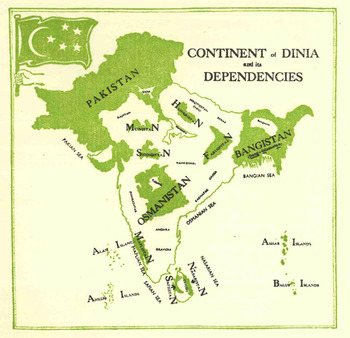
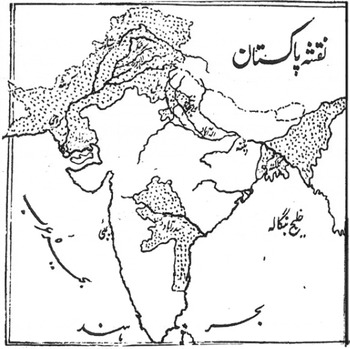
A number of Muslim thinkers, particularly after 1937, began to think in terms of federations or confederations that redefined and reallocated territorial authority on entirely new premises. Even where they discarded the inherited administrative and territorial contours of the Raj, the empire nevertheless continued to provide a framework for novel territorial imaginaries in the subcontinent.Footnote 96 The creator of the neologism ‘Pakistan’, Choudhry Rahmat Ali, envisioned a fragmented yet sub-continental landscape of Muslim sovereignty. Aside from the Muslim-majority areas in north-western and north-eastern India that would later become West and East Pakistan, Rahmat Ali also proposed a Muinistan in Rajputana, a Haideristan in U.P., a Faruqistan in Bihar and Orissa, a Maplistan in Kerala, and, most significantly, an Osmanistan roughly adhering to the territorial boundaries of Hyderabad state (see Figure 2).
Continent of Dinia and its dependencies, sourced from Rahmat Ali, The Millat & the Mission. Cambridge: Pakistan National Movement, 1944.

Yet, while Rahmat Ali used the Nizam's name for his proposed Osmanistan, he rejected what he considered the ‘blunder’ of ‘dynasticism’ and dismissed the princely order as a legitimate basis for Muslim nationhood. He proposed instead that the extant Hyderabad state be utilized as a mechanism for creating a Muslim-majority nation state in the Deccan:
The old demand of the Pakistan National Movement for the de facto recognition of the de jure sovereignty of Ala Hazrat the Nizam, which is essentially based on the solemn treaties with him as a sovereign ally, is no more than a prelude to the national construction of Osmanistan by a voluntary exchange of her Hindoo population with Muslim population of the neighbouring regions.Footnote 97
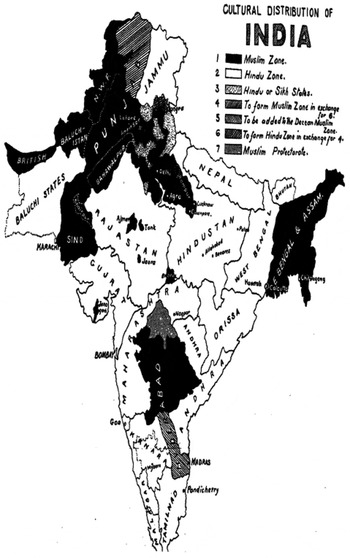
Similar proposals appeared in the rush of federation schemes issued in the wake of the 1937 elections. In his 1939 book, The Muslim Problem in India, Dr Syed Abdul Latif, a former professor of English at Osmania University, proposed the formation of four Muslim ‘cultural zones’: one each in the north-west and north-east, another in U.P., and one in Hyderabad. These four zones were to be brought together in a loose federation with 11 Hindu cultural zones as the first step towards a full exchange of population that was to take place over a period of 25 years (see Figure 3).Footnote 98 Latif argued that reorganizing India into cultural zones—including some defined by language—would actually accomplish the long-standing Congress demand for linguistic states. Indeed, the map of Latif's Indian federation looks much like the map of India after the States Reorganization Act of 1956, except with the Marathi-, Kannada-, and Telugu-speaking peoples of Hyderabad removed to their respective ‘homelands’ and replaced by the Muslims of peninsular India. Despite its overwhelmingly Hindu population, Hyderabad was held up as a ‘Muslim zone’. Dynastic sovereignty was to act as a transitional foundation for popular sovereignty based on an eventual Muslim majority. These two principles for territorial sovereignty—kingship and ‘the people’—coexisted in many of these plans just as they did in all official plans of federation.
Cultural distribution of India, sourced from Syed Abdul Latif, The Muslim Problem in India. Bombay: Times of India, 1939.

In a 1938 pamphlet entitled The Outlines of a Scheme of Indian Federation, Sikandar Hayat Khan, the Premier of the Punjab, proposed the reallocation of Indian territory into seven regional ‘zones’ comprising both British Indian provinces and princely states.Footnote 99 The plan included princely representatives in both regional and federal governments, but did not require any internal reform in the states and guaranteed internal autonomy and princely privileges, thus institutionalizing the princely system within an all-India federation.Footnote 100
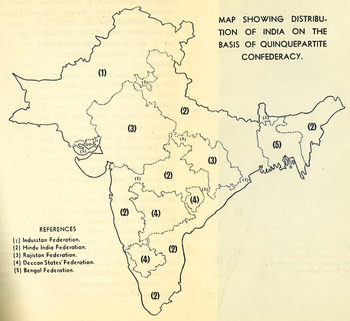
The Confederacy of India, published in 1939 by the Nawab of Mamdot (Sir Shah Nawaz Khan, president of Punjab Muslim League and member of All India Muslim League Working Committee), suggested a division of India into five separate regional federations, or ‘countries’, united in a loose confederation (see Figure 4).Footnote 101 These countries included Muslim-majority ‘Indusstan’ in the north-west and a ‘Bengal federation’ in the north-east. The British Indian provinces of U.P., C.P., Bombay, Madras, and Assam were bundled into a ‘Hindu India Federation’. The final two federations comprised princely states: a ‘Rajistan Federation’ combining the states of Rajputana, central India and Orissa; and a Hyderabad-dominated ‘Deccan States Federation’ linking the Nizam's dominions to Mysore and Bastar. Here, again, we have an uneasy combination of demographic and dynastic criteria for territorial sovereignty. Linking the fate of Hyderabad and Kashmir together, the author accepts continued Hindu sovereignty over the latter as a ‘guarantee for the security of the Muslim minority and Hyderabad State’ and ‘a Muslim Nizam in Hindu India’.Footnote 102
Sourced from ‘A Punjabi’, Confederacy of India. Lahore: Nawab Sir Muhammad Shah Nawaz Khan, 1939.

Also in 1939, Sayyid Zafarul Hassan and Dr Muhammad Afzal Husain Qadri, both professors at Aligarh Muslim University, published The Problem of Indian Muslims and Its Solution.Footnote 103 They proposed dividing India into four independent and sovereign states: Pakistan, Bengal, Hindustan, and Hyderabad.Footnote 104 In his review of the Aligarh Scheme, the Congressman Rajendra Prasad noted that ‘Hyderabad commands a position which is exclusively its own …. Hyderabad with its restored territories should be recognized expressly as a sovereign State, at least as sovereign as Nepal. With Karnatak restored it will have a sea-coast and will naturally become the southern wing of Muslim India’.Footnote 105 Indeed, the Nizam was insistent on the restoration of Berar and other ceded territories all the way up to 1947. Hyderabad was thus imagined in various ways—as an independent state, as a federated state, and vis-à-vis Pakistan—in interwar visions of India's future.
A 1940 map made by the U.P.-based writer Anis al Din Ahmad Rizvi, recently reproduced by Venkat Dhulipala, shows Hyderabad as the southern wing of Pakistan (see Figure 5).Footnote 106 Anis al Din too had difficulty explaining why Hyderabad should be exempted from a demographic logic. Like others, he conceded that a population transfer might be necessary in order to transform Hyderabad into a homeland for South Indian Muslims.Footnote 107 To give another example from a region considerably distant from the Deccan, the pro-League branch of the Jamiat-ul-Ulema in the North West Frontier Provinces passed a resolution in 1940 calling for the ‘formation of an independent Muslim State consisting of Eastern Afghanistan, Tribal territory, the Frontier Province, Kashmir, the Punjab, Sind, Baluchistan’, which was ‘to be placed under the Nizam of Hyderabad’.Footnote 108 The Nizam as the king of Pakistan!
Anis al Din Ahmad Rizvi's Pakistan, sourced from Venkat Dhulipala, Creating a New Medina: State Power, Islam, and the Quest for Pakistan in Late-colonial North India. Cambridge: Cambridge University Press, 2015.

In October 1940, Gandhi addressed this possibility directly as part of a wider argument about the necessity of non-violence. In a battle of arms, Gandhi reasoned, the princes, and the Nizam above all, may very well emerge victorious. ‘But if you ask me in advance whether I would face anarchy in preference to foreign orderly rule,’ he continued, ‘I would unhesitatingly plump for anarchy say, the rule of the Nizam supported by Chiefs become feudatory to him or supported by the border Muslim tribes. In my estimation it will be cent per cent domestic. It will be home rule though far, far from self-rule or swa-raj.’Footnote 109 The Mahatma reiterated his long-standing position that, if the princes perform their duties as servants of the people, they will have an ‘honourable place’ in his ‘scheme of things’.
While Jinnah refused to commit himself to any specific constitutional proposals, in 1941, the prominent Muslim Leaguer from Sindh, Sir Abdullah Haroon, convened a self-styled ‘Muslim League Foreign Sub-Committee’ comprising various authors of constitutional schemes, including Afzal Hussain Qadri, Syed Abdul Latif, and the Nawab of Mamdot. The subcommittee's report offered a detailed territorial and demographic outline for their proposal that ‘one Muslim State can be formed in the North-West and another in the North-East’.Footnote 110 In addition to these two federated states, they suggested that the League commit itself to ‘conserve and perpetuate the Muslim influence wherever it predominates in any form in non-British India’ and that the Nizam's dominions should constitute a ‘Third Zone of Muslim Influence and Power’:
Hence it is that all the native states, large or small, ruled by Muslim Princes, should be regarded for purposes of the Muslim constitutional plan as sovereign Muslim States. This must be made a basic demand. Of such Muslim States, Hyderabad with its vast territory is not a feudatory or creation of the British government in the sense every other native state whether Muslim or Hindu is. Besides being the principal seat of the culture of Muslim India it is an independent state in its own inherent and historic rights.Footnote 111
The subcommittee emphasized Hyderabad's cultural importance and unique constitutional standing. An independent Hyderabad under the Nizam would, moreover, serve the interests of Muslims located in the non-majority areas of India:
Who knows that in the fullness of time the Muslims of India might find it to their advantage to make Hyderabad their rallying point and the centre of their growing strength. This will thus be the third wide sphere of Muslim influence, the other two being those in the N.-W. and the North-East—the three forming a triangular stronghold of the Muslims in India.Footnote 112
While Jinnah refused to recognize the subcommittee and his idea of Pakistan was marked, as Devji has argued, by a rejection of history and traditional forms of authority, it is nevertheless suggestive that such discussions were taking place within the League.Footnote 113
Jinnah insisted up to August 1947 that the Indian states were sovereign entities and that any settlement between the League, Congress, and British would apply to British India alone.Footnote 114 Jinnah was particularly keen to maintain the territorial integrity of the constituent units of the Raj, especially the provinces of Punjab and Bengal. This principle applied equally to the states. By refusing to include the states in a constitutional settlement, Jinnah took the incredibly risky gamble that Jammu and Kashmir would potentially be kept out of Pakistan or go to India. Taking this risk with respect to Kashmir, still contested 70 years later, was due to the value placed on maintaining Muslim sovereignty in the Deccan and the Nizam's dynasty in particular. Jinnah warned Mountbatten in July 1947 that ‘if Congress attempted to exert any pressure on Hyderabad, every Muslim throughout the whole of India, yes, all the hundred million Muslims, would rise as one man to defend the oldest Muslim dynasty in India’.Footnote 115 Although Jinnah encouraged the Nizam to stay out of the federation and to pursue independence, the League and Pakistan ultimately did little to aid him. Yet the desire to preclude a ‘triangular stronghold of the Muslims’—what Congress leader, Vallabhbhai Patel, called on the eve of the Police Action a ‘Pan-Islamic block’—influenced Congress's eventual concession of a territorial Pakistan limited to the north-east and north-west of British India.Footnote 116
The princes and the partition
The Pakistan demand and the various federation schemes proposed by Indian Muslims in the latter half of the 1930s emerged within a global context in which many groups began to make territorial claims as nations rather than minorities. In India, the criteria deployed in arguments for nationhood and statehood were diverse, contradictory, and contested. Sikh leaders responded to the Pakistan demand with their own demand for a sovereign state, variously referred to as Azad Punjab, Sikhistan, or Khalistan.Footnote 117 ‘Periyar’ E. V. Ramasami Naicker promoted an idea of Dravidasthan or Dravidanad based on the racial, cultural, and linguistic distinctiveness of the South. There was a proliferation of other claims to nationhood, from Punjabi Dalit leaders proposing an Achhutistan to the demands for Jharkhand and tribal independence in the north-east. During the 1940s, the Communist Party of India (CPI) accepted the legitimacy of Pakistan on the basis of national self-determination and proposed an all-India federation in which any of the 17 ‘national homelands’ in India could choose to accede or secede on the basis of a popular vote.Footnote 118 The CPI argued that it was only by acknowledging the legitimacy of the various national territorial claims that Hindu–Muslim unity could be forged and, equally importantly, princely territoriality dismantled.
With the multinational character of India a point of general agreement, the major political question was not how to define a single hegemonic theory of nationhood, but to determine what sort of territorial state or states should structure a post-colonial and multinational order in the subcontinent. A primary motivation of Congress's eventual recognition of Pakistan and of religious demography as the basis of territorial sovereignty was to preclude any further divisions along racial, regional, linguistic, or princely lines. Patel argued that Indians should abandon the ‘mirage of many “stans”’ that would turn ‘India into a pagalistan [mad-land]’.Footnote 119 Nehru, citing the United States of America and the Union of Soviet Socialist Republics as continental analogues, pointed to a global trend in which the ‘idea of the national state was giving place to the multi-national state’.Footnote 120 Rajendra Prasad proposed the idea of an ‘unnational state’.Footnote 121 These Congress leaders recognized that, in order to overcome both the minority problematic and the ‘multinational’ character of India, sovereign statehood needed to be severed from nationality, and citizenship from culture.
Yet, from at least 1935, it was clear that the princely states were the most intractable obstacles to an all-India federation and thus a united India. As such, they played an integral role in the ultimate partition along the lines of religious demography. Congress's primary objection to the proposals put forth by Cripps in 1942 was the provision for both provinces and princely states to secede from an all-India union federated under a weak central authority. Reacting to the provision allowing the princes to send their chosen representatives to the constituent assembly, Nehru wrote:
[T]he same right of non-accession to the Indian union was given to the Indian states, and it should be remembered that there are nearly 600 such states in India, some major ones and the great majority tiny enclaves. These states, as well as the provinces, would all join in the constitution making, would influence that constitution, and then could walk out of it. The whole background would be one of separatism and the real problems of the country, economic or political, would take secondary place. Reactionary elements, differing from each other in many ways, would unite to frustrate the evolution of a strong, progressive, unified national state.Footnote 122
The Muslim League, on the other hand, not only reaffirmed their commitment to the princely right to independence, but also considered Cripps's provision for provincial secession as an implicit recognition of Pakistan.Footnote 123 Consequently, Nehru signalled his grudging acceptance of Pakistan if only as a means of preventing further territorial fragmentation along provincial or princely lines:
Circumstances may force a partition of what logically and normally must not be divided. But the proposals put forward on behalf of the British Government did not deal with any definite and particular partition of India. They opened out a vista of indefinite number of partitions of provinces and states. They incited all the reactionary, feudal, and socially backward groups to claim partition …. If they were backed by British policy, as they well might be, it meant no freedom at all for a long time …. Thus this proposal was not a mere acceptance of Pakistan or a particular partition, bad as that would have been, but something much worse, opening the door to the possibility of an indefinite number of partitions. It was a continuing menace to the freedom of India.Footnote 124
For Nehru, federation meant a ‘chequer-board containing scores of nominally independent or semi-independent states’ that would preclude ‘political or economic unity’, allowing the British or other foreign powers to continue to exercise dominance over India.Footnote 125
In certain respects, both the Cripps Plan and the 1946 Cabinet Mission Plan sought to innovate upon the idea of federation in ways similar to the schemes proposed after 1937 and examined above. They had little in common with normative notions of exclusive sovereignty over a bounded national space that held sway in the emerging postwar international system. Rather, they were at home in empire with its multiple jurisdictions, legal plurality, and vague notions of layered sovereignty. Cripps assured the princes that the British would ‘stand by our treaties with the States unless they asked us to revoke them’.Footnote 126 In this regard, the Cabinet Mission also stayed within the established framework of imperial constitutionalism that had produced the 1935 Act. They envisioned an all-India federation with a weak centre exercising powers limited to defence, foreign affairs, and communications. Below the centre was a middle tier of three sub-federations comprising groups of provinces. At the bottom tier were the individual provinces themselves, which were provided with a mechanism for opting out of the sub-federations, but not out of the all-India federation. The Mission made statements to the press that the princely states would ‘become wholly independent’. Their ‘Memorandum on States’ Treaties and Paramountcy’ held that ‘the rights of the States which flow from their relationship to the Crown will no longer exist and … all the rights surrendered by the States to the paramount power will return to the States’.Footnote 127
The continued ambiguity surrounding the sovereignty of the princely states contributed to the Cabinet Mission Plan's undoing. Congress considered non-accession as unacceptable, yet accession on parity with the provinces of British India an equally unacceptable institutionalization of princely autocracy. Moreover, recognizing the right of all the nearly 600 princely states to federate would, in theory, have given constitutional parity to a wide range of entities amongst the states themselves, most of which were petty estates and jagirs. Perhaps more troubling would have been the inability of a centre exercising powers limited to foreign affairs, defence, and communications to intervene in the administration of the states or to impose representative institutions on them.Footnote 128 As with the 1935 Constitution, the Cabinet Mission Plan, by maintaining the fragmented jurisdictional landscape of the Raj, would have foreclosed the possibility of a universal regime of citizenship rights. In the event of provincial grouping giving birth to two Muslim-majority groups in the north-west and north-east, a Hyderabad under the continued rule of the Nizam would have ultimately turned the map of India under the Cabinet Mission Plan into something akin to the proposals cited above put forth by Sikandar Hyat Khan or the 1941 Haroon Sub-Committee.
With the perceived obstructionism of Muslim League ministers in the Interim Government, unrest in the countryside, and ‘communal’ violence raising the spectre of civil war, the Congress High Command began in the early months of 1947 to see partition as a means of escaping the constitutional impasse. Not only that; it was a means, in a single move, of sequestering their League adversaries in a truncated Pakistan on the fringes of the subcontinent while allowing Congress to lay claim to the rest of India, including the vast princely territories. At an 8 March meeting of the Congress Working Committee, Patel moved a resolution accepting the fundamentals of Pakistan. Supported by Nehru and Maulana Azad, the resolution was adopted unanimously by the Working Committee. Nehru clarified this position in April: ‘the Muslim League can have Pakistan, but on condition that they do not take away other parts of India which do not wish to join Pakistan.’Footnote 129 Speaking as president of the All-India States’ Peoples’ Conference on 18 April, Nehru made it clear that any princely state that did not join the constituent assembly would be considered ‘hostile’ and made ‘to bear the consequences of being so regarded’. His ultimate fear was not the division of ‘the country into one or two parts but into one hundred or more’.Footnote 130
This was the reason for Nehru's apoplectic reaction to the ‘Plan Balkan’ approved by the British Cabinet and presented by Viceroy Mountbatten in Shimla on 10 May 1947. The plan would have transferred sovereignty to the provinces rather than the central government and allowed the princes to claim legal rights to independence and continued relations with the Crown. Nehru wrote to Mountbatten that, instead of producing a ‘sense of certainty, security and stability’, the plan encouraged ‘disruptive tendencies everywhere and chaos and weakness’: ‘[T]he proposals start with the rejection of an Indian Union as the successor to power and invite the claims of large numbers of successor States who are permitted to unite if they so wish in two or more States.’Footnote 131 The implications of the plan, he concluded, would be ‘the Balkanisation of India’ and, echoing the 1928 Nehru Report, the creation of multiple ‘Ulsters in India’.Footnote 132
The 3 June ‘Partition’ Plan departed from the established conventions of imperial constitutionalism by abandoning the triangulation of interests between Hindus, Muslims, and the princes in favour of the simple binary of religious demography. V. P. Menon, Constitutional Advisor to Mountbatten and a key player in the integration of the states into the Indian Union, argued that, if Congress accepted both partition and dominion status, India would accrue a net gain of territory with the accession of the princely states: ‘By the partition India had lost an area of 364,737 square miles and a population of 81½ millions. By the integration of the States, we brought in an area of nearly 500,000 square miles with a population of 86½ millions (not including Jammu and Kashmir).’Footnote 133 This argument appealed to both Nehru and Patel, who were approaching the question of partition in terms of the territorial state it would produce.
Even though the 3 June Plan did not require the accession of the princely states, the recognition of demography as the legitimizing principle of territorial sovereignty was an implicit refutation of princely sovereignty. By taking population rather than state or province as the deciding criteria, the 3 June Plan represented a break from the constitutional genealogy of earlier federation schemes that maintained the existing provinces and states of the Raj. The idea that provinces and states should remain intact in any constitutional settlement had since the 1920s been a point of consensus among the British, the Muslim League, and the princes. It was on precisely this basis that the 1944 Gandhi–Jinnah talks failed, with the latter famously rejecting a partitioned Punjab and Bengal as ‘a shadow and a husk, maimed, mutilated, moth-eaten Pakistan’. In order to convince Congress to accept the plan, Mountbatten committed himself to delivering the princely states to the Indian Union—a ‘full basket of apples’, as he put it.Footnote 134 The Indian Independence Act, passed by the British parliament in July and in effect from 15 August, not only created the two dominions of India and Pakistan, but also repudiated the Crown's treaties with the princely states and refused them entrance into the Commonwealth.
The 3 June Plan, then, offered the Congress-led central government de jure control over the British Indian provinces, minus the areas going to Pakistan, and de facto control over the princely states. At the 14 June 1947 meeting of the All India Congress Committee at which the plan was approved, Nehru sold partition as a means of assuring Congress's unhindered control over a powerful central government.Footnote 135 The adoption of the resolution in favour of partition was immediately followed by a resolution denying the right of any princely state to declare itself independent.Footnote 136 Patel was clear about the connection between partition and the princely states:
The country is saved from fragmentation by the accession of States. Otherwise, a Raja-sthan would have been something worse than Pakistan…I can tell you that if we had not accepted partition, India would have broken into bits. Now that we have been able to salvage a major part of India and have been able to build it up into an extensive single unit, let us make it powerful.Footnote 137
And, unlike Nehru, who, while favouring partition, nevertheless always spoke of it in terms of a lament, Patel openly sought to claim responsibility: ‘I would make no efforts to explain away the responsibility of the Congress for dividing the country. We took these extreme steps after great deliberation … I felt convinced that in order to keep India united it must be divided now.’Footnote 138
The Ministry of States, established in July 1947 and placed under the directive of Patel, moved swiftly to incorporate, by force where necessary, and dissolve princely territories. By November 1949, only six of the 552 states that had acceded to India maintained their old territorial boundaries.Footnote 139 Legally, this was a relatively straightforward administrative process rather than a constitutional crisis over the sovereign integrity of the federated units within the Indian Union. In the following years, the states were brought into a unified legal regime with the rest of the country.Footnote 140 Thus, with what Nehru referred to as the ‘sudden sweep of the big broom of history’, the legal plurality, territorial fragmentation, and layered sovereignty of the Raj were consolidated into a relatively homogeneous ‘national’ regime of sovereignty.Footnote 141
Conclusion: ‘federation versus freedom’?
The territorial nation states that emerged in the subcontinent after 1947 were products not simply of dividing the Raj, but of a complex and thorough process of territorialization. India and Pakistan (and latterly Bangladesh) had to be made. This making not only took place at the level of elite constitutional negotiations and boundary commissions, but was also mediated through a series of violent events that affected millions of people and inaugurated new historical trajectories. The partition of 1947 and the Police Action of 1948 were not only part of the same violent territorialization of the subcontinent, but were outcomes of a shared history of debates over the nature of sovereignty in late-colonial India. The question of kingship was not distinct from that of minority or nation, and Hyderabad was both literally and figuratively right in the middle of these important debates.
Responding to the Nizam's firman of June 1947, B. R. Ambedkar, law minister in the Union Cabinet and widely recognized leader of India's Dalits, remarked that Hyderabad was a problem that ‘may turn out to be worse than the Hindu-Muslim problem as it is sure to result in the further Balkanisation of India’.Footnote 142 Ambedkar wrote the most thorough critiques of both federation and Pakistan.Footnote 143 Ambedkar rejected the federation proposed by the 1935 Government of India Act on the basis that it ‘places the strings of India's political evolution in the hands of the Princes. The destiny of India will be controlled by the Princes’.Footnote 144 Not only would the princes, through their guaranteed representation in the central legislature, control the government, but the very act of allowing them to federate would have amounted to a recognition of their sovereign status: ‘Recognition of its sovereign status means the recognition of its indestructibility which means its right to the integrity of its territory and to guaranteeing of its powers of internal administration.’ Codifying the imperial regime of sovereignty, and thus freezing the jurisdictional structures of the Raj, would have made the linguistic reorganization of the Indian states a constitutional crisis rather than a straightforward legislative-bureaucratic operation. In this manner, then, the failure of federation followed by partition made it possible for a very different sort of federalism to develop in the years after 1947—a system that some have credited with providing a foundation for Indian democracy in the decades since.Footnote 145 Hyderabad was broken up along linguistic lines in 1956 as part of India's first wave of federal reorganization.
Ambedkar saw the inclusion of the princes in an Indian federation as a means to ‘curb the rising tide of democracy in British India’. ‘What,’ he asked, ‘is the use of housing British India and the Indian States under one edifice if the result is to make them quarrel with each other?’ This was precisely the point he raised in favour of recognizing the Pakistan demand. Rather than forcing Hindus and Muslims into a single constitutional arrangement that would guarantee ongoing antagonism, ‘Pakistan liberates both the Hindus and the Muslims from the fear of enslavement of and encroachment against each other’. More importantly,
It [Pakistan] removes, by providing a separate constitution for each, Pakistan and Hindustan, the very basis which leads to this perpetual struggle for keeping a balance of power in the day to day life and frees them to take in hand those vital matters of urgent social importance, which they are now forced to put aside in cold storage.Footnote 146
For Ambedkar, the ‘matters of urgent social importance’ included, most prominently among others, the fight against caste inequality. With constitutional developments in interwar India largely driven by concerns over the Muslim ‘minority’ question and the status of the princely states, plans of federation militated against or, at best, had little to offer in terms of a nationwide citizenship regime aimed at recognizing and ameliorating caste inequality and poverty. The legal plurality of the Raj and the mantra of ‘regional autonomy’ could deliver little in this regard, leaving federation with no answer to the ‘social question’ that animated the Directive Principles of the Indian Constitution as well as the post-colonial developmental state.Footnote 147
The basic argument in favour of federation was its potential for accommodating difference; a weak central government and regional autonomy would allow minorities (primarily Muslims) and the princes to avoid domination of a majoritarian central government. Sardar Patel, much like Ambedkar, was not convinced that converting the layered sovereignty of the Raj into a decentralized polity with multiple sites of political authority would be an effective means of managing social and political antagonisms.Footnote 148 He argued instead that a weak central authority would lead to more rather than less conflict, whereas a single sovereign authority operating across a homogeneous national space provided a firmer foundation for the Indian republic and the contentious forms of democratic competition that would sustain it. Finally, what united Ambedkar with Patel and Nehru was a shared commitment to a republican India grounded in popular sovereignty and thus a complete break with the imperial regime of sovereignty. When Nehru moved the Objectives Resolution at the inauguration of the Constituent Assembly in December 1946, he insisted, in a direct reference to the princely states, that ‘a free India can be nothing but a republic’.Footnote 149 The demos rather than dynasty—what Patel called ‘the ultimate Paramountcy of popular interests and welfare’—would necessarily be the source of sovereignty for a democratic India and for later iterations of Indian federalism.Footnote 150 This was precisely the point of the Nizam's challenge in 1947–48, which ended not in a constitutional settlement, but in an event of foundational violence that saw ‘the people’ and the nascent Indian nation state come together in new and significant ways.Footnote 151