1. Introduction
Different conceptions and understandings of space in compositional and sound art practices significantly influence the aesthetic outcomes of musical works. For instance, post-serial notions of space as structure yield different aesthetic results compared with the concept of space as place, as conceived in sound art, or space as bodily presence, which often appears in Musiktheater. In spatial electronic music, the development of ambisonics as a powerful tool for modelling spaces implicitly relies on a Euclidean conception of space (Fellgett Reference Fellgett1975). In contrast, Denis Smalley’s work on the spatial dimensions of acousmatic music is rooted in relativistic notions of space (Smalley Reference Smalley2007), while phenomenological conceptions of space as place, alongside social constructions of space, are central to site-specificity and sound art works (LaBelle Reference LaBelle2010; Born Reference Born2013).
While space in electronic composition since the 1960s has been associated with utopian ideas of openness (Boehmer Reference Boehmer and Söll1961; Nauck Reference Nauck1997), contemporary composers have increasingly engaged with notions of contingency and material agency (Sergeant et al. Reference Sergeant, van Elferen and Wilson2020). On the other hand, sound art has addressed the relationship between contingency and space, while composers such as Alvin Lucier (Lucier and Simon Reference Lucier and Simon1980), Agostino Di Scipio (Solomos Reference Solomos2014) and Gerard Eckel (Reference Eckel2018) have explored the connections between space, contingency and material agency in contemporary electronic spatial music practices. This article contributes to this discussion from a practitioner’s perspective by examining the intersection of space and contemporary concepts of contingency (Meillassoux Reference Meillassoux2009) within the frameworks of new materialism (Braidotti Reference Braidotti1994; Barad Reference Barad2007; Bennett Reference Bennett2010), object-oriented philosophy (Harman Reference Harman2007) and relational conceptions of space from social studies (Löw Reference Löw2016).
In what follows, I will discuss concepts and compositional strategies – exemplified by case studies from my own work – that I developed during my doctoral artistic research (Romero Reference Romero2021a). My investigation explored both the theoretical and the artistic possibilities of creating multiple understandings and experiences of the same sound work through the localisation of sound sources. In my compositions, I aim to create an open sound experience that retains identity while allowing agency for both the sound material and the listener, raising questions about what shared agency means for the role of the composer. This approach involves partially relinquishing control over the sound outcome in favour of collaboration and interaction with other agents, such as the sound material. The compositional strategies outlined in this article reflect my artistic approach and serve to open the experience and understanding of the sound work by providing a multiplicity of virtual spaces. These spaces emerge from the interaction between the composer, material and listeners, rather than from a singular spatial image imposed by the composer.
To achieve this, I have employed the following strategies: 1) localisation of sound sources based on relational space; 2) networks of family resemblances; and 3) parametric spatialisation. While discussing these strategies, I will address their precedents in the practice of other composers. These strategies serve as my means of exploring openness through the use of space in my artistic practice, facilitating the agency of the material while retaining my agency as a composer.
In the current context of economic and ecological crises, as well as movements for reclaiming agency from excluded collectives, it is essential to rethink how we interact with the world. Traditional strategies of control and domination have proven ineffective, and this shift can be reflected in artistic practices – in how we relate to sound material and listeners. The goal is to create an open aesthetic experience in which space is used as a tool to enable the agency of both the sound material and the listeners, while also asserting a new identity (a feminist one) for the composer. Through the interaction of these agencies, the sound work and sound space emerge.
2. Space
As mentioned, different conceptions of space in compositional practices influence the aesthetic outcomes of musical works. Therefore, it is necessary to define the concepts of space and openness, as they impact the methods, means and aesthetic results.
In my practice, space plays a crucial role in creating a multiplicity of experiences. Parameters and networks of sound materials possess a spatial dimension, where sounds result from combinations of spatial processes rather than merely being distributed in space. This approach implies a relativist and relational conception of space, akin to the concept described by sociologist Martina Löw in The Sociology of Space: Materiality, Social Structures, and Action (Löw Reference Löw2016). Drawing on phenomenological conceptions of space from Maurice Merleau-Ponty (Reference Merleau-Ponty2005) and Gaston Bachelard (Reference Bachelard1994), as well as the relativistic ideas of Henri Lefebvre (Reference Lefebvre1991) and Michel Foucault (Reference Foucault1984), Löw proposes a relational concept of space. She describes space as a relational arrangement (An-Ordnung) of social goods and bodies in constant motion, such that the arrangement itself is always changing. Beings have agency in shaping and creating spaces, but social goods, such as sounds or odours, also influence the creation of space and the arrangement of beings. Space is not fixed or prior to actions and bodies; rather, it is created through the linking of bodies and things (Löw Reference Löw2016: 129). Moreover, space is not pre-existent but rather emerges by virtue of elements and their relational connections: ‘Space is never only a substance and never only the relationship; rather, space emerges from the arrangement, that is, from placement in relation to other placements’ (ibid.: 189). Nevertheless, space is not merely a disposition of people and things; the perception, imagination, regulation and institutionalisation of spaces play crucial roles in their constitution and continuous transformation. All these aspects influence the constitution of space, its characteristics and its transformations.
In my compositional work, I understand space similarly to Löw’s relational concept – as a dynamic system of interactions between objects, structures, social relations and actions. Therefore, material and space itself emerge, much like in Barad’s conception of the experiment (Barad Reference Barad2007), through the diffractive encounter Footnote 1 between a network of sound parameters and materials, listeners, performers and the acoustics and dimensions that constitute the performance space. This emergent space is also in continuous transformation throughout the compositional process. There is no pre-existing space that remains constant throughout the entire piece; rather, the different relationships established by the instruments and materials among themselves create and transform space. The listener, due to their position relative to the sound sources, establishes their own links and relations with the sound material. In turn, the listener’s perception, expectations, and understanding of sound events modify their experience of subsequent events within the musical work. My conception of space, being relativist and relational, embraces the differences in perception and experience by each individual involved. Although I use geometrical space as a tool to represent reality and construct models and systems, space emerges during performance and is not identical to its geometrical representation. It arises from the interaction between sound material, performers, listener positions, the placement of walls and objects, their acoustic properties, and the listener’s perception and understanding.
It could be argued that pieces that use the localisation of sound sources, or any pieces performed in a concrete space, are perceived differently depending on the one’s spatial position. However, this is not always the composer’s intention, as works employing ambisonics, as well as instrumental pieces that create a specific area or ‘sweet spot’, seek to render a sound image as close as possible to the composer’s vision. In these cases, the sound works do not aim for a multiplicity of sound images but instead strive to reproduce the composer’s sound ideal as accurately as possible. According to Barrett, ambisonic techniques facilitate this precise rendition of the acoustic experience for the listener:
However, with ambisonics, because you can accurately compose the spatial information, you gain tighter control over the spatial musical structure and therefore allow it to play a more important role. With sound diffusion performance, you really have to accept some chance. (Barrett Reference Barrett2005: 12)
The use of spatialisation technology and the localisation of sound sources does not necessarily imply an engagement with openness. For example, in the work of Brona Martin, ambisonics aims to ‘retain the composed spatial image’ (Martin Reference Martin2024: 91–2), while Barrett employs ambisonics to achieve ‘the stability of the spatial image and its direct transmission from composer-intent to listener-reception’ (Barrett Reference Barrett2010: 8). In my compositional work, however, spatialisation is intended to facilitate a multiplicity of experiences and interpretations of the same sound event throughout the compositional process. However, specific compositional strategies must be employed to achieve the desired results. I have used various strategies in my compositions related to the localisation of sound sources, parametric spatialisation, and the use of systems and networks. In what follows, I will discuss those strategies related to the localisation of sound sources.
3. Localisation of sound sources
In order to facilitate a multiplicity of understandings, I developed four interrelated strategies in relation to the localisation of sound sources, which can be used simultaneously:
-
1. Asymmetry in the localisation of sound sources.
-
2. Movements and areas of activity instead of sound trajectories.
-
3. Space as inherent to material, space as material.
-
4. Immersion of the listener in sound rejecting the frontal perspective.
These strategies are not without precedent. Luigi Nono and Iannis Xenakis expanded the perception of their works by immersing the audience in sound masses – Xenakis, in particular, offered a multisensory experience with the Polytopes – while Maryanne Amacher disrupted the frontal perspective in Living Sound, Patent Pending. In my approach, the localisation of sound sources intertwines with the strategies of the network of family resemblances and parametric spatialisation.
The use of an asymmetrical disposition of sound sources avoids the creation of an ideal position or ‘sweet spot’, thereby preventing the formation of a singular, privileged sound image. Instead, asymmetry fosters a multiplicity of perspectives and sound experiences. Moreover, rather than tracing fixed sound trajectories, I tend to create movements and areas of activity. Trajectories imply an unambiguous gesture with a clear interpretation, forcing the listener’s attention in a specific direction. In contrast, in my practice, sound material and its movements activate and create different spatial areas that expand, transform and change dynamically. The different sound sources generate distinct areas of activity in space that interact and relate to each other.
These concepts can be better illustrated through the concrete case study of ins Offene (2012–13) for ten instruments and live electronics. Footnote 2 The starting point of ins Offene was the localisation of sound sources and listeners in a hypothetical performance space without separation between stage and audience. The percussionist is located in the centre of the performance space, while the audience is seated around the percussionist. The other nine instruments are placed around the audience at regular intervals, forming a circle. Surrounding the musicians are four speakers arranged in a square, with each speaker situated in one of the square’s corners (Figure 1). The electronics amplify and transform the sound of the instruments in real time. For each instrument – except the percussion – there is a microphone that picks up its sound and sends it to the computer, where it is either amplified or transformed using a granular synthesis processor. This asymmetrical disposition of sound sources avoids creating a sweet spot for any member of the audience, offering each person a different perspective and experience of the same sound event.
Disposition of instruments, speakers and audience, ins Offene.

Based on this map of sound sources, I can build different areas of activity within the composition by relating various instruments and their sound materials. For example, I can create areas between instruments that belong to the same family or register, such as woodwinds, strings, or the lower register. I can also establish areas between instruments that are close to each other or positioned opposite one another. Additionally, I can use the space of the entire ensemble or the space created among the speakers (Figure 2). Each loudspeaker can amplify and process the sound of the instruments closest to it, but it can also transform the sound of instruments on the opposite side, creating a mirror effect. These different areas can sound simultaneously or in succession, enabling me to create a counterpoint of spaces.
Different possible areas, ins Offene.

In most of my pieces, the starting point for conception is the disposition of sound sources – that is, the representation of the localisation of musicians, speakers and audience within the geometrical space based on the performance venue. From this, I develop a matrix of parameters and sound materials that are localised in space according to the position of the sound sources. In this way, the resultant materials of this matrix are not spatialised in a later step; rather, they possess a spatial character from the outset and in their relationships. Although I construct a system in which geometrical space is involved and materials are conceptualised based on this matrix, neither space nor sound material exists as a pre-existing object within the piece. Instead, they emerge during the performance through their interactions and the relationships established by the listeners. This emergence is not a materialisation of an idea into practice, because there is no pre-existent idea or form; rather, there is a system – a matrix of relations and localisations – that, in their encounters, allows for an open event.
In the piece ins Offene, a network of materials was created based on the map of the localisation of the sound sources, giving the material an inherent spatial dimension (Figure 3). The network for this piece contains three categories of materials for the percussion – A, B and C – which do not remain fixed but transform throughout the piece. Each of these categories can trigger three different possible materials for each of the other instruments. The use of the matrix can be described as follows. For each category of percussion material, certain constraints apply to the other instruments. For example, if I use category A for the percussion, I can alternate between the options A1, A2 or A3 for the other instruments. I can use each of these material options in different combinations and instrumentation. The matrix allows me to relate the different categories of materials to each other.
Set of materials for the beginning of the piece, ins Offene.

The final strategy regarding the localisation of sound sources is the immersion of listeners in sound. A frontal perspective of a musical event prioritises a single experience of it, while an immersive arrangement of sound sources allows for multiple perceptions of the event. Moreover, gender studies have discussed how the social construction of the ‘male gaze’ establishes an unequal power relation between the subject (male) who sees and the object (female) who is seen. The male gaze is frontal, objectifies and commodifies what it sees, thereby exerting control over it (Mulvey Reference Mulvey1975).
Similarly, Tara Rodgers discusses how metaphors of sound as waves in acoustic investigations and electronic music research are influenced by narratives of conquest and control from a detached observer. In ‘Toward a Feminist Epistemology of Sound’ (Rodgers Reference Rodgers and Rawlinson2016), the author examines multiple examples of narratives – from Hermann von Helmholtz to Columbia-Princeton’s Electronic Music Studio – that present sound as a wave to be controlled by the subject/researcher from above and at a safe distance in order to gain knowledge. However, these metaphors are: ‘More than merely abstract or poetic concepts, wave metaphors and maritime themes are integral to audio-technical designs’ (ibid.: 196). They shape research practices and the use of technology, reinforcing a system of control and power in which an objective researcher remains separate from the research object. This aligns with ‘visualist logics of scientific objectivity, in which knowledge and power [are] consolidated in the subject position of a detached or distant observer’ (ibid.).
Moreover, the objectification of sound material and sound space serves to gender and racialise the research object:
[T]he discourse is consistent with [a] colonialist narrative in which a white, Western, male subject voyages out in pursuit of scientific discovery, engages in affective contacts with racialised exoticized others, and returns home having gain knowledge and material resources from conquest. (Ibid.: 201)
In response to these metaphors and practices, Rodgers suggests the concept of fluidity and immersion in fluids. Following Irigaray’s essay ‘The “Mechanics” of Fluids’ (Irigaray Reference Irigaray1985), Rodgers argues that fluids, being formless and resistant to containment and control, challenge dominant ideas of reason, logic and the separation of subject and object (Rodgers Reference Rodgers and Rawlinson2016: 202). This argument aligns with critiques of the supposed objectivity of the scientific method by other scholars such as Haraway and Barad. As in Barad’s theory of the intra-active relationship between subject and research object: ‘[T]his subject position within the waves, far from being detached and controlling, is characterized by being affected by, and connected to, modes of experience beyond the boundaries of oneself’ (ibid.: 208).
Along these lines, sound studies have contrasted visual frontality with the concept of immersive sound. While vision implies a separation between subject and object, hearing is associated with the immersion of the subject into a medium and the blurring of the boundaries between inside and outside (Dyson Reference Dyson1999; Kahn Reference Kahn1999).
However, in the works of authors such as Frances Dyson (Reference Dyson1999) and Douglas Kahn (Reference Kahn1999), there exists what Will Schrimshaw (Reference Schrimshaw2015) has termed an ‘ideology of immersion’. This ideology presupposes that hearing, in contrast to seeing, is pre-critical. Moreover, it characterises sound as inherently immersive, vague and imprecise. Additionally, these authors’ positions pose a re-mystification of the sound experience, suggesting a merging of the inside (subject) and outside (object). I agree with Schrimshaw that this conception of immersion limits the scope of art. Furthermore, analysing hearing as pre-critical and describing sound as vague and imprecise disregards acoustic and psychoacoustic studies of sound, underestimates the analytic capacities of the trained ear (ibid.: 161), and overlooks listening as an active process. In my understanding, hearing is not necessarily immersive. While sound phenomena indeed surround us, this does not necessarily negate frontality in a concert situation where sound is projected from the stage. Moreover, we perceive the position of sound sources localised in space and our own position in relation to them. Therefore, sound alone does not guarantee immersion.
In my practice, immersion is created through the localisation of sound sources. However, the immersion I propose is not a holistic one, passive and uncritical, but rather involves active listening to an event that manifests differently depending on the listener’s position. In this sense, I understand immersion as Brandon LaBelle understands sound: ‘sound may create a relational space, a meeting point, diffuse and yet pointed’ (LaBelle Reference LaBelle2010: xvi). To me, an immersive localisation of sound sources breaks the frontal perspective and immerses the listener in the sound event. Instead of controlling the event from afar, the listener becomes part of it. Through their active listening, the listener creates relationships with the sound material. Immersion is not an attempt to merge inside and outside or to mystically reconnect the two. Instead, immersion allows for the emergence of a relational space between sound material and listeners, where both have agency in the outcome due to the relationships they establish with each other. In doing so, the hierarchical binary division of subject and object is subverted in the relationship between listener and musical work.
The localisation of sound sources in ins Offene is immersive. The listeners are surrounded by sound sources, which integrates them into the sound environment. However, the listeners are not dissolved in a drone that induces an introspective state. Instead, the various areas of activity invite them to actively engage with and trace the material in its movements through active listening. This experience is present throughout the piece, but an example can be found towards the end. At this point in the piece, the entire ensemble plays a sound aggregate – a harmonic organisation composed of different gestures and echoes of previous sound materials. This aggregate is conceived as a timbre that has evolved over time, with the different gestures contributing to its synthesis. The timbre and its nuances are experienced differently depending on the listener’s position. Because the aggregate morphology and instrumentation do not always remain the same, this experience varies over time and space.
In ins Offene, the use of space aims to achieve openness and contingency in the work. In this sense, the strategies related to the localisation of sound sources seek to create a work that can be described as open while simultaneously retaining its identity. But how can we define this situation? What is our understanding of openness in twenty-first-century art?
4. Openness
The concept of openness in relation to space was explored by composers in the 1960s and 1970s. In these composers’ practices, openness was often the result of chance or probabilities, or an ‘open form’, where the outcome – that is, the work – varied with each performance. In recent years, however, there has been a renewed interest in openness, reflected in the concept of contingency. Formulations of contingency and openness, and their relationship with material, are currently discussed in new materialist and object-oriented philosophies (Coole and Frost Reference Coole and Frost2010). Furthermore, contingency has recently become a key concept not only in contemporary art practices but also among practitioners of contemporary music, such as Matthew Sergeant (Reference Sergeant2016), Lisa Lim (Reference Lim2020), Scott McLaughlin (Reference McLaughlin and Impett2021) and Artemi-Maria Gioti (Reference Gioti2021).
In this context, contingency is defined as something that may or may not happen. It is related to necessity, as its opposite, and as such, contingency is something that does not proceed from rational necessity and can only be thought of as an event (Mackay Reference Mackay2015: 1). On the other hand, necessity subordinates events within structures of relations and hierarchies of cause and effect. While necessity and the succession of cause and effect are known in advance, contingency subverts order and remains unknown. Contemporary concepts of contingency formulated at the beginning of the twenty-first century are not the same as the idea of openness as a product of possibilities or chance. Chance and probability are tools in an attempt to understand and apprehend contingency. As Robin Mackay puts it, the understanding of contingency as a product of chance or probability is ultimately a failed attempt to control contingency by limiting it to certain parameters or to a set of controlled possibilities (Mackay Reference Mackay2015: 2). As such it fails to achieve ‘real’ openness since, as described by Quentin Meillassoux, contingency is not conceived as an event constrained to chance and probability, but it is rather something that just happens to us:
The contingent, in a word, is something that finally happens – something other, something which, in its irreducibility to all pre-registered possibilities, puts an end to the vanity of a game wherein everything, even the improbable, is predictable. (Meillassoux Reference Meillassoux2009: 108)
Therefore, in new practices of contingency, it is no longer possible to conceive of a work of art as matter being shaped by a necessary form, or as a ‘block of matter ordered and organized to present an autonomous, intentional, controlled experience’ (Mackay Reference Mackay2015: 4). Instead, a work that embraces the premises of contingency exceeds its limits, undermines the traditional categories of form and material, and acknowledges what is left out. In this sense, I agree with Mackay that an artistic practice directed towards contingency should not merely replicate old practices related to openness. A new practice should not rely on chance and probabilities, as was common in the practices of the 1960s and 1970s, nor should it affirm the ‘privilege of meaning-making over material contingencies’ (ibid.: 5). Since attributing meaning to material imposes a concept and necessity upon it, a practice oriented towards contingency must reject using material symbolically and focus instead on the concrete – on material and its potential for agency.
I seek to enable the agency of the material through the use of networks and their spatialisation. This agency is contingent and inherent to the material’s nature. Before addressing how these strategies manifest in my practice, I will continue to define my understanding of openness and its relationship with materiality, following Graham Harman’s discussion on object relations and agency (Harman Reference Harman2007).
I seek openness at two stages: in the process of composition – in the experiment – by creating a work that is intrinsically open, and in its perception by the listeners, in its experience (Romero Reference Romero2021a). But what is the open experience that a musical practice can offer? Openness in the experience of music can be understood in at least three non-conflicting ways: 1) as in Cage’s experiment (Cage Reference Cage1961: 39), the outcome of a musical experiment is not known in advance but emerges during the process; 2) the musical experiment produces a different result with each iteration, similar to the aleatory experimental music of the 1960s, as seen in the works of John Cage, Pierre Boulez and Karlheinz Stockhausen, or in improvised music; 3) openness depends on each listener’s subjective interpretation, as in Umberto Eco’s semiotic understanding of the open artwork (Eco Reference Eco1989), where a multiplicity of understandings arises from different readings by the listeners.
I would like to propose a fourth way of understanding openness that does not reject the previous ones: a multiplicity of experiences inherent to the result of the experiment, rather than derived exclusively from the divergent semantic interpretations of each listener. This type of openness is what I referred to earlier as ‘openness in the composition process’ or ‘openness in the experiment’. Aligning with some speculative realist positions, I view multiplicity and openness as also inherent in the relations that objects establish among themselves, independent of the subject. Along these lines, the philosopher Graham Harman (Reference Harman2007) rejects the privilege of the human perspective in relation to objects. Harman writes:
The world is neither a grey matrix of objective elements, nor raw material for a sexy human drama projected onto gravel and sludge. Instead, it is filled with points of reality woven together only loosely; an archipelago of oracles or bombs that explode from concealment only to generate new sequestered temples. (Ibid.: 211)
In this scenario of autonomous objects, things do not need human reason to relate to each other; rather, they interact independently, beyond human access, and according to their nature. However, these relations are not established directly between two real objects but rather between a real object and an aspect of another object that the first one ‘needs’. This kind of mediated relation between objects is similar to how humans relate to objects. A person does not interact with the real tree as an object but rather with their image of the tree, shaped by their perspective and needs. Similarly, when fire burns cotton, it does not interact with the entirety of the cotton. For fire to react to cotton, some of the cotton’s qualities, such as softness and colour, are irrelevant. Fire relates to the cotton’s flammability rather than to the real cotton. As Harman writes, ‘The separation of a thing from its quality is no longer a local phenomenon of human experience, but instead is the root of all relations between real objects’ (ibid.: 220). In this sense, materials relate to each other by forming networks of contingent relations that are independent of human intentions and expectations.
In my practice, I aim to create a scenario of autonomous sounds by formulating a network of family resemblances and utilising systems that are distributed in space through parametric organisation.
5. Network of family resemblances, parametric spatialisation and non-linear systems
A network of family resemblances is a network of relations that remains open to the contingency of its different appearances while still retaining coherence through these very relations. The use of networks of musical parameters in relation to openness in the compositional process and the agency of the material has been explored by other composers in the past. Karlheinz Stockhausen, John Cage and Iannis Xenakis employed different strategies to relate the parameters of pitch, duration, timbre and dynamics – but, particularly in the case of Xenakis and Stockhausen, also space – so that they interacted and influenced each other creating the sound material in their encounter (Landy Reference Landy1991: 11–16). A recent particularly relevant work in this sense of parametric spatialisation is that of Erik Nyström (Reference Nyström2018), who proposes extending the concept of sound synthesis to space. In my approach to networks, parameters and sonic qualities – such as frequency, duration, density, timbre and the amount of distortion or noise – are arranged according to scales and categories inherently connected to a spatial dimension. Parametric spatialisation is crucial because I do not localise the material after the compositional process; rather, different musical parameters and behaviours are localised in space during composition. This means that the components of the material – its formants – are spatialised among different sound sources. The behaviours and parameters dynamically shift, change, and transform in space throughout the piece, generating diverse spatial experiences. The ‘family resemblances’ categories are generalisations and morphologies I use as tools to enable the production of concrete sound materials, which are conceived as processes rather than static objects. However, the resultant materials are not merely the sum of the different parameters; they are the result of the intra-action and encounter of different layers of parametric organisation. In this way, sonic identities emerge as sorts of ‘phenotypes’, which are always more than their ‘genotypic’ parametric description. The audible commonality of these sound materials can be described phenomenologically in terms of family resemblances. Since such family resemblances are perceptual categories, they create a connection between my imaginative listening in the composition process and the listeners’ experience of the performance. The creation of meaning is thus always distributed among perception, composition, performance and space. Semantic functions, such as causation, contrast and continuation, remain ambiguous and are activated by the perception of a situated listener in a concrete space.
A network of family resemblances can be described as a non-linear system that allows for the search and emergence of the agency of the material. The result of a non-linear system may be unexpected, since it is not in proportion with its input. In contrast, the output of a linear system is proportional to its input (Strogatz Reference Strogatz1994). Linear systems can be analysed by examining their parts and constituent relations, and their results are predictable. In this sense, linear systems, as idealisations, are important tools for representing reality and emulating behaviours. Conversely, a non-linear system is difficult to analyse, with its parts colliding and intra-acting with each other. Its results are not proportional to its inputs and therefore cannot be entirely foreseen. Linear systems are used to confirm theories. While linear systems translate ideas into music, non-linear systems do not necessarily prove or translate ideas into sound matter. Instead, non-linear systems can be used to introduce openness into the compositional process, enabling a search for the unknown, fostering intra-action with sound, and allowing the musical work to emerge during its creation. Through the diverse interactions of its parts, a non-linear system grants the material agency in the creation of the musical work, while the network of family resemblances opens the experience and meaning of the sound work to the individual experiences of the listener.
However, an openness inherent to the work due a spatialised non-linear system, such as a network of family resemblances, goes beyond the semiotic openness. In Eco’s opera aperta (Eco Reference Eco1989), openness ultimately relies on the listener, presupposing that the work of art is an object of projection of the listener’s expectations or a symbol for them to interpret. This does not mean that any form of semiotic interpretation is excluded in my practice. However, owing to its multiple nature, the work resists its reduction to a mere carrier of meaning and rejects the status of a passive object. The relations of crystals in a kaleidoscope are contingent on their shapes, weight and rugosity – not on their colours – yet they influence the colours and image that we see, namely our perception of it. In the same way, the relations of the different partials of a multiphonic depend on their loudness and its changes over time. The interactions of partials create beatings which in turn create new relations. These processes are independent of our perception of the multiphonic as an overall timbre, yet they influence it. Likewise, on the macro scale of the piece, the different materials interact with each other in various ways according to their resemblances, as well as their loudness, projection, localisation, and frequency content, to name a few, all of which influence our perception of the overall event. The work is ambiguous and inherently open, shaping its understanding through the encounter with the listener. Therefore, the work compels the listener to actively engage with it, to intra-act with it, and to follow its continuous meandering. The experience of the piece, its knowledge, is the presentation of an ever-changing network of materials and their behaviours in space and in their encounter with the listener.
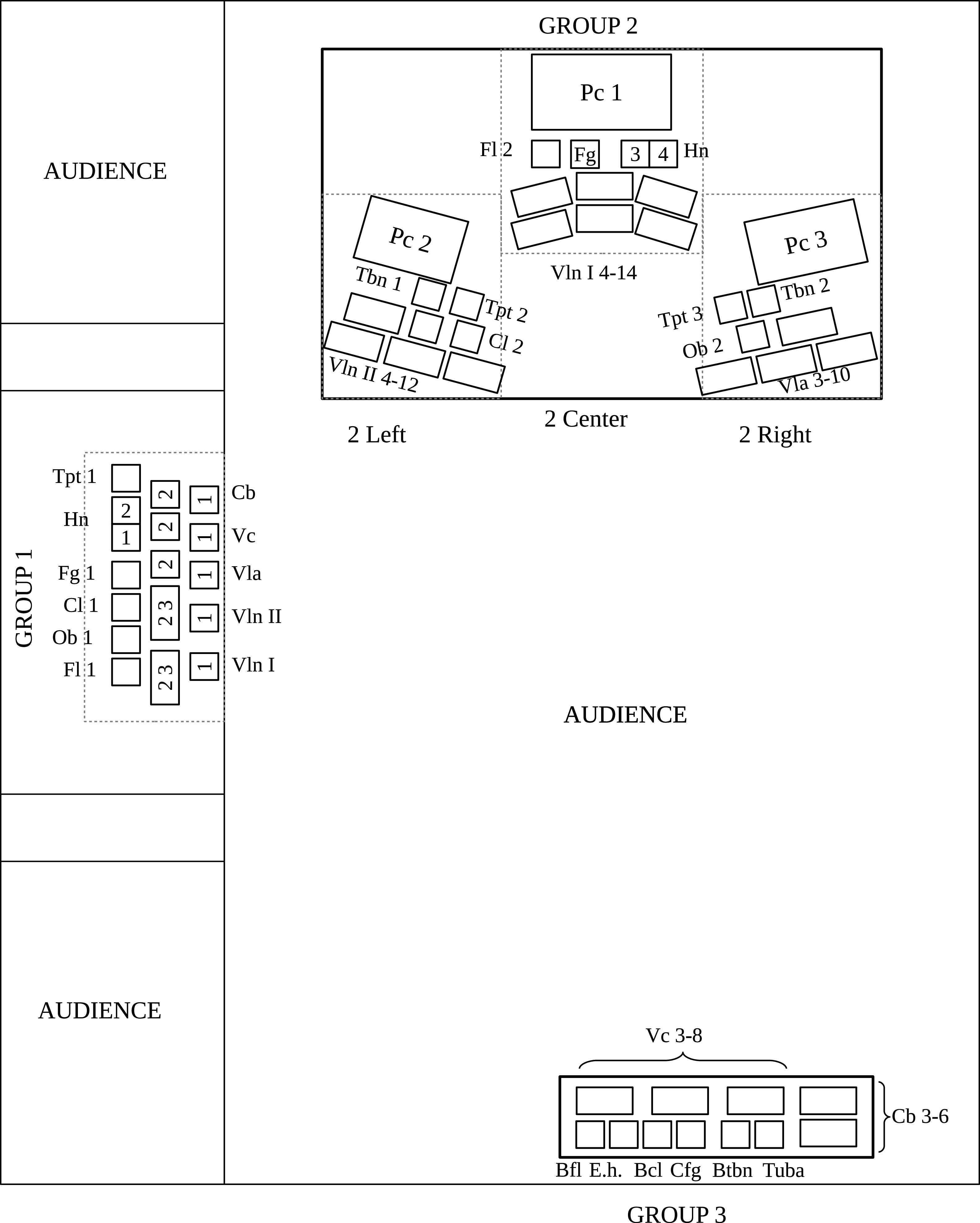
An early example of the use of a matrix of behaviours and family resemblances can be found, as I mentioned before, in the piece ins Offene, in which I created a spatialised network of materials. A more recent and sophisticated case study of this approach is Parallax (2019–20) for symphonic orchestra. For Parallax, I created a map for the instruments of the orchestra. The disposition of sound sources is asymmetrical and immersive. There are three groups of musicians: the first is on the left side of the audience, above on a gallery; the second group is on the stage, subdivided into three; and the third group is behind the audience (Figure 4).
Disposition of the instruments of the orchestra, Parallax.

Upon this map, I created a network of relations. The material is not localised afterwards; rather, the different musical parameters and the material behaviours are localised in space. That is, the components of the material, instead of the material itself, are localised among the different groups. Behaviours and parameters dynamically shift, change and transform in space throughout the piece, generating diverse spatial experiences (Figure 5).
Network of relations of family resemblances, Parallax.

For example, from bars 139 to 213, each group has a distinct rhythmical pattern and harmonic aggregates, presented in various degrees of distortion, oscillation, density and instrumentation within each group. The resulting sound is a complex sound mass in which components are spatially dispersed around the listener. An active listener is invited to explore and follow different activities, contingent upon their position relative to the groups. Material, form, space and the musical work emerge as the collective outcome of my compositional intentions, the behaviour of the material in space, and the listener’s comprehension (Figure 6). Footnote 3
This project – although for orchestra – involved the development of a spatialisation model in SuperCollider, which simulates how listeners perceive various sound sources within a performance space. The model aids in the experimentation of compositional pieces and consists of three main components:
Bars 139–63, Parallax.

Calculations. By entering the dimensions of the performance hall, the positions of the different sound sources, and listeners in this hall, the software calculates and models the real distances and angles between listener and sound sources. The model then computes these numeric data and renders them as the sound diffusion parameters of the instruments: gain (amplitude), angle of diffusion (direction of the sound), reverberation in the hall, and delay time.
Sound display. The diffusion parameters previously collected are used to playback recorded sounds of the sound sources using first-order ambisonics. The software then emulates the diffusion of the sources’ sounds as they would be heard from the listener’s position in the simulated hall. The software offers two possibilities of displaying the sound: through headphones or using a four-speaker setup.
Graphical display. The software has a graphical user interface that displays a schematic floor plan of the hall and the positions of the instruments and the listener in it. The graphical interface enables the user to move the listener. When doing so the software recalculates the position of the listener and with it the aural simulation. The model also has the possibility of changing the instruments’ positions and of adding new instruments by entering the appropriated data in the SuperCollider code (Figure 7).
Graphical interface of the spatialisation model.

Although the conception of space in this project is relativistic and relational, I consider mathematical and geometrical space an important tool for imagining and representing space. Geometrical space serves as a tool to enable testing with the spatialisation model. While the model does not replicate the specific acoustics of the performance space it represents, this could easily be integrated through the use of convolution. However, the model is not focused on simulating a particular space. Since it is not intended for performance but rather as a tool for developing strategies, the representation of positions and their effects on listening are sufficient for the purposes of this project. Footnote 4
6. Conclusion: identity/es
But why should we be concerned with contingency and openness in relation to space? What are the consequences of sharing our compositional agency with that of the material? Engaging with openness, in my artistic practice, is a way to assert a different kind of agency as a composer – one distinct from mastery and domination. It involves a practice that does not impose my will but instead intra-acts with the agency of sound materials, allowing for the emergence of otherness and difference.
In Vers une musique informelle, Adorno described and criticised the overall effects of the identity principle inherent in the universalism of Western rationality as an imposition of identity over difference – an exclusion of difference by reducing everything to an abstract sameness (Adorno Reference Adorno1961). For Adorno, form (in art and music) is an imposition of the principle of identity, a projection of sameness, of the One onto the material, the concrete, difference and the Other. This implies a hierarchical division between passive material and an active subject – the composer. Under this hylomorphic view, art is the elevation of raw material by the abstract thinking of the subject, rendering the material world an object to be exploited and used by human thought. As we saw in the discussion on immersion, investigations in electronic music have been permeated by ideals of the subject’s control over sound matter through technological means (Rodgers Reference Rodgers and Rawlinson2016).
This view has been criticised by some experimental practices, notably by John Cage, who proposed rejecting the subject’s control, namely the influence and intention of the composer. While I find this critique necessary, Cage’s solution – rejecting the subject – is not sufficient. A member of an excluded collective, whether woman, queer, non-binary, racialised, marginalised, or migrant, gains agency by acting. To negate the agency of the composer when they belong to such collectives is to deny their agency once more. However, this new agency of the composer is not to be gained by mastering the material and reproducing the same power relations of exploitation of the material, others and the world.
Alternative approaches have been proposed, moving away from the master-composer paradigm and questioning technological norms while claiming new subjectivities by sound art, improvisation, performance art and embodied practices. From the early example of Pauline Oliveros’s Deep Listening; to Christina Kubisch’s Electrical Walks, which explores the agency of listeners and urban landscapes; and Pamela Z’s work, which addresses embodiment and the feminisation of the voice; and more recently, Maria Chavez’s practice with broken vinyls, which generates unexpected results (Rodgers Reference Rodgers2010); or Arca’s engagement with the cyborg (Haraway Reference Haraway1991) as a tool for articulating non-binary identities (Waugh Reference Waugh2017).
To this ongoing discussion, I add my own practice, in which I propose a feminist reformulation of the composer (Romero Reference Romero and Impett2021b) based on the theories of philosopher Rosi Braidotti (Reference Braidotti1994) and scientific theorists Karen Barad (Reference Barad2007) and Donna Haraway (Reference Haraway1991). This reformulation envisions the composer similarly to the reconceptualisation of the scientific observer (Barad Reference Barad2007): not as a master who examines or shapes material from a safe, ‘objective’ distance, but as one who is immersed in the sound material and its space – who explores, intra-acts and interacts with the material, sharing their agency with the material as it emerges and manifests through the compositional process. It is a practice aimed at rendering perceptible differences and identities – what is left out – rather than producing morphologies and generalisations. In this sense, it aligns with Braidotti’s Nomadic figuration, a subjectivity that is not fixed but in a constant state of becoming (Braidotti Reference Braidotti1994). Figurations are tools for articulating difference – the Other, the female, the queer, the non-binary, the racialised – what is excluded from the category of the male and from conceptual generalisation. The nomadic figuration itself is in a continuous state of redefinition. It does not impose its mimetic reflection onto the world but instead explores the world through nomadic dérives and the world’s own fluctuations. As Rodgers notes, ‘for many diasporic and queer subjects, “home” is neither a fixed origin nor a destination but rather a feeling of affectual yearning [that catalyses] a homemaking that does not settle’ (Rodgers Reference Rodgers and Rawlinson2016: 208–9). By doing so, the nomadic figuration generates knowledge both of itself and of the concrete (Braidotti Reference Braidotti1994).
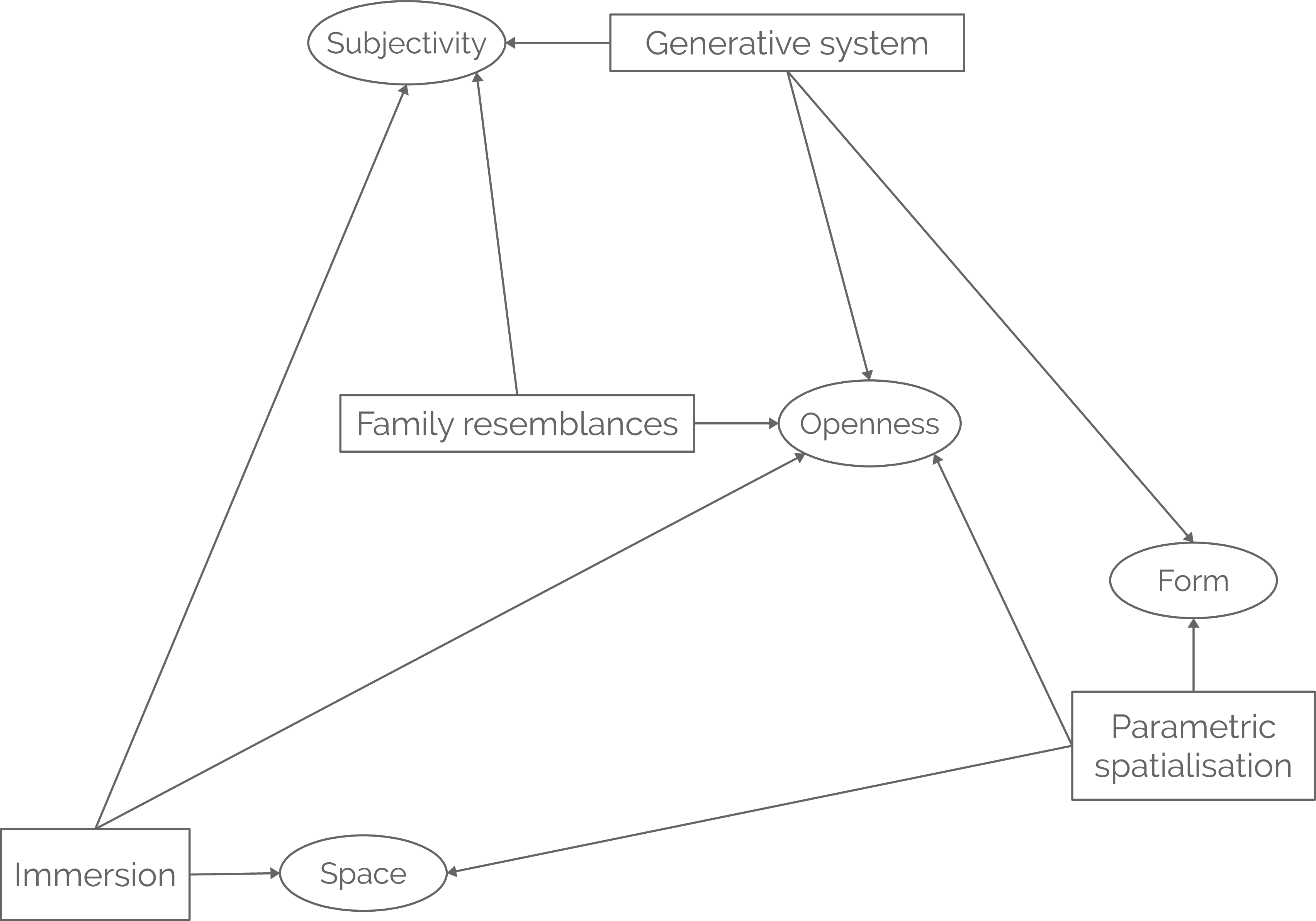
Similarly, the composer proposed in my practice explores concreteness and difference within the material, exercising their own difference and agency in the process. My approach to space and openness in composition is a way to address, in my artistic practice, difference and other ways of being in the world – experiences of collectives traditionally relegated from classical conceptualisations of the subject (Figure 8 illustrates how the various concepts and compositional strategies interact). This queer/woman/racialised subject is a nomad, engaged in a never-ending process of transformation and change. In my work, this manifests through the localisation of sound sources and the spatialisation of non-linear systems and networks – not to control, but to enable the emergence of the unknown. These networks and systems, as previously discussed, are not about erasing the composer’s influence, nor do they imply a lack of imagination, expertise, or technical knowledge, or a delegation of responsibility. Rather, they represent a conscious shift towards experimentation – towards something not yet known, towards new spaces.
Topography of concepts and compositional strategies.