Microbes can be transferred from patients to healthcare personnel (HCP) gloves and then from gloves to surfaces. Reference Guerrero, Nerandzic, Jury, Jinno, Chang and Donskey1,Reference Takoi, Fujita and Hyodo2 The World Health Organization has recommended intervention strategies aimed at reducing transmission by disinfecting gloves with alcohol-based hand rubs (ABHRs) at health hygiene moments such as after touching a patient, bodily fluid, or patient surroundings. 3 To date, no standardized method has been established for sampling healthcare gloves to evaluate the efficacy of ABHR or other interventions to reduce transmission of pathogens. Reference Robinson, Otieno and Johnson4 Cellulose sponges are a widely used sampling tool for healthcare surfaces, though no studies have the reported routine use of the sponge method in recovering bacteria from healthcare gloves. Directly imprinting gloved hands onto agar has been used in studies, though data in controlled settings are limited. Reference Robinson, Otieno and Johnson4 In this study, we compared the efficiency of 2 sampling methods to recover 4 pathogens from gloved hands: direct imprinting onto agar (imprint) and sponge sampling and processing (sponge).
Materials and methods
Carbapenemase-producing KPC+ Klebsiella pneumoniae BAA-1705 (KPC), Acinetobacter baumannii multilocus strain type 12, and methicillin-resistant Staphylococcus aureus ATCC 43300 (MRSA) were grown on trypticase soy agar with 5% sheep blood (TSA II, Becton Dickson, Franklin Lakes, NJ) overnight at 35°C. Spores of Clostridioides difficile ATCC 43598 were produced as described by Hasan et al. Reference Hasan, Japal, Christensen and Samalot-Freire5 Cells and spores were diluted in series to a titer of 102 or 101 CFU/mL in 20% artificial test soil (ATS, Healthmark Industries, Frasier MI).
Each experiment consisted of 3 volunteers inoculated at either the higher or lower inoculum, and each experiment was conducted a minimum of 4 times (n ≥ 12). Volunteers were double gloved, with inner gloves having an extended cuff. Outer gloves were textured nitrile gloves (SafePoint, Naples FL and Microflex, Iselin NJ). Gloved hands were inoculated inside a biosafety cabinet; 3 µL of bacterial suspension per fingertip and thumb, and 5 µL across the top and bottom of each palm (25 µL total/glove). Gloved hands were then gently pressed together to aid in drying. Gloves were sampled upon being visibly dry (~5 minutes).
One glove from each volunteer was sampled (n ≥ 12) by directly imprinting onto an agar plate (150 mm diameter); the remaining glove was sampled using a cellulose sponge (Sponge-Stick, 3M, St Paul MN).
Direct imprint sampling consisted of pressing the gloved thumb and each fingertip onto the agar for 5 seconds at ~1 kg pressure, followed by pressing the palmar surface with the same pressure on the bottom half of the plate. Trypticase soy agar with 5% sheep blood (TSAII) was used for KPC, A. baumanii, and MRSA, and brain heart infusion agar with horse blood and taurocholate (BHI-HT) incubated anaerobically was used for C. difficile. The volunteer’s second gloved hand was sampled using the sponge method. Finger pads were wiped with the larger face of the sponge, and top and bottom palmar areas sampled sequentially with the smaller edge of the sponge, followed by the sponge tip. Sponges were held for 1 hour at room temperature, then the cells were eluted into 45 mL phosphate-buffered saline with 0.02% Tween 80 (PBST) using a Stomacher 400 Circulator (Seward Laboratory Systems, UK) operated for 1 minute. Eluents were centrifuge concentrated and decanted, leaving 3–5 mL. Pellets were resuspended and cultured (in triplicate) on TSA II for vegetative cells or anaerobically on BHI-HT for C. difficile spores. Colony-forming units (CFU) were counted, and percent recovery (% R) was calculated relative to the inoculum. The Student t test was used to determine significant differences, with significance set at ≤.05.
Results
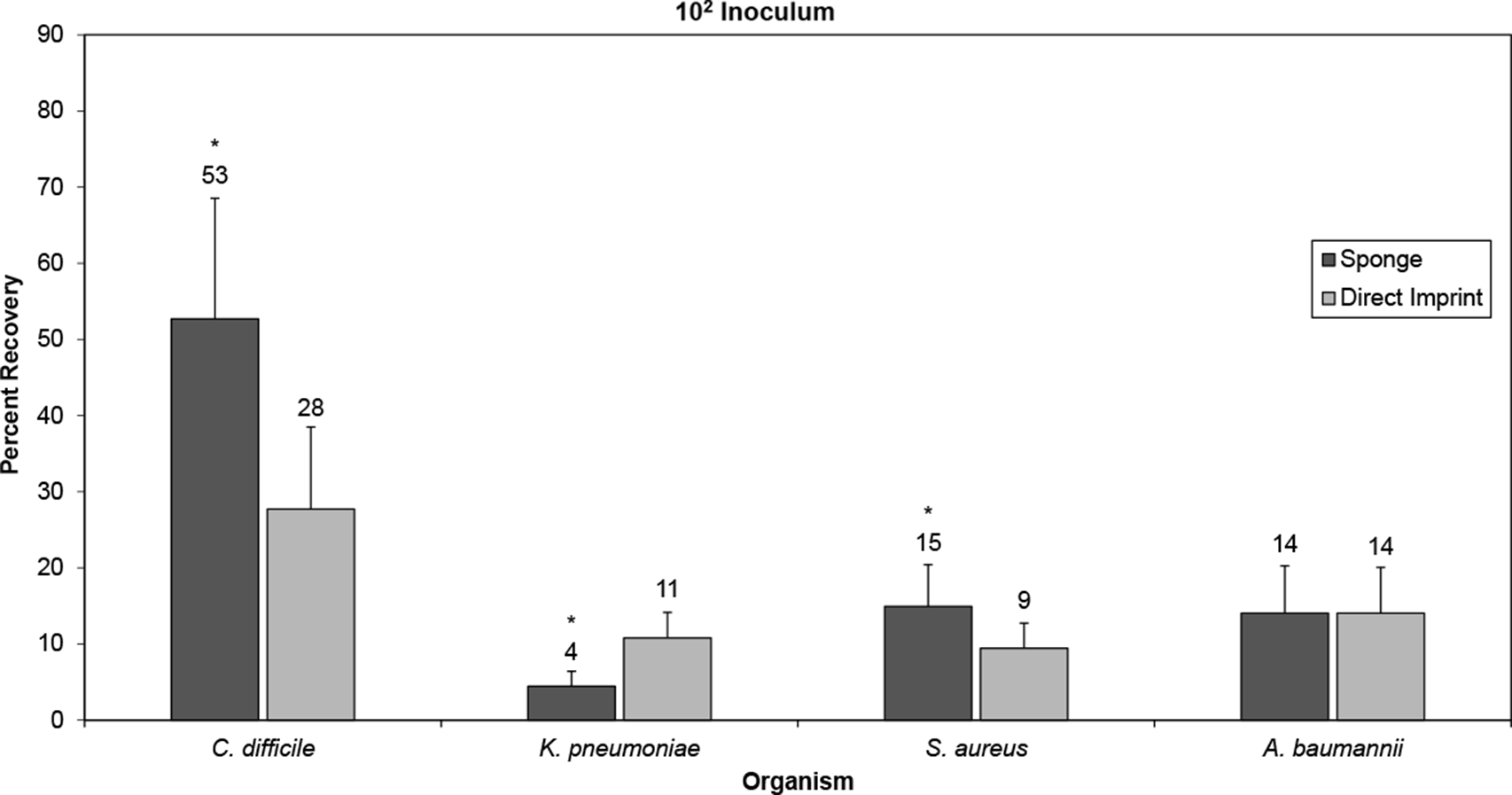
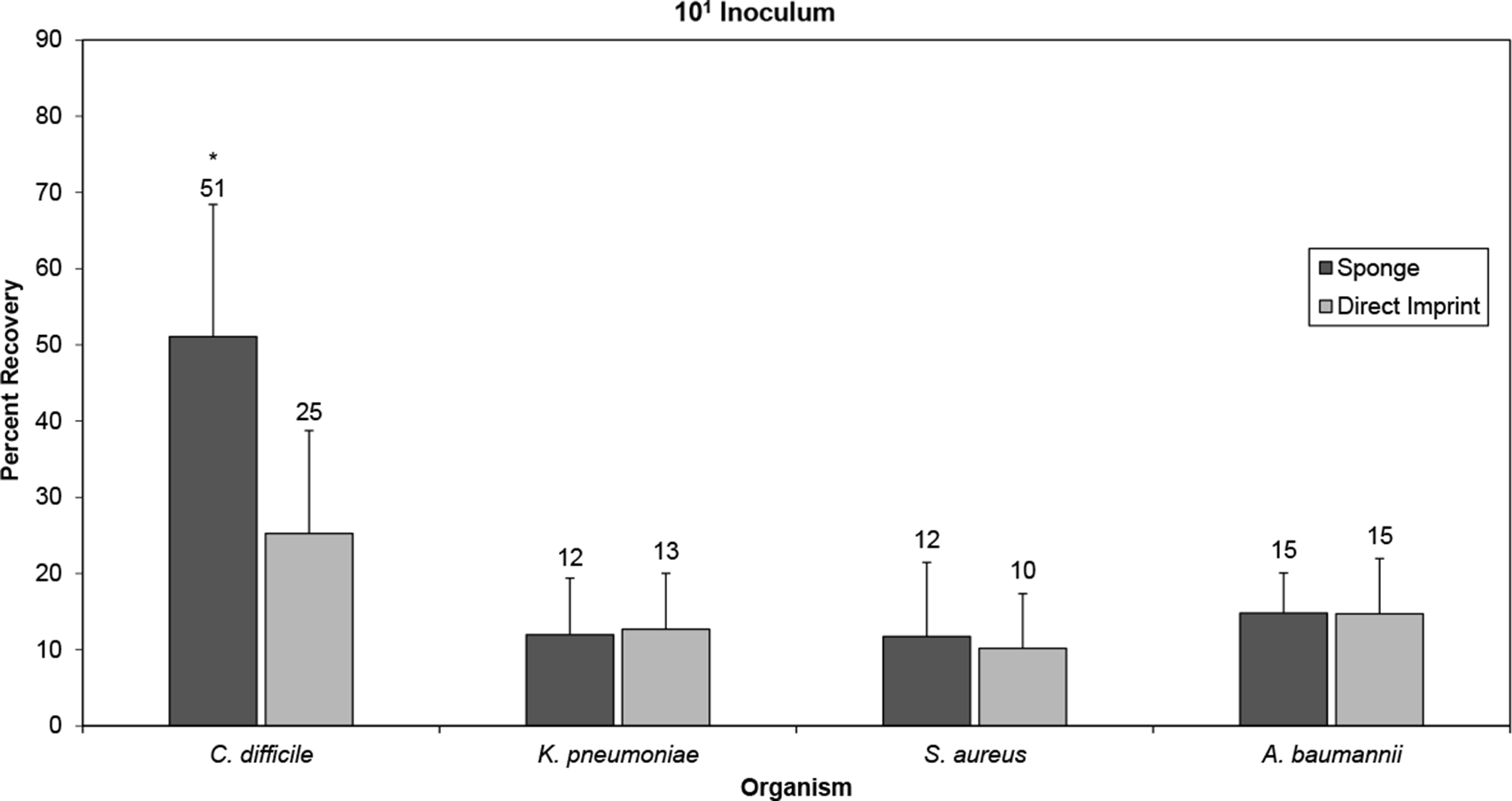
The sponge method resulted in a significantly higher % R of C. difficile than the imprint method at both inoculum levels (Figs. 1 and 2). No statistically significant differences were seen between the 2 methods for A. baumanii, regardless of inoculum level (means, 14%–15%). At 101 inoculum no significant differences were observed between sampling methods for MRSA and KP, but at 102 inoculum KP was recovered significantly better by imprint than with the sponge method (10.8% [SD, 3.4%] and 4.4% [SD, 2%], respectively). In contrast, at the higher inoculum, MRSA was recovered significantly better using the sponge (14.9%; SD, 5.5%) as compared to the imprint method (9.4%; SD, 3.3%).
Percent recovery (% R) of 4 healthcare pathogens using 2 glove-sampling methods; 102 CFU/mL inoculum (n ≥ 12). *denotes P ≤ .05.

Percent recovery (% R) of 4 healthcare pathogens using 2 glove-sampling methods; 101 CFU/mL inoculum (n ≥ 12). *denotes P ≤ .05.

Discussion
Failure of HCP to change gloves and perform hand hygiene prior to patient contact and after contact with contaminated surfaces can increase the risk of HAI transmission. Reference Girou, Chai and Oppein6 In response to poor hand hygiene compliance, intervention strategies have been investigated such as the use of alcohol based hand rub on gloved hands, and antibacterial gloves. Reference Robinson, Otieno and Johnson4,Reference Kahar Bador, Rai, Yusof, Kwong and Assadian7 To best evaluate the efficacy of intervention studies and the role of glove contamination in pathogen transmission, a standard glove sampling method is needed. Currently, the most commonly used hand-sampling method is the glove juice method, 8 but this method is difficult, time consuming, and has not been proven effective for gloved hands. Sponge processing is also time consuming (30–40 minutes per sample), whereas the imprint method requires no processing. Although the recovery was surprisingly low, these sampling recovery results coincide with the 1–2 log10 loss relative to the inocula reported by Kpadeh et al. Reference Kpadeh-Rogers, Robinson and Alserehi9 Recovery of the same pathogens from steel and plastic surfaces were observed to range from 6.9% for KPC to 54.7% for C. difficile. Reference Harris10 This lower recovery may indicate that cells are adhering more to the nitrile gloves, though additional investigations are needed to understand the adherence dynamics between nitrile and these healthcare organisms.
The imprint method is a convenient glove-sampling method for active healthcare settings due to time and resources saved in processing, allowing the collection of a larger number of samples during epidemiological investigations or transmission intervention studies. Although typical background environmental organisms that might overgrow or mask the target pathogens were not included in this work, use of selective media could be used to inhibit their growth. The most efficient sampling method will provide the best evaluation of a transmission intervention strategy. These data show higher or equivalent recovery using the direct imprint method for the vegetative organisms evaluated when compared to the sponge sampling method. If targeting C. difficile spores, the sponge method should be considered because it provides a better estimate of spores present. For the vegetative organisms evaluated, this method can be considered a reliable, time-saving glove-sampling method for hand hygiene and transmission studies.
Acknowledgments
We would like to thank Monica Chan, Lauren Franco, Hollis Houston, Lori Spicer, and Carrie Whitworth for their laboratory support. The conclusions, findings, and opinions expressed by authors contributing to this journal do not necessarily reflect the official position of the US Department of Health and Human Services, the Public Health Service, the Centers for Disease Control and Prevention, or the authors’ affiliated institutions. The use of trade names is for identification only and does not imply endorsement by the Public Health Service or by the US Department of Health and Human Services.
Financial support
No financial support was provided relevant to this article.
Conflicts of interest
All authors report no conflicts of interest relevant to this article.