Introduction
Cold arid Ladakh is a high altitude and mountainous region, situated between 3048-3658 m above mean sea level (MSL) in the Himalayas on the far northern frontiers of India. This region is characterised by extreme hot and cold climatic conditions. Summer is of short duration while winter is long, with sub-zero temperatures (up to -30°C at Leh). Rain fall is scarce (less than 100 mm in a year) and there are frequent snow falls in winter, of six to eight inches depth. Average relative humidity remains around 40 to 50% annually. Intensive sunlight, high evaporation rate, strong wind velocity, hypoxic conditions and land-locked, snow-bound conditions characterise the general climatic condition of Ladakh. Due to the extremely long winter, the agricultural season is short; extending generally from May to September. This makes agricultural and animal husbandry practices very difficult in this region. Out of the total area reported, 55.71% of the land in Leh district is barren and un-cultivable. Therefore, shortage of locally available nutritious animal feed resources limits efficient animal husbandry practices in this region. Based on animal populations, their projected feed requirements, and the local availability of animal fodder and feed materials, it is evident there is marked shortage (almost 85% deficit of each roughage and concentrate) of resources that are required for the optimal nutrition of animals in this region. Most of the animals either remain undernourished or farmers must rely on procuring animal fodders and concentrates from low land regions far away, leading to uneconomic animal husbandry practices.
Sea buckthorn (Hippophae rhamnoides) is a shrub that can be planted in the cold arid Himalayan region of Ladakh. It is not only adaptable to the arid and barren region, but also contains an abundance of nutrients in the leaves and fruits. Studies showed that the leaves and fruit residues of sea buckthorn could be used to feed poultry and livestock without the accumulation of toxins, and that the feed also had a stimulating effect on growth and performance of poultry and livestock (Liu et al., Reference LIU, HE, ZHANG and L1989). In recent years less attention has been paid to the use of sea buckthorn as a poultry and livestock feed, therefore determining the feed value of sea buckthorn will provide scientific information that can be used to promote its use as livestock and poultry feed in the cold arid Himalayan region of Ladakh, India.
The north western part of the Himalaya shows varied climatic and topographic features. This part exhibits an extreme cold and dry climate for most of the year, which hinders the growth and productivity of biomass. Vegetation cover is much less in areas like Ladakh, Kargil, Drass and Lahaul-Spiti. In winter, the temperature falls to -35°C and the altitude varies from 3048-3658 m from mean sea level (MSL). The atmospheric oxygen pressure is 30% short of MSL. This type of cold arid and desert like conditions doesn't suit the natural habitat of Poultry birds.
Poultry farming is an important industry in most of the provinces and regions of India, but its development has been limited due to the shortage of feed. In India, over half of the feed material is from grain. However, the use of grain as an animal feed reduces its availability for human consumption, which is not desirable. This trend is not satisfactory as more grain will be allocated for human use. Therefore, developing and searching for new feed resources and feed substitutes for poultry are of paramount importance.
Major constraints for poultry farming in Ladakh
To become successful in poultry farming in this cold–arid region it is imperative to understand the constraints and difficulties which come in the way of poultry production. The following are some of the major hurdles:
religious sentiments
The majority of the population in this region is Buddhist. They are vegetarian and consequently avoid killing animals. Their interest in poultry is therefore limited to keeping egg-laying birds.
extreme cold and hypoxic environment
Day old chicks of any species of poultry are physiologically prone to the adverse effects of cold stress because of their poor homoeothermic limit. The temperature range for optimal production is 17-23°C (i.e. the thermo-neutral zone). Any variation of temperature above or below this range affects the growth and production parameters of birds. In this Himalayan region, the temperature fluctuates from + 35°C in summer (day temperature) to -35°C in winter (night temperature) which exerts stress on the homoeothermic control system of birds as well as expenditure in maintaining the optimum temperature inside the house in extreme winter conditions. The altitude varies from 9000 to 12000 ft which directly affects the hatchability percentage of chicks because of the reduced partial pressure of oxygen in the air. This single factor is mainly responsible for the non-existence of any hatchery in this region and the poor popularity of poultry farming. Cold stress coupled with a hypoxic and dry environment (RH =35-45%) reduces the optimum production and liveability potential of poultry birds.
low availability of day old chicks (doc) and poultry feed material
Due to the non–existence of a significant hatchery and poultry feed industry, it is difficult to procure DOC and readymade poultry feed in winter as this region is cut off for at least six month from other parts of the country due to road blockages and heavy snow fall. Transportation difficulties in high altitude and its high charges add to the burden of farmers. The local availability of poultry feed ingredients in this region is minimal and it is very difficult to get them at regular intervals. Lack of availability of suitable poultry breeds that are adapted to the regional conditions, with optimum production potential adds to the constraints of poultry production in this area.
suitable germ-plasm
Considering the climatic conditions and constraints, selection of appropriate germ- plasm for broiler and layer becomes very important. Germ-plasm should be able to withstand harsh climatic conditions and produce optimally. Research findings of the Defence Institute of High Altitude Research (DIHAR), Leh and Jammu and Kashmir State Animal Husbandry Department suggested that the commercial egg laying strains of WLH and RIR are suitable for egg production purposes. These two breeds survive well with good production performance even in backyard farming. F1 strains of slow growing commercial broilers are suitable for backyard farming. In poultry houses with better temperature control, fast growing Venkcobb broilers have been found to be more economical due to their rapid weight gain and low feed conversion ratio (Biswas et al., Reference BISWAS, ROY, GOGOI, AHMED and SINGH2010). But in general, cockerels of slow growing strains (Chabro, CPBF) and dual purpose Indian varieties like Dhanraja and Vanraja will be more appropriate because of their hardy nature and better survivability at the farmer's level. To encourage poultry farming at the backyard level, there is a need to introduce dual purpose broody native birds.
housing systems
The housing of poultry birds is difficult in cold and arid climates especially in the winter season. Biswas et al. (Reference BISWAS, ROY, GOGOI, AHMED and SINGH2010) describes the following housing systems at high altitude regions:
Over ground mud walled poly sheds
These sheds are made of double wall mud bricks, with the inner first third up from the floor consisting of cement. The roof is made from bamboo, wood, grass and other locally available materials. The middle third of one side of the wall facing the sun is made from a polythene sheet supported by wooden logs and at the centre is a glass window. This whole portion is then covered with another white polythene sheet to trap the sun light and thus maximize the heat inside the house.
Semi-underground mud /stone walled house
These houses are constructed of a double wall of mud or stone up to the ground level, with mud bricks being used to construct the rest of the wall as well as the roof. The roof is double layered with mud bricks and part of ceiling inside is supported with wooden logs and locally available packing materials. False roofing is made by covering the inner aspect of the roof with polythene, cardboard, paper or ply wood. One or two windows are made where the wall interfaces with the ground. Another type of semi-underground house has been attempted by the Defence Institute of High Altitude Research (DIHAR). In this instance, the walls and floor were made of concrete bricks and asbestos sheets were used for the roof. At the centre of the roof, polycarbonate sheets were used to trap solar radiations. A double door was used to prevent incoming air drafts.
Trombay wall shed
This housing is a scientific adaptation of typical local poultry houses; designed to cater to the needs of farmers by DIHAR. They are made of double wall mud bricks and plastered with mud on all sides. The lower one third of the wall is covered with galvanized aluminium sheets for easy cleaning. The roof is the same as the farmer's other sheds. Many small windows are fitted on the lower part of the walls in order to meet ventilation requirements.
Solar poultry house
The solar poultry house has been designed by the DIHAR to provide maximum comfort, maximum protection from the cold, better ventilation and hygienic conditions for the birds. This type of housing is very costly but most efficient in maintaining optimum temperature and ventilation inside.
feed
Grain production is limited in this region, therefore farmers are provided with subsidised human rations. However, for animal rations there is no such system and cereals or commercial poultry feed have to be imported from elsewhere by the farmer.
Wheat, barley, peas and mustard are the main local food grains, which are produced by farmers in limited quantities. However, very little amounts of surplus grain are available to spare for poultry feed. Farmers generally import poultry feed ingredients such as maize, soybean and wheat bran, or purchase readymade feeds from other parts of country when road route remains open (i.e. during the summer). The transportation and storage of feed from distant locations exerts extra economic pressure on the farming enterprise.
Balanced, readymade feed is not always procured by farmers. To save money, they tend to purchase a few ingredients and supplement them with locally available feeds. Using such unbalanced feed decreases weight gain in birds and increases the feed conversion efficiency ratio. Generally, readymade starter feed is given to chicks, and maize-based, locally prepared, poor quality feed is provided to birds from four weeks of age. In winter, at the time of feed scarcity, farmers make their own poultry feed with locally available vegetables and cereals. This includes spinach, cabbage, onion, garlic, lucerne leaves, crushed turnip, barley, gram, wheat flour and mustard oil.
Scientific feed formulations optimising metabolisable energy (kcal) and crude protein (CP) are essential for this region. Because of the added stress of the cold and high altitude, readymade feed available in other markets would not be appropriate for birds in this region. Ascites becomes a major problem in fast growing broilers if the energy and protein levels in the feed are not optimized. Depending on the season (winter or summer), quality and type of day-old chicks (fast or slow growing), scale of feeding (ad-libitum or restricted) and incidence of ascites, feed formulations need to be adjusted and energy and protein levels, along with the use of feed additives need to be optimized.
Sea buckthorn as a poultry feed material
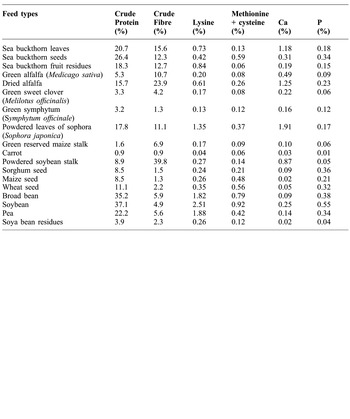
Sea buckthorn is a locally available feed material that could be useful in feeding poultry in this region. The nutrient content of sea buckthorn varies somewhat with the age of stand, site condition, etc. but this variability is less than 14%. The average nutritional values of leaves, seeds and fruit residues of sea buckthorn, along with 15 kinds of green forage grass, powdered leaves, dried grass, grain and legumes that are used in feed in this region are compared in Table 1.
• The crude protein (CP) content of sea buckthorn seeds was slightly lower than that of soybean and broad bean, but higher than that of pea. The CP content of sea buckthorn leaves was lower than the above mentioned feed ingredients.
• The crude fibre content of sea buckthorn leaves, seeds and fruit residues were slightly higher than that of most other feeds.
• The lysine contents of sea buckthorn fruit residues and seeds were slightly lower than broad beans, soyabeans, peas and powdered leaves, but higher than all the others.
• The methionine+cysteine contents of soybean and broad bean were the highest, followed by sea buckthorn seeds and fruit residues, and carrot had the lowest value.
• Highest calcium content was found in powdered-leaves of sophora, dried alfalfa and the sea buckthorn leaves.
• The phosphorus content of soybean was the highest of all the feeds, and the sea buckthorn seeds rank third along with peas.
Contrast of feed values among sea buckthorn and 15 other feeds (Lu et al., Reference LU, LIN and PENG1991).

Five factors, namely crude protein, lysine, methionine+cysteine, calcium and phosphorus, were selected for evaluation by common feed analyses (Liu et al., Reference LIU, HE, ZHANG and L1989; Lu et al., 1991). Since the leaves, seeds and fruit residues contain high crude protein, amino acid, calcium and phosphorus; they have advantages as basic materials for feed formulations for poultry. The development of feed formulations containing sea buckthorn must allows for the selection of feed components, production and marketing (Tian et al., Reference TIAN, XU and ZHANG1990). The lysine content, which is the first limiting amino acid for poultry, especially in hens, is rather high in the leaves and fruit residues of sea buckthorn. Body weights of poultry have increased greatly after feeding leaves, seeds and fruit residues of sea buckthorn. The egg production rate and numbers are increased by 10.3 and 28.1% respectively for 2 year old hens, and the weight of chicken hens is increased by 5.74 and 7.81% after feeding with leaves and fruit residues after 56 days, respectively (Wang, Reference WANG1997).
Compared with the National Research Council (Reference NATIONAL RESEARCH COUNCIL1994) it was found that, serving as a fodder, the leaves, seeds and fruit residues of sea buckthorn contain enough crude fat and crude protein for the growth of hens, but are deficient in calcium and phosphorus. Therefore measures must be adopted to increase the contents of calcium and phosphorus, such as adding limestone powder, egg shell, conch or bone dust (Wang and Hu, 1992). The leaves and fruit residues of sea buckthorn can be treated through the methods of silaging and aminating to decrease the content of crude fibre, increase the digestibility of crude fibre and dainty for livestock and poultry. The research and development of formula feed, pre-feed, and feed additives of sea buckthorn have great potential and market in India. More research and feeding trial are required to fully determine the usefulness of this feed material.
Conclusions
Sea buckthorn is a unique and valuable plant species currently being domesticated in various parts of the world. The species has been used to a limited extent in India for conservation plantings, but the use of food and non-food sea buckthorn products has not been pursued. The plants are easily propagated, yields are relatively high, and production is reliable, with the potential market. Most sea buckthorn research has been conducted in Asia and Europe in the past however, India has increased its research recently. Unique plant products, especially those with proven nutritional quality, are gaining popularity in the cold arid Himalayan region of India. Development of the sea buckthorn industry in this region presents a unique opportunity for agricultural production of a value-added crop on marginal land.